
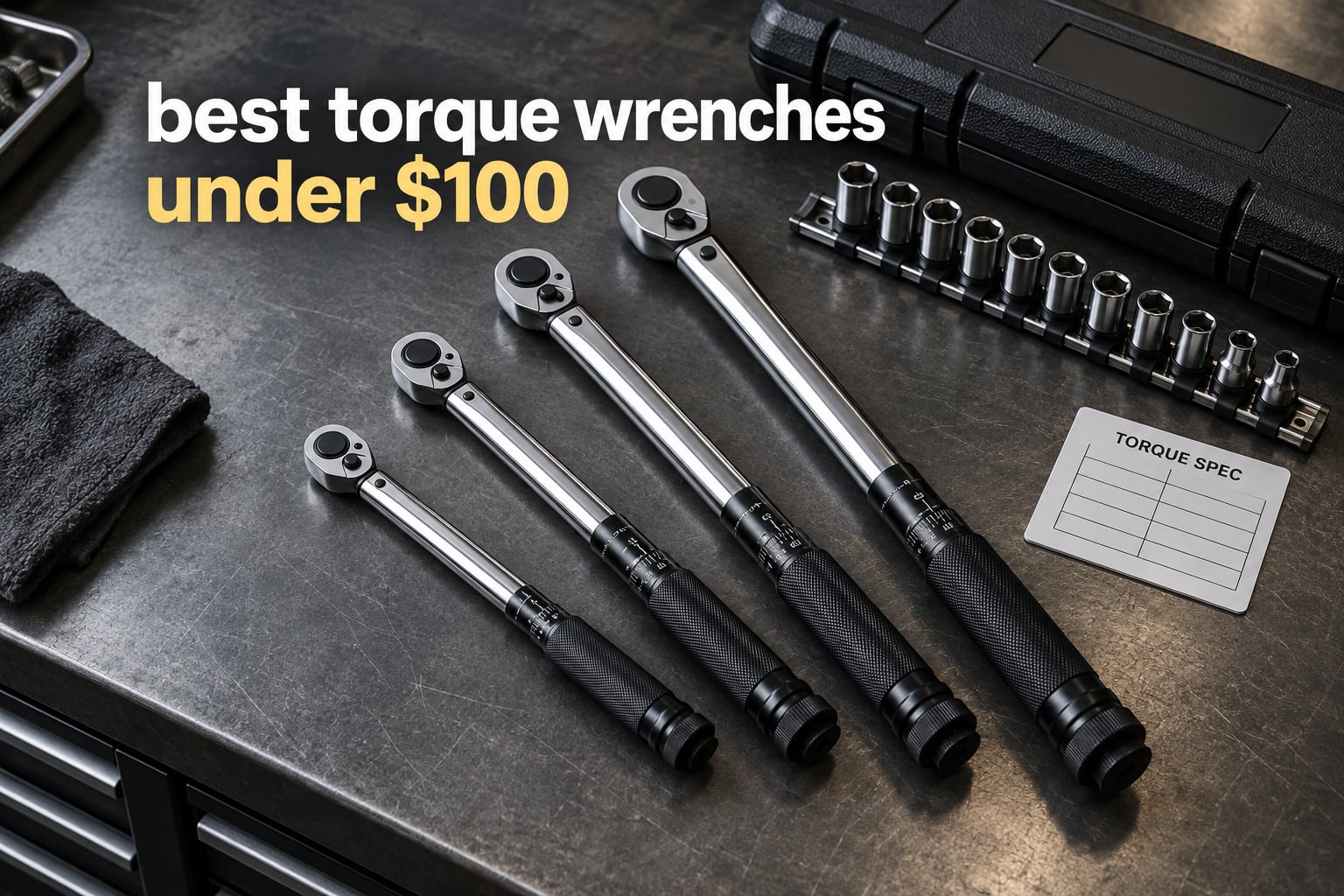
Torque wrenches are the cheapest insurance in a garage. Strip a wheel stud, crack an aluminium caliper housing, or warp a head gasket because a lug nut was snugged by feel, and one over-torqued job can cost more than every wrench on this list combined. The problem is that the tool most people need sits in an awkward price gap: the very cheapest click wrenches are everywhere, and the professional electronic wrenches that shops use start several times higher.
That gap is what this roundup covers. We looked at ten torque wrenches that live inside a 100 dollar budget and ranked them on the things that actually matter once a wrench is in your hand: stated accuracy, whether it arrives with a traceable calibration certificate, torque range and drive fit for real car and bike work, and the build quality you can feel while pulling.
The short answer: the EPAuto 1/2-Inch Drive Click Torque Wrench (10-150 ft-lb) is the best torque wrench under 100 dollars overall, because it pairs a 4.6 star average across more than 23,000 ratings with a hardened Cr-V ratchet head and an included extension bar. The LEXIVON LX-183 is the pick if you want documented accuracy, since it ships with a calibration certificate carrying a traceable serial number. For a 3/8-inch drive, the EPAuto 3/8-Inch (10-80 ft-lb) is the best value, and the ACDelco ARM601-4 is the only digital option that fits the budget at all.
A note on how we ranked, so you know what you are reading. This is not a laboratory bench test. We did not put these wrenches on a calibrated torque transducer. Instead we weighted published accuracy claims, the presence of a serialized calibration certificate, owner review volume and consistency, range and drive coverage, build materials, and the recurring complaints in the review data and in owner forums. Where a listing makes a claim we could not verify, we say so. We also flag contradictions rather than quietly picking a side, which is why two entries below carry a caveat we would rather you read than discover later.
For the wider picture, our guide to the best torque wrenches for mechanics covers the premium end that this budget cannot reach, and it is worth reading if you do engine internals.
Top 3 Best Torque Wrenches Under $100 (October 2026)
These three cover the widest range of real jobs for the money, and between them they handle wheels, brakes, engine fasteners, small hardware and a torque reading you can watch. If you only read one part of this guide, read these.

EPAuto 1/2-Inch Click Torque Wrench…
- 10-150 ft-lb and 13.6-203.5 Nm range
- Plus or minus 4 percent pre-calibrated
- Hardened Cr-V ratchet head
- 5-inch extension bar and case included
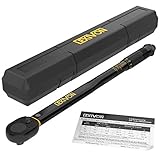
LEXIVON LX-183 1/2-Inch Click 10-150 ft-lb
- Plus or minus 4 percent with calibration certificate
- Reversible ratchet head
- Yellow-on-black dual-range scale
- Electro-Black corrosion finish

EPAuto 3/8-Inch Click Torque Wrench 10-80…
- 3/8-inch drive at 10-80 ft-lb
- Plus or minus 4 percent pre-calibrated
- Includes 1/4 and 1/2 inch adapters
- Compact 14.5 inch body
All 10 Torque Wrenches Under 100 Dollars Compared in 2026
Every pick in the table below sits inside our budget, and every one is a mechanical click-type wrench except the last one, which is digital. Drive size and torque range matter more than any other two columns here, because a wrench cannot do a job outside its range no matter how accurate it is.
| Product | Specifications | Action |
|---|---|---|
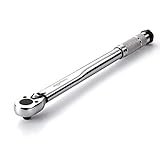
| EPAuto 1/2-Inch Click Torque Wrench 10-150 ft-lb |
|
Check Latest Price |
| LEXIVON LX-183 1/2-Inch Click 10-150 ft-lb |
|
Check Latest Price |
| EPAuto 3/8-Inch Click Torque Wrench 10-80 ft-lb |
|
Check Latest Price |
 LEXIVON LX-184 1/2-Inch Click 25-250 ft-lb LEXIVON LX-184 1/2-Inch Click 25-250 ft-lb |
|
Check Latest Price |
 LEXIVON LX-182 3/8-Inch Click 10-80 ft-lb LEXIVON LX-182 3/8-Inch Click 10-80 ft-lb |
|
Check Latest Price |
 Amazon Basics 1/2-Inch Click 20-150 ft-lb Amazon Basics 1/2-Inch Click 20-150 ft-lb |
|
Check Latest Price |
 Amazon Basics 3/8-Inch Click 15-80 ft-lb Amazon Basics 3/8-Inch Click 15-80 ft-lb |
|
Check Latest Price |
 YIYEIE 50-Piece 1/4-Inch Bike Torque Wrench Kit YIYEIE 50-Piece 1/4-Inch Bike Torque Wrench Kit |
|
Check Latest Price |
 CRAFTSMAN 3/8-Inch Torque Wrench CMMT99433 CRAFTSMAN 3/8-Inch Torque Wrench CMMT99433 |
|
Check Latest Price |
 ACDelco ARM601-4 1/2-Inch Digital Torque Wrench ACDelco ARM601-4 1/2-Inch Digital Torque Wrench |
|
Check Latest Price |
1. EPAuto 1/2-Inch Drive Click Torque Wrench, 10-150 ft-lb: Best Overall
EPAuto 1/2-inch Drive Click Torque Wrench, 10-150 ft/lb, 13.6-203.5 N/m
10-150 ft-lb and 13.6-203.5 Nm
Plus or minus 4 percent pre-calibrated
Hardened Cr-V ratchet head
5-inch extension bar and case
Pros
- Pre-calibrated to plus or minus 4 percent out of the box
- Hardened treated Chrome Vanadium steel ratchet head
- High-contrast dual-range scale is easy to read
- Knurled grip and sturdy plastic storage case
- Clear audible and tactile click at the setting
Cons
- Measures torque clockwise only
- No calibration certificate included
- Heavier and bulkier than a comparable digital wrench
This is the wrench I hand to friends who ask what to buy first, and it is the one I keep coming back to for wheel and brake work. The range runs 10 to 150 ft-lb, which covers the 80 to 100 ft-lb band most passenger car lug specifications sit in with genuine headroom above it, and the same wrench handles caliper bracket bolts and suspension fasteners without a second tool.
Accuracy is stated at plus or minus 4 percent from the factory, and the review data supports that claim rather than contradicting it. Across more than 23,000 ratings averaging 4.6 stars, owners repeatedly describe torque readings that match their service manuals, a clear click, and steel that feels like it will outlast the car. That volume of owner feedback is itself a form of testing that a newer listing cannot offer you.
Two details matter more than they look on paper. The dual-range scale is printed in high contrast, so you can read a setting in a dark garage without angling a flashlight at it, and the 5-inch 1/2-inch extension bar is included, which saves you from a socket handle hanging off the end and shifting your angle. The ratchet head is hardened, treated Chrome Vanadium steel with a satin finish that resists corrosion.
The honest weakness is direction. Like most click wrenches in this class, it measures torque clockwise only, which means a left-hand-threaded fastener is outside what this tool can report. Owners who overload it on a seized fastener occasionally report internal damage, which is the single most common complaint in the review set and the reason we put the wind-down rule in the buying guide rather than burying it here.
What this wrench is genuinely good for
Lug nuts, wheel spacers, brake caliper bolts, caliper brackets, tie rod ends, control arm fasteners and exhaust hardware. Anything in a 10 to 150 ft-lb window on a 1/2-inch drive, which is most of what happens between the fenders of a normal car.
It is also the right first wrench for a weekend mechanic, because a 1/2-inch drive is the size the bulk of your socket set is built around, so you are not hunting for adapters to make it work.
What it is not good for
Torque-to-yield head bolts. There is no angle measurement, no electronic sensor, and no way to add them. If you are building an engine or doing a cylinder head, this is the wrong class of tool entirely.
It is also the wrong tool for the smallest fasteners. The 10 ft-lb floor means trim screws, oxygen sensor connectors and interior hardware are out of reach, and a 1/2-inch drive will not accept the 1/4-inch bit sockets those jobs need.
2. LEXIVON LX-183 1/2-Inch Click Torque Wrench, 10-150 ft-lb: Top Rated with Paperwork
LEXIVON Torque Wrench 1/2-Inch Drive Click 10~150 Ft-Lb/13.6~203.5 Nm (LX-183)
10-150 ft-lb and 13.6-203.5 Nm
Plus or minus 4 percent with calibration certificate
Reversible ratchet head
Electro-Black finish
Pros
- Ships with a traceable calibration certificate
- Highest average rating in this roundup at 4.7 stars
- Yellow-on-black scale is exceptionally easy to read
- Electro-Black coating resists rust and corrosion
- Reinforced heat-treated Cr-V ratchet gear head
Cons
- Measures torque clockwise only
- Not suited to counter-clockwise torque measurement
- Heavier feel than some competing models
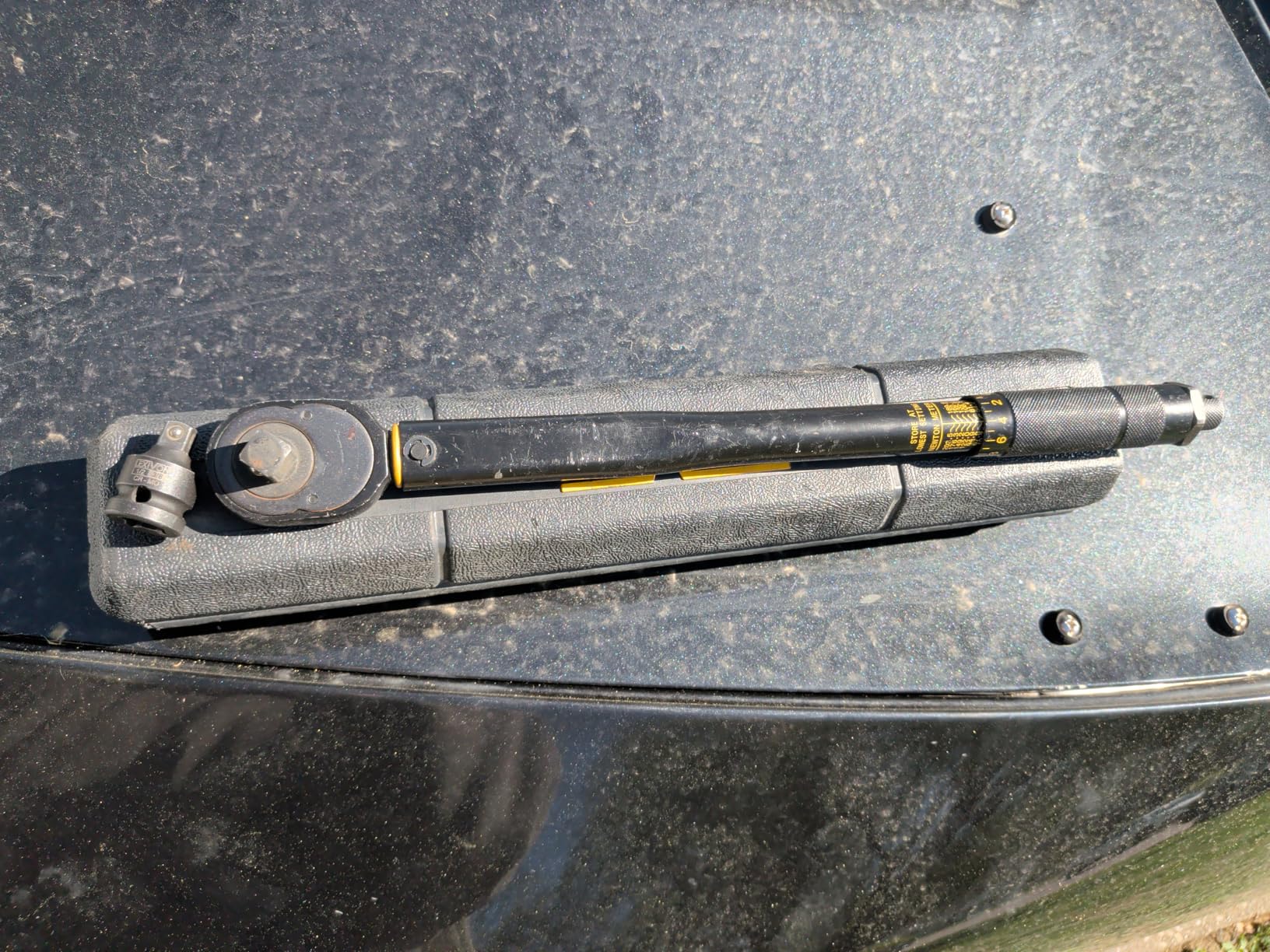
If accuracy claims are going to be the deciding factor for you, this is the pick. It is the only 1/2-inch click wrench in this roundup that ships with a calibration certificate carrying a trackable serial number, and that single piece of paper changes the conversation completely when something feels off, when a shop wants documentation, or when you want to send the tool back and have the question answered.
The 4.7 star average is the highest of any wrench here, across more than 12,000 ratings. Owners single out the yellow-on-black dual-range scale as the most readable they have used, and several mention checking the tool against a digital torque adapter and finding the readings consistent.
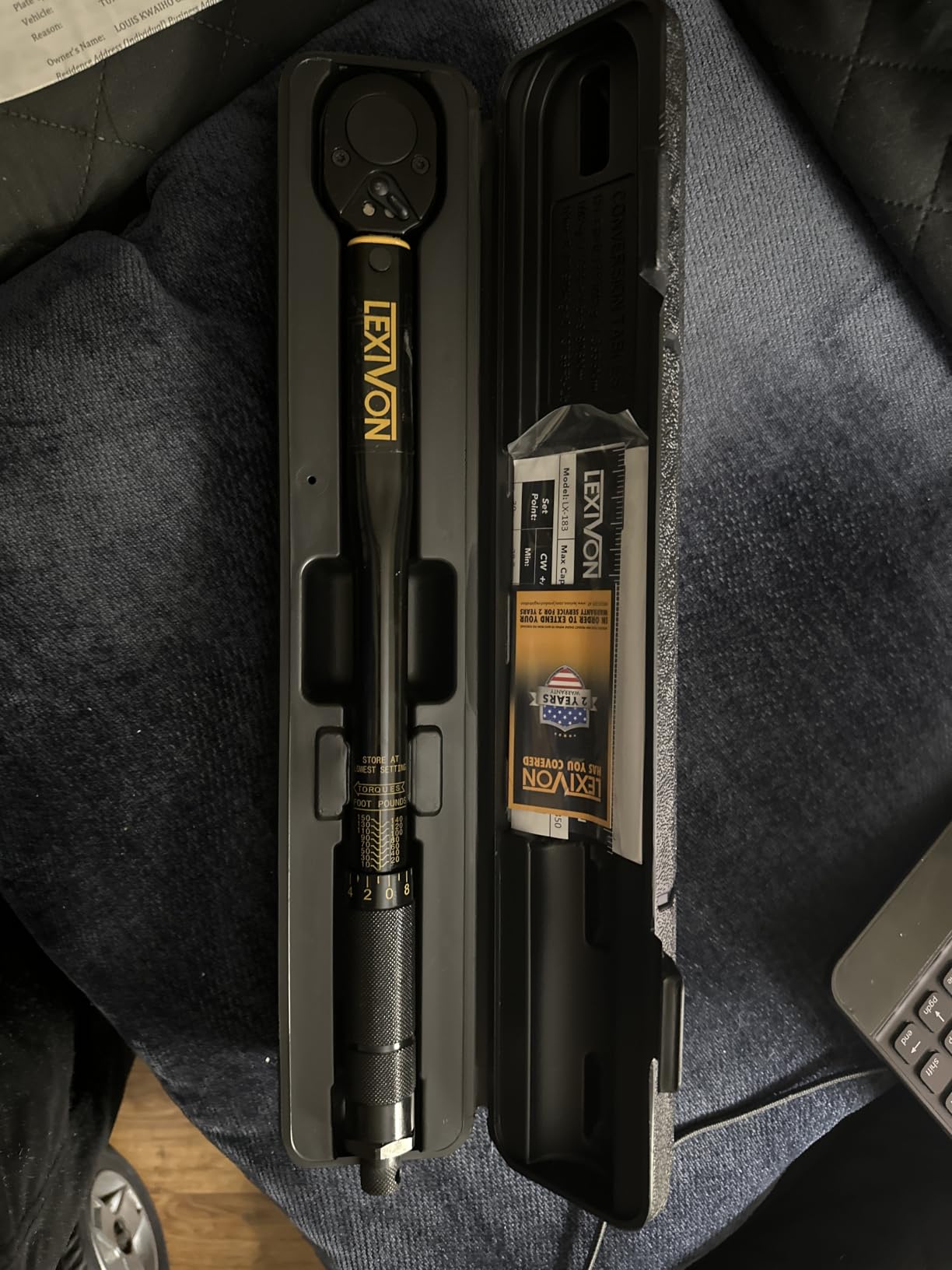
The ratchet gear head is reinforced and heat-treated Chrome Vanadium alloy steel, and the Electro-Black finish is a real corrosion barrier rather than a cosmetic coat, which matters if the wrench lives in a damp shed. The head is reversible, so you can drive in both directions, but the torque measurement itself still works clockwise only. That distinction trips people up constantly, so it is worth reading twice: reversible head, one-direction measurement.
At 17 inches and 3 pounds, it is longer and slightly heavier than the EPAuto but still short enough to work around a strut tower. One small fudge in the listing is worth flagging: the head is described as reversible, and some owners interpret that as bidirectional measurement, which it is not.
Why the certificate matters more than you think
A calibration certificate with a serial number gives you traceability. If the wrench is off, you can point at a specific unit rather than arguing with a listing, and the serial number is what a service department or a calibration bench will ask for first.
It is also the cleanest answer to the distrust that shows up constantly in owner threads, where the complaint is not that a cheap wrench is inaccurate but that nobody will stand behind the claim.
Where it falls short of the EPAuto
There is no extension bar in the box. You will want one for brake and suspension work, and that is a small but real gap when you are working inside a fixed budget.
It measures torque clockwise only, same as the field standard at this price. Neither of these top two wrenches solves the counter-clockwise problem, and that is a buying criterion almost nobody checks.
3. EPAuto 3/8-Inch Drive Click Torque Wrench, 10-80 ft-lb: Best Value
EPAuto 3/8-Inch Drive Click Torque Wrench 10-80 Ft-lb./ 13.6-108.5 Nm
10-80 ft-lb and 13.6-108.5 Nm on a 3/8-inch drive
Plus or minus 4 percent pre-calibrated
1/4 and 1/2 inch adapters plus extension bar
14.5 inch body
Pros
- Verified accurate within 1-2 percent using a digital torque meter
- Very consistent repeat readings across the range
- Compact 14.5 inch length gives more clearance in tight spaces
- Includes 1/4-inch and 1/2-inch adapters plus extension bar
- Knurled handle and storage case
Cons
- Measures torque clockwise only
- No calibration certificate included
- Some buyers report quality variance between units
- Click can be weak below roughly 16 ft-lb
This is the wrench that answers the question owners keep asking on mechanic forums, which is whether a 3/8-inch drive is worth owning alongside a 1/2-inch. It is, and the reason is the job list: spark plugs, drain plugs, valve cover bolts, oil pan bolts, and fuel and intake hardware all live below 80 ft-lb and come in 3/8-inch drive.
Owners report checking the readings against a digital torque meter and landing within 1 to 2 percent of the setting, which is inside the plus or minus 4 percent factory claim. For a set of bolts going to the same value, that repeatability is the property that actually matters, and this wrench is described as consistent.
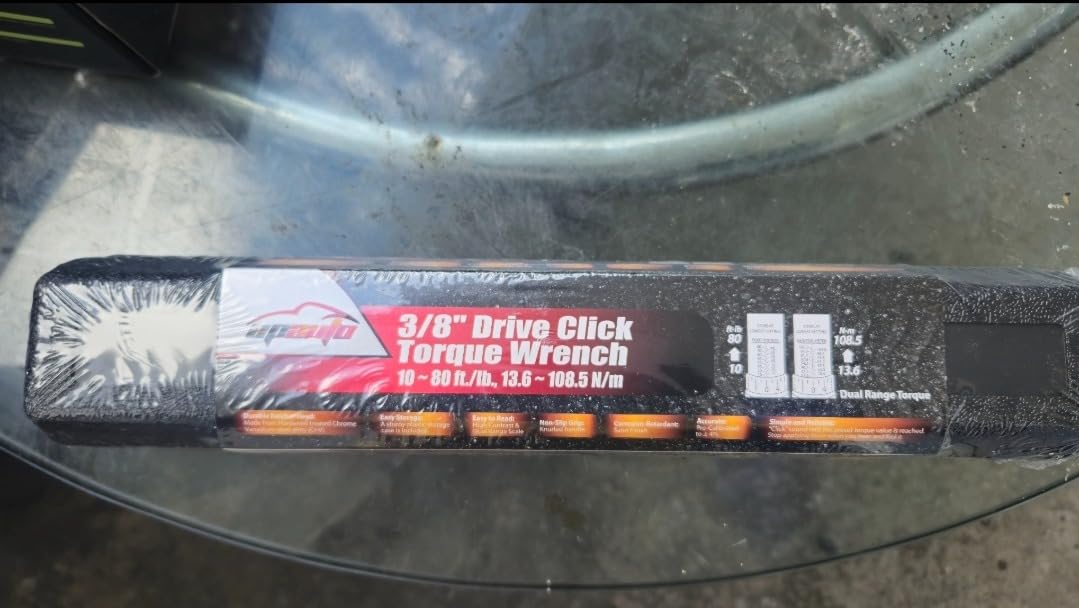
The 14.5-inch length is the sleeper advantage here. A shorter wrench means more clearance between the ratchet head and the body of the car, which is exactly what you need on an engine bay that has not been apart in a decade. The included 3/8-inch to 1/4-inch and 3/8-inch to 1/2-inch adapters plus an extension bar mean you can cover small hardware and larger fasteners from one purchase.
Two caveats. There is no calibration certificate, so verifying the wrench on arrival is on you. And some owners report the click feeling weak below about 16 ft-lb, which overlaps with spark plug territory, so on low-torque jobs listen carefully rather than relying on the sound alone.
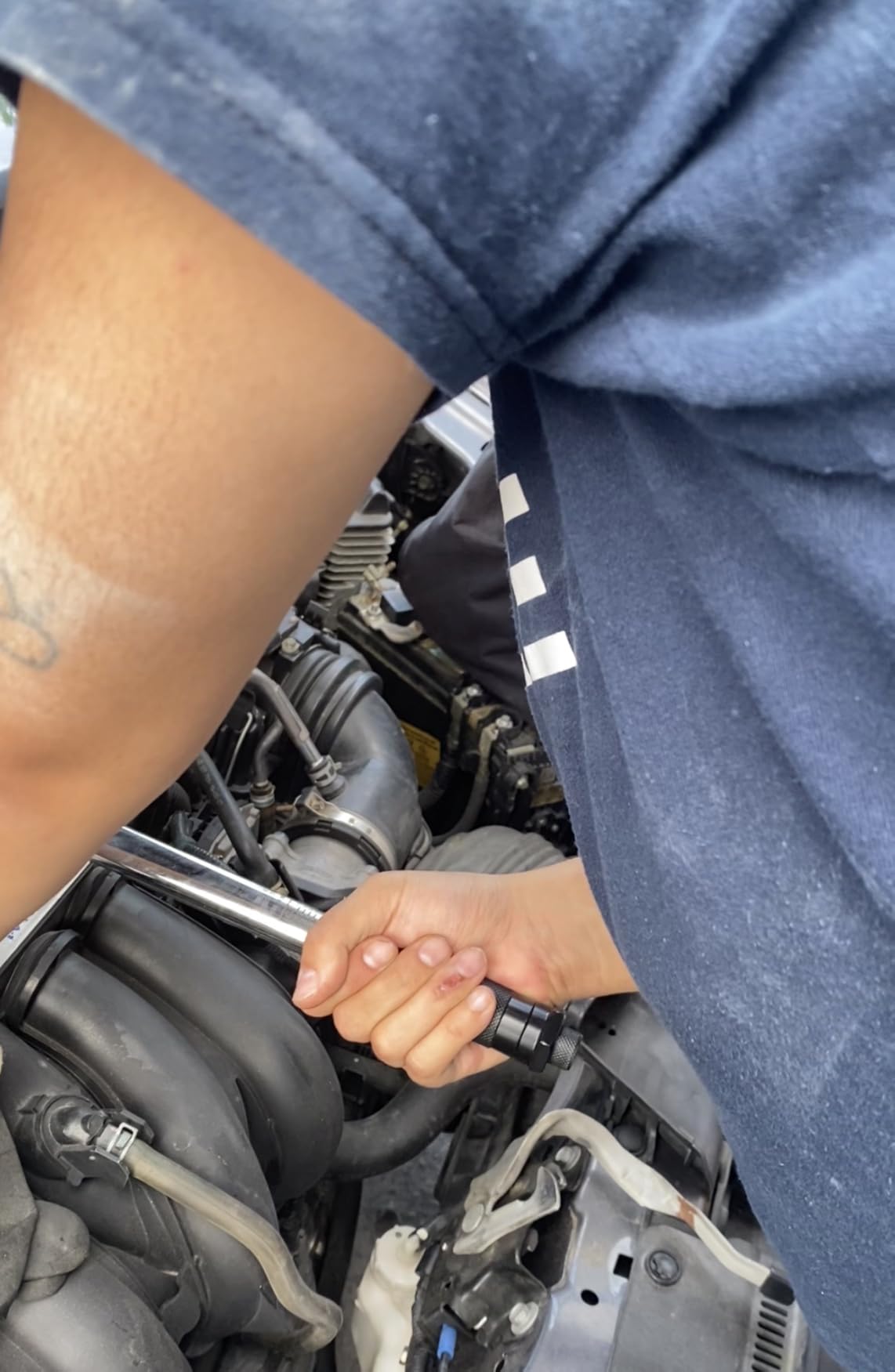
Best for the engine bay jobs a 1/2-inch wrench cannot reach
Spark plugs, oil and transmission drain plugs, valve cover fasteners and small intake hardware. The 3/8-inch drive fits the sockets you already own for those jobs, and the lower range stops you accidentally applying 100 ft-lb to a 12 ft-lb bolt.
It is also the right wrench for a small engine, a motorcycle, or a machine with mid-size fasteners in awkward spaces where a 16-inch 1/2-inch wrench will not fit.
Where owners report disappointment
Unit-to-unit consistency is the reported weak spot, with some buyers noting quality differences between production units. If accuracy is critical to you, the LEXIVON LX-182 below covers the same range with a certificate.
It measures clockwise only, and its 80 ft-lb ceiling means it is not a substitute for a 1/2-inch wrench on wheels, hubs or suspension hardware.
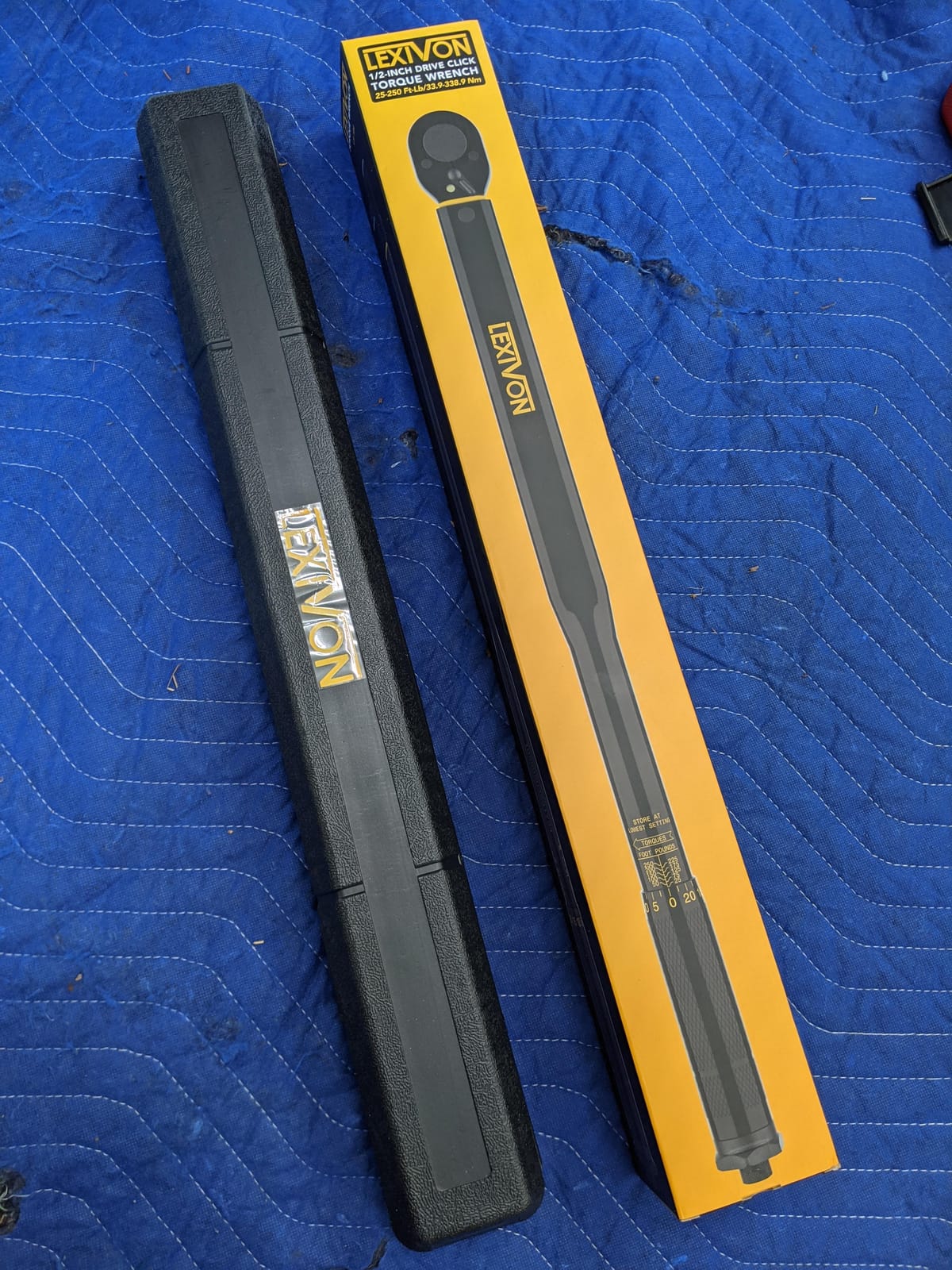
4. LEXIVON LX-184 1/2-Inch Click Torque Wrench, 25-250 ft-lb: Best for Truck and Axle Work
LEXIVON 1/2-Inch Drive Click Torque Wrench 25-250 Ft-Lb/33.9-338.9 Nm (LX-184)
25-250 ft-lb and 33.9-338.9 Nm on a 1/2-inch drive
Plus or minus 4 percent with calibration certificate
Reversible ratchet head
Electro-Black finish
Pros
- Highest torque capacity in the roundup at 250 ft-lb on a 1/2-inch drive
- Verified accurate within 1-2 ft-lb against a digital torque adapter
- Durable build that shows no wear after repeated high-torque jobs
- Smooth adjustment with a distinct audible click
- Readable highlighted yellow scale
Cons
- Somewhat short for settings near the 250 ft-lb top of the range
- Measures torque clockwise only
- Heaviest wrench in the group at 6.4 pounds
Most click wrenches stop at 150 ft-lb, and most bolts on a pickup, a dually, or a trailer hub want more than that. This one goes to 250 ft-lb, which puts axle, hub and heavy suspension fasteners back inside the tool envelope instead of forcing you into a breaker bar and a gamble.
It carries the same 4.7 star average as the LX-183 across close to 9,000 ratings, and it also ships with a calibration certificate with a trackable serial number. Owners report verifying it against a digital torque adapter within 1 to 2 ft-lb, and describe the adjustment as smooth with a click that is distinct rather than mushy.
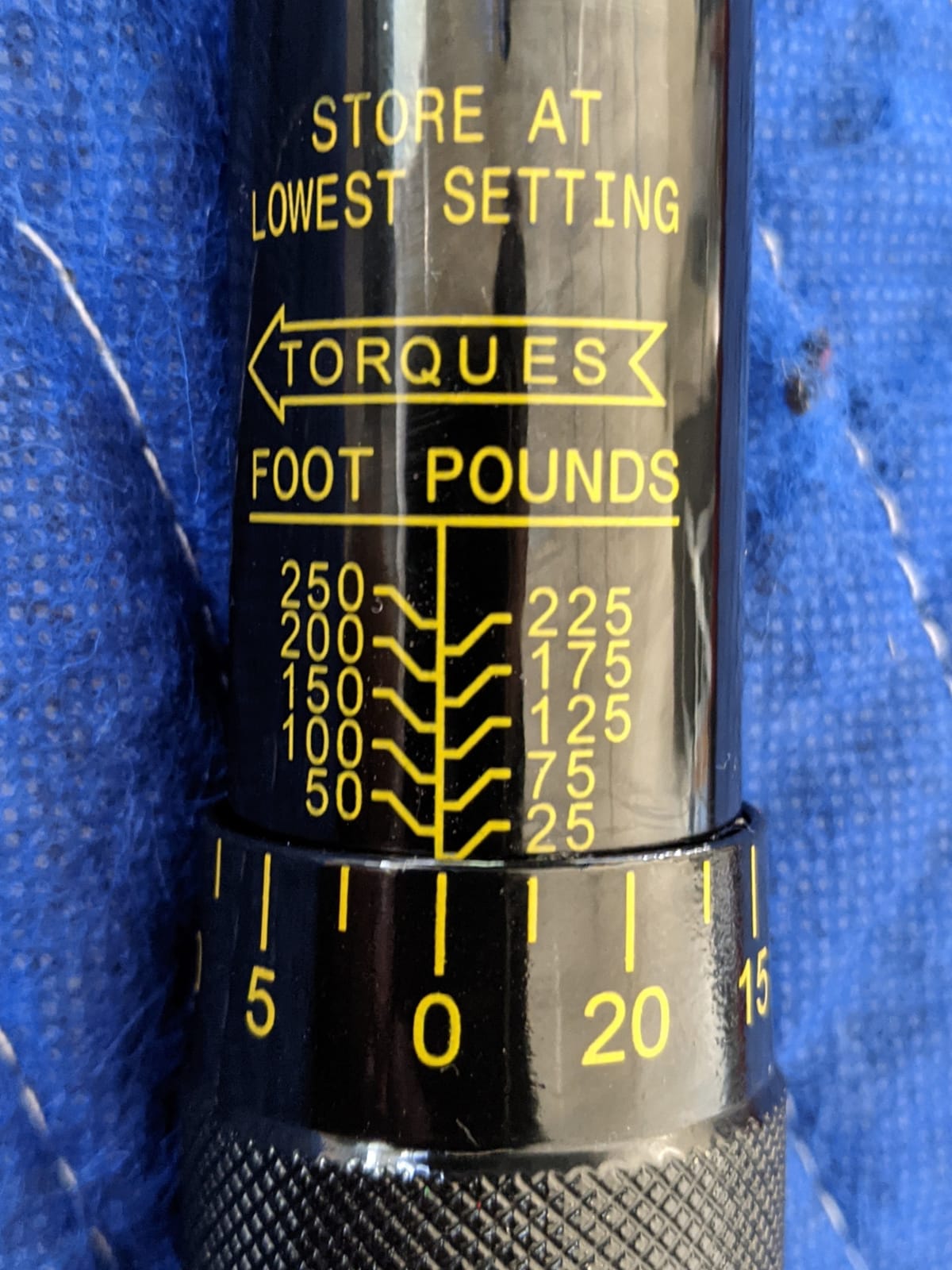
The Electro-Black finish, reinforced heat-treated Cr-V ratchet gear head and yellow-on-black dual-range scale carry over from the smaller LEXIVON, so a dark garage is not a problem. It is 24.84 inches long, which is the correct length for its range: a short wrench at 250 ft-lb puts too much strain through the handle.
It is also 6.4 pounds, the heaviest wrench in the roundup by a wide margin. On a single axle job that is irrelevant. Across a long suspension rebuild it will fatigue your hand, and that is the tradeoff you are making for the extra range.
Why a 250 ft-lb ceiling changes what you can own
Truck and trailer hub and axle fasteners regularly specify values above 150 ft-lb. Without a wrench that reaches them, the choices are an impact wrench with a torque reaction or a beam wrench you read by eye, and neither is a good answer for a spec you are supposed to hit accurately.
Owning this alongside a 10-150 ft-lb wrench covers essentially the whole fastener list of a full-size truck, which is why the two-wrench pairing comes up so often in owner discussions.
Where the extra range costs you
Weight and length. Six point four pounds is real, and this wrench is not the right tool for delicate work or for a full day of repetitive work.
It also measures torque clockwise only, and several owners note that the length becomes marginal in the region above roughly 200 ft-lb even with the heavier build.
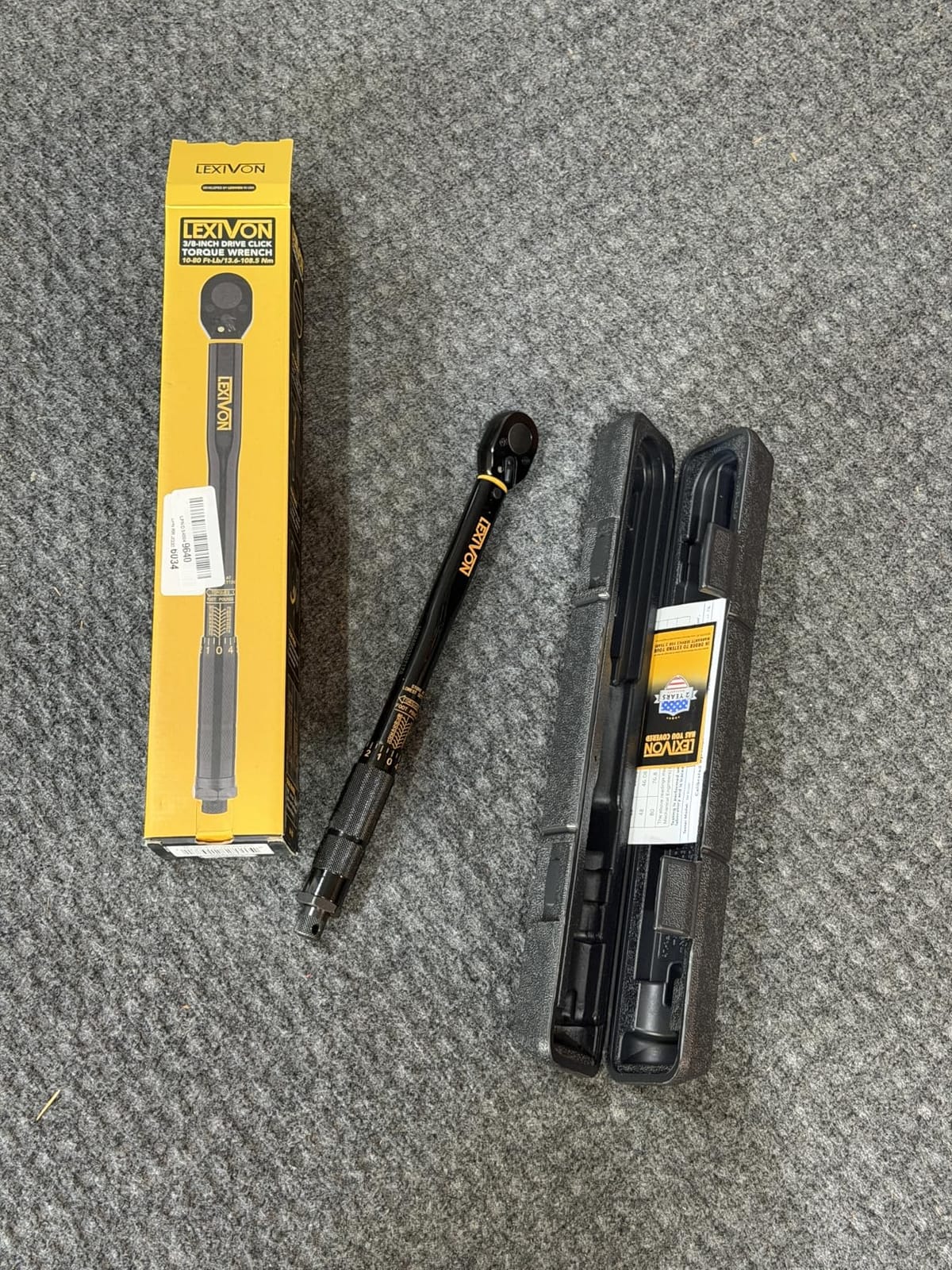
5. LEXIVON LX-182 3/8-Inch Click Torque Wrench, 10-80 ft-lb: Best for Spark Plugs and Drain Plugs
LEXIVON 3/8-Inch Drive Click Torque Wrench 10~80 Ft-Lb/13.6~108.5 Nm (LX-182)
10-80 ft-lb and 13.6-108.5 Nm on a 3/8-inch drive
Plus or minus 4 percent with calibration certificate
Reversible ratchet head
Snap-lock storage case
Pros
- Ships with a calibration certificate showing verified accuracy before shipping
- Yellow-on-black scale is far more readable than engraved chrome
- Robust solid-feeling build with a snap-lock storage case
- Accurate enough for low-torque work such as spark plugs
- Compact 14.76 inch length gives good clearance
Cons
- Click feel described by some owners as a bump stop rather than a true click
- Nm scale uses decimal values rather than round numbers
- Measures torque clockwise only
- Handle base must be unscrewed before adjusting the collar
Same range and same drive as the EPAuto 3/8-inch, different answer to the documentation question. Where the EPAuto asks you to trust the calibration claim, the LX-182 hands you a certificate with a traceable serial number, verified before shipping, which makes it the pick for anyone who has been burned by a wrench that arrived out of spec.
Owners consistently praise the yellow-on-black markings as more readable than chrome engraving, including older users, and several mention verifying the tool against a professional digital wrench on spark plug work and being satisfied.
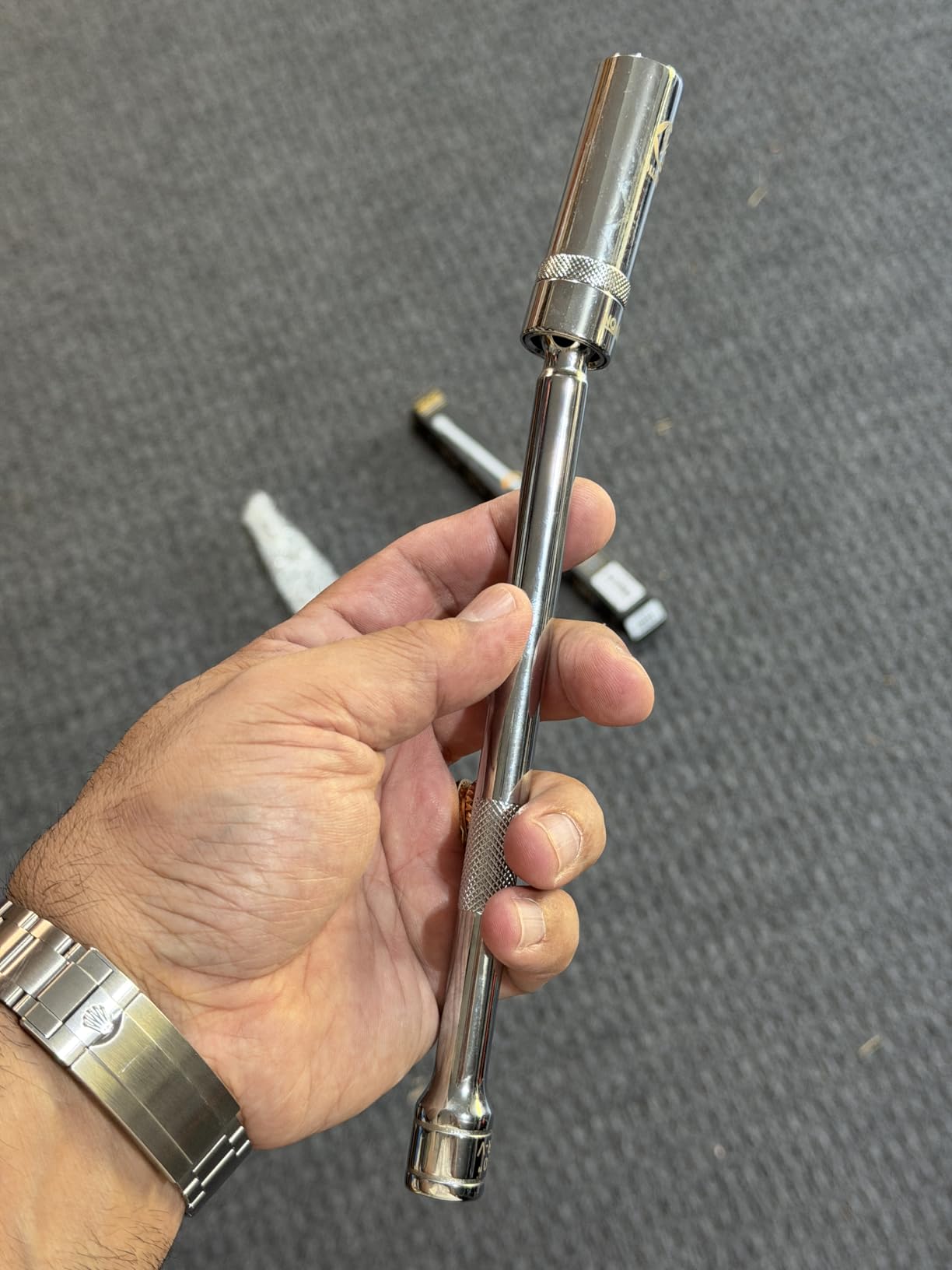
At 14.76 inches and 2.3 pounds it is compact and light, and the reinforced heat-treated Cr-V ratchet gear head with Electro-Black finish is the same construction used on the 250 ft-lb model. The reversible head drives both ways while the measurement works clockwise, which is the standard arrangement across this price tier.
Two honest quirks. Some owners describe the feedback as a bump stop rather than a sharp click, so on low-torque jobs you need to feel for the break rather than listen for it. And the Nm scale is printed with decimal values, which makes metric settings awkward to dial in precisely.
Best when low-torque accuracy is the whole point
Spark plugs, oil pan bolts, valve cover fasteners, drain plugs and small brackets. At 10 ft-lb at the bottom, this covers the low end better than any 1/2-inch wrench in the list, and the certificate lets you prove it does.
It is also a sensible second purchase for someone who already owns a 1/2-inch wrench and finds themselves repeatedly reaching for an adapter.
Where the ergonomics get in the way
The base of the handle has to be unscrewed before the collar will move, which is a deliberate anti-tamper design rather than a flaw, but it is a step you will notice every time you change settings.
The Nm scale with decimals, plus a soft click, makes this a slower tool to work with on metric settings than the EPAuto 3/8-inch, even though both are accurate.
6. Amazon Basics 1/2-Inch Click Torque Wrench, 20-150 ft-lb: Most Versatile
Amazon Basics 1/2-inch Drive Click Torque Wrench, 20-150 foot-lb, 27.1-203.5 Nm, Sturdy Construction with Storage Case
20-150 ft-lb and 27.1-203.5 Nm on a 1/2-inch drive
Plus or minus 4 percent pre-calibrated
High-contrast dual-range scale
Storage case included
Pros
- Lowest-priced 1/2-inch click wrench here while still holding a 4.6 star average
- Hardened treated Cr-V steel ratchet head resists rust and corrosion
- High-contrast dual-range scale pre-calibrated to plus or minus 4 percent
- Sturdy plastic storage case included
- Unlock-adjust-lock mechanism is straightforward
Cons
- No calibration certificate with a traceable serial number
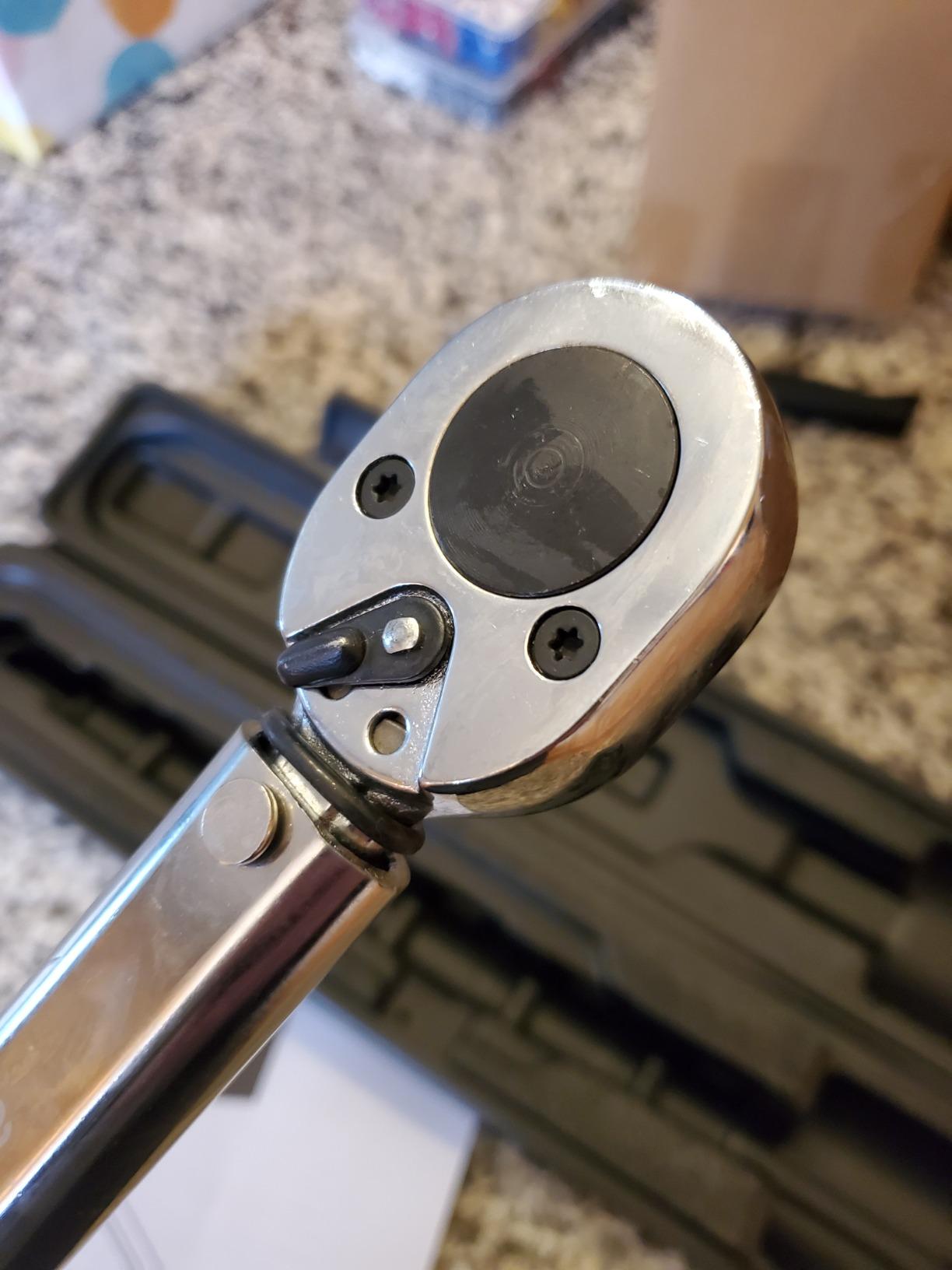
- Fixed square drive head rather than a reversible ratchet
- Listing material attribute is generic rather than specific to the steel head
This is the wrench to buy if you want a 1/2-inch click tool and would rather spend what is left on sockets. It lands at the bottom of this roundup cost-wise while still holding a 4.6 star average across more than 4,000 ratings, which is a hard combination to find.
The range is 20 to 150 ft-lb, so note the raised floor compared with the two EPAuto and LEXIVON 1/2-inch wrenches at 10 ft-lb. That matters if you do small fasteners on a 1/2-inch drive, and it does not matter at all for wheel and brake work.
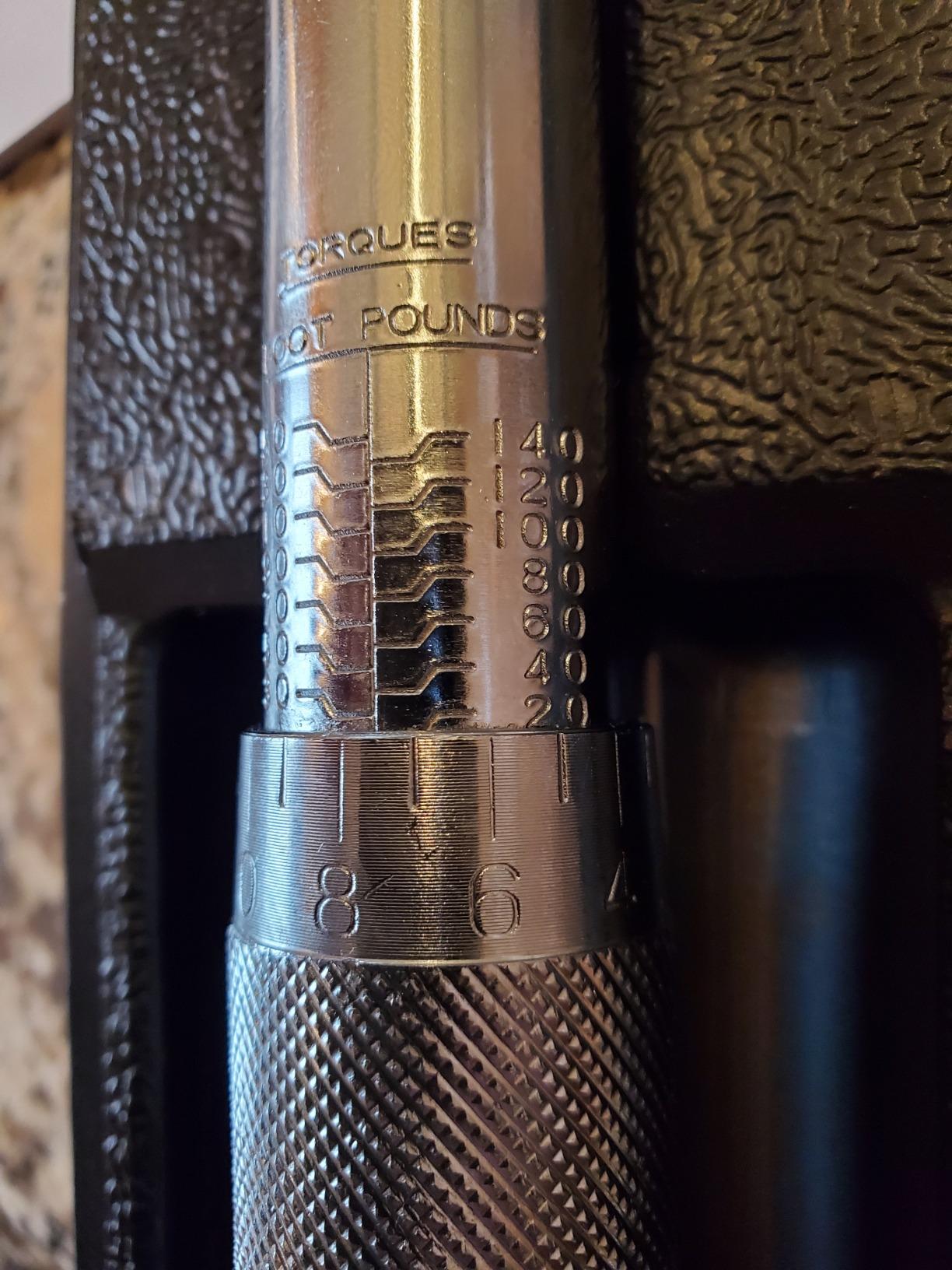
The ratchet head is hardened, treated Cr-V steel with rust and corrosion resistance, the scale is high contrast, and a sturdy plastic case is included. The lock and unlock behavior is the familiar one: unlock before adjusting, lock after, and return the collar to its lowest setting when you are done.
The head is a fixed square drive rather than a reversible ratchet, so it drives one way only. That is a real limitation for ratcheting through a tight access path, and it is one of the reasons a slightly cheaper tool costs you a little more time on some jobs.
Where the budget pick genuinely wins
Wheel, brake and suspension work on a 1/2-inch drive, and any job whose specification lands between 20 and 150 ft-lb. Owners report a readable scale, a pre-calibrated plus or minus 4 percent accuracy claim, and a case that keeps the tool from going to rust between infrequent uses.
It is also the easiest entry point here for a first-time buyer who just wants to stop guessing at lug nut torque.
Where you give something up
No calibration certificate. If a reading looks wrong to you, there is no serial number to quote and no unit to point at, which is the trust gap that costs owners money on return shipping.
The fixed head also means more wrenching when access is tight, and the generic material attribute in the listing is not something we would repeat as a spec.
7. Amazon Basics 3/8-Inch Click Torque Wrench, 15-80 ft-lb: Best for Oil Changes and Hitch Work
Amazon Basics 3/8-inch Drive Click Torque Wrench Ratchet, 15-80 ft.-lb, 20.4-108.5 Nm
15-80 ft-lb and 20.4-108.5 Nm on a 3/8-inch drive
Plus or minus 4 percent pre-calibrated
Polished chrome Cr-V steel head
Storage case included
Pros
- Lowest cost in the roundup while still pre-calibrated to plus or minus 4 percent
- Solid well-made feel with a bright polished chrome finish
- Click is easy to both feel and hear at the target torque
- Smooth adjustment with marks etched in 5 and 10 ft-lb intervals
- Sturdy plastic case helps prevent rust between infrequent uses
Cons
- Lowest average rating in the group at 4.2 stars with a 10 percent one-star share
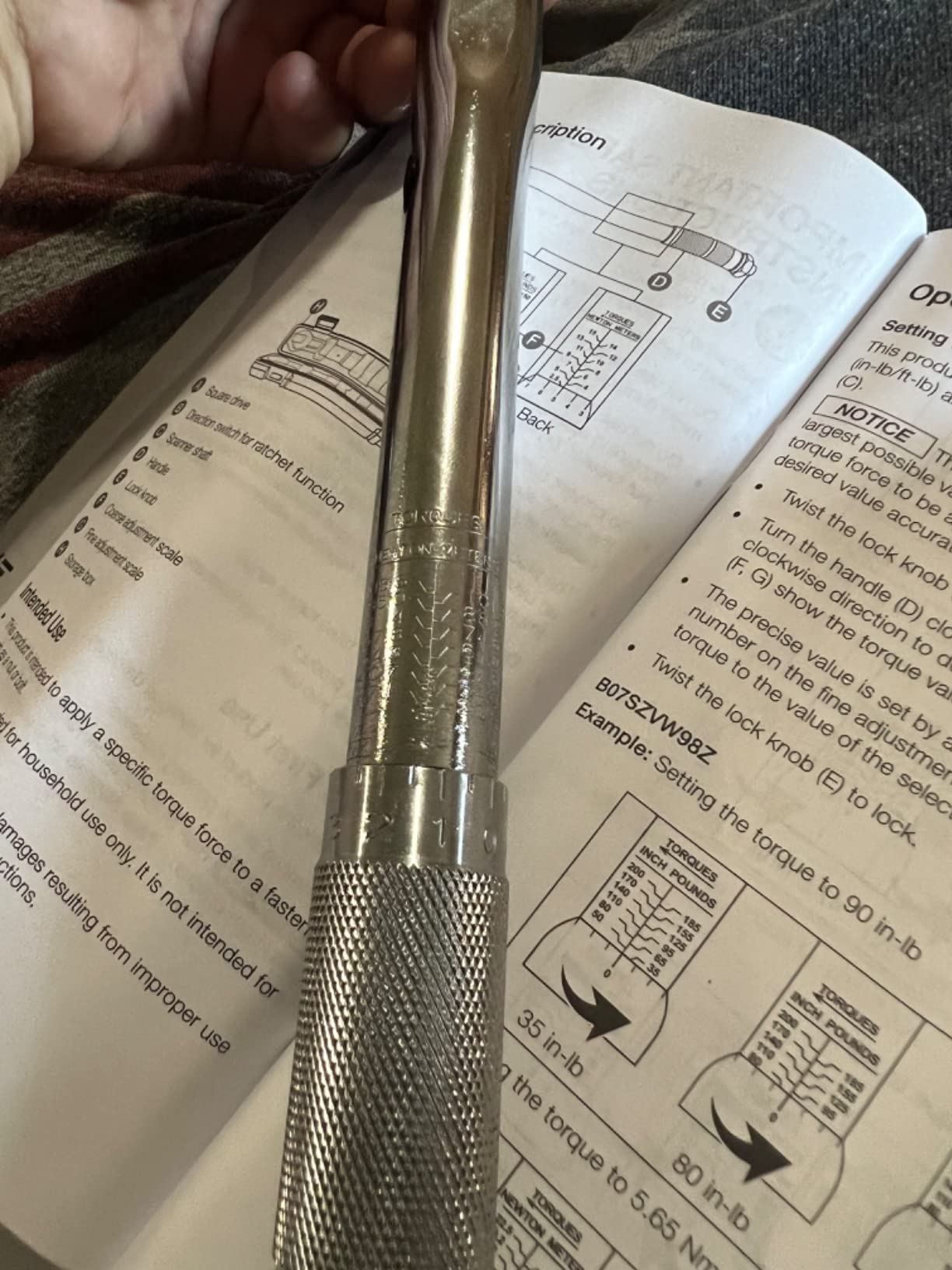
- Torque values are faint and hard to read without direct light
- Alignment edge is ambiguous so the set value can be off by several ft-lb
- Adjustment feel is less refined than premium brands
This one earns its place for a specific reason: the click is easy to feel and hear, and the adjustment is smooth with clearly etched marks at 5 and 10 ft-lb intervals. For the oil change and hitch installation jobs that make up a lot of casual wrench use, that combination matters more than a color-printed scale.
The 4.2 star average is the lowest in this roundup, with roughly a 10 percent one-star share, and the complaints concentrate on one thing. The torque values are faint and the alignment edge is ambiguous, which some owners say leaves the actual setting several foot-pounds away from the intended value.
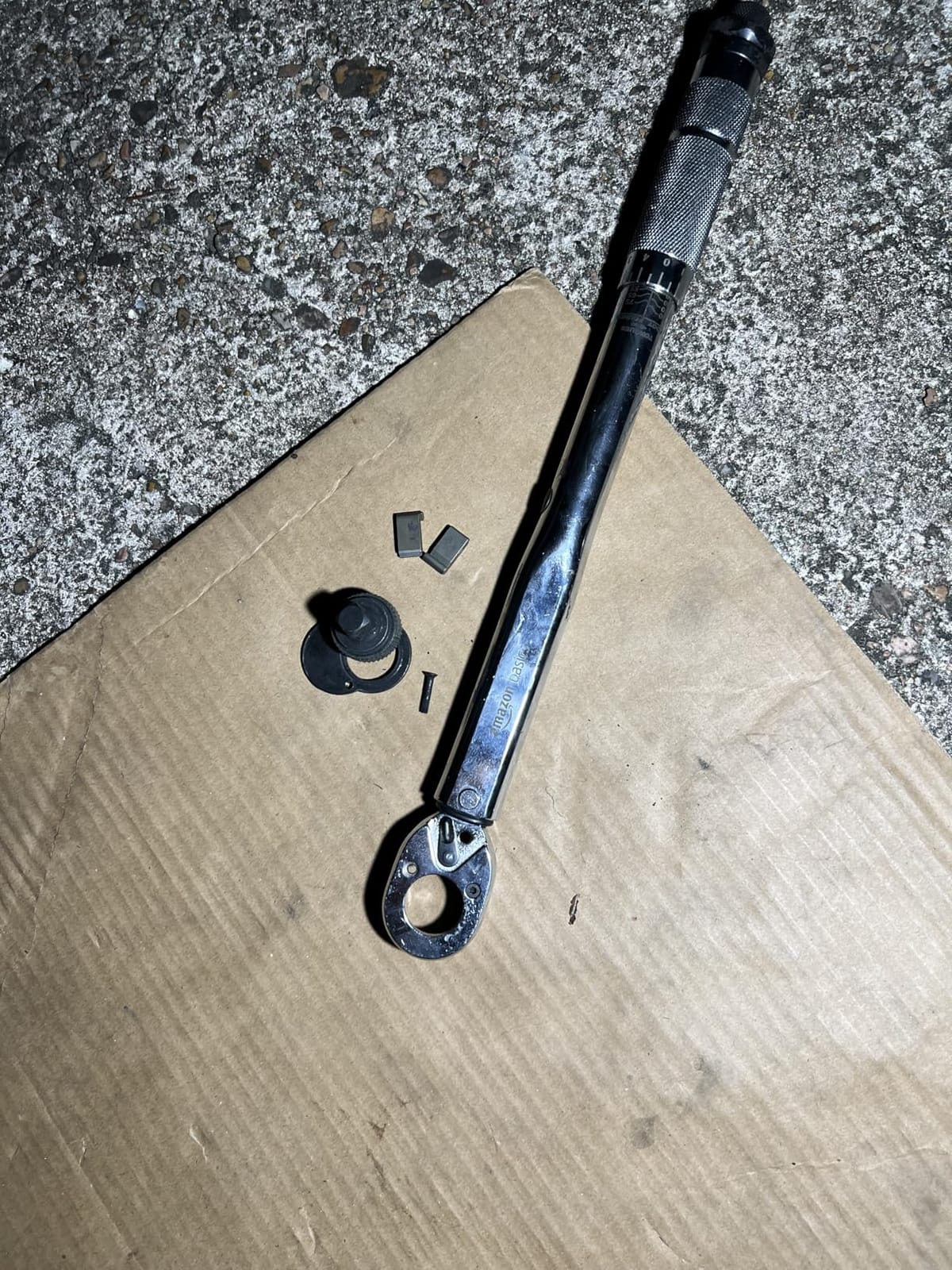
The bright polished chrome finish wipes clean and resists corrosion, and the hardened treated Cr-V steel ratchet head is the right material for the job. The listing also advises using the imperial scale for precise adjustment, where 1 Nm equals 8.86 in-lb, which is a useful detail when a service manual quotes Newton metres.
There is a 15 ft-lb floor, higher than the 10 ft-lb wrenches above it, and a 3/8-inch fixed square head rather than a reversible ratchet. Some owners also report sockets sitting loosely on the drive, so check the fit before torquing anything critical.
Best for the jobs where you tighten by feel and confirm by click
Oil changes, hitch and ball mounts, battery terminals and general hardware in the 15 to 80 ft-lb band. Many owners use it exactly this way, and the click is the confirmation they are getting.
It is a good low-frequency tool for the garage that does an oil change twice a year and a hitch install once a year, and the included case helps with exactly that use pattern.
Where the trade-off shows up
The faint scale and ambiguous alignment index are the reasons it lands seventh rather than higher. On a lug nut or a structural bolt, a several foot-pound error in either direction is not something you want to discover after the fact.
It also has the smallest review base of the 1/2 and 3/8-inch clickers here alongside the lowest rating, so there is less long-term owner history backing the accuracy claim.
8. YIYEIE 50-Piece 1/4-Inch Bike Torque Wrench Kit, 10-230 in-lb: Best for Bicycles and E-Bikes
YIYEIE 50Pcs Master Bike Torque Wrench Set, 1/4 Inch Drive, 10-230 IN.LB (1-26.0 Nm), Inch Pound Click Torque Wrench with Bit Sockets, 0.1 Nm Micro, 3/8 Adapter, Pro Bicycle Tool Kit for MTB
10-230 in-lb and 1-26.0 Nm on a 1/4-inch drive
Plus or minus 3 percent with calibration certificate
72-tooth reversible ratchet head
50-piece kit with bit sockets
Pros
- Tightest published accuracy in the roundup at plus or minus 3 percent with a certificate
- 50-piece kit covers most bicycle fasteners in one package
- 0.1 Nm micro-adjustment for delicate components
- 72-tooth reversible ratchet head with quick release
- Best value option for bicycle and e-bike work
Cons
- Inch-pound range only so it cannot cover automotive fasteners
- Click is faint below roughly 5 Nm
- 1/4-inch drive caps maximum torque at 230 in-lb
- Lower brand recognition and a smaller review base
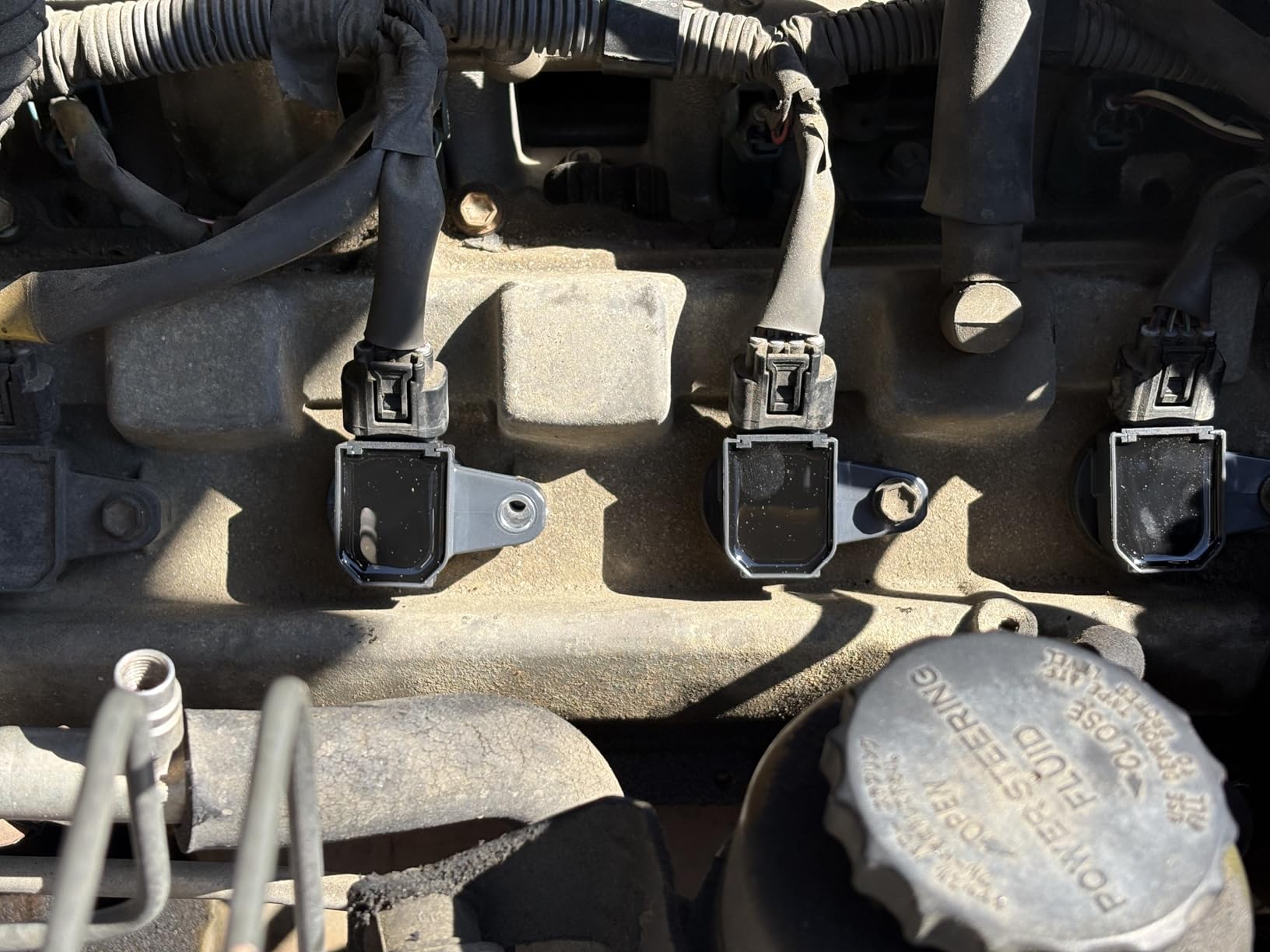
Car and motorcycle work has almost nothing in common with bicycle and e-bike work, and this kit exists because of that. It is the only inch-pound wrench here, the only one with a plus or minus 3 percent claim, and the only one that arrives as a 50-piece set with the bit sockets that bike work actually needs.
The dual range covers 10 to 230 in-lb, which is 1 to 26.0 Nm, with 1 in-lb and 0.1 Nm micro-adjustment. That fine increment is the feature that matters on a stem, seat post clamp or brake caliper, where the difference between 40 and 45 in-lb is the difference between a safe and an unhappy part.
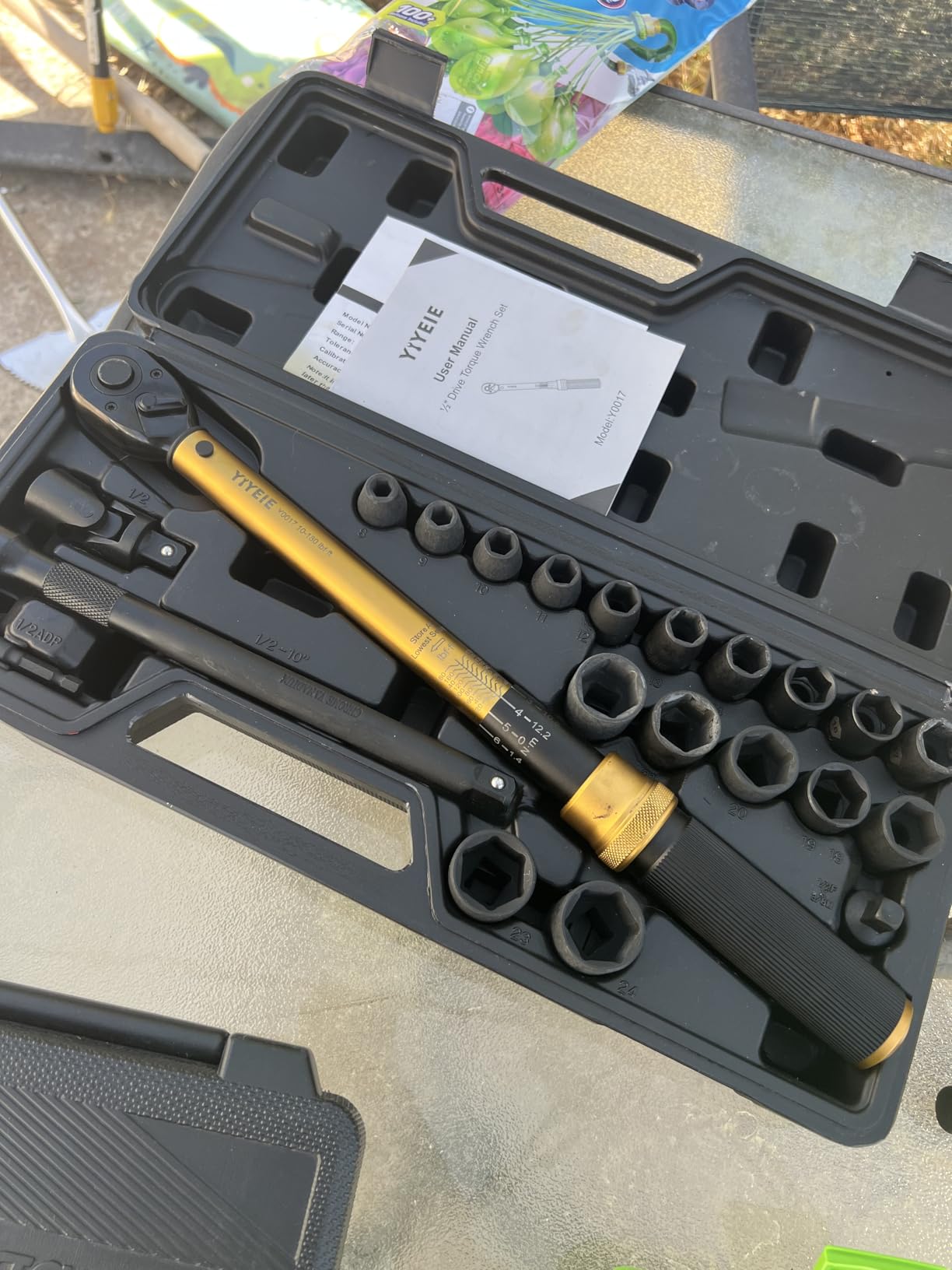
You get Hex, Torx, six-point, Pozidriv, Phillips, Slotted and Robertson bit sockets, plus a 1/4-inch to 3/8-inch adapter, bit holder, universal joint, bit adapter, drill adapter, a 4-inch extension bar and a case. The 72-tooth reversible ratchet head gives both-direction drive with a quick-release button, and the construction is Cr-V steel with aerospace aluminium.
The click is strong and distinct above roughly 44.25 in-lb, which is 5 Nm, and faint below that. On a lightweight frame or a carbon post, that is exactly the zone you care about, so listen rather than assume. The listing also claims the tool exceeds ASME and DIN-ISO standards and ships with a calibration certificate carrying a traceable serial number.
Best for bike and e-bike work, including delicate components
Stem and seat post bolts, handlebar clamps, crank bolts, disc brake calipers, derailleurs, bottle cages and e-bike motor hardware. Owner threads on bike forums consistently treat bolt torque as the part of a build you do not guess at, and this is the budget answer to that.
The 72-tooth head also makes it workable in the awkward angles that bike frames produce, where a coarse ratchet cannot fit.
Where it is the wrong tool
Automotive work of any kind. The 230 in-lb ceiling is about 19 ft-lb, and most car fasteners are outside that entirely.
It also has a smaller review base and lower brand recognition than the leading picks, so the long-term owner history backing the plus or minus 3 percent claim is thinner. If accuracy documentation is your priority, check it on arrival.
9. CRAFTSMAN 3/8-Inch Drive Torque Wrench CMMT99433: Best for Handle Comfort
CRAFTSMAN Torque Wrench, 3/8″ Drive (CMMT99433)
3/8-inch drive up to 100 ft-lb and 135 Nm
Bi-material handle
Quick-locking adjustment
Stamped inch and metric scales
Pros
- Recognizable mainstream tool brand holding a 4.6 star average
- Bi-material handle improves grip comfort and reduces hand fatigue
- Quick-locking adjustment makes setting torque fast and stable
- Scales stamped into the housing showing inch and metric settings
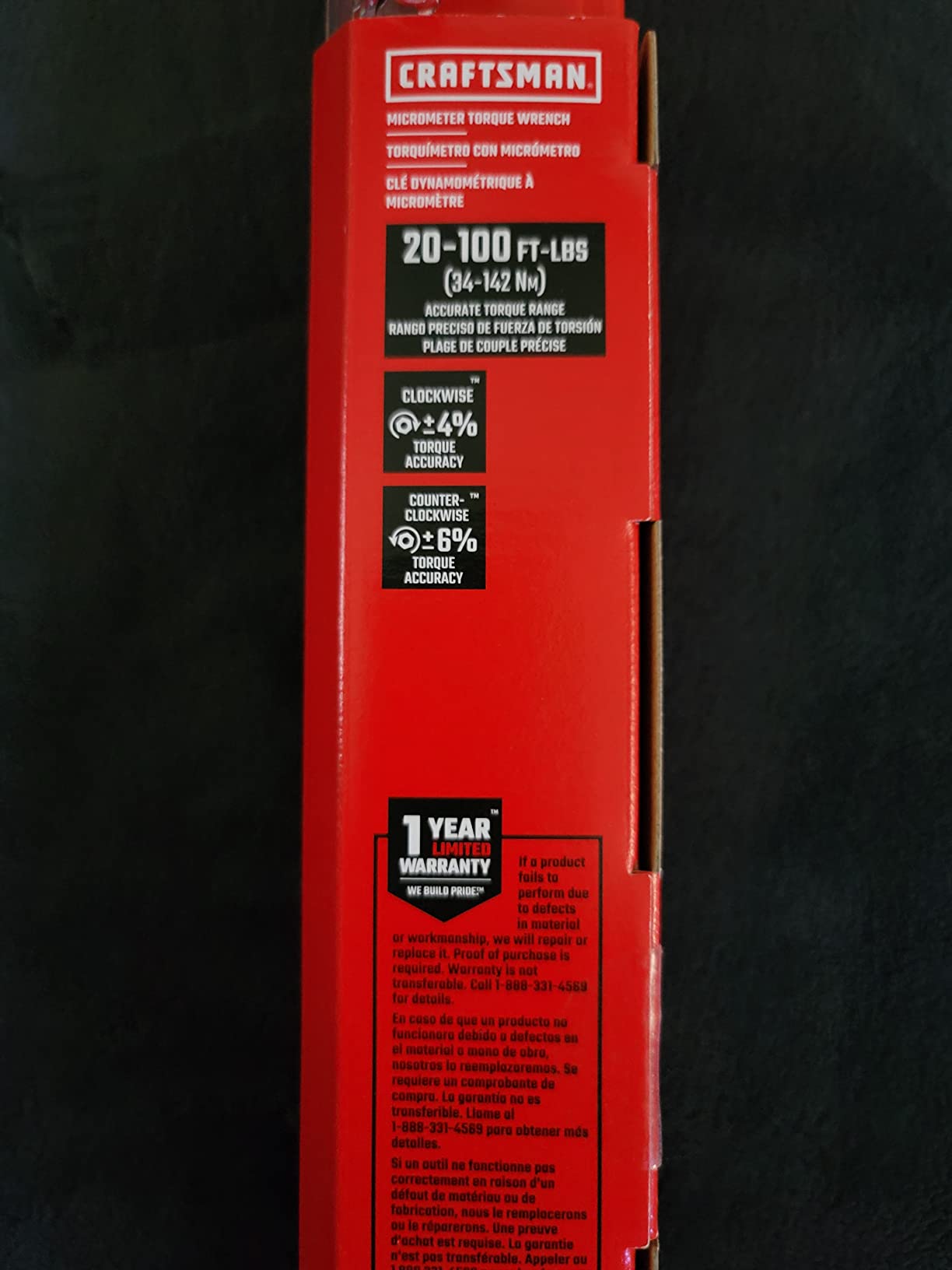
- Meets or exceeds ASME specifications with a durable case
Cons
- Lowest torque capacity among the click wrenches here at 100 ft-lb
- Stamped scales are less readable than color-printed ones
- Stamped markings can wear and become hard to read over time
- No calibration certificate mentioned in the listing
The reason this one is here is the handle. The bi-material grip is the most frequently praised feature across the review data, with owners specifically noting comfort and reduced hand fatigue on longer jobs, and for a 17.2-inch 3/8-inch wrench doing engine bay work that is a real quality-of-life difference.
The quick-locking adjustment is the other repeated positive. Being able to set the value and know it has locked means you are not re-checking the collar on every bolt in a set, which saves time and prevents the classic off-by-a-few foot-pounds mistake.
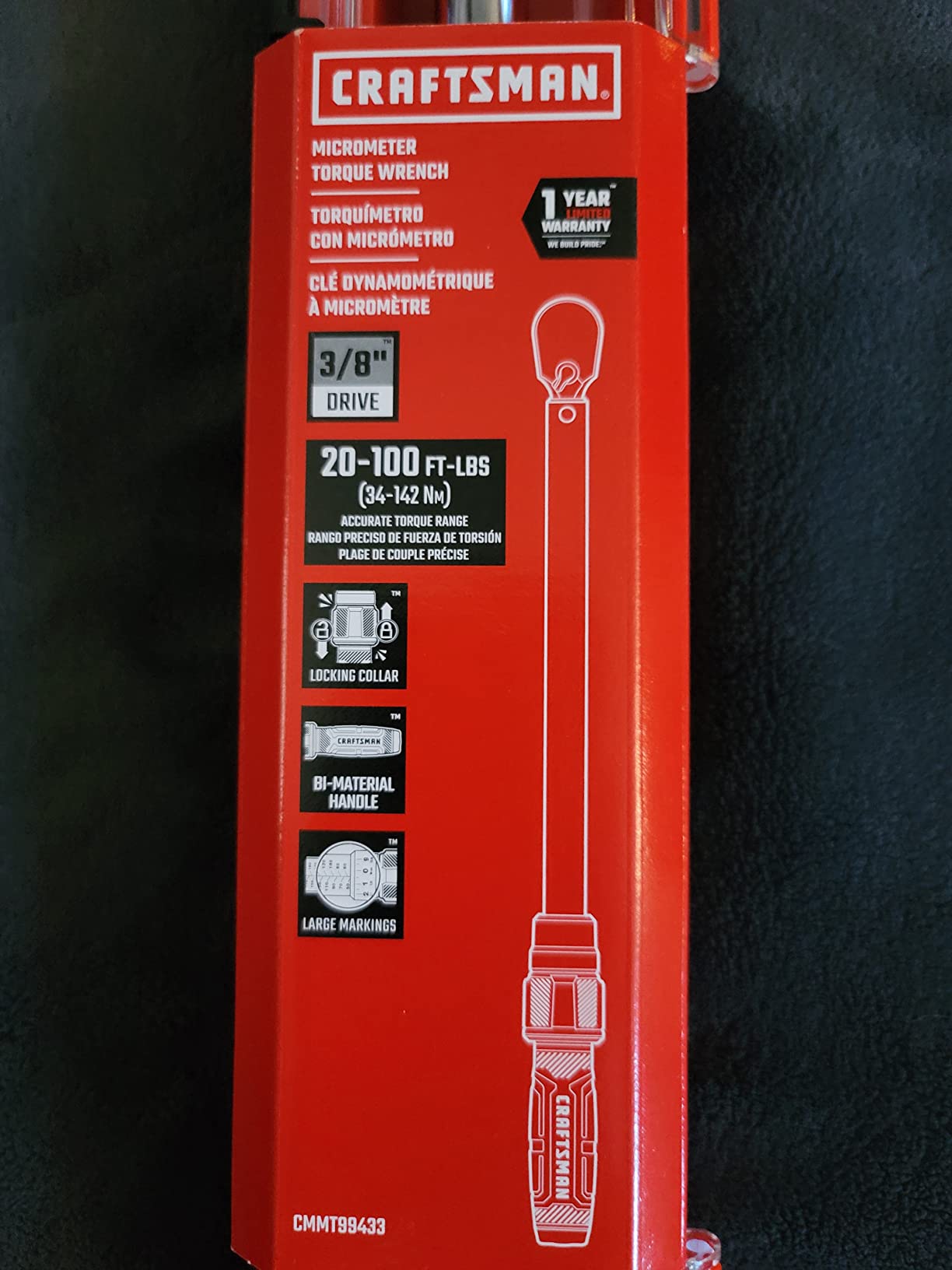
Scales are stamped into the housing showing both inch and metric settings, the tool meets or exceeds ASME specifications, and a durable case is included for storage or transport. It is 17.2 inches, a sensible length for its 100 ft-lb ceiling.
Two limits. The 100 ft-lb capacity is the lowest among the click wrenches in this roundup, so lug nuts at 80 to 100 ft-lb sit right at the edge of the scale with nothing in reserve. And the stamped markings are less legible in bright light than the color-printed scales on the LEXIVON and Amazon Basics models, and they wear over time.
Best for long sessions in tight spaces
Engine bay work, undercarriage fasteners and anything where your hand is in an awkward position for a while. The bi-material handle and quick-lock collar are the two features you will feel on every bolt.
It is also the pick if a recognizable brand name on the tool matters to you, which is a reasonable thing to want in a garage shared with other people.
Where the 100 ft-lb ceiling bites
Suspension and subframe bolts, and heavier hardware, sit above what this wrench can reach. It covers engine and small chassis work well and stops there.
There is no calibration certificate mentioned, and the stamped scale is harder to read than a printed one, so budget a little more care when you dial in a setting.
10. ACDelco ARM601-4 1/2-Inch Digital Torque Wrench: Best Digital Option Under 100 Dollars
ACDelco ARM601-4 1/2” (14.8 to 147.5 ft-lbs.) Heavy Duty Digital Torque Wrench with Buzzer and LED Flash Notification – ISO 6789 Standards with Certificate of Calibration
14.8-147.5 ft-lb and 20-200 Nm on a 1/2-inch drive
2 percent clockwise and 3 percent counter-clockwise accuracy
Peak and Trace modes with buzzer and LED flash
NIST-traceable certificate
Pros
- Only digital wrench here with real-time readings plus Peak and Trace modes
- Buzzer and LED flash make the target easy to find in noisy or dark spaces
- NIST-traceable certificate of calibration on an individually serialized tool
- Slim 44 centimeter body is easier to position in tight spaces than a long click wrench
- Works in both clockwise and counter-clockwise directions
Cons
- Requires 4 AAA batteries which are not included
- Some owners report the tool powering down after about 60 seconds
- Menu controls take time to learn and the manual does not match the functions
- Lowest alarm cannot be set below roughly 10 ft-lb
Everything else on this list tells you the torque has been reached. This one shows you the number as you pull, which is a fundamentally different experience and the reason electronic wrenches exist. It is also the only wrench here that measures counter-clockwise, so if a left-hand-threaded fastener ever comes up, this is the tool that handles it.
Accuracy is stated at 2 percent clockwise and 3 percent counter-clockwise of the indicated value across 20 to 100 percent of full scale, and the tool is individually serialized with a certificate of calibration traceable to NIST. It also meets or exceeds ASME B107.14.14-2004 and ISO 6789. That is a documented accuracy level none of the mechanical picks in this roundup can claim.
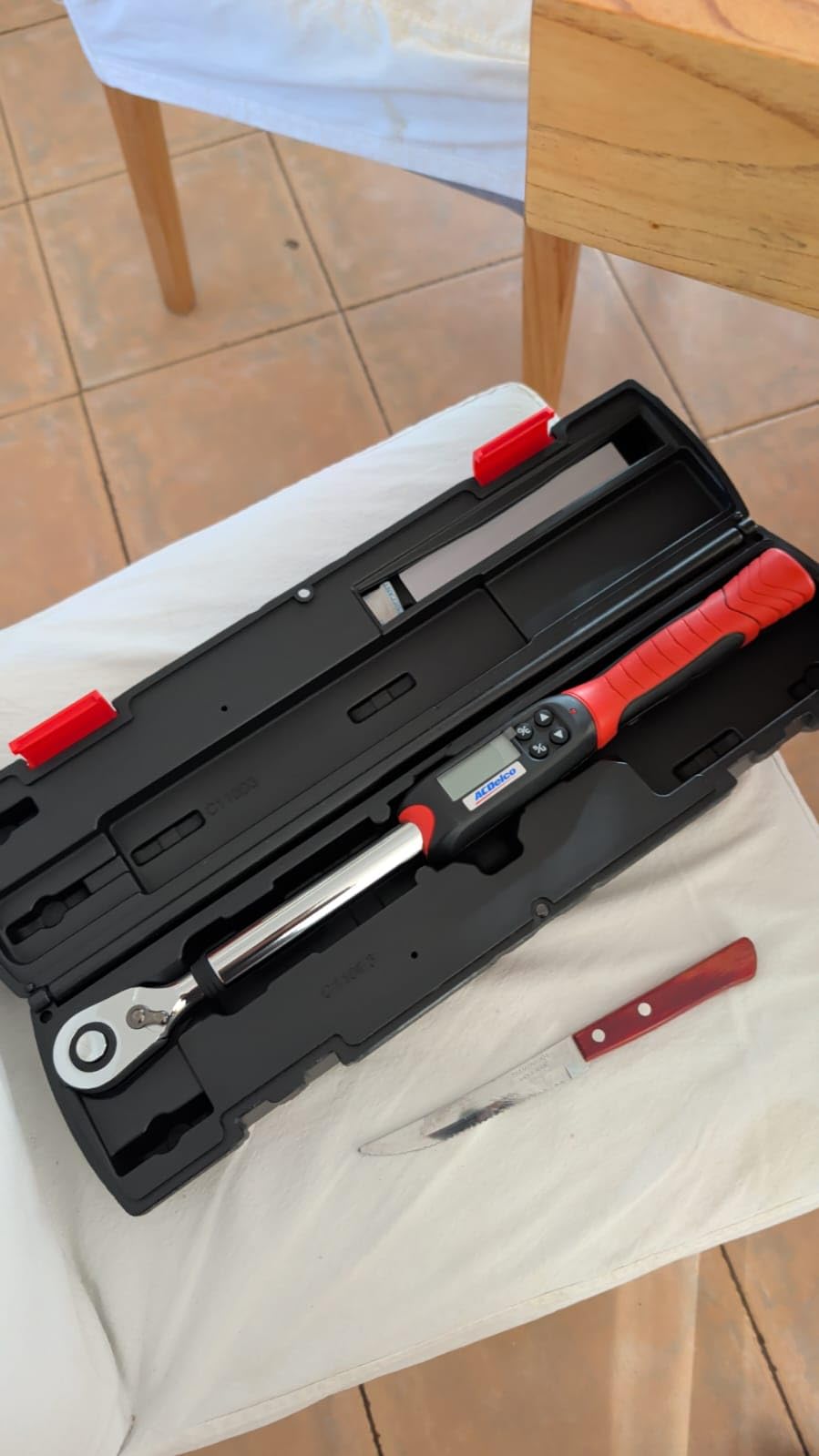
The measuring range is 14.8 to 147.5 ft-lb, which is 20 to 200 Nm, with torque, measurement, and Peak and Trace modes. The LCD beeps and the LED flashes at the target value, which matters in a noisy shop or a dark garage. At 44 centimeters it is far shorter than a click wrench, so positioning around a strut or a crossmember is much easier.
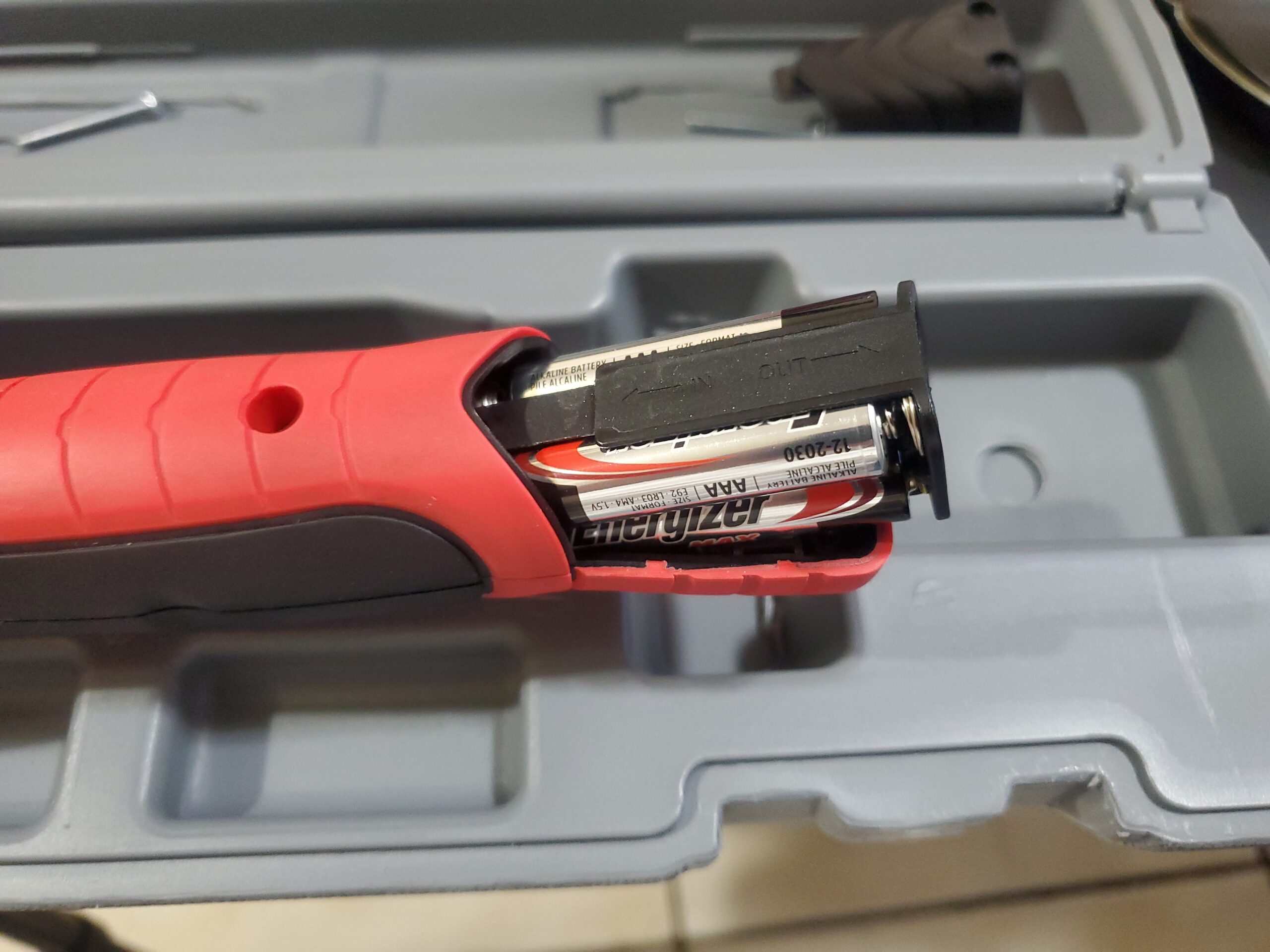
Now the honest part. It runs on 4 AAA batteries, which are not included, and the single most common complaint in the review data is battery behaviour: the unit powering down after roughly 60 seconds and draining cells quickly when idle. Owners also report the menu controls taking time to learn and the instructions not fully matching the tool functions.
Best when you need a reading, not a click
Suspension and subframe bolts where you want to see the number climb, work on a vehicle with left-hand threads, and any job where an owner or customer wants evidence of the value used. It is also the only entry with a NIST-traceable certificate.
For a mobile mechanic moving between a small set of jobs, the counter-clockwise capability and the compact body are worth more than they look on the spec sheet.
Where the digital experience frustrates owners
Automatic power-down and idle battery drain are the recurring complaints, and the batteries are not supplied. Keep a spare set with the tool and accept the extra step.
The lowest alarm setting will not go below roughly 10 ft-lb even though the meter itself reads down to 4 ft-lb, so very low-torque confirmation is limited. It also sits at the top of this roundup cost-wise, and the two modes take practice before they feel intuitive.
How to Choose a Torque Wrench Under 100 Dollars
How we ranked these ten wrenches
We weighted the criteria rather than counting features, because a feature that does not matter for your job is worth nothing. Accuracy carried the most weight, since an inaccurate tool defeats the purpose of owning one at all. Owner feedback came next, because a four-thousand-rating history tells you more about long-term accuracy than a listing claim does.
Accuracy claim and verification: 45 percent. Whether the tool states a tolerance, whether a calibration certificate with a traceable serial number ships with it, and whether owner reports contradict the claim.
Owner feedback and feedback quality: 25 percent. Review volume, rating consistency, and whether the alert is a clear click, a soft bump, a buzzer, or a combination.
Range and drive fit: 20 percent. Whether the torque span and square drive cover real jobs at useful settings, and how wide the useful window is.
Build, finish and warranty: 10 percent. Head material, corrosion coating, grip, and whether a case is included.
Are cheap torque wrenches any good?
Yes, within limits. Every click wrench here is pre-calibrated at plus or minus 4 percent, which is the industry baseline, and the tightest claims in this group are plus or minus 3 percent for the bike kit and 2 percent clockwise for the digital wrench.
Here is the arithmetic that matters for a lug nut. At a 100 ft-lb specification, plus or minus 4 percent means your wrench is allowed to break over anywhere between 96 and 104 ft-lb. A manufacturer spec of 80 to 100 ft-lb sits comfortably inside that window, which is exactly why a budget click wrench is safe for wheels, brakes and suspension in a home garage. It is also why the same wrench should not be trusted for a head bolt that wants a precise figure, and never for torque-to-yield work.
The under-torquing risk is real too. A fastener left loose vibrates loose, and a fastener overtightened in aluminium cracks the housing rather than the bolt. Both failures are more expensive than the difference between a plus or minus 4 percent wrench and a plus or minus 2 percent one.
Click, beam, digital and preset: which mechanism do you need?
Click-type wrenches make up this roundup because they are the right answer for almost all home and workshop work. You set a value, pull smoothly, and the head breaks over with a click when the torque is reached. They are fast, mechanical, need no batteries, and hold their calibration as long as you treat them properly.
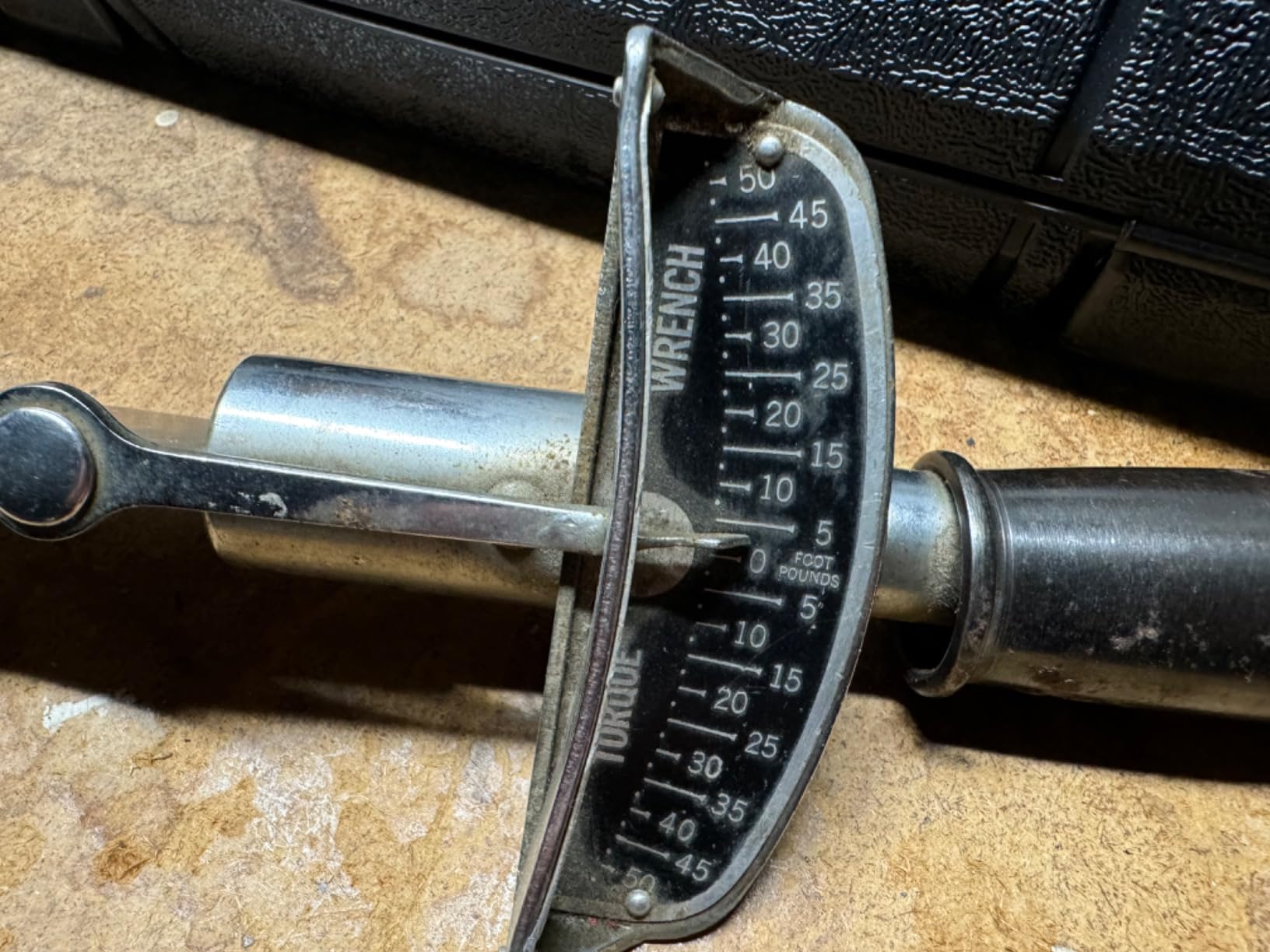
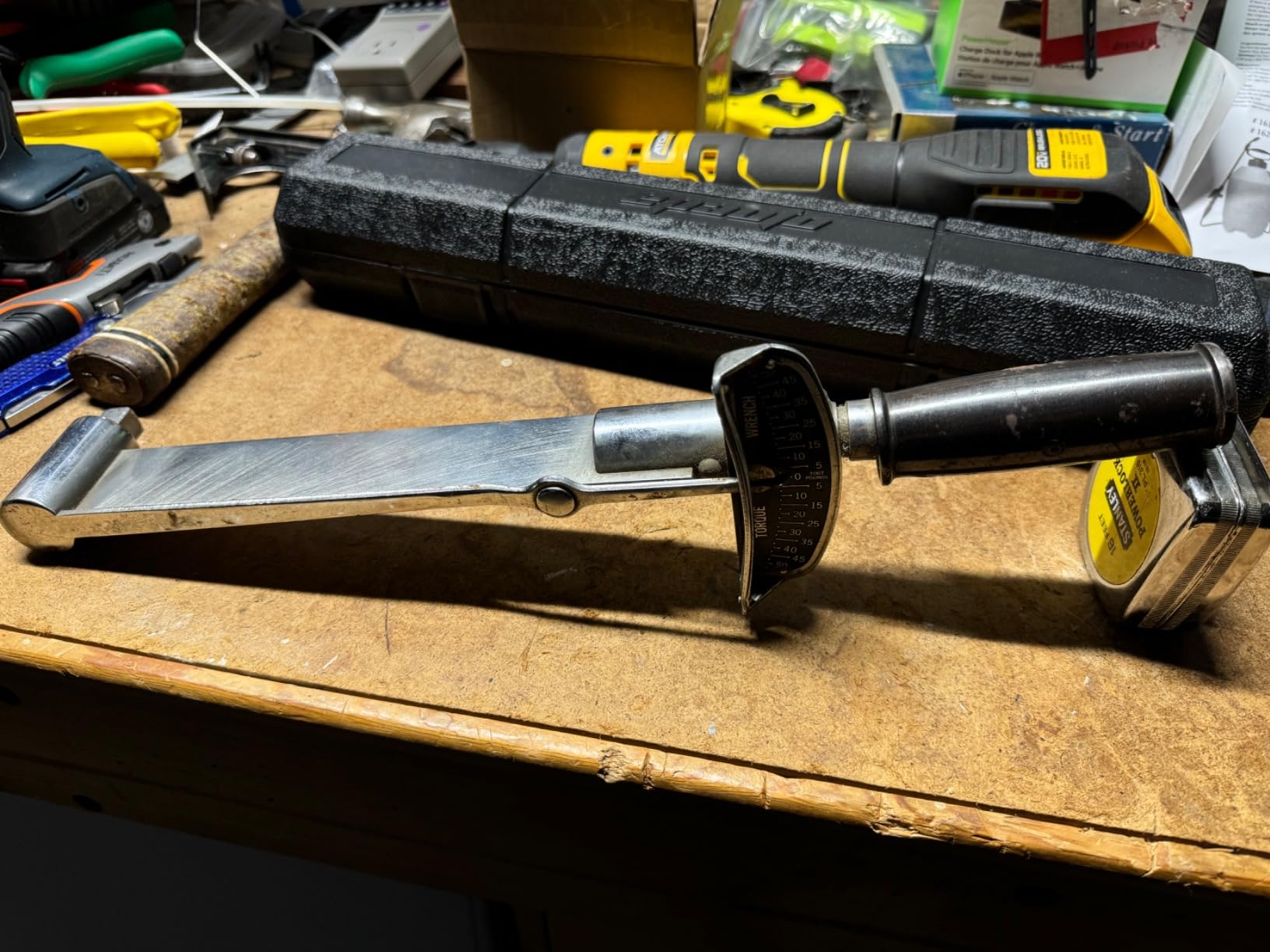
Beam wrenches flex a calibrated handle against a pointer and scale. They are simple, they are often treated as a reference tool to cross-check a click wrench, and reading them under load is slower and less precise. A digital torque wrench uses a strain gauge and a display with audible, vibrating or flashing alerts, and it shows you the number as you pull. It is the most accurate option here and the only one that can measure counter-clockwise, and it is also the only one with battery behaviour to manage.
Preset torque keys are a fourth category and they are bike-specific. They cap at a fixed value, which is fine for stems and seat posts, and they are not a substitute for a wrench when a specification changes. The kit in slot eight is the closest thing to this in our picks, though it is adjustable rather than preset.
Which drive size do you need?
The square drive size dictates which sockets fit and roughly how much torque the tool can carry. A 1/2-inch drive is the everyday answer for a car, because most of your socket set is built around it and it handles lug nuts, hubs and suspension. A 3/8-inch drive covers the engine bay below 80 ft-lb, where spark plugs, drain plugs and valve cover bolts live, and its shorter body fits tighter spaces. A 1/4-inch drive is for inch-pound work on trim, sensors, and bike or motorcycle hardware.
The most common regret in owner threads is buying one wide-range wrench and then finding it useless for small bolts. A wide range sounds generous, but accuracy at the very bottom of a wide scale is not what the tolerance claim is really covering.
Our guide to the best impact wrenches covers the other half of wheel work, since removing a seized lug nut and torquing it to spec are two different jobs needing two different tools.
Torque ranges and units: reading the scale correctly
One foot-pound equals 12 inch-pounds, and roughly 1.36 Newton-metres. That is the whole conversion table, and it is enough to read most service manuals without confusion.
Match the range to the job, not the other way round. A 10 to 150 ft-lb wrench is ideal for wheel and brake work. A 25 to 250 ft-lb wrench covers truck and trailer hub and axle fasteners that a 150 ft-lb ceiling cannot reach. A 10 to 80 ft-lb 3/8-inch wrench handles the low-torque engine work. An inch-pound wrench at 10 to 230 in-lb handles bicycle components and nothing automotive.
Watches go both ways on units. The Amazon Basics 3/8-inch listing explicitly recommends setting metric values on the imperial scale, where 1 Nm equals 8.86 in-lb, because the decimal Nm markings on some of these tools are hard to dial in precisely.
The counter-clockwise warning almost nobody checks
Nine of the ten wrenches in this roundup measure torque clockwise only. That is not a defect; it is the standard for mechanical click wrenches at this price. But it does mean they cannot report torque on a left-hand-threaded fastener, which appears on some vehicles, imported hardware and certain steering and suspension components.
Read the listing carefully for a second trap too. A reversible ratchet head means the tool drives in both directions. It does not mean it measures in both directions. Several of the wrenches here have reversible heads and clockwise-only measurement, and that distinction is easy to misread.
Better to buy two or three wrenches than one wide-range model
This is the single most useful piece of advice we can give inside a 100 dollar budget. A 1/2-inch 10-150 ft-lb wrench, a 3/8-inch 10-80 ft-lb wrench and a 1/4-inch inch-pound wrench together cost less than one premium wide-range wrench, and between them they cover everything a car or a bike will ask of you.
Pick combinations based on the gaps. If you are starting from nothing, a 1/2-inch 10-150 ft-lb plus a 3/8-inch 10-80 ft-lb covers the overwhelming majority of home garage work. Add a 1/4-inch inch-pound set only if you do bikes, e-bikes, motorcycles or interior trim.
If you drive a truck or tow anything, swap the second wrench for a 25-250 ft-lb model instead, because axle and hub fasteners will not fit inside a 150 ft-lb ceiling. For fitting jobs, our best impact wrenches for lug nuts guide covers removal, and cordless impact wrench picks cover getting the fastener out before you ever think about torque.
How to check a cheap torque wrench at home
You cannot replace a calibration bench, but you can catch a wrench that arrived badly out of spec. Method one is a two-wrench comparison. Set your click wrench to a value, tighten a bolt with it, note the angle on your phone, then back the bolt out with a second click wrench. If the second wrench breaks over at a very different point, one of the two is lying to you.
Method two is the known-weight test, and the arithmetic is simple. Torque equals force multiplied by lever arm. Hang a 20 pound weight on a 24 inch arm and you are applying 40 ft-lb. Hang it on 12 inches and you are at 20 ft-lb. Attach a socket to the drive, pull steadily, and note where the click falls. It is crude, but it catches a wrench that is wildly wrong.
Whatever method you use, test at several points in the range rather than one. A tool can be accurate in the middle and drift at the ends, and a single test tells you almost nothing about that.
How to tighten a bolt properly and keep the tool calibrated
Torque wrenches are calibrated tools, and almost all early calibration loss comes from misuse rather than wear. Seven steps cover it.
First, clean the threads and make sure the fastener is seated before you apply any torque, because the clamping force depends on friction at the threads. Second, run the fastener in by hand until it is properly engaged. Third, set the target value and lock the collar. Fourth, pull smoothly in one steady motion. Fifth, stop at the first click and do not go past it. Sixth, wind the collar back down to the lowest setting after every job. Seventh, never use the wrench to break a fastener loose.
That last rule is the one owners break most often and regret most. Using a torque wrench to loosen a seized bolt can damage the ratchet mechanism, and the internal damage is not always visible until the tool starts breaking over at the wrong value. Break fasteners loose with a breaker bar, a cheater bar or an impact wrench, then torque them properly.
On the recalibration interval, the common guidance is to treat any click wrench as needing service or replacement every 5,000 cycles or 12 months, whichever comes first, and to recalibrate immediately after a drop, a bend or a suspected overload.
Frequently Asked Questions
Are cheap torque wrenches any good?
Yes, for the jobs they are sold for. Every click wrench in this roundup is pre-calibrated at plus or minus 4 percent, the industry baseline, which at a 100 ft-lb setting means a break-over anywhere between 96 and 104 ft-lb. That is comfortably inside the 80 to 100 ft-lb band most passenger car lug specifications call for. Budget wrenches are suitable for wheels, brakes, suspension, spark plugs and drain plugs. They are not suitable for torque-to-yield head bolts.
What is the best value-for-money torque wrench?
For most home mechanics the EPAuto 1/2-Inch Drive Click Torque Wrench covering 10-150 ft-lb is the best value. It holds a 4.6 star average across more than 23,000 ratings, ships pre-calibrated at plus or minus 4 percent, has a hardened Chrome Vanadium steel ratchet head, and includes a 5-inch extension bar and a storage case. No wrench in this roundup offers more verified owner history at this price tier.
How accurate is a click-type torque wrench?
Factory accuracy for the click wrenches in this roundup is plus or minus 4 percent, with the bike kit rated at plus or minus 3 percent and the digital wrench at 2 percent clockwise and 3 percent counter-clockwise. The widest gap between rated and actual tends to appear at the extreme ends of the scale, which is why mid-range settings on a narrower-range wrench are the most trustworthy.
Do I need a 3/8-inch or 1/2-inch torque wrench?
Start with a 1/2-inch drive for wheels, brakes and suspension, since most socket sets are built around that size. Add a 3/8-inch drive at 10-80 ft-lb for spark plugs, drain plugs and valve cover bolts, which fall below the 1/2-inch range and need a smaller socket. Many owners end up owning both, and the pair covers almost all home garage work.
How often should a torque wrench be calibrated?
Treat any click wrench as due for service or replacement every 5,000 cycles or 12 months, whichever comes first. Recalibrate or replace immediately after a drop, a bend, or any suspected overload. The cheapest digital torque adapters can give you a reasonable spot check between service intervals, and any wrench that arrived with a serialized calibration certificate is far easier to deal with when a reading looks wrong.
Can you use a torque wrench to loosen bolts?
No, not as a matter of routine. Even when a manufacturer permits it, using a torque wrench to break a seized fastener can damage the ratchet mechanism, and internal damage often does not show up until the tool breaks over at the wrong value. Use a breaker bar, a cheater bar or an impact wrench to remove fasteners, then torque them to specification with the wrench.
What type of torque wrench is most accurate?
Digital electronic wrenches are the most accurate, and the ACDelco ARM601-4 here claims 2 percent clockwise accuracy with an individually serialized certificate of calibration traceable to NIST. Beam wrenches can be very accurate but are slower and harder to read under load. Click wrenches sit at plus or minus 4 percent, which is ample for wheels, brakes, suspension and most engine fasteners.
Which is better, a click-type or a digital torque wrench?
For most home and workshop work a click wrench is better, because it is faster, needs no batteries and cannot run out of power mid-bolt. A digital wrench is better when you want to watch the value, when you work on left-hand-threaded fasteners, or when a customer or documentation requires evidence of the torque used. Many mechanics keep a click wrench as the primary and a digital adapter for verification.
The Verdict
The best torque wrench under 100 dollars is the EPAuto 1/2-Inch Drive Click Torque Wrench, 10-150 ft-lb, because it puts the most verified owner history behind the most useful range in the category. It covers lug nuts, calipers, suspension and exhaust work on the drive size your sockets are already built around, and the included extension bar means you can use it immediately.
Buy the LEXIVON LX-183 instead if you want documented accuracy and a calibration certificate with a trackable serial number. Add the EPAuto 3/8-Inch 10-80 ft-lb for spark plugs and drain plugs, swap in the LEXIVON LX-184 if you own a truck or trailer, and choose the ACDelco ARM601-4 only when you need a live reading, counter-clockwise measurement or documented traceability. Whatever you pick, wind it down, never loosen with it, and check it against something else once a year.