
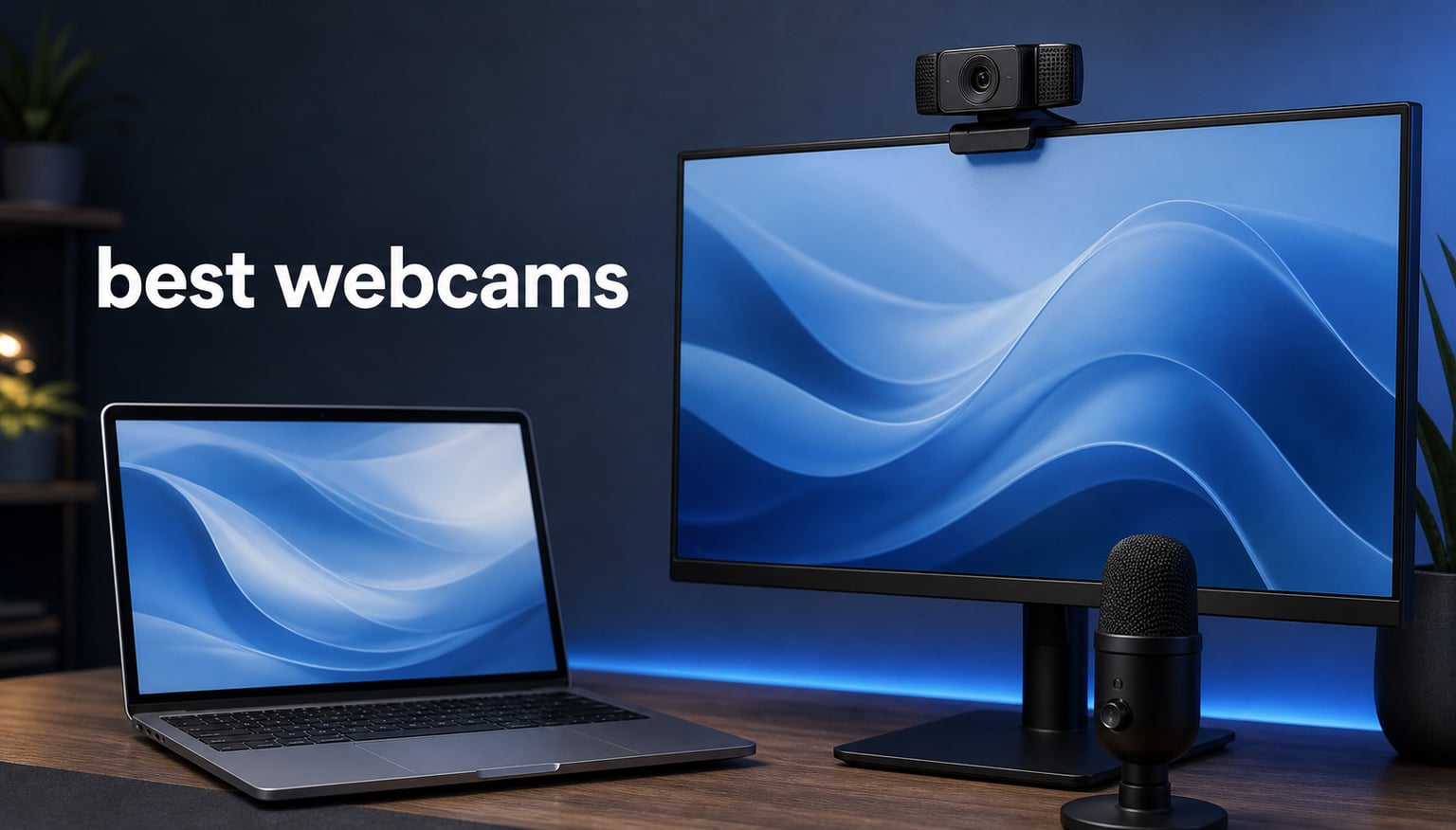
The best webcams make a laptop or desktop look more credible on calls without asking you to turn your office into a studio. An external webcam can bring sharper resolution, better auto exposure, a practical mount, and a privacy shutter to Zoom, Teams, gaming streams, or a job interview.
I built this guide around the details that change a real video call: sensor size, low-light behavior, autofocus, field of view, microphone design, and whether the camera can keep a moving presenter in frame. The product information and buyer-feedback patterns here cover 12 current USB webcams, from straightforward 1080p models to 4K PTZ cameras that pan and tilt themselves.
For a wider desk upgrade, pair a camera choice with one of our best laptops for working from home picks. If you use a business notebook, our guide to the best ThinkPads with 5MP webcams can also help you decide whether the built-in camera is enough.
Table of Contents
The top 3 picks answer most webcam needs
My clearest recommendations are the Insta360 Link 2 Pro for its larger sensor and physical tracking, the Anker PowerConf C200 for focused video calls with adjustable framing, and the Logitech Brio 101 for a basic, private 1080p setup. Pick the first for creator-level controls, the second for flexible meetings, and the third when plug-and-play simplicity matters most.
These best webcams in 2026 cover 12 different setups
The overview below is a fast way to narrow the list. Resolution does not decide image quality by itself, so I have included the features that affect framing, light handling, privacy, and on-camera movement.
| Product | Specifications | Action |
|---|---|---|
 Insta360 Link 2 Pro Insta360 Link 2 Pro |
|
See Details |
 Insta360 Link 2 Insta360 Link 2 |
|
See Details |
 OBSBOT Meet 2 OBSBOT Meet 2 |
|
See Details |
 OBSBOT Tiny 3 OBSBOT Tiny 3 |
|
See Details |
 Anker PowerConf C200 Anker PowerConf C200 |
|
See Details |
 Logitech Brio 101 Logitech Brio 101 |
|
See Details |
 OBSBOT Tiny 2 Lite OBSBOT Tiny 2 Lite |
|
See Details |
 Logitech MX Brio Logitech MX Brio |
|
See Details |
 Logitech Brio 105 Logitech Brio 105 |
|
See Details |
 Razer Kiyo V2 X Razer Kiyo V2 X |
|
See Details |
 Razer Kiyo V2 Razer Kiyo V2 |
|
See Details |
 AnkerWork C310 AnkerWork C310 |
|
See Details |
1. Insta360 Link 2 Pro is the strongest 4K tracking choice
Insta360 Link 2 Pro – 4K PTZ Webcam for PC/Mac, 1/1.3” Sensor, Low-Light, AI Tracking, HDR, Directional Noise-Canceling Mics, Supports Stream Deck, Zoom, Teams, Twitch for Streaming or Meetings
4K
1/1.3 inch sensor
PTZ tracking
Pros
- Large 1/1.3 inch sensor
- Physical AI pan and tilt
- Directional noise-canceling mics
- Desk and whiteboard modes
Cons
- No ARM Windows support
- No Windows Hello
- Digital zoom only
The Link 2 Pro is the best fit here when image quality in imperfect room light and active framing are both priorities. Its 1/1.3 inch CMOS sensor, f/1.9 aperture, HDR, and 4K output give it the strongest technical foundation in this roundup, while its motorized head follows a presenter instead of merely cropping the image.
I would point a solo creator, instructor, or frequent whiteboard presenter toward its DeskView, Whiteboard, and portrait modes. The 4K Portrait Mode and Stream Deck integration also make sense when a webcam is part of a repeatable production routine rather than an occasional meeting tool.
The Link 2 Pro works best in active presentations
Physical pan and tilt are the practical difference. AI Tracking can follow a speaker around a standing desk or a teaching space, and the directional noise-canceling microphones use beamforming to focus pickup more deliberately than a basic single-mic webcam.
Its natural bokeh option is a useful visual choice for a busy home office, but background separation should not replace placing a light in front of you. The sensor is the reason this model has a better chance of retaining detail as the room gets dimmer.
The Link 2 Pro has clear computer compatibility limits
Do not choose it for an ARM-based Windows computer, because that platform is listed as incompatible. It also does not work with Windows Hello face recognition, a meaningful omission for anyone who wants their camera to double as a secure sign-in device.
The camera relies on USB power from the computer and its 4x zoom is digital. Those are normal tradeoffs for a desk webcam, though they matter if you expect a cordless camera or optical zoom.
2. Insta360 Link 2 is the balanced 4K PTZ option
Insta360 Link 2 – PTZ 4K Webcam for PC/Mac, 1/2″ Sensor, AI Tracking, HDR, AI Noise-Canceling Mic, Gesture Control for Streaming, Video Calls, Gaming, Works with Zoom, Teams, Twitch & More
4K HDR
1/2 inch sensor
PDAF tracking
Pros
- 4K HDR image
- Fast PDAF autofocus
- AI tracking
- Automatic privacy tilt
Cons
- No ARM Windows support
- No Windows Hello
- USB powered
The standard Link 2 keeps the motorized tracking idea but uses a 1/2 inch sensor rather than the Pro model’s larger 1/1.3 inch sensor. It still records 4K, supports HDR, has phase-detection autofocus, and includes an AI noise-canceling microphone, which is a well-rounded list for calls and streaming.
Its privacy behavior is unusually thoughtful: it tilts down after 10 seconds of inactivity. That approach gives you a visible privacy state rather than asking you to remember a separate shutter after every call.
The Link 2 is strongest when focus speed matters
PDAF is designed for quick, crisp autofocus, so the Link 2 suits demonstrations where hands, an object, and a face move through the frame. AI Tracking, gesture control, smartphone control, DeskView, and Whiteboard modes add options without adding another camera.
For a remote tutor or a host who changes position, physical framing can look more natural than a digital crop. HDR also helps where a window or bright monitor creates a difficult exposure situation.
The Link 2 should be checked against your platform first
The same two limitations apply here: no ARM-based Windows support and no Windows Hello Face Recognition. Confirm your computer architecture before treating this as the simple plug-in choice.
The camera needs power through its USB connection, which is standard for this class. If a fixed position and a basic shutter are all you need, a less feature-heavy model may be easier to live with.
3. OBSBOT Meet 2 is the compact 4K creator camera
OBSBOT Meet 2-4K Webcam for PC with 1/2″ Sensor, AI Framing & Autofocus
4K
1/2 inch sensor
AI framing
Pros
- Only 40.5 grams
- 4K 60 FPS capability
- AI framing
- Gesture control
- Dual mics
Cons
- Can get warm
- Small body may limit mounting
The OBSBOT Meet 2 puts a 1/2 inch CMOS sensor, 4K resolution, HDR, AI framing, and gesture control into a body that weighs 40.5 grams. That compact size is a real advantage for a laptop lid or a travel kit where a heavy camera can make the screen tilt.
It also lists 60 FPS capability and dual omnidirectional noise-canceling microphones, so it has a clear role for livestreaming, gaming, and conversations where movement looks better at a higher frame rate. The Beauty Mode is available for people who prefer a processed presentation, though I favor starting with good front light before adding effects.
The Meet 2 fits travel and light laptop lids
A compact USB-C webcam is easier to pack and less likely to become a permanent desk fixture. Its landscape, portrait, and upside-down shooting modes give creators flexibility when a monitor mount is not the only place they record.
AI Framing can keep one person composed as they shift in their chair, while autofocus removes a common budget-webcam frustration. Community feedback repeatedly points to slow or inaccurate focus as an annoyance, making this a meaningful spec rather than decoration.
The Meet 2 needs breathing room during long sessions
Buyer feedback notes that the camera may get hot during use, described as normal behavior. That does not automatically signal a problem, but it is worth allowing open air around the camera during an extended stream.
The very small form factor may not suit every mounting arrangement. Check whether your display and tripod position give the lens a stable, eye-level view before choosing it purely for size.
4. OBSBOT Tiny 3 is the high-motion 4K PTZ pick
OBSBOT Tiny 3 AI-Powered Spatial Audio 4K Webcam, AI Tracking PTZ Camera
4K 30 FPS
1080p 120 FPS
PTZ tracking
Pros
- 1/1.28 inch sensor
- Tri-mic spatial audio
- 1080p 120 FPS
- Voice and gesture control
- Tracking modes
Cons
- Controls can act erratically
- No Wi-Fi or Bluetooth
The Tiny 3 is for a creator who wants a larger 1/1.28 inch sensor and AI tracking but also values 1080p at 120 FPS for exceptionally smooth motion. It records 4K at 30 FPS, has a compact motorized body, and offers both automatic and manual focus.
Its tri-mic system is positioned around spatial audio, with omnidirectional and directional microphone options. That is more ambitious than the microphones on many desk cameras, although anyone recording serious video should still think of a dedicated microphone as the safer audio upgrade.
The Tiny 3 suits movement-heavy streaming and demonstrations
AI Tracking 2.0 supports different targets, zone tracking, desk mode, and whiteboard mode. Voice and gesture control can be useful when your hands are busy with an item demonstration, instrument, or keyboard.
The wide ISO range of 0 to 12800 and DCG HDR are relevant for changing light. They give the camera more room to handle a dark corner or a bright background, but no webcam can fully correct a room lit only from behind.
The Tiny 3 rewards patient setup rather than hands-off operation
Some feedback reports erratic behavior when voice or gesture commands are used with gimbal movement. I would set a few stable presets in OBSBOT Center and test commands before using them in a live presentation.
There is no Wi-Fi or Bluetooth connectivity, so plan around a USB-C connection. That is not unusual for a webcam, but it rules out a wireless placement plan.
5. Anker PowerConf C200 is the practical meeting-camera value
Anker PowerConf C200 2K Webcam for PC/Laptop/Mac, Low-Light Correction
2K video
65 to 95 degree view
Privacy cover
Pros
- Sharp 2K video
- Adjustable field of view
- Low-light correction
- AI noise-canceling mics
- Privacy cover
Cons
- No 4K output
- Listed for laptop compatibility
- 2 MP still resolution
The PowerConf C200 makes the most sense for a webcam for Zoom or Teams when you need better-than-1080p detail but do not need tracking hardware. Its 2K video, autofocus, low-light correction, stereo microphones, and built-in privacy cover address the everyday problems that prompted many forum discussions.
The standout specification is its adjustable field of view: 65, 78, or 95 degrees. That range lets you frame a single face tightly, include a wider desk, or bring a second person into a call without moving the mount.
The C200 gives meeting users better control of framing
A 95-degree view is useful for a shared workspace, but it can reveal a cluttered room and make a single speaker look distant. I would begin at 65 or 78 degrees for one-on-one video conferencing and widen only when the meeting needs it.
Its dual microphones use AI noise cancellation, which can make a home office more manageable. Still, microphone quality is regularly criticized in user discussions, so use a headset or external mic for client recordings and streams where audio carries the message.
The C200 is a meeting camera rather than a 4K creator tool
The C200 delivers 2K rather than 4K, and its still resolution is listed at 2 MP. That is completely adequate for clear video calls, but it leaves less flexibility for cropping and detailed YouTube recording.
Its compatible-device listing says laptop, so verify your intended computer and software before purchase. The physical privacy cover is a strong reason to choose it when camera security is a daily concern.
6. Logitech Brio 101 is the simple private 1080p choice
Logitech Brio 101 Full HD 1080p Webcam for Streaming and Meetings – Black
1080p
RightLight balance
Integrated shutter
Pros
- Straightforward plug and play
- RightLight brightness balance
- Privacy shutter
- Built-in mic
- Logi Options controls
Cons
- Fixed focus
- USB-A only
- 60 degree field of view
The Logitech Brio 101 is the answer for a desktop user who wants a straightforward 1080p webcam with a physical shutter. It uses USB-A, has fixed focus, a 60-degree field of view, a built-in microphone, and RightLight auto-light balance that Logitech says can boost brightness by up to 50%.
It is also compatible with Nintendo Switch 2 GameChat mode, making it relevant to casual console users as well as remote workers. The recycled-plastic construction is a nice material detail, but the practical value is that the camera is easy to connect and frame.
The Brio 101 works best for a single seated speaker
A 60-degree view and fixed focus favor a predictable setup: sit at the same distance, keep one person in the shot, and place light in front of the screen. That is a sensible formula for regular meetings and ordinary family calls.
The Logi Options+ app provides customizable zoom and framing. It is an accessible way to make minor adjustments, though it does not turn fixed focus into the fast subject handling that creators get from autofocus models.
The Brio 101 is limited by its fixed-focus USB-A design
Fixed focus can be a benefit when you never move, because it removes focus hunting. It is a limitation for showing a product close to the lens or moving between a chair and a standing position.
USB-A is common, but many newer laptops rely on USB-C ports. Check your computer ports and any adapter arrangement before treating this as a completely cable-free decision.
7. OBSBOT Tiny 2 Lite is the accessible 4K PTZ streamer
OBSBOT Tiny 2 Lite 4K Webcam for PC, AI Tracking PTZ Streaming Camera
4K 30 FPS
1080p 60 FPS
AI PTZ tracking
Pros
- 1/2 inch sensor
- Custom tracking areas
- Gesture control
- HDR
- Stream Deck support
Cons
- No Wi-Fi
- Some features removed in Lite version
The OBSBOT Tiny 2 Lite combines a 1/2 inch CMOS sensor with 4K at 30 FPS, 1080p at 60 FPS, HDR, and motorized AI tracking. It is a logical option for a webcam for streaming when you want motion-following composition without moving to the highest-tier PTZ models.
Its software support is notable: SDK, OSC, Stream Deck, and global hotkey support are listed alongside customizable preset positions. Those details matter more to a frequent streamer than another generic claim of “smart” tracking.
The Tiny 2 Lite helps streamers repeat their framing
Preset positions and customizable tracking areas can save time between a face camera, a desktop demonstration, and a wider shot. Upper-body and hand tracking are useful when you want the camera to respond to a particular kind of movement instead of every change in the room.
Gesture Control 2.0 handles target lock and zoom without opening an app. I would still set up presets before going live, since a predictable frame is preferable to relying on gestures in the middle of a broadcast.
The Tiny 2 Lite trades some premium features for a leaner package
There is no Wi-Fi, so the camera is designed around a USB-C computer connection. The Lite version also removes some streaming features, which is a reason to compare the exact control options you rely on before buying.
It remains a capable moving camera, but a stationary webcam can be the more sensible choice if every call happens at one desk. PTZ capability is most useful when you will actually change position.
8. Logitech MX Brio is the manual-control collaboration pick
Logitech MX Brio Ultra HD 4K Webcam Collaboration and Streaming – Graphite
4K 30 FPS
1080p 60 FPS
Show Mode
Pros
- 4K and 1080p 60 FPS
- Manual image controls
- Show Mode
- Dual beamforming mics
- Rotating privacy cover
Cons
- Larger body
- Premium category model
The MX Brio is a strong fit for a professional who wants 4K at 30 FPS or 1080p at 60 FPS plus control over ISO, shutter speed, tint, and vibrance. Logitech also lists auto exposure, auto white balance, noise reduction, and pixels 70% larger than its previous generation.
It is certified for Zoom, Microsoft Teams, Google Meet, and Streamlabs, which makes it easy to place in a mixed work-and-creator setup. The rotating privacy cover is more reassuring than a software toggle because its state is visible at a glance.
The MX Brio makes desk sharing more useful
Show Mode is designed for sharing desk work, making this camera appealing to designers, teachers, and people who frequently point to notes or objects. The dual beamforming microphones add a cleaner built-in option for regular calls.
For users who need strong visual tools beside a camera, see our laptops for graphic designers guide. A camera can improve your video, but display space and computer performance still shape a collaborative call.
The MX Brio asks for space and deliberate adjustment
The larger form factor needs a stable monitor edge or tripod position. Measure your screen clearance, especially if you use a shallow shelf or an ultrathin laptop lid.
Manual controls are a strength when you want repeatable color and exposure, but they also invite unnecessary tweaking. Start with automatic exposure and white balance, then change one setting at a time if your lighting stays consistent.
9. Logitech Brio 105 is the business-ready 1080p camera
Logitech Brio 105 Full HD 1080p Business Webcam with Auto-Light Balance
1080p
RightLight 2
Privacy shutter
Pros
- Autofocus
- RightLight 2
- Privacy shutter
- Google Meet certification
- Chromebook support
Cons
- USB-A only
- Limited review history
- No 4K
The Brio 105 is a basic business webcam that keeps the key workplace features: 1080p Full HD, autofocus, RightLight 2 balancing, a physical privacy shutter, and plug-and-play USB-A. It is certified for Google Meet, works with Chromebook, and supports Logitech Sync for remote deployment.
That last point makes it more relevant for an IT-managed fleet than a consumer-only webcam. It is also compact at 2.65 ounces, so it should be easier to standardize across laptop and monitor setups.
The Brio 105 fits managed workplace video calls
Google Meet certification and Chromebook compatibility help teams reduce setup uncertainty. Logitech Sync support can matter where an administrator needs oversight of a group of devices rather than a single home office.
Autofocus is a sensible improvement over the Brio 101’s fixed-focus design. For a worker who occasionally holds up paperwork or changes distance from the display, this can make calls look less fussy.
The Brio 105 is not the pick for content-heavy 4K work
This model is built around dependable 1080p video, not 4K capture or high-frame-rate streaming. That makes it a clean choice for office communication, but not the natural choice for a cropped YouTube shot or detailed product recording.
Its review count is much smaller than several other entries in this guide. I would value its stated business compatibility, but keep that smaller review history in mind when comparing it with long-established workhorse options.
10. Razer Kiyo V2 X is the smooth 1440p gaming camera
Razer Kiyo V2 X Webcam for Streaming and Meetings, 1440p 60 FPS, White
1440p 60 FPS
80 degree view
Autofocus
Pros
- 1440p at 60 FPS
- Fast autofocus
- Privacy shutter
- Tripod thread
- Synapse controls
Cons
- Lower 4.2 rating
- White finish may show dirt
The Kiyo V2 X targets a useful middle ground for gaming streams: 1440p at 60 FPS. That resolution and frame rate can look smoother than a 4K-at-30-FPS feed when you move frequently, and the camera adds autofocus, an 80-degree wide-angle lens, a built-in microphone, and a privacy shutter.
Razer Synapse offers customization, while the pivoting mount includes a tripod thread. This is useful for positioning a face camera above a side monitor or placing it on a small desk tripod instead of blocking the main display.
The Kiyo V2 X favors motion clarity for gaming
For a webcam for gaming, 60 FPS is often more practical than simply chasing the largest resolution. Viewers notice natural hand and head movement, and a 1440p stream can still provide a clean, detailed face camera.
It works with OBS, XSplit, Streamlabs, Discord, Zoom, and Teams, covering both game broadcasts and ordinary calls. If you are choosing a computer for that mixed use, compare our gaming laptops for streaming as well.
The Kiyo V2 X needs a realistic expectation of its rating
Its 4.2 rating is lower than the ratings on most of the cameras above, so it is not the safest broad recommendation. It earns its place because the 1440p 60 FPS specification, flexible mount, and privacy shutter match a specific gaming use case.
The white color may show dirt more readily than a darker body. That is small, but it matters when the camera stays visible in a carefully arranged streaming setup.
11. Razer Kiyo V2 is the 4K ultrawide streaming alternative
Razer Kiyo V2 Webcam for Streaming and Collaboration 4K 30Fps, Black
4K 30 FPS
Sony STARVIS
AI auto-framing
Pros
- Sony STARVIS sensor
- 4K recording
- AI auto-framing
- HDR
- Privacy cover
- Tripod mount
Cons
- Synapse may be needed
- Lower 4.2 rating
The Razer Kiyo V2 steps up to 4K at 30 FPS and 1080p at 60 FPS, using a Sony STARVIS sensor and a 93-degree ultrawide lens. It brings AI-powered auto-framing, HDR, low-light image enhancement, a privacy cover, and a tripod-ready pivoting mount.
The broad field of view makes it useful for a streaming desk with instruments, props, or a second person. It also works with OBS, XSplit, Discord, Zoom, and Teams, so its role does not stop at gaming.
The Kiyo V2 handles wide scenes with automatic framing
A 93-degree lens can include more of a room without requiring a second camera. AI face tracking and automatic framing can help keep a speaker positioned inside that larger view, while HDR aims to retain more contrast in mixed lighting.
Its one-click image enhancement manages exposure, white balance, and noise reduction. Those conveniences are helpful when you move between calls, though manual controls are preferable when you need an exactly repeatable look.
The Kiyo V2 may need software to reach its full feature set
Razer Synapse may be required for deeper customization, so download the software before a planned recording rather than discovering that requirement minutes before going live. Software and drivers are a recurring user concern across webcam brands.
Its 4.2 rating is another reason to compare it closely with the similar-spec alternatives here. Choose it for the STARVIS sensor, ultrawide framing, and Razer software fit, not merely because it says 4K.
12. AnkerWork C310 is the feature-rich 4K home-office pick
Pros
- 12 MP 4K video
- 1080p 60 FPS
- AI autofocus and framing
- Privacy cover
- Adjustable field of view
Cons
- Digital zoom only
- Lower 4.1 rating
The AnkerWork C310 is a capable feature set for a home office: a 12 MP 4K camera, AI autofocus, AI framing, dual-microphone AI noise canceling, adjustable field of view, and a built-in privacy cover. It also lists 1080p at 60 FPS HDR through USB 3.0 with YUV encoding.
Its 1/2.5 inch sensor and f/2.0 aperture are positioned for adaptive low-light performance. The 4.1 rating is lower than several competitors, so I see it as a fit for buyers who specifically want its combination of framing and privacy features rather than a universal default.
The C310 combines flexible framing with clear call priorities
AI framing can help keep you centered, and adjustable field of view lets you decide how much of the desk enters the shot. That is a useful pairing for hybrid work where one day is solo calls and the next includes a colleague at the same desk.
The camera’s dual microphones add noise-canceling support, but the same audio rule applies: an external microphone remains the better choice for polished voice recording. A better camera cannot correct distant, echoing speech.
The C310 is more useful at close desk distances than for zooming
It has digital rather than optical zoom, so move the camera physically closer for a tighter composition instead of relying on enlargement. Starting with 4K gives you more cropping flexibility, but it does not create extra lens reach.
The listed requirement for two AAA batteries is unusual for a webcam and should be confirmed in the product documentation if that affects your setup. Its privacy cover, autofocus, and adjustable view remain the more decision-relevant details.
Our assessment compares the specs that shape real video
We compared the supplied product specifications and buyer-feedback summaries across resolution and frame rate, sensor size and aperture where available, autofocus, auto exposure, white balance, low-light claims, field of view, privacy hardware, software controls, mounts, microphones, and stated compatibility. We did not present unverified hands-on testing as fact.
That approach matters because a spec sheet can overstate what changes your day-to-day call. Community discussions repeatedly flag grainy laptop cameras, poor low-light behavior, slow autofocus, driver issues, missing shutters, and disappointing onboard microphones, so these factors shaped our recommendations more than resolution alone.
For a professional video call, a camera should show your face cleanly, hold focus, fit your monitor, and stay private between calls. For streaming, I give more weight to 60 FPS, manual controls, software integration, tracking, and a tripod-ready mount.
The buying guide starts with your actual recording space
Resolution should match how much you crop and record
1080p is enough for routine video conferencing, interviews, and a fixed single-person shot. A 4K webcam is worth it when you record video, crop within the image, share a wider desk view, or want extra detail before a platform compresses the feed.
A higher number is not automatically a better image. A larger sensor, a capable lens, stable auto exposure, and front-facing light can have a bigger effect than moving from 2K to 4K in a dim room.
Sensor size and front light decide low-light results
When the room is dark, a larger sensor and a wider aperture can collect more light, which helps preserve facial detail and reduce noise. The Link 2 Pro’s 1/1.3 inch sensor, Tiny 3’s 1/1.28 inch sensor, and several 1/2 inch models have an advantage on paper over smaller-sensor alternatives.
Put a soft light in front of your face, slightly above eye level, and turn off bright light directly behind you when possible. This simple change helps auto exposure and white balance work with the camera instead of fighting a silhouette.
Field of view and mounts decide how natural the frame feels
Choose a narrower view for one person at a desk and a wider field of view for a shared meeting, an instrument, or a room demonstration. Adjustable options such as the C200’s 65, 78, and 95-degree settings are more flexible than a fixed lens.
Set the lens at eye level or a little above it, then leave enough cable slack that adjusting the screen does not pull the camera. A pivot mount with a tripod thread is useful for gaming screens and monitor arms where the top edge is crowded.
Autofocus and tracking matter only when you move
Fixed focus works well for a seated caller who remains in one place. Autofocus is better for product demos and frequent movement, while PTZ tracking earns its place for teachers, fitness instructors, presenters, and streamers who move around a space.
Tracking is not always better. If you are still at a desk, a stable frame is less distracting and a basic camera can be the calmer choice.
Microphones and privacy hardware solve different problems
Built-in mics are convenient, and beamforming or AI noise cancellation can reduce some background sound. For streaming, podcasts, or client-facing recordings, use a separate microphone or headset when voice quality matters; forums consistently report that webcam microphones are the first audio compromise.
A physical shutter or cover is more reliable as a habit because you can see whether the lens is blocked. The Link 2’s automatic tilt-down privacy mode is another useful option, but check whether you prefer a shutter you control manually.
A smartphone can be a better short-term camera alternative
A recent smartphone often has a better main camera than a basic laptop webcam. If your phone and computer support a webcam connection method, place the phone at eye level on a stable mount and use the rear camera for a clear temporary upgrade.
This route may be less convenient for long calls because it uses your phone and can affect battery life. A dedicated USB webcam is simpler when meetings, streaming, or recording are a regular part of your week.
The most common webcam questions have direct answers
What is the best webcam for video conferencing?
The Insta360 Link 2 Pro is the strongest overall choice for video conferencing when you need 4K, a large sensor, physical AI tracking, and directional microphones. The Anker PowerConf C200 is a focused alternative for calls because it combines 2K video, adjustable framing, low-light correction, and a physical privacy cover.
What are the best webcams for gaming?
For gaming, choose the Razer Kiyo V2 X when smooth 1440p at 60 FPS and a tripod-ready mount matter most. Choose the OBSBOT Tiny 2 Lite when AI tracking, 4K, 1080p at 60 FPS, and Stream Deck support suit your streaming workflow.
What is the best webcam for streaming?
The Insta360 Link 2 Pro is the best webcam for streaming in this guide because its 1/1.3 inch sensor, 4K output, physical AI tracking, DeskView, Whiteboard mode, and Stream Deck integration suit varied creator work. The OBSBOT Tiny 3 is a strong alternative when 1080p at 120 FPS and voice control are priorities.
What is the best budget webcam for streaming?
The Logitech Brio 101 is the basic streaming option for a fixed 1080p setup, with RightLight balance, a built-in microphone, and a privacy shutter. If you need smoother footage and autofocus, the Razer Kiyo V2 X provides 1440p at 60 FPS, though it has a lower rating than several alternatives.
Is a 4K webcam worth it?
A 4K webcam is worth it for recording, cropping, desk demonstrations, and wide shots where you want more detail. For ordinary calls at a fixed desk, a good 1080p or 2K model with front lighting, reliable focus, and a suitable field of view can look just as professional after video-call compression.
The best webcam is the one that fits your calls and space
For the best webcams in 2026, the Insta360 Link 2 Pro is my top all-around pick for creators and active presenters, the Anker PowerConf C200 is a sensible calls-first choice, and the Logitech Brio 101 covers simple private 1080p use. Start with your lighting and frame, then choose only the resolution, tracking, and software features you will genuinely use.
Before choosing, confirm computer compatibility, port type, monitor mount, and privacy preference. That short checklist will lead to a more useful camera than choosing based on a resolution label alone.