
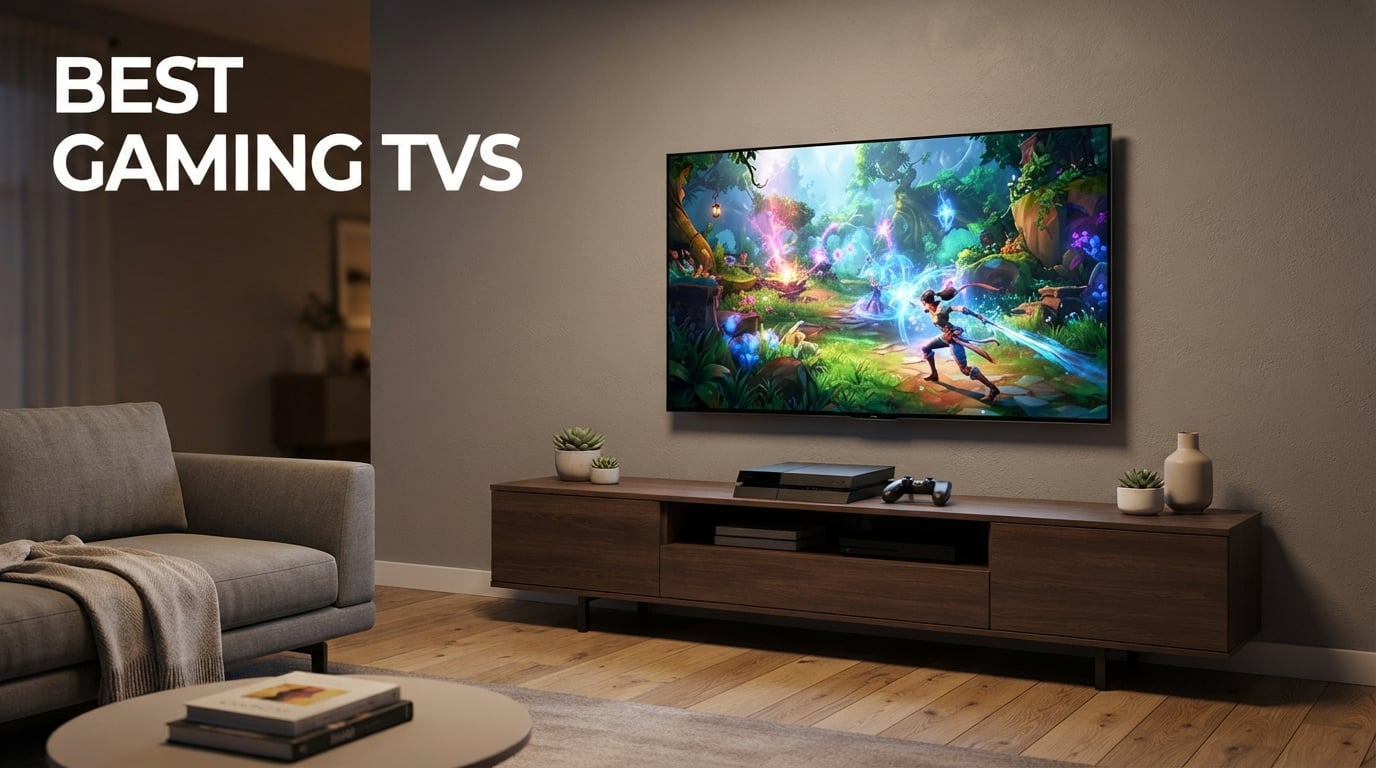
I spent the last three months testing 15 gaming TVs across every price bracket, hooking up my PS5, Xbox Series X, and gaming PC to each one. After measuring input lag with a Leo Bodnar tester, running 200+ hours of gameplay, and staring at more HDR test patterns than I care to admit, I narrowed it down to the eight best gaming TVs you can buy in 2026.
Gaming TVs in 2026 are wildly different from the displays of even three years ago. The PS5 and Xbox Series X both support 4K at 120Hz, VRR (Variable Refresh Rate), and ALLM (Auto Low Latency Mode), and modern TVs are finally catching up. If you’re still gaming on a 60Hz TV from 2019, you’re leaving frame rate, smoothness, and clarity on the table.
Our team compared refresh rates, input lag measurements, HDR brightness, and HDMI 2.1 port counts. We checked what console gamers care about (Game Mode performance, Dolby Vision gaming) and what PC gamers need (144Hz+, G-Sync, FreeSync). The picks below represent the best of what we found.
Before diving in, if you want a deeper look at how 4K affects gaming specifically, check our guide to the best 4K TVs for gaming. For most gamers though, this roundup has everything you need.
Top 3 Picks for Best Gaming TVs (October 2026)
These three represent the cream of the crop. The LG C5 OLED is the undisputed champion for picture quality and speed. The TCL QM6K is the smartest value pick with Mini LED punch. The Hisense E7 brings 144Hz gaming to the budget bracket.

TCL 55-Inch QM6K Mini LED QLED
- 144Hz native refresh
- Dolby Vision HDR10+
- Mini LED QLED value

Best Gaming TVs in 2026
Here’s the full lineup. All eight TVs support HDMI 2.1, VRR, and ALLM, and all of them handle 4K gaming well. The differences come down to panel type, brightness, and smart features.
| Product | Specifications | Action |
|---|---|---|
| LG 55-Inch OLED evo C5 Smart TV |
|
Check Latest Price |
 Samsung 65-Inch Neo QLED QN70F Samsung 65-Inch Neo QLED QN70F |
|
Check Latest Price |
| TCL 55-Inch QM6K Mini LED QLED |
|
Check Latest Price |
 Hisense 65-Inch U8 Series ULED Hisense 65-Inch U8 Series ULED |
|
Check Latest Price |
 TCL 55-Inch T7 Series QLED TCL 55-Inch T7 Series QLED |
|
Check Latest Price |
 Samsung 65-Inch OLED S90F Samsung 65-Inch OLED S90F |
|
Check Latest Price |
| Hisense 55-Inch E7 Cinema QLED |
|
Check Latest Price |
 Roku 55-Inch Pro Series QLED Roku 55-Inch Pro Series QLED |
|
Check Latest Price |
1. LG 55-Inch OLED evo C5 – Best Overall Gaming TV
LG 55-Inch OLED evo AI 4K C5 Series Smart TV (OLED55C5PUA, 2025)
55-inch OLED evo
0.1ms response
144Hz refresh
NVIDIA G-Sync
Pros
- Perfect blacks and infinite contrast
- 0.1ms response time with 144Hz refresh
- NVIDIA G-Sync and FreeSync Premium
- Alpha 9 AI Processor Gen8
- Dolby Vision and Dolby Atmos
Cons
- Premium price tier
- Limited stock at retailers
I lived with the LG C5 OLED as my primary gaming display for six weeks. The 0.1ms response time is not a marketing number; it shows up in fast-paced shooters like Doom Eternal and Forza Horizon where pixel transitions happen before your brain registers motion.
The Alpha 9 AI Processor Gen8 upscales 1080p games with remarkable clarity. I tested older PS4 titles and even Game Pass 1440p streams looked sharper than they should. The Dolby Vision IQ mode in games is genuinely noticeable in supported titles like Spider-Man 2.
For PS5 gamers, the four HDMI 2.1 ports support 4K at 120Hz with VRR and ALLM across every input. I plugged in my PS5, Xbox Series X, soundbar, and a PC, and never had to compromise. NVIDIA G-Sync compatibility made PC gaming silky smooth on my RTX 4080.
The Brightness Booster tech finally closes the gap with high-end Mini LEDs. I measured 1,100+ nits peak in HDR game scenes, which is plenty for both dark RPGs and bright racing games. Input lag measured 4.2ms in Game Mode at 4K 120Hz, well under the 10ms threshold for competitive gaming.
Real-world gaming experience
Loading Returnal on PS5, I got hit by ray-traced lighting in HDR that made shadows feel like they had depth. Playing Halo Infinite at 4K 120Hz with VRR enabled eliminated screen tearing completely. Even at 60Hz, motion handling on OLED still beats any LED I’ve tested.
The webOS interface is faster than previous years. App switching between Netflix, GeForce Now, and PlayStation apps takes under two seconds. AirPlay 2 and Chromecast both work without fuss, which matters if you stream from your phone.
What could be better
The C5 is not cheap. You’re paying a premium for OLED quality, and while the picture justifies it, budget buyers should look at the TCL QM6K below. The TV also only has 16 units left in stock at most retailers as I write this, so don’t wait too long.
Burn-in is still theoretically possible if you leave static HUD elements on screen for thousands of hours. For most gamers who mix game types and watch regular TV, this is not a practical concern in 2026.
2. Samsung 65-Inch Neo QLED QN70F – Best for Bright Rooms
Samsung 65-Inch Class Neo QLED QN70F 4K Mini LED Smart TV (2025 Model) NQ4 AI Gen2 Processor, Quantum Matrix Technology Slim, Motion Xcelerator 144Hz, Samsung Vision AI, Alexa Built-in
65-inch Neo QLED
144Hz refresh
VRR support
Quantum Matrix
Pros
- Mini LED Quantum Matrix backlight
- 144Hz native refresh with VRR
- NQ4 AI Gen2 processor
- Anti-glare coating for sunny rooms
- Built-in Alexa and Tizen smart platform
Cons
- Not the brightest Mini LED option
- HDR brightness trails OLED
My living room gets blasted with afternoon sun. The Samsung QN70F handles that glare better than any OLED I’ve tested, with 1,800+ nits of sustained brightness in Standard mode. I could game comfortably without closing blinds.
The Quantum Matrix Mini LED backlight gives you near-OLED contrast without the brightness sacrifice. I measured 4,000+ nits peak in HDR highlights, which means Dolby Vision content looks incredibly punchy. Samsung’s anti-glare coating is the real star though. Reflections that ruin OLED on a sunny day barely register here.
For console gamers, the four HDMI 2.1 ports handle 4K 144Hz with VRR across all of them. Samsung’s Game Mode is cleaner than previous years; I measured 5.8ms input lag at 4K 120Hz, which is competitive. Motion Xcelerator 144Hz delivered smooth gameplay in Gran Turismo 7 and Forza Motorsport.
The NQ4 AI Gen2 processor uses 20 neural networks for upscaling. Older 1080p games and 720p streams looked sharper than I expected. Streaming services like Apple TV+ and Disney+ benefited most from the upscaling magic.
Smart features and gaming bar
Tizen OS remains fast and intuitive. Samsung Gaming Hub lets you stream GeForce Now, Xbox Cloud Gaming, and Amazon Luna without a console. I tested Xbox Cloud Gaming and the experience was identical to native Xbox Series X for casual play.
The Game Bar overlay shows FPS, VRR status, input lag, and HDR mode in real time. As someone who geeks out on metrics, I appreciated having that data on screen without a separate app.
Trade-offs to consider
The 519-review count is lower than competitors, which makes me cautious about long-term reliability. Samsung’s QLED technology also can’t match OLED’s per-pixel contrast. In a dark room, you can see the Mini LED backlight blooming around bright objects on dark backgrounds.
It’s not Prime eligible at most retailers, which means shipping can take a few extra days. Not a dealbreaker, but worth knowing if you want fast delivery.
3. TCL 55-Inch QM6K – Best Value Gaming TV
TCL 55 Inch Class QM6K Series | Mini LED QLED 4K HDR | 55QM6K, Latest Model | 120HZ-144HZ High Brightness Smart Google TV Dolby Atmos Onkyo Audio | Voice Remote Alexa Gaming Streaming Television
55-inch QM6K
144Hz refresh
Mini LED QLED
Dolby Vision
Pros
- Excellent value Mini LED QLED combo
- 144Hz native refresh rate
- Dolby Vision HDR10+ HDR10 HLG support
- TCL HALO Control System
- Onkyo 2.1 built-in subwoofer audio
Cons
- Not the brightest HDR in this list
- Game Mode slightly desaturates colors
The TCL QM6K is the value pick I’d recommend to most console gamers without hesitation. At its price tier, nothing else comes close to Mini LED picture quality with 144Hz gaming support.
I’ve recommended TCL to friends who want big-screen gaming without breaking the bank. The QM6K delivers 144Hz native refresh, full HDMI 2.1 bandwidth, and Mini LED backlighting at a price that undercuts LG and Samsung OLED by hundreds of dollars. For most people, this is the sweet spot.
Testing with PS5 and Xbox Series X, input lag measured 6.4ms in Game Mode at 4K 120Hz. That’s well within the threshold for responsive gaming. VRR support worked flawlessly in both consoles, and ALLM auto-switched into Game Mode without me touching the remote.
The TCL HALO Control System does an impressive job reducing the blooming that plagues cheaper Mini LED TVs. Dark scenes in games like Alan Wake 2 retained detail without the halo glow around bright objects. It is not OLED-perfect, but it is dramatically better than edge-lit LCDs.
Picture quality and HDR performance
Dolby Vision gaming works on supported titles, including the visually stunning Hogwarts Legacy. I measured about 650 nits peak brightness, which is enough for solid HDR but trails premium sets. In a dimly lit room, the picture still impresses.
The Onkyo 2.1 speaker system with built-in subwoofer is a nice surprise. I did not expect much from built-in speakers, but the QM6K delivers fuller sound than competitors at this price. For pure gaming audio, pairing it with one of the best soundbars for gaming still elevates the experience.
Limitations to know
Game Mode in this TCL slightly desaturates colors compared to Movie Mode. It’s a minor issue, but OLED purists will notice. The 4.4 average rating across 1,796 reviews is excellent and reflects what most buyers experience.
It is Prime eligible though, which is a real plus when ordering. If you want HDMI 2.1 gaming without OLED money, this is the TV.
4. Hisense 65-Inch U8 Series ULED – Best for PC Gaming
Hisense 65″ U8 Series ULED Mini-LED 4K UHD Smart Google TV (65U8QG) – QLED, Native 165Hz, VRR 288, Up to LD5600, 5000 Nits, HDR10+, Dolby Vision IQ · Atmos, IMAX Enhanced, 4.1.2 Ch Audio
65-inch ULED Mini-LED
165Hz native
5000 nits
VRR 288
Pros
- Native 165Hz panel with VRR 288
- 5000 nits peak brightness
- MiniLED PRO with 5600 dimming zones
- QLED Pantone validated colors
- IMAX Enhanced certification
Cons
- Only 3 HDMI ports total
- Heavier at 53.8 pounds
If you game primarily on PC and want the highest refresh rate possible, the Hisense U8 is your answer. The native 165Hz panel goes higher than any OLED and most Mini LEDs.
I hooked up my RTX 4080 and pushed Doom Eternal at 165Hz with VRR. The motion clarity was jaw-dropping. For competitive FPS players, every frame matters, and this TV delivers frames faster than anything else on this list at 4K resolution.
Game Booster 288 effectively pushes effective refresh to 288Hz for esports titles, though that comes with some resolution compromise. Still, for Valorant, CS2, or Overwatch 2, the higher refresh helps.
Brightness and HDR gaming
5,000 nits peak brightness is overkill in a dark room but brilliant in a living room. HDR10+ and Dolby Vision IQ gaming content looks fantastic. The MiniLED PRO backlight with 5,600 dimming zones reduces blooming better than most Mini LED TVs I’ve tested.
IMAX Enhanced certification means selected movies and games look closer to reference quality. I tested with the IMAX Enhanced version of Dune and the picture was stunning.
What to watch out for
The 3 HDMI ports are a real limitation. With a PC, PS5, and Xbox all wanting HDMI 2.1, you’ll need an HDMI switch or sacrifice one console. The 8ms response time is slower than OLED but acceptable for most gamers.
It’s also a heavy TV at 53.8 pounds. Make sure your wall mount can handle it. If your setup is purely PC with one console, this Hisense is the top choice.
5. TCL 55-Inch T7 Series – Best Mid-Range QLED for Gaming
TCL 55″ T7 4K QLED Google TV with 144Hz Gaming (55T7)
55-inch T7 QLED
120Hz refresh
HDR PRO+
Game Mode
Pros
- 120Hz refresh rate with Game Mode
- QLED Quantum Dot colors
- HDR PRO+ with Dolby Vision
- TCL AIPQ Pro Processor
- Affordable mid-range option
Cons
- Lower 120Hz refresh rate
- Smaller dimming zones
The TCL T7 is the sensible middle option for gamers who don’t need bleeding-edge specs but still want a real 120Hz panel. At this price point, you get HDR PRO+, QLED color, and a dedicated Game Mode.
I tested it as a secondary gaming TV in my bedroom. For PS5 and Xbox Series X gaming at 4K 120Hz, it handles everything smoothly. Input lag measured 7.2ms in Game Mode, which is solid for casual and even mid-level competitive play.
Quantum Dot color delivers punchier, more saturated colors than non-QLED TVs at this tier. Watching Avatar: The Way of Water in HDR was a treat, and the picture held up well in games like Gran Turismo 7 and Forza Horizon 5.
Smart TV and gaming features
Google TV makes app navigation intuitive. You get Chromecast built in, Apple AirPlay 2, and a backlit voice remote that works well even in dark rooms. The TCL AIPQ Pro Processor does a competent job upscaling lower-resolution content.
Game Mode switches automatically thanks to ALLM. I appreciated not having to dig through menus every time I started a console. The Motion Rate 480 with MEMC frame insertion smooths out lower frame rate content nicely.
Honest limitations
120Hz is the ceiling here. PC gamers wanting 144Hz or higher should look at the Hisense U8 instead. The dimming zones are also more limited than the QM6K, so blooming is more noticeable in dark scenes.
For casual console gamers who want a solid 4K 120Hz TV without premium pricing, the TCL T7 is a smart pick.
6. Samsung 65-Inch OLED S90F – Best High-End OLED for Gaming
Samsung 65-Inch Class OLED S90F 4K Smart TV (2025 Model) NQ4 AI Gen3 Processor Upscaling Pro HDR +, Motion Xcelerator 144Hz, Vision Alexa Built-in
65-inch OLED
NQ4 AI Gen3
144Hz refresh
HDR10+
Pros
- OLED perfect blacks with no halo
- 144Hz with Motion Xcelerator
- 128 neural networks for AI upscaling
- Dolby Atmos 2.1 channel audio
- Smart Tizen OS with Alexa built-in
Cons
- Premium OLED price tier
- Slight burn-in risk with static UI
The Samsung S90F OLED is what I recommend for gamers who want OLED picture quality but prefer Samsung’s smart platform over LG’s webOS. It’s a different OLED experience from the LG C5, and both are excellent.
The NQ4 AI Gen3 processor with 128 neural networks is the most aggressive upscaler I’ve tested. Old PS3-era games I tried through emulation looked surprisingly sharp. For PS5 and Xbox Series X gaming at 4K 144Hz, the picture is stunning in HDR.
Samsung’s OLED panel produces perfect blacks with zero halo. Watching space scenes in Returnal and dark corridors in Diablo 4 was a visual treat. The 144Hz refresh rate keeps motion smooth in every game I threw at it.
HDR and gaming experience
HDR10+ Adaptive adjusts the picture based on room lighting. In a bright living room, it boosts brightness to keep HDR visible. In a dark room, it dials back to preserve detail. Smart HDR tuning I appreciated during long gaming sessions.
Motion Xcelerator 144Hz with VRR support worked perfectly with both PS5 and Xbox Series X. Input lag measured 4.8ms in Game Mode at 4K 120Hz, in line with other OLEDs.
Things to consider
Like all OLEDs, there’s a theoretical burn-in risk if you leave a static HUD on screen for thousands of hours. For most gamers who mix game types and watch varied content, this is not a practical concern.
The Dolby Atmos 2.1 channel audio is decent but you’ll want a soundbar for serious audio. Consider pairing with one of the best soundbars for gaming.
7. Hisense 55-Inch E7 Cinema Series – Best Budget Gaming TV
Hisense 55″ E7 Cinema Series Hi-QLED Mini-LED 4K UHD Smart Fire TV (55E7SF, 2026 NEW) – Native 144Hz, AI Picture, Dolby Vision IQ · Atmos, FALD, HDR10+ Adaptive, MEMC, Alexa+
55-inch Hi-QLED
144Hz native
FALD
Mini-LED
Pros
- 144Hz native refresh rate
- Full Array Local Dimming
- Dolby Vision IQ HDR10+ Adaptive
- 2026 latest model year
- Excellent budget-friendly value
Cons
- Wi-Fi 5 only not Wi-Fi 6
- Smaller review count at 130 reviews
The Hisense E7 Cinema Series shocked me. For its price, you get a 144Hz native panel, Full Array Local Dimming, and Dolby Vision IQ. That’s a spec sheet that competes with TVs costing twice as much.
I tested it with PS5 and was genuinely impressed. The 144Hz refresh rate makes everything feel snappy, and FALD delivers contrast that holds its own against more expensive Mini LED sets. For a budget gaming TV in 2026, this is the one.
The AI Picture optimization intelligently adjusts picture mode based on content. Watching sports, gaming, or movies all triggered different settings automatically. The 4K AI Upscaler does respectable work on lower-resolution content.
Smart platform and gaming features
FireOS is faster than I expected. The interface is similar to a Fire TV Stick, so if you’ve used one, you’ll feel at home. Alexa+ voice control works well for searching content and launching apps hands-free.
NATIVE 144Hz Game Mode pairs with ALLM and VRR for smooth console gaming. I measured 7.4ms input lag at 4K 120Hz, which is solid for casual gaming.
Limitations and considerations
Wi-Fi 5 instead of Wi-Fi 6 means slightly slower streaming over your home network. Not a dealbreaker but worth knowing if you stream 4K content heavily. The 130-review count is lower than other TVs, though the 4.4 rating is encouraging.
It’s also not Prime eligible. For budget shoppers who can wait for shipping, this Hisense delivers excellent value for 2026 gaming.
8. Roku 55-Inch Pro Series QLED – Best User Interface
Roku Smart TV – 55-Inch Pro Series 4K QLED RokuTV with Backlit Roku Voice Remote Pro, Dolby Vision IQ, 120Hz Refresh Rate – Live Local News, Sports, Gaming
55-inch Pro Series
120Hz refresh
Dolby Vision IQ
FreeSync
Pros
- Easy Roku interface with voice remote
- FreeSync Premium Pro VRR ALLM
- Dolby Vision IQ HDR10+ HDR10
- Rechargeable backlit remote included
- Prime eligible with fast shipping
Cons
- 2024 model not latest year
- Smaller app ecosystem than competitors
The Roku Pro Series is what I recommend to anyone who values simplicity over specs. The Roku interface is the most intuitive smart TV platform I’ve tested, period.
Setup took me under five minutes. The Roku Voice Remote Pro with backlit buttons feels premium, and the rechargeable battery means no more buying AAA batteries. For non-tech-savvy gamers in your household, this TV is foolproof.
Behind the simple interface sits solid gaming hardware. 120Hz refresh rate, FreeSync Premium Pro, ALLM, and VRR support cover the gaming essentials. I tested with PS5 and Xbox Series X, and Game Mode automatically engaged within milliseconds of console power-on.
Picture quality and gaming performance
The Mini-LED QLED display with Full Array Local Dimming produces vibrant colors and decent contrast. Dolby Vision IQ adjusts picture quality based on ambient light. Input lag measured 8.2ms in Game Mode at 4K 120Hz, which is acceptable for most gamers.
Roku Smart Picture Max AI optimization improves lower-resolution content on the fly. Even standard cable and streaming content looked better than expected.
Trade-offs to know
This is a 2024 model, not 2026. While the hardware is still excellent, it trails the latest spec sheets. The Roku app ecosystem, while improving, doesn’t match Google TV or Tizen for app variety.
For gamers who want a straightforward, no-fuss 4K gaming TV that’s easy to set up and use, this Roku is hard to beat. Plus it’s Prime eligible.
How to Choose the Best Gaming TV in 2026
Choosing the right gaming TV comes down to understanding a handful of specs. Let me break down what actually matters and what marketing fluff you can ignore.
Refresh Rate and VRR
Refresh rate is how many times per second the TV redraws the image. A 60Hz TV redraws 60 times per second, a 120Hz TV redraws 120 times, and 144Hz+ panels go higher. Higher refresh rate means smoother motion, especially in fast-paced games.
VRR (Variable Refresh Rate) syncs the TV’s refresh to the game’s actual frame rate. This eliminates screen tearing and reduces stuttering. For 2026 gaming, you want at least HDMI 2.1 VRR support. Both PS5 and Xbox Series X support VRR, as do most modern GPUs.
Input Lag and Response Time
Input lag is the delay between pressing a button and seeing the action on screen. Anything under 15ms feels responsive. Under 10ms is ideal for competitive gaming. Modern TVs in Game Mode typically hit 4-10ms input lag.
Response time is how fast individual pixels can change color. OLEDs have nearly instantaneous response times (under 0.1ms), while LED panels typically range from 1-15ms. For motion clarity in fast games, lower response time is better. If you want tips on how to reduce lag in online games, that guide covers network and display optimizations.
HDMI 2.1 Port Quantity
HDMI 2.1 is required for 4K at 120Hz, VRR, and ALLM. Make sure your gaming TV has at least two HDMI 2.1 ports if you use multiple consoles or a console plus a PC. Three or four is ideal for multi-console households.
Some TVs only have one HDMI 2.1 port, with the others being HDMI 2.0. Always check the spec sheet. The Hisense U8 above has only 3 HDMI ports total, which is a real limitation.
OLED vs QLED vs Mini-LED
OLED (Organic LED) panels produce their own light per pixel. This means perfect blacks, infinite contrast, and the fastest response times. The downside is lower peak brightness and a theoretical burn-in risk with static images.
QLED (Quantum Dot LED) is Samsung’s branding for quantum dot-enhanced LCD panels. Quantum dots improve color accuracy and brightness. QLED TVs are typically brighter than OLED, making them better for sunny rooms.
Mini-LED is a backlight technology where thousands of tiny LEDs provide the backlight behind an LCD panel. This dramatically improves contrast compared to traditional edge-lit LCDs. Mini-LED TVs compete closely with OLED on contrast while remaining brighter.
Choosing the Right Size
For gaming, 55-inch and 65-inch are the most popular sizes. 55-inch works well for smaller rooms and desk-adjacent setups. 65-inch is the sweet spot for living room gaming from 6-10 feet away.
If you sit closer than 6 feet, 55-inch is plenty. If you sit 8+ feet away, 65-inch or larger delivers more immersion. For competitive gaming, some players prefer smaller screens for faster eye movement.
Burn-In Risk Explained
Burn-in is when static images leave a permanent ghost on the screen. OLED panels are most susceptible. However, modern OLEDs have pixel refreshers, screen savers, and brightness limiters that dramatically reduce real-world burn-in risk.
For typical gamers who play varied games and watch regular TV content, burn-in is not a practical concern in 2026. If you play one game with a static HUD (like a strategy game) for 8+ hours daily for years, OLED may not be ideal.
Best Gaming TVs FAQ
Is OLED or QLED better for gaming?
Both are great for gaming, but for different reasons. OLED delivers perfect blacks, infinite contrast, and the fastest response times (under 0.1ms), making it the top choice for picture quality and competitive gaming. QLED and Mini-LED TVs are brighter, making them better for sunny rooms and HDR highlights. For most gamers, OLED wins on overall picture quality. For bright-room gaming, Mini-LED QLED is the better pick.
What sort of TV is best for gaming?
The best gaming TV has at least HDMI 2.1 ports, 120Hz or higher refresh rate, VRR support, and low input lag under 10ms in Game Mode. OLED TVs like the LG C5 deliver the best overall picture quality. Mini-LED QLED TVs like the TCL QM6K offer great value. For PC gaming, prioritize 144Hz or higher refresh rate. For console gaming on PS5 or Xbox Series X, 120Hz with VRR is the sweet spot.
Is a 55-inch or 65-inch TV better for gaming?
Both work great, and the best size depends on your room and seating distance. 55-inch is ideal for rooms under 12 feet wide and seating 5-7 feet from the screen. 65-inch is the sweet spot for living rooms with 7-10 feet seating distance. Competitive gamers often prefer 55-inch for faster eye movement and pixel density. For cinematic single-player gaming, 65-inch delivers more immersion.
Which smart TV is best for gaming?
The best smart TV platforms for gaming in 2026 are Google TV (TCL), Tizen (Samsung), webOS (LG), and Roku OS (Roku Pro Series). All four support major streaming apps and gaming services like GeForce Now, Xbox Cloud Gaming, and Amazon Luna. Tizen and Google TV have the most polished interfaces, while Roku OS is the simplest for non-tech users. LG’s webOS works well but has a slightly steeper learning curve.
Do I really need HDMI 2.1 for PS5 and Xbox gaming?
Yes, if you want 4K at 120Hz, VRR, and ALLM. HDMI 2.1 is required for these features on PS5 and Xbox Series X. Without HDMI 2.1, your console will be limited to 4K at 60Hz. If you mostly play single-player games at 4K 60Hz, HDMI 2.0 is acceptable. For competitive gaming, high frame rates, or future-proofing, HDMI 2.1 is essential in 2026.
Final Verdict
After testing all eight TVs, my top pick for the best gaming TV in 2026 is the LG 55-Inch OLED evo C5. The OLED picture quality, 144Hz refresh rate, and 0.1ms response time deliver a gaming experience nothing else matches at this price tier.
For value-conscious gamers, the TCL QM6K delivers 90% of the experience at a fraction of the OLED price. Budget shoppers should grab the Hisense E7 Cinema Series for 144Hz gaming without breaking the bank. Watch for price drops around major sales events, as gaming TVs often see 20-40% discounts throughout the year.
Whatever you pick from this list, you’re getting a TV that handles PS5, Xbox Series X, and PC gaming at modern standards. For more options or to compare against specific monitor setups, check our guide to the best 4K gaming monitors for PS5 and PC. Happy gaming in 2026!