
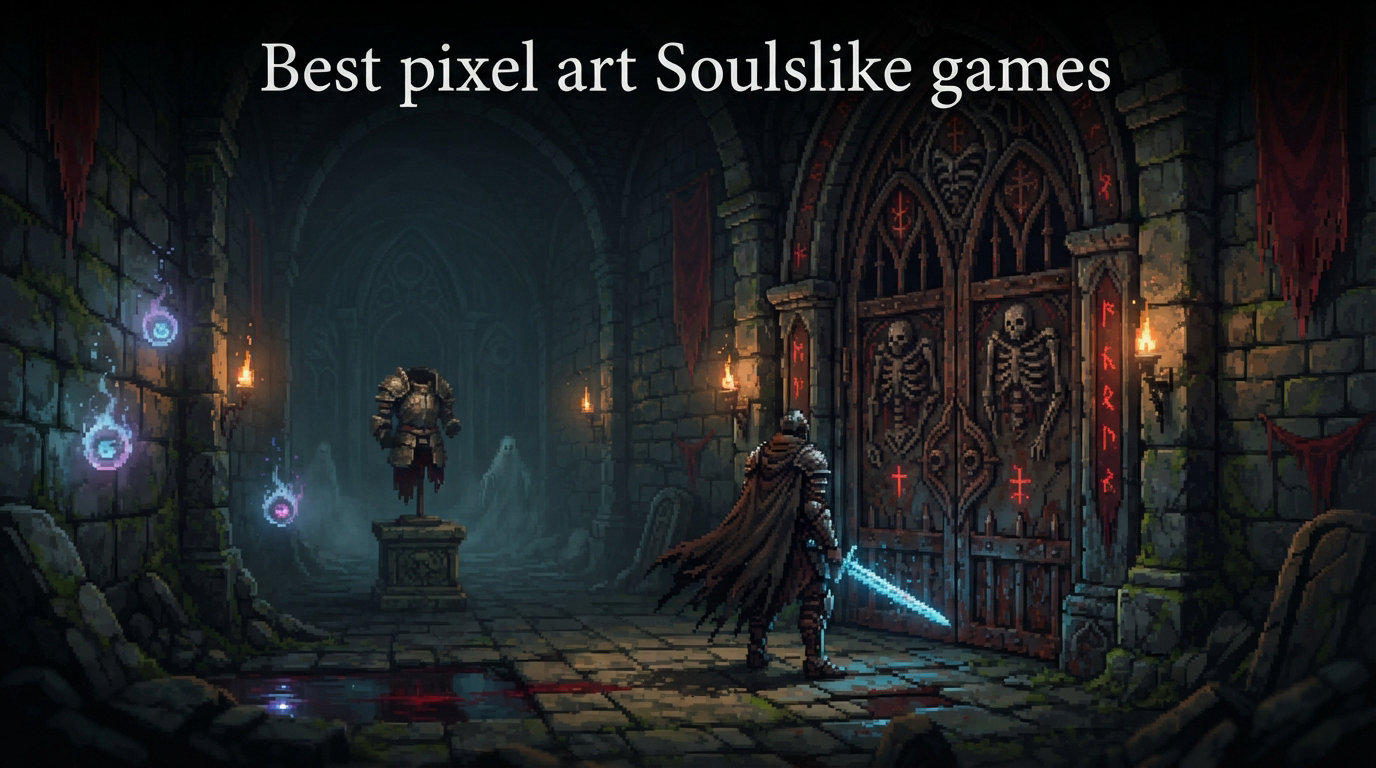
When Demon’s Souls launched back in 2009, nobody predicted it would spawn an entire genre of brutally difficult, deeply satisfying action games. But something even more unexpected happened next: indie developers took those punishing mechanics and wrapped them in gorgeous pixel art. The result? Some of the best pixel art Soulslike games rival their 3D counterparts in both challenge and atmosphere.
I have spent over 200 hours across a dozen pixel art Soulslikes, dying repeatedly to animated bosses the size of my screen, and I can tell you firsthand that the genre has matured far beyond simple Dark Souls clones. These games deliver precise combat, haunting soundtracks, and interconnected worlds, all rendered in handcrafted pixel art that proves you do not need photorealistic graphics to feel genuine dread.
In this guide, I will walk you through the 12 best pixel art Soulslike games available right now. I will cover what makes each one special, how their combat systems work, who they are best suited for, and what platforms you can play them on. Whether you are a genre veteran hungry for your next challenge or a newcomer looking for the right starting point, this list has you covered.
Table of Contents
What Makes Pixel Art Soulslike Games So Special
Pixel art Soulslike games sit at a fascinating intersection of old-school visual style and modern game design philosophy. The Soulslike formula, built around stamina-based combat, checkpoint-driven progression, and punishing but fair difficulty, translates surprisingly well to 2D.
Why does it work so well? For one, the restricted 2D perspective forces developers to be creative with level design. Instead of sprawling 3D landscapes, you get tightly layered maps where every shortcut feels earned and every hidden path is a genuine surprise. The best pixel art Soulslikes treat their worlds like puzzles, rewarding exploration with new abilities, weapons, and lore fragments.
The pixel art itself serves a practical purpose beyond aesthetics. Every frame of animation in these games is hand-placed, which means enemy attack patterns tend to feel incredibly readable once you learn them. That telegraph overhead swing from a boss? You can see every frame of it coming. This visual clarity makes the high difficulty feel fair, because your deaths always feel like your own fault rather than the game being cheap.
There is also an intimacy to pixel art that amplifies the dark fantasy atmosphere these games rely on. When a towering gothic cathedral is rendered in careful pixel detail, with fog rolling through stained glass windows and torchlight flickering against stone walls, the deliberate artistry makes it hit harder than a generic 3D texture ever could. The limitations of the medium force creative decisions that make these games feel genuinely distinct from one another.
Best Pixel Art Soulslike Games
Here are my top picks for the best pixel art Soulslike games, ranked by overall quality, combat depth, and artistic achievement. Each entry includes platform availability, difficulty notes, and who I think will enjoy it most.
1. Blasphemous
Blasphemous is the game most people think of when they hear the phrase “pixel art Soulslike,” and for good reason. Developed by The Game Kitchen, this side-scrolling action game draws heavy inspiration from the religious iconography and folklore of Seville, Spain. The result is one of the most visually distinctive games I have ever played.
The pixel art in Blasphemous is genuinely on another level. Every background, character, and animation frame looks like it was carved into a cathedral wall. The protagonist, known as the Penitent One, wears a towering pointed helmet called a capirote that immediately sets the tone. Enemies range from hooded flagellants to grotesque amalgamations of flesh and gold, all rendered in fluid, detailed pixel animation.
Combat in Blasphemous is faster and more aggressive than many Soulslikes. There is no stamina bar, which means you can swing your sword, the Mea Culpa, as often as you want. The trade-off is that enemies are relentless, and healing requires executing specific actions rather than simply pressing a button. Boss fights are multi-phase spectacles that test your reaction time and pattern recognition. The Expositions Villa and the Wall of Holy Prohibitions are just two of the environments that stuck with me long after I finished the game.
Blasphemous also benefits from a free update called the Wounds of Eventide, which added new content, bosses, and a true ending. If you want the definitive pixel art Soulslike experience, this is where I would start. You can find it on PC, PlayStation 4, Xbox One, and Nintendo Switch.
2. Blasphemous 2
The sequel takes everything the original did well and refines it into something even more impressive. Blasphemous 2 introduces a full RPG system with stats, leveling, and three distinct weapons: the Rapier, the Sickle, and the great Mace. Each weapon changes how you approach combat, and the game encourages you to experiment with all three.
The world design in Blasphemous 2 is a massive step up from the first game. Instead of a mostly linear path with branching detours, the sequel delivers a genuinely interconnected world with meaningful shortcuts and hidden areas. I found myself drawing a physical map on paper because the layout was complex enough to warrant it.
The pixel art quality has improved as well. Environments are richer in detail, enemy animations have more frames, and the boss designs are more ambitious. The Choir of Thorns and the Profound Labyrinth are standout areas that showcase what this art style can achieve when backed by a larger budget and more development time.
If you enjoyed the original but wanted deeper RPG mechanics and a more open world, Blasphemous 2 delivers on both fronts. It is available on PC, PlayStation 5, Xbox Series X/S, and Nintendo Switch.
3. The Last Faith
The Last Faith is frequently described as Castlevania meets Dark Souls, and that comparison is remarkably accurate. Developed by Kumi Souls Games, this title takes the gothic horror atmosphere and weapon variety of classic Castlevania and layers Soulslike mechanics on top.
What impressed me most about The Last Faith is its weapon system. You have access to a wide range of melee weapons, firearms, and magic, and each category feels fully developed rather than like an afterthought. Switching between a greatsword for crowd control and a pair of daggers for quick boss damage became second nature within the first few hours.
The pixel art leans heavily into dark gothic aesthetics. Cathedrals, graveyards, and cursed villages make up the bulk of the environments, and the color palette stays muted and oppressive throughout. Enemy designs are grotesque in the best way possible, with bosses that fill the screen and attack with multiple phases.
Forum users on Reddit consistently praise The Last Faith for its responsive controls and satisfying combat feel. If Blasphemous is the visual benchmark for the genre, The Last Faith is the mechanical one. It is available on PC, PlayStation 4, PlayStation 5, Xbox One, Xbox Series X/S, and Nintendo Switch.
4. Death’s Gambit: Afterlife
Death’s Gambit started as a solid pixel art Soulslike and then received a massive free update called Afterlife that essentially rebuilt large portions of the game. The updated version adds new classes, reworked progression, expanded areas, and significantly improved combat flow.
You play as Sorun, a soldier bound to Death itself, exploring the alien world of Siradon. The narrative is more prominent than in most Soulslikes, with fully voiced cutscenes and character interactions that give context to the world around you. I found the story genuinely engaging, which is rare for this genre.
Combat in Death’s Gambit emphasizes weapon-specific movesets and abilities. Each weapon type has its own skill tree, and the class you choose at the start of the game determines which abilities you can unlock first. The game also features mounted boss fights and unique mechanics like the Immortal trait, which lets certain enemies respawn unless you destroy their soul anchors.
The pixel art style is clean and colorful compared to the darker palette of Blasphemous or The Last Faith. It has more of a fantasy illustration quality, with vibrant blues and greens contrasting against dark dungeons. It is available on PC, PlayStation 4, and Nintendo Switch.
5. Eldest Souls
Eldest Souls strips the Soulslike formula down to its purest element: boss fights. There are no common enemies to grind through, no sprawling maps to explore, and no loot to collect. You walk into an arena, face a boss, and either win or die trying.
This boss-rush approach might sound reductive, but Eldest Souls makes it work through sheer quality. Each of the game’s bosses is a multi-phase encounter with unique mechanics, and the variety is impressive. Some fights demand aggressive play, others require patient dodging, and a few force you to manage environmental hazards while fighting.
The combat system revolves around a charge mechanic. Building up charge through attacks lets you unleash powerful abilities, which creates a satisfying risk-reward loop. Do you play it safe and charge slowly, or do you stay aggressive and risk taking damage to charge faster? This single decision colors every fight in the game.
The pixel art in Eldest Souls uses a darker, more painterly style. Bosses are enormous, filling most of the screen, and their attack animations are fluid and threatening. If you love boss fights more than exploration, this is your game. It is available on PC, PlayStation 4, PlayStation 5, Xbox One, Xbox Series X/S, and Nintendo Switch.
6. Grime
Grime stands out from every other game on this list because of its unique parry mechanic. Instead of simply blocking or dodging enemy attacks, you absorb them. Successful parries let you consume enemy traits, which essentially means you are building your character by eating the skills of the creatures you defeat.
This mechanic creates a fascinating gameplay loop. Every new enemy type is potentially valuable, because absorbing its trait might unlock a new ability or passive bonus. I found myself deliberately seeking out enemies I had not encountered before, which is the opposite of how I usually approach Soulslike games where I avoid unnecessary fights.
The world of Grime is surreal and alien. You play as a humanoid figure whose head is literally a black hole, and the environments around you are made of living rock, flesh, and strange organic matter. The pixel art is detailed and unsettling in a way that feels distinct from the gothic horror of Blasphemous or the dark fantasy of Salt and Sanctuary.
Reddit users specifically praise Grime for making the parry mechanic feel rewarding rather than punishing. The timing window is generous enough to be learnable but tight enough to feel satisfying. Grime is available on PC, PlayStation 4, PlayStation 5, Xbox One, Xbox Series X/S, and Nintendo Switch.
7. Ender Lilies: Quietus of the Knights
Ender Lilies takes a different approach to the Soulslike formula by replacing traditional weapons with a spirit summoning system. Instead of finding new swords or axes, you defeat bosses and then summon their spirits to fight for you. Each spirit has unique attacks and abilities, and you can equip multiple spirits simultaneously to create your own build.
This system is incredibly flexible. You might equip a heavy-hitting knight spirit for damage, a ranged archer spirit for safe poke, and a healing spirit for sustain. Swapping spirits mid-combat becomes second nature, and experimenting with different combinations kept me engaged for dozens of hours.
The pixel art in Ender Lilies is among the most beautiful in the genre. The color palette leans toward soft blues, purples, and whites, creating a melancholic atmosphere that matches the story of a fallen kingdom. Character animations are smooth and expressive, and the enemy designs range from tragic corrupted knights to massive blighted beasts.
The story is also worth highlighting. You play as Lily, a young priestess purifying a cursed land, and the narrative unfolds through the spirits you collect. Each spirit has its own backstory revealed through brief cutscenes, and piecing together what happened to this world is genuinely compelling. It is available on PC, PlayStation 4, PlayStation 5, Xbox One, Xbox Series X/S, and Nintendo Switch.
8. Salt and Sanctuary
Salt and Sanctuary is one of the earliest 2D Soulslikes, released in 2016 by the two-person team at Ska Studios. Despite its age, it remains one of the most mechanically dense entries in the genre. The game features a full stat system, dozens of weapon types, armor sets, magic schools, and a skill tree that branches in multiple directions.
What makes Salt and Sanctuary remarkable is how faithfully it translates 3D Soulslike mechanics into 2D. There are stamina bars, equip load systems that affect dodge speed, weapon scaling based on your stats, and even an online “creed” system that determines which vendors and items are available to you. The depth here is staggering for a game made by two people.
The pixel art has a hand-drawn quality that gives everything a slightly sketchy, organic feel. Character models are small but readable, and the enemy designs are grotesque and memorable. The architecture of the world draws clear inspiration from Dark Souls, with crumbling castles, flooded caverns, and corrupted churches connected by shortcuts and elevators.
Salt and Sanctuary is the game I recommend to anyone who wants the full Dark Souls experience in pixel art form. It is available on PC, PlayStation 4, PlayStation Vita, Xbox One, and Nintendo Switch.
9. Dead Cells
Dead Cells occupies an interesting space in the Soulslike conversation because it is also a roguelike. You explore procedurally generated levels, collect weapons and abilities during each run, and lose most of your progress when you die. But the combat, which features dodge rolls, parries, and precise timing windows, is deeply Soulslike in its execution.
The reason Dead Cells belongs on this list is simple: the pixel art is extraordinary. Motion Twin created some of the most fluid and expressive pixel animation in any game, period. Every weapon swing, dodge roll, and enemy death animation has a weight and impact that makes combat feel incredible even after hundreds of runs.
Progression works through permanent upgrades purchased between runs, new weapons unlocked through blueprint drops, and difficulty modifiers called Boss Stem Cells that you unlock by beating the game. Each difficulty level changes enemy placement, adds new enemy types, and makes the game significantly harder. At higher difficulty levels, Dead Cells becomes as punishing as any traditional Soulslike.
If you enjoy the combat of Soulslikes but want more replayability, Dead Cells is the perfect fit. It is available on PC, PlayStation 4, PlayStation 5, Xbox One, Xbox Series X/S, and Nintendo Switch.
10. Vigil: The Longest Night
Vigil: The Longest Night draws heavy inspiration from Salt and Sanctuary while adding its own flavor through a branching weapon system and a stronger emphasis on combo-based combat. You play as Leila, a member of a vigilante group investigating a darkness consuming her hometown.
The combat system lets you switch between multiple weapon types on the fly, and each weapon has its own combo string. Mastering these combos and learning when to switch weapons mid-fight adds a layer of mechanical depth that sets Vigil apart from more straightforward entries in the genre.
The pixel art is detailed and atmospheric, with a muted color palette that shifts depending on the area you are exploring. Forests are suffocated by fog, dungeons are lit by flickering torchlight, and boss arenas are dramatic set pieces that make each encounter feel like an event.
Vigil: The Longest Night is a strong choice if you want a traditional Metroidvania-style world with Soulslike combat layered on top. It is available on PC, PlayStation 4, Xbox One, and Nintendo Switch.
11. Unworthy
Unworthy takes the unconventional approach of removing your ability to dodge. Instead of rolling away from danger, you have a shield and nothing else for defense. Every encounter becomes a puzzle of positioning, timing your blocks, and finding windows to strike back.
This sounds frustrating on paper, but in practice it creates a combat rhythm that feels completely different from every other game on this list. You cannot rely on i-frames or dash cancels. You have to stand your ground, read enemy patterns, and commit to your attacks. The restriction forces a level of focus that I found genuinely meditative once I got into the groove.
The pixel art in Unworthy uses a muted, almost desaturated palette that reinforces the bleak tone. Environments are sparse but atmospheric, with fog effects and subtle lighting that create a sense of isolation. Enemy designs are creepy without being over-the-top, and boss encounters are tense because your defensive options are so limited.
Unworthy is a hidden gem that most lists overlook. If you want a pixel art Soulslike that challenges you in a fundamentally different way, this is it. It is available on PC.
12. Momodora: Reverie Under the Moonlight
Momodora: Reverie Under the Moonlight is the most accessible game on this list, and I mean that as a compliment. It delivers solid Soulslike combat without the crushing difficulty that keeps some players away from the genre entirely.
You play as Kaho, a priestess from the village of Lun, who sets out to investigate a curse afflicting her homeland. The story is straightforward, the world is compact but well-designed, and the difficulty curve is gradual enough that you can learn the mechanics without being punished mercilessly for mistakes.
The pixel art has a charming, almost cute quality that contrasts with the darker elements of the story. Character sprites are small and expressive, environments are colorful and varied, and boss designs strike a balance between intimidating and visually appealing. It is the kind of game that looks inviting on the surface but still demands skill to complete.
If you are new to Soulslikes or want something that respects your time without sacrificing engagement, Momodora is the best starting point. It is available on PC, PlayStation 4, and Xbox One.
What to Look for in a Pixel Art Soulslike
Not every pixel art Soulslike is built the same way. After playing through all of the games on this list, I have identified a few key factors that separate the great ones from the merely decent.
Combat Feel and Responsiveness
The single most important quality in any Soulslike is how the combat feels when you press a button. Does your character respond immediately, or is there input lag? Do attacks have the right amount of startup and recovery frames? Does dodging feel crisp or sluggish?
Games like Blasphemous, The Last Faith, and Dead Cells excel here because their combat systems respond the instant you press a button. Every dodge, attack, and parry has a clear animation that communicates exactly what is happening. When you die in these games, you know it was your timing that failed, not the game’s input handling.
Art Style Consistency
The best pixel art Soulslikes maintain a consistent visual language throughout. Every sprite, background, and UI element should look like it belongs in the same world. Blasphemous is the gold standard here, with its religious iconography style applied uniformly across every asset in the game.
Watch for games that mix high-quality pixel art with low-effort assets or jarring stylistic shifts. Consistency matters more than raw resolution or frame counts. A game with simple but cohesive pixel art will always look better than one with technically impressive sprites that clash with their environments.
World Design and Exploration
Soulslikes thrive on interconnected worlds where shortcuts and secrets reward curious players. In pixel art games specifically, this means the map should encourage you to revisit areas with new abilities, find hidden rooms behind breakable walls, and unlock shortcuts that make traversal easier.
Salt and Sanctuary and Blasphemous 2 are the best examples of this principle in action. Both games feature worlds that loop back on themselves in satisfying ways, with each new area connecting to previous ones through shortcuts you unlock as you progress.
Difficulty Curve and Fairness
A good Soulslike is hard but fair. The difficulty should ramp up gradually, introducing new mechanics and enemy types at a pace that lets you learn before punishing you for not knowing. Boss fights should have clear telegraph patterns that you can learn through observation and repetition.
Games like Momodora and Ender Lilies handle this well by starting with forgiving encounters and scaling up over time. On the other end of the spectrum, Eldest Souls throws you into brutal boss fights immediately, but it compensates by making every attack pattern readable once you have seen it a few times.
Pixel Art Styles in Soulslike Games: Retro vs Modern
One thing most guides ignore is that pixel art in Soulslike games is not a single style. There is a meaningful difference between retro-inspired pixel art and modern pixel art, and understanding this distinction can help you find games that match your visual preferences.
Retro-style pixel art uses limited color palettes and lower sprite resolutions to evoke the look of 8-bit and 16-bit games. Games like Salt and Sanctuary and Unworthy lean into this approach, creating visuals that feel nostalgic while still conveying dark fantasy atmosphere. The charm here comes from seeing how much expression the developers can squeeze out of strict limitations.
Modern pixel art uses higher sprite resolutions, more colors, and more animation frames while still maintaining the deliberate, pixel-by-pixel aesthetic. Blasphemous, Dead Cells, and Ender Lilies represent this approach. The result is pixel art that can rival hand-drawn animation in fluidity and detail while retaining the distinct charm of the medium.
Neither approach is inherently better. Retro pixel art creates a specific nostalgic mood that works well for darker, more oppressive atmospheres. Modern pixel art enables more expressive combat animations and more detailed environments. The best games in the genre understand their chosen style and commit to it fully.
FAQs
What is the best pixel art Soulslike game?
Blasphemous is widely considered the best pixel art Soulslike game overall. Its handcrafted pixel art, deep combat, and gothic atmosphere set the benchmark for the genre. For players wanting more RPG depth, Blasphemous 2 and Salt and Sanctuary are strong alternatives.
What is the best Soulslike game ever?
Elden Ring is generally regarded as the best Soulslike game ever made, combining open-world design with FromSoftware’s signature combat. However, if you restrict the question to pixel art Soulslikes, Blasphemous and Salt and Sanctuary are the top contenders.
What is the best pixel game ever?
This is subjective, but frequent contenders include Celeste for platforming, Dead Cells for action, Undertale for storytelling, and Blasphemous for dark fantasy atmosphere. In the Soulslike category specifically, Blasphemous is the most acclaimed pixel art title.
What pixel art game has 100 endings?
The Stanley Parable is the game most commonly associated with a massive number of endings, though its exact count is debated and many endings are variations rather than fully distinct outcomes. Among pixel art Soulslikes, Blasphemous has multiple endings tied to player choices, but no pixel art Soulslike has anywhere near 100 endings.
Is pixel art or 3D harder?
Both are challenging in different ways. Pixel art requires meticulous frame-by-frame animation and working within strict resolution and color limitations, which demands patience and precision. 3D modeling requires understanding of geometry, lighting, textures, and often more complex software. For game development specifically, pixel art can be faster for small teams but becomes extremely labor-intensive for complex animations. 3D offers more flexibility but has a steeper technical learning curve.
Are pixel art Soulslike games good for beginners?
Some are. Momodora: Reverie Under the Moonlight and Ender Lilies: Quietus of the Knights are excellent entry points because their difficulty curves are more forgiving. Dead Cells is also beginner-friendly because its roguelike structure means failure is expected and built into the progression. Start with one of these before tackling harder titles like Eldest Souls or Blasphemous.
Final Thoughts on the Best Pixel Art Soulslike Games
The best pixel art Soulslike games prove that you do not need a massive budget or photorealistic graphics to deliver an unforgettable experience. From the religious horror of Blasphemous to the spirit-summoning elegance of Ender Lilies, these titles offer some of the most satisfying combat and beautiful pixel art in all of gaming.
My top recommendation for most players is Blasphemous, because it represents the genre at its most visually striking and mechanically polished. If you want a gentler introduction, start with Momodora or Dead Cells. If you want pure boss fight intensity, Eldest Souls will keep you on the edge of your seat for hours.
Whatever you choose, these 12 games represent the absolute best pixel art Soulslike games you can play in 2026. Each one delivers on the promise of challenging, fair combat wrapped in gorgeous handcrafted pixel art. Pick one that matches your playstyle and prepare to die, a lot, but always with a reason to try again.