
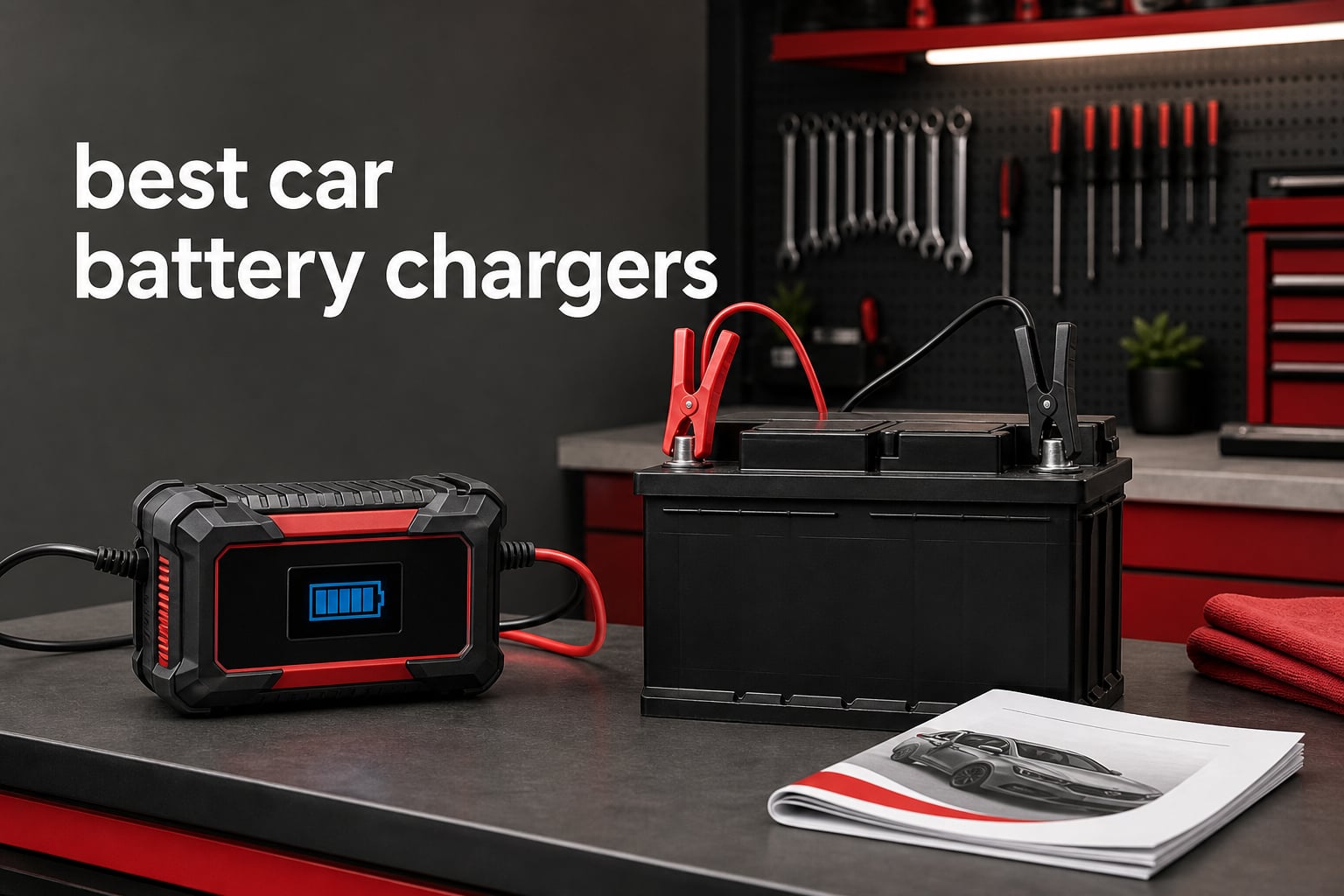
A flat starter battery is frustrating because it usually appears when the car is needed most. The best car battery chargers give owners a controlled way to restore a compatible battery, then hold it at a safe maintenance level during long gaps between drives.
This guide compares 10 supplied 12V and 12V/24V smart chargers. The choices are based on published chemistry support, output, charging stages, protections, warranty details, and the supplied rating and review information; this is not an unverified hands-on garage test presented as fact.
There is an important distinction to make before choosing. A charger supplies current to refill a battery, while a battery charger maintainer moves into a low-current float or trickle mode after the battery is full, so it is better suited to seasonal storage and cars that sit for weeks.
A smart battery charger adjusts its program as charge state and temperature change. That does not turn it into a jump starter or a cure for a failed battery: several models here state a minimum detectable battery voltage, and a badly damaged or zero-volt battery may need diagnosis instead.
For a normal 12V passenger-car lead-acid battery, 10A to 15A is a practical middle ground for routine charging. A 20A model makes more sense for a larger battery, a deep-cycle application, or a household with several vehicles, while lower current is often a calmer choice for long-term maintenance.
Community discussion keeps returning to the same concerns: whether more amps harm a battery, whether a maintainer can stay connected through winter, and which chemistry setting to use. The answers below focus on the charger’s stated limits rather than guesswork, because battery labels and vehicle manuals still have the final say.
Table of Contents
The top 3 best car battery chargers are the NEXPEAK NC215, PZ.P 15-Amp, and HTRC 20-Amp
The NEXPEAK is the most balanced pick when you need 12V and 24V support, a 15A 12V output, and broad lead-acid and LiFePO4 compatibility. The PZ.P brings similar 9-stage capability and temperature-aware operation in a compact format, while the HTRC fits people who specifically need 20A 12V charging and a longer stated 13-foot cable.
Every pick below has a different strength, so the badges are a starting point rather than a claim that one charger suits every battery. Confirm the battery’s voltage and chemistry before connecting clamps, especially on a lithium-equipped vehicle or a 24V system.
These 10 car battery chargers cover routine charging, storage maintenance, and higher-current 12V or 24V jobs
The overview makes it easier to spot the two details that matter first: supported voltage and maximum current. Chemistry support matters just as much, because a charger mode for lead-acid, AGM, gel, flooded, or LiFePO4 batteries must match the battery you own.
| Product | Specifications | Action |
|---|---|---|
 NEXPEAK NC215 NEXPEAK NC215 |
|
Check Latest Price |
 PCHH Heavy Duty PCHH Heavy Duty |
|
Check Latest Price |
 PZ.P 15-Amp PZ.P 15-Amp |
|
Check Latest Price |
 YHCHKJ 20-Amp YHCHKJ 20-Amp |
|
Check Latest Price |
 TOPDC 10A TOPDC 10A |
|
Check Latest Price |
 YDBAO 10A YDBAO 10A |
|
Check Latest Price |
 HTRC 20-Amp HTRC 20-Amp |
|
Check Latest Price |
 YONHAN 15A YONHAN 15A |
|
Check Latest Price |
 Huiaipaic 20-Amp Huiaipaic 20-Amp |
|
Check Latest Price |
 Haibro 20-Amp Haibro 20-Amp |
|
Check Latest Price |
1. NEXPEAK NC215 is the balanced 15-amp charger for mixed 12V and 24V use
NEXPEAK NC215 15-Amp Battery Charger, Trickle Charger Car Battery Charger 12V 24V LiFePO4 Lead Acid Portable 9-Stage Smart Battery Maintainer w/Temp Compensation for Car Truck Lawn Mower Boat Marine
15A 12V and 8A 24V
9-stage charging
Temp compensation
Pros
- 15A fast charging
- 9-stage program
- Large color display
- LiFePO4 support
- 2-year warranty
Cons
- Cannot activate 0V batteries
- Requires detectable battery voltage
The NEXPEAK NC215 is the clearest all-round choice in this list because its stated output covers 12V at 15A and 24V at 8A. Its compatibility list includes lead-acid AGM, gel, SLA, and flooded batteries as well as LiFePO4, which is useful only when the selected mode agrees with the battery label.
The listing calls out a 9-stage program, float mode, pulse repair, and temperature compensation rather than treating charging as a one-setting job. The large color LED screen also reports charge information and temperature, a helpful check before leaving a vehicle connected.
Its supplied review data shows a 4.6 rating from 457 reviews, with 79% five-star feedback. That is a meaningful sample, although ratings do not replace checking clamp placement, cable condition, and the manual for your exact battery.
The NC215 is best when 12V and 24V flexibility matters
Choose this model if the garage includes a car plus a 24V application, or if a boat, lawn mower, or deep-cycle battery is also on the maintenance list. At 0.66 kilograms and 6.1 by 3.46 by 2.6 inches, it is notably compact for a charger with these stated modes.
It is also a sensible pick for drivers who want visible charging data rather than a bare indicator light. Summer and winter modes give the owner a specific temperature-related setting to verify before charging.
The NC215 is not a jump starter for a zero-volt battery
The manufacturer states that it cannot activate a dead 0V battery. If the screen cannot recognize the battery, do not keep cycling repair mode in hopes of forcing a recovery; inspect the battery and vehicle charging system first.
Pulse repair can support battery maintenance, but it cannot promise to reverse physical damage or a failed cell. That limitation is common across this roundup and is worth taking seriously before choosing a charger for dead-battery recovery.
2. PCHH Heavy Duty is the substantial 12V and 24V charger for larger vehicle lists
PCHH 12V 24V Car Battery Charger Heavy Duty, 0-15A Automatic Battery Maintainer, Smart Trickle Charger with Auto Shutoffs, Repair, Winter Mode, for Automotive Car Truck Motorcycle Lawn Mower Boat AGM
0-15A automatic charge
Auto 12V/24V
Repair above 3V
Pros
- Copper coil construction
- Fast and trickle modes
- Auto shut-off
- Winter mode
- 3-year warranty
Cons
- 12.4-pound unit
- Repair needs battery above 3V
The PCHH is built around a stated 0-to-15A automatic charging range and automatic 12V/24V detection. Its compatible-device list is broad, including cars, trucks, motorcycles, boats, RVs, lawn mowers, and marine vehicles, which suits a multi-vehicle owner who does not want separate units for every task.
Heavy-duty copper-coil construction separates it from the small brick-style chargers here. The tradeoff is physical size: it weighs 12.4 pounds and measures 11.4 by 5.8 by 8.6 inches, so it is better kept on a bench or shelf than carried in a glove box.
The supplied data gives it a 4.6 rating across 443 reviews, with 81% five-star feedback. Auto shut-off and maintain mode address the overcharging worry that appears often in owner discussions, but safe unattended use still depends on following the product instructions and inspecting the setup.
The PCHH is a fit for trucks, boats, and several battery types
Its lead-acid list includes AGM, gel, wet or flooded, EFB, calcium, MF, and other common types. That is helpful for a household with different conventional batteries, though this listing does not state LiFePO4 compatibility, so lithium owners should choose a listed lithium-compatible model instead.
The LCD display, winter mode, and switch between fast and trickle charging make it practical when one charger must cover seasonal equipment as well as a road vehicle. A stated 2.5-hour battery charge time appears in the listing, but actual time changes with battery capacity and starting state.
The PCHH needs a battery above 3V for its repair claim
The repair mode is specified for batteries above 3V. That is better guidance than assuming any charger can revive any flat battery, and it tells you to stop and diagnose rather than attempt a recovery below that threshold.
Plan for its 12.4-pound weight before selecting it for a motorcycle or a very small storage space. The three-year warranty is a useful ownership detail, but it does not make the large enclosure more portable.
3. PZ.P 15-Amp is the compact 9-stage choice for compatible lithium and lead-acid batteries
PZ.P 15-Amp 12V/24V Smart Battery Charger, Maintainer & Trickle Charger for LiFePO4, Lead Acid Batteries – Fully Automatic 9-Stage Charging w/Temp Compensation for Motorcycle Car Truck Lawnmower Boat
15A 12V and 8A 24V
9-stage charge
14F to 82F operation
Pros
- LiFePO4 and lead-acid support
- Color LED screen
- Float mode
- Temp compensation
- 18-month warranty
Cons
- Cannot charge totally dead batteries
- Needs detectable battery voltage
The PZ.P has the same headline 12V 15A and 24V 8A arrangement as the NEXPEAK, plus stated support for LiFePO4, AGM, gel, SLA, and flooded batteries. Its small 7.88 by 3.74 by 3.55-inch footprint makes it an appealing battery charger maintainer for an owner who needs to store the unit between uses.
The feature list names fully automatic 9-stage charging, TKL trickle or float mode, pulse repair, and summer and winter modes. A color LED display with temperature information gives a quick read on the selected task rather than leaving the owner to guess what the charger is doing.
The provided rating is 4.6 from 358 reviews, with 81% five-star feedback. That review count is smaller than the biggest models on this page, yet still enough to treat the feedback as a useful signal alongside the published specifications.
The PZ.P suits owners who want an automatic storage maintainer
Automatic transition to trickle or float mode makes this model relevant to a car parked for seasonal storage, provided its instructions permit the intended duration. A maintainer is not the same as a constant high-current charge; the low-current phase is the reason it is used for a stored battery.
The stated operating range is 14F to 82F. That gives a concrete boundary to consider for cold garages and sheds instead of assuming winter mode covers every temperature.
The PZ.P cannot charge a totally dead battery
The listing says it cannot charge a totally dead battery. If a multimeter reading is absent or extremely low, a technician may need to determine whether a cell failure, parasitic drain, or alternator issue caused the problem.
Do not confuse a pulse-repair feature with guaranteed battery restoration. It is a maintenance function, not evidence that a battery with internal damage will return to dependable service.
4. YHCHKJ 20-Amp is the adjustable-current choice for faster compatible charging
YHCHKJ 20A Car Battery Charger, 12/24V Smart Trickle Charger & Maintainer
20A 12V and 10A 24V
Adjustable current
Desulfator
Pros
- 20A maximum output
- Adjustable modes
- Lithium support
- Desulfation
- 5-year warranty
Cons
- Minimum starting voltage 2V
- Not a jump starter
The YHCHKJ gives the owner more control than a fixed-output charger. It lists 5A, 10A, and 20A choices for 12V batteries, alongside 3A, 5A, and 10A choices for 24V batteries, so current can be matched more carefully to the job.
Its stated chemistry range includes lithium, LiFePO4, lead-acid, AGM, gel, SLA, and marine batteries. The LCD is designed to show charging status, voltage, current, and temperature, which is useful when comparing a selected mode with the battery you are actually charging.
The supplied review snapshot is 4.5 from 164 reviews, with 79% five-star feedback. The lower review count means more weight should be placed on the published 2V minimum and mode labels than on a broad claim about long-term use.
The YHCHKJ works when adjustable current is the priority
Pick it for a larger 12V battery or a 24V application where 20A or 10A output is appropriate, not simply because higher amperage sounds better. Current selection is about battery capacity, charge condition, and the manufacturer’s guidance, not a contest to finish first.
The five-year warranty and 24/7 support listed by the manufacturer are ownership positives. Summer and winter modes plus temperature compensation add another layer of control for a garage whose temperature varies sharply.
The YHCHKJ needs at least 2V and cannot jump-start a vehicle
The listing sets a 2V minimum starting voltage and explicitly says this is not a jump starter. That rules it out for a battery that is fully unresponsive when the immediate goal is to crank an engine.
Its pulse repair and desulfation functions may be useful maintenance tools, but they do not diagnose the battery. Test the resting voltage and inspect for swelling, leakage, or damage before connecting any charger.
5. TOPDC 10A is the accessory-ready charger for 12V and 24V battery maintenance
TOPDC 10A 12V/24V Smart Battery Charger & Maintainer, IP65, LiFePO4
10A 12V and 5A 24V
7-stage charge
Clamps and O-rings
Pros
- 7-stage charging
- Auto maintenance
- LiFePO4 support
- Digital display
- Two connector types
Cons
- 32 supplied reviews
- No warranty detail listed
The TOPDC is worth a look for its included alligator clamps and O-ring terminals. O-ring terminals can make a repeat maintenance connection more convenient on a battery that is hard to reach, as long as they are fitted correctly and the vehicle manufacturer permits the setup.
It lists 10A charging at 12V and 5A at 24V, with a 7-stage intelligent process and automatic maintenance mode. Its chemistry list covers wet, AGM, standard, gel, and flooded lead-acid batteries plus LiFePO4, giving it broad stated compatibility.
The digital display reports voltage, current, status, and battery type. Supplied review data is a 4.5 rating from 32 reviews, so this is the smallest feedback sample in the roundup and deserves a more cautious reading than products with hundreds or thousands of reviews.
The TOPDC is useful when permanent-style terminals simplify maintenance
The combination of clamps and O-ring terminals makes this model relevant to motorcycles, ATVs, lawn equipment, RVs, and cars where repeated access is inconvenient. The 12.68 by 7.17 by 2.72-inch dimensions should also be considered if storage space is tight.
Automatic maintenance mode is the attraction for seasonal storage. Before using it on a stored vehicle, clean the terminals, confirm electrolyte and battery condition where applicable, and keep the charger in a dry, ventilated location.
The TOPDC has limited supplied review history and no listed warranty detail
A 32-review sample does not mean the charger will perform poorly; it means there is less supplied customer feedback to compare. The listing also does not provide a warranty description, which is a point to clarify before purchase if coverage is important to you.
It provides reverse-polarity warning and error detection, but those are safeguards rather than permission to connect casually. Turn the charger off or unplug it before moving clamps, and follow the product connection sequence.
6. YDBAO 10A is the straightforward 12V charger with a large review sample
Car Battery Charger 12V 10A Automatic Smart Trickle Charger & Maintainer
10A 12V charge
LCD display
Winter and summer modes
Pros
- Compact form
- LCD data
- LiFePO4 support
- 8 protections
- Pulse repair
Cons
- 12V only
- Unattended use beyond 12 hours not recommended
The YDBAO is a 12V-focused option rather than a 12V/24V charger. It lists 10A output, support for 12V lead-acid AGM, gel, SLA, and VRLA batteries plus LiFePO4, and a compact 5 by 9 by 2-inch body.
Its 3-in-1 description groups charging, trickle maintenance, and recovery features together. The backlit LCD provides charging information, while the dual winter and summer modes are intended to account for temperature changes.
The supplied review base is one of the strongest here: 2,153 reviews at a 4.4 average, with 76% five-star feedback. A large sample is useful context, but it does not alter the stated instruction that operating unattended for more than 12 hours is not recommended.
The YDBAO suits a 12V owner who values simple display feedback
This model is a logical choice for a conventional 12V car, truck, motorcycle, boat, or lawn mower battery when 24V support is unnecessary. Plug-and-play operation and a readable LCD are useful for an owner who wants to see the process without a complicated control panel.
Its listed 8-in-1 protection design supports safe operation alongside the user’s own checks. Look for clean, secure clamps and a stable charging location; protection circuitry cannot correct damaged cables or a reversed connection made outside the instructions.
The YDBAO is not the choice for 24V batteries or long unattended sessions
Its published compatibility is 12V, so it should not be selected for a 24V system. Verify the system voltage rather than assuming a larger vehicle automatically needs 24V, since many cars and light trucks still use 12V electrical systems.
The listing advises against unattended operation beyond 12 hours. That makes it less attractive for a months-long winter-storage plan unless the manual supplies a specific approved maintenance procedure.
7. HTRC 20-Amp is the high-current pick with a stated 13-foot cable
20-Amp Smart Battery Charger,Lithium,LiFePO4,Lead-Acid(AGM/Gel/SLA..) Car Battery Charger,Trickle Charger, Maintainer/deep Cycle Charger,12V/20A and 24V/10A,for Boat,Motorcycle,Lawn Mower,Golf cart..
20A 12V and 10A 24V
Auto voltage detection
13 ft cable
Pros
- 20A fast charge
- Wide chemistry support
- LCD display
- 13 ft cable
- Pulse repair
Cons
- Cannot activate depleted batteries
- Minimum starting voltage 1V
The HTRC provides 20A at 12V and 10A at 24V, with stated automatic detection of 12V and 24V batteries. It also lists compatibility with lithium, LiFePO4, and a wide range of lead-acid labels including AGM, gel, EFB, MF, flooded, VRLA, SLA, and wet batteries.
A 13-foot cable is its practical differentiator. That extra reach can make placement easier when the outlet is not directly beside the vehicle, though the charger should still sit where the manual permits and where cables cannot create a trip or pinch hazard.
The supplied data reports a 4.4 rating from 1,654 reviews, with 77% five-star feedback. Its CPU-monitored charging process, cooling system, temperature compensation, and protection list are well aligned with the attributes most often requested by people managing more than one battery type.
The HTRC is best for larger 12V batteries and hard-to-reach parking spots
Its higher stated current fits situations where a compatible battery and manufacturer guidance call for it, including some trucks, boats, golf carts, or agricultural equipment. It is also listed for motorcycles and lawn mowers, but a smaller battery does not automatically benefit from selecting the highest setting.
The LCD allows a check of charging and battery status. Pair that with a deliberate chemistry selection, especially with lithium batteries, because auto voltage recognition does not substitute for choosing the correct battery program.
The HTRC still needs at least 1V before it can begin charging
The listing says it cannot activate a depleted battery and specifies a 1V minimum starting voltage. That is a lower threshold than some options in this guide, but it is still not a promise of recovery for a fully failed battery.
Use the long cable for positioning convenience, not to stretch leads across a wet floor or through a moving door. Good cable routing is one of the simplest safety steps in any battery-charging session.
8. YONHAN 15A is the memory-equipped charger for repeated 12V and 24V maintenance
YONHAN 15A Battery Charger 12V/24V LiFePO4 Trickle Charger
15A 12V and 24V
9-stage charging
Memory function
Pros
- LiFePO4 support
- 9-stage process
- Pulse repair
- One-touch memory
- Temp-adaptive float mode
Cons
- Cannot revive completely dead batteries
- Not Prime eligible
The YONHAN joins the 15A group with support for 12V and 24V batteries, LiFePO4, and a wide lead-acid list that includes AGM, gel, EFB, MF, flooded, VRLA, SLA, and wet types. Its compact 6.49 by 3.42 by 2.59-inch dimensions make it easier to put away than the bench-style units.
Its technical details include nine charging stages, pulse repair, sulfation and acid-stratification detection, memory function, and temperature-adaptive float or trickle charging. The memory feature is appealing for repeated use, although the first setup still requires checking that the remembered setting matches the battery in front of you.
The supplied review data shows a 4.4 rating from 483 reviews, with 72% five-star feedback. That is enough feedback to place it above the very new, low-sample options, while remaining below the biggest review bases in this comparison.
The YONHAN is helpful for routine repeat charging with the same battery type
One-touch operation and intelligent memory can reduce setup friction for a vehicle that receives the same maintenance routine. Its temperature-adaptive float function also makes it a relevant option for a stored car, motorcycle, boat, or lawn mower when the manual allows the planned connection period.
The stated detection of sulfation and acid stratification points toward maintenance-oriented use. Think of it as a way to support a serviceable battery, not a reason to defer replacing a battery that repeatedly loses charge.
The YONHAN cannot revive a completely dead battery
The product information is explicit that a completely dead battery cannot be revived. This is a sensible limitation to acknowledge before buying any desulfation charger for a no-start situation.
Prime eligibility is not listed for this unit, and its warranty is stated as one year. Those facts may matter to owners who place a lot of weight on delivery programs or length of listed coverage.
9. Huiaipaic 20-Amp is the handled charger for fast 12V and 24V service
20-Amp Car Battery Charger, 12V/20A and 24V/10A LiFePO4,Lead-Acid(AGM/Gel/SLA) Automatic Smart Trickle Charger Maintainer,Desulfator, 300W Fast Charging for Automotive Truck Motorcycle Lawn Mower Boat
20A 12V and 10A 24V
LCD and seasonal modes
Foldable handle
Pros
- 20A quick charge
- Charge-maintain-desulfate
- LCD display
- Clip organizer
- Foldable handle
Cons
- Cannot activate dead batteries
- Cannot repair serious battery damage
The Huiaipaic combines a 20A 12V output with 10A at 24V in a unit that lists charging, maintaining, and desulfurizing functions. It is specified for cars, trucks, SUVs, ATVs, RVs, motorcycles, snowmobiles, tractors, farm vehicles, and golf carts.
Its physical details are unusually practical: a foldable handle and clip organizer can make the unit easier to carry and store, while the large LCD reports charging status. Summer and winter modes bring temperature into the setup rather than asking the owner to treat every season alike.
The supplied review snapshot is 4.4 from 368 reviews, with 74% five-star feedback. Its listed MCU controller and multi-protection system are good safety-related features, but the charger still needs the correct chemistry and voltage selected by the user.
The Huiaipaic is a fit when storage and cable organization matter
Choose this unit if a 20A 12V or 10A 24V model is appropriate and you value a handle for moving it between equipment. The 1,020-gram weight and 6.5 by 7.56 by 4.02-inch dimensions are manageable for a high-current unit, though it is not pocket-sized.
The 3-in-1 description may help consolidate equipment for an owner maintaining several compatible batteries. A clip organizer matters more than it sounds, because protecting clamps and keeping leads untangled supports safer repeat use.
The Huiaipaic cannot wake a dead battery or repair severe damage
The listing says it cannot activate a dead battery and cannot repair seriously damaged batteries. That boundary is valuable: charging equipment can maintain a serviceable battery, but it cannot reverse every mechanical or chemical fault.
Before using repair mode, look at battery age, resting voltage, and the cause of discharge. A repeated dead battery may point to a vehicle electrical issue rather than a battery that needs another recharge cycle.
10. Haibro 20-Amp is the 9-foot-cable option for microprocessor-controlled charging
Haibro 12V/24V Car Battery Charger and Maintainer, Max 20A Fast Charging
20A 12V and 10A 24V
7-stage process
9 ft cable
Pros
- 20A fast charge
- 7-stage control
- Wide chemistry support
- Winter mode
- 9 ft cable
Cons
- Cannot revive dead batteries
- 1-year manufacturer warranty
The Haibro is another 20A at 12V and 10A at 24V model, aimed at cars, trucks, SUVs, motorcycles, lawn mowers, golf carts, and boats. It lists LiFePO4, lead-acid, AGM, gel, SLA, and flooded-battery compatibility, along with a seven-stage microprocessor-controlled charging process.
Temperature detection, multiple protections, a brighter LCD, pulse repair, and a winter maintainer mode round out the feature set. The supplied total cable length is 9 feet, a useful middle ground if the outlet is not beside the battery.
The reported rating is 4.4 from 153 reviews, with 75% five-star feedback. That is a positive but moderate-sized review sample, so the stated specs and one-year manufacturer warranty should carry substantial weight in the decision.
The Haibro is suited to owners who need a 20A charger with moderate reach
At 2.3 pounds, it remains portable while offering higher current than the 10A and 15A entries. Its stated more-than-85% charging efficiency is part of the product information, but actual charge duration still depends on capacity, discharge depth, temperature, and battery condition.
One-key repair and automatic sulfation or acid-stratification detection make it appealing as a maintenance tool. Use those modes only on battery types the manufacturer identifies as compatible, particularly where a vehicle uses a lithium auxiliary battery.
The Haibro cannot restore a completely dead battery
The product states that it cannot revive a completely dead battery. Do not depend on it as emergency starting equipment, and do not attempt to charge a swollen, leaking, or visibly damaged battery.
The one-year manufacturer warranty is shorter than the explicitly listed longer coverage on a few rivals. If warranty duration is central to your buying decision, compare that detail before selecting a charger with similar current and chemistry support.
The right car battery charger starts with voltage, chemistry, and a realistic charging job
Start with the battery label, not the vehicle category. A typical passenger vehicle uses a 12V starting battery, while some equipment uses 24V; putting a charger into the wrong voltage situation can damage equipment or create a safety hazard.
Next, match chemistry. Flooded, AGM, gel, EFB, SLA, and LiFePO4 batteries do not all use the same charging profile, so an AGM battery charger should state AGM support and a lithium battery should only be connected to a charger that explicitly lists its chemistry.
The amp rating should fit battery capacity and the task
Amperage is the rate at which the charger can supply current, not a universal battery-health score. A 10A charger is often suitable for regular 12V battery work, while 15A and 20A models can reduce charging time for appropriately sized, compatible batteries.
Higher current does not automatically shorten battery life when the charger, mode, and battery are compatible. The practical risk comes from using the wrong setting, ignoring heat, charging a damaged battery, or assuming a smart charger can make any setup safe.
Charging time cannot be promised from the amp number alone. A battery’s amp-hour capacity, depth of discharge, temperature, internal condition, and the changer’s changing charge stages all affect how long the process takes.
A maintainer is best for storage after the battery is charged
A trickle charger is often used as a loose name for a low-current maintenance device, but a modern battery maintainer should monitor charge state and transition to float mode. That controlled behavior is why a smart maintainer is more appropriate for a car, classic vehicle, or motorcycle that will sit for an extended period.
Check the manual before leaving any product connected for weeks or months. One model in this list specifically advises against unattended operation beyond 12 hours, which shows why “automatic” is not a blanket approval for every storage plan.
For a multi-vehicle household, label each charger with its chemistry and voltage capability. That small habit cuts the chance of connecting a lithium setting to a lead-acid battery or reaching for a 12V-only charger when the equipment needs 24V.
The safe connection order is charger off, positive first, and a final polarity check
Park in a dry, ventilated space away from flames, sparks, and children. Turn the charger off or unplug it, inspect the battery for damage, identify the positive and negative terminals, and read both the vehicle and charger instructions before attaching anything.
Connect the positive clamp to the positive terminal first. Connect the negative clamp as directed by the vehicle and charger manuals; depending on the procedure, that may be the negative terminal or an approved chassis ground away from the battery.
Then select the correct voltage, battery type, and current mode before powering the charger. Reverse-polarity and short-circuit protection are useful backstops, but a manual polarity check is still mandatory because no protection feature replaces careful setup.
When charging is complete, switch off or unplug the charger before removing leads, then remove the negative connection before the positive one unless the manual says otherwise. Do not put clamps on corroded, loose, or damaged terminals without addressing that issue first.
Winter use calls for temperature awareness and a closer look at battery condition
Cold temperatures reduce available battery performance, which is why winter modes and temperature compensation are common on this list. Use a charger whose stated operating range covers the environment, and do not expect winter mode to correct a battery with a failed cell.
If a vehicle repeatedly struggles after a cold night, check its battery health and charging system rather than only adding more charging current. A charger can restore charge; it cannot fix an alternator fault, a parasitic draw, or a battery that no longer holds capacity.
Solar charging is useful only when its output and conditions match the need
A solar maintainer can make sense for off-grid storage, but none of the ten supplied products is a solar charger. Solar output varies with panel size, weather, placement, and daylight, so it should not be treated as a substitute for a mains-powered charger when dependable recovery is needed.
For a stored vehicle, a solar setup also needs a compatible controller and a safe permanent connection approach. Use only equipment that specifically supports the battery chemistry and the intended maintenance role.
Hybrid and EV owners should charge only the documented auxiliary battery
Many hybrid and electric vehicles still have a 12V auxiliary battery, but their high-voltage traction pack is not a DIY target for a consumer car battery charger. Consult the vehicle manual for approved 12V connection points and battery chemistry before doing any maintenance charging.
Do not assume a LiFePO4-capable charger is automatically correct for every modern vehicle battery. The exact battery label and manufacturer instructions are more reliable than guessing from the vehicle’s powertrain.
These FAQs answer the most common car battery charger questions directly
What is the most reliable car battery charger?
The most reliable choice is a charger that explicitly matches your battery voltage and chemistry, has automatic maintenance and safety protections, and publishes clear operating limits. In this list, the NEXPEAK NC215 stands out for stated 12V and 24V support, 9-stage charging, temperature compensation, and a 4.6 rating from 457 supplied reviews.
Which car battery charger is best?
The best charger depends on the job. Choose the NEXPEAK NC215 for balanced 15A 12V and 24V support, the PZ.P for a compact 9-stage charger with listed LiFePO4 compatibility, or the HTRC when a 20A 12V output and 13-foot cable suit the battery and parking setup.
What are the top 10 battery chargers?
The 10 chargers in this roundup are NEXPEAK NC215, PCHH Heavy Duty, PZ.P 15-Amp, YHCHKJ 20-Amp, TOPDC 10A, YDBAO 10A, HTRC 20-Amp, YONHAN 15A, Huiaipaic 20-Amp, and Haibro 20-Amp. They differ in voltage support, current, battery chemistry compatibility, cable setup, and stated maintenance features.
What are the best battery chargers to buy?
The strongest choices are smart chargers that list your exact battery chemistry, provide automatic float maintenance, include reverse-polarity and overcharge protections, and state their minimum starting voltage. The ten chargers here range from 10A 12V-focused units to 20A models with 12V and 24V operation, so match the charger to the battery label first.
The NEXPEAK NC215 is the most balanced choice, while the right match depends on your battery
For most owners comparing the best car battery chargers in 2026, the NEXPEAK NC215 has the most balanced stated combination of 15A 12V output, 24V support, 9-stage charging, temperature compensation, and compatible lead-acid and LiFePO4 modes. The PZ.P is a compact alternative with a similar voltage and current profile, while the HTRC, Huiaipaic, Haibro, and YHCHKJ provide higher-current options for jobs that genuinely call for them.
Choose chemistry and voltage first, then select current, cable reach, display, and storage features. A careful connection, an intact battery, and the right mode matter more than a large amp number or a repair label.