
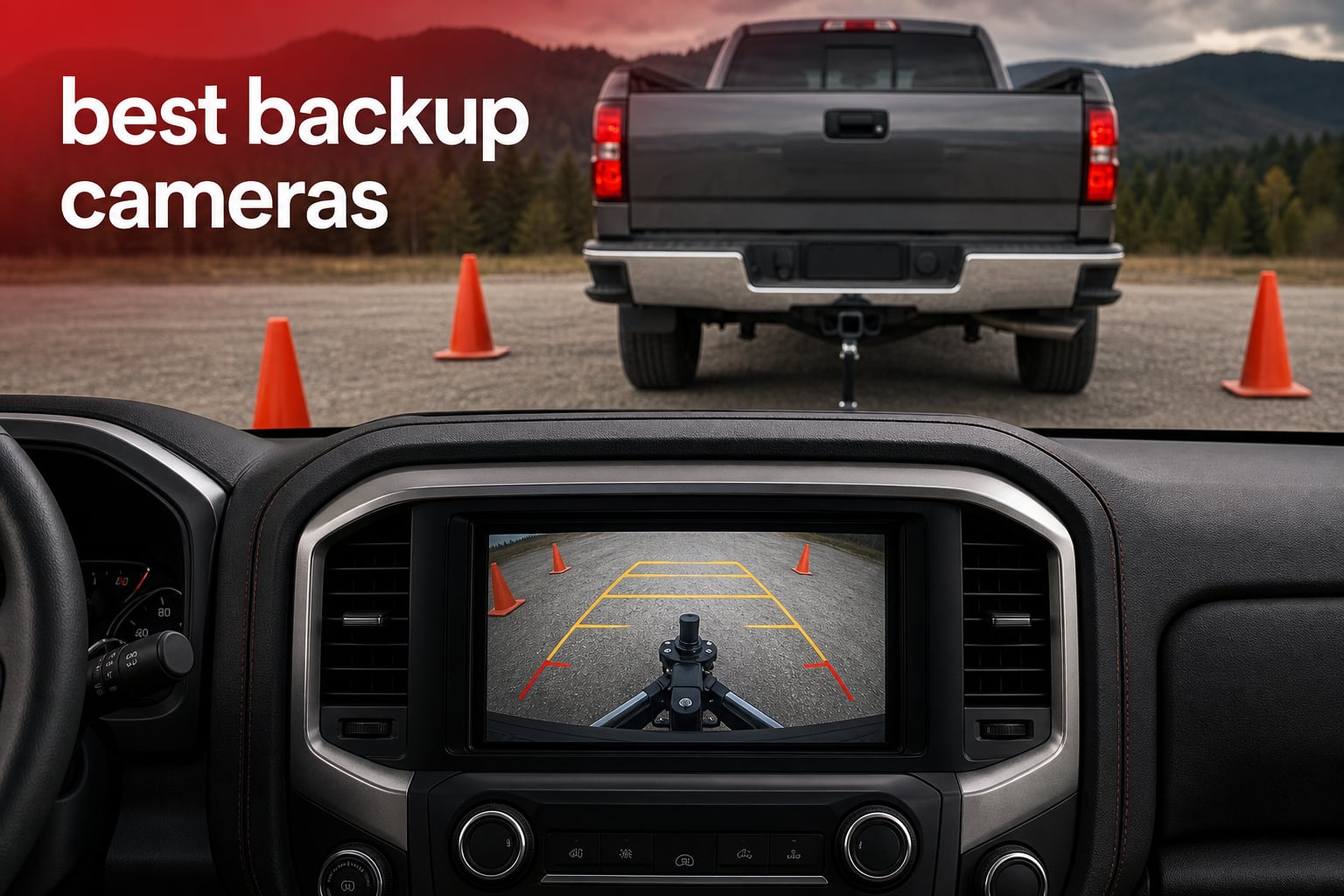
The best backup cameras give you a live view of the space behind a vehicle when reverse is selected, so a blind spot becomes a visible parking decision. For this 2026 roundup, I compared 12 current systems by the facts that matter after the box arrives: display type, connection method, stated view angle, low-light hardware, weather rating, range, mounting, and the volume behind each marketplace rating.
There is no single right rearview camera for every vehicle. A compact car with a clean license-plate area has different needs than a pickup pulling a trailer, while an older vehicle without a screen may be better served by a complete backup camera system with its own monitor.
I also treated wireless claims carefully because that is where forum users most often run into confusion. A solar magnetic camera can remove drilling and routing, but it still needs charging discipline; a wired rear view camera takes more routing effort, yet its video path does not depend on a radio signal.
For readers who enjoy comparing how lenses frame a scene, our guides to best wide angle lenses and best camera gimbals for smooth video offer useful camera-language context. Here, the priority is much simpler: a dependable view that helps you reverse with more awareness.
Every pick below has an included display or a stated phone/tablet monitor route, so none asks you to assume an aftermarket radio will accept its feed. Ratings and review counts are listing snapshots rather than a substitute for checking fitment, wiring access, and local safety requirements on your own vehicle.
Table of Contents
The top 3 best backup cameras answer three different needs
The Thybro is my editor’s choice for a tool-free RV or trailer setup, the eRapta suits drivers who want a wired kit with extensive review history, and the YIMU is the straightforward license-plate-mount route. Those are distinct answers, not interchangeable winners.
These best backup cameras in 2026 cover cars, trucks, RVs, and trailers
The quick view below separates portable magnetic systems, dedicated wired kits, RV-ready systems, and the phone-based Casoda. Read the stated range as a vehicle-fit clue, especially when a camera will sit at the back of a long trailer.
| Product | Specifications | Action |
|---|---|---|
 Thybro Magnetic RV Camera Thybro Magnetic RV Camera |
|
Check Latest Price |
 Casoda Magnetic WiFi Camera Casoda Magnetic WiFi Camera |
|
Check Latest Price |
 pemacom Solar Magnetic Camera pemacom Solar Magnetic Camera |
|
Check Latest Price |
 ZEROXCLUB Furrion RV System ZEROXCLUB Furrion RV System |
|
Check Latest Price |
 Xrizuo Dual Camera System Xrizuo Dual Camera System |
|
Check Latest Price |
 LeeKooLuu Color Night Kit LeeKooLuu Color Night Kit |
|
Check Latest Price |
 LeeKooLuu 7 Inch Wireless LeeKooLuu 7 Inch Wireless |
|
Check Latest Price |
 eRapta AY7 Monitor Kit eRapta AY7 Monitor Kit |
|
Check Latest Price |
 AUTO-VOX Solar DVR Camera AUTO-VOX Solar DVR Camera |
|
Check Latest Price |
 YIMU License Plate Camera YIMU License Plate Camera |
|
Check Latest Price |
 VOONOA Dual Magnetic System VOONOA Dual Magnetic System |
|
Check Latest Price |
 VTimes Long Range RV Camera VTimes Long Range RV Camera |
|
Check Latest Price |
1. Thybro Magnetic RV Camera is the easiest pick for a quick trailer view
HD 1080P Magnetic Wireless Backup Camera for RV – 1-Min Easy Install
1080p
7 inch monitor
56ft signal
IP69K
Pros
- Magnetic tool-free mount
- 170 degree view
- Solar and USB-C power
- 24-month warranty
Cons
- 56ft stated range
- Only 21 reviews
Thybro’s 1080p magnetic system is the cleanest answer when I want a camera that can move between an RV, trailer, or other metal-backed vehicle without tools or drilling. Its listing states a 50-pound magnetic pull, a 7-inch monitor, and a 56-foot stable connection, which creates a clear fit for shorter rigs rather than a claim for every trailer length.
The camera has a 170-degree lens, infrared night vision, solar power with USB-C backup charging, and an IP69K weather rating. Those are unusually practical specifications for a removable rear camera, because the unit may spend more time exposed to rain, road spray, and bright sun than a permanently wired license-plate camera.
The 4.8 rating is based on 21 reviews, so I would read the score as encouraging but still small-sample feedback. The listing’s 24-month warranty is another concrete reason it makes sense for a portable installation where the mount and charging routine deserve attention.
The Thybro fits short RVs and trailers that need a movable rear view
Choose this system when a fast setup matters more than adding several camera angles. A magnetic base is especially useful for temporary towing, rentals, or drivers who do not want to make permanent holes in a trailer body.
Before ordering, measure the route from the intended camera position to the monitor location. The stated 56-foot signal range should be treated as the boundary for your vehicle layout, not as extra margin for a much longer combination.
The Thybro needs a charging plan and a compatible mounting surface
A solar panel helps sustain the battery, but shaded storage, long cloudy stretches, or a camera placed where the panel sees little sun still make USB-C backup charging relevant. The magnetic approach also calls for a clean ferrous-metal surface with enough flat area for the base.
Drivers who need multiple views, DVR recording, or a far longer stated signal range should consider the Xrizuo, AUTO-VOX, or VTimes systems instead. This is a focused one-camera solution, and that simplicity is its main appeal.
2. Casoda Magnetic WiFi Camera is the phone-first choice for hitch and towing checks
Wireless Backup Camera, Strong WiFi Signal Clear Picture Magnetic Rechargeable Rear view Reverse Back up Camera for Hitching Towing Gooseneck Travel Boat Horse 5th Wheel Trailer Truck Camper Pickup RV
1080p CCD
Phone or tablet app
150ft range
9600mAh
Pros
- 150ft stated range
- Phone/tablet display
- 180 degree rotatable mount
- 12 infrared lights
Cons
- Needs a mobile device
- App connection is required
Casoda takes a different route from the dashboard-monitor kits: it uses a phone or tablet as the monitor through its app. That makes it a notable wireless backup camera for drivers who dislike another screen on the dash and want a portable view while lining up a hitch, gooseneck, boat, or trailer.
The camera lists a FHD 1080P CCD sensor, H.265 video encoding, a 150-foot WiFi signal, a 9600mAh rechargeable battery, and 12 infrared lights. Its magnetic mount rotates through 180 degrees, which is useful when the required viewing angle changes between reversing and hitch alignment.
With a 4.7 rating from 238 reviews, this unit has more review depth than the Thybro. I would still make the phone workflow the deciding question, because app permissions, battery status, screen brightness, and a reliable automatic connection shape the daily experience as much as image resolution.
The Casoda works best when a phone is the display you actually want
This is a strong match for a driver who already keeps a phone or tablet within reach and wants a rear camera only when towing or parking calls for it. It also avoids the visual clutter of a dedicated monitor that stays in the cabin between trips.
The stated 150-foot range gives it more room than short-range portable systems, but physical obstructions and the layout of a truck-and-trailer combination can affect wireless behavior. Check the connection in the exact position where the camera will be used before relying on it in a tight reverse.
The Casoda is less suitable when a fixed, instant display is non-negotiable
A phone-based rearview camera introduces another device to charge, mount, unlock, and keep visible. If you prefer a dedicated screen that turns on as part of a fixed vehicle setup, a monitor kit will be the more direct choice.
Night performance is supported by 12 infrared lights, yet infrared hardware alone does not tell you how every driveway or unlit campsite will look. Test any backup camera with night vision at the locations and reversing distances you use most.
3. pemacom Solar Magnetic Camera is the long-running portable monitor system
1080P HD Wireless Backup Camera – 1 Minute Magnetic Easy Install No Wiring
1080p
7 inch anti-glare monitor
15000mAh
IP69
Pros
- 15000mAh battery
- Solar panel
- Anti-glare monitor
- Dual video channels
Cons
- Uses 2.4GHz signal
- Portable camera needs charging
Pemacom pairs a magnetic camera with a 7-inch anti-glare LCD monitor, so it sits between the phone-led Casoda and a fully wired car backup camera. I would start here for a truck, SUV, small RV, or trailer owner who wants 1080p viewing and a separate display without routing a video cable through the vehicle.
The stated hardware includes a 15000mAh battery, 5W solar panel, F1.2 aperture, 170-degree view, IP69 water resistance, 2.4GHz WiFi, and dual video-channel support. Its listing also describes an auto-sleep mode, which matters because portable systems work best when their battery is not wasted between reversing tasks.
This model carries a 4.4 rating from more than 2.5k reviews, a substantially broader feedback base than several newer magnetic alternatives. I would view that review count as useful evidence that its form factor has been adopted widely, while still checking the monitor position and camera-to-cab distance on your own rig.
The pemacom is best for drivers who want a dedicated screen without cable routing
A 7-inch anti-glare monitor avoids the need to sacrifice phone screen space, and dual channels leave an upgrade path for another view. The magnetic camera also makes this a practical choice if a vehicle serves more than one towing or parking job.
Its 170-degree stated field of view can show a broad rear area, but wide lenses make distant objects appear smaller. Use the image for awareness, then apply the same mirror checks and slow reversing habits used with any rear view camera.
The pemacom requires realistic expectations for solar power and signal paths
The stated 24-hour battery life and solar panel are useful features, not a reason to forget charging completely. Keeping a charging cable available is sensible whenever a camera may spend time under cover or in poor weather.
Wireless placement is also physical: metal, cargo, and distance can affect a 2.4GHz link. Mount the camera where it has a clear practical route toward the monitor, then confirm the view before a trip.
4. ZEROXCLUB Furrion RV System is the direct answer for compatible pre-wired RVs
ZEROXCLUB 1080P 7″ Wireless RV Backup Camera System, Compatible with Furrion Pre-Wired RV Truck Trailer, DVR Monitor & IR Night Vision Rear View Camera, IP69 Waterproof, Adjustable Parkinglines, BW7M
1080p
7 inch IPS
100ft range
DVR recording
Pros
- Furrion pre-wire compatibility
- IPS monitor
- Four-camera split screen
- Adjustable parking lines
Cons
- Best fit is pre-wired RVs
- 100ft stated range
ZEROXCLUB is designed around Furrion pre-wired RV compatibility, which is a more meaningful buying filter than a generic “easy install” label. If your RV already has that preparation, the stated plug-and-play path can reduce the work compared with creating a new wiring route from scratch.
Its system brings a 1080p camera, 7-inch IPS display, dual antennas, 100-foot stated signal range, six infrared lights, IP69K protection, adjustable parking lines, and SD-card loop recording. The monitor supports split-screen viewing for up to four cameras, making this more expandable than a basic single-camera backup setup.
The 4.4 rating comes from 467 reviews, which gives this RV-specific option a meaningful base of feedback. My main fit check would be the existing RV connection and the actual vehicle length, because compatibility and signal placement determine whether its promised convenience applies to you.
The ZEROXCLUB is right for an RV with Furrion pre-wiring and room to expand
This system makes sense when the rear camera is only the first viewpoint you need. The stated four-camera split-screen support can serve drivers who later want side or additional rear angles on a larger camper setup.
An IPS screen is also a worthwhile detail for a dedicated monitor because it is built as the viewing surface rather than an afterthought. Set the adjustable parking lines only after the camera is mounted at its final height and angle.
The ZEROXCLUB is not the simple answer for every car or unprepared trailer
Furrion compatibility is a benefit only when that is the preparation your RV has. Owners of cars, pickups, or trailers with no matching pre-wire point should check connector requirements and installation steps before choosing it.
The 100-foot stated range is generous for many RVs but shorter than the long-range VTimes and AUTO-VOX claims. A long rig, dense construction, or a monitor mounted far forward can make that distinction important.
5. Xrizuo Dual Camera System is the large-screen choice for a big RV or trailer
10″ Wireless Backup Camera System for RV Truck with HD Touch Monitor
Two 1080p cameras
10 inch touch screen
500ft range
4 channels
Pros
- Two cameras included
- 10 inch IPS touch screen
- 500ft stated range
- DVR recording
Cons
- Larger monitor footprint
- Only 86 reviews
Xrizuo is built for a driver who needs more than a single narrow rear perspective. The package includes two 1080p cameras and a 10-inch IPS touch-screen monitor, then supports up to four channels, giving a large RV, camper, or trailer user a logical base for multiple viewpoints.
The stated 500-foot range is one of the most substantial figures in this roundup, and each camera has a 150-degree lens, IR night vision, and IP69K protection. DVR loop recording, image flipping, and adjustable guide lines add useful control for a system intended to stay installed.
Its 4.4 rating comes from 86 reviews, so I would give more weight to vehicle fit and the published feature set than to a small rating difference. A 10-inch screen is easy to see, but that physical size needs a safe, legal mounting location with no interference to the driving view.
The Xrizuo serves large rigs that need two views and a visible monitor
Two included cameras can cover a rear view plus another position, rather than forcing a later second purchase. The four-channel design also makes sense for drivers who know they will add coverage around a large camper or trailer.
For driving visibility, measure the intended monitor area before fitting anything. A big display can be helpful during a reverse, but its placement should never obstruct forward sight lines or vehicle controls.
The Xrizuo is excessive for a simple small-car parking aid
A compact car owner who only needs a license-plate rear view may find the YIMU’s smaller monitor and fixed cable approach more proportionate. The Xrizuo’s scale is justified by the second camera, four-channel capacity, and stated long-range use.
It is also a system where installation planning pays off. Decide camera locations, cable or power routing, and monitor position before attaching hardware so the two views solve distinct visibility problems.
6. LeeKooLuu Color Night Kit is the clear choice for stated 10-meter night viewing
HD 1080P Backup Camera : Night Vision See Clearly at Night Up to 10M
1080p
7 inch screen
10m color night vision
IP69K
Pros
- Stated 10m color night vision
- 15-minute DIY setup
- 150 degree lens
- 36-month warranty
Cons
- 23.5ft stated signal
- Single-camera system
This LeeKooLuu kit puts its strongest claim right in the low-light specification: color night vision up to 10 meters, or 33 feet. That makes it a sensible first comparison point for a driver who regularly reverses into a dark driveway and wants a 7-inch dedicated monitor rather than app-based viewing.
The listed details are 1080p resolution, a 150-degree view, IP69K weather resistance, a 23.5-foot signal range, and a 15-minute DIY setup. It is positioned for trucks, cars, pickups, and SUVs, while the short stated range makes it a more natural fit for a vehicle than a very long RV combination.
It has a 4.4 rating from 55 reviews and a 36-month warranty. The warranty period is worth noting for any externally mounted parking camera, but the modest review count means I would not treat its rating as stronger evidence than systems supported by several thousand buyers.
The LeeKooLuu Color Night Kit suits drivers who prioritize a night specification
A stated color image to 10 meters is unusually specific and gives a useful benchmark for comparing night-focused listings. The 150-degree lens also offers a broad enough rear area for ordinary parking and reversing tasks.
Still, low-light video changes with rain, reverse lamps, street lighting, and the reflectivity of objects behind you. Set up the camera, then test it at night in the same conditions where you park.
The LeeKooLuu Color Night Kit fits vehicles better than long trailer combinations
The published 23.5-foot signal range is a constraint to respect. A car, pickup, or SUV creates a much clearer match than a long tow setup where the rear camera sits far behind the cabin monitor.
For an RV or trailer, move up to a system with a longer stated range and antennas designed around that distance. The question is not whether 1080p is useful; it is whether the camera can maintain a dependable link across your vehicle layout.
7. LeeKooLuu 7 Inch Wireless is the popular two-view option for a truck or SUV
HD 1080P 7 Inch Wireless Backup Camera for Truck: 15-Min Easy to Install
1080p
7 inch monitor
two-camera split screen
IP69
Pros
- 6.1k reviews
- Two-camera split screen
- Adjustable parking lines
- Wide temperature range
Cons
- Stated 150 degree differs from 120 degree real angle
- Two cameras are not included
With more than 6.1k reviews, this LeeKooLuu system has the deepest buyer-feedback base in the roundup. It pairs a 1080p camera with a 7-inch monitor, supports split-screen mode for up to two cameras, and gives drivers one-click channel switching when a second view has been added.
The listing states a 150-degree viewing angle and a 120-degree real angle, which is helpful because it distinguishes lens coverage from the effective view. It also lists IP69 protection, built-in night vision, adjustable parking lines, and operation from minus 22 to 176 degrees Fahrenheit.
I would consider this one of the safer mainstream choices for a car, pickup, SUV, or short truck backup setup simply because its feature set is clear and the review base is broad. The important limitation is that split-screen capability does not mean two cameras come in the box; the listing says it supports up to two.
The LeeKooLuu 7 Inch Wireless is best when review volume matters to you
Thousands of reviews do not guarantee that a system fits every vehicle, but they provide a much broader set of owner experiences than a new listing with a few dozen ratings. The 4.3 rating should be read alongside that large sample size.
Its second-channel support is useful for owners who start with one rear view and later decide they need another angle. Plan the first camera location carefully so it remains useful after an additional camera is connected.
The LeeKooLuu 7 Inch Wireless needs a careful read of stated viewing angles
Wide-angle figures are not interchangeable, and the listing’s 150-degree stated angle versus 120-degree real angle illustrates why. Use the effective view to judge coverage, then avoid positioning the camera so high or low that the image hides the area you need near the bumper.
This is also not the longest-range option on the page. Owners of an extended RV or trailer should give priority to published distance and antenna design, rather than treating a conventional vehicle camera as a universal tow camera.
8. eRapta AY7 is the wired monitor kit with detailed image controls
eRapta Backup Camera for Truck 7”HD 2K Front/Rear View Monitor kit IP69 Waterproof Night Vision DIY Grid Lines for Car RVs Trucks Tractors Bus Semi-Trailers Pickup AY7
2K image
7 inch monitor
0.1 Lux
IP69K
Pros
- 5.1k reviews
- 0.1 Lux rating
- DIY grid lines
- Image controls
Cons
- Cable-based installation
- 2K listed as 1080p effective
The eRapta AY7 is the pick I would examine first when a cable route is acceptable and image adjustment matters. It provides a 7-inch monitor, a stated 2K image with 1080p effective resolution, a 149-degree listed view with a 140-degree real angle, 0.1 Lux rating, nine LED lights, and IP69K protection.
It also includes DIY reversing lines, mirror-flip capability, and controls for brightness, contrast, saturation, and tint. Those adjustments are valuable because the view behind a vehicle is affected by camera height, reverse lamps, glare, and the reflectivity of pavement or cargo.
This eRapta has a 4.3 rating from more than 5.1k reviews and includes a two-year warranty. The review count supports its position as a widely adopted backup camera for truck, RV, tractor, bus, semi-trailer, pickup, and car applications, but the cable route remains the key installation commitment.
The eRapta AY7 is right when you prefer a wired signal and image adjustment
A fixed cable path trades an easier portable setup for a connection that does not depend on a wireless signal between camera and monitor. That is appealing when a vehicle stays configured one way and the owner is comfortable with the routing work.
The 0.1 Lux figure and nine LEDs give more low-light detail than a generic “night vision” label. Use the adjustable picture controls after installation, because setting them in a garage at midday may not suit an unlit driveway.
The eRapta AY7 is less suitable when drilling or cable routing is off limits
A plug-and-play car-charger-powered monitor can simplify the cabin side, yet camera placement still requires a practical cable route. If you move the camera among trailers or want no permanent routing, a solar magnetic camera is the more fitting design.
Also read the resolution statement literally: the listing says 2K clear image and 1080p effective resolution. It is a useful image-focused kit, but resolution labels should not replace a check of real viewing angle and night conditions.
9. AUTO-VOX Solar DVR Camera is the long-range portable choice with recording
AUTO VOX Wireless Backup Camera Solar Magnetic, 7.2″ DVR 1080P Monitor
1080p
7.2 inch DVR
524ft range
20 hour battery
Pros
- 524ft stated range
- Dual antennas
- Split screen recording
- Solar powered
Cons
- Portable battery management
- 130 degree real angle
AUTO-VOX brings rare long-distance claims to a magnetic portable format: 524 feet of stated range through dual antennas. That figure, plus a 7.2-inch dual-split DVR monitor and 1080p camera, makes it a serious candidate for trailer and RV owners who need more reach than ordinary vehicle systems advertise.
The camera is solar and battery powered with a stated 20-hour battery life, auto-sleep mode, IR night vision, IP69K protection, and 170-degree listed view. Its published real angle is 130 degrees, which is the more useful figure for judging the actual rear coverage.
The AUTO-VOX carries a 4.3 rating from nearly 1.7k reviews. I like that the DVR loop-recording function makes the monitor more than a live reverse screen, though a buyer should confirm how recording and storage fit their own expectations before treating it as a dash cam backup camera replacement.
The AUTO-VOX is best for a long trailer that needs a portable camera and monitor
The 524-foot stated range is its main differentiator. Pair that with dual antennas, and the design directly addresses the signal-distance concern that comes up repeatedly with long RV, camper, and trailer layouts.
The dual-split monitor is also practical when a rear view is not enough. A driver can build a second-camera setup rather than trying to make one wide-angle lens cover every blind area.
The AUTO-VOX still needs battery and camera-angle checks before travel
Solar charging and a 20-hour claim reduce maintenance but do not remove it. Verify charge status before a journey and mount the panel where it has usable light instead of assuming it will recover under every storage condition.
Set the final angle using the real 130-degree coverage, not only the wider 170-degree lens figure. A view that is too broad or badly placed can make a hitch, bumper, or nearby object harder to judge.
10. YIMU License Plate Camera is the straightforward fixed setup for a car
YIMU Backup Camera System with License Plate Backup Reverse Camera, Easy Installation, Plug & Play, DIY Guide Lines, 150° Wide Angle, Night Vision, IP69K Waterproof, Optional Dual Bracket K4302
720p
4.3 inch monitor
26ft cable
IP69K
Pros
- License plate mount
- 26ft video cable
- Adjustable grid lines
- Two-year warranty
Cons
- 720p resolution
- Small 4.3 inch display
YIMU is a classic license plate camera kit with a 4.3-inch monitor and 26-foot video cable. I would choose this approach for an older car or small truck where a permanent backup camera for car parking is more useful than a removable solar unit.
It lists 720p resolution, a 150-degree stated view with a 170-degree real angle, IP69K protection, adjustable parking grid lines, and a flexible double-bracket installation. The manufacturer calls out compatibility with cars, trucks, RVs, and SUVs, though the supplied cable length should guide the final vehicle decision.
At 4.3 from 522 reviews, the YIMU has a moderate, established feedback base. The listing includes a two-year warranty and a 30-day money-back period, which are concrete terms worth considering alongside the camera’s smaller display and lower listed resolution.
The YIMU is best for an older vehicle that needs a fixed license-plate rear view
A license-plate mount is intuitive because it puts the camera near the center of the rear of a car. The cable route makes this a dedicated setup rather than a device moved between vehicles, which can be an advantage when the car is your daily driver.
The 4.3-inch screen is compact and may suit a cabin with limited open dashboard space. Decide where it can be placed without blocking gauges, vents, controls, or forward visibility.
The YIMU is not the answer when you need a large display or long wireless reach
Its 720p spec and 4.3-inch monitor are more basic than the 1080p seven-inch systems above. Drivers who want a wider, more easily read display should look toward a 7-inch or 10-inch kit.
The 26-foot video cable also deserves a tape-measure check before purchase. A car can be a clear fit, while a long RV or truck-and-trailer layout may call for a system designed around greater distance.
11. VOONOA Dual Magnetic System is the two-camera solar answer for hitch and rear coverage
VOONOA 2 Magnetic Wireless Backup Camera with 7” HD 1080P DVR Monitor System, 15000mAh Rechargeable Waterproof Dual Solar Reverse Camera for Hitch Towing Car Trailer Truck RV VN007
Two 1080p cameras
7 inch DVR
15000mAh
dual solar
Pros
- Two cameras included
- 24+ hour stated battery
- Remote camera control
- Six magnets
Cons
- 2.4G wireless link
- Only 615 reviews
VOONOA is a dual-camera magnetic system for drivers who want separate views without building a fixed wired installation. The package includes two 1080p cameras, a 7-inch DVR monitor, 15000mAh battery capacity, dual solar panels, six strong magnets, and 2.4G digital wireless connectivity.
The listing states more than 24 hours of battery life and three-minute DIY installation, plus remote-controlled camera on/off. I see its most practical use on a trailer or RV where one camera watches the rear and the other can assist with hitching, side awareness, or another trouble spot.
Its 4.2 rating comes from 615 reviews. That is enough feedback to be useful, but lower than the single-camera market leaders, so its extra hardware should be the reason you choose it rather than a narrow ratings comparison.
The VOONOA is best when two removable camera positions solve a real problem
Two cameras can be more useful than one extremely wide lens because each can be placed for a defined job. For example, one can show the rear of a trailer while the other is set for a hitch or another reversing angle.
Remote camera control also makes more sense in a dual setup, since you may not need every camera active for every maneuver. Decide each camera’s role before mounting so the views do not duplicate each other.
The VOONOA needs a deliberate charging and signal routine
Its dual solar panels and 15000mAh battery help support a portable design, but two cameras also mean two units to position and monitor. Keep charging access available and check both images before a tow.
As with other 2.4G digital wireless systems, the real vehicle arrangement matters. Long distance, metal structure, cargo, and monitor location deserve a live test before you depend on the system at a campsite or launch ramp.
12. VTimes Long Range RV Camera is the choice for the farthest stated signal range
VTimes Wireless Backup Camera for Trucks, RV Backup Camera with HD Monitor
720p
7 inch monitor
984ft range
4 channels
Pros
- 984ft stated range
- Blind spot detection
- Four-channel split screen
- 20 infrared lights
Cons
- 720p resolution
- Only 172 reviews
VTimes has the longest stated signal range in this list at 984 feet, so it belongs at the top of the shortlist for an exceptionally long RV, truck, trailer, or camper arrangement. Its 7-inch 1280 by 720 monitor supports four channels and split screen, giving it more scope than a basic reversing display.
The stated feature set includes blind spot detection alerts, 20 infrared lights, IP69K protection, a 120-degree lens, recording and playback with support for a 128GB SD card, DIY guide lines, and Furrion pre-wired compatibility. This is an RV-oriented backup camera system rather than a compact car accessory.
It has a 4.2 rating from 172 reviews. The range claim and multi-channel design are the headline strengths, while the 720p resolution and smaller feedback base are reasons to compare it against the Xrizuo or AUTO-VOX when image detail is as important as distance.
The VTimes is best for a long-distance RV or trailer camera connection
The 984-foot stated range is the standout specification and can give a long rig far more stated headroom than typical vehicle-oriented models. Its Furrion pre-wire compatibility is another useful fit indicator for prepared RV installations.
Four channels and split screen create a path to broader coverage, while blind spot detection adds a separate alert-oriented feature. Treat any alert as an additional aid, not a replacement for mirrors, observation, and careful reversing.
The VTimes is less suitable when maximum displayed resolution is your first priority
The monitor is listed at 1280 by 720 and the camera at 720p, so buyers seeking a 1080p specification should compare the other systems directly. A longer link does not automatically make a lower-resolution view more detailed.
Infrared lights and IP69K protection are useful for outdoor placement, but assess night vision at the real distance behind your rig. The camera must be positioned to show the zone you need, not just transmit a signal over a long maximum distance.
Choose a backup camera by display, connection, view, and vehicle fit
The highest quality backup camera is the one that provides a stable, correctly framed image in your actual vehicle and reverse conditions. Start with four checks: whether you need a fixed monitor or phone app, whether the camera-to-display distance fits the stated connection range, whether the mount fits the rear bodywork, and whether the image remains usable in low light.
A wired camera is better for a permanent vehicle, while wireless is better for flexibility
Wired and wireless backup cameras solve different problems. A wired system such as the eRapta or YIMU needs a practical video-cable route, but avoids the radio connection between camera and monitor; it is a good fit when the camera will live on one car or truck.
A wireless system reduces routing work and can make a removable camera practical for trailers, hitch checks, and seasonal use. Look past the word “wireless,” though: a solar magnetic unit still has power management, and its stated range needs to cover the physical distance between camera and screen.
For very long trailers, prioritize published range, antenna arrangement, and a test in the final mounted position. VTimes lists 984 feet, AUTO-VOX lists 524 feet, and Xrizuo lists 500 feet; those figures identify their intended use better than a generic wireless label.
A dedicated monitor is simpler, while a smartphone display reduces dashboard hardware
Most picks here include a 7-inch monitor, with Xrizuo moving to 10 inches and YIMU using 4.3 inches. A dedicated monitor gives you a consistent viewing surface without relying on an unlocked mobile device, but it requires a location that does not block the driver’s forward view or vehicle controls.
Casoda uses a phone or tablet app instead. That can make sense if you only need the view when towing or lining up a hitch, and it can keep the dash cleaner, but it also means the mobile device must be charged, mounted, visible, and connected.
There is a related display choice if your vehicle has an aftermarket stereo screen. Do not assume a camera kit can feed that screen unless its connection type and the stereo’s camera input are confirmed; a complete camera-and-monitor kit avoids that compatibility question.
A wide view helps awareness, but the real viewing angle and camera height matter more
Field-of-view numbers appear throughout the listings, from 120 degrees to 170 degrees. A wide angle can reveal more of the rear area, but it can also make objects look farther away or smaller, which is why a parking camera should support careful observation rather than replace it.
When a listing provides both a broad lens figure and a real angle, use the real angle for comparison. The LeeKooLuu 7-inch system, eRapta, AUTO-VOX, and YIMU all provide examples of why those two figures may differ.
Mount height changes the result as much as the lens does. A camera low near a license plate shows the bumper area well, while a camera high on an RV may frame a larger area behind the vehicle but needs its guide lines adjusted after installation.
Night vision needs a stated specification and an after-dark test
“Night vision” is not a uniform feature. The listings use different evidence: the eRapta states 0.1 Lux and nine LED lights, the LeeKooLuu Color Night Kit states color viewing up to 10 meters, Casoda lists 12 infrared lights, and VTimes lists 20 infrared lights.
Those facts help narrow the field, yet an after-dark check remains important. Reverse lamps, rain, driveway lighting, reflective surfaces, and the distance to an obstacle all affect how a rearview camera image looks in real use.
Set brightness, contrast, and parking lines in conditions that resemble your normal parking spot. The eRapta provides direct image adjustments, while several other systems provide adjustable guide lines; either feature is only helpful when the final camera position has been established.
An IP69 or IP69K rating and a solid mount matter for an exterior camera
Most cameras in this roundup list IP69 or IP69K water resistance, which is reassuring for a component living outside the vehicle. Still inspect cable entry points, mounts, and the surface around the camera, because the system is only as durable as the installation.
Magnetic models are convenient when the mounting surface is suitable and clean. The Thybro lists a 50-pound magnetic pull, while the VOONOA lists six magnets; both details make secure placement a decision factor rather than an afterthought.
License-plate and bracket systems are more permanent. Check that the mount does not obscure the plate, interfere with a hatch or tailgate, or place the camera where dirt, exhaust, and road spray will quickly cover the lens.
An RV or trailer needs range and camera coverage, while an older car needs simple fitment
For a truck backup camera, start by measuring the distance from the rear mount to the proposed monitor. For an RV camera, add trailer length, construction, and whether the rig is Furrion pre-wired; ZEROXCLUB and VTimes explicitly state Furrion compatibility, while Xrizuo offers two included cameras and four channels.
For an older car with no factory camera, a license-plate setup like the YIMU can be easier to conceptualize because it includes its own monitor and 26-foot video cable. A fixed wired camera is often the cleanest route when the vehicle does not need to share the system with a trailer.
Before you install anything, identify a safe camera position, a monitor position, a power plan, cable or signal route, and the reverse-light connection requirements if applicable. If wiring, trim removal, or power connections feel beyond your experience, a qualified installer is the sensible choice.
For other ways to think about camera framing and displays, see our best cameras for sports photography guide. Drivers using a phone as their Casoda monitor may also find our comparison of best iPhones for photography and best Samsung phones with great cameras useful when screen visibility is part of their setup.
These backup camera questions have clear answers
What is the highest quality backup camera?
The highest quality backup camera is one with a stable connection that fits the vehicle length, a properly mounted lens, a usable screen, an exterior weather rating, and low-light specifications you can verify after dark. For a long RV or trailer, stated range and antenna design matter as much as resolution; for a car, a clean fixed cable route and correct monitor fit may matter more.
Which is better wired or wireless backup cameras?
Wired backup cameras are better for a permanent installation when you can route a cable, because their video path does not depend on a wireless signal. Wireless cameras are better when fast installation, removable placement, or trailer flexibility matters, but you still need to manage power and confirm that the stated signal range covers the mounted camera-to-monitor distance.
Which is the best reverse parking camera?
The best reverse parking camera depends on the vehicle. Thybro is a strong magnetic choice for a short RV or trailer setup, eRapta is a wired option with detailed image controls and a large review base, and YIMU is a simple license-plate kit for a fixed car installation. Match the camera to the display, mounting position, and distance you need.
Are aftermarket backup cameras any good?
Aftermarket backup cameras can be very good when the system matches the vehicle and is installed correctly. They are especially useful for vehicles built without a factory camera, trucks, RVs, and trailers, because dedicated kits can add a monitor, long-range link, parking lines, night hardware, or more than one viewing angle.
The best backup camera depends on the vehicle and display you need
For a fast magnetic RV or trailer view, I would begin with Thybro; for a cable-based kit with broad buyer feedback and image controls, eRapta is the practical comparison; and for the greatest stated distance, VTimes is the specialist. The best backup cameras in 2026 are not one-size-fits-all devices, so measure the vehicle, choose the display you will actually use, and confirm the camera position before committing to an installation.
Whichever system you choose, test the view in daylight and after dark, set parking lines only after mounting, and keep using mirrors and slow reversing habits. A well-matched rear view camera adds useful visibility, but attentive driving remains the safety foundation.
1 thought on “12 Best Backup Cameras (September 2026) Top Expert Picks”