
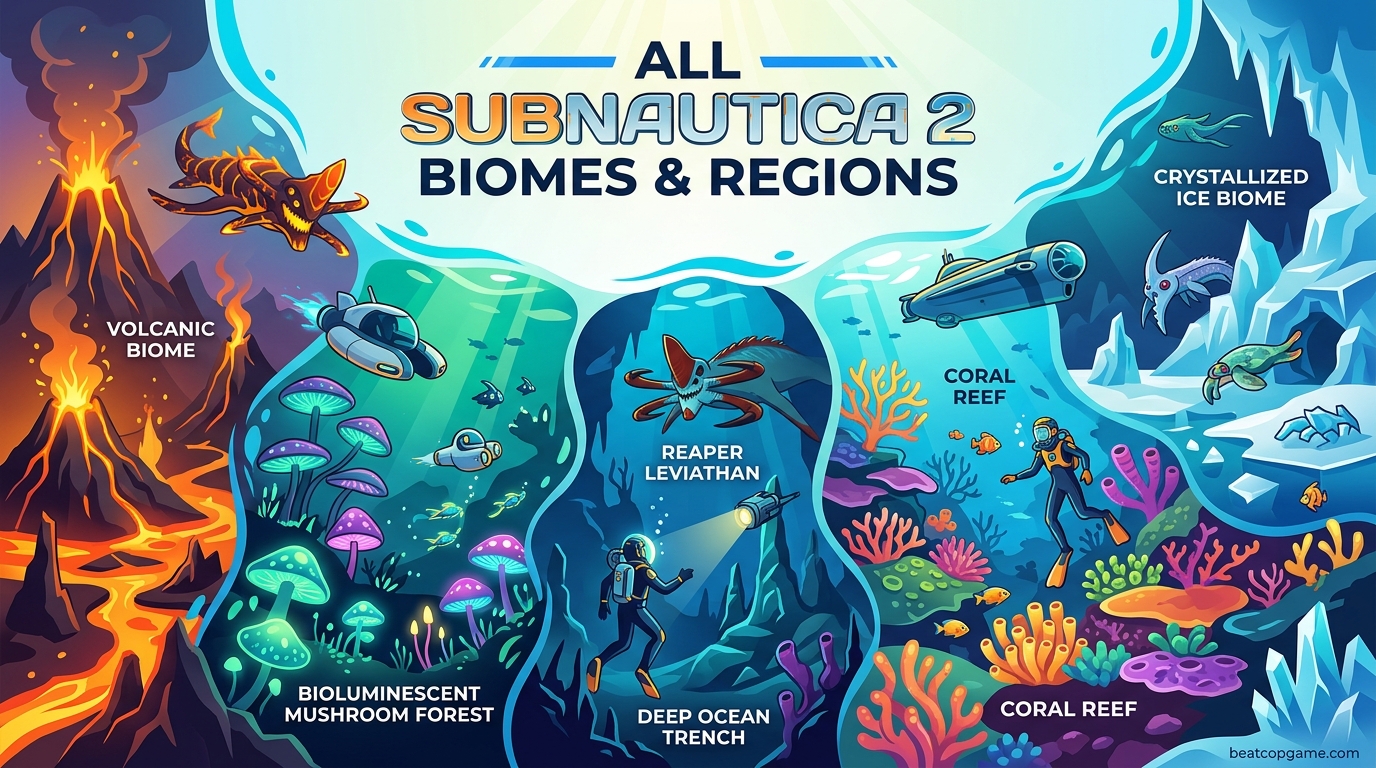
If you are diving into Subnautica 2 for the first time, the sheer scale of the underwater world can feel overwhelming. There are biomes everywhere, each packed with unique creatures, resources, and hidden points of interest that pull you deeper into the story. Our team has spent dozens of hours exploring every corner of the early access build, cataloging every biome we could find along the way.
This guide covers all Subnautica 2 biomes and regions currently available in the game. We break down every biome by region, listing depth ranges, resources, points of interest, and dangers so you know exactly what to expect before you swim in. Whether you are hunting for specific materials like Titanium and Copper or trying to reach the deepest parts of the map, this guide has you covered.
Subnautica 2 currently features two main regions: Coral Gardens and Karakorum. Each region contains several distinct biomes that range from safe, shallow waters to dangerous, heat-filled depths. A third region, the World Tree, is planned for future updates. Let us walk you through every single one.
Table of Contents
Complete List of All Subnautica 2 Biomes
Here is every biome currently available in Subnautica 2, organized by region. We have included depth ranges and key highlights so you can quickly find what you need.
Coral Gardens Region Biomes:
- The Shallows (0-50m) – Starting area, safe, basic resources
- Plateaus / Jelly Barrens (50-150m) – Open terrain, jellyfish-like fauna, mid-tier resources
- Anemone Hills (100-200m) – Colorful anemone formations, moderate resources
- Sandstone Ridges / Lead Zone (150-300m) – Lead-rich area, increased danger
- Tufa Towers (200-350m) – Tall mineral towers, deep exploration required
Karakorum Region Biomes:
- Graveyard (200-400m) – Dark, atmospheric, wreckage and lore elements
- Axum Observatory (300-500m) – Story-critical location, advanced resources
- Power Plant (350-600m) – Heat zones, dangerous fauna, key story progression
- Roots Canyon (250-450m) – Tight canyon passages, unique flora and resources
Additional Areas:
- Cave Biomes (Various depths) – Underground cave systems with rare resources
- World Tree Region (Upcoming) – Endgame content planned for future updates
Coral Gardens Region Overview
The Coral Gardens is the starting region in Subnautica 2 and the area you will spend your first several hours exploring. It stretches from the surface down to roughly 350 meters and is home to five distinct biomes. The overall atmosphere here is bright and vibrant compared to the deeper Karakorum region.
This region is generally safer than Karakorum, making it the ideal place to gather early-game resources like Titanium, Copper, and Quartz. Most of the story setup and tutorial elements happen here as well. You will find your lifepod in this region and begin your journey from the shallower waters before gradually venturing deeper.
Coral Gardens connects to Karakorum through deeper transitional passages. You will know you are entering Karakorum when the water gets noticeably darker and the fauna becomes more hostile. The region also contains multiple cave entrances that lead to underground micro-biomes with rare materials.
The Shallows
The Shallows is your starting biome in Subnautica 2 and the safest area in the entire game. It sits at a depth range of 0 to 50 meters, with warm, clear water and abundant sunlight filtering down from the surface. This is where your lifepod lands and where you will build your first base.
Resources here are basic but essential. You will find plenty of Titanium, Copper, Quartz, and Creepvine samples scattered across the ocean floor. These materials are enough to craft your initial equipment, including the basic oxygen tank, fins, and your first tools. The Shallows also contain small coral formations and kelp forests that provide additional crafting components.
Points of interest include your lifepod, a nearby thermal biome that players have praised for its convenience, and several small wreckage sites that contain blueprints and data logs. There are no hostile creatures in the Shallows, which makes it a great place to learn the game mechanics at your own pace.
For beginners, take your time here. Scan everything you can find, collect resources, and craft basic equipment before venturing into deeper biomes. The Shallows connects directly to the Plateaus biome as you move away from the center of the Coral Gardens region.
Plateaus (Jelly Barrens)
The Plateaus, also known as the Jelly Barrens, is the second biome most players encounter in Subnautica 2. It sits at a depth range of roughly 50 to 150 meters and features wide, open terrain with gently rolling underwater hills. The biome gets its alternate name from the jellyfish-like creatures that float throughout the area.
Resources here are a step up from the Shallows. You will find Silver, Gold, and larger deposits of Quartz alongside the usual Titanium and Copper. The open terrain makes resource gathering straightforward, but you will need a sea glide or basic vehicle to cover the large distances efficiently.
Fauna in the Plateaus is mostly passive. The jellyfish-like creatures pose no threat, and smaller fish swim throughout the area. However, you may occasionally encounter predators that wander in from neighboring biomes. Stay aware of your surroundings, especially near the edges where the biome transitions into deeper areas.
Points of interest include scattered wreckage sites and data terminals that provide lore about the colonists and the world. The Plateaus also serve as a major navigation hub since paths branch off toward the Anemone Hills, Sandstone Ridges, and the deeper Karakorum region from here.
Anemone Hills
The Anemone Hills biome sits at a depth range of approximately 100 to 200 meters and is one of the most visually striking areas in the Coral Gardens region. Large, colorful anemone formations cover the rolling hills, creating a landscape that feels alien yet beautiful. The biome is well-lit compared to deeper areas, making exploration pleasant.
Resources in the Anemone Hills include Celestine, Quartz, and moderate amounts of Silver and Gold. The anemone formations themselves can sometimes be harvested for organic materials used in advanced crafting recipes. You will also find Coral samples and Barnacle deposits on the rock formations scattered throughout the area.
Fauna here is more diverse than in the Plateaus. You will encounter larger herbivorous creatures grazing among the anemones, along with small predators that hunt them. The overall threat level is moderate. Most creatures will not attack unless provoked, but keep an eye on your oxygen supply since the depth requires careful management.
Navigation through the Anemone Hills is relatively straightforward thanks to the distinctive terrain features. Use the tall anemone clusters as landmarks. There are also several cave entrances hidden among the hills that lead to underground areas with rare resources and unique flora not found on the surface.
Sandstone Ridges (Lead Zone)
The Sandstone Ridges, commonly called the Lead Zone by the community, sits at a depth range of 150 to 300 meters. This biome marks the transition point in the Coral Gardens region where things start to feel genuinely dangerous. The terrain features sharp ridges and narrow valleys carved into sandstone rock formations.
This biome is the primary source of Lead in the early game, which is critical for radiation suits and hull reinforcements. You will also find large deposits of Sandstone that yield Gold, Silver, and Diamond when broken down. The resource density here is higher than in shallower biomes, making it worth the extra risk.
The danger level increases noticeably in the Sandstone Ridges. Hostile fauna is more common here, and the narrow valleys can make it difficult to escape if you get cornered. Players frequently mention on forums that this is where the game starts to feel tense. Bring a reinforced dive suit and a weapon if possible.
Points of interest include the Colonist Bunker, which contains important story elements and blueprints. There are also multiple wreckage sites scattered along the ridges that yield technology fragments. The biome transitions into the Tufa Towers at greater depths and connects to the Karakorum region through deep passages.
Tufa Towers
The Tufa Towers is the deepest biome in the Coral Gardens region, sitting at a depth range of approximately 200 to 350 meters. It features massive, towering mineral formations that rise from the ocean floor like underwater skyscrapers. The visual spectacle here is impressive, with the towers creating a labyrinthine environment to explore.
Resources in the Tufa Towers are excellent. You will find high concentrations of rare materials including Lithium, Diamond, and deep-sea mineral deposits. The towers themselves can be mined for unique minerals used in late-game blueprints. Bring a vehicle with good depth capabilities to make the most of this area.
The fauna here is more dangerous than anywhere else in the Coral Gardens region. Larger predators patrol between the towers, and visibility can drop in certain areas. The tight spaces between tower formations mean you need to be careful about getting lost. Always carry beacons and mark your entry points.
Points of interest include several large wreckage sites that contain advanced technology fragments and a hidden Angel Comb formation that players have discovered through exploration. The Tufa Towers also contain cave entrances that lead to micro-biomes with exclusive resources. This is a high-reward area for players who come prepared.
Karakorum Region Overview
The Karakorum region is the deeper, darker, and more dangerous half of Subnautica 2’s current map. It starts at around 200 meters and extends down to 600 meters and beyond. If Coral Gardens feels like a vibrant coral reef, Karakorum feels like an abyss. The water is colder, visibility is lower, and the creatures are bigger and meaner.
Four main biomes make up the Karakorum region: the Graveyard, Axum Observatory, Power Plant, and Roots Canyon. Each biome has its own distinct character, but they all share a darker, more oppressive atmosphere compared to the Coral Gardens. You will need upgraded vehicles and equipment to explore safely.
Story progression is heavily tied to this region. Many of the major plot points, colonist encounters, and technology unlocks happen in Karakorum. The Proteavirus storyline, cybernetic adaptations, and encounters with the tadpole diver all connect to this area. Come prepared with radiation protection, reinforced suits, and plenty of oxygen capacity.
The transition into Karakorum is unmistakable. As you swim deeper from the Coral Gardens, the color palette shifts from bright blues and greens to dark teals and near-black depths. The temperature rises near the Power Plant biome, and you will start seeing thermal vents. This is where the game really tests your preparation and survival skills.
Graveyard
The Graveyard biome sits at a depth range of roughly 200 to 400 meters and is the first Karakorum biome most players encounter. The name is fitting. The ocean floor here is littered with wreckage, debris, and skeletal remains of massive creatures. The atmosphere is haunting, with low visibility and an eerie sense of scale.
Resources in the Graveyard include advanced materials like Titanium in large quantities, Copper, Silver, and rare organic compounds found near the skeletal remains. The wreckage sites scattered throughout the biome contain technology blueprints and data logs that advance the story. You will spend a lot of time scanning here.
Fauna in the Graveyard is hostile and territorial. Large predators roam between the wreckage sites, and the low visibility means you may not see them until they are close. The community has noted that this biome feels like a significant difficulty spike. A sea glide is essential for quick escapes, and a reinforced dive suit will save your life.
Points of interest are abundant here. Major wreckage sites contain critical blueprints for vehicle upgrades and base modules. There are also lore terminals that reveal information about the colonists and what happened before you arrived. The Graveyard connects directly to the Axum Observatory and serves as a gateway to the deeper Karakorum biomes.
Axum Observatory
The Axum Observatory is one of the most story-critical biomes in Subnautica 2, sitting at a depth range of approximately 300 to 500 meters. This area contains the remains of a massive research facility that once served as the central hub for the colonists. The architecture is partially intact, creating eerie underwater corridors and chambers to explore.
Resources here include advanced technology components salvaged from the observatory structure itself. You will find computer chips, wiring kits, and rare minerals embedded in the facility walls. The observatory also contains storage rooms with pre-fabricated materials and data banks full of research notes and story information.
The observatory is a major story location. Exploring its corridors reveals what happened to the colonists, the nature of the Proteavirus, and the purpose of the research conducted here. The Tadpole Diver makes appearances in this area, and several key plot moments unfold within these walls. Take your time and read every data log you find.
Fauna is moderately dangerous in the observatory. The enclosed spaces mean encounters can feel claustrophobic, and some creatures have adapted to the facility environment. However, the main threat comes from the depth itself. At 300 to 500 meters, you need a vehicle with appropriate depth ratings. Running out of oxygen inside a flooded corridor is a real danger.
Power Plant
The Power Plant biome is the deepest and most dangerous area currently accessible in Subnautica 2, sitting at a depth range of approximately 350 to 600 meters. As the name suggests, this area is built around a massive thermal power generation facility. The water is hot, the lighting is harsh, and everything here wants to kill you.
Heat zones are the defining feature of this biome. Thermal vents and superheated water pockets create areas that will damage you if you swim through them without proper protection. You need a reinforced thermal suit to explore safely. The heat also affects vehicles, so make sure your submarine has thermal shielding upgrades installed.
Resources in the Power Plant are among the best in the game. Kyanite, Nickel, and other rare minerals spawn here in significant quantities. The facility itself contains advanced technology blueprints that are essential for endgame progression. If you want the best equipment in the game, you need to brave this biome.
Fauna here is the most aggressive in the entire game. Leviathan-class creatures patrol the deeper sections, and the thermal vents attract hostile predators adapted to extreme heat. The community consistently ranks this as the most dangerous biome in early access. Bring your best vehicle, maximum oxygen capacity, and a plan for quick escapes.
Story-wise, the Power Plant is where the game’s central mysteries start to converge. The facility was clearly central to the colonists’ operations, and exploring it reveals critical information about the world and your place in it. This biome is essential for completing the current story content in early access.
Roots Canyon
Roots Canyon sits at a depth range of roughly 250 to 450 meters and offers a unique biome experience within the Karakorum region. The area is defined by massive root-like structures that wind through deep canyon walls, creating a maze of interconnected passages. The roots appear to be organic in origin, though their exact nature is part of the game’s mystery.
Resources in Roots Canyon include organic materials harvested from the root structures, along with mineral deposits embedded in the canyon walls. You will find Copper, Silver, and Gold here, along with unique organic compounds used in advanced biomedical crafting. The canyon structure also creates natural traps for sediment, sometimes concentrating resources in certain spots.
Navigation is the primary challenge in Roots Canyon. The winding passages can disorient even experienced players, and many paths lead to dead ends or drop-offs into deeper water. The community recommends placing beacons at every junction to avoid getting lost. The tight passages also limit vehicle access, so you may need to explore on foot in some areas.
Fauna in Roots Canyon is unique. The root structures attract specialized creatures not found elsewhere in the game. Some are passive and feed on the organic material, while others are ambush predators that hide among the roots. Move slowly and keep your scanner active to detect threats before they detect you. The canyon also contains hidden chambers with rare loot for thorough explorers.
Cave Biomes in Subnautica 2
Cave biomes deserve their own section because they cut across both the Coral Gardens and Karakorum regions. These underground systems exist at various depths and often contain resources and creatures you will not find anywhere else. Every major surface biome has at least one cave entrance, and some caves connect different biomes together.
Cave biomes in the Coral Gardens tend to be shallower and less dangerous. They contain resources like Quartz, Lithium, and sometimes rare mineral formations. The Shallows caves are perfect for beginner exploration since they are small and close to the surface. As you move into deeper biomes, the caves get larger, darker, and more dangerous.
Karakorum cave systems are where things get intense. These caves are deeper, more complex, and often contain hostile creatures that have adapted to the dark environment. However, the rewards are significant. Rare resources like Kyanite and Nickel can be found in deep cave deposits, and some caves hide unique points of interest including hidden research stations and lore terminals.
Our top tip for cave exploration is to always bring extra oxygen tanks and a sea glide. Caves can disorient you quickly, and running out of oxygen in a tight underground passage is one of the most common ways players die. Place beacons at cave entrances and at major junctions inside. The rebreather module is also highly recommended for extended cave runs.
World Tree Region (Upcoming Content)
The World Tree is a planned region for Subnautica 2 that has not yet been fully released in early access. Based on information from developer updates and community data mining, this region is expected to serve as the endgame area. It appears to be connected to the deeper parts of the Karakorum region, possibly extending below 600 meters.
Details are limited, but the community has identified references to massive tree-like structures and bioluminescent environments. The World Tree seems connected to the central lore of the game, potentially tying together the Proteavirus storyline, the colonists’ fate, and the mysterious organic structures found throughout the map.
Some players have found what appears to be the entrance to the World Tree region near the deepest parts of the Power Plant biome, but the area is currently blocked off or incomplete. Based on the early access roadmap, this region will likely be added in a future major update along with new creatures, resources, and story content.
If you want to stay updated on World Tree developments, keep an eye on the official Unknown Worlds development blog and community forums. The early access roadmap suggests this content is a priority for upcoming patches. When it arrives, expect it to be the most challenging and rewarding area in the game.
Coral Gardens vs Karakorum: Region Comparison
Understanding the differences between the two main regions in Subnautica 2 helps you plan your exploration more effectively. Here is a direct comparison of everything that matters.
Depth: Coral Gardens spans from 0 to 350 meters, while Karakorum extends from 200 to 600+ meters. Karakorum is significantly deeper and requires upgraded vehicles and equipment.
Safety: Coral Gardens is the safer region overall. Only the Tufa Towers and parts of the Sandstone Ridges pose serious threats. Karakorum is dangerous throughout, with the Power Plant being the most hostile biome in the game. If you are new, stick to Coral Gardens until your equipment is upgraded.
Resources: Coral Gardens provides all the basic and mid-tier resources you need for early progression. Titanium, Copper, Lead, Quartz, and Silver are all readily available. Karakorum offers advanced resources like Kyanite, Nickel, and rare organic compounds that are essential for late-game blueprints and vehicle upgrades.
Story Content: Coral Gardens contains the tutorial elements, initial story setup, and early colonist lore. Karakorum holds the major story revelations, the Proteavirus investigation, and the most significant plot developments currently in the game. Both regions are necessary for full story progression.
Recommended Order: Start in Coral Gardens and explore every biome thoroughly. Gather resources, scan everything, and upgrade your equipment. Once you have a vehicle capable of reaching 300+ meters and a reinforced dive suit, begin exploring Karakorum. The Graveyard and Roots Canyon are good starting points in Karakorum before tackling the Observatory and Power Plant.
Tips for Navigating Subnautica 2 Biomes
One of the biggest challenges players face in Subnautica 2 is navigation. The game does not have a traditional in-game map, which the community frequently mentions as a pain point. Here are practical tips we have gathered from dozens of hours of exploration.
Use Beacons Liberally: Craft beacons as early as possible and place them at every major point of interest. Label them clearly with the biome name and what you found there. This creates your own personal navigation system that you can see from anywhere on the map.
Learn Biome Transitions: Each biome has distinct visual characteristics. The Shallows are bright and warm, the Plateaus are open and blue, the Anemone Hills are colorful, and so on. Pay attention to these visual shifts because they tell you when you are entering a new area. The transition into Karakorum is especially obvious with the color palette shift to darker tones.
Follow the Depth: In general, biomes get progressively more dangerous as you go deeper. If you are running into hostile creatures or heat zones, you have probably gone too deep for your current equipment level. Head back to shallower water, upgrade your gear, and try again.
Mark Cave Entrances: Cave biomes are easy to miss and hard to find again. Whenever you discover a cave entrance, drop a beacon immediately. Caves often contain rare resources and unique points of interest that you will want to revisit later.
Build Waypoint Bases: Small, minimal bases at biome boundaries serve as safe havens and navigation landmarks. A single multipurpose room with a power source and fabricator can be a lifesaver when you are exploring far from your main base.
Frequently Asked Questions
What are all the biomes in Subnautica 2?
Subnautica 2 currently has 9 main biomes across two regions. Coral Gardens contains The Shallows, Plateaus (Jelly Barrens), Anemone Hills, Sandstone Ridges (Lead Zone), and Tufa Towers. Karakorum contains the Graveyard, Axum Observatory, Power Plant, and Roots Canyon. There are also cave biomes throughout both regions, and the World Tree region is planned for future updates.
Will Subnautica 2 be bigger than Subnautica 1?
Yes, based on community measurements and developer statements, Subnautica 2 features a larger map than the original game. Players describe the map as gigantic, with more vertical depth and greater distance between biomes. The addition of cave systems and planned future regions like the World Tree will make it even larger over time.
What is the deepest biome in Subnautica 2?
The Power Plant biome in the Karakorum region is currently the deepest accessible area, reaching depths of approximately 600 meters. This biome features extreme heat zones and the most dangerous creatures in the game. The upcoming World Tree region is expected to extend even deeper when it is released in a future update.
Will Subnautica 2 have a map?
Subnautica 2 does not currently have a traditional in-game map, similar to the first game. Players must rely on beacons, landmarks, and visual biome characteristics to navigate. The community has created text-based biome maps and fan-made interactive tools to help with navigation. There is no official word on whether an in-game map will be added in future updates.
How many regions are in Subnautica 2?
Subnautica 2 currently has two main regions: Coral Gardens and Karakorum. A third region called the World Tree is planned for future early access updates. Each region contains multiple biomes with unique environments, resources, and creatures. The Coral Gardens region has 5 biomes and Karakorum has 4 biomes as of the current early access build.
Which biome is best for beginners in Subnautica 2?
The Shallows is the best biome for beginners in Subnautica 2. It is the starting area where your lifepod lands, with a depth range of 0 to 50 meters and no hostile creatures. The Shallows provides all the basic resources you need to get started, including Titanium, Copper, and Quartz. Spend time here learning the mechanics before venturing into deeper biomes like the Plateaus or Anemone Hills.
Conclusion
Subnautica 2 biomes offer one of the most rewarding exploration experiences in gaming right now. With nine distinct biomes spread across the Coral Gardens and Karakorum regions, there is always something new to discover whether you are a first-time player or a returning veteran. From the peaceful Shallows to the dangerous depths of the Power Plant, every biome has its own personality, resources, and stories waiting to be uncovered.
Keep in mind that Subnautica 2 is still in early access, and Unknown Worlds has plans to expand the world with additional regions like the World Tree. The biomes covered in this guide reflect the current state of the game, but expect new areas, creatures, and resources as updates roll out. We will keep this guide updated as new content drops so you always have the most accurate information.
If you found this guide helpful, bookmark it for future reference as you explore deeper into the world. Every biome in Subnautica 2 rewards careful exploration, so take your time, scan everything, and enjoy the journey into the deep.