
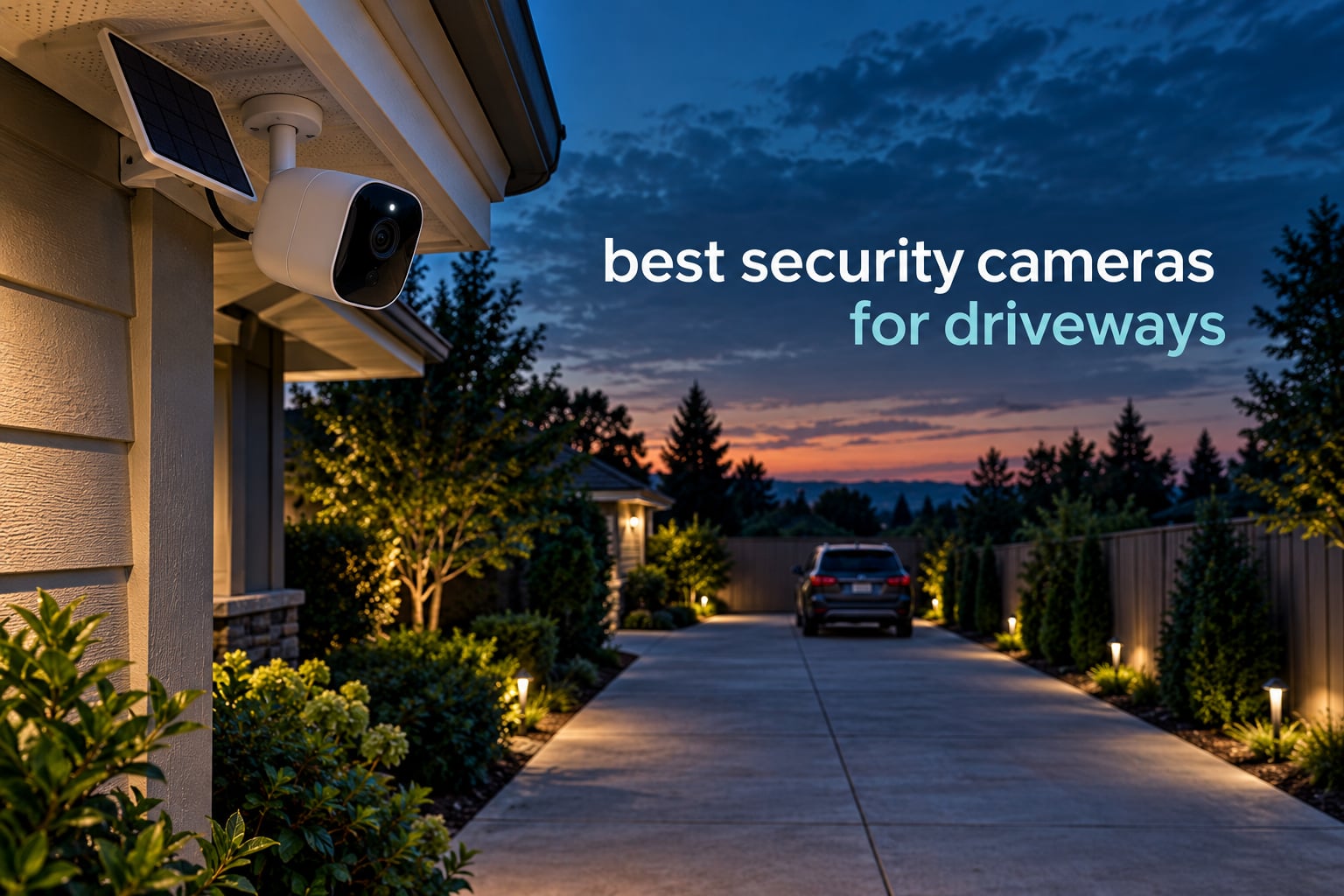
A driveway is the widest, brightest, and least defended part of most properties. It is also the route that a vehicle thief, a package thief, or someone testing your front door takes every single time. Most of the cameras people already own point at the wrong thing: the doorbell camera watches a porch, and the indoor camera watches a living room.
Choosing the best security cameras for driveways is a different job than choosing a camera for a front door. A driveway view is wide, often unlit, and frequently framed against the sky rather than against a wall. What matters is how far the lens reaches into the dark, whether the sensor can hold a license plate at the point where a car stops, whether the power and the Wi-Fi actually reach that far, and whether the footage still exists three days later when you notice a car is gone.
Our overall pick is the Ring Floodlight Cam Wired Plus, because light plus continuous power plus a fixed view solves three driveway problems at once. If your priority is reading plates rather than scaring people off, the Tapo C660 KIT does it with a 4K sensor and no monthly fee. Everything below is broken down by the situation you are actually trying to cover.
We also wrote broader roundups on security cameras in general, outdoor security cameras, and solar security cameras if you want to compare beyond the driveway use case.
Top 3 Picks for Best Security Cameras for Driveways (October 2026)

Ring Floodlight Cam Wired Plus
- 2000-lumen motion floodlights
- 1080p HD
- hardwired continuous power
- 85dB siren
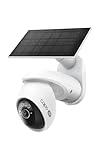
Tapo C660 KIT 4K Solar
- 4K 8MP sensor
- 360 pan and 98 tilt
- solar charging
- no subscription for detection

Best Security Cameras for Driveways Compared in 2026
| Product | Specifications | Action |
|---|---|---|
| Ring Floodlight Cam Wired Plus |
|
Check Latest Price |
| Tapo C660 KIT 4K Solar |
|
Check Latest Price |
| REOLINK Duo 3 PoE |
|
Check Latest Price |
 eufy Security SoloCam S340 eufy Security SoloCam S340 |
|
Check Latest Price |
 Ring Outdoor Cam Stick Up Cam Ring Outdoor Cam Stick Up Cam |
|
Check Latest Price |
 Blink Outdoor 4 three-camera system Blink Outdoor 4 three-camera system |
|
Check Latest Price |
 REOLINK Argus Eco with 3W solar panel REOLINK Argus Eco with 3W solar panel |
|
Check Latest Price |
 ZEEPORTE Solar 2K Pan and Tilt ZEEPORTE Solar 2K Pan and Tilt |
|
Check Latest Price |
 aosu D1 Classic four-camera kit aosu D1 Classic four-camera kit |
|
Check Latest Price |
 REOLINK RLC-810A 4K PoE REOLINK RLC-810A 4K PoE |
|
Check Latest Price |
 Blink Wired Floodlight Camera Blink Wired Floodlight Camera |
|
Check Latest Price |
 REOLINK RLC-811A 5X optical zoom REOLINK RLC-811A 5X optical zoom |
|
Check Latest Price |
How We Picked
We scored every camera here on six things, weighted for the driveway specifically rather than for general home security.
Coverage and identification (30%): sensor resolution, field of view, and whether the lens can hold detail on a person or a plate at realistic driveway distances.
Night performance (20%): stated infrared range, aperture, and whether a color spotlight or floodlight removes the black-and-white guesswork.
Power reliability (15%): whether the camera keeps recording through a cold week, a power cut, or a long cable run.
Storage and running cost (15%): what a five-year ownership picture looks like on local storage versus a cloud plan.
False-alert behaviour (10%): on-device person and vehicle detection, adjustable zones, and how owners describe alert noise.
Weatherproofing and mounting (10%): the IP rating and whether the housing suits an exposed soffit, eave, or wall mount.
Specifications come from the manufacturer listings, and the pros and cons come from the pattern in owner reviews rather than from a spec sheet alone. Review volume is high in this category and much of it is about app behaviour rather than image quality, so we weighted owner feedback most heavily on the storage and alert sections. If you want a broader baseline before reading, our roundup of wireless security cameras covers the battery and hub ecosystems in more depth.
1. Ring Floodlight Cam Wired Plus: Best Active Deterrence Pick
Ring Floodlight Cam Wired Plus, Outdoor Home or Business Security with Motion-Activated 1080p HD Video and Floodlights, White
2000-lumen floodlights
1080p HD video
85dB siren
Hardwired for continuous power
Pros
- Bright motion-activated lights flood a whole driveway
- Motion detection is accurate rather than noisy
- Hardwired so there is no battery to service
- Custom motion zones and brightness control
- All mounting hardware and a multi-tool included
Cons
- Fixed camera with no pan tilt or zoom
- Light control is limited to simple on/off and brightness
- Video history and advanced alerts need Ring Protect
This is the camera I recommend when the goal is to stop someone rather than film them. Two thousand lumens of motion-activated LED light turns a dark driveway into a lit one at the exact moment a person walks in, and the 85dB siren gives you something to trigger from the app. Because it is hardwired, it does not care about battery drain in February.
Owners consistently describe installation as quick: you scan a QR code, connect it to your existing outdoor light wiring, and mount it over a junction box. The floodlight output is the feature people mention first, because a driveway with no house light in range is the normal case.
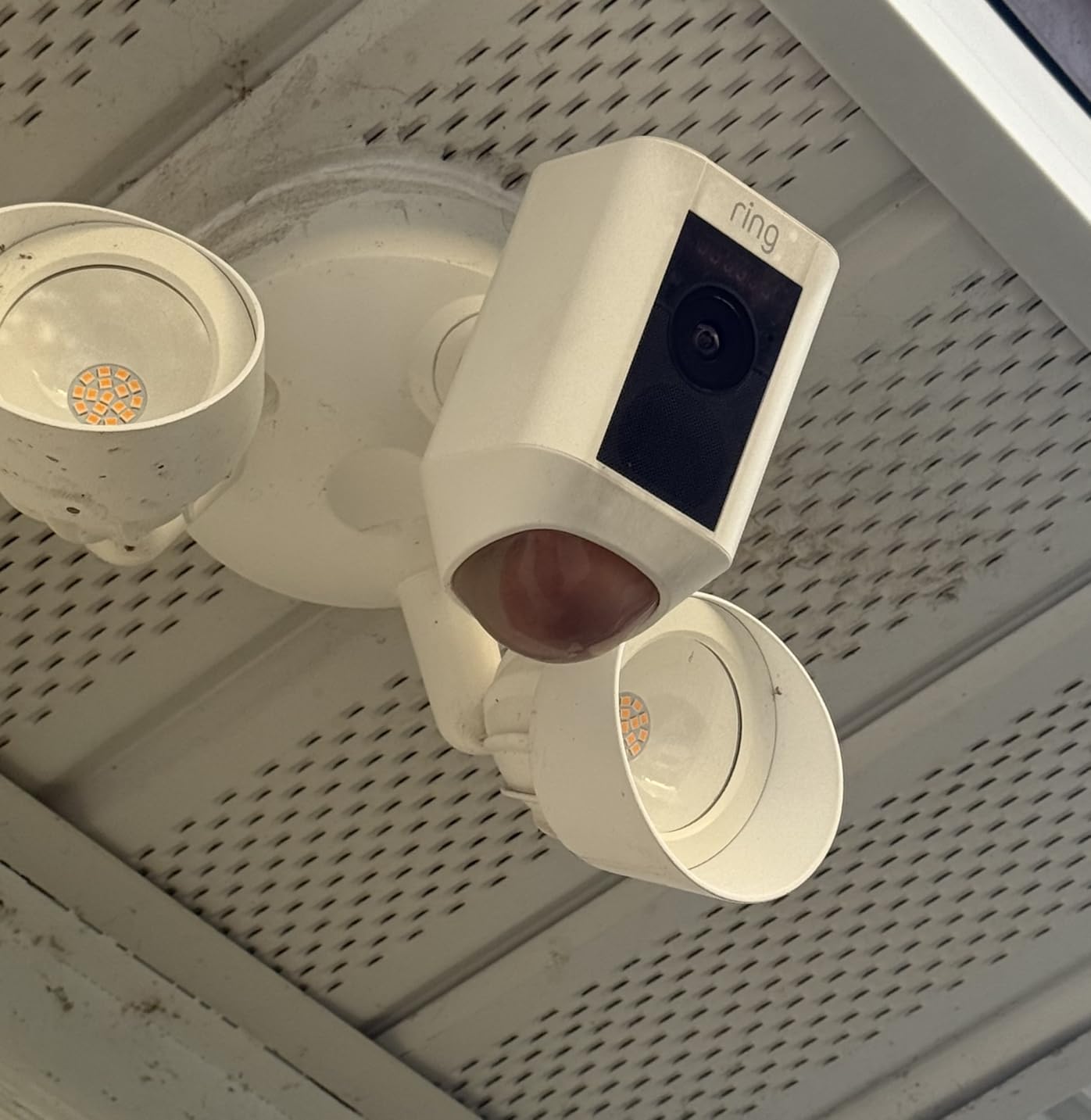
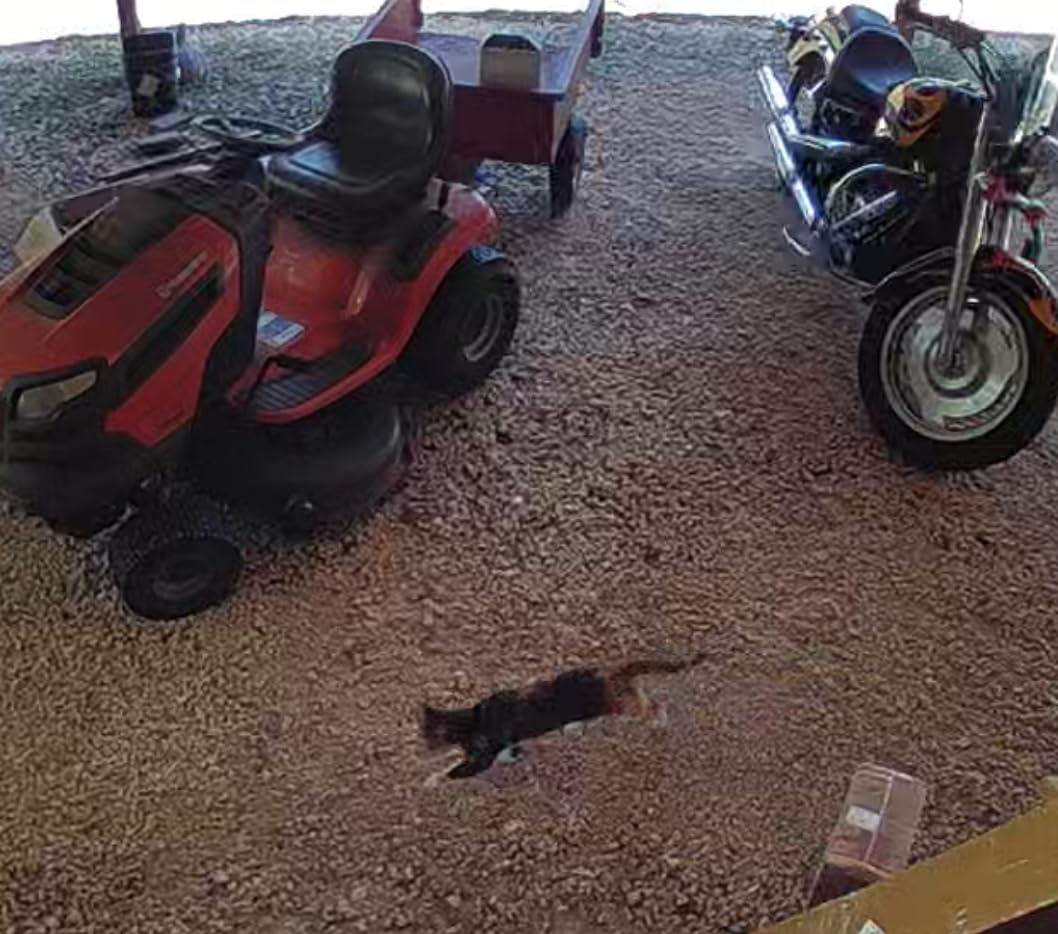
The 1080p sensor holds up in daylight and the colour night mode keeps vehicle shapes readable close to the house. Motion detection is the part that surprised me most positively in the reviews: it is described as smart and low-noise, with zones you can draw to ignore the street side of the frame.
The trade is flexibility. This is a fixed bullet-style body, so the angle you choose at install is the angle you keep, and the light behaviour cannot be dialled down to a dim glow before full brightness. You can adjust brightness and scheduling, but there is no dim-then-brighten-on-motion sequence.
Who this camera suits
It suits a suburban driveway where there is existing outdoor wiring, an outlet or a junction box nearby, and a real chance of someone walking up rather than a car passing at speed. The light is the deterrent, and the deterrent is what stops opportunistic theft.
It also suits anyone who has been annoyed by dead batteries. Continuous mains power means the camera records as long as the circuit is live, with no charging discipline.
Who should skip it
Skip it if you need to identify a vehicle at range rather than scare one off. 1080p across a long driveway produces a recognisable vehicle shape, but not a reliably readable plate at 60 feet or more.
Skip it if you have no outdoor wiring at the mounting point, or if you rent and cannot drill into a junction box. Also skip it if you refuse cloud services entirely: video history beyond live view is a Ring Protect feature, so without a plan your recording history is very short.
2. Tapo C660 KIT 4K Solar: Best Pick for Reading License Plates
Tapo 4K Outdoor Pan/Tilt Wireless Security Camera, Solar Charging, C660 KIT
4K 8MP sensor
360 pan and 98 tilt
10000 mAh battery plus solar
Dual-band Wi-Fi
Pros
- 4K detail sharp enough for plates and faces
- 360 pan with 98 tilt and auto-patrol tracking
- Supports both 5 GHz and 2.4 GHz Wi-Fi
- Solar panel needs about 45 minutes of daily sun
- 24/7 continuous capture at 1-60s intervals
- On-device person vehicle and pet detection with no fee
Cons
- Continuous recording needs a microSD card or H500 hub sold separately
- Field of view is wider than the mechanical pan range
- Solar panel must get about 45 minutes of direct sun
This is the camera for the question we hear most: can a driveway camera actually read a plate? A true 8MP 4K sensor at 15 or 20 frames per second gives you roughly four times the pixel count of 1080p, and owners specifically report reading plates and faces across a driveway with this model.
It also solves the two annoyances that push people toward older budget brands. It is dual-band, so it pairs on 5 GHz as well as 2.4 GHz, and the person, vehicle, and pet detection runs on the device, so alerts are not billed to a subscription.
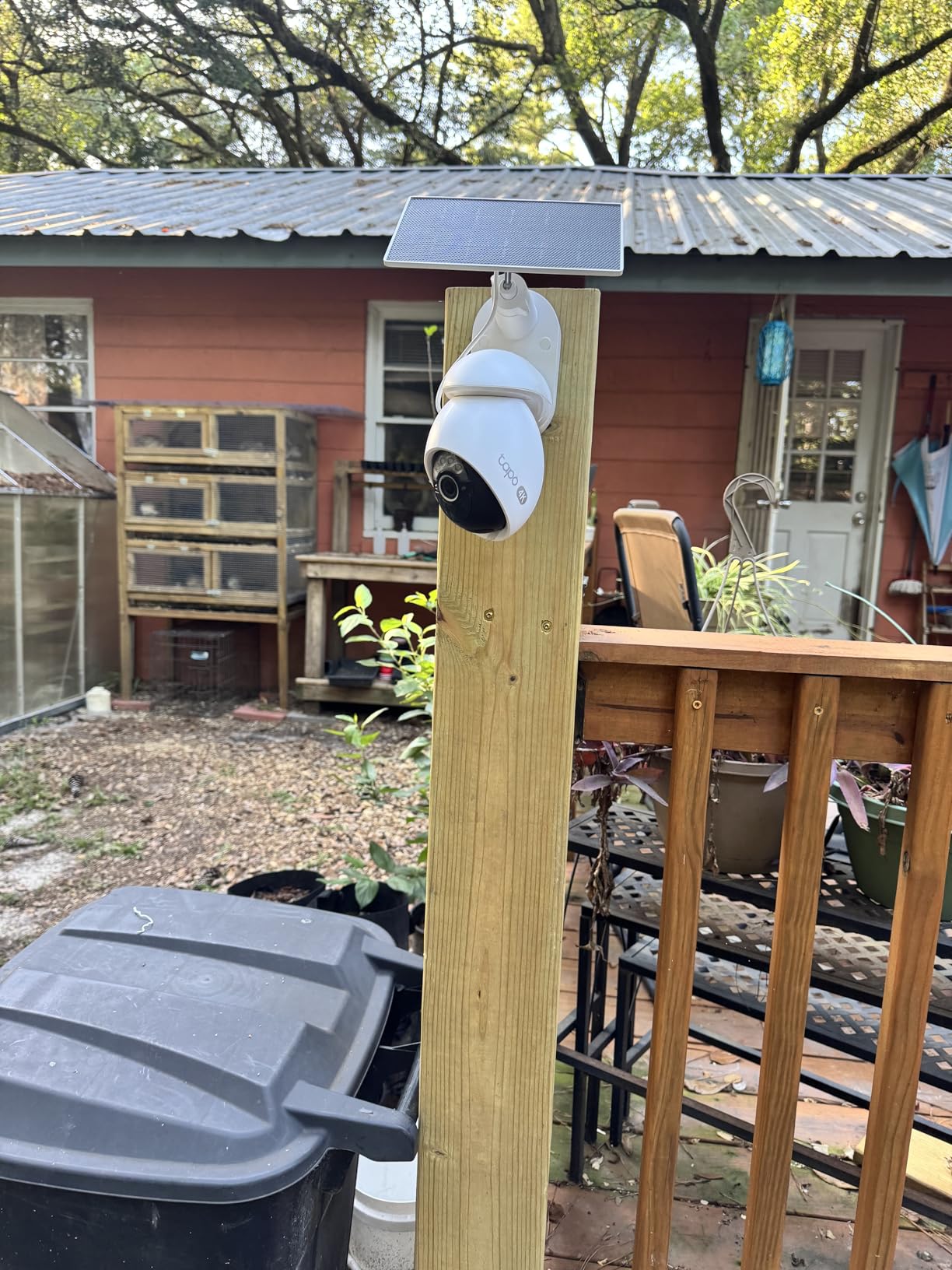
The 360-degree pan and 98-degree tilt with auto-patrol is a real advantage on a wide drive, because one dome can replace two fixed cameras. Smart motion tracking follows a vehicle across the frame rather than leaving you to chase it through a timeline.
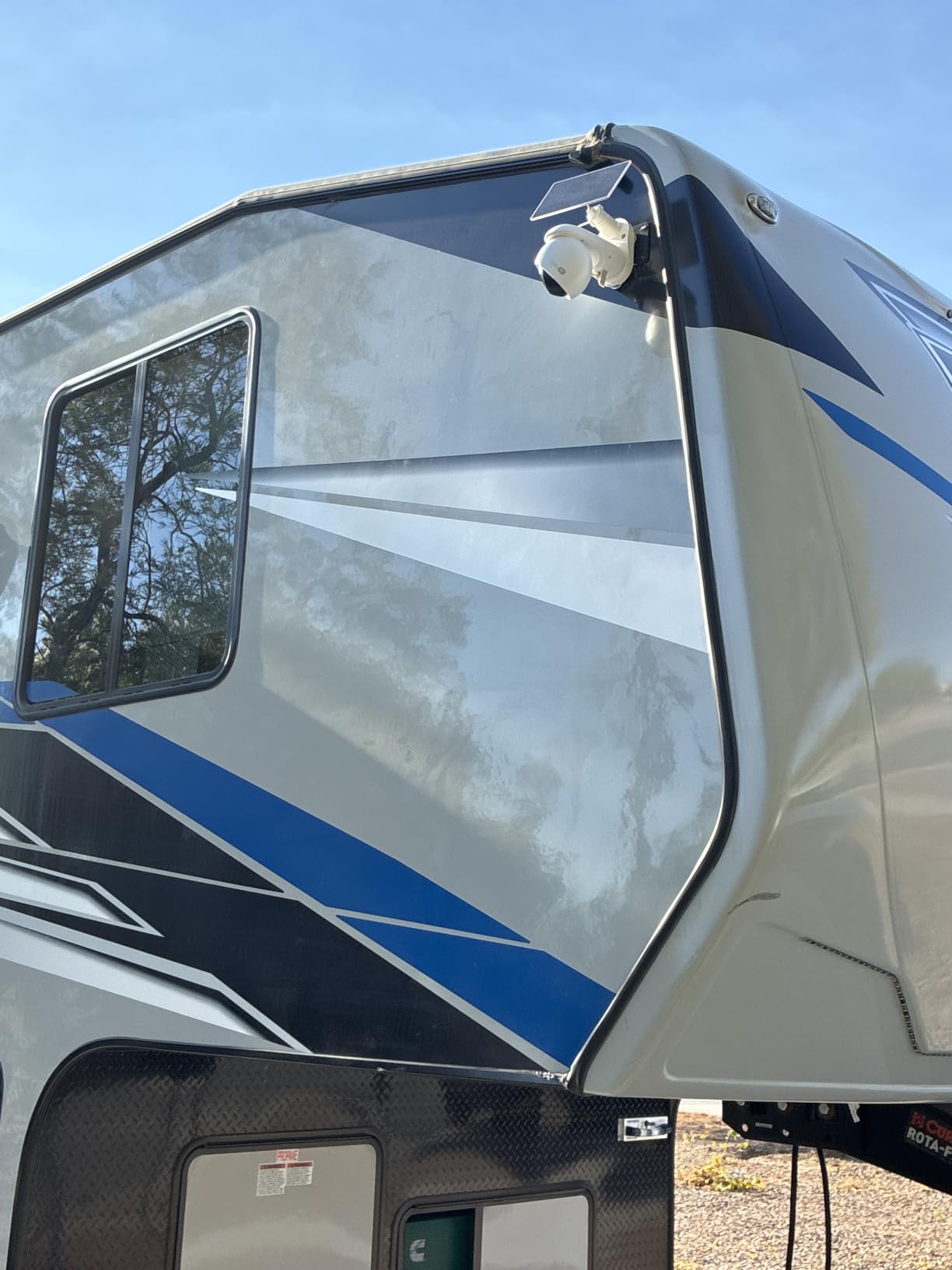
Battery is a 10000 mAh lithium-ion pack with a Tapo A201 solar panel and a 13 foot cable in the box, which means you can put the panel on a sunny roof edge and the camera in shade. Continuous capture is adjustable from 1 to 60 second intervals, which is the feature 1080p-only competitors in this group simply do not offer.
Who this camera suits
It suits a driveway where you want evidence, not just a notification: a vehicle is parked outside, a contractor arrives, or a theft is discovered days later. When a plate has to go into a police report, the 4K sensor is the difference between a usable still and a grey rectangle.
It also suits anyone on a modern dual-band router who has fought 2.4 GHz-only cameras, and anyone who wants continuous recording without paying a monthly fee for it.
Who should skip it
Skip it if you need storage included. The kit ships with no microSD card and no hub, so real 24/7 capture means buying a card up to 512 GB or pairing the camera with an H500 CentralHub and a 2.5 inch drive.
Skip it if the mounting spot gets little direct sun or if you need to narrow the view after installation. The stated field of view is a little wider than the physical pan and tilt range, so there are small edges you cannot aim at, and there is no optical zoom on this body.
3. REOLINK Duo 3 PoE: Best Pick for a Wide Open Driveway
REOLINK Duo 3 PoE Dual-Lens PoE Security Camera with 180° Panoramic View
16MP from dual 4K sensors
180 panoramic stitched view
F1.6 aperture
100 ft night vision
Pros
- Highest pixel count in this group at 16MP
- 180 degree stitched view without fisheye distortion
- F1.6 aperture gives strong colour at night
- Motion Track shows a subject path in one image
- Person vehicle and animal detection cuts false alarms
- Single-cable PoE for power and data
Cons
- PoE switch NVR or injector not included
- Stitched view cannot be narrowed after installation
- Costs more than single-lens 4K PoE models
A standard bullet camera covers a wedge. The Duo 3 covers a hemisphere: two 4K sensors are stitched into a single 16MP image with a 180-degree field of view, and owners consistently point to the reduced distortion as the reason they bought it. On a wide suburban drive with a gate at the far end, that is the difference between one camera and two.
The F1.6 aperture is the quiet hero here. Larger apertures gather more light, and in reviews this is the model that produces usable colour rather than grey infrared at night, which matters when you are trying to describe clothing or vehicle paint.
Motion Track is a genuinely useful feature for driveway work: instead of scrubbing through footage, the app draws the complete path of a subject across a single frame. Combined with person, vehicle, and animal detection, that is a fast way to find the ten seconds that matter after an alert.
Power and data run on one PoE cable, so there is no battery and no Wi-Fi dependency. Recording goes to microSD up to 512 GB, an NVR, or an FTP server, with no subscription involved.
Who this camera suits
It suits long, wide approaches: a drive with a gate, a four-car driveway, or a property where you want one ceiling mount to see the full length. It also suits anyone who is done with infrared-only night footage and wants colour without adding a separate floodlight.
It suits owners who already have, or plan to add, a PoE switch or NVR, since power over Ethernet is the most reliable long-run install available.
Who should skip it
Skip it if you want one camera you can re-aim later. The dual-lens position is fixed at install and the stitched view cannot be narrowed to a single 4K stream afterwards, so the zoom decision is permanent.
Skip it if you have no plan for PoE hardware or no appetite for running cable. The switch, NVR, or injector and the DC adapter are all sold separately, and that hardware is where most of the real cost of this camera lives.
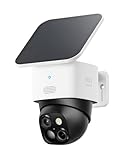
4. eufy Security SoloCam S340: Best Pick for Solar 360 Coverage
eufy Security SoloCam S340, 3K Dual-Lens Solar Security Camera
3K dual-lens with 8x zoom
360 pan and tilt
Removable solar panel
10000 mAh battery
Pros
- 3K dual-lens with 8x hybrid zoom and 40 ft detection
- 360 pan and tilt removes driveway blind spots
- Removable panel plus 10000 mAh battery
- 8 GB built-in local storage with no monthly fee
- Fast wire-free installation
- AI tracking with color night vision
Cons
- Only 8 GB built-in storage limits continuous recording
- Solar panel needs a genuinely sunny position
- Cloud and expanded storage are separate add-ons
This is the one-unit answer to a driveway with awkward corners. The 360-degree pan and tilt removes the blind spot that fixed bullets leave beside a garage wall, and the dual 3K lenses give you 8x hybrid zoom for pulling detail off a vehicle in the far corner.
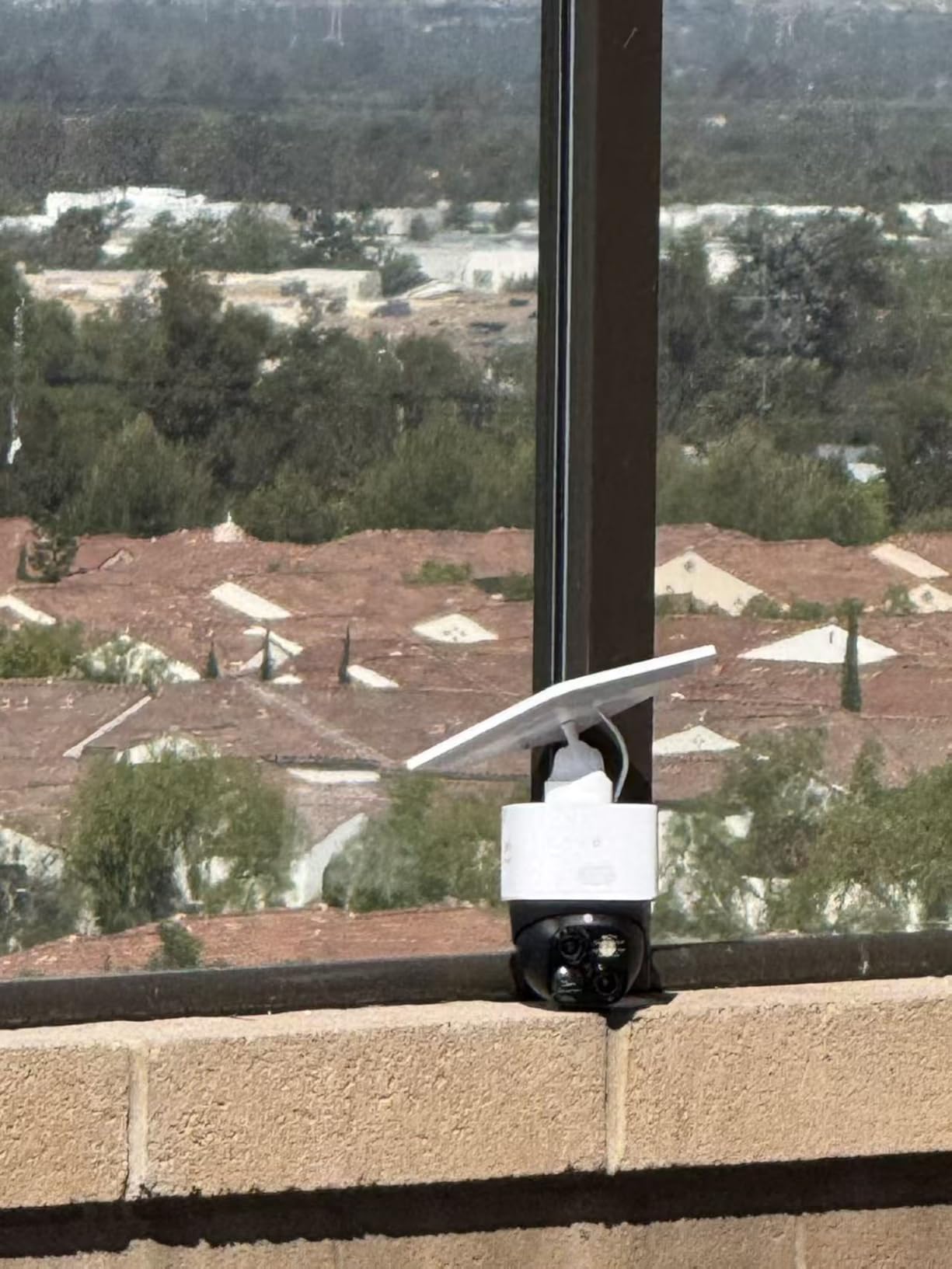
The removable solar panel is a practical upgrade over integrated panels, because you can mount it on the sunniest surface you own and run power across with a cable rather than orienting the whole camera toward the sun.
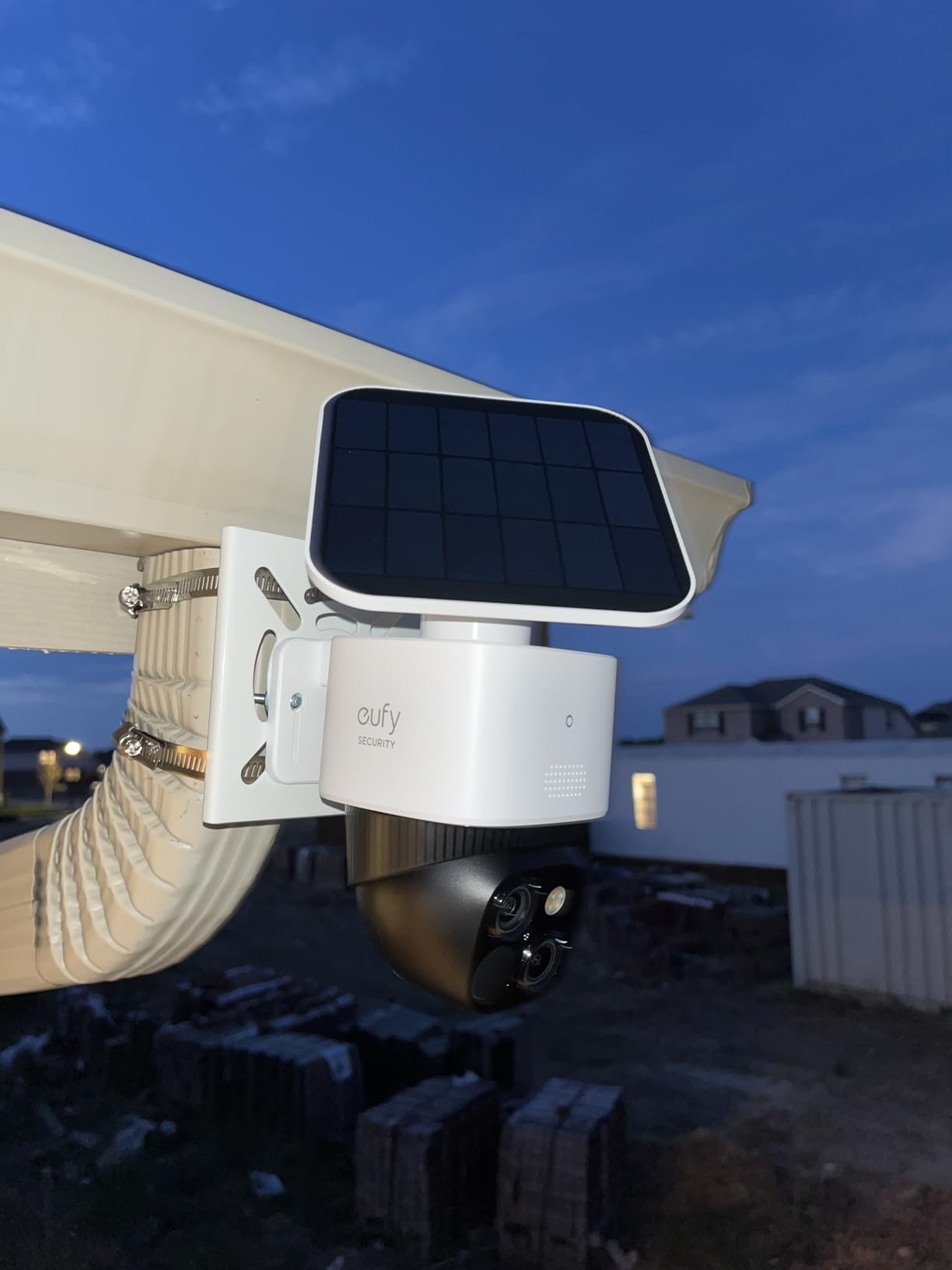
The part that keeps coming up in reviews is the subscription-free storage. Eight gigabytes is not a lot, but it records locally without a plan, which puts this camera ahead of most floodlight and battery models in this group for anyone who objects to recurring fees.
Installation is genuinely fast. There is no hub, no base station, and no wiring to the mains, which makes this the easiest 360 solar unit here to add to a rental or an older property.
Who this camera suits
It suits a wide drive where one fixed camera would leave a gap, and it suits people who want rotation rather than a narrow cone. AI tracking plus colour night vision helps when the interesting area moves: a car circling, a person testing the side gate, a dog walker versus a stranger.
It also suits anyone without a power outlet at the driveway, since the 10000 mAh battery and panel handle the whole job.
Who should skip it
Skip it if you plan to record continuously for weeks. Eight gigabytes fills quickly at 3K, and the larger storage options are add-ons, so this is a motion-recording camera rather than a full surveillance recorder.
Skip it if the mounting position is shaded. The panel is the power source in practice, and a north-facing eave in winter will mean regular manual charging.
5. Ring Outdoor Cam (Stick Up Cam): Best Pick for a Quick Battery Setup
Ring Outdoor Cam (Stick Up Cam), Weather-Resistant Home or Business HD Security Camera, Live View, Color Night Vision, Two-Way Talk, Motion Alerts, Works with Alexa, White
Battery powered stick-up form
1080p HD with color night vision
Two-way talk
Wall or surface mount
Pros
- Very easy to install and set up in the Ring app
- Good image quality day and night
- Places on a surface or wall mounts with the bracket
- Multiple cameras run from one app dashboard
- Wide angle view suits a driveway and side yard
Cons
- Motion zones cannot cover the whole frame
- Audio clarity on two-way talk is only fair
- No continuous recording option
- Battery must be fully removed to power the camera down
When you need a driveway covered today rather than after a weekend of drilling, this is the camera. It is a small stick-up body that sits on a shelf or mounts to a wall with the included bracket, runs on a rechargeable battery, and joins the same app as every other Ring camera in the house.
With more than 65k owner reviews behind it, this is also the most thoroughly debugged option in the group. Colour night vision is widely described as holding up nearly as well as daytime footage at close range, which is unusual for a battery stick-up at this tier.
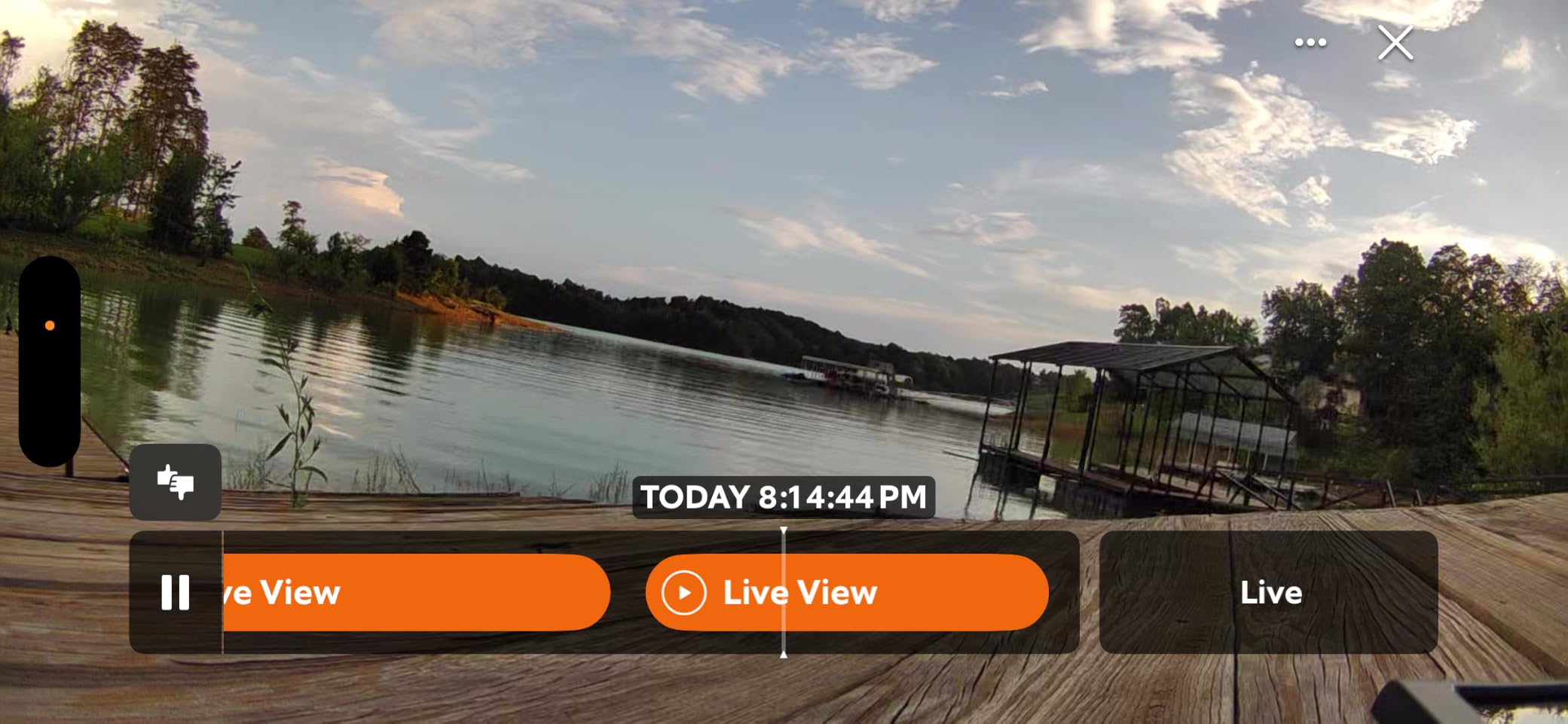
The wide field of view is the quiet strength here. Owners mount it on a porch post or an eave to cover a driveway and side yard in a single frame, and they like that adding a second or third camera later is just another tile in the app.
Where it frustrates people is motion tuning. The detection zones cannot cover the entire frame, so a strip at the edge of the image is effectively not monitored, and sensitivity behaves oddly: too twitchy close to the camera, too calm further out.
Who this camera suits
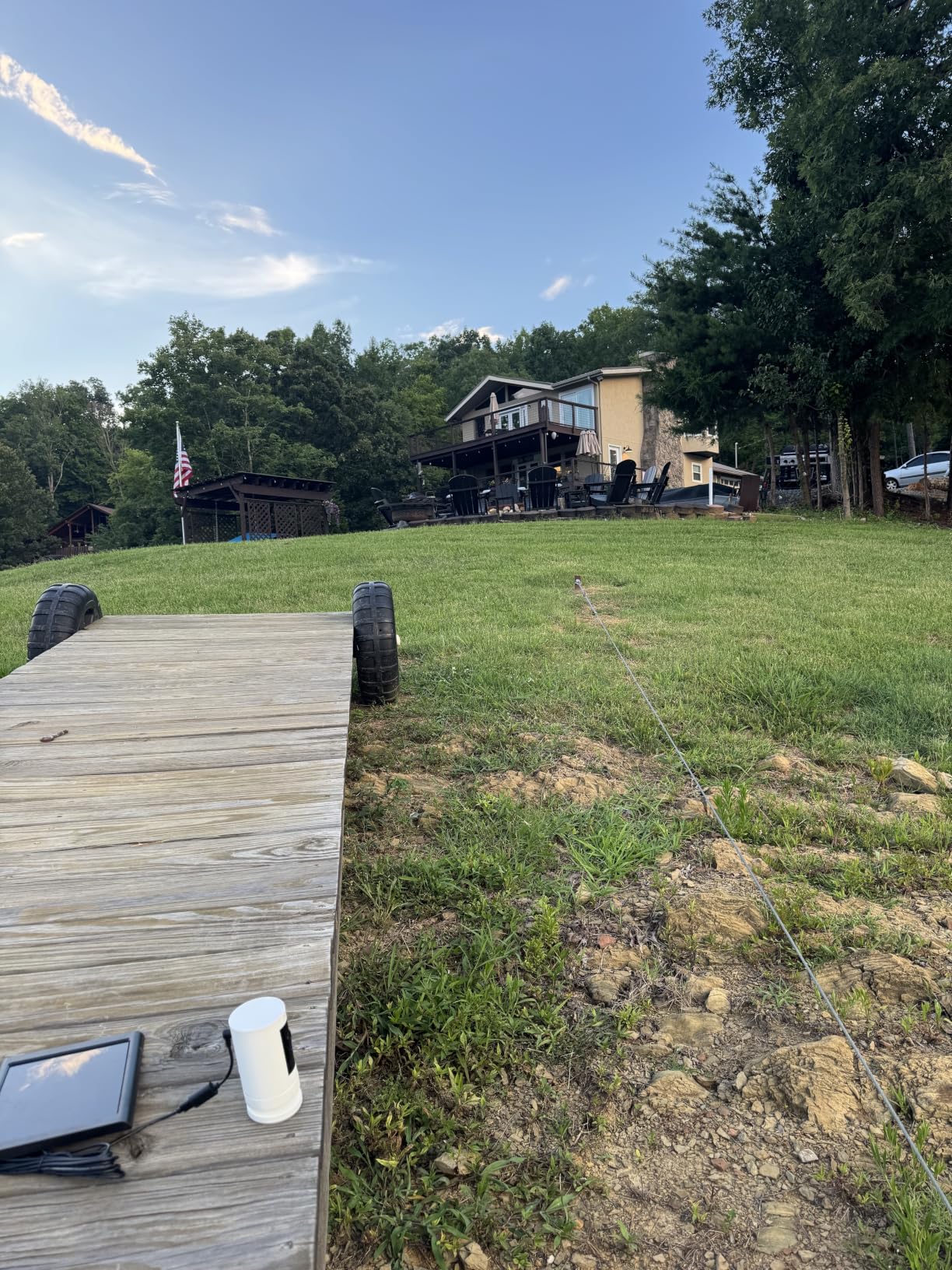
It suits renters, first-time buyers, and anyone who wants a second layer of coverage on a side yard or an RV pad without running cable. The install is genuinely a five-minute job if you have a screw gun and a ladder.
It also suits households already in the Ring ecosystem, where alerts, live view, and shared access already work the way you expect.
Who should skip it
Skip it if you need plate-level detail at distance. 1080p over a long drive shows a vehicle clearly enough to describe it, but the fixed wide view means you cannot crop into a plate the way you can on a 4K body.
Skip it if you rely on continuous recording or on long video history without a plan. This records on motion events only, and the battery has to be physically removed rather than switched off in the app.
6. Blink Outdoor 4 Three-Camera System: Best Pick for Battery Multi-Point Coverage
Blink Outdoor 4 – Wireless smart security camera, two-year battery life, 1080p HD day and infrared night live view, two-way talk. Sync Module Core included – 3 camera system
Three battery cameras included
Sync Module Core hub
Up to two-year battery life
1080p HD and IR night view
Pros
- Three-camera bundle includes the required hub
- Up to two years of battery on included AA lithium cells
- 1080p live view with infrared night vision
- Dual-zone enhanced motion detection
- Quick setup with Alexa multi-camera view
Cons
- Sync Module Core has no local storage and cannot record
- Person detection needs an optional subscription
- Local backup needs a separately sold Sync Module 2 or XR
Most driveway problems need more than one viewpoint: the drive itself, the side gate, and the front walk. This bundle gives you three battery cameras and the Sync Module Core they need to join the network, so coverage across a property is a mounting job rather than an architecture project.
The battery claim is the headline. Owners report up to two years on the included AA lithium cells, which removes the most common complaint about battery driveway cameras, though heavily trafficked drives will pull that down considerably.
The catch, and it is a real one, is storage. The included Sync Module Core has no local recording at all. Cloud clip storage and person detection both sit behind an optional Blink subscription, and local backup requires a different hub sold on its own.
So this is a camera system for people who will pay for a plan, or who will buy a second module specifically for storage. If neither is acceptable, the Reolink and Tapo options further down do the same job without the fee.
Who this camera suits
It suits a large property with multiple exterior points and no interest in wiring. Three wireless cameras on one hub is the fastest way to cover a driveway, a side path, and a back corner in a single afternoon.
It suits households that want alerts in a shared Alexa routine, since arming and multi-camera live view work well through that path.
Who should skip it
Skip it if you refuse subscriptions, and skip it if local-only storage is a requirement. As bundled, the hub cannot record, which makes this the weakest storage story of the twelve.
Skip it for identification work. Dual-zone detection helps with noise, but there is no subscription-free person or vehicle classification, and 1080p is below the bar for plate reading across a long drive.
7. REOLINK Argus Eco: Best Subscription-Free Solar Pick
REOLINK Solar Camera Outdoor Wireless 2K 5MP Smart AI Detction Argus Eco
2K 5MP sensor
3W solar panel
33 ft IR night vision
microSD up to 512 GB
Pros
- 3W panel and battery remove wiring and battery swaps
- 2K 5MP sensor reads faces better than 1080p
- No subscription required for local recording
- Person vehicle and pet detection with siren alerts
- IP65 housing works from 14 to 131 degrees F
Cons
- 2.4 GHz Wi-Fi only
- Fixed 110 degree view with digital zoom and no pan or tilt
- 33 foot night range is short for a long drive
- microSD card not included
This is the recommendation that comes up most often in long rural driveway threads, and the reason is simple: it records locally to a microSD card up to 512 GB with no cloud plan and no fee for the detection features. The 3 watt solar panel and rechargeable battery mean no cable and no battery swaps.
The 2K 5MP sensor is a genuine step up from 1080p, and owners single it out for reading faces and identifying vehicles at close to medium range. For a driveway where the nearest router is inside the house, that combination is what makes it work.
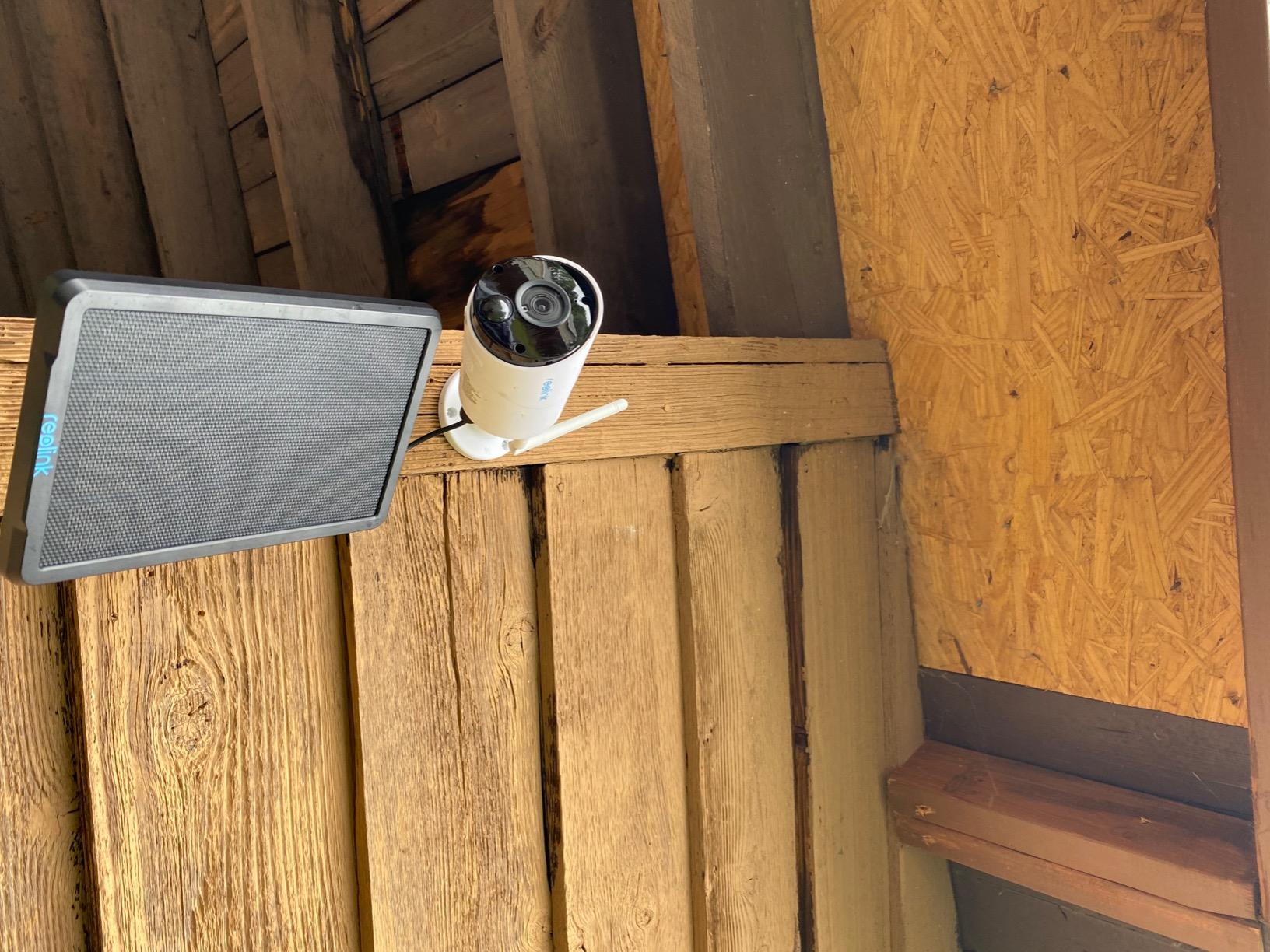
Be realistic about two limits. The lens is fixed with a 110-degree viewing angle and digital zoom only, so there is no pan, tilt, or optical zoom. Night vision is rated at 33 feet, which is fine for a gate or a short drive and thin for anything longer.
The radio is 2.4 GHz only. That is not a problem on most homes, but on a newer dual-band router it can mean moving the camera closer to the router during pairing or enabling a separate 2.4 GHz network.
Who this camera suits
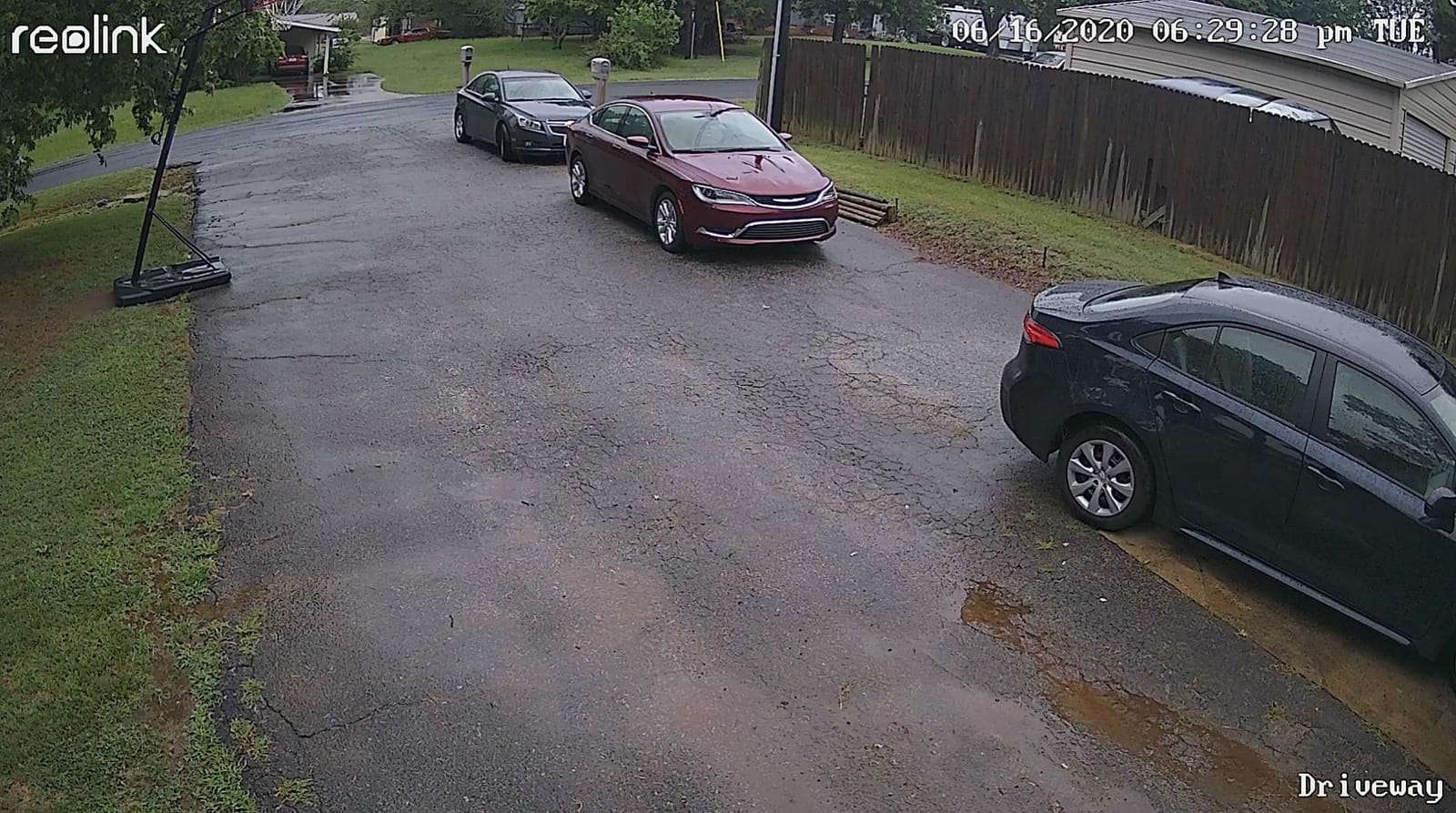
It suits a long or rural driveway with no power and no reliable Wi-Fi at the far end, especially if a game camera or a cheaper consumer unit has disappointed you there before. It also suits anyone who has decided recurring fees are not acceptable.
It suits cold climates within its rated 14 to 131 degree operating range, where the solar panel and battery remove the maintenance cycle entirely.
Who should skip it
Skip it for long-range night identification. A 33 foot infrared range is the shortest of the higher-resolution options here, and combined with a fixed lens it cannot be re-aimed once the car stops further out than expected.
Skip it if you need continuous 24-hour coverage or a tracking camera. There is no motion tracking, and it records event clips rather than continuous capture.
8. ZEEPORTE Solar 2K Pan and Tilt Camera: Best Value
Solar Security Cameras Wireless Outdoor, 2K Pan/Tilt 360° View Solar/Battery Powered WiFi Cameras for Home Security with AI Motion Detection, Spotlight, 2-Way Audio, Siren, IP65, SD/Cloud Storage
2K 2304 x 1296 sensor
360 pan and tilt
2W solar panel and 5200 mAh
IP65 housing
Pros
- 2K resolution is four times the pixels of 1080p
- 360 degree view with 355 degree pan and 120 degree tilt
- Integrated 2W panel and 5200 mAh battery
- IP65 rated for rain and snow
- Two-way talk and a siren alarm
- Works with microSD up to 256 GB
Cons
- 2.4 GHz Wi-Fi only and no 5 GHz support
- No motion tracking and no continuous recording
- AI recognition and custom alert areas need a subscription
- Starlight night vision limited to about 33 feet
If the constraint is money and there is still no outlet at the end of the drive, this camera answers it. You get a 2K sensor at 2304 by 1296, a full 360-degree view with 355 degrees of horizontal rotation, an integrated solar panel, a siren, and two-way talk.
That is a feature list most people would expect to pay considerably more for, and at 4.3 stars across more than 11k reviews the satisfaction level is real. The IP65 housing and the battery-plus-panel combination make it a straightforward install on a fence post or an eave.
The honest limit is the software tier. AI recognition of specific object types, expanded cloud memory, and custom alert areas sit behind a paid plan, and there is no motion tracking and no continuous recording, only event clips. Night vision is a starlight sensor rated to about 33 feet.
Local microSD storage up to 256 GB works without the plan, though the card is not included. Like most cameras here, the radio is 2.4 GHz only.
Who this camera suits
It suits a first camera on a budget, a renter who cannot drill into power, and anyone covering a yard or side path rather than trying to identify a distant plate. The 360 rotation is worth the most here, because it covers the whole approach from a single mount.
It also suits anyone who wants a siren and two-way talk as a deterrent without paying for a floodlight model.
Who should skip it
Skip it if identification is the goal. A 2K sensor is a step up from 1080p, but it is still well short of what a 4K body gives you on a plate at the far end of a driveway, and the 33 foot night range caps that further.
Skip it if you want free smart detection or tracking. The features that make this camera pleasant to live with beyond basic recording are the ones behind the plan.
9. aosu D1 Classic Four-Camera Kit: Best Pick for Whole-Property Coverage
aosu D1 Classic 4-Cam Kit, Security Cameras Wireless Outdoor, Solar Powered
Four solar cameras plus aosuBase
32 GB local loop recording
360 pan and tilt
Cross-camera tracking
Pros
- Four cameras and a base station cover a whole property
- No subscription with up to 4 months of loop recording on 32 GB
- Footage stays on the base if a camera is damaged or taken
- Panels need about 3 hours of sunlight daily
- Cross-camera tracking links related event clips
Cons
- 3MP resolution trails the 4K and 16MP models here
- Four cameras mean drilling three holes each and full Wi-Fi coverage
- Lower detail for distant license plate identification
Where the other single cameras solve one mounting point, this kit solves the property. Four solar cameras, each with 360-degree pan and tilt, feed a base station with 32 GB of built-in encrypted storage that holds up to four months of loop recording with no subscription at all.
The resilience detail matters more than it first appears: because footage lives on the base rather than the cameras, a camera that is stolen or smashed does not take your evidence with it. For a driveway that is the point.

Cross-camera tracking links related event clips from different parts of the property, and you can watch four live feeds at once. Each camera carries its own solar panel and needs roughly three hours of daylight a day to hold charge.
The compromise is resolution. At 2K with 3MP, this kit sits below the 4K and 16MP bodies here, so a vehicle at the far end of a long drive is identifiable but not crisply readable. Treat it as coverage first and identification second.

Who this camera suits
It suits a property where the driveway, gate, side path, and back corner all need watching and you would rather buy one box than four cameras and four apps. It also suits anyone who wants months of history without paying for it.
It suits households already using Alexa, Google Assistant, or SmartThings, since all three are supported.
Who should skip it
Skip it if you need to read a plate from 50 feet or more. The 3MP sensor is the first thing you would want to upgrade, and this kit does not offer a higher-resolution variant in the box.
Skip it if drilling four mounting points is not realistic, or if Wi-Fi does not reach every camera position. Coverage is only as good as the network underneath it, and this kit needs signal at all four mounts.
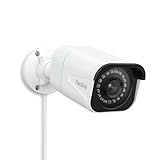
10. REOLINK RLC-810A 4K PoE: Best Pick for Long-Range Night Vision
REOLINK RLC-810A PoE Security Camera, 4K Wired Outdoor Surveillance
4K 8MP at 25 fps
100 ft IR night vision
Single-cable PoE install
microSD up to 512 GB
Pros
- True 4K 8MP recording at 25 fps
- 100 ft infrared is the longest range here
- Human and vehicle detection cuts animal false alarms
- Single-cable PoE with no Wi-Fi dependency and no battery
- Local microSD NVR or FTP recording with no subscription
Cons
- PoE NVR switch or injector and DC adapter not included
- Fixed 87 degree view with no pan tilt or optical zoom
- Requires a cable run back to a switch or NVR
This is the model to beat for a driveway you cannot light. One hundred feet of infrared reach is the longest in this group, and pairing that with an 8MP sensor means you can work out what happened at the far end of a long drive without a single floodlight on the property.
The 87-degree field of view is narrower than the pan-tilt models, which is a deliberate trade: a tighter, longer view with permanent framing beats a wide view you cannot re-aim at the critical spot.
Single-cable PoE is the reason owners recommend it for fixed outdoor positions. There is no battery to service, no Wi-Fi dropout to chase, and no pairing drama on a 5 GHz network. Power and data come down the same Cat cable.
Recording is local by default: microSD up to 512 GB, an NVR, or an FTP server, with no subscription attached. Smart human and vehicle detection is what reduces the animal and shadow false alarms that plague open driveways.
Who this camera suits
It suits a fixed mount over a gate, at the end of a long drive, or at the far corner of a yard, anywhere the question is what happened at 80 feet rather than what happened at the door. It also suits anyone who will commit to running one cable.
It suits owners who already run an NVR or are planning a small PoE system, since that is where this camera is most at home.
Who should skip it
Skip it if you cannot or will not run cable. The PoE switch, injector, or NVR and the DC adapter are all sold separately, so this is a system purchase rather than a single-camera purchase.
Skip it if you need to cover a wide, irregular driveway where you would want rotation, since the body is fixed with no pan, tilt, or optical zoom. For colour at night rather than black-and-white infrared, look to the spotlight models instead.
11. Blink Wired Floodlight Camera: Budget Pick
Blink Wired Floodlight Camera – Smart security camera, 2600 lumens, HD live view, enhanced motion detection, built-in siren, Works with Alexa – 1 camera (Black)
2600-lumen floodlight
1080p HD with color night view
Built-in siren
Wired to existing power
Pros
- Brightest floodlight output in this group at 2600 lumens
- 1080p HD with color night view and two-way audio
- Built-in siren for active deterrence
- Dual-zone motion detection you can customise
- Wired design removes all battery maintenance
Cons
- Needs existing outdoor wiring and a Blink Sync Module
- Person detection and cloud storage need a subscription
- Local storage requires a separately sold Sync Module 2 or XR
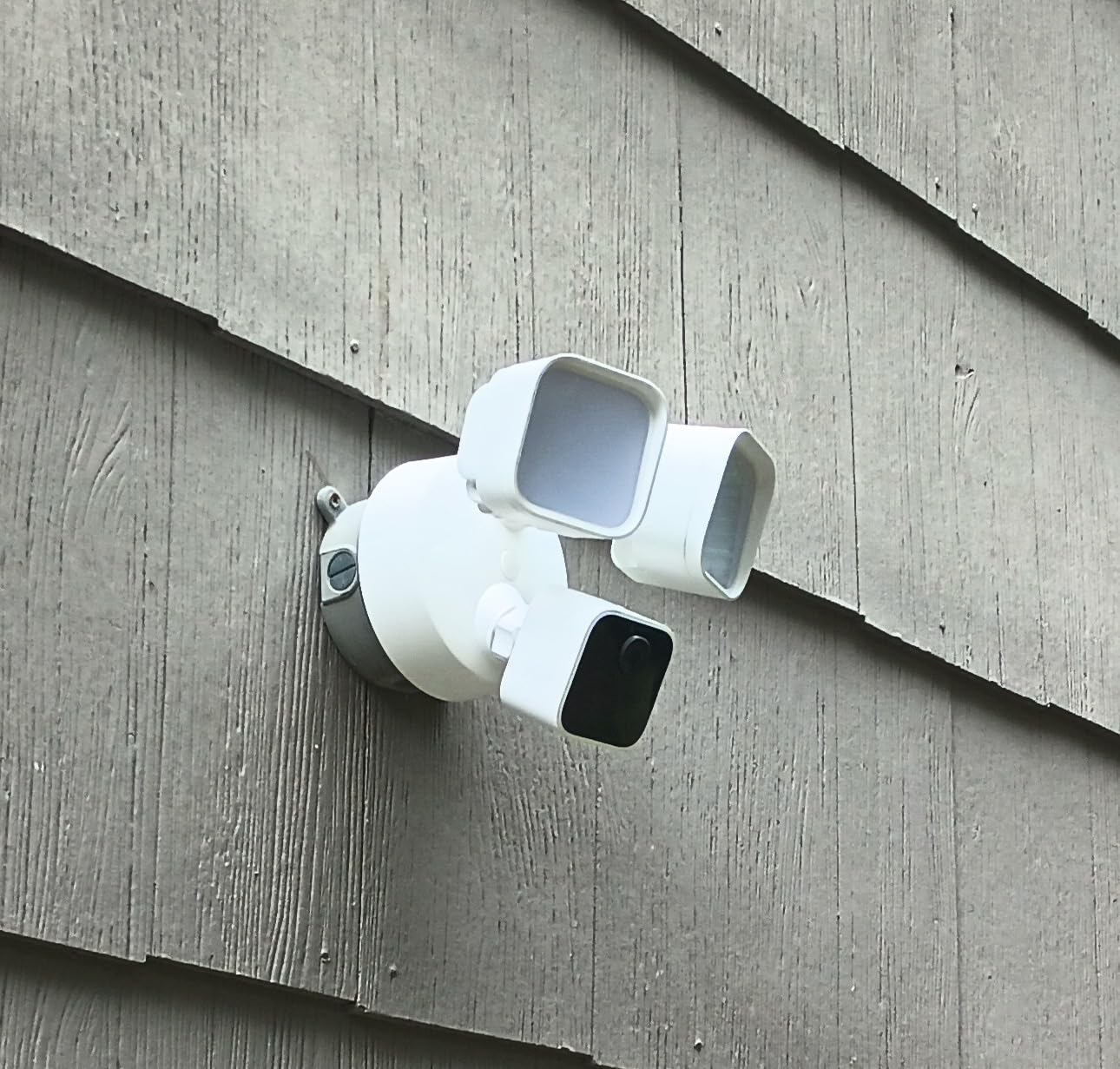
Two thousand six hundred lumens is the brightest light in this group, and it is the reason people buy this camera. Mounted where a floodlight already sits, it turns a dark drive into a usable scene the moment someone enters the detection zone.
Being wired also means there is no battery in the design at all. If you are replacing an existing exterior light fixture, this is a swap rather than a new electrical run, and the included installation kit covers the mounting hardware.
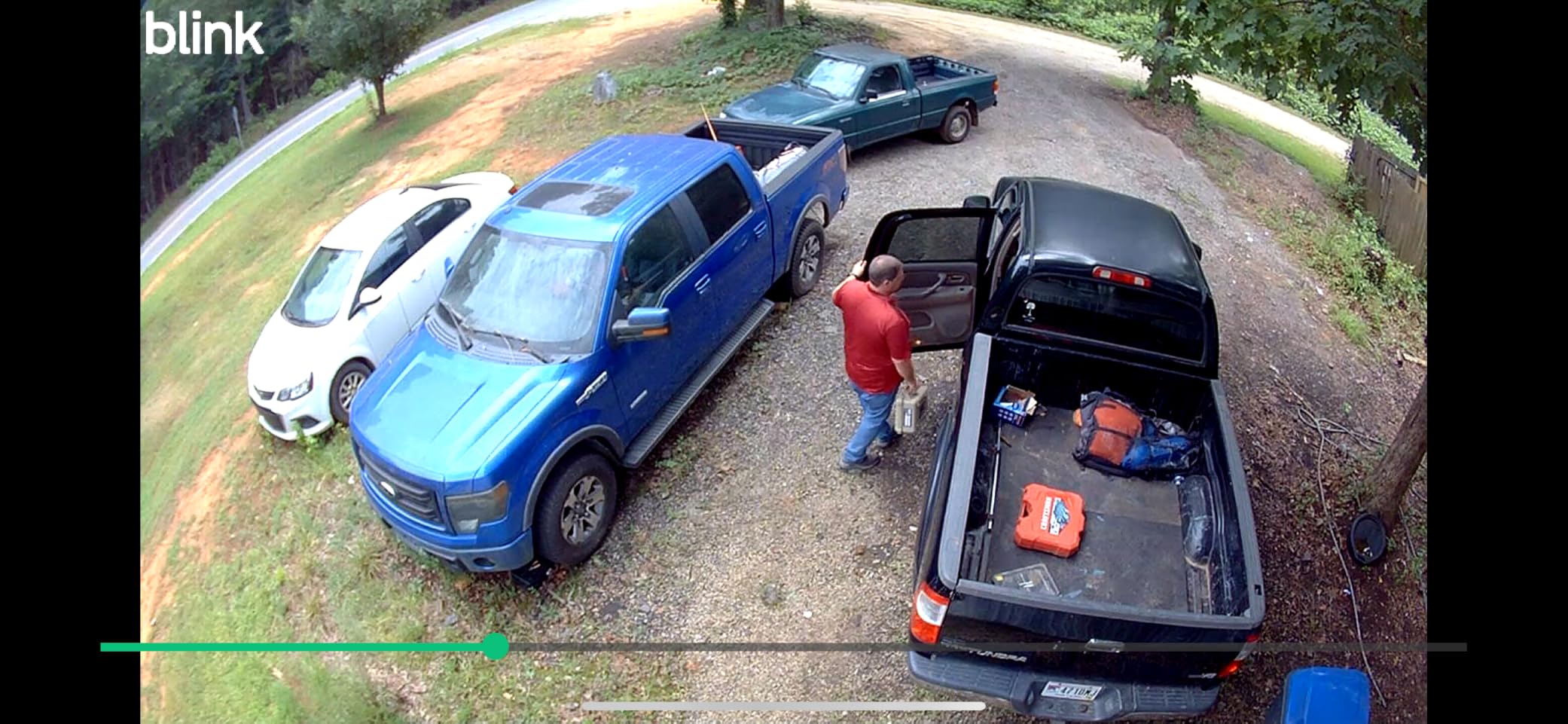
The image quality is a 1080p sensor with colour night view and two-way audio that reviewers describe as crisp, which is better than you would assume from an entry-level light camera. Dual-zone motion detection lets you shape the trigger area around the drive rather than the whole yard.
As with the rest of the Blink range, person detection and cloud clip storage sit behind an optional plan, and local recording needs a different hub. Check that against the Ring Floodlight Cam Wired Plus, which pairs similar hardware with a broader app ecosystem.
Who this camera suits
It suits anyone replacing an outdoor light fixture who wants maximum illumination for the least effort. The siren also makes it a genuine active deterrent rather than a silent recorder, which matters for a drive next to a busy footpath.
It suits households that have already committed to Blink and want a camera that fits the existing hub rather than adding another system.
Who should skip it
Skip it if you have no existing outdoor wiring at that spot, since this camera has no battery fallback. Skip it if you need local storage without paying, because the hub in this ecosystem does not include it.
Skip it if you need to identify a vehicle at distance. 1080p plus a fixed view is a deterrence and presence tool, not an identification tool.
12. REOLINK RLC-811A 5X Optical Zoom: Best Pick for Pinning Down a Distant Vehicle
REOLINK PoE Security Camera RLC-811A 5X Optical Zoom, 4K Color Night Vision
4K 8MP sensor
5x optical zoom on a varifocal lens
Colour night vision with spotlight
IP66 aluminum body
Pros
- 5x optical zoom preserves 8MP detail on distant subjects
- 123 degree field of view covers a wide drive from one mount
- Full colour night vision with a built-in spotlight at 100 ft
- Spotlight and siren can fire automatically on detection
- Human vehicle and animal detection with adjustable zones
Cons
- PoE NVR switch or injector and DC adapter not included
- No remote motorised zoom after the mount position is set
- Heavier at 2.5 pounds than the RLC-810A
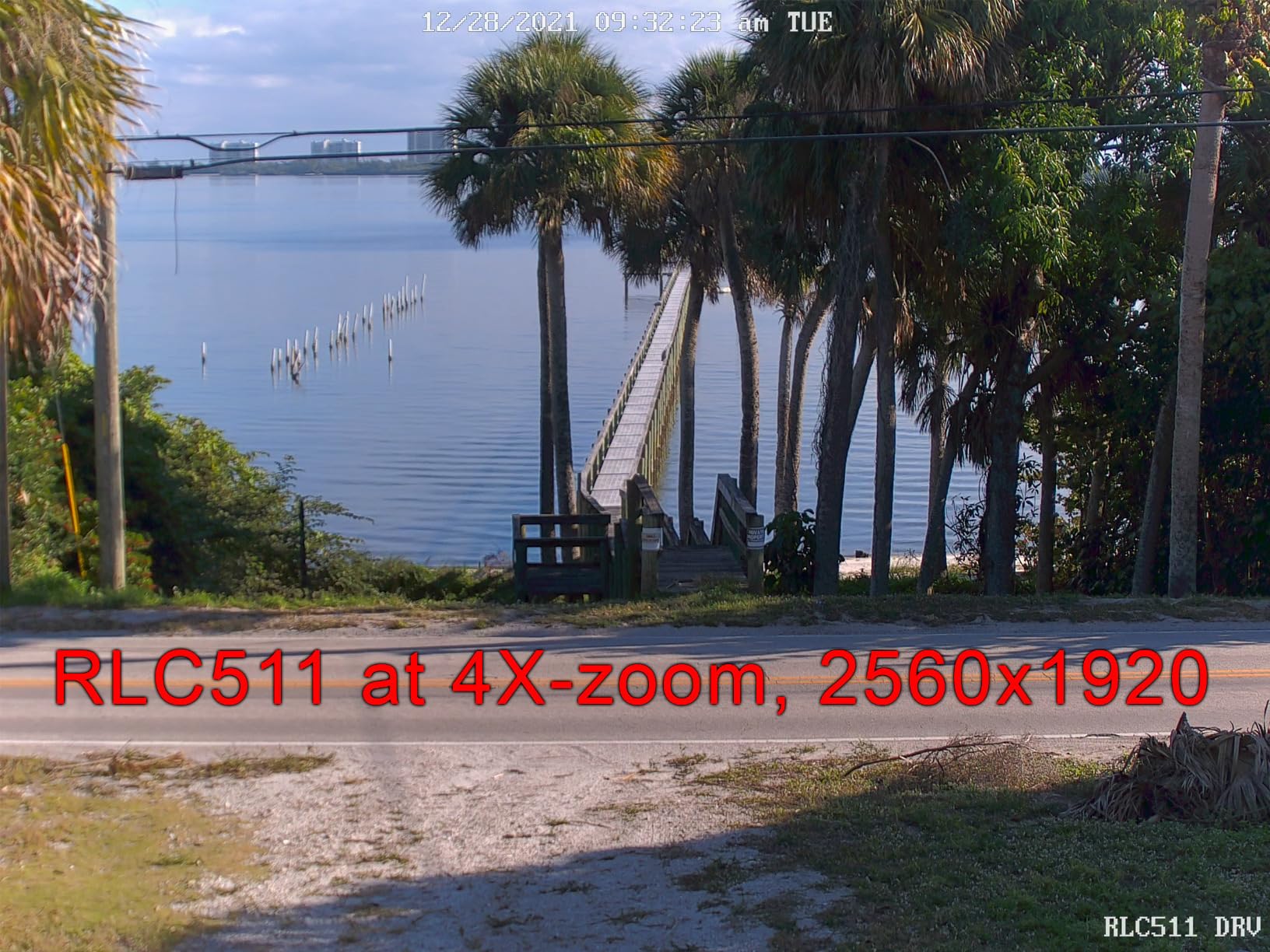
This is the pick when the whole purpose of the camera is one question: what was that vehicle. The 5x optical zoom on a varifocal lens keeps native 8MP detail on a subject far down the drive, where digital zoom on the other models would smear the image into guesswork.
The built-in spotlight with full colour night vision also fixes the problem owners complain about most on plain infrared cameras. Infrared tells you a shape was there; colour tells you the paint colour and what the person was wearing.
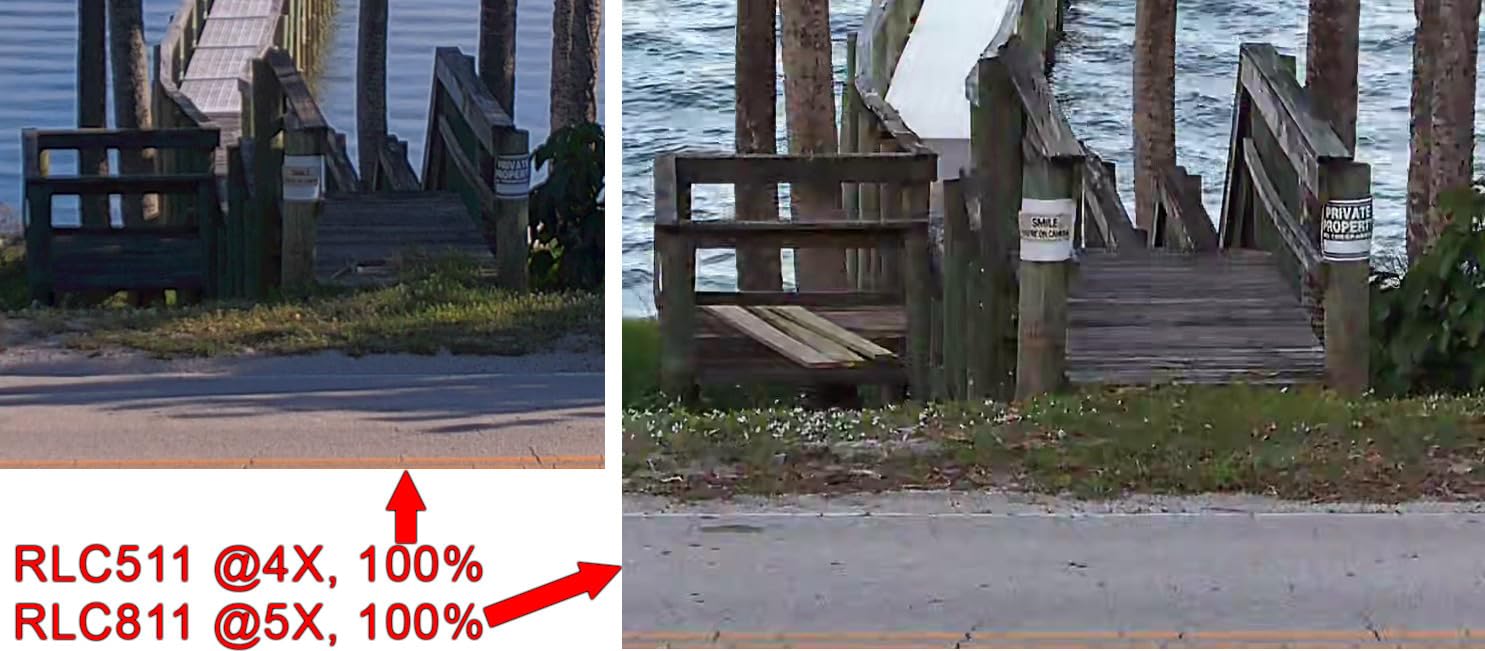
The 123-degree field of view is genuinely wide, so even at low zoom you can cover a broad driveway from a single mount. The IP66 aluminum housing is one step above the IP65 plastic bodies here, which matters on a soffit exposed to driving rain.
Detection covers people, vehicles, and animals with adjustable zones and sensitivity, and the spotlight and siren can be set to trigger automatically or fired manually from the app when you want to make a point.
Who this camera suits
It suits a long driveway where you need to pull detail off a car that has stopped well away from the house, or a shared drive where distinguishing your own vehicle from a visitor’s matters. Colour night footage is the reason it beats the plain infrared models for identification.
It suits anyone who will run PoE and wants the strongest build in this group, since the aluminum body is rated a notch higher than most.
Who should skip it
Skip it if you expect to re-aim the camera after installation. The zoom position is chosen at mount time with no motorised control, so getting it right the first time matters.
Skip it if you want wireless or battery power, and skip it if you are not prepared to source PoE hardware. At 2.5 pounds it also needs solid fixing into brick or masonry rather than a light soffit.
How to Choose a Driveway Security Camera
Resolution is only useful if it survives the distance
The single most-asked question in driveway camera threads is whether a camera can read a plate, and the honest answer is that resolution alone does not decide it. Angle, lens focal length, motion at the moment of capture, and light all matter as much as pixel count.
As a working guide: a 1080p sensor is fine for confirming a person or vehicle shape within about 30 feet, and becomes a smudge beyond that. A 2K sensor buys meaningful improvement in the 30 to 50 foot band. A 4K 8MP sensor is where plate reading becomes plausible across a normal two-car driveway, and a 16MP stitched view is what you reach for when the drive is wide or the subject is at the far gate.
Optical zoom is the thing people underrate. Digital zoom crops pixels and throws detail away; the 5x optical zoom on the RLC-811A keeps the native resolution on a distant subject, which is the difference between a usable still and a grey rectangle.
Infrared, colour spotlight, or floodlight
Infrared gives you monochrome footage out to a stated range, and it is the most reliable option for an unlit driveway because it does not depend on ambient light. The REOLINK RLC-810A reaches 100 feet this way, and that reach is the whole point of it.
Colour night vision with a built-in spotlight gives you colour at the cost of range and light pollution. It is the better choice when you need to describe clothing or paint, and worse when you need to see something 80 feet away in the dark.
A motion floodlight is a different tool rather than a night-vision mode. It is the strongest deterrent available here because the light itself announces that a camera is present, but it only works on the same trigger as the recording, so a camera aimed badly stays badly aimed.
Power: wired, battery, solar, or cellular
Wired cameras win on reliability and lose on installation effort. If there is a junction box or an outlet at the mount, hardwiring removes batteries and Wi-Fi from the equation entirely.
Battery cameras are the easiest to install and the most annoying to maintain, because cold weather and high-traffic drives both drain packs faster than the marketing figure suggests.
Solar cameras solve both problems when the mount genuinely gets sun. The aosu cameras need roughly three hours of daily light, the Tapo panel about 45 minutes, and the larger Reolink and eufy panels more. Owners in cold regions are right to be sceptical about winter performance on a shaded north-facing eave.
For a genuinely remote gate with no power and no Wi-Fi, a 4G LTE camera is the category to look at, although none of the twelve models here uses cellular. In those situations, enthusiast communities often recommend a trail or game camera, which is a reasonable and inexpensive way to confirm activity even if it does not integrate with an app.
Storage and what it actually costs
Four storage models exist and they are not equivalent. A microSD card in the camera is the simplest and cheapest, but footage dies with the camera. A home hub or base station holds weeks or months and survives a camera being taken. An NVR holds longer still and is the usual choice for wired systems. Cloud storage is the easiest to share but is the only one that expires on a schedule.
Three of the picks here are fully subscription-free for core recording: the REOLINK Argus Eco, the Tapo C660 KIT, and the aosu kit all record locally with no fee. The Ring and Blink models gate their video history, and the ZEEPORTE gates its AI recognition features.
When you compare, run the arithmetic honestly. A local-storage camera costs a card once. A cloud plan costs a monthly fee every month for five years, and it is the only option where footage disappears if you stop paying. Buyers in driveway forums consistently report that this is the deciding factor, and it is the one most often left unsaid in roundups like this one.
Weatherproofing, false alerts, and field of view
IP65 means dust-tight and protected against water jets, which covers most soffits and walls. IP66 adds protection against powerful water jets, and IP67 adds temporary immersion, which matters only if the camera can actually get wet on that face.
On false alerts, the pattern is consistent: open driveways generate them from branches, animals, shadows, and passing traffic. On-device person and vehicle detection filters most of that without a subscription, and drawable motion zones let you exclude the street side of the frame.
Field of view is a straight trade against detail. A 180-degree stitched panoramic view covers a whole approach but shrinks everything inside it, while an 87-degree fixed view covers less and resolves more. Measure your driveway before choosing, and remember that a pan and tilt camera you never re-aim is worse than a narrow one pointed correctly.
Where to Mount a Driveway Camera
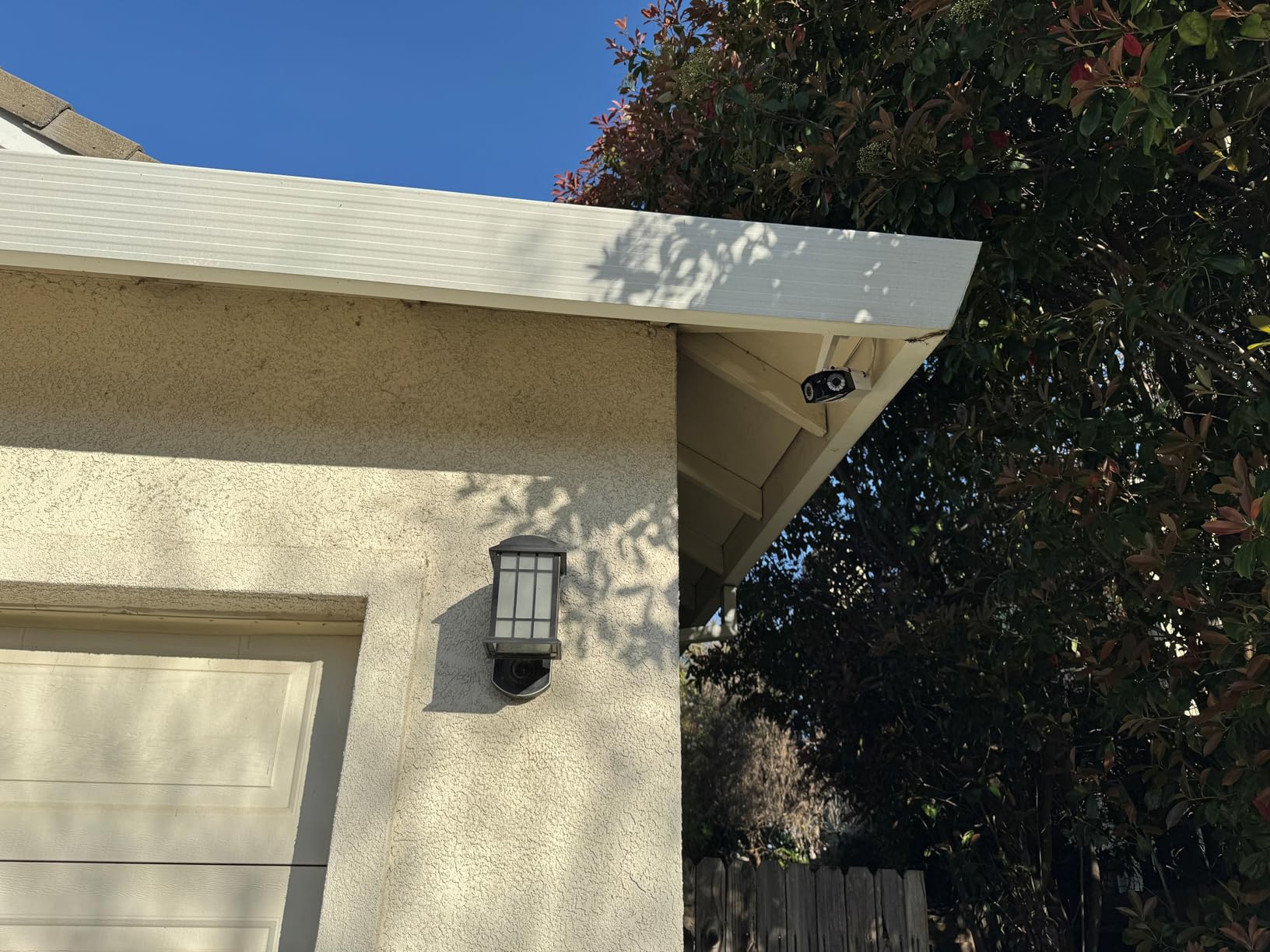
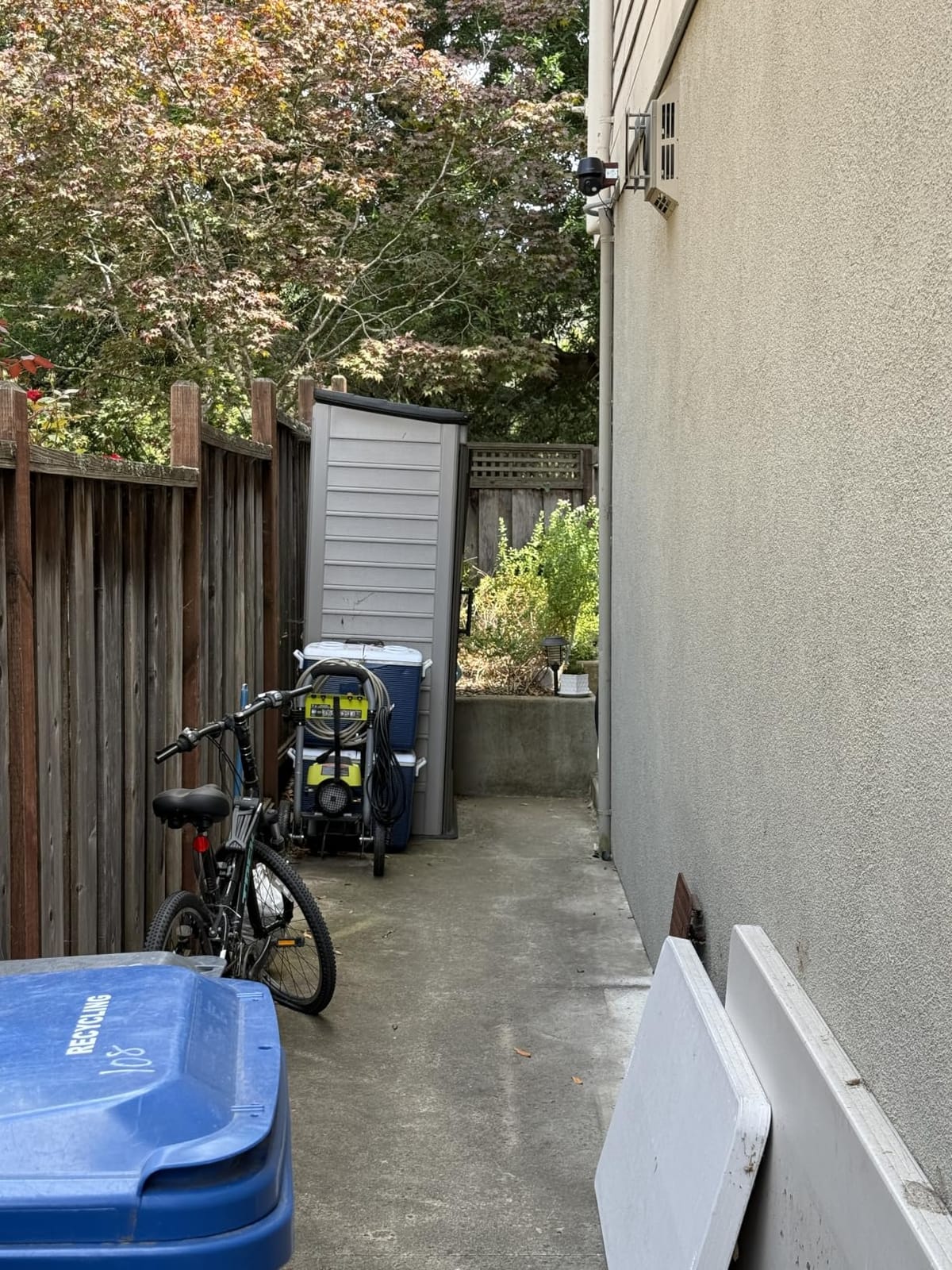
Aim for eight to ten feet. That band gives you a view of faces rather than the tops of heads, and keeps the lens above the splash line from a car driving through a puddle.
Angle down toward the stopping point, not the kerb. A driveway camera is most useful at the point where a vehicle actually pauses. A steep downward angle catches roofs and loses plates.
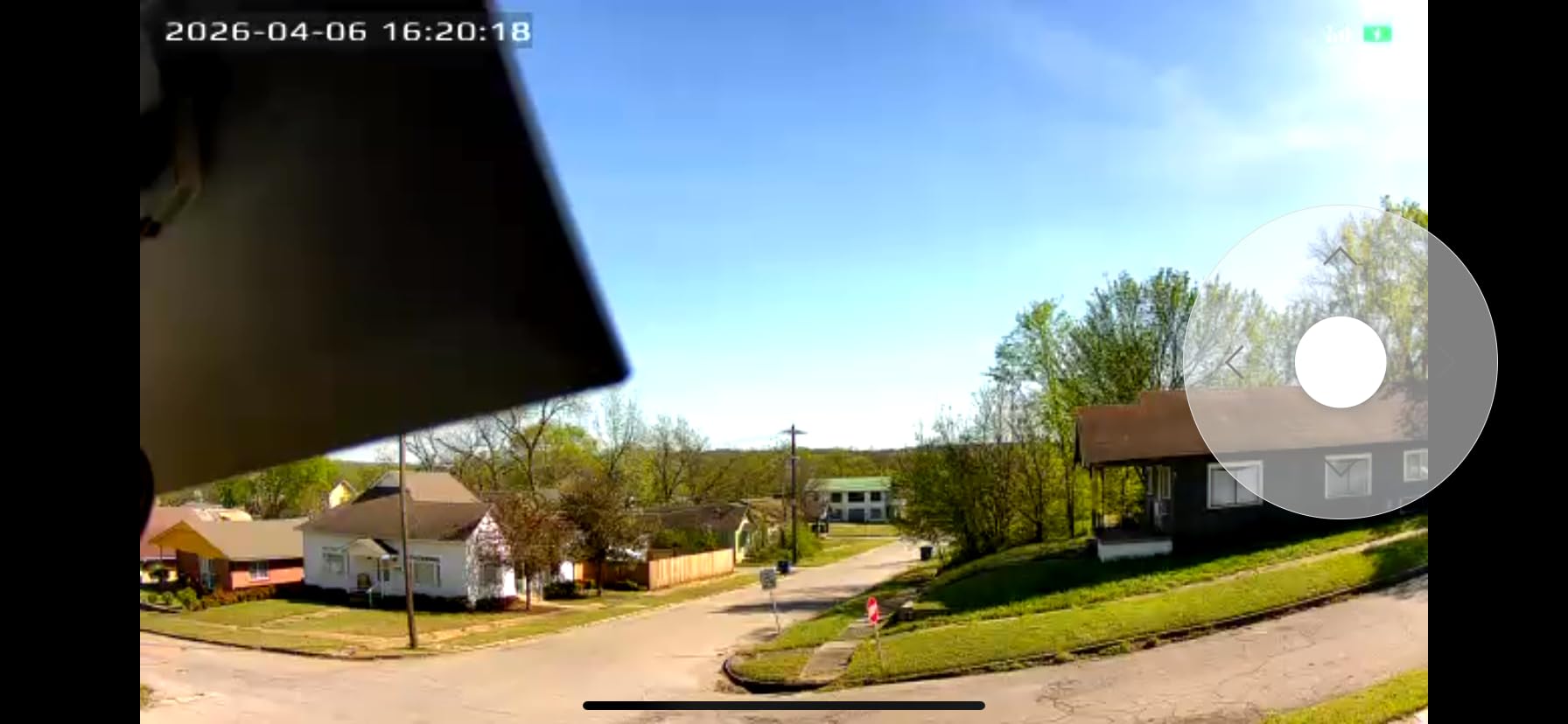
Check the sun before you drill. For an east-facing drive, mount facing west and vice versa. Backlight washes out detail in a way no amount of resolution fixes, and IR reflectors in a plate flare badly into a low sun.
Keep foliage and irrigation out of the frame. A branch that fills a third of the view is the most common false-alert source, and a sprinkler head in the top corner will blur footage every morning.
Test at night before you finish. Walk the full length of the drive in the dark and check the frame from the camera’s point of view. Most disappointing night footage is an aiming problem, not a sensor problem.
Pair it with a second trigger if alerts drive you crazy. In smart-home forums, owners who pair a driveway alarm or an infrared break-beam with the camera cut false positives far more effectively than fiddling with sensitivity alone, because the external sensor triggers on a broken beam rather than on a moving shape.
Privacy, Permits, and Sharing Footage With Police
Recording your own driveway is straightforward. The camera should frame your own property, the public sidewalk or road if it falls within your view, and ideally nothing else. Neighbours are a common source of friction, since a camera angled across a boundary captures people who have no idea they are being filmed.
Rules differ by municipality, and some places require signage for visible cameras or restrict recording of areas where people have an expectation of privacy. If you install anything overlooking a street, it is worth a short check of your local guidance before you mount it.
For evidence, the practical points are retention and export quality. Cloud-only cameras are the weakest option here, because a clip that expires before you notice a theft is worthless. Local storage on a hub or card is better, and an NVR is better still.
When you do need to share footage, keep it simple: find the event in the timeline, export the clip with the original file rather than a screen recording, save an unaltered copy with the date and time visible, and hand it over with your case number so the department can file it correctly. If you also cover interior entry points, our indoor security camera guide covers the hallway and stairwell cases that driveway coverage does not.
Frequently Asked Questions
What is the best driveway camera?
The best driveway camera depends on what you need from it. For deterrence, the Ring Floodlight Cam Wired Plus pairs 2000-lumen motion lights with a siren. For identifying a vehicle, the Tapo C660 KIT uses a true 4K 8MP sensor with 360-degree auto-tracking. For a wide approach, the REOLINK Duo 3 PoE gives you a stitched 180-degree view from one mount.
What is the best outdoor security camera without a subscription?
Several picks here record locally with no monthly fee. The REOLINK Argus Eco and Tapo C660 KIT both run person and vehicle detection on the device and save to a microSD card, while the aosu four-camera kit holds months of loop recording on its 32 GB base. Ring and Blink gate video history and smart detection behind paid plans.
How far can a driveway security camera see at night?
It depends on the sensor and the lens more than the marketing number. Infrared models in this group are rated from about 33 feet for the battery and solar units up to 100 feet for the REOLINK RLC-810A and RLC-811A. Spotlight and floodlight cameras see in colour but only across a much shorter distance.
Can I have a camera facing my driveway?
Yes, pointing a camera at your own driveway and the public street beyond it is normal practice. What matters is framing: keep the aim on your own property so you are not deliberately capturing inside a neighbour’s home or windows. Local rules vary, so check whether your municipality requires signage.
Can my neighbour have a camera pointed at my driveway?
They can, and in most places it is not illegal as long as the camera is on their own property and is not intrusive or deliberately aimed at private areas inside your home. The practical response is to improve your own coverage so you are not relying on their footage, and to have a direct conversation if the angle feels unreasonable.
Do home security cameras actually deter crime?
Visible cameras with motion-activated lighting are the ones that deter, because the light announces the presence of recording at the moment someone approaches. Models with a built-in siren, such as the Ring Floodlight Cam Wired Plus and the Blink Wired Floodlight Camera, add an audible deterrent on top of the footage. The models without lights are far more useful after an incident than before one.
Which Driveway Camera Should You Buy?
Match the camera to the driveway, not the other way around. A suburban drive with existing outdoor wiring and a theft problem wants the Ring Floodlight Cam Wired Plus, our editor’s choice, because light and continuous power solve more than footage alone.
A long drive where you need to know which vehicle was there wants the Tapo C660 KIT for its 4K sensor, or the REOLINK RLC-811A if the vehicle stops at the far end. No power and no Wi-Fi at the gate means solar, and the REOLINK Argus Eco or the eufy SoloCam S340 keep the whole thing subscription-free.
Whatever you choose in 2026, mount it between eight and ten feet, point it at the stopping point rather than the kerb, and test the frame at night before you call the job finished.