
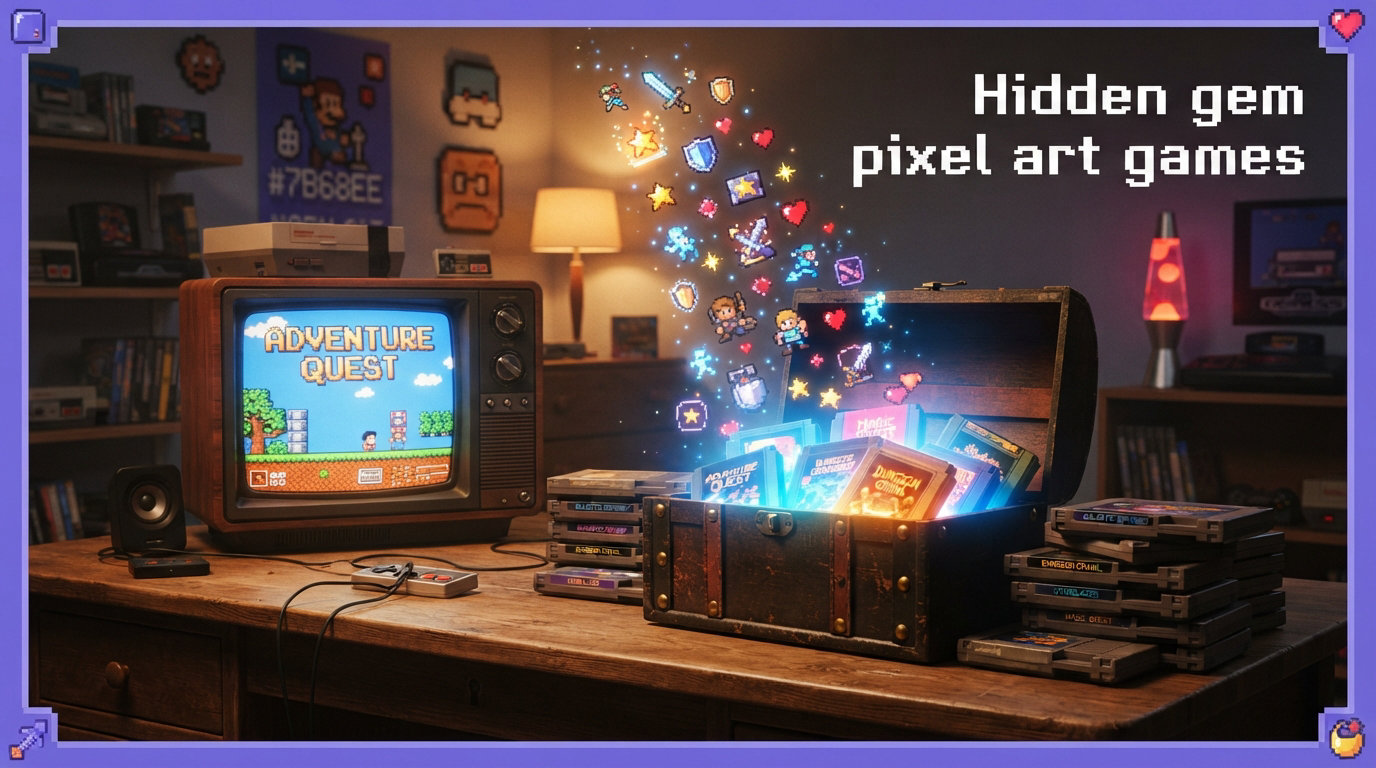
Hidden gem pixel art games are lesser-known video games featuring hand-crafted 2D pixel-based graphics that deliver exceptional visual appeal and gameplay but never quite reached mainstream popularity. Think of the games that sit buried under the top sellers list on Steam, waiting for someone willing to scroll past the usual suspects. These are the titles where small teams poured their hearts into every single pixel, creating art that rivals studios with ten times the budget.
I have spent years digging through itch.io bundles, obscure Steam tags, Reddit threads, and NeoGAF forums hunting for pixel art games that deserve way more attention than they get. Every time someone asks me for recommendations, I skip past Stardew Valley and Celeste (as much as I love them) and point them toward the games almost nobody talks about. That is exactly what this guide is about.
Our team has put together a comprehensive breakdown of the best hidden gem pixel art games across retro arcade, modern indie, story-rich adventures, free-to-play, and mobile categories. Whether you want something cozy to unwind with or a retro arcade experience that pushes sprite work to its absolute limit, you will find it here. We also cover exactly how to find these games yourself, because the next great discovery is always one search away.
Table of Contents
What Makes Pixel Art Games So Special?
Pixel art games occupy a unique space in gaming. They are not just “retro for the sake of retro” — the best pixel art is a deliberate artistic choice that creates experiences no other visual style can replicate. Every frame is hand-placed, every animation crafted pixel by pixel, and every color chosen with intention.
The appeal comes down to three things: nostalgia, artistry, and imagination. Pixel art taps into the visual language many of us grew up with on the NES, SNES, and Genesis. But modern pixel art games go far beyond what those old consoles could render. Developers today use techniques like subpixel animation, dynamic lighting, and color palettes that would have been impossible on actual retro hardware.
What separates great pixel art from mediocre pixel art is the level of detail in the sprite work. Games like Metal Slug set a standard that most developers never reach — fluid animation on par with hand-drawn cartoons, with backgrounds packed with environmental storytelling. When a small indie team approaches that level of quality, it becomes something truly special.
Retro Pixel Art vs Modern Indie Pixel Art
Retro pixel art games were built within the hardware constraints of their era. Arcade cabinets like the Neo-Geo could display a limited number of colors and sprites on screen at once. Developers worked within those limitations, squeezing every ounce of visual fidelity out of custom hardware. The result is a distinctive look — bold silhouettes, limited but carefully chosen color palettes, and animation that maximizes every frame.
Modern indie pixel art games have no such constraints. A developer working in 2026 can render pixel art at any resolution, use unlimited colors, add particle effects, and layer dynamic lighting on top of it all. Games like Moonstone Island and Fields of Mistria blend pixel art characters with lush, expressive environments that would have been impossible on actual retro hardware.
Both approaches have merit. Retro pixel art carries authenticity — it looks the way it does because it had to. Modern pixel art uses the style as a deliberate aesthetic choice, combining nostalgia with modern game design sensibilities. The best hidden gem pixel art games exist in both camps, which is why this guide covers both.
How to Find Hidden Gem Pixel Art Games Worth Playing
Before we get into specific recommendations, let me share how I actually find these games. The biggest problem the pixel art community faces is discoverability. Thousands of incredible games get buried under algorithm-promoted titles every year. Knowing where to look makes all the difference.
Reddit communities like r/CozyGamers, r/gamingsuggestions, and r/pixelart are goldmines for discovering underrated titles. Real players share games they personally loved, often with screenshots that sell you on the art style before you even read the description. I have found at least a dozen of my favorite games through a single Reddit thread where someone asked “what pixel art games should I play?”
Steam tags and curators are another powerful tool. Searching the “pixel graphics” tag and sorting by user reviews (not global top sellers) surfaces games you would never find otherwise. itch.io goes even deeper — many of the most creative pixel art games are only available there, often as pay-what-you-want downloads during bundle events.
NeoGAF forum threads dedicated to hidden gem pixel art games are especially valuable for retro arcade discoveries. Community members there post animated GIFs and side-by-side comparisons that highlight sprite detail you would miss from screenshots alone. The community has deep knowledge of arcade hardware and can point you toward games that never got a home console release.
Finally, YouTube channels that focus specifically on indie game coverage (not the big algorithm-chasing ones) regularly feature pixel art games months before they gain any traction. Subscribing to a few curated channels and watching their “hidden gems” compilations has led me to some of my all-time favorites.
Retro Arcade Hidden Gem Pixel Art Games
The arcade era produced some of the most stunning pixel art in gaming history, and the vast majority of it never made it into the mainstream conversation. Everyone knows Metal Slug. Everyone knows Street Fighter III. But the games below represent the same level of craft with a fraction of the recognition.
Demon Front (2002)
Demon Front is a run-and-gun arcade game developed by IGS that practically nobody outside of dedicated arcade collectors has played. It runs on hardware similar to the Neo-Geo and features some of the most fluid sprite animation I have ever seen in an arcade game. The character designs are colorful and expressive, with detailed backgrounds that scroll with multiple parallax layers.
What makes Demon Front a true hidden gem is how it blends Metal Slug-style run-and-gun action with a fantasy aesthetic instead of military themes. You play as anthropomorphic characters with unique weapons and abilities, fighting through stages filled with creative enemy designs. The boss battles are enormous and packed with animation frames that put many bigger-budget games to shame.
If you want to play Demon Front, your best option is emulation through MAME or a compatible frontend. The game never received an official home console release, which is exactly why it remains a hidden gem. It is the kind of game that makes you wonder how many other incredible pixel art arcade titles are sitting undiscovered in cabinet collections around the world.
Gunforce 2 (1994)
Gunforce 2, also known as Geo Storm, is an Irem arcade game that delivers the kind of explosive, vehicle-heavy action that defined the best 90s arcade experiences. The pixel art is phenomenal — detailed military vehicles, destructible environments, and character sprites that animate smoothly through every action. Irem was responsible for some of the best-looking arcade games of the era, and Gunforce 2 shows why.
The game deserves attention because it represents peak sprite work from the golden age of arcade development. Every explosion, every vehicle, and every environmental element is hand-drawn with a level of care that modern games with ten times the budget often fail to match. It is the definition of a hidden gem pixel art game — stunning work that most people have never seen.
Undercover Cops (1992)
Another Irem classic, Undercover Cops is a beat-em-up with gritty, detailed pixel art that captures a cyberpunk-inspired city in decay. The backgrounds alone are worth studying — neon signs, crumbling buildings, and crowded streets rendered with remarkable detail for 1992 hardware. The character sprites are large and expressive, with attack animations that carry real weight.
Undercover Cops stands out because its art direction tells a story. You can feel the atmosphere of the city through the pixel art alone, which is a rare achievement. The Japanese version includes additional content and refined gameplay compared to the international release, making it worth seeking out specifically. For anyone interested in retro pixel art games that push the boundaries of what 16-bit-era hardware could achieve, Undercover Cops is essential.
Blazing Star (1998)
Blazing Star is a Neo-Geo horizontal scrolling shooter developed by Yumekobo that showcases what dedicated arcade hardware could do when pushed to its limits. The ship designs are intricate, the enemy sprites are enormous and detailed, and the weapon effects fill the screen with colorful pixel art chaos. Every stage introduces new visual elements that keep the experience fresh from start to finish.
This game often gets overshadowed by Pulstar, its spiritual predecessor, but Blazing Star is arguably the more visually impressive of the two. The animation quality on the larger enemy sprites is particularly noteworthy — bosses have multiple attack phases, each with unique animation sets. It is exactly the kind of retro pixel art game that enthusiasts on NeoGAF celebrate, and for good reason.
Modern Indie and Cozy Hidden Gem Pixel Art Games
The modern indie scene has embraced pixel art as a deliberate aesthetic choice, and the results are often breathtaking. These games combine retro-inspired visuals with contemporary game design, creating experiences that feel both nostalgic and fresh. The cozy gaming community in particular has championed pixel art games that offer relaxing, beautiful worlds to get lost in.
Moonstone Island
Moonstone Island is a creature-collecting life simulation game set in a procedurally generated world of floating islands. The pixel art is vibrant and expressive, with a color palette that shifts beautifully through day and night cycles. Every creature you collect has a distinct, memorable design that makes the collecting loop genuinely rewarding.
What sold me on Moonstone Island was how it combines Stardew Valley-style farming and relationship building with a monster-collecting system and deck-based combat. It sounds like too many ideas for one game, but the pixel art ties everything together visually. The world feels cohesive despite its procedural generation, which is a rare achievement. I spent over 80 hours in my first playthrough and kept finding new areas and creatures I had missed.
The game does not get nearly the recognition it deserves, partly because it launched in a year packed with major releases. But if you enjoy cozy pixel art games with genuine depth, Moonstone Island is one of the best hidden gems you can play right now. It is available on Steam and Nintendo Switch.
Fields of Mistria
Fields of Mistria is a farming simulation game with some of the most beautiful pixel art I have seen in any modern indie title. The character portraits alone are stunning — detailed, expressive, and full of personality. The seasonal environments change dramatically, with each season bringing new color palettes and visual details to discover across the world.
I bring up Fields of Mistria specifically because the Reddit pixel art community consistently praises its art direction as a cut above most farming sims. The sprite work recalls the best of the 16-bit era while adding modern flourishes like dynamic lighting and weather effects that give the world a lived-in, atmospheric quality. Every building, crop, and piece of furniture is rendered with obvious care.
The game is still in early access, which means it is actively growing with new content updates. That also means it flies under the radar for players who wait for full releases. If you are looking for a cozy pixel art game that you can watch evolve over time, Fields of Mistria should be at the top of your list.
Potion Permit
Potion Permit puts you in the role of a chemist arriving in a town that does not trust modern medicine. Your job is to gather ingredients, brew potions, and earn the trust of the townspeople by healing their ailments. The pixel art has a warm, storybook quality that makes every interaction feel inviting. Character expressions are surprisingly detailed for such a small art style.
What makes Potion Permit a hidden gem is how it weaves its pixel art into the gameplay itself. Brewing potions involves a mini-game that is visually satisfying, and diagnosing patients has you matching symptoms to treatments in a way that feels engaging rather than tedious. The town itself changes visually as you earn the residents’ trust, which gives the art a narrative purpose beyond just looking nice.
Players on the cozy gaming subreddit frequently recommend Potion Permit as an alternative to bigger-name titles in the genre. It is available on Steam, PlayStation, Xbox, and Switch, making it one of the more accessible hidden gem pixel art games on this list.
Sun Haven
Sun Haven is a fantasy farming sim that lets you build a farm, explore dangerous dungeons, and develop relationships with a colorful cast of characters. The pixel art blends medieval fantasy aesthetics with a warm, approachable style that makes even the dungeon environments feel inviting. Spell effects and magical abilities are rendered with flashy, satisfying animations.
I recommend Sun Haven specifically because it addresses a common complaint from the pixel art gaming community: wanting a game they can spend 100 or more hours on. Sun Haven delivers on that front with multiple romance options, deep farming mechanics, an extensive skill tree, and a world that keeps opening up the more you explore. The pixel art quality stays consistent throughout, which is impressive for a game of this scope.
The multiplayer support means you can also share the experience with friends, exploring the world together and building adjacent farms. If you have been looking for a pixel art game that combines cozy farming with genuine RPG depth, Sun Haven deserves your attention.
Story-Rich Hidden Gem Pixel Art Adventures
Some of the most memorable gaming experiences come from story-driven pixel art games that use their visual style to enhance emotional impact. A well-crafted pixel art scene can convey mood and atmosphere just as effectively as high-end 3D graphics, sometimes more so because your imagination fills in the gaps. These hidden gems deliver stories that stay with you long after the credits roll.
Chicory: A Colorful Tale
Chicory: A Colorful Tale is an adventure game set in a coloring book world where you wield a magic brush that can paint and modify the environment. The pixel art style is distinctive — it looks hand-drawn in a way that most pixel art games do not attempt. Every character, building, and landscape looks like it was sketched with a real pencil and then colored in with watercolors.
The story deals with themes of self-doubt, creativity, and what it means to be responsible for something bigger than yourself. It handles these topics with a level of emotional maturity that caught me off guard. I went in expecting a cute painting game and came away having had one of the most personally affecting narrative experiences in any game I have played.
Chicory is not completely unknown, but it consistently gets left out of conversations about the best pixel art games, which is a shame. The art direction alone makes it worth experiencing, but the story elevates it into something genuinely special. Available on Steam, PlayStation, and Switch.
Eastward
Eastward follows the journey of a miner named John and a mysterious girl named Sam through a decaying world where humanity has retreated underground. The pixel art is absolutely top-tier, with detailed environments that tell stories without a single word of dialogue. Underground towns feel cramped and lived-in, while the surface world is rendered with a haunting beauty that makes you want to explore every corner.
The game draws heavy visual inspiration from classic adventure games but establishes its own identity through a unique blend of action and puzzle-solving gameplay. The character animation is smooth and full of personality — Sam’s expressions in particular convey more emotion than most games manage with fully voiced dialogue.
Eastward deserves a spot on any list of hidden gem pixel art games because it represents exactly what the medium can achieve when talented artists and designers work together. The world feels real despite being built from tiny squares, and the story of John and Sam is one worth experiencing for yourself.
Unpacking
Unpacking tells the story of a person’s life through the simple act of unpacking their belongings every time they move to a new home. There is no dialogue, no text, and no explicit narrative — the entire story is told through the objects you place on shelves, in drawers, and on desks. The pixel art renders every item with enough detail that you can infer the character’s interests, relationships, and personal growth from what they keep and what they leave behind.
I was skeptical when I first heard the concept. Unpacking boxes sounded like a gimmick, not a game. But the execution is brilliant. Each level represents a different stage of life, and the pixel art changes subtly to reflect the character’s circumstances — a childhood bedroom gives way to a cramped college dorm, then a first apartment, and beyond. The art style adapts to each setting while maintaining a consistent visual identity.
For anyone who values storytelling in games, Unpacking is a masterclass in showing instead of telling. It is one of the most creative uses of pixel art I have encountered, and it absolutely qualifies as a hidden gem that more people should experience.
Free-to-Play and Mobile Hidden Gem Pixel Art Games
Not every great pixel art game costs money. The free-to-play and mobile spaces are full of hidden gems that deliver impressive pixel art without asking for a dime up front. These are games you can download right now and start playing within minutes, which makes them perfect for anyone new to the pixel art game scene who wants to explore before committing to paid titles.
Free-to-Play Hidden Gems on PC
itch.io is the best place to find free pixel art games, and many of them are genuinely excellent. During events like the “Bundle for Racial Justice and Equality” and similar charity drives, thousands of indie games were made available for minimal cost, including many pixel art titles that would have been worth paying full price for. Even outside of bundle events, browsing the pixel art tag on itch.io sorted by “most popular” or “new and popular” consistently surfaces quality free games.
Some standout free pixel art experiences on PC include short narrative games and experimental projects from developers testing new ideas. These games often push the boundaries of what pixel art can do because their creators are not bound by commercial expectations. I have found some of the most creative pixel art I have ever seen in free games that took 20 minutes to play but left an impression that lasted for weeks.
Steam also has a free-to-play tag that, when combined with the pixel graphics tag, reveals a surprising number of quality options. Sorting by “user reviews” rather than “relevance” is key, since the algorithm tends to push games with microtransactions over genuinely free experiences.
Mobile Hidden Gem Pixel Art Games (iOS and Android)
Mobile gaming gets a bad reputation, and sometimes that reputation is deserved. But buried under the ad-supported clone games and aggressive monetization schemes, there are pixel art games on iOS and Android that rival anything on PC or console. The key is knowing where to look and what to avoid.
For iOS users, the App Store’s “Indie” and “Retro” categories occasionally highlight pixel art games, but Apple’s curation is inconsistent. A more reliable approach is following indie game recommendation accounts on social media, where developers frequently share their mobile releases directly with the community. Reddit threads specifically asking about hidden gem pixel art games on iOS tend to surface genuinely good recommendations from players who have actually spent time with the games.
Android users have access to itch.io’s mobile app, which opens up a much larger library of indie pixel art games than the Google Play Store alone. Many developers release their Android versions exclusively through itch.io, which means the best pixel art experiences on Android might not even appear in a standard Play Store search.
Notable mobile hidden gems include ports of PC indie games that actually control well on touchscreens, as well as original mobile-first pixel art games designed specifically for shorter play sessions. The pixel art style actually works to mobile games’ advantage — the visuals look sharp on small screens where more detailed 3D graphics would struggle.
Best Platforms for Finding Hidden Gem Pixel Art Games
Where you look for pixel art games matters as much as what you look for. Each platform has its own strengths and weaknesses when it comes to discovering hidden gems. Here is a breakdown of the best options available in 2026.
Steam remains the largest single repository of pixel art games, but its discovery algorithms heavily favor established titles. To find actual hidden gems, you need to dig deeper than the front page. Use the “pixel graphics” tag, sort by user reviews (not popularity), and set filters for release date ranges to find games that may have been overlooked. Steam Curators who specialize in indie and retro content can also point you toward lesser-known titles worth your time.
Nintendo Switch has become an excellent platform for pixel art games thanks to its portable mode and strong indie game library. The eShop’s “Indie” and “Retro” categories surface pixel art games regularly, and many indie developers prioritize Switch releases because the audience there actively seeks out this style. For players looking for underrated pixel art games on Switch, browsing the eShop during indie game sales events yields the best results.
itch.io is the most important platform for finding truly obscure pixel art games. It is where developers experiment, where game jam entries live, and where you will find the most creative and unusual pixel art being produced today. The discovery tools are not as polished as Steam’s, but that is part of the charm — you have to put in effort, and the reward is finding something nobody else is talking about.
PlayStation and Xbox both have growing indie libraries, but their discovery tools are less refined for niche genres like pixel art. Searching specifically for “pixel art” or “retro” in the PlayStation Store or Xbox Store will surface some hidden gems, especially among the ID@Xbox and PlayStation Indies programs. For PS4 and PS5 players specifically looking for hidden gem pixel art games, checking the “Indie” section during regular sales is your best bet.
RetroArch and other emulation frontends deserve a mention here for retro arcade pixel art games specifically. If you want to experience the hidden gems of the arcade era, emulation is often the only practical option since many of these games never received official digital re-releases. The MAME core in RetroArch gives you access to thousands of arcade games, most of which qualify as hidden gems by definition — they were only ever available in physical arcade cabinets.
Start Digging Into These Hidden Gem Pixel Art Games
The world of hidden gem pixel art games is deeper and more rewarding than most players realize. From the jaw-dropping sprite work of retro arcade titles like Demon Front and Gunforce 2 to the cozy charm of Moonstone Island and Fields of Mistria, there are incredible experiences waiting to be discovered on every platform. The games on this list represent years of digging through forums, storefronts, and community recommendations to find pixel art that deserves more attention.
I encourage you to pick just one game from this guide and give it a real chance. Start with whatever genre appeals to you most — retro arcade action, cozy farming, story-driven adventure, or a free download to test the waters. Then use the discovery tips in this article to find your own hidden gems. The best pixel art game you have never heard of is out there right now, waiting on a storefront page that nobody has visited in months.
FAQs
What are hidden gem pixel art games?
Hidden gem pixel art games are lesser-known video games that feature hand-crafted 2D pixel-based graphics. These games deliver exceptional visual quality and engaging gameplay but have not reached mainstream popularity. Examples include retro arcade titles like Demon Front and modern indie games like Moonstone Island.
What are the best hidden gem pixel art games?
Some of the best hidden gem pixel art games include Moonstone Island (creature-collecting life sim), Fields of Mistria (farming sim with stunning pixel art), Chicory: A Colorful Tale (emotional adventure), Eastward (post-apocalyptic exploration), Potion Permit (cozy alchemy sim), and retro arcade titles like Demon Front, Gunforce 2, Undercover Cops, and Blazing Star.
Are there free hidden gem pixel art games?
Yes, there are many free hidden gem pixel art games available. itch.io is the best platform for finding them, with hundreds of free pixel art games from independent developers. Steam also has free-to-play pixel art games when you filter by the pixel graphics tag and sort by user reviews. Many game jam entries on itch.io offer creative pixel art experiences at no cost.
What platform has the best hidden gem pixel art games?
Steam has the largest library of hidden gem pixel art games, but you need to sort by user reviews rather than popularity to find them. Nintendo Switch is excellent for cozy and indie pixel art games. itch.io is best for discovering truly obscure and experimental pixel art titles. For retro arcade pixel art games, RetroArch with MAME core provides access to thousands of lesser-known arcade titles.
Can I find hidden gem pixel art games on iOS and Android?
Yes, both platforms have hidden gem pixel art games. On Android, the itch.io mobile app provides access to a large library of indie pixel art games. On iOS, following indie game recommendation communities and checking the App Store’s Indie category can surface quality pixel art titles. Pixel art games actually look particularly sharp on mobile screens due to their low-resolution aesthetic.