
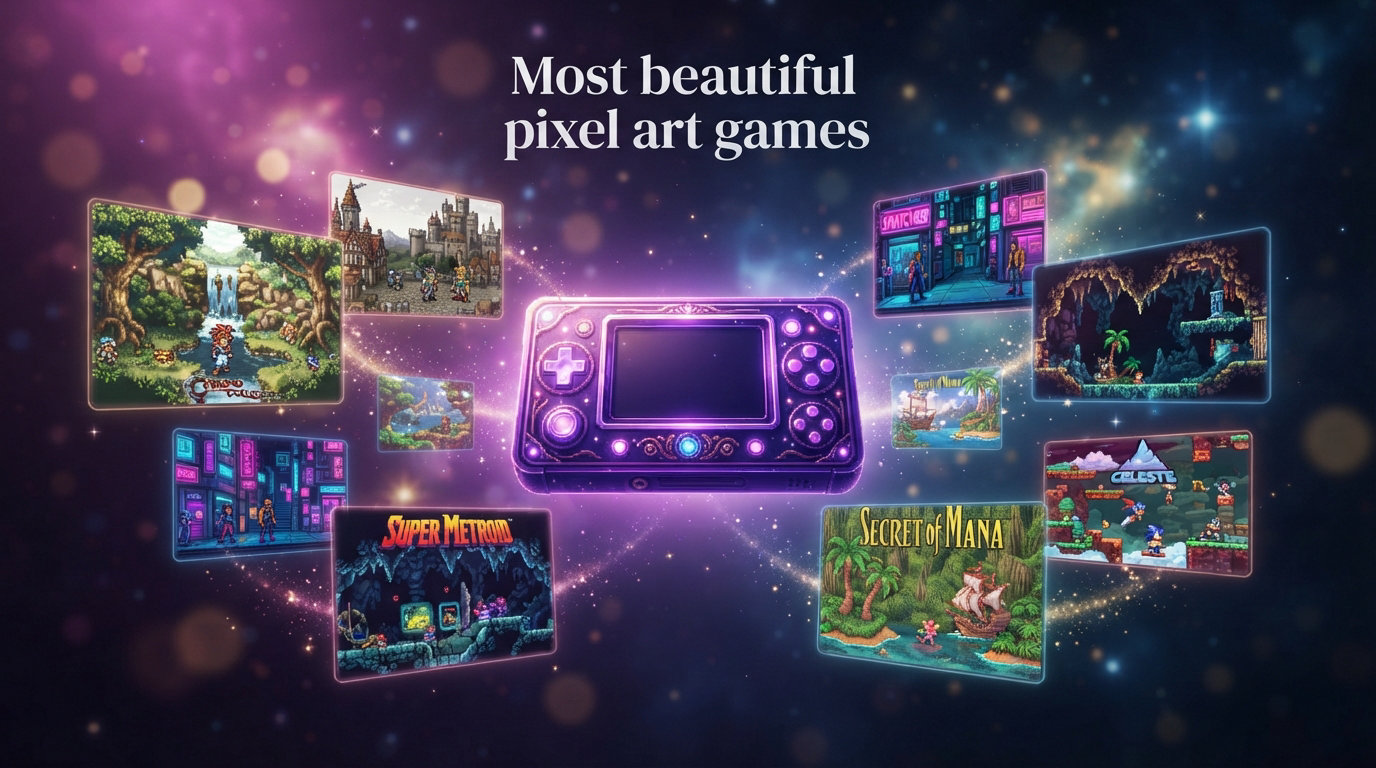
Some of the most beautiful pixel art games do not try to look realistic. They lean into their pixels, turning every square into a deliberate brushstroke. I have spent hundreds of hours exploring pixel art worlds across every platform, and the best ones do not just look retro. They look intentional.
The most beautiful pixel art games in 2026 range from hand-painted RPG adventures to neon-soaked cyberpunk thrillers. Developers like Sabotage Studio, ConcernedApe, and Heart Machine have proven that pixel art is not a stepping stone to “better” graphics. It is the destination.
In this guide, I will walk you through 15 visually stunning pixel art games, explain what makes pixel art beautiful on a technical level, and help you find the right game for your taste. Whether you want a cozy farming sim or an atmospheric action RPG, there is a pixel art masterpiece waiting for you.
Table of Contents
What Makes Pixel Art Beautiful in Modern Games
Most lists of beautiful pixel art games just describe what you see. I want to go deeper and explain why certain pixel art looks gorgeous while other pixel art feels flat.
The answer comes down to four things: color palette design, sprite detail, lighting, and animation. When a developer nails all four, you get a game that screenshots cannot do justice.
Color Palette: Less Is More
Great pixel art games use limited color palettes to their advantage. Instead of trying to reproduce every shade in nature, artists pick 16 to 32 colors that define the entire mood of a scene. Sea of Stars uses warm golds and cool ocean blues to make its world feel alive. Hyper Light Drifter relies on saturated pinks and teals against deep purples to create tension without a single word of dialogue.
This constraint forces intentionality. Every pixel carries more weight because the palette cannot hide behind gradients or blur effects. When a pixel artist chooses a color, it means something.
Sprite Work and Handcrafted Detail
Sprites are the building blocks of pixel art. A single character sprite in a high-quality game might contain 200 to 500 individually placed pixels, each one positioned by hand. Owlboy took nearly a decade to develop partly because every character, tree, and cloud was drawn pixel by pixel.
The difference between good and great sprite work shows up in the small details. The way a cape billows during a dash. The subtle bob of an idle animation. The way water ripples distort reflections. These micro-moments are where pixel art transcends nostalgia and becomes genuine art.
Dynamic Lighting Effects
Modern pixel art games use real-time lighting that would have been impossible on original 16-bit hardware. Sea of Stars renders dynamic shadows and volumetric light beams across pixel environments. Torches flicker and cast warm gradients. Sunsets paint entire landscapes in shifting oranges and purples.
This combination of old-school sprite work with modern lighting is what makes 2026‘s best pixel art games feel fresh. You get the charm of hand-drawn sprites with atmospheric depth that pulls you into the world.
Animation Quality and Frame Count
Animation is where pixel art games separate themselves from static pixel illustrations. A game can have beautiful screenshots but feel stiff in motion. The best pixel art games use 12 to 24 animation frames per action, creating fluid movement that makes characters feel alive.
Celeste is a masterclass in this. Madeline’s hair flows behind her as she dashes, changing direction with physics-like momentum. Every character has dozens of animation states, and the parallax backgrounds shift in layers that give the mountain real depth.
Pixel Art Styles: 8-Bit vs 16-Bit vs HD-2D
Not all pixel art looks the same. Before I dive into the games, it helps to understand the three main styles you will encounter. Each has its own visual personality.
8-Bit Pixel Art
8-bit pixel art uses large, chunky pixels with a limited color count, usually under 16 colors per sprite. Think of the original NES era. Games like Undertale and The Messenger’s past sections use this style to evoke raw nostalgia. The simplicity forces artists to communicate more with less.
8-bit art works best for games that want to feel retro and approachable. The large pixels are easy to read at a glance, which makes it great for fast-paced action where clarity matters.
16-Bit Pixel Art
16-bit pixel art is the sweet spot for most of the games on this list. Smaller pixels, richer palettes of 32 to 256 colors, and more room for detail. This is the SNES era pushed to its absolute limit. Games like Sea of Stars, Stardew Valley, and Eastward use 16-bit techniques with modern enhancements.
If you want pixel art that feels detailed without losing its handcrafted quality, 16-bit is where you will find the most variety and visual richness.
HD-2D: A Hybrid Approach
HD-2D combines 2D pixel art sprites with fully 3D environments, modern lighting, and depth-of-field effects. Square Enix popularized this with Octopath Traveler, and it has sparked debate in the pixel art community about whether it counts as “true” pixel art.
I think HD-2D is its own thing, and it is gorgeous. The pixel characters against rich 3D backgrounds create a diorama effect that looks like holding a tiny painted world in your hands. I have included a few HD-2D games in the honorable mentions because they deserve attention even if they blur the line.
Sea of Stars
Sea of Stars is, in the words of the Reddit community, “in a league of its own” when it comes to pixel art. Developed by Sabotage Studio, this turn-based RPG channels the spirit of Chrono Trigger while adding modern lighting that makes every scene look like a painting.
The game’s day-night cycle is the standout feature. As time passes, shadows shift across pixel-art landscapes, water surfaces reflect the changing sky, and torchlight flickers with realistic warmth. I have found myself pausing mid-dungeon just to watch the lighting change.
Sabotage Studio built a custom engine to handle dynamic light interactions with pixel sprites. The result is something that screenshots barely capture. You need to see it in motion. Available on PC, PlayStation 4 and 5, Xbox One and Series X/S, and Nintendo Switch.
Owlboy
Owlboy is frequently praised by players as having “museum-quality” pixel artwork, and I agree. D-Pad Studio spent nearly ten years handcrafting every element of this game, and it shows. There is no procedural generation here. Every cloud, every tree, every stone was placed with the care of a traditional painter.
The game follows Otus, a mute owl-human hybrid, through floating sky islands. The environments range from lush overgrown ruins to storm-wracked pirate ships, each rendered with an attention to detail that makes you want to zoom in and examine individual pixels.
What makes Owlboy special is how its art serves its story. The world feels lived-in and real despite being made of tiny colored squares. That emotional connection between art and narrative is rare. Available on PC, PlayStation 4, Xbox One, and Nintendo Switch.
Eastward
Eastward feels like a Studio Ghibli film rendered in pixels. Developed by Pixpil and published by Chucklefish, this adventure game drops you into a decaying underground society and eventually lets you explore a beautiful, dangerous surface world.
The color palette shifts dramatically between environments. Underground stations are rendered in sickly greens and rusty browns. The surface explodes with warm sunset oranges, deep forest greens, and water that shimmers with hand-drawn reflections. Each area has its own visual identity.
Character expressions deserve special mention. Despite their small size, the pixel characters convey genuine emotion through subtle animation. A shrug, a sideways glance, a nervous fidget. These tiny movements make the cast feel human. Available on PC and Nintendo Switch.
Celeste
Celeste proves that pixel art can be both beautiful and emotionally resonant. Developed by Extremely OK Games (formerly Maddy Makes Games), this precision platformer uses color as a storytelling tool. Each of the mountain’s chapters has a distinct color palette that reflects Madeline’s internal state.
The early sections are bright and hopeful, with clear blue skies and green forests. As you climb higher, the palette shifts to anxious reds and cold blues. The summit chapter strips away almost all color, leaving stark whites and shadows. It is visual storytelling at its finest.
The parallax scrolling deserves praise too. Background layers shift independently as you move, creating a genuine sense of altitude. Looking down from the mountain’s upper sections gives you a real sense of how far you have climbed. Forum discussions note that the difficulty can sometimes overshadow the visuals, but I encourage you to take breaks and just look around. Available on PC, PlayStation 4, Xbox One, and Nintendo Switch.
The Messenger
The Messenger does something no other game on this list attempts: it visually shifts between two distinct pixel art eras as a core gameplay mechanic. Developed by Sabotage Studio (the same team behind Sea of Stars), the game starts in an 8-bit style that looks like an NES title and then transforms into a full 16-bit world when you travel through time portals.
The transition is seamless and genuinely surprising the first time it happens. Colors bloom from muted 8-bit tones into a rich 16-bit palette. The world geometry stays the same, but suddenly there are parallax backgrounds, particle effects, and environmental details that were impossible in the 8-bit era.
This dual-style approach is not just a gimmick. It reinforces the game’s time-travel narrative and lets the art team show off two distinct skill sets. Available on PC, PlayStation 4, Xbox One, and Nintendo Switch.
Katana ZERO
Katana ZERO is a neo-noir fever dream rendered in pixel art. Developed by Askiisoft, this action game drops you into a dystopian cityscape bathed in neon pinks, electric blues, and the warm amber of streetlights against rain-slicked streets.
The visual style borrows heavily from cyberpunk and retro-futurism, but the pixel art gives it a texture that 3D cyberpunk games cannot match. Every neon sign flickers with hand-drawn animation. Every slash through an enemy triggers screen shake and particle bursts that make combat feel visceral despite the small sprites.
The game also uses color to communicate gameplay information. Red highlights mark interactive elements. Blue tones indicate slow-motion sequences. This integration of art and design is something I wish more pixel art games attempted. Available on PC and Nintendo Switch.
Hyper Light Drifter
Hyper Light Drifter is a masterclass in wordless visual storytelling. Developed by Heart Machine, this action RPG tells its entire story through environment design, color, and animation. There is no text, no voice acting, and no traditional cutscenes. The pixel art does all the talking.
The color palette is the star. Saturated pinks, electric teals, and deep purples create a world that feels alien and familiar at the same time. Each of the four main areas has a distinct color identity: lush greens for the eastern forests, cold blues for the northern lake, fiery oranges for the southern deserts, and haunting purples for the western catacombs.
Forum players note that the combat difficulty can be intense, which sometimes distracts from simply enjoying the scenery. I recommend taking your time between encounters to absorb the environmental details. The world is dense with visual secrets. Available on PC, PlayStation 4, Xbox One, and Nintendo Switch.
Stardew Valley
Stardew Valley is proof that a single person can create pixel art that rivals entire studio productions. Eric Barone, working alone as ConcernedApe, designed every sprite, tile, and animation in the game over four years of solo development.
What makes Stardew Valley’s pixel art beautiful is its warmth. The seasonal color palettes shift the entire mood of the valley. Spring is soft pinks and fresh greens. Summer explodes with vibrant flowers and golden sunlight. Autumn brings warm oranges and reds. Winter strips everything down to cool blues and whites.
The character portraits deserve a special mention. Each villager has a range of expressive pixel art portraits that convey personality through subtle details. The art style is approachable and cozy, which perfectly matches the gameplay tone. Available on virtually every platform: PC, PlayStation, Xbox, Nintendo Switch, iOS, and Android.
Dave the Diver
Dave the Diver surprised everyone by combining two completely different gameplay styles and making both look fantastic in pixel art. Developed by Mintrocket, the game splits between deep-sea diving exploration and running a sushi restaurant, each with its own visual treatment.
The underwater sections use layered pixel art to create genuine depth. Fish species are rendered with surprising accuracy, each one identifiable by its pixel art silhouette. Light filters down from the surface in visible shafts, and deeper zones get progressively darker and more mysterious.
The restaurant sections are brighter and more cartoony, with expressive character animations that make every customer feel distinct. This contrast between the two halves of the game shows how versatile pixel art can be. Available on PC, PlayStation 4 and 5, Xbox, and Nintendo Switch.
Undertale
Undertale proves that minimalist pixel art can be beautiful in its own way. Toby Fox created most of the game’s art himself, using a stark black-and-white palette for the overworld with strategic bursts of color for key moments and characters.
The beauty here is not in technical complexity. It is in emotional impact. When Undertale does use color, it means something. A yellow flower against a monochrome background. A flash of red during a climactic moment. These restrained choices make the colored pixels feel like events, not just decoration.
The battle screens are where the art shines most. Each enemy has a distinct, memorable pixel art design that communicates personality at a glance. Some are cute, some are unsettling, and a few are genuinely moving. Available on PC, PlayStation 4, Xbox One, Nintendo Switch, and mobile.
Fez
Fez solves a visual puzzle that most pixel art games never attempt: how to make 2D pixel art feel three-dimensional. Developed by Polytron Corporation, the game lets you rotate the entire world 90 degrees at a time, revealing hidden paths and entirely new perspectives on familiar scenes.
The color palette is dominated by soft sunset tones: warm golds, dusty pinks, and deep twilight blues. It gives the entire game a peaceful, contemplative atmosphere. Even the more challenging puzzle sections feel calming because the world is so pleasant to look at.
The perspective shifts are where Fez’s pixel art truly impresses. What looks like a flat wall in one rotation becomes a deep corridor in another, with pixel art that maintains its charm from every angle. Available on PC, PlayStation 3 and 4, Xbox 360 and One, and Nintendo Switch.
Inmost
Inmost is pixel art bathed in shadow and light. Developed by Hidden Layer Games, this atmospheric puzzle-platformer uses darkness as a visual tool, revealing its world through shafts of light, glowing objects, and carefully placed color accents against near-black backgrounds.
The result is a game that feels like exploring a haunted painting. Each environment is rendered in muted, desaturated tones punctuated by single sources of warm light. A flickering candle. A beam of moonlight through a crack. The glow of mysterious technology. These light sources become anchors that draw your eye and guide you forward.
The animation quality is exceptional for such a small team. Character movements are smooth and weighted, with fabric and hair that respond to movement and wind. It is one of the most technically impressive pixel art games I have played. Available on PC, PlayStation 4, Xbox One, and Nintendo Switch.
Animal Well
Animal Well creates a surreal, dreamlike world that feels unlike any other pixel art game. Developed by Shared Memory (a solo developer, Billy Basso), this metroidvania populates its environments with strange creatures and impossible architecture rendered in a muted, watercolor-like palette.
What sets Animal Well apart is its use of light and particles within a pixel art framework. Fireflies drift through dark spaces with soft glowing trails. Water reflects and refracts light in ways that should not be possible with sprites. Smoke and fog behave like real volumetric effects, not just layered transparent tiles.
The game is also full of visual secrets. Areas you think are decorative turn out to be interactive. Background elements contain hidden patterns. It rewards careful looking in a way few games do. Available on PC and Nintendo Switch.
Unpacking
Unpacking tells an entire life story through isometric pixel art of household objects. Developed by Witch Beam, this puzzle game has you unpacking boxes across multiple moves, each one representing a chapter of someone’s life.
The beauty is in the small details. Each item is rendered with enough pixel art fidelity to be instantly recognizable: a specific model of game console, a toothbrush holder, a framed photo. As the years progress, objects age, break, get replaced, and accumulate. You learn about the character entirely through what she keeps and what she leaves behind.
The isometric view gives each room a dollhouse quality that invites careful arrangement. The pixel art style makes every object feel precious and worth placing thoughtfully. Available on PC, PlayStation 4 and 5, Xbox One and Series X/S, Nintendo Switch, and mobile.
Terra Nil
Terra Nil uses pixel art to visualize environmental transformation in a way that feels genuinely hopeful. Developed by Free Lives, this reverse-city-builder starts you with a barren, grey wasteland and tasks you with restoring it to lush wilderness.
The visual progression is the reward. Grey tiles slowly turn green as you introduce plant life. Wetlands fill with pixel art frogs and dragonflies. Forests grow from single saplings to dense canopies. The color palette expands as the ecosystem recovers, and watching the world bloom is deeply satisfying.
The isometric perspective shows off the pixel art at its best scale. Zooming out reveals the entire landscape transforming in real time. It is environmental art as gameplay. Available on PC, iOS, and Android via Netflix.
Honorable Mentions: Games Pushing Pixel Art Boundaries
These games deserve recognition even though they bend the definition of “pure” pixel art. They represent exciting directions for the medium.
Octopath Traveler and Octopath Traveler II
Square Enix’s HD-2D engine places 2D pixel art characters inside fully 3D environments with modern lighting, depth of field, and water effects. The result looks like miniature dioramas. It sparked an entire subgenre, and both Octopath Traveler games remain the gold standard for HD-2D.
Chrono Trigger
I cannot write about beautiful pixel art without mentioning Chrono Trigger. Released in 1995, Akira Toriyama’s character designs rendered in 16-bit pixel art remain a benchmark. Many of the games on this list, especially Sea of Stars, openly cite it as inspiration. Play it on the DS or mobile version for the best experience.
The Last Night
The Last Night caused a sensation when its trailer debuted, showing a pixel art cyberpunk city with cinematic depth. While the full release has faced lengthy delays, the art direction demonstrated that pixel art can achieve filmic atmosphere. I am still holding out hope for its eventual release.
Kingdom: Classic and Kingdom Two Crowns
The Kingdom series proves that minimal pixel art can be deeply atmospheric. Side-scrolling landscapes rendered in flat silhouettes against evolving skies create a meditative visual experience. The simplicity is the point. Available on PC, consoles, and mobile.
How to Choose a Beautiful Pixel Art Game for Your Taste
With so many stunning pixel art games available, picking one can feel overwhelming. Here is how I would narrow it down based on what you want from the experience.
Choose by Genre
If you want a turn-based RPG with gorgeous visuals, start with Sea of Stars. For precision platforming, Celeste is unmatched. If cozy farming is your thing, Stardew Valley is the obvious choice. Metroidvania fans should look at Animal Well or The Messenger. For narrative-driven exploration, Eastward and Owlboy deliver story and beauty in equal measure.
Choose by Art Style
If you love the 16-bit SNES aesthetic, Sea of Stars, Stardew Valley, and Eastward are your best bets. For something darker and moodier, Inmost, Hyper Light Drifter, and Katana ZERO push pixel art into atmospheric territory. If minimalist 8-bit appeals to you, Undertale and The Messenger’s 8-bit sections deliver charm with simplicity.
For the HD-2D hybrid approach, Octopath Traveler and Octopath Traveler II offer the most polished experience. These games blur the line between pixel art and full 3D in a way that feels fresh rather than compromised.
Choose by Platform
Most of the games on this list are available on PC and Nintendo Switch, which makes sense for the indie pixel art scene. Stardew Valley and Undertale have the widest platform availability, including mobile. Console-exclusive players should check individual game availability on PlayStation and Xbox stores.
If you game primarily on mobile, Stardew Valley, Undertale, and Terra Nil are your strongest options. All three control well on touchscreens and look great on smaller displays.
Choose by Atmosphere
Bright and colorful games like Stardew Valley, Fez, and Unpacking create warm, inviting worlds. Dark and atmospheric games like Inmost, Hyper Light Drifter, and Katana ZERO use shadow and neon to create tension and mystery. Somewhere in the middle, Eastward and Sea of Stars balance beauty with emotional depth.
Think about what mood you want to inhabit for the next 10 to 40 hours. The right pixel art game will match not just your playstyle but your emotional bandwidth.
FAQs
What are the most visually stunning pixel art games?
Sea of Stars, Owlboy, Eastward, Celeste, and Hyper Light Drifter are widely considered the most visually stunning pixel art games. Sea of Stars stands out for its dynamic lighting and Chrono Trigger-inspired world. Owlboy is praised for museum-quality handcrafted sprites that took nearly a decade to complete.
Which pixel art game has the best graphics?
Sea of Stars is often cited as having the best pixel art graphics because of its real-time dynamic lighting, reflective water surfaces, and day-night cycle that transforms every scene. Owlboy is a close second for the sheer density of handcrafted detail in every frame.
What games have the most beautiful pixel art style?
The games with the most beautiful pixel art styles include Sea of Stars (16-bit RPG with modern lighting), Celeste (color-as-storytelling), Katana ZERO (neo-noir cyberpunk), Stardew Valley (cozy seasonal palettes), and Hyper Light Drifter (wordless visual narrative through color).
Are there any modern pixel art games that look like paintings?
Yes. Sea of Stars is frequently described as looking like a living painting, with its dynamic lighting and reflective water effects. Eastward evokes Studio Ghibli films with its pixel art. Inmost uses shadow and light to create scenes that resemble dark oil paintings. These games prove pixel art can achieve fine-art quality.
Why do developers still choose pixel art for new games?
Developers choose pixel art because it offers a unique aesthetic that realistic 3D graphics cannot replicate. Pixel art allows small indie teams to create visually distinctive games without massive budgets. It also evokes emotional nostalgia and lets artists express creativity through constraint. The style has become a deliberate artistic choice, not a technical compromise.
What is the difference between 8-bit and 16-bit pixel art?
8-bit pixel art uses larger pixels and fewer colors (typically under 16), creating a chunky, retro look similar to NES games. 16-bit pixel art uses smaller pixels and richer color palettes (32 to 256 colors), allowing for more detail similar to SNES-era games. Modern pixel art games often use 16-bit techniques enhanced with dynamic lighting, particle effects, and smooth animations that would have been impossible on original hardware.
Final Thoughts on the Most Beautiful Pixel Art Games
The most beautiful pixel art games are not living in the past. They are showing us something that photorealistic graphics cannot: that constraint breeds creativity, and that every pixel can carry meaning when placed with care.
From Sea of Stars and its living, breathing pixel art world to the museum-quality craftsmanship of Owlboy, these games represent the best of what the medium offers. Whether you are drawn to the neon glow of Katana ZERO or the quiet warmth of Stardew Valley, there is a pixel art game that will stay with you long after the credits roll.
My advice? Pick the game whose atmosphere speaks to you, give it your full attention, and let the art do what great art does. Every game on this list earned its place through genuine visual artistry, not nostalgia. Pixel art is not going anywhere, and based on what I have seen from recent releases like Animal Well and Terra Nil, it is only getting more beautiful.