
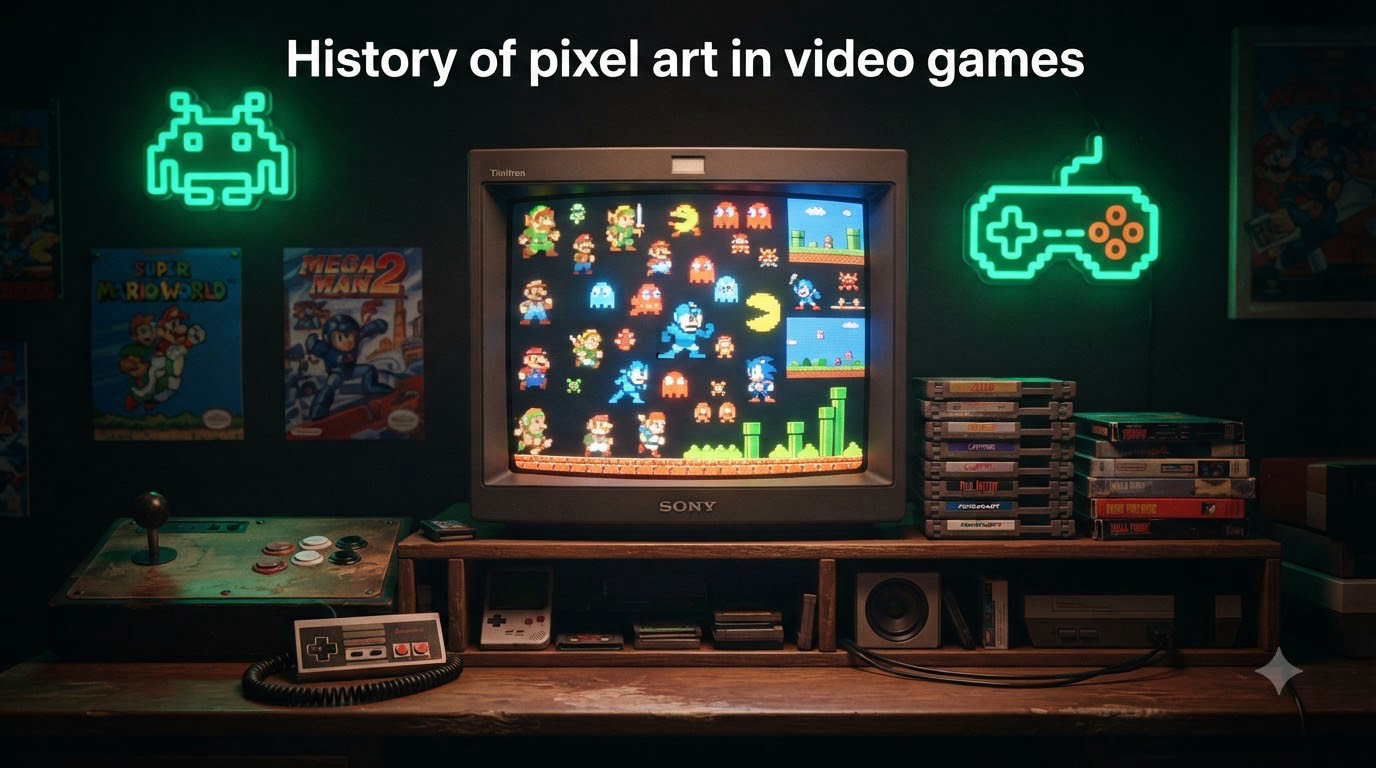
Pixel art is a form of digital illustration where images are constructed one pixel at a time. This technique became the defining visual language of early video games, shaping how millions experienced their favorite arcade cabinets and home consoles. The history of pixel art in video games spans more than five decades, evolving from a technical necessity into a celebrated art form that continues thriving today.
In this comprehensive guide, we will walk through the complete evolution of pixel art in gaming, from its origins in the 1970s to its renaissance in modern indie games. Whether you are a retro gaming enthusiast or simply curious about why those blocky characters feel so nostalgic, this article covers everything you need to know about the art form that refuses to fade away.
Table of Contents
What Is Pixel Art in Video Games?
Pixel art is a digital art technique where images are built using individual pixels as the fundamental building blocks. Unlike vector graphics or modern 3D renders that use mathematical curves or polygon meshes, pixel art relies on a fixed grid of colored squares that, when viewed together, form recognizable shapes and characters.
Two key concepts define pixel art in video games. First, sprites are the individual movable graphic elements that games display, from your main character to enemies, items, and environmental objects. Second, indexed color means games restrict themselves to a limited palette, often just 16 or 256 colors, which creates the characteristic look of 8-bit and 16-bit era graphics.
The appeal of pixel art comes from its constraints. Working within tight resolution limits and limited color palettes forced artists to become masters of suggestion. A single well-placed pixel could imply muscle definition, fabric texture, or atmospheric perspective. This requirement for creative economy turned technical limitations into artistic advantages.
Why Pixel Art Dominated Early Gaming
Early video games used pixel art not by choice but by necessity. The hardware of the 1970s and 1980s could only handle tiny amounts of graphical data. Processors were slow, memory was expensive, and storage capacity was extremely limited compared to modern standards.
Consider the Nintendo Entertainment System, one of the most successful consoles of the golden age. Its Picture Processing Unit could handle only 64 colors simultaneously, with a maximum of 25 colors displayed on screen at once. Games working within these strict limitations developed the visual vocabulary of pixel art that we still recognize and love today.
CRT monitors of the era also contributed to the aesthetic. The electron beam of a CRT naturally softened individual pixels, blending them together in a way that made early games appear smoother than they actually were. This combination of hardware constraints and display technology created the distinctive look that defines retro gaming in our memories.
The Origins: Pixel Art in the 1970s
While pixel art became inseparable from video games, its origins technically predate the gaming industry by several years. In 1962, students at MIT created Spacewar, one of the earliest digital games, using vector graphics rather than pixels. However, these early computer experiments laid essential groundwork for what would come next.
Atari’s Pong in 1972 changed everything. When that simple white ball bounced across a black screen, audiences saw something magical. The crude graphics were pixel art by necessity, composed of just a few dozen pixels, yet the gameplay transcended the technical limitations and created a cultural phenomenon.
The late 1970s brought arcade classics that established pixel art as a dominant cultural force. Taito’s Space Invaders in 1978 featured hundreds of descending alien invaders, each composed of carefully crafted pixel sprites. The game proved that pixel art could create memorable characters with distinct personalities and compelling visual storytelling.
Other pioneers followed, including Asteroids, which used vector graphics but demonstrated the appetite for arcade gaming, and the early home consoles that began experimenting with simple sprite-based graphics. The stage was set for the explosion of the 1980s.
The Golden Age of Pixel Art: 1980s
The 1980s represented the golden age of pixel art in video games. Hardware finally allowed for more complex sprites while still maintaining the pixelated aesthetic that defined the medium. This decade gave us some of the most iconic images not just in gaming, but in popular culture generally.
Namco’s Pac-Man in 1980 introduced a character with genuine personality despite being composed of just a few pixels. The simple yellow circle with its distinctive wedge mouth became a global icon, appearing on lunch boxes, clothing, and eventually in animated series. Nintendo’s Donkey Kong in 1981 gave us Jumpman, the precursor to Mario, demonstrating how pixel art could convey athletic movement and physicality.
The launch of the Nintendo Entertainment System in 1985 brought pixel art into living rooms across America. Super Mario Bros established new standards for sprite animation, with Mario’s running cycle, jumping arc, and responsive controls all conveyed through carefully animated pixels. The attention to detail in that game’s sprites set benchmarks that developers still discuss today.
Games like Mega Man, Castlevania, and Metroid showcased the diversity of pixel art styles possible within the 8-bit format. The color palette expanded, animation frames multiplied, and artists pushed the NES hardware to its absolute limits. Meanwhile, Sega’s Master System and other competitors pushed the medium forward with their own technical achievements.
The arcade scene remained vibrant throughout the decade, with companies like Capcom, Konami, and SNK delivering increasingly impressive sprite work. Street Fighter, Final Fight, and countless other arcade classics demonstrated that pixel art could deliver visual spectacle rivaling any other medium.
The 1990s: Higher Resolution and the Demoscene
The 1990s brought significant changes to pixel art as 16-bit consoles raised resolution and color counts dramatically. The Super Nintendo and Sega Genesis could display thousands of colors and larger, more detailed sprites, allowing artists unprecedented creative freedom within the pixel art framework.
Capcom’s Street Fighter II from 1991 demonstrated how far pixel art animation had come. Each character featured dozens of animation frames capturing every kick, punch, and special move with fluid precision. The attention to detail in sprites like Ryu and Chun-Li set new standards for the industry and proved pixel art could deliver cinematic action.
Yet the era also saw pixel art face its first major challenge. Companies like Sega with Donkey Kong Country in 1994 experimented with pre-rendered 3D graphics that mimicked pixel art’s detail without using the traditional technique. This signaled an upcoming shift in the industry toward three-dimensional graphics.
The demoscene emerged as a crucial creative force during this decade. Independent programmers and artists created demonstrations showcasing graphics capabilities that commercial games had not yet achieved. These communities kept pixel art techniques alive and pushed them to new levels of sophistication through friendly competition.
Sega continued pushing sprite technology with the Saturn, while Sony’s PlayStation debuted in 1994, marking the beginning of the transition to 3D. Games like Ridge Racer showed what was possible with polygons, but pixel art remained dominant in 2D games throughout the decade.
The 2000s: Pixel Art Becomes an Art Form
As 3D graphics became the industry standard in the early 2000s, pixel art seemingly disappeared from mainstream gaming. Games looked increasingly photorealistic, and the chunky sprites of the past seemed relegated to history. However, something unexpected happened that kept pixel art alive.
Pixel art found new life in online communities. Websites like Pixeljoint, Pixel Planet, and communities on deviantART created spaces where artists could share and celebrate pixel art independent of games. Pixel dolls, avatar creation, and independent illustration kept the art form alive during its commercial eclipse from mainstream gaming.
The demoscene continued thriving as well. Competitions at demoparties like Assembly in Finland and Deadline in Germany showcased pixel artists creating increasingly sophisticated work within extreme technical constraints. These artists treated limitations not as obstacles but as creative opportunities to push their skills further.
By the mid-2000s, a quiet renaissance was building. Games like Cave Story in 2004 proved that pixel art could still create compelling experiences with minimal resources. The deliberate choice to use pixel aesthetics signaled something important: pixel art was becoming an artistic statement rather than a technical necessity.
Independent games throughout the decade experimented with pixel art in unique ways. Companies like Team Meat with Super Meat Boy, and Edmund McMillen’s earlier work, showed that there was enduring appeal in the classic aesthetic. The indie movement was building momentum that would explode in the following decade.
The 2010s: The Indie Pixel Art Renaissance
The 2010s witnessed pixel art return to mainstream gaming in dramatic fashion. Indie developers, freed from the pressure to match AAA graphics budgets, embraced pixel art as a way to differentiate their games and tap into nostalgia while creating entirely new experiences.
Phil Fish’s Fez in 2012 demonstrated that pixel art could be visually stunning and intellectually stimulating. Polytron’s gorgeous rotating world showed what was possible when modern tools met classical techniques. The pixel art became a conversation point rather than a limitation to overcome, earning recognition from mainstream gaming publications.
Yacht Club Games’ Shovel Knight in 2014 represented a passionate love letter to 8-bit era gaming. Every sprite, every animation frame, every color choice echoed NES classics while feeling fresh and exciting. The game proved there was substantial commercial appetite for pixel art experiences and sparked a wave of retro-inspired indie titles.
Stardew Valley, Undertale, Hyper Light Drifter, and countless other indie hits followed. The accessibility of pixel art tools like Aseprite meant developers no longer needed large teams to create beautiful graphics. A solo developer or small team could produce visually striking games that competed with major studios on aesthetic grounds alone.
Crowdfunding platforms like Kickstarter enabled developers to fund ambitious pixel art projects directly. The connection between developers and audiences became more direct, and pixel art games found their audience before a single sprite was animated. This decade transformed pixel art from a nostalgic choice into a strategic artistic decision.
Pixel Art in 2026: The Modern Scene
In 2026, pixel art continues thriving in ways its creators could never have imagined during the early days of Space Invaders and Pac-Man. Modern indie games regularly top sales charts using pixel aesthetics, and the art form has achieved cultural recognition that would have seemed impossible a generation ago.
Games like Dead Cells, Celeste, and Hades have shown that pixel art can convey emotion, action, and atmosphere equal to any 3D graphics engine. These titles prove that the medium itself is not the limiting factor for artistic expression, only the artist’s skill and vision.
The NFT era brought new attention to pixel art, with some pixel artists achieving record sales for their work. While the NFT market has calmed from its speculative peaks, pixel art’s position in the digital art world has been permanently elevated. Collectors recognize the artistry in single-pixel craftsmanship and are willing to pay accordingly.
The COVID-19 pandemic unexpectedly boosted pixel art communities. With people spending more time at home, many turned to creative hobbies like pixel art. Online tutorials and accessible tools led to a surge of new pixel artists learning techniques passed down through decades, ensuring the art form will continue evolving.
Museum recognition has followed. The Smithsonian and other institutions have featured pixel art in exhibitions exploring digital culture and gaming history. What began as a technical workaround has become acknowledged as a legitimate art form worthy of cultural preservation alongside more traditional artistic mediums.
Key Pixel Art Techniques That Shaped Gaming
Understanding pixel art requires knowing the techniques that define the craft. These methods emerged from the constraints of early hardware but have become the signature approaches that professional pixel artists still use today.
Dithering involves using patterns of alternating pixels to create the illusion of additional colors when the color palette is limited. This technique was essential in early games where artists had to suggest gradients and shading using only a few available colors. Classic examples show checkerboard patterns and dot arrangements that suggest intermediate tones.
Anti-aliasing in pixel art works differently than in modern graphics. Rather than smoothing edges mathematically, pixel artists manually place transitional pixels to suggest smoothness along curves and diagonals. This hand-crafted approach gives pixel art its distinctive look while maintaining the grid-based aesthetic that defines the medium.
Color palette restriction is perhaps the most defining characteristic of pixel art. Professional pixel artists often work with palettes of 16 or 32 colors, forcing creative solutions for shading, lighting, and visual hierarchy. The 70-30 rule in art suggests using one dominant color for approximately 70 percent of an image with secondary colors filling the remaining 30 percent, creating balanced and pleasing compositions.
Sprite animation fundamentals rely on key frames and in-between frames. Early games used limited animation with as few as 2-3 frames per action, but skilled artists made these frames feel fluid through careful attention to weight and timing. Modern pixel art often expands animation to 8 or more frames while maintaining the classic aesthetic.
Isometric pixel art creates the illusion of three dimensions on a two-dimensional grid. This technique emerged in the late 1980s and 1990s with games like Q*bert and later Sonic’s pseudo-3D sections. Understanding pixel art requires knowing how artists created depth without true 3D rendering capabilities.
Why Pixel Art Persists: More Than Nostalgia
Many assume pixel art persists solely through nostalgia, but that explanation misses something important about the medium. Pixel art offers genuine advantages that keep artists and developers choosing it over modern alternatives, regardless of when they grew up.
For indie developers, pixel art remains practical and economical. A small team can produce asset-heavy games in pixel art style that would require massive resources in 3D. This accessibility has democratized game development, allowing more diverse voices to enter the industry with their unique stories and perspectives.
The connection to traditional crafts has surprised many observers. Pixel art shares DNA with cross-stitch embroidery, mosaic tiling, and pointillist painting. The patience required to place individual pixels mirrors the meditative process of these established art forms, creating works that reward careful attention.
There is also an undeniable emotional resonance. Pixel art triggers different cognitive responses than photorealistic graphics. The implied rather than explicit details leave room for player imagination, creating more personal connections to characters and worlds. Players often report stronger emotional attachment to pixel art characters than to 3D models.
The aesthetic has become timeless rather than merely nostalgic. New players discovering pixel art games today do not experience them as retro throwbacks but as legitimate artistic experiences. This cross-generational appeal ensures pixel art will remain relevant regardless of advances in rendering technology.
Frequently Asked Questions
Did pixel art exist before video games?
Yes. Digital pixel art technically predates video games, originating in 1960s computer graphics research. However, pixel art became widely recognized through video games in the 1970s and 1980s when arcade cabinets and home consoles made it a cultural phenomenon.
Why did games use pixel art?
Early games used pixel art because hardware limitations made it the only practical option. Processors could only handle low-resolution graphics with limited colors, and pixels were the natural building blocks of digital images on those systems.
Why were old games pixelated?
Games appeared pixelated because early hardware had low resolution, often around 256 by 240 pixels, and limited color palettes sometimes consisting of just 2 to 16 colors. These severe constraints defined the visual style of early gaming.
What is the 70-30 rule in pixel art?
The 70-30 rule is a color theory principle suggesting that a composition should use one dominant color for approximately 70 percent of the image with secondary colors filling the remaining 30 percent. In pixel art, this helps create visually balanced and appealing color palettes.
The History of Pixel Art in Video Games: A Living Legacy
The history of pixel art in video games is not merely a nostalgic journey through old graphics. It represents one of the most remarkable artistic adaptations in any medium. What began as a technological constraint became a beloved aesthetic that continues inspiring new generations of artists and gamers alike.
Pixel art has completed a full circle from necessity to art form. Today, museums display pixel art, collectors pay premium prices for pixel artwork, and some of the most successful indie games of recent years have embraced the pixelated aesthetic. The art form that critics once dismissed as primitive has earned its place in cultural conversations worldwide.
As we look ahead, pixel art shows no signs of fading from relevance. New tools, new communities, and new interpretations ensure this distinctive visual style remains compelling. Whether you are playing the latest indie hit or revisiting a classic from the arcade era, pixel art reminds us that constraints can breed creativity and limitations can define beauty.