
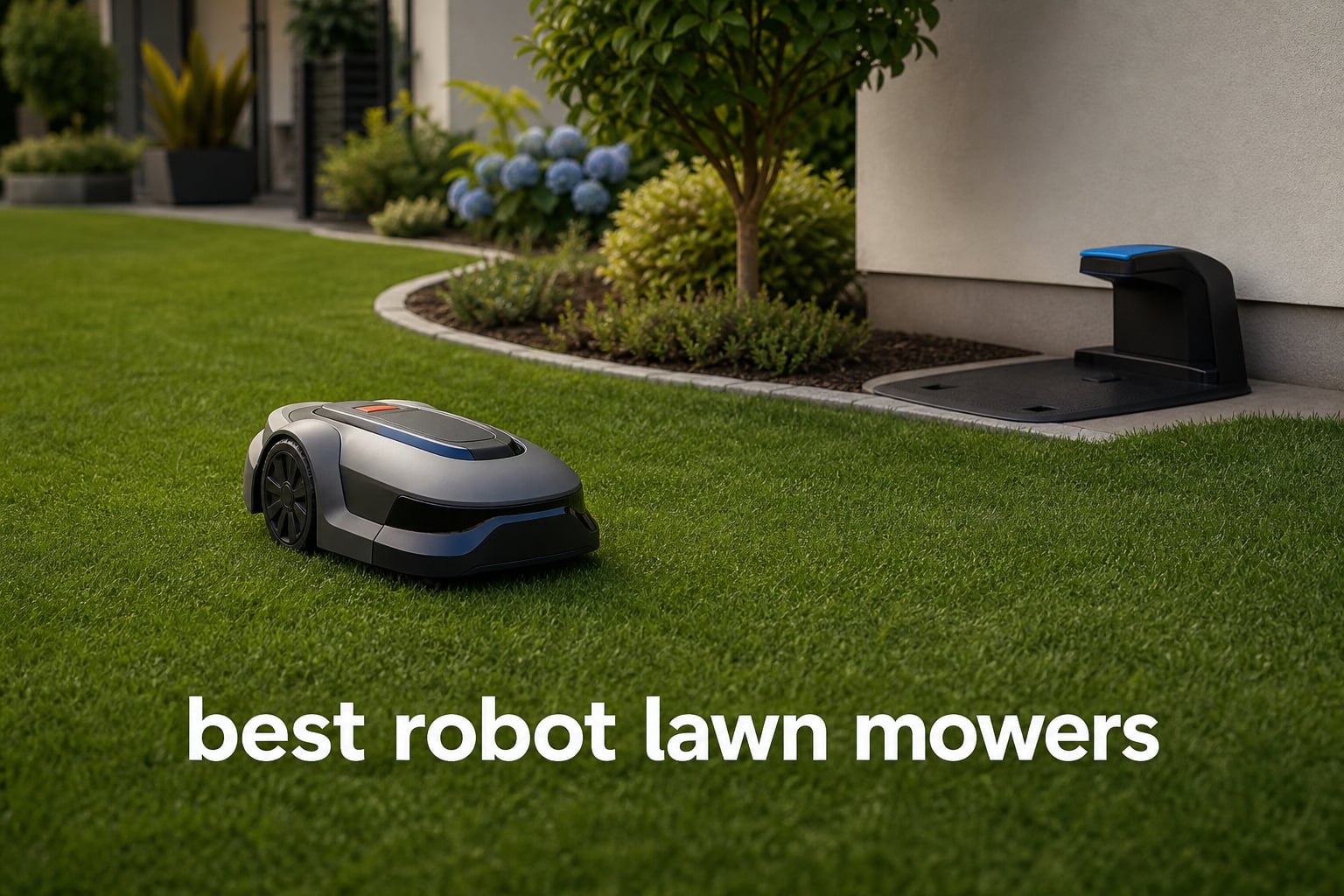
The best robot lawn mowers keep grass short through frequent, quiet passes while you spend less time behind a walk-behind machine. The right one is not simply the model with the longest feature list: it has to match your lawn’s size, slopes, tree cover, borders, and places where a small machine could get stuck.
For this 2026 guide, we reviewed the published specifications and listing feedback for 12 robot lawn mowers, from compact visual-guidance units for 1,600-square-foot lawns to all-wheel-drive machines rated for three-quarters of an acre. I have treated claimed coverage, cutting-height range, slope rating, guidance hardware, and review count as separate decision points rather than assuming one impressive specification answers every yard problem.
A robot lawn mower is an autonomous grass cutter that follows a boundary wire, satellite positioning, laser sensing, cameras, or a mix of those systems, then returns to its dock when it needs power. It can save the recurring effort of weekly mowing, but it will not remove the need to clear toys, branches, heavy leaf fall, and narrow trouble spots before a run.
Table of Contents
The top three robot mower picks answer the most common yard needs
Best overall: Mammotion LUBA 3 AWD 3000H. Its stated three-quarter-acre capacity, four-wheel drive for 80% slopes, 15.75-inch cutting width, and combined LiDAR, NetRTK, and AI vision make it the broadest-fit option for a large, varied property.
Best value: ANTHBOT M9. This quarter-acre mower brings dual vision, full-band RTK, up to 30 work zones, a 45% slope claim, and a listed noise level of 58 dB or less. Its 370 listing reviews provide a much larger feedback sample than most models here.
Budget pick: YARDCARE V100. A visual guidance system, no perimeter-wire installation, a supplied magnetic no-go strip, and 1,600-square-foot stated coverage make the V100 a focused choice for small, simple lawns. Its 5.0 listing rating comes from 47 reviews, so I would regard that rating as an early signal rather than a final verdict.

These labels are starting points, not replacements for measuring your usable mowing area. A small but steep lot may favor AWD over acreage, while a shady yard with satellite interruptions may favor LiDAR or camera guidance over an RTK-led model.
The best robot lawn mowers in 2026 cover small, large, and steep yards
The overview below puts every reviewed mower in one place. Use it to make a short list, then read the corresponding review for the trade-offs that matter around borders, slopes, zones, and charging.
| Product | Specifications | Action |
|---|---|---|
 YARDCARE V100 YARDCARE V100 |
|
Check Latest Price |
 YARDCARE M800Plus YARDCARE M800Plus |
|
Check Latest Price |
 LEBOSBO V3 LEBOSBO V3 |
|
Check Latest Price |
 DREAME A3 AWD 1000 DREAME A3 AWD 1000 |
|
Check Latest Price |
 Segway Navimow X430 Segway Navimow X430 |
|
Check Latest Price |
 Sunseeker X5 AWD Sunseeker X5 AWD |
|
Check Latest Price |
 ECOVACS Goat O1000 ECOVACS Goat O1000 |
|
Check Latest Price |
| Mammotion LUBA 3 AWD 3000H |
|
Check Latest Price |
 ECOVACS Goat A3000 ECOVACS Goat A3000 |
|
Check Latest Price |
 MOVA LiDAX Ultra 3000 MOVA LiDAX Ultra 3000 |
|
Check Latest Price |
 ANTHBOT M9 ANTHBOT M9 |
|
Check Latest Price |
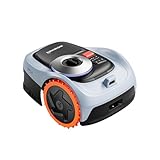 Segway Navimow i206 AWD Segway Navimow i206 AWD |
|
Check Latest Price |
1. YARDCARE V100 is the small-lawn visual-guidance pick
YARDCARE V100 Robot Lawn Mower with HD Vision Navigation, Smart Obstacle Detection, Collision Sensors, Adjustable Cutting Height, Low-Noise Operation—Perfect for Small Lawns up to 1,600 sq ft.
Vision guidance
1,600 sq ft coverage
6.3 in cut
20 degree slopes
Pros
- Camera-based grass recognition
- No perimeter wire
- 32 ft magnetic strip
Cons
- Small 1
- 600 sq ft coverage
- 20 degree slope rating
The YARDCARE V100 is built for a contained lawn rather than a sprawling property. Its published 1,600-square-foot capacity and 6.3-inch cutting width put it in the small-yard class, where a narrow body and cordless setup may be more useful than high acreage claims.
I like the practical idea behind its camera and AI system: it distinguishes grass from non-grass areas and is stated to identify up to 150 obstacle types. A 32-foot magnetic strip creates a no-go area without burying a perimeter wire, which is helpful for a flower bed or one exclusion zone close to the house.
The V100 suits flat small lawns with clear borders
This robot lawn mower makes the most sense on a simple, visible lawn with firm borders and only occasional objects in the mowing path. Its 0.8-to-2.4-inch cutting-height adjustment supports a short, regular maintenance cut, and the listed rain sensor, tilt sensor, emergency stop, charger, extra blades, and 4Ah battery cover the basic operating package.
The V100 leaves larger and steeper yards to other models
The 20-degree slope rating is a firm planning boundary, and 1,600 square feet will be restrictive on a medium lawn. Review feedback from owners across the category repeatedly flags uneven ground and heavy debris as sticking points, so I would fill holes, remove branches, and keep the magnetic boundary visible before relying on this model.
2. YARDCARE M800Plus is the app-controlled medium-lawn option
YARDCARE 2026 New M800Plus Robot Lawn Mower, GPS & 3D Vision, with 32.8 ft Magnetic Stripe, Obstacle Avoidance, Auto-Charging, APP Control, Bow-Shaped Mowing for Lawns up to 8611 sq.ft (Dark Black)
GPS plus 3D vision
8,611 sq ft claim
7.1 in cut
auto charging
Pros
- GPS and 3D vision
- App control
- Spiral spot mowing
Cons
- 20 degree slope limit
- 32 ft magnetic strip for no-go zones
The M800Plus moves up to a stated 8,611-square-foot lawn capacity while keeping the cord-free concept. GPS and 3D vision work with a camera to identify grass, obstacles, and non-grass areas, and the mower can return for charging rather than stopping when power runs low.
Its app control and bow-shaped mowing approach are the practical features to study if you want less manual supervision. The model also lists spiral spot mowing, which gives it a targeted response for a patch that needs additional attention instead of waiting for a full scheduled pass.
The M800Plus answers medium-yard scheduling needs
For a lawn below the stated limit, this is a sensible candidate when app control, a 7.1-inch cutting width, and automatic charging rank high. The adjustable 0.8-to-2.4-inch cut range is the same low maintenance range as the smaller V100, so this is aimed at frequent trimming rather than letting grass grow tall.
The M800Plus still needs a clear plan for difficult terrain
Its published slope capacity is 35%, also described as 20 degrees, so it does not replace an aggressive all-wheel-drive machine on a hillside. The supplied 32-foot magnetic stripe is useful for a contained no-go area, but a complicated property with many separated beds calls for careful mapping before purchase.
3. LEBOSBO V3 is a quiet visual mower for simple compact yards
LEBOSBO V3 Robot Lawn Mower with Visual Navigation, Smart APP Control, Quiet Operation, Adjustable Mowing Height, Boundary Strip No-Go Zones, Reliable Robotic Lawn Mower for 1600 Sq.Ft Yards
Vision guidance
1,600 sq ft yards
6.3 in cut
app updates
Pros
- AI visual recognition
- No wire installation
- OTA app updates
Cons
- Small 1
- 600 sq ft coverage
- No slope rating listed
The LEBOSBO V3 shares the small-lawn brief of the V100, with 1,600-square-foot stated coverage, a 6.3-inch cutting width, visual obstacle recognition, and no perimeter wire. Its listing emphasizes quiet operation, a useful trait for people who plan frequent daytime runs near patios or close neighbors.
Instead of a buried line, the V3 uses a 32-foot magnetic strip for no-go areas. That approach can make first setup less intimidating, and the included stakes, charger, replacement blades, and strip mean the basic boundary tools are present from the start.
The V3 works for owners who want simple app adjustments
The smart app offers over-the-air updates, which can matter when a maker improves mower behavior after installation. Its 0.8-to-2.4-inch height range provides regular trimming control, and the compact 17.01-by-13.9-inch footprint should be easier to store than the large AWD machines in this list.
The V3 requires caution on unlisted slopes and rough ground
No slope specification appears in the analyzed product record, so I would not assume it can take on an embankment just because it has camera guidance. It is a safer match for level turf, open sight lines, and lawn edges that can be supplemented with a handheld trimmer.
4. DREAME A3 AWD 1000 is the steep-slope LiDAR alternative
[Latest Upgrade All-Terrain Wire-Free] DREAME A3 AWD 1000 Robot Lawn Mower, 360° 3D LiDAR & AI Dual Vision Smart Robotic Mower for 0.25 Acre, 80% Slopes & 45min Fast Charge
3D LiDAR plus AI vision
80% slopes
0.25 to 0.5 acre
45 min charge
Pros
- AWD for 80% slopes
- No RTK station
- Edge cutting near borders
Cons
- 0.25 to 0.5 acre coverage
- Optional trimmer module
The DREAME A3 AWD 1000 is one of the clearest answers for a hilly lawn that does not need a full-acre machine. Its all-wheel-drive system is rated for 80% slopes, while 360-degree 3D LiDAR and binocular AI vision guide it without a perimeter wire or a separate RTK station.
This combination is appealing where satellite-dependent setups can struggle under tree cover. The stated lawn range is one-quarter to one-half acre, and a 45-minute fast charge is designed to keep a maintenance schedule moving rather than leaving a partial area unfinished for long.
The A3 AWD 1000 suits sloped yards with trees or changing light
LiDAR maps surroundings with laser returns, while dual vision adds object recognition; together they provide more than a single guidance source. The 1-to-4-inch cutting-height range is also broad, which gives owners more seasonal flexibility than compact machines capped at 2.4 inches.
The A3 AWD 1000 asks buyers to match capacity to lawn size
Its acreage claim belongs to medium lawns, not wide open acreage beyond one-half acre. The mower lists edge cutting within 1.97 inches, but tight borders still deserve a realistic expectation: an optional trimmer module is offered, which shows that a separate edge tool may remain useful for a finished look.
5. Segway Navimow X430 is the large-yard and extreme-slope choice
Segway Navimow X430 Robot Lawn Mower Wire Free, for up to 1 Acre, 4WD for 84% Slopes, Zero-Turn for Damage-Free Mowing, ORV-Tuned Lawnmower, MowMentum with 2 × 180W Motors, 0.75–4 in Cutting Height
1 acre coverage
84% slopes
17 in cutting width
4WD zero-turn
Pros
- Four-wheel drive
- 17 inch cutting width
- One-tap auto mapping
Cons
- 63.71 lb body
- 4.3 rating from 78 reviews
The Segway Navimow X430 has the largest published capacity in this comparison at up to one acre. A 17-inch cutting width, dual 180W motors, two cutting discs, and 12 blades give it the hardware to cover open ground more quickly than the compact seven-inch class.
Its 4WD design is rated for 84% slopes, or 40 degrees, and the machine uses dual suspension, eccentric front-wheel steering, and a turf-safe zero-turn system. Those details make it a serious candidate for terrain where turning in place can otherwise scuff grass or lose traction.
The X430 answers one-acre and steep-terrain requirements
EFLS tri-frequency Network RTK, 360-degree vision, VIO, and VisionFence AI form a layered guidance package, while the maker states that its AI can identify more than 200 obstacle types. One-tap auto mapping and GeoSketch editing should appeal to people who want to adjust virtual areas without digging a boundary line.
The X430 needs room for its size and capabilities
At 63.71 pounds and 33.5 inches long, this is not the unobtrusive answer for a tiny courtyard. Its published cut-height range of 0.75 to 4 inches and EdgeSense margin below two inches are strong on paper, but intricate beds, gates, and narrow passages should be measured before committing to a large chassis.
6. Sunseeker X5 AWD is the half-acre RTK-vision candidate
Sunseeker X5 AWD Robot Lawn Mower, RTK, Vision AI, 0.5 Acre, Wire-Free
0.5 acre coverage
RTK vision
AWD suspension
virtual boundaries
Pros
- Half-acre stated coverage
- No boundary wire
- AWD with rugged tires
Cons
- 1.6 in minimum cut height
- Slope rating not listed
The Sunseeker X5 AWD is rated for one-half acre, or 21,780 square feet, which places it between compact robots and large-acreage machines. It pairs RTK satellite positioning with visual guidance, then lets the owner set virtual boundaries in the app instead of placing a physical wire.
All-wheel drive, rugged tires, and independent suspension are meaningful features for a property with ruts, transitions, or ordinary unevenness. The listed 8.7-inch cutting width should cover more ground per pass than the smaller visual-only models without moving to the very large 15-inch-and-up category.
The X5 AWD fits everyday medium yards with virtual boundaries
This model suits someone whose yard benefits from app-edited mowing areas and who does not want a trench around the property line. Its vision AI is stated to recognize common yard objects and adjust its route, which is useful only when the lawn is still cleared of items that could damage blades or wheels.
The X5 AWD leaves slope limits and low-cut needs unresolved
The analyzed listing does not give a numerical slope rating, so its AWD hardware should not be treated as proof of performance on a very steep bank. The stated 1.6-to-3.2-inch height range also begins higher than several rivals, which matters if your preferred cut is below 1.6 inches.
7. ECOVACS Goat O1000 is the tight-space edge-cutting pick
ECOVACS Goat O1000 LiDAR PRO Robot Lawn Mower, Wire-Free Mapping with LiDAR Navigation, AI Obstacle Avoidance, Smart Edge Mowing, App Control, for Lawns Up to 1/4 Acre
LiDAR guidance
0.25 acre coverage
TruEdge trimmer
0.8 m passages
Pros
- No RTK antenna
- Integrated edge trimmer
- Passes 0.8 m paths
Cons
- Quarter-acre coverage
- No slope rating listed
The ECOVACS Goat O1000 centers on the two issues that make smaller developed yards frustrating: narrow links between lawn areas and grass left against borders. It uses wire-free LiDAR guidance, maps custom zones and no-go areas through the app, and is designed to pass through paths as slim as 0.8 meters.
The built-in TruEdge trimmer is the key differentiator. Rather than accepting a wide uncut border as normal, the O1000 is designed for closer edge work, though I would still expect a hand tool to be useful around steps, irregular stone, and vertical walls.
The Goat O1000 fits quarter-acre lawns with narrow connectors
Its stated one-quarter-acre capacity gives a clear upper range for planning, and its 8.66-inch cutting width keeps the body suited to smaller spaces. HoloScope dual-LiDAR is listed with 2-centimeter positioning and no RTK antenna, a welcome setup approach where an antenna placement would be awkward.
The Goat O1000 needs a separate slope check before buying
The product record does not state a slope limit, so do not use it as the default choice for a hillside. Its obstacle system is stated to identify more than 200 object types, but fallen fruit, long twigs, hoses, and dense leaves remain regular cleanup jobs for any robotic grass cutter.
8. Mammotion LUBA 3 AWD 3000H is the versatile large-property winner
Mammotion LUBA 3 AWD 3000H Robot Lawn Mower with Garage (Ship Separately), 0.75 Acre, 360° LiDAR+NetRTK+AI Vision, All-Wheel-Drive for 80% Slopes, 30 Multi-Zone Management, Cutting Height 2.2″-4.0″
0.75 acre coverage
80% slopes
LiDAR plus NetRTK
30 zones
Pros
- Tri-Fusion guidance
- Four-wheel drive
- 30 multi-zone management
Cons
- 2.2 in minimum cut height
- Garage ships separately
The Mammotion LUBA 3 AWD 3000H earns the overall spot because its capabilities meet in the middle of the large-yard market. It combines three guidance sources—360-degree LiDAR, NetRTK, and AI vision—with a stated three-quarter-acre coverage rating, 30-zone management, and all-wheel drive for 80% slopes.
That layered approach has real decision value. Forum discussions often mention RTK signal trouble under trees, so LiDAR and vision provide useful backup inputs rather than asking satellite reception to do every task by itself.
The LUBA 3 answers complex large-yard and multi-zone needs
The mower has a 15.75-inch cutting width, 165W cutting system, and six-blade discs, which are strong figures for covering a large maintenance area. Its AI processor is stated to avoid more than 300 obstacle types, and adaptive suspension plus four independent motors are aimed at variable ground rather than a perfectly level rectangle.
The LUBA 3 needs height and accessory planning
The published height range is 2.2 to 4 inches, so it will not satisfy an owner who maintains turf below 2.2 inches. The optional garage ships separately, and no robot can safely cut through thick seasonal leaf cover, so I would plan a short leaf-clearing routine even with a sophisticated guidance package.
9. ECOVACS Goat A3000 is the high-power LiDAR option for dense grass
ECOVACS Goat A3000 LiDAR PRO Robotic Lawn Mower, Dual LiDAR Navigation
0.75 acre coverage
Dual-LiDAR guidance
TruEdge trimmer
70 min battery
Pros
- Dual-LiDAR positioning
- Integrated edge trimmer
- 32V power system
Cons
- No slope rating listed
- 4.1 rating from 89 reviews
The ECOVACS Goat A3000 is a wire-free, three-quarter-acre contender that emphasizes a 32V power system for thicker American grass types. Its listing specifically names Bermuda, Zoysia, Fescue, and St. Augustine, so this mower deserves attention when a light-duty small-yard robot may struggle to keep up with vigorous growth.
Dual-LiDAR guidance gives it a published 2-centimeter positioning figure without a perimeter wire or RTK antenna. The 7,500 mAh battery and 189W fast charging are paired with a stated 70-minute battery duration, useful data for understanding how it may cycle through a broad lawn.
The Goat A3000 suits large lawns that prioritize border cleanup
Its 12.99-inch cutting width gives it more coverage per pass than the O1000, and the built-in TruEdge trimmer pursues a closer edge line. Custom zones through the app are also valuable on a lawn split by a driveway, patio, or gate, provided the passages are accessible to the machine.
The Goat A3000 needs a terrain rating before hillside use
There is no published slope figure in the reviewed record, so buyers with sharp grades should choose one of the models with an explicit 80% or 84% claim instead. The 1.2-to-3.6-inch cut-height range works for many lawn styles, although it does not reach the four-inch maximum of several large AWD competitors.
10. MOVA LiDAX Ultra 3000 is the RTK-free all-terrain alternative
MOVA LiDAX Ultra 3000 AWD Robot Lawn Mower Wire Free RTK Free for up to 0.75 Acre*Dual Maps, 360° 3D LiDAR & AI Dual Vision Mapping, Robotic Mower with 4G, for 80% Slopes, Cutting Height 1.2”–3.9“
0.75 acre coverage
3D LiDAR plus vision
80% slopes
15.8 in cut
Pros
- No RTK station
- AWD for 80% slopes
- 1.2 in edge margin
Cons
- 52 lb machine
- 0.25 acre per charge
The MOVA LiDAX Ultra 3000 brings a broad property claim—up to three-quarters of an acre—without depending on RTK. Its stated 360-degree 3D LiDAR and AI dual vision create wire-free maps, while AWD is rated for 80% slopes and obstacles up to 2.4 inches.
I would put this model on the shortlist for a large lawn where an RTK reference placement is inconvenient or tree cover makes satellite-first systems less attractive. Its 15.8-inch cutting width sits virtually alongside the LUBA’s 15.75 inches, and it lists coverage up to one-quarter acre per charge.
The LiDAX Ultra 3000 solves RTK-free mapping on varied terrain
Its dual-map capability is helpful for owners with more than one maintained area, while 4G support provides a connection option beyond close-range phone control. The maker says its LiDAR-and-vision system avoids more than 300 obstacle types, but those capabilities work best after a deliberate walk-through of the lawn.
The LiDAX Ultra 3000 remains a large machine with cycling time
The 52-pound body and 29-by-21-inch dimensions require a sensible dock location and access route. A one-quarter-acre-per-charge figure does not reduce its three-quarter-acre claim; it means the mower may need charging cycles to finish a large property, so schedule expectations should account for that.
11. ANTHBOT M9 is the multi-zone small-to-medium yard recommendation
ANTHBOT M9 Robot Lawn Mower 1/4 Acre, Dual Vision+Full-Band RTK & NRTK Robotic Lawnmower, No Perimeter Wire, App Control Obstacle Avoidance, 45% Slope, Cutting Height, Multi-Zone Mapping
0.25 acre coverage
Dual vision plus RTK
30 zones
58 dB or less
Pros
- 30 work zones
- 45% slope claim
- 1
- 000 plus obstacle types
Cons
- Quarter-acre coverage
- 2.7 in maximum cut height
The ANTHBOT M9 has a particularly useful mix for a quarter-acre property with separated mowing areas. It combines dual AI vision with full-band RTK, maps up to 30 work zones, supports customizable no-go areas in the app, and is rated for 45% slopes.
The listing reports a noise level of 58 dB or less, which gives this model a concrete quiet-operation claim rather than a vague promise. With 370 reviews, its 4.0 rating has a larger listing sample than any other mower included here, although rating volume is still only one part of a purchase decision.
The M9 answers multi-zone control for segmented quarter-acre lawns
Adaptive Cruise Control, self-charging with automatic resume, OTA updates, and five free-rotating blades speak to routine maintenance mowing rather than one-off tall-grass cleanup. Its stated recognition of more than 1,000 obstacle types is impressive, but I would keep kid’s toys, hoses, and pet waste out of every scheduled area.
The M9 has a modest capacity and height ceiling
Its published coverage stops at one-quarter acre, while its 1.2-to-2.7-inch cutting-height range is narrower than many AWD models. That makes it a better match for a maintained lawn with several zones than a large property or a lawn that needs a high seasonal cut.
12. Segway Navimow i206 AWD is the compact AWD choice
Segway Navimow i206 AWD Robot Lawn Mower, New i105N, 0.15 Acre, 45% Slopes
0.15 acre coverage
45% slopes
NRTK plus vision
20 zones
Pros
- AWD with stability control
- 20-zone control
- One-tap auto mapping
Cons
- 0.15 acre coverage
- 2 in minimum cut height
The Segway Navimow i206 AWD is sized for a stated 0.15 acre, but it has terrain features normally associated with larger machines. All-wheel drive, electronic stability control, a third wheel, and zero-turn steering support its 45% slope claim while aiming to reduce grass damage during turns.
Its EFLS Network RTK combines tri-frequency RTK with vision and one-tap auto mapping, while the app supports up to 20 zones. That is a capable control suite for a compact lawn with a front section, back section, and a few locations that need virtual exclusions.
The i206 AWD fits small sloped lawns with several work areas
The 7.1-inch cutting width and 2.5Ah battery, stated to cover up to 1,350 square feet per charge, fit a steady maintenance pattern on a compact property. Real-time GPS alerts and auto resume after charging add useful oversight for an owner who is not standing outside during each run.
The i206 AWD does not replace a medium-yard mower
The 0.15-acre ceiling is the deciding constraint, and the 2-to-3.6-inch height range excludes a very low cut. This is the model I would choose for a small yard with a noticeable grade, not for a large flat lawn where a wider deck and higher acreage rating will save time.
The right robot mower starts with an honest yard suitability check
Measure mowable turf, not the entire lot. Remove the footprint of the house, driveway, sheds, dense planting, and areas you never intend to cut, then leave a margin below a maker’s stated capacity so weekly growth or battery cycles do not push the mower to its limit.
These seven signs point to a poor fit or a need for extra yard preparation:
- The route includes slopes steeper than the mower’s stated rating.
- Loose gravel, exposed roots, deep holes, or abrupt curbs interrupt the grass path.
- Gates, passages, or lawn bridges are narrower than the mower can pass.
- Heavy leaf drop, fruit, branches, hoses, or toys commonly cover the mowing area.
- There are many disconnected grass islands without a safe access route.
- Dense tree cover blocks an RTK-led mower and there is no LiDAR or vision backup.
- You expect the mower to cut flush against every wall, bed, and stair without follow-up trimming.
None of these points automatically rules out lawn automation. They show where a wire-free robot needs virtual zones, a better guidance type, a cleared route, or a small amount of manual trimming after it finishes.
The best guidance system matches the obstacles above your grass
Boundary-wire systems follow a physical wire installed around the mowing area. Forum participants often describe mature wired installations as dependable, but installing and repairing a wire can take time, especially on an L-shaped lawn or around numerous beds.
RTK GPS systems use high-accuracy satellite positioning to create virtual boundaries. They are excellent for open yards and editable zones, yet tree canopy, buildings, and poor reference placement can interrupt positioning; this is why the Segway, Sunseeker, ANTHBOT, and LUBA models should be placed with a clear view of their guidance needs in mind.
LiDAR systems read nearby surroundings with laser sensing, which can be useful in shaded or complex spaces. The DREAME, both ECOVACS models, MOVA, and LUBA use LiDAR in different combinations, but laser sensing does not make branches, leaves, or narrow hard edges disappear.
Camera or vision systems recognize grass, objects, and visual features. The two YARDCARE options and LEBOSBO concentrate on visual guidance, while larger products layer vision with RTK or LiDAR for redundancy; I prefer that layered approach on a high-commitment property.
Coverage, cutting height, and slope ratings decide everyday performance
Coverage is a stated maximum, not a promise that every oddly shaped lawn will finish in one uninterrupted session. A wide 17-inch deck such as the X430’s is useful in open terrain, while a 6.3- or 7.1-inch deck can be better suited to compact areas and tighter turns.
Choose the height range for your grass and preferred maintenance routine. The LUBA’s 2.2-inch minimum may not suit a low-cut preference, while the DREAME reaches from 1 to 4 inches; a robot works best when it clips a little often instead of trying to recover an overgrown lawn in one session.
Treat slope figures as limits rather than targets. Community reports say many robotic mowers struggle beyond roughly 20 to 25 degrees, so an explicit 80% or 84% rating from an AWD model is meaningful, but wet grass, loose soil, roots, and cross-slope turns can still reduce real traction.
Setup and maintenance determine whether the mower feels hands-off
Wire-free does not mean zero setup. Walk the perimeter, map zones, define no-go spaces, select a dock location with power and a clear approach, and run supervised first cuts; complex yards can take several hours to map and refine according to forum experience.
Before each schedule, clear branches, toys, hoses, pet waste, and dense leaf piles. Oak leaves and similar debris can jam blades, and obstacle recognition should be treated as a second line of protection rather than permission to leave hazards on the grass.
Keep spare blades available, clean clippings from the deck, inspect wheels, and store the mower as directed when the mowing season ends. Owners commonly report needing a battery replacement after two to three seasons, so battery availability, support quality, and a nearby dealer or installer deserve attention alongside the feature list.
For edge work, read the claim closely. ECOVACS TruEdge is an integrated trimmer approach, while the DREAME and Segway give a stated remaining border of roughly two inches; every layout with walls, irregular stones, or raised beds can still require a finishing tool.
Robot lawn mower FAQ answers the questions buyers ask most
What are the problems with robotic lawn mowers?
The common problems are setup time, getting stuck on bumps or steep slopes, RTK signal loss under trees, app or connection issues, weak edge cutting, battery aging, and blades jamming on leaves or debris. A clear, measured yard and the right guidance type reduce many of these issues.
What is the life expectancy of a robot mower?
A robot mower’s service life depends on weather exposure, battery condition, blade care, terrain, and support for replacement parts. Forum users commonly report battery replacement after two to three seasons; cleaning the deck, clearing debris, and storing the mower properly help extend usable life.
How do robot lawn mowers navigate without perimeter wires?
Wire-free robot mowers use one or more of RTK satellite positioning, LiDAR laser sensing, cameras, and visual mapping to locate themselves and respect virtual boundaries. Hybrid systems such as LiDAR plus RTK plus vision offer more guidance inputs when a yard has trees, shadows, or complex features.
What are the best robot lawn mowers for different yard types?
Choose the YARDCARE V100 or LEBOSBO V3 for simple small lawns, the ECOVACS Goat O1000 for tight paths and border work, the ANTHBOT M9 for quarter-acre multi-zone control, the DREAME A3 AWD 1000 for steep medium lawns, and the Mammotion LUBA 3 AWD 3000H or Segway Navimow X430 for larger, demanding terrain.
Are robot lawn mowers worth the investment?
Robot lawn mowers can be worth it for homeowners who value time, have a lawn that fits the stated coverage and terrain limits, and accept light preparation and occasional edge trimming. They are a weaker fit for yards with constant debris, inaccessible grass islands, very narrow passages, or steep unlisted slopes.
The best robot lawn mower is the one that fits your real yard
Among the best robot lawn mowers for 2026, the Mammotion LUBA 3 AWD 3000H is the broadest recommendation for a complex three-quarter-acre property, while the Segway Navimow X430 makes more sense for a full acre and the most demanding stated slopes. For compact yards, match the YARDCARE V100, LEBOSBO V3, or Segway i206 to their much smaller coverage limits instead of overbuying capability you cannot use.
Measure first, choose a guidance system that works around your trees and borders, and give the mower a clean route. That preparation is what turns an automated lawn mower from an interesting device into a dependable part of weekly lawn care.