
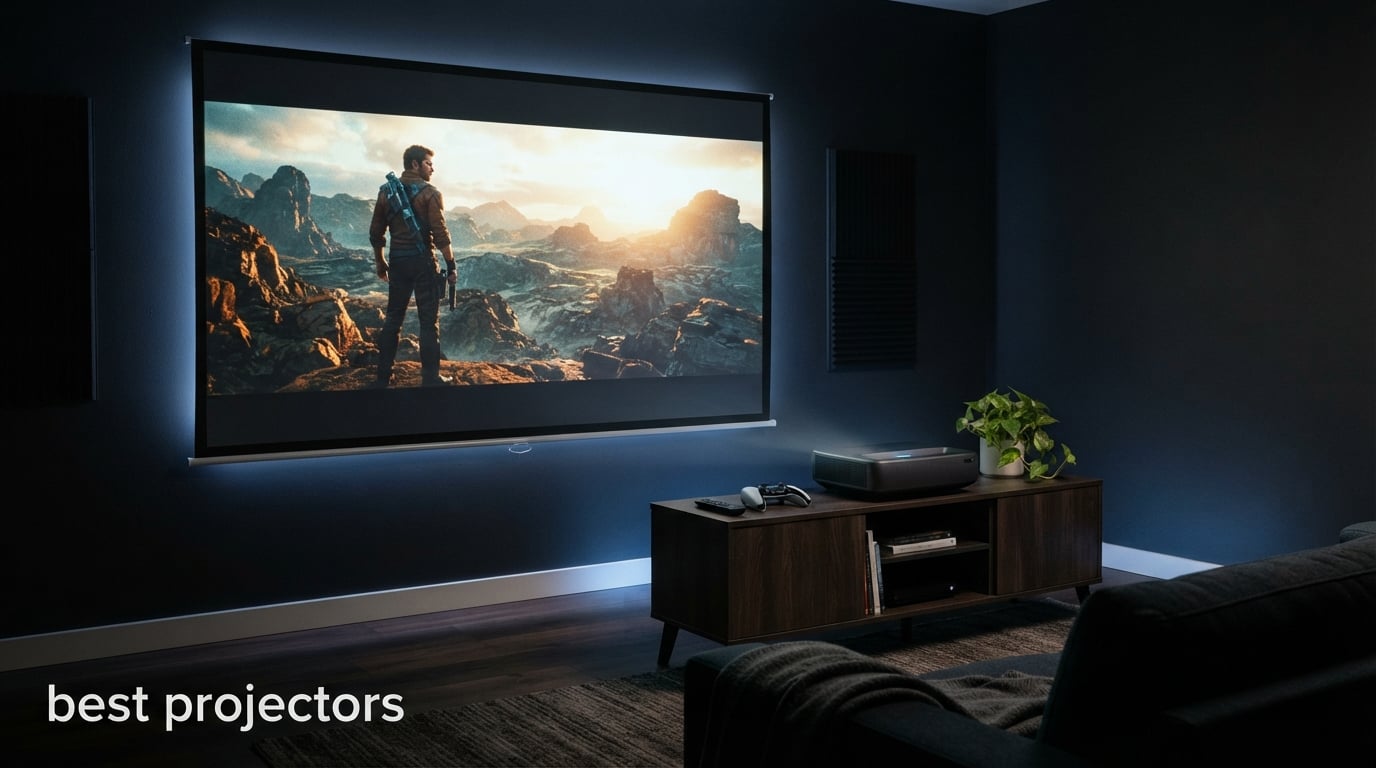
The best projectors turn a spare wall or screen into a genuinely large viewing space, but the right one depends far more on your room than a glossy feature list suggests. A compact smart model can make a bedroom movie night simple, while a bright laser unit or an ultra-short-throw projector makes more sense in a living room with daylight and limited placement options.
I built this 2026 guide around the listed specifications, supported formats, connectivity, stated brightness, setup features, and review data for 12 current models. I did not treat “4K support” as native 4K, and I call out when a brightness figure is listed as ANSI or ISO lumens versus a less-defined marketing claim.
Before choosing, measure the wall-to-seat path, decide whether you will watch with lights on, and identify your main source: a console, streaming service, Blu-ray player, or laptop. If your projector will be part of a PC media setup, our guide to the best graphics cards for movies can help you match the source device to a large display.
A projector is a display device that sends an image through a lens onto a wall or screen, giving you the option of a 100-inch-plus picture without an equivalently huge television. The trade-off is planning: ambient light, throw distance, screen quality, mounting, and audio all matter more than they do with a TV.
Table of Contents
The top 3 picks for best projectors are XGIMI, Hisense, and Aurzen
These three picks answer the most common needs without pretending one projector fits every room. The XGIMI HORIZON 20 has the strongest stated blend of RGB laser brightness, native 4K, flexible optics, and high-refresh gaming; the Hisense PL2 solves placement problems with an ultra-short-throw laser design; and the Aurzen EAZZE D1R keeps streaming and setup straightforward in a compact 1080p format.
XGIMI HORIZON 20
- 4K RGB triple laser
- 3200 ISO lumens
- 240Hz and 1ms gaming
- Optical zoom and lens shift

These are the 12 best projectors in 2026
The comparison below is a fast way to narrow the field by image type, stated brightness, viewing format, and standout setup feature. Read the full sections before deciding, because a headline brightness number or a 4K label alone does not tell you where a projector can sit or how it handles your preferred content.
| Product | Specifications | Action |
|---|---|---|
 WiMiUS P62 Pro WiMiUS P62 Pro |
|
Check Latest Price |
| Aurzen EAZZE D1R |
|
Check Latest Price |
 ELEPHAS AC401 ELEPHAS AC401 |
|
Check Latest Price |
 ONOAYO ONO5 Pro ONOAYO ONO5 Pro |
|
Check Latest Price |
 Hisense PL2 Hisense PL2 |
|
Check Latest Price |
 Epson Home Cinema LS11000 Epson Home Cinema LS11000 |
|
Check Latest Price |
| XGIMI HORIZON 20 |
|
Check Latest Price |
 Epson Lifestudio Pop Plus Epson Lifestudio Pop Plus |
|
Check Latest Price |
 XGIMI Horizon Pro XGIMI Horizon Pro |
|
Check Latest Price |
 Epson Home Cinema 2350 Epson Home Cinema 2350 |
|
Check Latest Price |
 Optoma UHZ36 Optoma UHZ36 |
|
Check Latest Price |
 Optoma HZ41 Optoma HZ41 |
|
Check Latest Price |
1. WiMiUS P62 Pro is the smart 1080p choice for flexible rooms
[Built-in Apps/4K Support] Smart Outdoor Projector with WiFi and Bluetooth, Movie Projector, DoIby Audio with Dual Speaker, Auto Focus w/ YouTube&PrimeVideo Proyector, Upgrad P62 Pro
1080p native
600 ANSI lumens
Wi-Fi 6 and dual 10W audio
Pros
- Native 1080p picture
- 600 ANSI brightness
- Wi-Fi 6
- dual HDMI ports
- auto focus
Cons
- Not native 4K
- limited headroom for bright rooms
I would start with the P62 Pro when the goal is a no-fuss projector for evening viewing rather than a dedicated blacked-out theater. It combines native 1920 by 1080 resolution with 4K input support, 600 ANSI lumens, HDR10, and a stated 40-to-300-inch image range.
Its smart OS includes Prime Video and YouTube, so a separate streaming stick may not be needed for those services. Wi-Fi 6, AirPlay, Miracast, two HDMI ports, two USB ports, and two-way Bluetooth make it unusually well connected for a portable-format model.
The listed auto-focus, keystone correction, obstacle avoidance, and screen alignment features are meaningful if the projector moves between rooms. A 50-to-100% zoom range also gives more placement latitude than a fixed-size image, although placing the projector square to the screen still gives the cleanest result.
The P62 Pro fits evening movies and multi-device setups
The dual 10W Dolby Audio speakers are a practical starting point for a bedroom, apartment, or casual outdoor viewing session. Its ceiling, floor, tabletop, tripod, and wall mounting options make it a sensible fit for someone who does not want a permanently installed home theater projector.
The 4-to-16-foot stated throw-distance range needs a room check before buying. A dim or dark room will play to its strengths much better than a sunlit living room, where 600 ANSI lumens has less reserve against ambient light.
The P62 Pro asks buyers to accept native 1080p
4K support means it can accept compatible content; the listed native panel is still 1080p. Viewers sitting close to a very large screen or building a premium movie room may prefer one of the native 4K models farther down this list.
I also would not rely on digital keystone as a substitute for correct placement. It is helpful for quick setup, but centering the lens and using a flat projection surface preserves more of the available detail.
2. Aurzen EAZZE D1R is the easiest Roku streaming projector
Aurzen Roku TV D1R Smart Portable Outdoor Projector with WiFi and Bluetooth
1080p native
Roku TV built in
Auto focus
Dolby Audio
Pros
- Roku TV built in
- official AirPlay
- auto setup
- smart home support
- compact format
Cons
- 200-inch maximum image
- brightness is not listed
The Aurzen EAZZE D1R is the straightforward pick for someone who wants a familiar streaming interface inside the projector. Its built-in Roku TV platform, native 1080p resolution, dual-band Wi-Fi, Bluetooth 5.2, and Dolby Audio remove several common setup steps.
I like that it lists Apple AirPlay, Apple TV, HomeKit, Siri, Alexa, and Google Assistant compatibility rather than treating casting as an afterthought. Auto focus and auto keystone complement a tabletop, foldable stand, floor stand, or ceiling installation.
The product data lists a 40-to-200-inch image range and a throw range from 3.71 to 18.58 feet. Those limits point toward bedrooms, smaller living rooms, and movie nights where the screen is moderate in size, rather than a huge dedicated theater wall.
The EAZZE D1R works best when streaming simplicity leads
Roku TV is the central reason to pick this projector over a basic model with an HDMI port. It gives a direct route to mainstream apps and keeps the remote routine familiar for households already using Roku devices.
The dual 5W speakers and Dolby Audio are convenient for casual use, but I would still plan external sound for a large room. A compact speaker or a sound system creates a fuller presentation than any small projector enclosure can manage.
The EAZZE D1R needs a realistic brightness plan
Aurzen does not list an ANSI or ISO brightness number in the supplied specifications. That missing comparable measurement means I would reserve it for controlled lighting instead of assuming it can overcome daytime light.
It also tops out at a stated 200 inches, which is ample for many homes but less ambitious than models that list 300 inches or more. Use its auto alignment to speed setup, then make small physical adjustments before leaning on keystone correction.
3. ELEPHAS AC401 is the rotating smart projector for awkward angles
ELEPHAS Smart 4K Projector with WiFi and Bluetooth for Indoor Outdoor
1080p native
800 ANSI lumens
270 degree rotation
HDR10+
Pros
- 800 ANSI lumens
- 270 degree rotation
- Netflix and Prime Video
- Wi-Fi 6
- auto calibration
Cons
- Not native 4K
- heavier portable body
The ELEPHAS AC401 brings a distinctive 270-degree rotatable body to a native 1080p smart projector. That makes ceiling viewing, a high shelf, or a temporary floor setup easier to attempt without buying a separate angled mount.
It lists 800 ANSI lumens, HDR10+ enhancement, 98% NTSC color gamut, and 4K decoding support. Netflix, Prime Video, and YouTube come preinstalled, while Wi-Fi 6, Bluetooth 5.4, AirPlay, Miracast, and DLNA cover the usual wired and wireless routes.
The four-part TOF calibration system handles focus, keystone, obstacle avoidance, and screen alignment. I see that as a useful convenience package for a projector that will be moved often, not a reason to skip measuring the room.
The AC401 suits flexible indoor and covered outdoor placement
Its listed 38.5-to-200-inch image range and 1.18-to-6-meter throw range work for a bedroom wall, living-room screen, or a covered patio after dark. The 800 ANSI rating gives it more specified brightness than the WiMiUS P62 Pro, though neither replaces a daylight-focused high-lumen laser projector.
At 4.35 kilograms, this is portable in the sense that it can move, but it is not a pocketable mini projector. The rotation feature has more value when it stays available in a few favorite locations than when it travels in a small bag.
The AC401 still delivers a 1080p native image
The maximum listed resolution is 3840 by 2160, but the native resolution is 1920 by 1080. That distinction matters for buyers who want the pixel density of native 4K for close seating or a very large home theater screen.
I would connect a console or media box over HDMI when image quality takes priority over wireless convenience. The model supports the major wireless protocols, yet a direct cable can avoid casting restrictions and keeps the signal path simple.
4. ONOAYO ONO5 Pro is the all-in-one pick for casual gaming and big sound
ONOAYO Outdoor-Projector-4K with 60W Dolby Audio and Official Licensed Apps
1080p native
18ms game mode
60W Dolby Audio
Sealed optical engine
Pros
- 18ms input lag
- 60W Dolby Audio
- licensed apps
- HDMI 2.1
- sealed optical engine
Cons
- Not native 4K
- brightness measurement label is unclear
The ONOAYO ONO5 Pro is built around convenience features that matter when a projector doubles as a streaming and gaming station. It lists Smart TV OS 2.0, licensed apps for Prime Video, YouTube, and Disney+, more than 1,500 live TV channels, Wi-Fi 6, and HDMI 2.1.
For gaming, the stated 18ms input latency is the key specification. That is paired with an AI auto-calibration system described as taking three seconds, plus 50-to-100% dynamic zoom for fitting an image to the space.
The 60W Dolby Audio system is unusually powerful on paper for a projector, and the sealed optical engine addresses a concern raised often in projector communities: dust gradually affecting the optical path. Its stated image range is 50 to 500 inches, giving a lot of size flexibility if the room can support it.
The ONO5 Pro fits people who want fewer add-on boxes
I would consider this model for a media room where a console, a game stream, and streaming apps all share one projector. The official app support reduces the uncertainty that can come with generic smart interfaces, while HDMI 2.1 gives current console owners a useful connection option.
The large stated audio output may be enough for casual viewing without immediately adding speakers. For a more enveloping movie setup, pairing it with one of our best sound systems for home theater remains the better route for separation and low-frequency impact.
The ONO5 Pro needs brightness claims read carefully
Its listing calls out a “3500 brightness level,” but does not identify that figure as ANSI or ISO lumens. I would not compare it one-for-one with the 2,700-lumen Hisense, the 3,200-ISO-lumen XGIMI, or the ANSI-lumen figures supplied for other models.
The listed native resolution is 1080p with 4K input support, so it is not the model for a native-4K priority. The low-latency mode is its clearer advantage for players who value response over maximum pixel count.
5. Hisense PL2 is the close-to-the-wall 4K home theater answer
Hisense PL2, Ultra Short Throw Home Theater Laser Projector, 80” – 150”, 4K UHD, 2,700 Lumens, 3000:1 Contrast, Dolby Vision & Atmos, 3D, Google TV, WIFI 6E
Native 4K
2700 lumens
Ultra short throw
Dolby Vision and Atmos
Pros
- Native 4K
- ultra short throw
- 2700 lumens
- Dolby Vision
- Google TV
Cons
- Stationary tabletop format
- 80-inch minimum image
The Hisense PL2 answers the small-room placement problem better than a conventional long-throw projector. Its ultra-short-throw design produces a stated 80-to-150-inch image while sitting only 0.22 to 1.5 feet from the screen or wall.
It uses X-Fusion laser light technology, has native 3840 by 2160 resolution, lists 2,700 lumens, and supports Dolby Vision and Dolby Atmos. Google TV, Wi-Fi 6E, Ethernet, HDMI, USB 3.0, Bluetooth 5, and voice control round out a home-theater-centered set of features.
I would classify it as a laser TV-style solution rather than a projector you pack for the garden. At 18.7 pounds with tabletop mounting specified, it is meant to become a stable focal point under a screen.
The PL2 works best in rooms without deep throw distance
An ultra-short throw unit can be the cleanest answer when seating, doorways, or ceiling fixtures make a rear shelf or ceiling mount impractical. It also keeps people from casting shadows by walking through the projection path.
The 80-inch minimum matters just as much as the 150-inch maximum. I would measure a wall or choose an appropriate ultra-short-throw screen before committing, because this is not designed for a tiny bedroom image.
The PL2 asks for a dedicated screen decision
Ultra-short throw optics are particularly sensitive to an uneven wall; small ripples can be more noticeable than with a conventional projector. A flat, compatible screen is a better partner, and ambient-light-rejecting models can help in a living room with windows.
Its 25,000-plus-hour laser life, native 4K image, and 2,700-lumen rating support a long-term theater setup. The fixed tabletop orientation means buyers should plan the furniture depth and cable path before it arrives.
6. Epson Home Cinema LS11000 is the serious 3LCD theater and gaming projector
Epson Home Cinema LS11000 4K PRO-UHD Laser Projector with HDR10+
4K PRO-UHD
2500 color and white lumens
3-chip 3LCD
120Hz
Pros
- 2500 color and white lumens
- 120Hz refresh
- HDR10+ and HLG
- motorized lens
- 3-chip 3LCD
Cons
- 28-pound body
- ceiling mounting specified
The Epson Home Cinema LS11000 is aimed at a dedicated theater where lens control and picture processing matter as much as a smart interface. It combines 4K PRO-UHD pixel shifting, 2,500 lumens of both color and white brightness, a laser light source, HDR10+, HLG, and a stated contrast ratio above 1,200,000:1.
Its true 3-chip 3LCD engine is notable for viewers who want to avoid the rainbow effect some people see with single-chip DLP systems. The Epson Picture Processor handles real-time color, contrast, and HDR processing, while the 10-bit HDR pipeline gives compatible content more tonal range.
For placement, motorized lens shift, focus, and zoom make this far more adjustable than a simple tabletop projector. The listed 50-to-300-inch image range and 5-to-62-foot throw span invite careful planning for a larger room.
The LS11000 rewards a permanent home theater installation
I would choose this Epson for a dedicated room where a ceiling mount, screen, and source devices will stay put. At 28 pounds, it deserves a properly rated mount and a deliberate cable run instead of an improvised shelf.
It lists a 120Hz refresh rate and HDMI 2.1, so it also gives console or PC gaming a credible place in the theater. If gaming is the central use, pair that large image with our recommended gaming headsets for projector gaming setup when late-night sessions need private sound.
The LS11000 requires source and streaming planning
The supplied product data focuses on HDMI, Ethernet, and USB connectivity rather than a built-in streaming platform. I would expect to attach the streaming device, disc player, or console that best matches the services and formats you use.
Its 4K PRO-UHD label refers to Epson’s advanced pixel-shifting approach, not a statement of native 4K panel resolution. That does not diminish the listed processing, brightness, or lens tools, but it is a useful distinction for spec-focused buyers.
7. XGIMI HORIZON 20 is the strongest all-round 4K laser projector
XGIMI HORIZON 20 4K RGB Triple Laser Home Projector, 3200 ISO Lumens
Native 4K
3200 ISO lumens
RGB triple laser
240Hz and 1ms lag
Pros
- RGB triple laser
- 3200 ISO lumens
- 240Hz and 1ms gaming
- optical zoom and lens shift
- Google TV with Netflix
Cons
- 220 to 240V listed
- limited review history
The XGIMI HORIZON 20 has the broadest high-end specification set in this roundup. Its native 4K RGB triple-laser engine is rated at 3,200 ISO lumens, with a stated 100,000:1 contrast ratio, IMAX Enhanced certification, Dolby Vision, and HDR10+ support.
It also handles the two areas that often force buyers to compromise: placement and gaming. Optical zoom and lens shift give physical adjustment, while 240Hz refresh, 1ms stated input lag, VRR, and ALLM are serious gaming-focused credentials.
Google TV with licensed Netflix and built-in Harman Kardon speakers make the projector ready for streaming without forcing an external box into the first setup. The 40-to-300-inch display range and 1.06-to-5.31-meter throw range still need to be checked against the intended room.
The HORIZON 20 is best for mixed movies, games, and living-room use
I would put the HORIZON 20 first for a buyer who wants one device for premium films, day-to-day streaming, and fast games. Its measured-format brightness label is more useful for comparison than an undefined “brightness level,” and 3,200 ISO lumens suggests far more daylight resilience than compact 700- or 800-lumen models.
The RGB laser engine, native 4K panel, and Dolby Vision support also make it a strong home theater projector for high-quality source material. Its flexible optics are especially welcome where a fixed mount position cannot land at the exact screen distance.
The HORIZON 20 needs power and room checks first
The listed voltage is 220 to 240V, so confirm that your regional power setup matches the model before making it a final choice. Do not assume a projector sold under the same family name uses identical electrical specifications in every market.
The available review count is smaller than on some established 1080p models in this guide. I would weigh the two-year warranty and the specific feature match against that shorter review history rather than treating the star score alone as a full picture.
8. Epson Lifestudio Pop Plus is the compact 4K streaming projector with Bose sound
Epson Lifestudio Pop Plus 4K PRO-UHD Personal Lifestyle Projector
4K PRO-UHD
700 color and white lumens
Bose sound
Google TV
Pros
- Light 3.8-pound body
- Sound by Bose
- Google TV
- 3-chip 3LCD
- auto alignment
Cons
- 700-lumen rating
- 150-inch maximum image
The Epson Lifestudio Pop Plus takes a different route from Epson’s large theater models: it combines a 3.8-pound portable body with 4K PRO-UHD, 700 lumens of color and white brightness, Google TV, and an integrated Sound by Bose stereo system.
Its 3-chip 3LCD Triple Core Engine should appeal to buyers who want accurate color without the single-chip DLP rainbow concern. EpiqSense 2.0 auto setup, auto focus, and auto screen alignment aim to keep a quick living-room or bedroom setup from becoming a long adjustment session.
The stated image range is 30 to 150 inches, with a 2-to-11-foot throw range. That makes it a portable projector for modest rooms and after-dark outdoor movie sessions, not a bright-room replacement for the XGIMI HORIZON 20 or a laser projector.
The Lifestudio Pop Plus fits compact spaces where sound matters
I would choose this model for someone who wants a compact all-in-one entertainment device instead of a rack of components. Google TV covers the smart side, while the Bose-branded integrated audio is a more promising starting point than the basic speakers often found in travel-style projectors.
Bluetooth, HDMI, USB, and Wi-Fi leave room to add a console, laptop, or speaker later. For a lawn screening, a pair of portable Bluetooth speakers for outdoor movie nights can be a better match than trying to fill open air with the integrated speakers.
The Lifestudio Pop Plus is for controlled lighting
The 700-lumen color and white rating is transparent and useful, but it also signals that room lighting needs to be managed. Close curtains, dim lights, or wait until dusk for the strongest contrast and color.
The 150-inch ceiling is enough for a big home image, yet buyers chasing a wall-filling theater screen should look at the 300-inch-capable Epson LS11000, XGIMI HORIZON 20, or Optoma UHZ36. Its strength is easy lifestyle use rather than maximum scale.
9. XGIMI Horizon Pro is the established smart 4K pick with Harman Kardon audio
XGIMI Horizon Pro 4K Projector, 1500 ISO Lumens, Android TV 10.0 Movie Projector with Integrated Harman Kardon Speakers, Auto Keystone Screen Adaption Home Theater Projector
Native 4K
1500 ISO lumens
Harman Kardon speakers
Android TV
Pros
- Native 4K
- 1500 ISO lumens
- Harman Kardon audio
- automatic setup
- 30000-hour light life
Cons
- Netflix is not native
- 240V listed
The XGIMI Horizon Pro remains a compelling smart projector for buyers who want native 4K and integrated sound in a movable form. It lists 8.29 million pixels, 1,500 ISO lumens, HDR10 and HLG support, Android TV 10.0, Chromecast, and a 30,000-hour light-source life.
Its dual 8W Harman Kardon speakers support DTS-HD, DTS Studio Sound, and Dolby Digital. Auto focus, obstacle avoidance, screen alignment, and vertical and horizontal auto keystone help the projector adapt when it is used in more than one spot.
I would view it as an indoor movie and streaming choice with enough brightness for a dimmed living room, rather than a model for a bright afternoon. Its 40-to-200-inch listed image range can still create an imposing picture without dedicating an entire theater room.
The Horizon Pro gives smart 4K a portable format
The useful combination here is native 4K resolution and a roughly 5-kilogram body. That lets a buyer get sharper detail than a 1080p portable projector while retaining the option to relocate it for a game, party, or movie night.
The product data lists a tabletop mount, HDMI, USB, headphone output, Wi-Fi, and Bluetooth 5. That connection set is enough for most household sources, and the built-in speakers make the first viewing session less dependent on other equipment.
The Horizon Pro requires a Netflix workaround
The provided data specifically notes that Netflix does not stream natively on this projector. A connected streaming device is the simple answer for households that use Netflix frequently, so account for an open HDMI input in the setup.
Its listed 240V requirement deserves the same attention as the HORIZON 20. Also, the strange listed minimum throw-distance figure should not be used to plan a room; verify placement requirements with the manufacturer documentation for your exact region.
10. Epson Home Cinema 2350 is the bright 4K PRO-UHD gaming projector
Epson Home Cinema 2350 4K PRO-UHD Smart Streaming Projector with Android TV
4K PRO-UHD
2800 color and white lumens
Under 20ms lag
3-chip 3LCD
Pros
- 2800 color and white lumens
- under 20ms input lag
- 3-chip 3LCD
- Android TV
- 500-inch maximum
Cons
- 10W speaker
- not native 4K panel
The Epson Home Cinema 2350 is the practical middle ground for a large screen in a room that is not always fully dark. It lists 2,800 lumens of color and white brightness, HDR10 and HLG, 4K PRO-UHD resolution enhancement, and a 3-chip 3LCD engine.
Gaming is a clear part of the design, with input lag under 20ms stated in the technical details. Android TV with Google Assistant and listed access to Netflix, Prime Video, Hulu, Disney+, HBO Max, and YouTube cover the basic streaming routine.
The 40-to-500-inch stated image range is expansive, and the 3.9-to-48.7-foot throw-distance range makes physical planning non-negotiable. At 9 pounds, it is less permanent than the LS11000 but still substantial enough to benefit from a stable stand or mount.
The Home Cinema 2350 works for responsive big-screen gaming
I would put this near the top for a console player who also watches movies in a shared living space. Under-20ms lag is a concrete, useful figure, while the 2,800-lumen color and white rating offers more confidence against moderate ambient light than small lifestyle projectors.
The three-chip LCD design is another draw for viewers who are sensitive to DLP rainbow artifacts. It is a good reminder that display technology is personal: if you want a primer on the acronym itself, the site’s discussion of DLP vs resin 3D printing technology explains that DLP is a light-projection method used in a different product category.
The Home Cinema 2350 benefits from external audio
The built-in speaker is rated at 10W, which is suitable for a quick setup but not the main reason to choose this projector. Bluetooth can help add a speaker, while a sound system is a stronger fit for movies and competitive games.
As with the LS11000, 4K PRO-UHD is Epson’s resolution-enhancement approach, not a claim of a native 4K panel. Buyers who need native 3840 by 2160 should prioritize the Hisense PL2, XGIMI HORIZON 20, XGIMI Horizon Pro, or Optoma UHZ36.
11. Optoma UHZ36 is the bright native 4K laser option for film-focused rooms
Optoma UHZ36 4K UHD Laser HDR Home Theater Projector – Black
Native 4K
3500 ANSI lumens
Laser light source
Filmmaker Mode
Pros
- Native 4K
- 3500 ANSI lumens
- 30000-hour laser
- Filmmaker Mode
- HDR support
Cons
- 1.2 to 1 throw ratio
- no smart platform listed
The Optoma UHZ36 combines native 4K UHD, a 3,500-ANSI-lumen brightness rating, HDR support, and a laser light source rated for 30,000 hours. It is the native-4K choice here for buyers who also want the picture to hold up better in a room with some ambient light.
Filmmaker Mode is the feature that signals its movie-first intent, preserving the director-oriented image approach for compatible content. PureEngine visual enhancement and PureMotion are also listed, alongside a 1,500,000 contrast ratio.
The projector supports 4K Blu-ray players, Apple TV 4K, PS5, Roku 4K, and Xbox Series X, so it does not lack source compatibility. There is no built-in smart operating system specified, which makes an external streaming source part of the expected setup.
The UHZ36 fits a bright room with a known screen position
I would select the UHZ36 when native 4K, high stated ANSI brightness, and long laser life rank above an all-in-one streaming interface. The 28-to-300-inch image range lets it scale from a moderate screen to a theater-size display.
Its 1.2:1 throw ratio is a fixed planning constraint. Measure the lens-to-screen distance and use the projector’s documentation to calculate the exact screen size before choosing a ceiling location or furniture position.
The UHZ36 needs a streaming and audio companion
HDMI and USB are listed, but no built-in smart platform or speaker specification is supplied. A streaming box, console, or media player will make its capable image hardware easier to use every day.
The product has a smaller review base than the WiMiUS or XGIMI Horizon Pro in this list. I would treat its laser, brightness, and native-resolution specifications as the decision drivers, then review current support terms for the exact seller and region.
12. Optoma HZ41 is the bright 1080p laser gaming projector
Optoma HZ41 Full HD 1080p Compact Laser Projector
1080p native
4600 ANSI lumens
120Hz
8.6ms input lag
Pros
- 4600 ANSI lumens
- 8.6ms input lag
- 120Hz refresh
- 30000-hour laser
- flexible mounting
Cons
- Native 1080p
- mixed rating history
The Optoma HZ41 is the brightness-and-speed specialist of this list. It has native 1920 by 1080 resolution, a 4,600-ANSI-lumen rating, 120Hz refresh, a stated 8.6ms input lag, 4K HDR input compatibility, and a 30,000-hour laser light source.
Those figures make it especially relevant for gaming in a living room, recreation room, classroom-style space, or any setup where lights cannot always be fully controlled. Ethernet, HDMI, USB, audio, RCA, and micro USB give it more connection choices than many compact smart projectors.
It is not a native 4K projector, and the 30-to-100-inch stated image range is narrower than many alternatives here. That can be a positive for buyers who want a bright, manageable screen instead of chasing the largest possible wall image.
The HZ41 is best for fast 1080p gaming in brighter spaces
I would target this Optoma at a gamer who values response, 120Hz motion, and a high ANSI brightness rating over native 4K detail. An 8.6ms stated lag figure is the lowest provided in this group, which is the most direct reason to consider it for competitive play.
Tabletop, wall, and floor mounting options give it more flexibility than a ceiling-only model. Its 1.48-to-1.62:1 throw ratio is still fairly specific, so work backward from the intended 100-inch-or-smaller image before ordering a mount.
The HZ41 trades resolution and rating history for its speed
It accepts a 4K HDR input but projects a native 1080p image. For cinematic close seating or a larger-than-100-inch screen, native 4K options will show more fine detail.
The 3.6 rating and relatively small review count are the clearest caution points in the supplied data. I would read current owner feedback closely, consider the stated one-year projector warranty and light-source terms, and buy it for its specific gaming-and-brightness strengths rather than as a universal recommendation.
The right projector starts with room light, distance, and primary use
The best projector is not automatically the one with the biggest listed number. Start with three questions: how much light enters the room, how far the lens can sit from the screen, and whether movies, gaming, streaming, or outdoor use is the main job.
Brightness matters most when ambient light is present
ANSI lumens and ISO lumens are standardized-style measurement labels that are much more useful for comparisons than an unexplained “lumen” or “brightness” claim. Marketing terminology varies, which is why projector forum users often warn against treating every large brightness number as equivalent.
For a light-controlled bedroom or a dark evening outdoors, a lower-rated portable projector can make sense. For a living room with lamps or daylight, choose a model with a clearly stated higher ANSI or ISO rating, such as the 3,200-ISO-lumen XGIMI HORIZON 20, the 3,500-ANSI-lumen Optoma UHZ36, or the 4,600-ANSI-lumen Optoma HZ41.
Brightness cannot fully solve direct sunlight or a white wall with reflections. Close blinds, position the screen away from windows, and favor a darkened environment when contrast and black levels matter.
Native resolution tells you what detail reaches the screen
A native 1080p projector has a 1920 by 1080 imaging resolution, while a native 4K model lists 3840 by 2160. A projector can accept a 4K signal and still display it through a 1080p panel, so check the native-resolution field rather than the phrase “4K support.”
Native 4K matters most for close seating, text, games with fine HUD elements, and large screens. Epson’s 4K PRO-UHD projectors use advanced resolution enhancement and can look very sharp, but the label is different from the native 4K specification listed for the Hisense PL2, the XGIMI models, and the Optoma UHZ36.
HDR support can improve highlights and color range when the projector and source both support it, but it is not a guarantee of the same effect seen on every display. Contrast, room darkness, source material, and projection surface also shape the result.
Throw distance decides whether the projector will physically fit
Throw distance is the gap from the projector lens to the screen, and throw ratio connects that distance to image width. Measure it before purchase, then compare it with the manufacturer’s stated image-size and throw-distance figures for the specific model.
A conventional projector usually needs several feet of space. The Hisense PL2 is different: its ultra-short-throw design makes an 80-to-150-inch image from a position close to the wall, which is why it suits rooms where a ceiling mount or rear shelf would be awkward.
Avoid making digital keystone correction the foundation of your layout. It is helpful for a temporary setup, but physical lens alignment and optical zoom or lens shift preserve more image area and reduce the need for digital adjustment.
Gaming projectors need low lag before extra pixels
Input lag measures the delay between a controller action and the projected response. For fast games, the stated 8.6ms Optoma HZ41, 18ms ONOAYO ONO5 Pro, under-20ms Epson Home Cinema 2350, and 1ms XGIMI HORIZON 20 are the relevant numbers in this selection.
Refresh rate matters too. The HZ41 lists 120Hz, the LS11000 lists 120Hz, and the HORIZON 20 lists 240Hz with VRR and ALLM; these features are useful only when the connected console or PC and the game can output an appropriate signal.
Use HDMI for the console, activate the projector’s game mode when supplied, and keep image processing to a minimum if response is the priority. Large-screen gaming benefits from proper seating distance, since a screen that fills too much of your view can make fast competitive play tiring.
Sound and streaming should be planned as separate systems
Built-in speakers vary widely. The ONO5 Pro lists 60W Dolby Audio, while the Epson Lifestudio Pop Plus lists Sound by Bose and the XGIMI models list Harman Kardon audio, but external speakers still offer better placement and stereo separation.
For outdoor sessions, choose speakers suited to the environment and place them near the audience, not beside the projector. For indoor theater, HDMI ARC or a separate receiver or sound system can make dialogue clearer and keep the projector fan farther from the listening position.
Smart platforms also differ. Roku TV on the Aurzen, Google TV on the Hisense PL2, XGIMI HORIZON 20, and Lifestudio Pop Plus, Android TV on the Epson 2350 and Horizon Pro, plus licensed apps on the ELEPHAS and ONOAYO each reduce the need for an external streamer in different ways; the Horizon Pro’s supplied data specifically says Netflix is not native.
The right screen can improve the image more than extra setup tricks
A smooth matte-white screen is a simple partner for a controlled, dark room. A compatible ambient-light-rejecting screen can be worthwhile in a brighter living room, particularly with an ultra-short-throw unit, but screen compatibility should be confirmed for the projector type.
Projecting on a wall is fine for a first trial, yet wall texture, paint sheen, and unevenness can soften a sharp image. Ultra-short-throw projectors can make wall imperfections more visible because of the steep angle of projection.
Finally, count the practical extras: a suitable mount, longer certified HDMI cable, power extension where safe, screen, and audio equipment. A setup that accounts for those pieces from the start is more likely to deliver the giant-screen experience people expect from the best projectors.
These projector FAQs answer the questions buyers ask most
What is the best home projector for the least amount of money?
The Aurzen EAZZE D1R is the strongest simple-value choice in this list because it combines native 1080p, Roku TV, auto focus, auto keystone, AirPlay, and Dolby Audio. For a little more stated brightness and dual HDMI, the WiMiUS P62 Pro adds 600 ANSI lumens, Wi-Fi 6, and built-in Prime Video and YouTube. Choose either for controlled-light viewing, not a sunlit room.
What are the best projectors for home theater?
The XGIMI HORIZON 20 is the best all-round home theater choice here for its native 4K RGB triple-laser engine, 3,200 ISO lumens, Dolby Vision, HDR10+, optical zoom, lens shift, and Google TV. The Epson Home Cinema LS11000 suits a permanent theater with 3-chip 3LCD, 2,500 color and white lumens, motorized lens controls, and 120Hz. Choose the Hisense PL2 when ultra-short-throw placement is the priority.
What is the best projector for living room?
The XGIMI HORIZON 20 is the most balanced living-room projector because its 3,200 ISO lumens, native 4K resolution, flexible optical zoom and lens shift, built-in Google TV, and gaming features cover several uses. For a room where the projector must sit near the screen, the Hisense PL2 is a better physical fit thanks to its ultra-short-throw design and 2,700-lumen laser engine.
What is the best 4K projector?
The XGIMI HORIZON 20 is the best 4K projector overall in this guide based on its native 3840 by 2160 resolution, RGB triple-laser engine, 3,200 ISO lumens, Dolby Vision, HDR10+, optical zoom, lens shift, and 240Hz gaming specification. The Optoma UHZ36 is a strong alternative for native 4K, 3,500 ANSI lumens, HDR, Filmmaker Mode, and long laser-light-source life.
What is the best budget projector?
The Aurzen EAZZE D1R is the best budget projector for easy streaming because it has Roku TV built in, native 1080p, auto focus, auto keystone, Dolby Audio, and broad smart-home compatibility. The WiMiUS P62 Pro is a better fit when you want a stated 600 ANSI lumens, Wi-Fi 6, dual HDMI, dual 10W speakers, and smart apps. Both work best with lights dimmed.
The right best projector is the one that matches your room
The best projectors in 2026 range from compact streaming models to bright laser home-theater machines, so start with the space rather than the specification that sounds biggest. Choose the XGIMI HORIZON 20 for the broadest premium mix, the Hisense PL2 for close-wall installation, the Epson LS11000 for a serious 3LCD theater, and the Aurzen EAZZE D1R for simple Roku-based viewing.
Measure throw distance, control ambient light, and plan audio before making the final choice. That small amount of preparation will do more for your movie nights and gaming than auto-keystone or an inflated marketing-lumen claim ever can.