
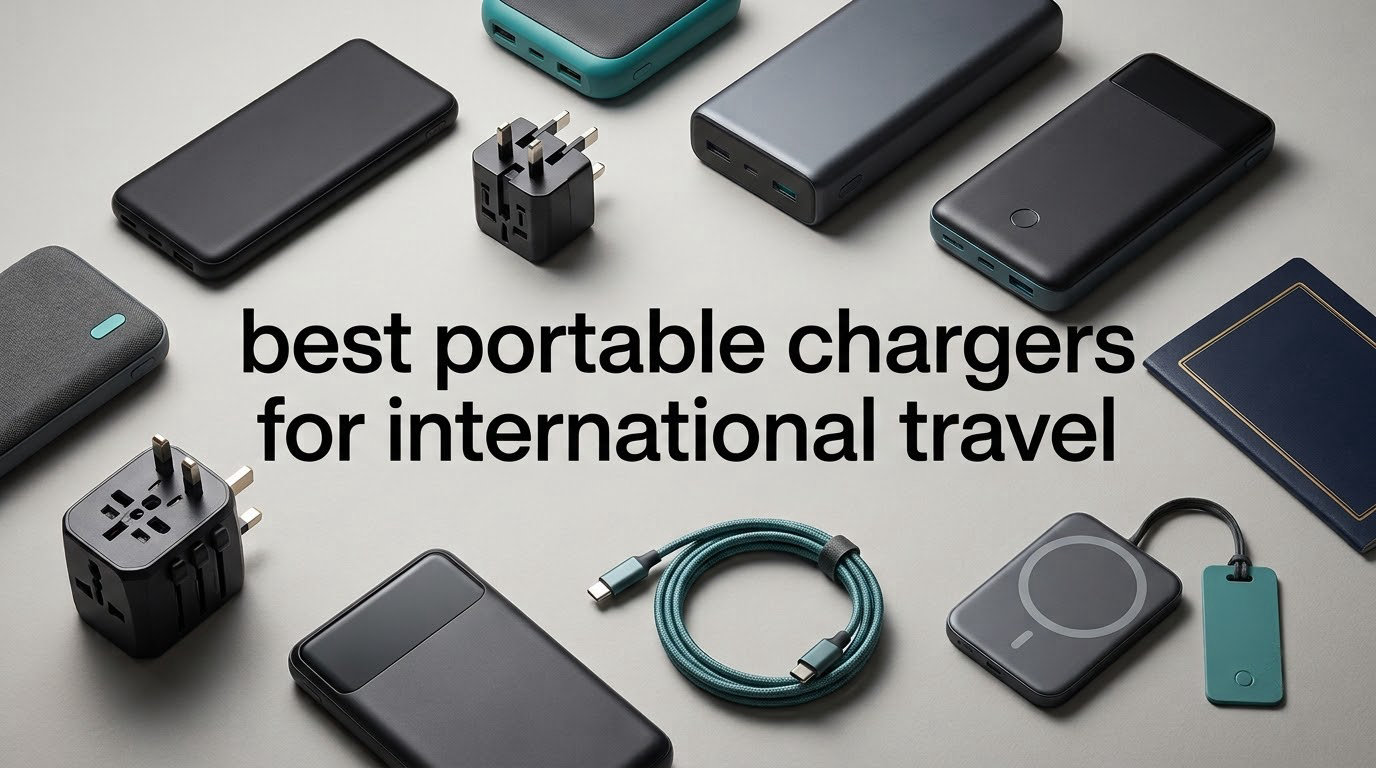
Portable charger and power bank are the same product, and if you are flying internationally, the one number that decides whether you can carry it is watt-hours, not mAh. The rule most travellers half-know is that lithium batteries stay in your cabin bag and stay under 100Wh, which works out to roughly 27,000mAh, and a 10,000mAh pack is about 37Wh. Every pack in this list sits under that ceiling, and we show you the arithmetic so you can check any power bank you already own before you fly.
Our best overall pick is the INIU 10000mAh 45W Fast Charging Portable Charger, because it is small enough to disappear into a jacket pocket, fast enough to refill a modern flagship in the time between boarding and the seatbelt sign, and far enough under the airline limit that no screener has a reason to stop you. If you plan to charge a laptop from the same pack, the Anker 737 at 140W is the one to buy instead.
We compared ten packs that all clear 100Wh, weighing capacity, real output wattage, weight, ports, and whether the battery percentage readout is something you can trust at a gate. The recurring theme in traveller forums is that a power bank is insurance, not a convenience: a dead phone in a foreign city is far more expensive than a dead phone at home, and a traveller in r/onebag framed it exactly that way. This is also the gear to buy alongside a carry-on bag built for international travel, since both are decided by the same constraint.
Top 3 Best Portable Chargers for International Travel (October 2026)
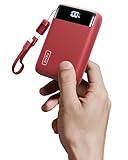
Those three cover the three jobs most travellers actually have. The INIU 10K is the pack you carry on every flight regardless of trip length, the Anker 737 is the one that replaces a laptop charger, and the INIU 20K is the multi-day workhorse when you would rather not hunt for a socket in a train station.
10 Best Portable Chargers for International Travel in 2026
| Product | Specifications | Action |
|---|---|---|
 INIU 10000mAh 45W Portable Charger INIU 10000mAh 45W Portable Charger |
|
Check Latest Price |
| INIU 20000mAh 22.5W Power Bank |
|
Check Latest Price |
 Anker 737 Power Bank 140W 24000mAh Anker 737 Power Bank 140W 24000mAh |
|
Check Latest Price |
 Anker 10000mAh 30W Built-In Cable Power Bank Anker 10000mAh 30W Built-In Cable Power Bank |
|
Check Latest Price |
 VRURC 10000mAh 4-Cable Power Bank VRURC 10000mAh 4-Cable Power Bank |
|
Check Latest Price |
 Anker 20000mAh 87W Travel Essential Anker 20000mAh 87W Travel Essential |
|
Check Latest Price |
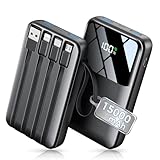 HELLEE 15000mAh 4-Cable Power Bank HELLEE 15000mAh 4-Cable Power Bank |
|
Check Latest Price |
 INIU 20000mAh 65W Laptop Power Bank INIU 20000mAh 65W Laptop Power Bank |
|
Check Latest Price |
 Orfeika 20000mAh 77Wh Power Bank Orfeika 20000mAh 77Wh Power Bank |
|
Check Latest Price |
 Tlsic Powerpack 5-in-1 10000mAh Tlsic Powerpack 5-in-1 10000mAh |
|
Check Latest Price |
Two things stand out across this table. First, the whole list sits between 18.5Wh and 88.8Wh, so the airline limit is not a differentiator here, it is a given. Second, output wattage varies far more than capacity does, and that is what actually decides whether your trip goes smoothly.
Can You Take a Power Bank on a Plane? The 100Wh Rule Explained
Yes, and the rules are simpler than most travellers assume. Here is the version worth memorising before you pack.
Carry-on only, never checked luggage. Power banks and spare lithium batteries are prohibited in checked baggage because a damaged cell can generate enough heat to start a fire in the hold.
The ceiling is 100 watt-hours for a single battery. Anything above that needs explicit airline approval, and anything between 100Wh and 160Wh is conditionally accepted only if you can show approval at check-in.
mAh is not the number screeners use. Watt-hours is, and it is calculated by multiplying the mAh rating by the cell’s nominal 3.7V, then dividing by 1000.
10,000mAh is about 37Wh. That is the most common pack size in travel and it sits comfortably under the limit.
Keep the label visible and intact. Wh markings printed on the casing are the fastest way through screening, and a scuffed or missing label is a reason to slow down.
Protect against damage. A crushed or punctured pack is a fire risk in the cabin, so do not wedge it into a tight compartment at the bottom of your bag.
The conversion is worth doing once so it stops feeling like a mystery. Take 10,000mAh at 3.7V: 10,000 x 3.7 is 37,000, divided by 1000 gives 37Wh. A 20,000mAh pack is 74Wh, and a 24,000mAh pack such as the Anker 737 comes to 88.8Wh. Twenty-five thousand milliamp-hours would be 92.5Wh, and the practical ceiling of 27,000mAh lands right at 99.9Wh. If your own pack’s arithmetic lands under 100, it flies in the cabin on any carrier that follows the standard rules.
The US rules come from the TSA and the FAA, but they are not uniquely American. The IATA Dangerous Goods Regulations set the template that most international carriers and the major aviation authorities, including EASA in Europe and CAAC in China, work from, which is why a pack that clears in Seattle also clears in Seoul or São Paulo. Airlines can be stricter than the baseline, particularly for packs without a printed Wh rating, so checking your carrier’s own wording before a long-haul itinerary is worth five minutes.
“TSA approved” is worth unpacking, because the phrase is used in listings as if it were a certification. No agency pre-approves individual power bank models. What screening officers do is check the rule set, the labelling, the physical condition of the cell, and their own discretion, which means the honest framing is that a compliant pack is permitted, not that a specific product carries an endorsement.
If a screener does stop you, the realistic outcomes are conditional approval for a 100Wh to 160Wh pack with paperwork, or removal of the pack from your cabin bag. Airlines routinely remove and destroy lithium packs found in checked luggage, and they generally do not return confiscated items, so the cheapest risk management is to keep the pack in your personal item where you can see it.
1. INIU 10000mAh 45W Portable Charger – Best Overall for Flights
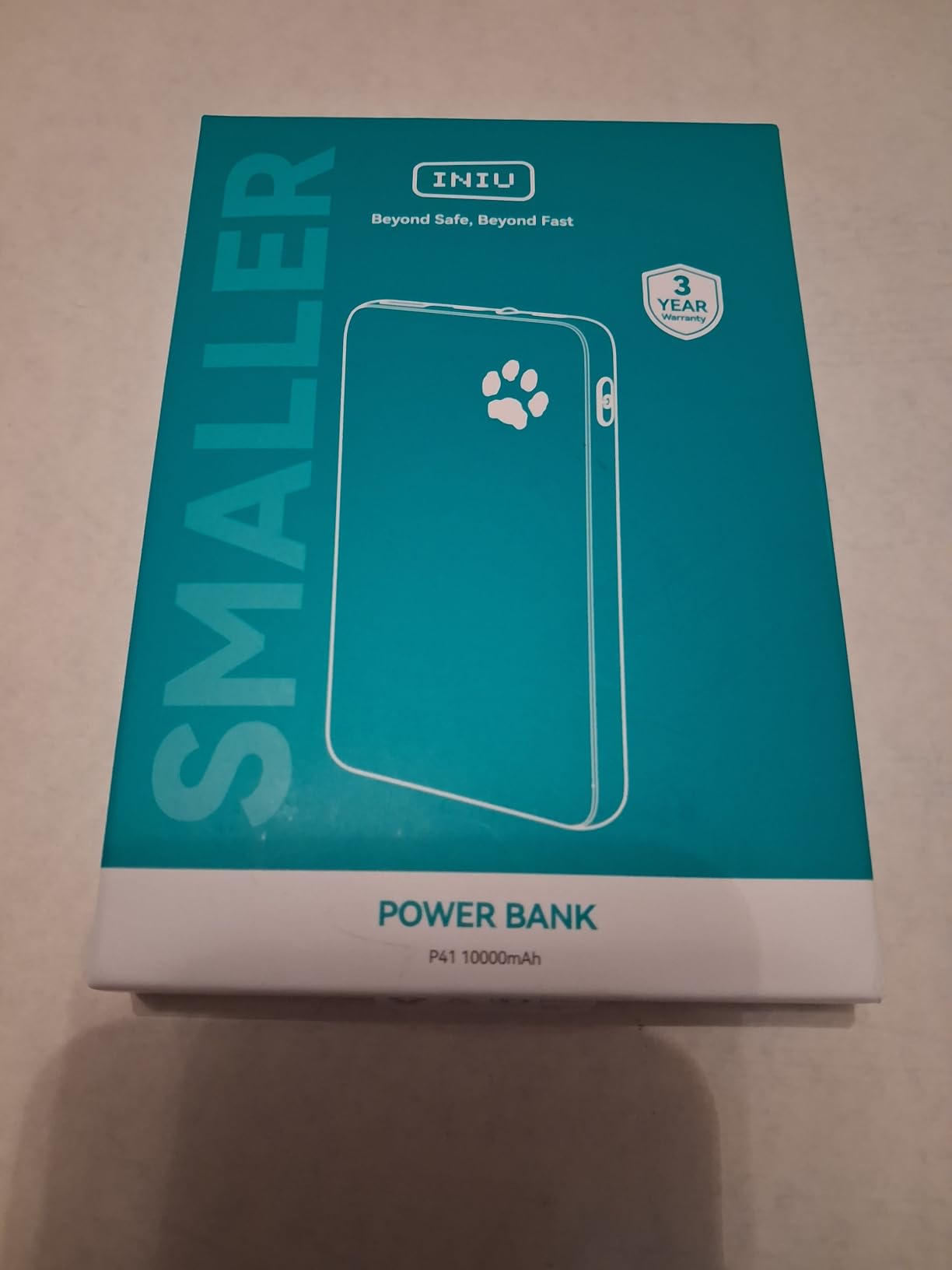
INIU 10000mAh 45W Fast Charging Portable Charger, Smaller Travel Power Bank
10,000mAh at 37Wh
45W USB-C output
3 ports
182g, 4.3 x 2.6 x 0.7 inch
Pros
- Very compact and light for 10000mAh
- 45W output refills modern flagships quickly
- Detachable braided USB-C cable can be swapped
- 3-year warranty
- Cabin-safe 37Wh rating
Cons
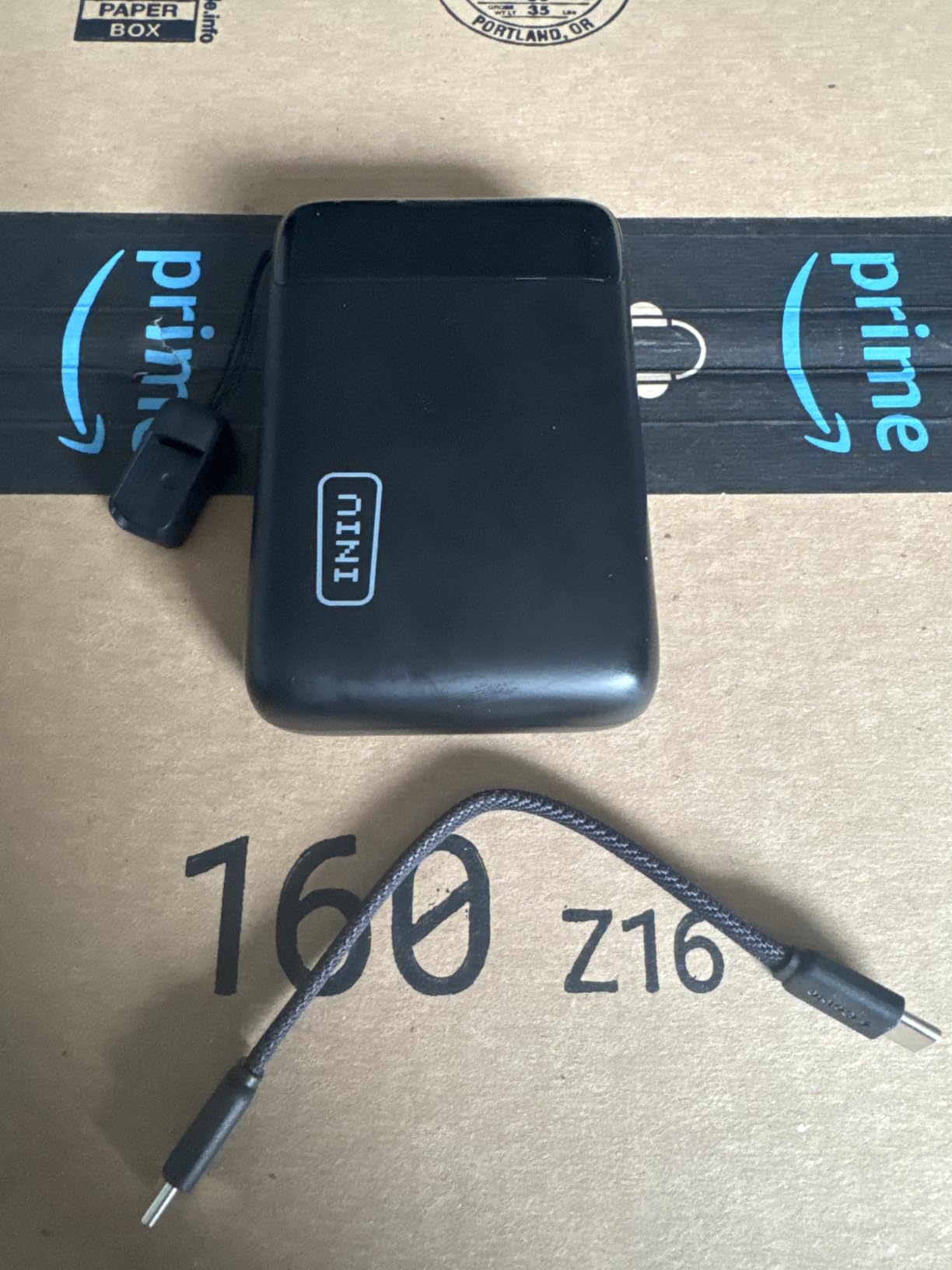
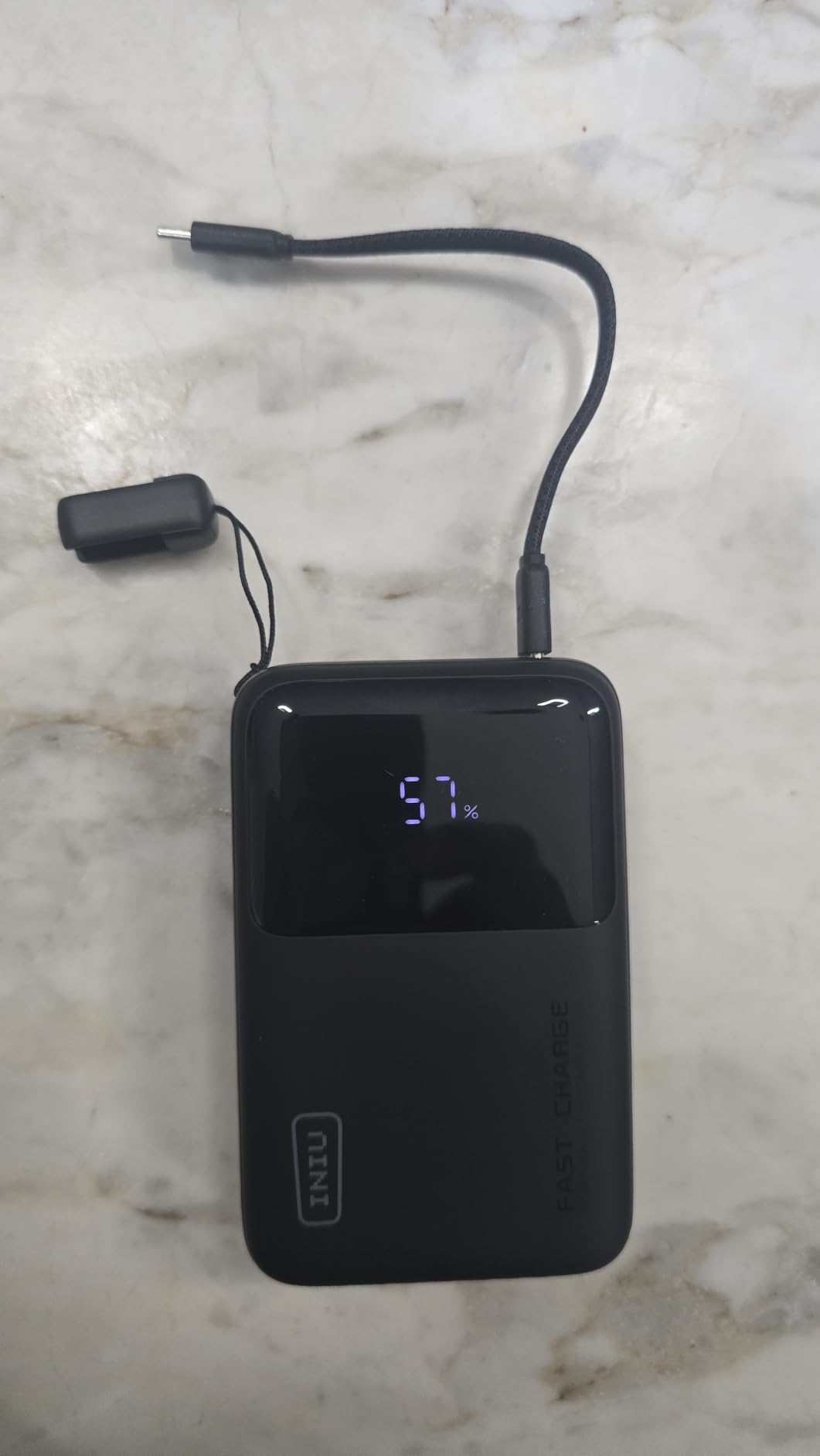
- Attached cable is only 0.4ft long
- 10000mAh gives about 1.5 to 2 phone charges
This is the pack we would hand to someone flying for the first time and saying “just get this one”. At 37Wh it uses barely a third of the airline allowance, and at 182g with a 0.7 inch profile it disappears into a jacket pocket rather than becoming another object to manage. The 45W output is the quiet advantage: a modern flagship reaches the mid-seventies in percentage in half an hour, so a top-up between the gate and take-off is genuinely useful.
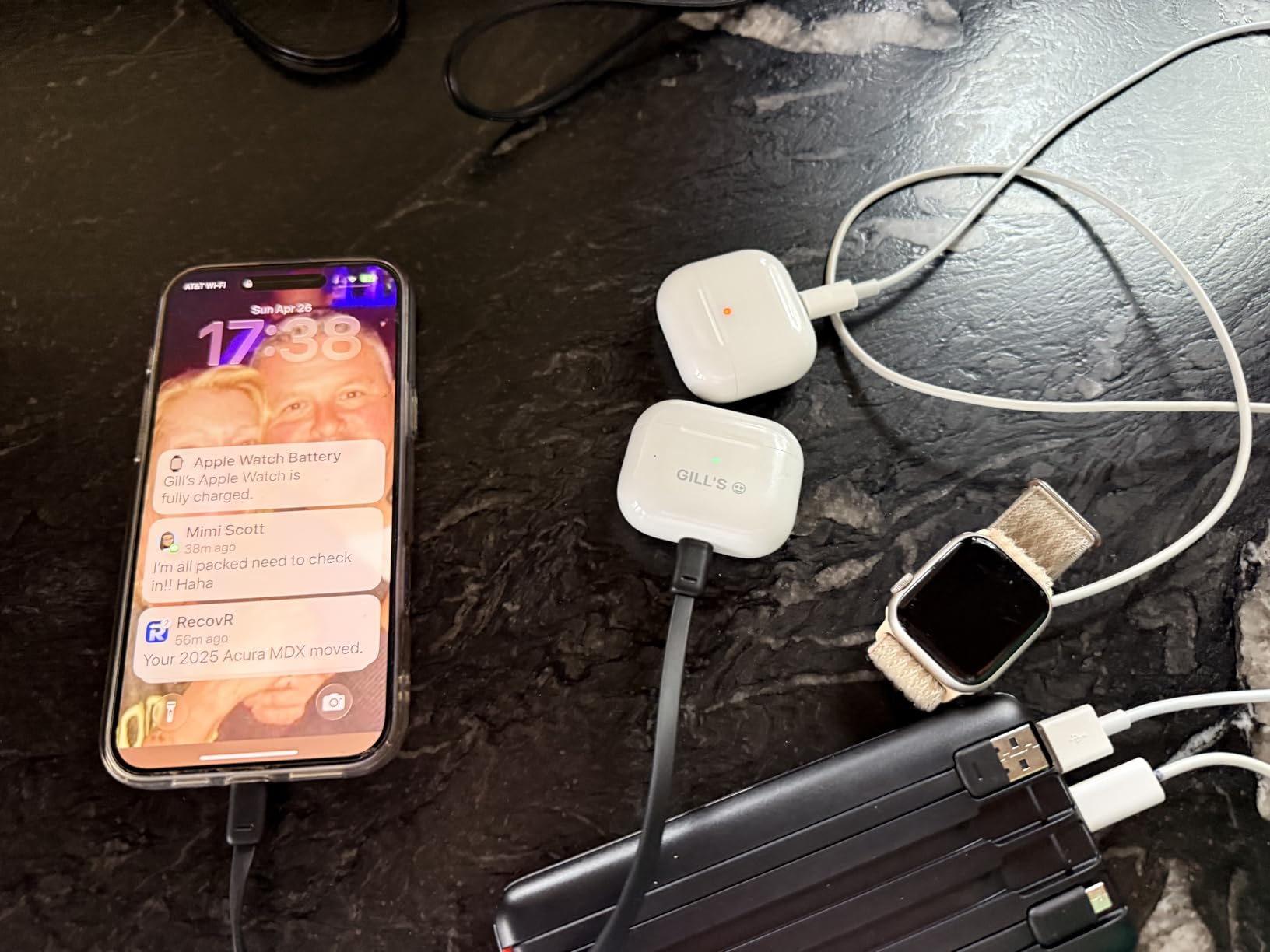
Three ports means you can charge a phone, earbuds and a watch at once without negotiating for a single socket, and the USB-C port handles both input and output. Reviewers repeatedly single out the detachable braided cable, which is a small design choice that matters a lot on a trip, because a cable you can replace is a trip that does not end because one connector frayed.
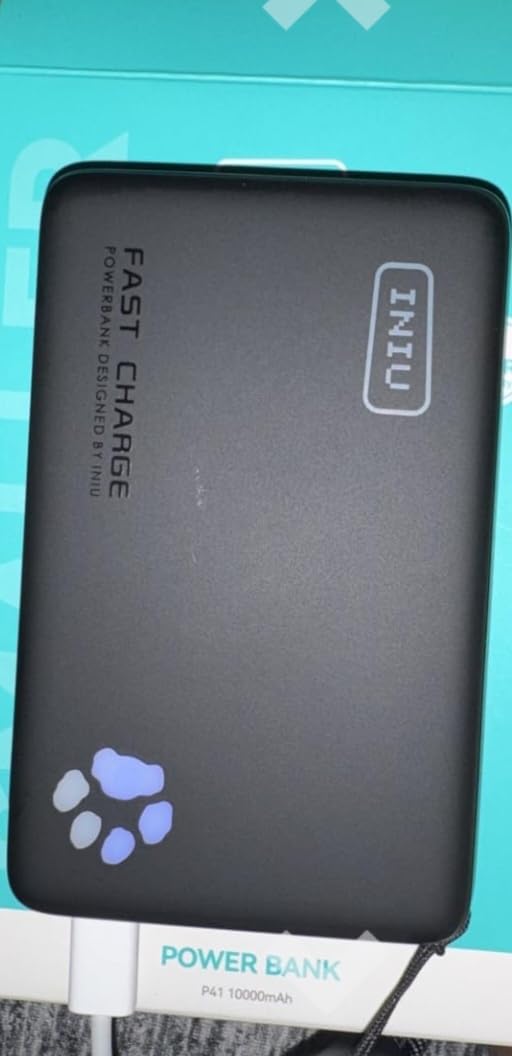
The honest weakness is the short 0.4ft attached cable. It is fine for topping up a phone on a tray table and awkward if you are charging a tablet propped up in bed, so pack one longer cable of your own. The second limitation is capacity: 10,000mAh is roughly one and a half to two full charges on a large flagship once conversion losses are accounted for, which is enough for a long-haul flight and thin for a week away.
Is 37Wh enough headroom for international screening?
Yes, and it is one of the most comfortable positions you can be in. Because the pack uses well under a third of the 100Wh allowance, there is no scenario where a stricter carrier on a tighter route treats it as an edge case. If you fly out of a country with a stricter enforcement culture, this is the category of pack that passes without a conversation.
The second practical benefit is that you can carry two of these and stay legal if your itinerary genuinely needs it, though most travellers find one is enough. Two compliant 37Wh packs give you redundancy against a lost bag without any of the arithmetic anxiety that comes with a single large pack.
When should you buy something bigger instead?
Buy a larger pack if you are away for more than three or four days without reliable access to a socket, or if you are travelling with a laptop or a handheld gaming PC that needs real wattage rather than milliamp-hours. 10,000mAh buys you a phone emergency kit, not a mobile office.
It also falls short if you are sharing power with a travel companion, because 20W-class charging split between two phones is a slow experience. In that case move up to the 20,000mAh options later in this list.
2. INIU 20000mAh 22.5W Power Bank – Best Value for Multi-Day Trips
INIU Portable Charger, Smallest 20000mAh 22.5W Fast Charging Power Bank
20,000mAh at 74Wh
22.5W output
3 ports
Digital display, 313.5g
Pros
- About 4 full phone charges from 74Wh
- Smart digital display shows exact percentage
- Detachable nylon lanyard cable
- Built-in flashlight
- 3-year warranty
Cons
- Heavy at about 11 oz for a pocket
- Self-recharge takes 5 to 6 hours
- Conversion losses cut usable output
If you take one pack on a two-week trip, this is the one. 20,000mAh converts to 74Wh, which is still a comfortable margin under the cabin limit, and it delivers about four full charges of a flagship phone. The smart digital display is the feature that changes behaviour: on a multi-country trip you can check remaining capacity in a restaurant in one language and know whether you need to find an outlet tonight.
The rating here is the highest in the set at 4.6 across more than 28,000 reviews, and the pattern in that feedback is consistency rather than excitement. Long-term owners report that it keeps performing trip after trip, and the detachable nylon lanyard cable is repeatedly praised for outlasting standard plastic cords.
Where it disappoints is weight. At 313.5g, roughly 11 ounces, it is noticeable in a jacket pocket and it is not a bag you forget about. The 5 to 6 hour self-recharge is the other practical issue, and it means you want to fill it the night before a flight rather than the morning of.
One point of caution comes directly from the review data: a small number of international buyers describe a safety incident. That is a minority of a very large review base, but it is the kind of report worth taking seriously with any lithium pack, which is why our airline section covers physical protection and why we prefer packs with visible Wh labelling.
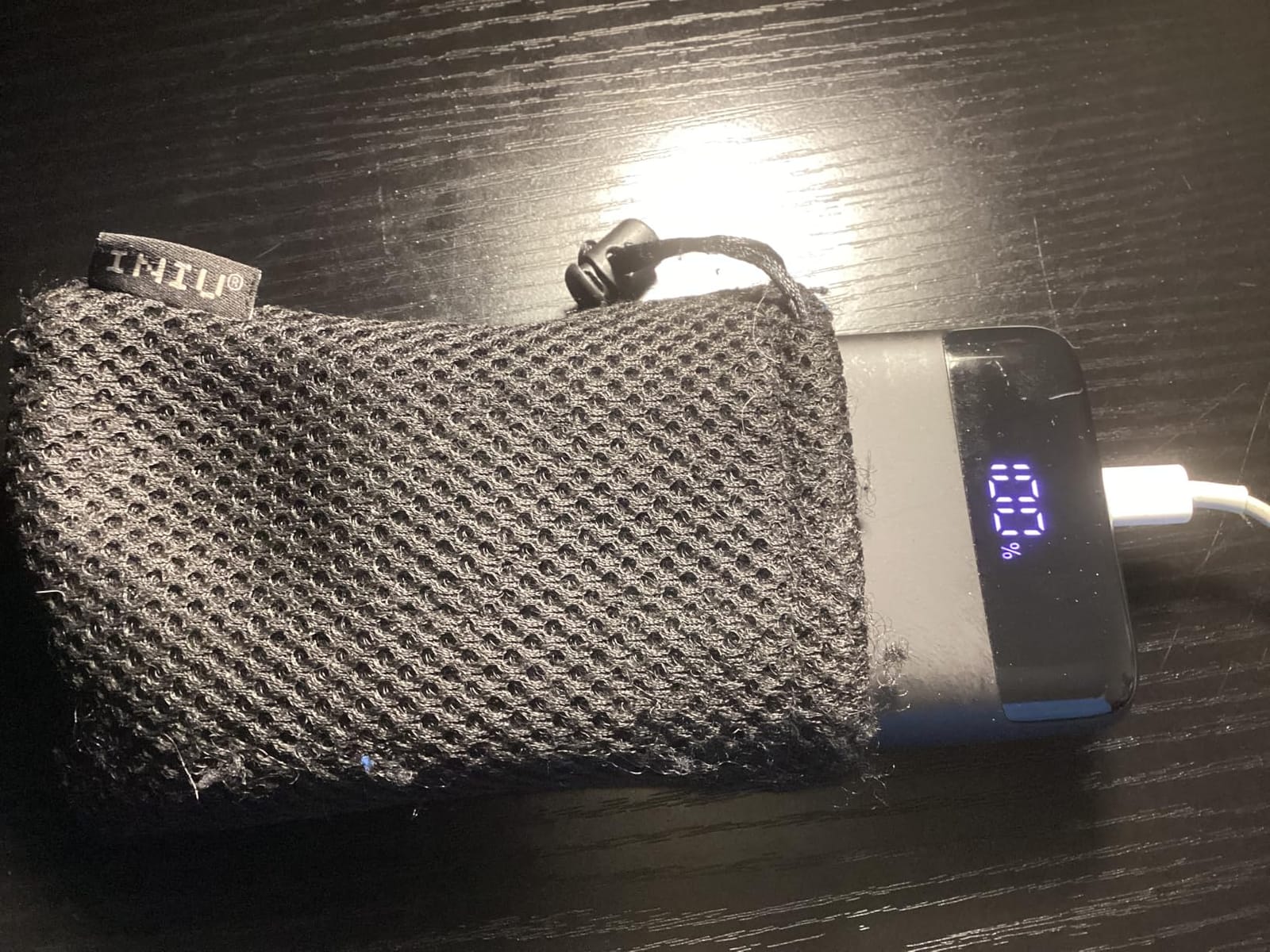
Does 20,000mAh clear the airline limit?
It does, comfortably. 20,000mAh at a 3.7V nominal cell is 74Wh, which is under the 100Wh ceiling that applies on virtually every international route. This is the largest capacity most travellers can carry without triggering the conditional-approval process.
That makes it the practical maximum for a general-purpose travel pack. Going higher means entering the 100Wh to 160Wh band that needs airline sign-off in advance, which is not something to sort out at the airport.
Is the extra weight worth carrying for a week abroad?
For most multi-day itineraries, yes. The 74Wh covers roughly four phone charges plus earbuds and watch top-ups, which in practice means you stop planning around wall sockets. If your trip is three days and light, the pick above this one is lighter and simpler.
It is also a shared pack in a way smaller ones are not, so a couple travelling together can cover both phones from one unit. Just check the 313.5g figure against whatever bag you are actually lifting into the overhead locker.
3. Anker 737 Power Bank 140W 24000mAh – Best for Laptop Charging
Anker 737 Power Bank, 140W 24,000mAh 3-Port Laptop Charger, Smart Display
24,000mAh at 88.8Wh
140W two-way output
3 ports
Smart display, 1.4 lb
Pros
- 140W output charges real laptops
- Display shows live input and output wattage
- About 4 iPhone 16 Pro charges
- Includes 140W cable and travel pouch
Cons
- Bulky and heavy for a carry-on
- Reaches 140W only with a 5A cable and 140W charger
A power bank with a phone-shaped output wattage is not a laptop charger, and that is the entire reason this one exists. At 140W two-way Power Delivery across three ports it can top up a 13-inch laptop from a seat, which no other pack in this list does, and a Steam Deck owner planning a 10-hour flight asked on r/SteamDeck for exactly this capability. The display reports live input and output wattage, so you can see whether the laptop is actually accepting the full rate.
Capacity is 24,000mAh, which converts to 88.8Wh. That is close to the ceiling, and it is the largest power bank here that still flies in a cabin bag without prior airline approval, so it needs a bit more care at screening than the smaller picks, though the casing carries its own printed rating.
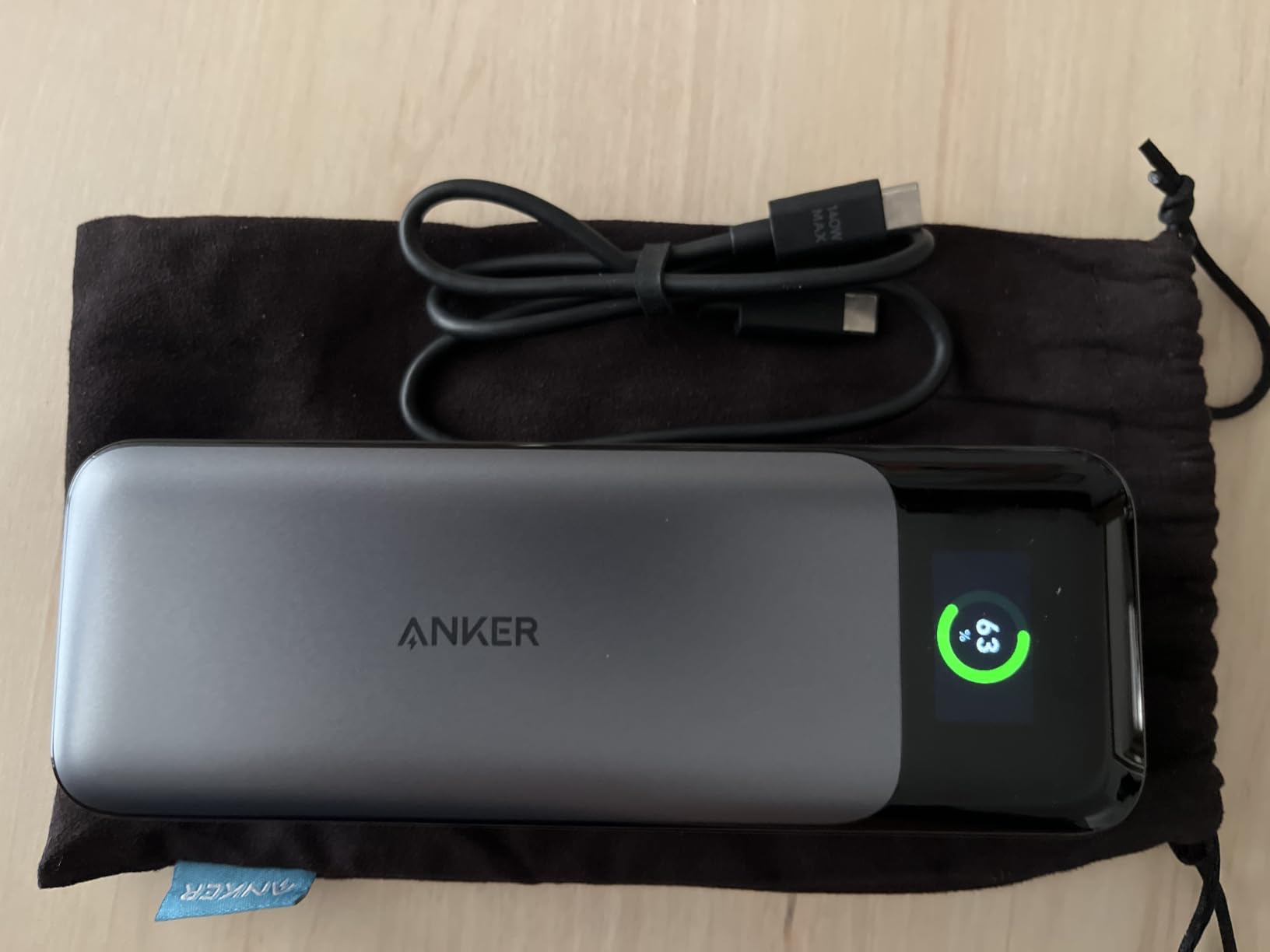
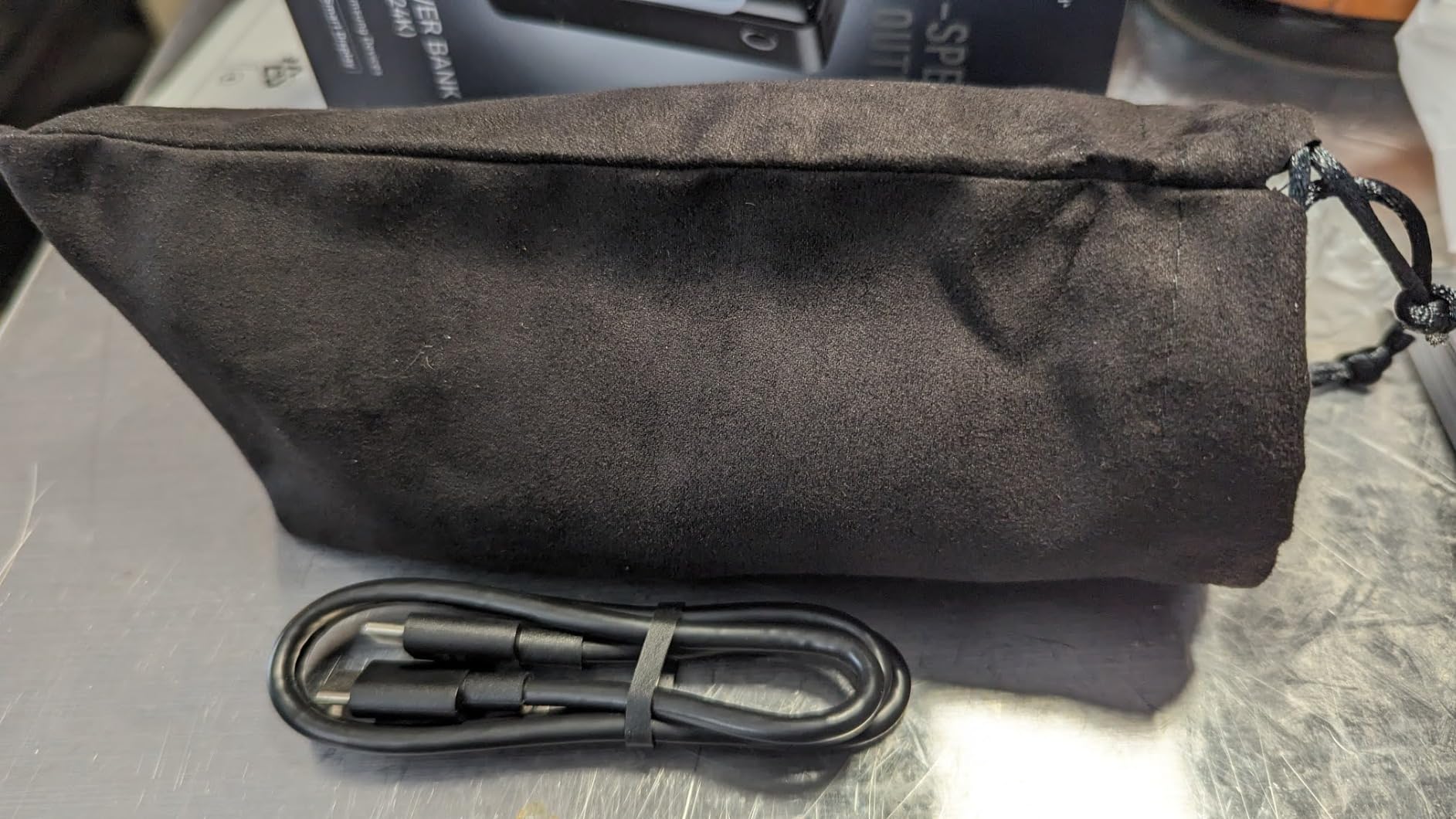
The compromises are size and the accessories you need to hit the rated speed. At 1.4 pounds and 6.13 by 2.14 by 1.95 inches, it is a genuine object in a carry-on rather than a pocket item, and reaching the full 140W requires a 5A cable and a 140W charger, which are not in the box. A 140W cable is included, but the wall charger is not.
At 22 ounces it also tips the balance the other way for a traveller who is optimising every gram, and for a two-day trip that weight buys capacity you will never use. Think of it as a working tool rather than an emergency battery.
Can it keep a laptop alive through a long flight?
Yes, that is what it is built for. A 13-inch laptop at cruise is drawing well under 140W, and 24,000mAh gives you enough energy for a meaningful working block rather than a token top-up. The same headroom runs a handheld gaming PC at a usable rate, which answers the most common question in handheld-gaming communities about flying.
The constraint is seats, not watts. If your airline does not provide a mains outlet and you plan to work for six hours, budget the math before boarding rather than assuming the pack lasts the whole flight.
Is 88.8Wh still comfortable to carry internationally?
It is legal without pre-approval, but it is close enough to the limit that a screener will look at the label. Keep the Wh marking readable, do not bury the pack at the bottom of a bag, and be ready to explain what it is. Compared with the 37Wh option, you have given up most of your safety margin in exchange for laptop-class power.
If your route is short or your devices are all phones, that trade is poor value. If you work in transit, it is the only pick here that makes the trip possible.
4. Anker 10000mAh 30W Built-In Cable Power Bank – Best for Everyday Carry
Anker Power Bank,10,000mAh 30W with USB-C Travel Essential Portable Charger
10,000mAh at 37Wh
30W bi-directional
Built-in USB-C cable
223g, 2 ports
Pros
- 30W is about twice the speed of a 5V 3A pack
- Built-in cable tested past 10000 bends
- One cable handles input and output
- Works with Steam Deck and MacBook
Cons
- Only about 1.5 to 2 flagship phone charges
- Older iPhones need their own cable
- Pass-through charging works but is slow
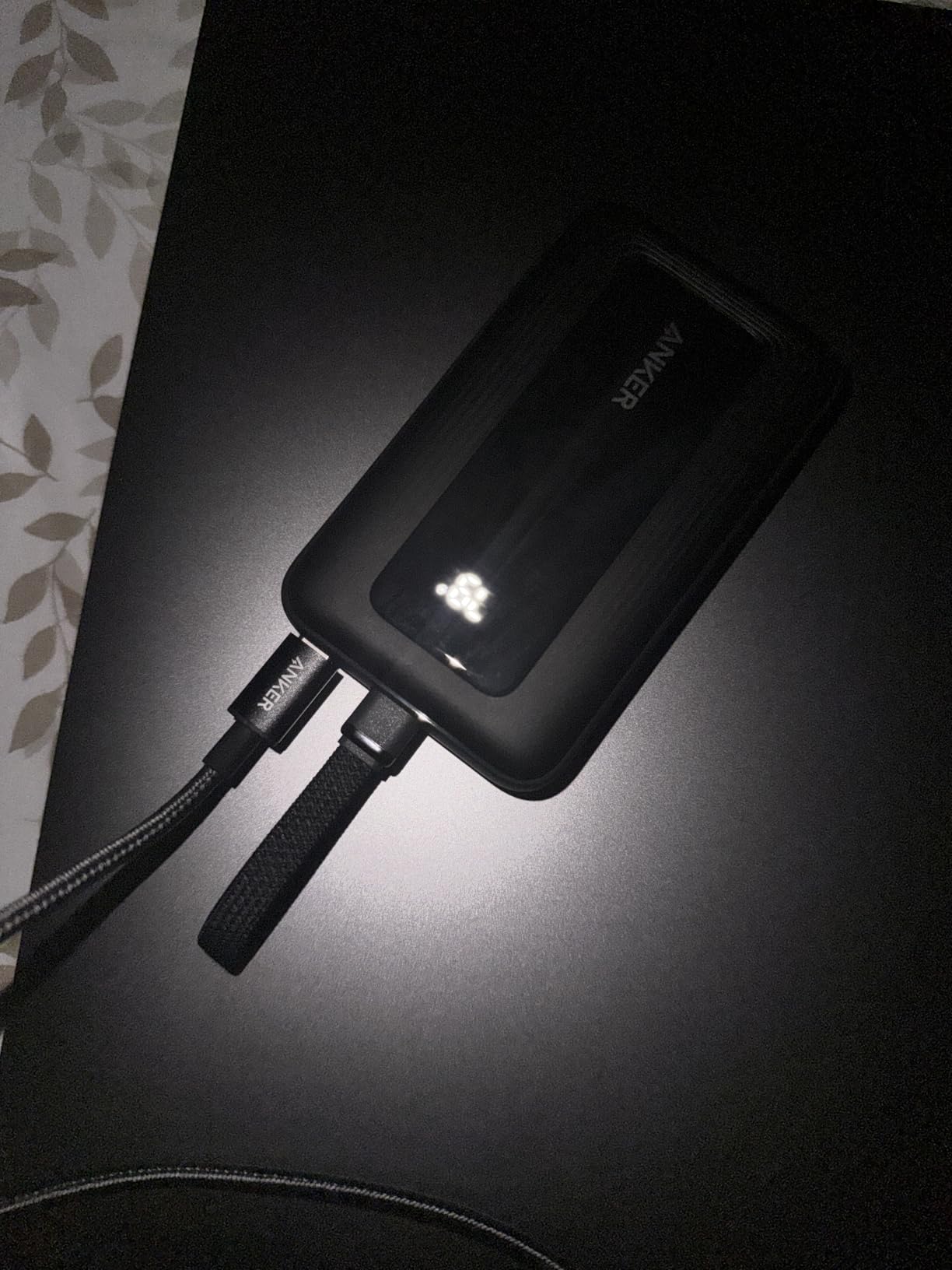
The built-in cable is the point. Travellers on r/MagSafe asked for one charger that covers phone, tablet and watch without a pile of cables, and this answers that directly: the 5.4 inch USB-C cable is permanently attached and rated past 10,000 bends, so it is not the weak link on a two-week trip. You carry the bank and nothing else.
30W bi-directional output is genuinely fast for a 10,000mAh pack, roughly double what a 5V 3A bank delivers, and the same USB-C port handles charging the bank itself. That single-port design is what makes the pack this small, and the compatibility list covers phones, tablets, MacBook, Switch and Steam Deck.
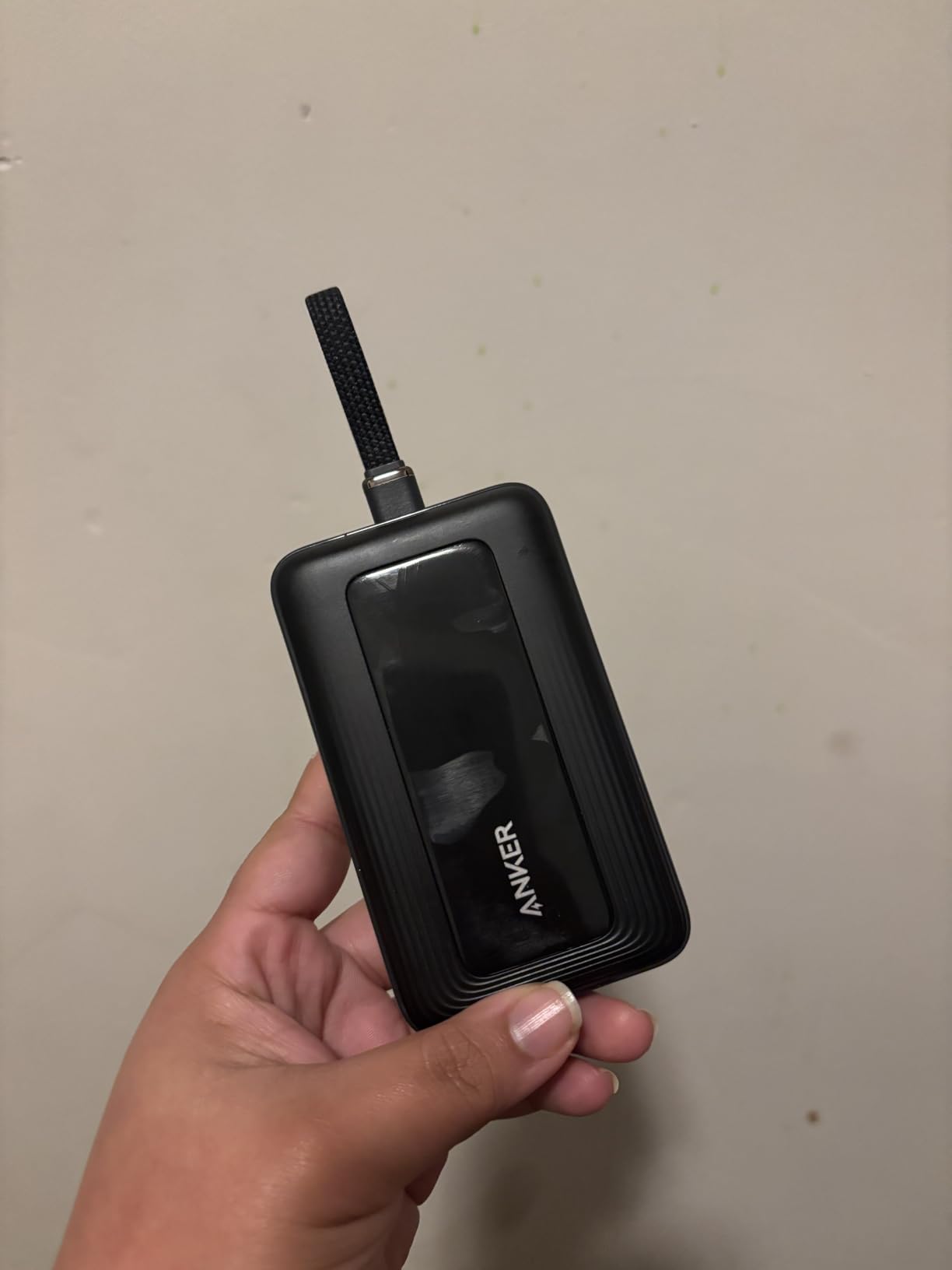
Limitations are honest ones. 10,000mAh on a large flagship is about one and a half to two charges, so this is a two-day pack, not a two-week pack. Anyone on an iPhone 14 or earlier still needs their own Lightning cable through the USB-A or USB-C port, and pass-through charging, which is charging a phone from the bank while the bank is plugged in, works but is not fast.
That last point matters for overnight flights, where you might want to charge a phone from a wall while the bank refills. It will do it slowly rather than quickly, and knowing that in advance is better than discovering it at 30,000 feet.
Is a built-in cable better than a detachable one?
For a phone-only traveller, yes, because it removes a failure point and a packing decision. You cannot leave the cable in a hotel room, and you cannot buy the wrong replacement in a country where you do not speak the language.
For a laptop traveller, a short built-in cable is less useful, since a 5.4 inch lead is awkward next to a 14-inch screen. Longer-term, a detachable cable that you can swap is the more flexible design, and that is the trade you are accepting here.
Will it charge a laptop in an emergency?
It will, but slowly, and that is worth framing honestly. 30W is enough to keep a thin and light laptop alive between gate and arrival, and it will run a handheld PC at a lower frame rate than its native charger. It is not a substitute for a 65W or 140W pack on a working flight.
For a traveller whose main device is a phone and whose laptop is a backup, the built-in cable version wins on simplicity. For anyone editing photos or writing long documents at altitude, the laptop-class pick is the one to spend the weight on.
5. VRURC 10000mAh 4-Cable Power Bank – Best Budget Cable-Free Pack
VRURC Portable Charger, Slim Power Bank Built-in 4 Cables, Travel Essential
10,000mAh at 37Wh
Four built-in cables
6 total outputs
12W, 260g
Pros
- Four built-in cables cover old and new phones
- Five outputs let a group share one pack
- LED display shows exact percentage
- Integrated lanyard for hands-free carry
Cons
- Output limited to 12W and 2.4A
- About 6 hours to self-recharge
- Some reports of cable failure after months
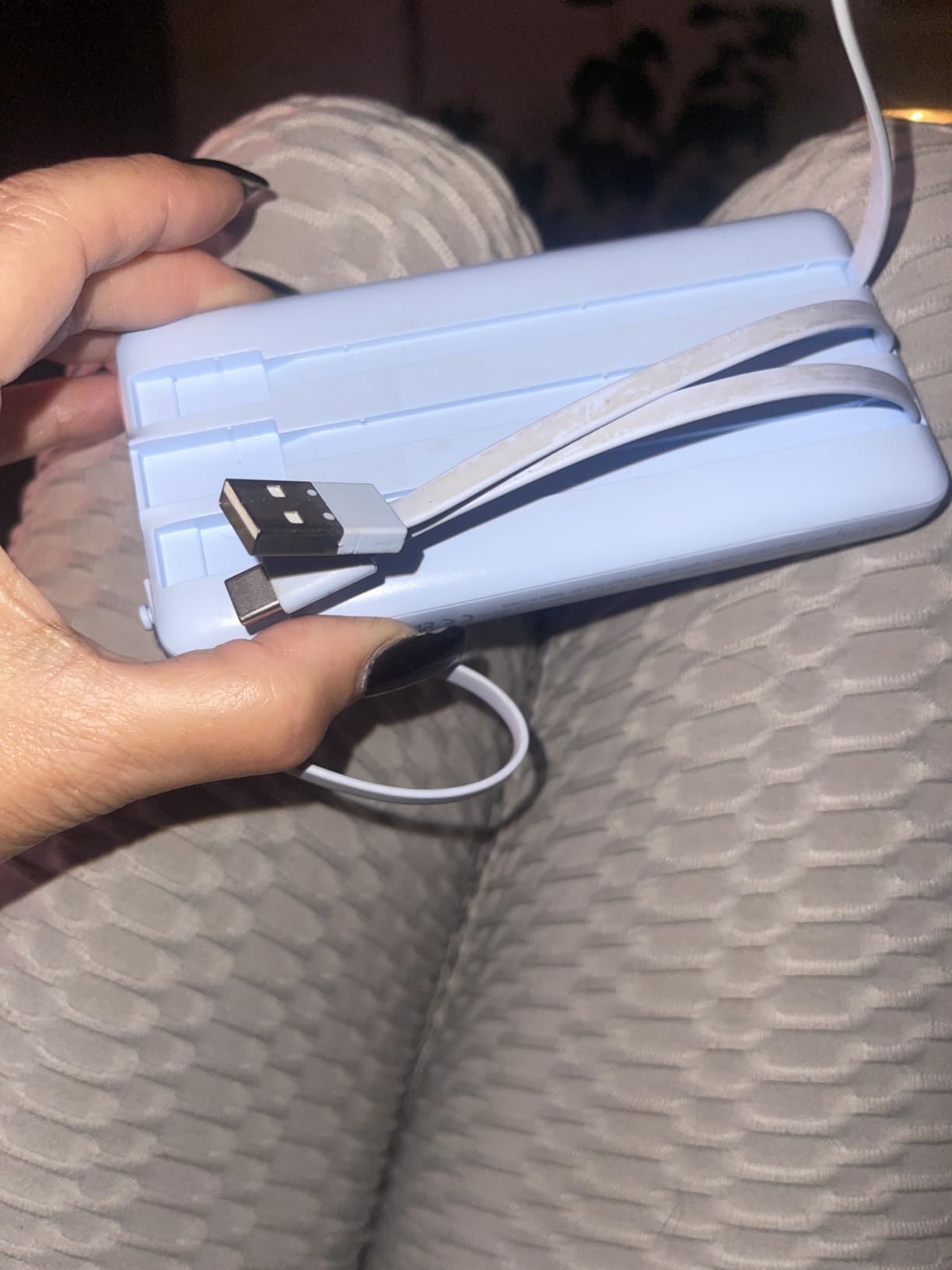
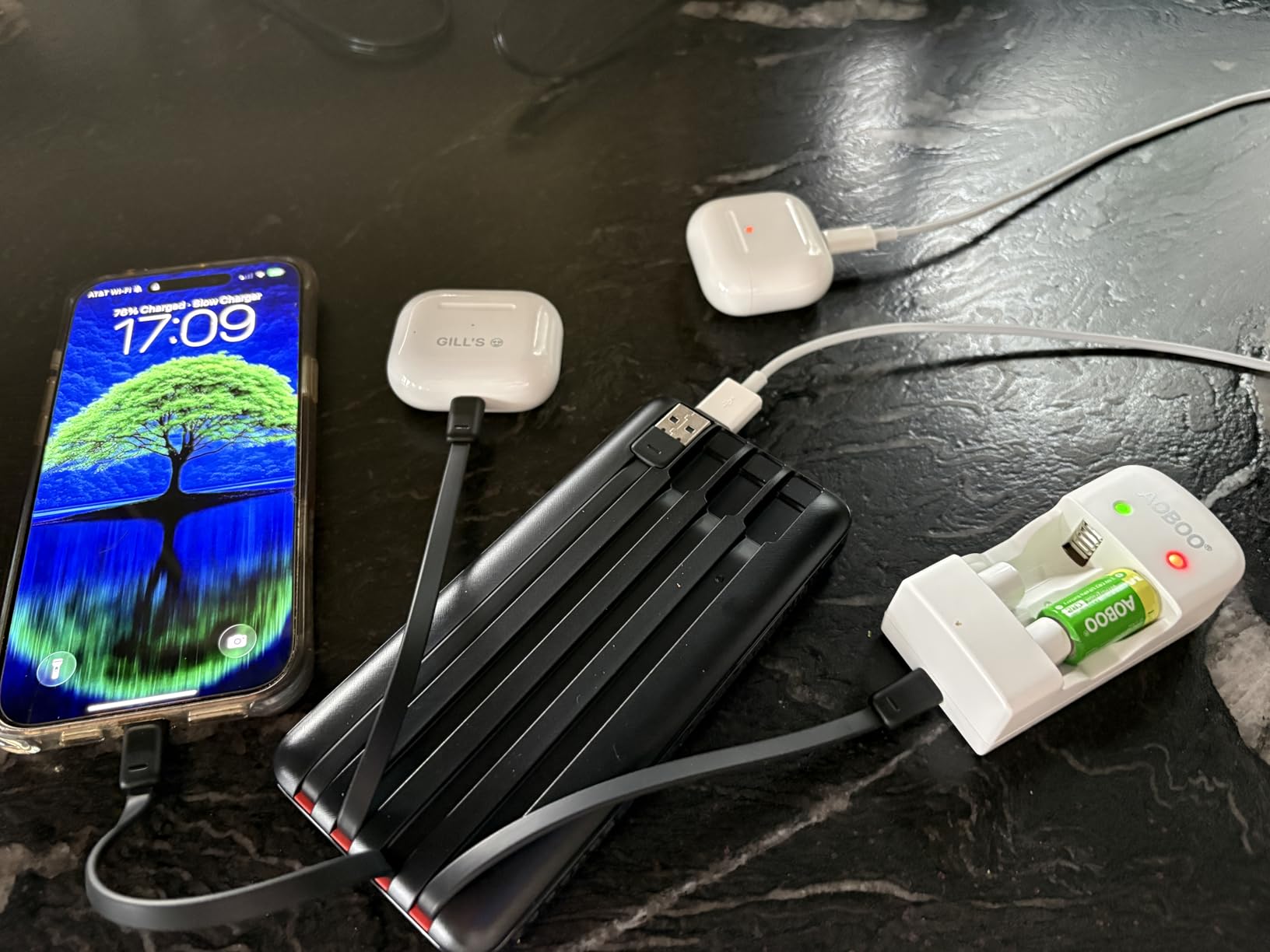
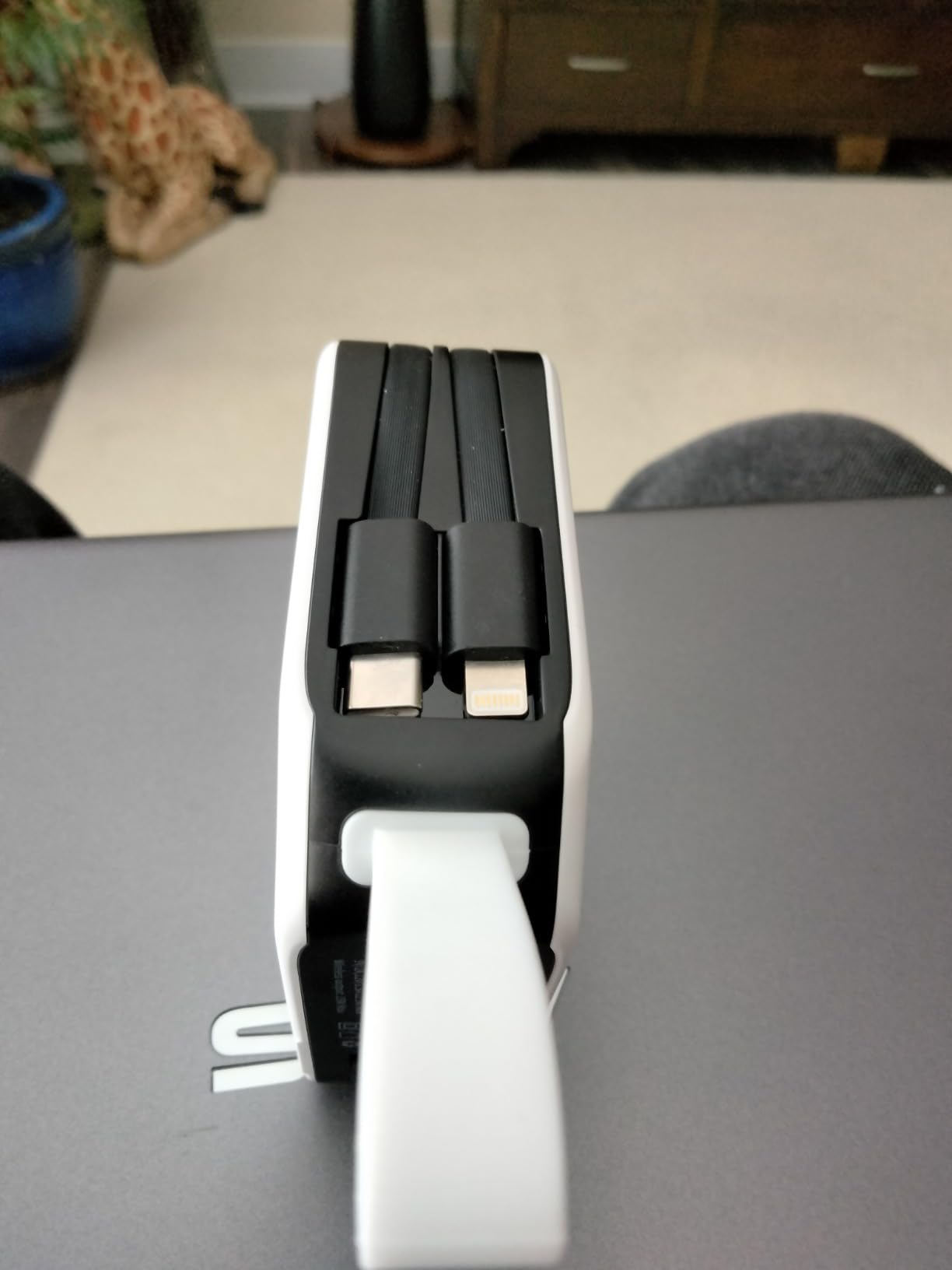
This solves the travel problem nobody else addresses: the friend whose phone still has a Lightning port, the older tablet with Micro USB, and your own USB-C device, all charging from one brick with nothing in your bag. Four cables are built into the body, and with the external ports there are five outputs, which means two people can share a single pack without playing pass-the-cable.
The lanyard that doubles as a carry strap is small but sensible, and the LED display gives you a percentage rather than four vague LEDs. The safety circuitry covers overcharging, overheating and short circuits, which is reassuring given how often this category of pack ends up in a hot car or a crowded overhead locker.
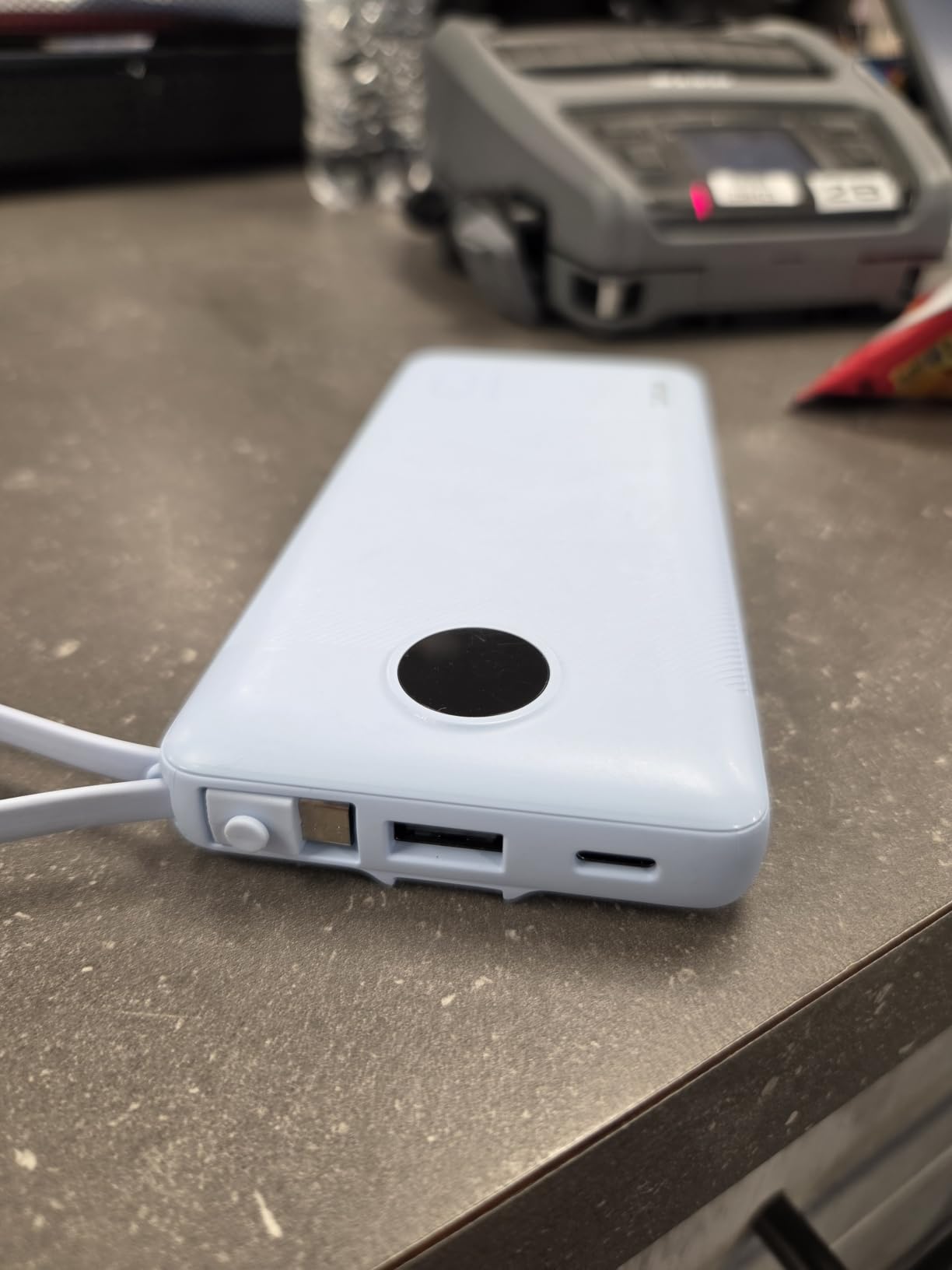
Twelve watts is the honest weakness. That is a 5V 2.4A figure, roughly half the speed of the 22.5W and 30W packs in this list, and on a large flagship a top-up takes the better part of an hour. Self-recharge takes about six hours, so it wants plugging in the night before.
A number of buyers also report built-in cables or the unit itself failing after several months of regular use, which is the natural risk of a design with more moving and stressed parts than a two-port bank. Treat it as a trip tool rather than a decade-long investment.
Who is this pack actually for?
It is built for groups and mixed-device households, particularly families or couples travelling with more than one generation of phone. Nothing else in this list charges a Lightning phone and a USB-C phone and a Micro USB accessory at the same time without three cables in your bag.
It is also the pack to buy if a teenager is coming on the trip, since a 12W top-up is fine for them and it removes any argument about whose cable goes in the shared bag.
What should you check before flying with it?
Confirm the Wh marking is present and readable, as with any pack, and keep the unit in your personal item rather than a checked bag. At 37Wh it is one of the safest picks here from a screening perspective, with far more margin than the 74Wh and 88.8Wh options.
Also check the display behaviour. It stays lit continuously, which several buyers find distracting at night, so a quick-tap-to-check model would suit some travellers better. If you want faster charging, the pick above is the better buy for the same cable-free idea.
6. Anker 20000mAh 87W Travel Essential – Best for Long International Trips
Anker Power Bank, 20,000mAh Travel Essential, Built-in USB-C Cable(Black)
20,000mAh at 74Wh
87W shared, 65W to one device
3 ports
15.2 oz
Pros
- Up to 65W to a single device for a 14-inch MacBook Pro
- 20000mAh charges four flagship phones
- Built-in cable tested past 10000 bends
- Refills in about 1.5 hours with a 65W charger
Cons
- Heavy at 15.2 oz and not pocketable
- Wall charger not included
- Apple devices may need a certified cable
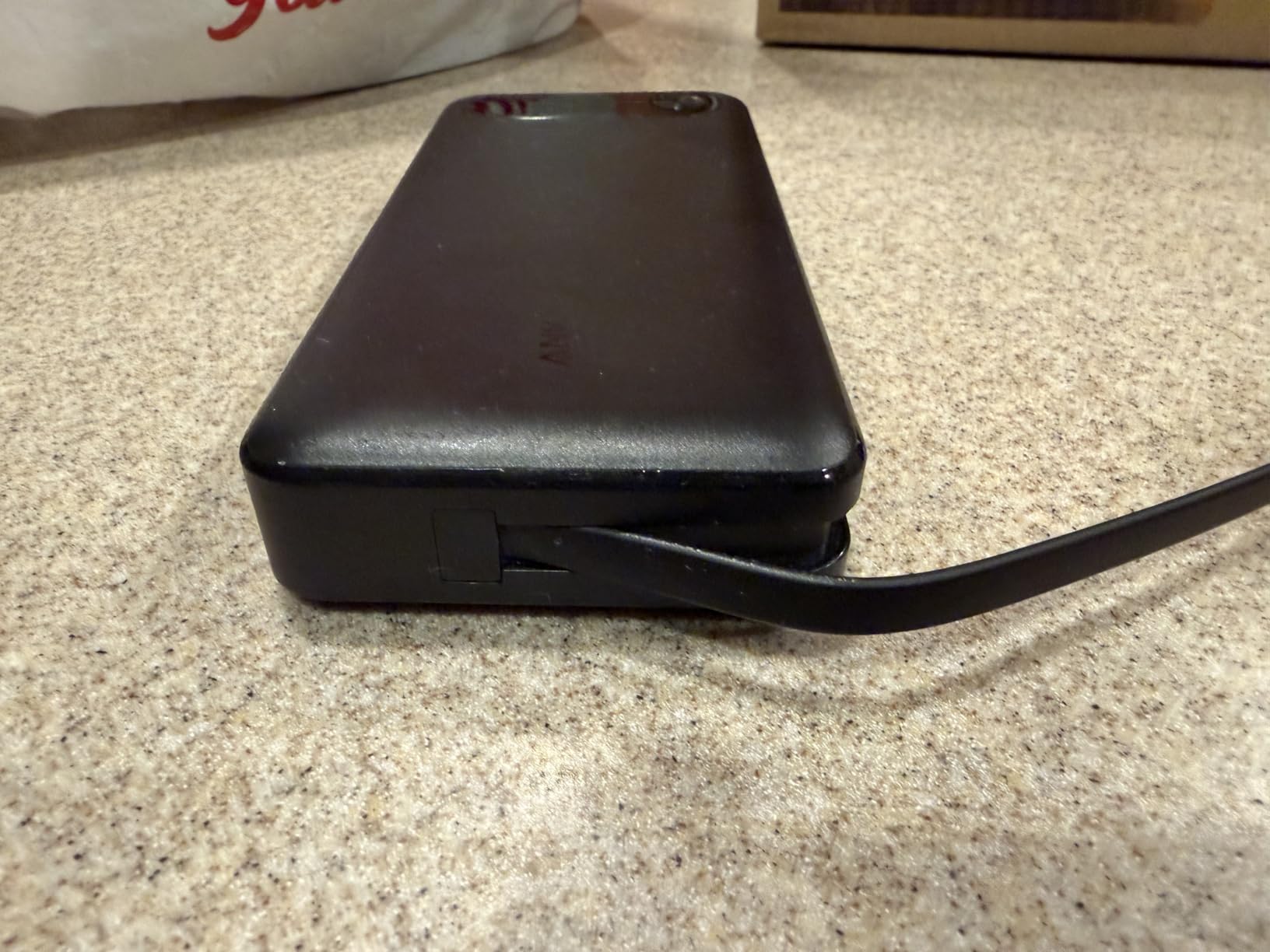
This is the most complete single pack in the list: 87W shared across three devices, with up to 65W going to one device, which is enough for a 14-inch MacBook Pro. A 20,000mAh cell then charges four flagship phones, so a two-week trip with a laptop in the bag is covered by one object. The built-in cable doubles as the input, so there is a single charging loop with nothing to misplace.
Self-recharge in about 1.5 hours with a 65W charger is a genuine travel advantage, because it means you can refill it during a layover or an evening in a hotel lobby rather than dedicating a night to it. At 74Wh it also sits at the top of the range that conservative international rules treat as straightforwardly legal.
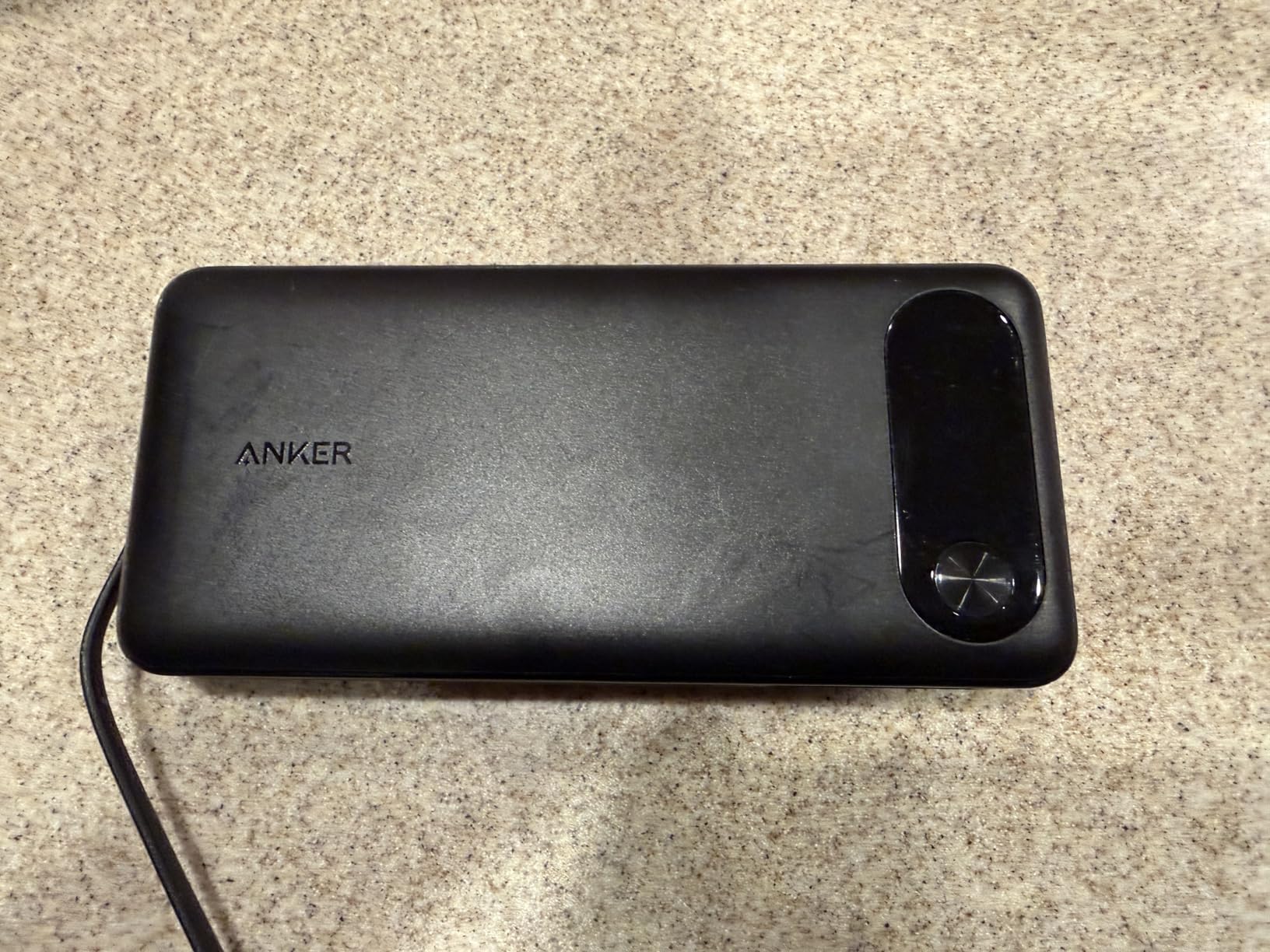
At 15.2 ounces this is not a pocket pack, and that is the main cost of carrying so much capability. The wall charger is not included, which matters if you bought it for the fast refill, and Apple devices may need a certified cable to reach full performance.
Long-term owners report consistent reliability rather than peak-of-class speed, so this is a dependable tool rather than the fastest option available. If you only ever charge a phone, you are carrying a kilogram of capability you will not use.
Is this the right all-round travel pack?
For a two-to-three-week trip where you work in transit, yes. It is the only product here that handles a laptop and a phone at the same time without a second brick, and 74Wh leaves adequate margin under the 100Wh limit for international routes.
For a lighter trip, the smaller 10,000mAh options are more sensible, because the difference in usable weight is greater than most people expect once a bag is packed.
What about voltage and plug type overseas?
Because the input is USB-C rather than mains, this pack sidesteps the international voltage problem entirely. It draws 5V from any USB charger or power bank, so it works in a hotel in Lisbon or a cafe in Bangkok without a plug adapter or a thought about 100-240V.
Voltage only becomes relevant if you buy a bank with a built-in AC socket, which is a separate category we cover in the buying guide. For a USB-only pack, the world’s plug shapes are simply not your problem.
7. HELLEE 15000mAh 4-Cable Power Bank – Best Mid-Capacity All-Rounder
HELLEE 15000mAh Portable Charger Power Bank, 45% Smaller Built-in 4 Cables
15,000mAh at 55.5Wh
22.5W output
4 built-in cables, 6 outputs
250g
Pros
- 15000mAh gives up to 3.5 flagship phone charges
- Four built-in cables plus external ports
- 22.5W refills a phone to half in 30 minutes
- Digital percentage display
Cons
- Heavier than expected for a slim body
- Built-in cables are short and not retractable
- Slow to refill from a low state
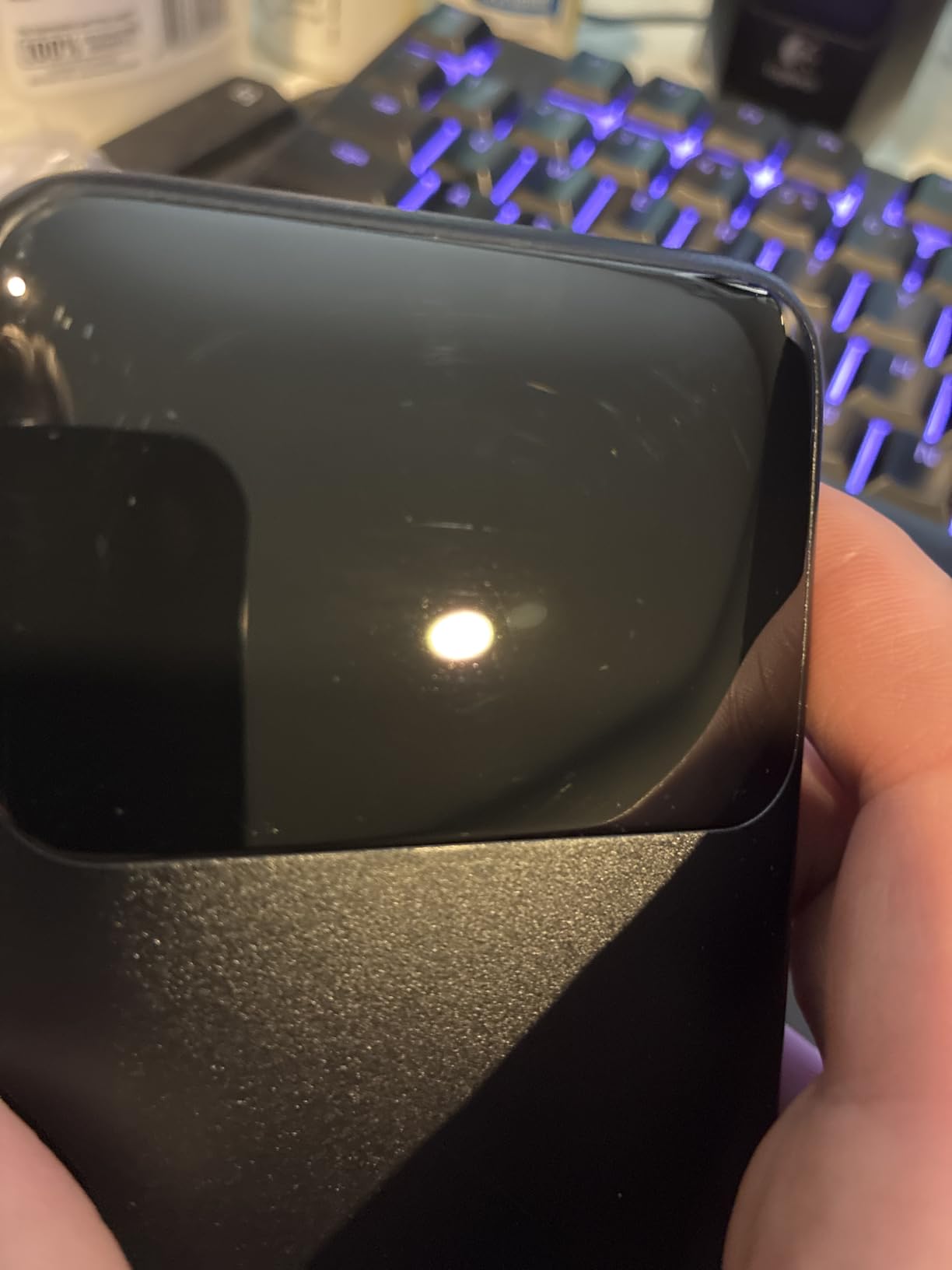
Fifteen thousand milliamp-hours is the sweet spot most roundups skip, and it is easy to see why. At 55.5Wh you get about three and a half flagship phone charges or a long run of earbud and watch top-ups, while staying lighter and smaller than the 20,000mAh packs. It is the capacity you want when a trip is a week rather than a fortnight and you still refuse to plan around outlets.
Like the VRURC, it carries four built-in cables for USB-A, USB-C, Lightning and Micro USB, and with the external ports it can serve six devices. 22.5W output puts a phone to roughly half charge in half an hour, and the bi-directional Type-C port handles the bank itself.
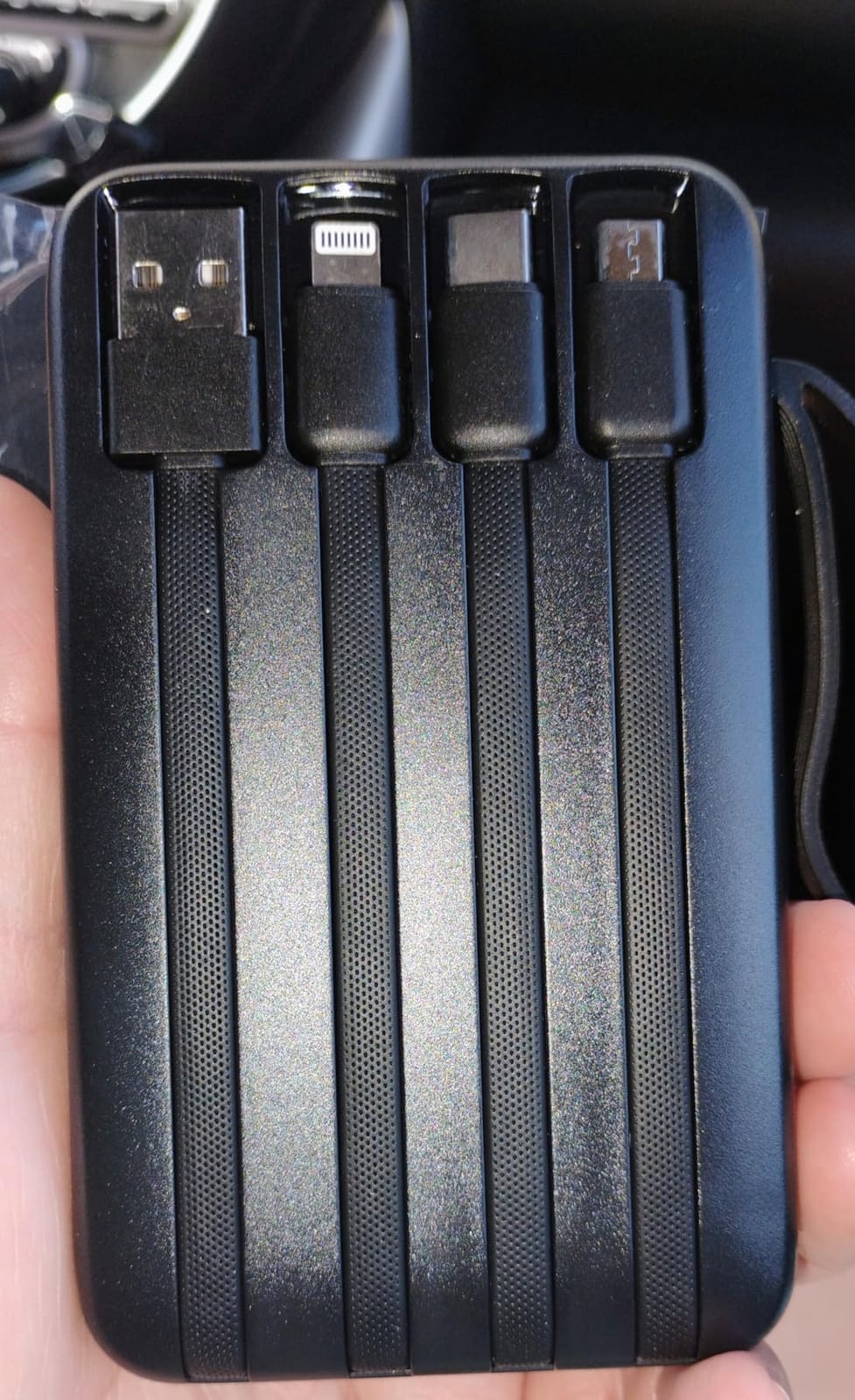
The complaints are consistent: it weighs more than the slim body suggests at 250g, the built-in cable leads are short and fixed rather than retractable, and a refill from a low state takes a few hours. None of those is disqualifying, but all three show up on day three of a trip rather than day one.
Real-world output will also be below the printed capacity once voltage conversion losses are counted, so plan on the lower of the two charge estimates when you are budgeting for a flight.
Why is 15,000mAh a smarter middle than 10,000mAh or 20,000mAh?
It buys most of the capacity benefit for a fraction of the weight penalty. Going from 10,000 to 15,000mAh adds roughly a day and a half of phone life; going from 15,000 to 20,000 adds less than that again while costing noticeably more mass in your hand.
At 55.5Wh it also sits far enough from the 100Wh ceiling that you never have to think about the arithmetic, which is worth something on an itinerary with a strict carrier.
Are the built-in cables worth the trade-off?
Yes for a group, maybe for a solo traveller. Four cables mean you can lend a lead to a companion without unpacking anything, which is the version of cable-free travel that actually pays off in practice.
For one person with one phone, you are paying weight for connectors you will not use, and the fixed short leads cannot be replaced. In that case, a two-port pack with a detachable cable is the better shape.
8. INIU 20000mAh 65W Laptop Power Bank – Best for Handheld Gaming PCs
INIU Laptop Power Bank, Smallest 20000mAh 65W Fast Charging Battery Pack
20,000mAh at 74Wh
65W across three ports
3 ports
13.4 oz
Pros
- 65W charges MacBook HP Lenovo and Dell to 50% in 30 minutes
- Wallet-sized body 38% smaller by volume
- Detachable 4.7 inch braided cable doubles as a handle
- Powers laptop phone and earbuds together
Cons
- Heavier than 10000mAh options despite compact size
- Laptop charging needs a compatible USB-C cable
- Lowest rating in the set at 4.3
This is the one to buy if your trip includes a handheld gaming PC. A Steam Deck owner planning a 10-hour flight asked for a bank with enough wattage to run the device, and 65W across three ports is the number that makes that realistic, while 20,000mAh means you are not rationing charge. Reviewers also highlight that the detachable 4.7 inch braided cable doubles as a carry handle, which is a genuinely good idea at this size.
The body is wallet-small by volume, 38% smaller than conventional packs, so it lives in a laptop sleeve rather than a side pocket. Full multi-layer overheating protection and a 3-year replacement warranty make it a sensible long-term purchase for someone who will fly often.
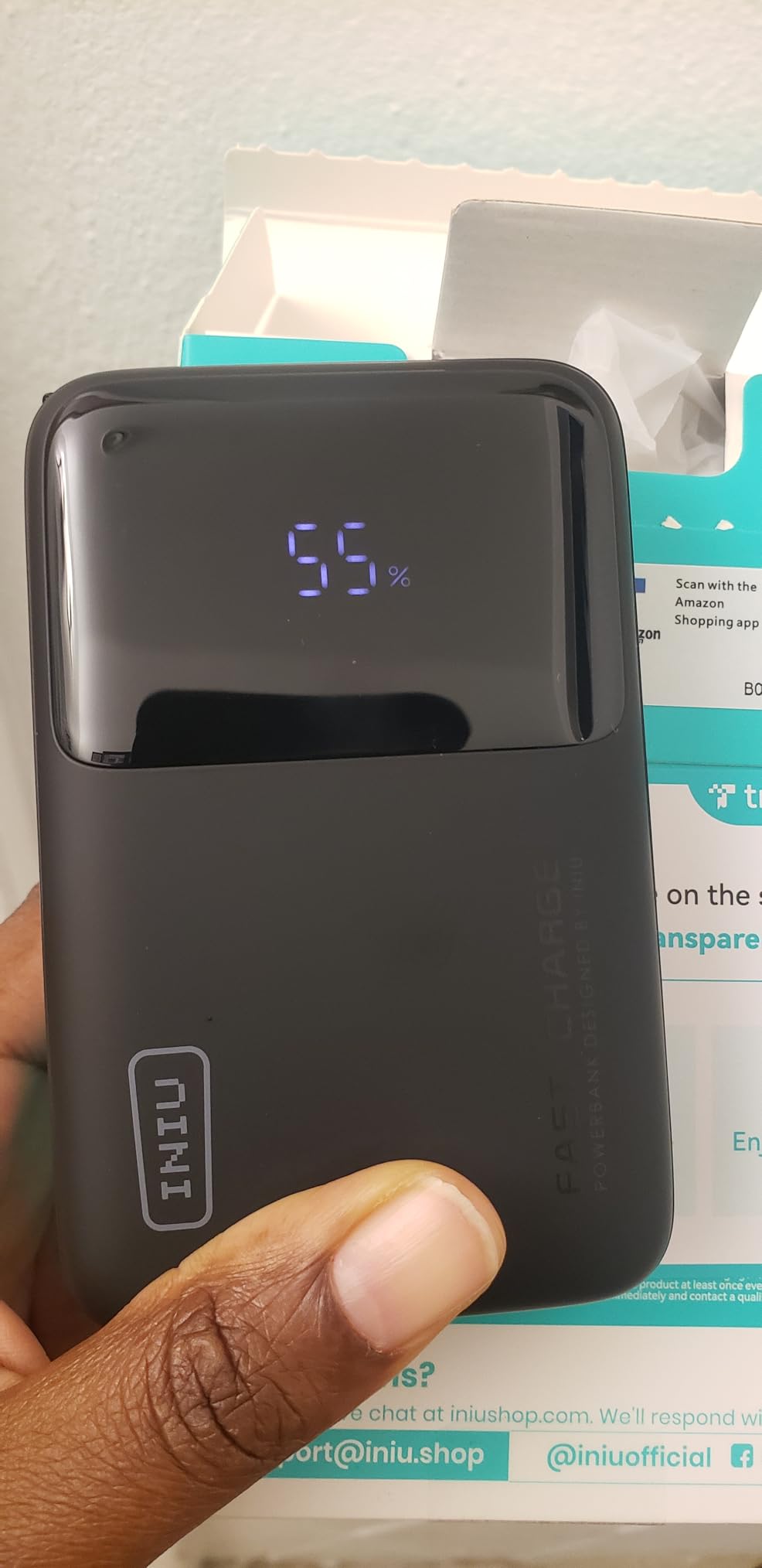
The rating of 4.3 is the lowest but one in this list, and the review data shows about 10% one-star feedback, which tells you the product satisfies most buyers while leaving a visible group unimpressed. Weight is the recurring theme: 13.4 ounces is heavy next to the 10,000mAh packs despite the compact footprint.
To get laptop speeds you also need a compatible USB-C cable and a PD-capable device, so if your laptop has a proprietary charger, check before you fly. The value question is real too, since this sits close in price to the 87W Anker without matching its peak output.
Is 65W enough for a handheld PC on a plane?
Yes, and the review data specifically names Steam Deck at full speed. A handheld PC draws 25W to 45W depending on the workload, so 65W headroom means the device charges as fast as it would from a wall while the pack keeps some capacity in reserve.
For a laptop, 65W covers a 13-inch model comfortably and a 14-inch model at a reduced rate. The cable requirement is the part people forget, so budget for a certified USB-C cable if you do not already own one.
Should a beginner buy this pack?
Probably not. A 4.3 rating with a wider spread of criticism than the rest of this list is a reasonable signal that the value proposition is more nuanced, and the 74Wh capacity is only worth carrying if you will genuinely use those watts.
Beginners are better served by the first pick in this list, which is smaller, faster to charge and far more forgiving. Choose this one when a laptop or handheld is a daily tool, not an occasional backup.
9. Orfeika 20000mAh 77Wh Power Bank – Best with a Printed Wh Rating
Orfeika 20000mAh Power Bank, Portable Charger with 4 Built-in Cables
20,000mAh at 77Wh printed
4 built-in cables
6 outputs, 4 inputs
11.84 oz
Pros
- 77Wh stated on the casing under the 100Wh limit
- Four built-in cables plus external ports
- UL 2056 and UN38.3 compliant
- LED display with low power mode for earbuds
Cons
- Only 20W output so top-ups take longer
- Self-recharge accepts up to 18W
- Some reports of intermittent charging cutoffs
The reason this one earns a place is compliance clarity. The 77Wh energy rating is stated on the product itself, which is exactly what a screener wants to see, and it sits a comfortable margin below the 100Wh ceiling. For a traveller who plans to fly from several countries with different enforcement habits, a visible Wh label removes an entire category of anxiety that no amount of marketing copy can fix.
It is also a well-equipped pack: four built-in cables, six outputs, four inputs, an LED percentage display, and a low power mode for earbuds and smartwatches that draw very little current and would otherwise never register on a normal pack. UL 2056 and UN38.3 compliance is a genuine mark of a manufacturer that tested rather than guessed.
Twenty watts is the trade. Charging an iPhone 16 to half takes about 45 minutes rather than the 25 to 30 minutes you get from 30W and 45W packs, and the self-recharge input is capped at 18W, so refilling from empty is a slow evening.
A handful of buyers report charging that cuts out intermittently and resumes after the pack cools, and the review base is the second smallest in this list at 1,378 ratings, so long-term durability is less proven than the numbers above suggest. The 4.6 rating reflects how well it does what it does, not how much it does.
Why does a printed Wh rating matter at the airport?
Because it is the only number the rule set is written in. Screeners are checking watt-hours, and a pack that states 77Wh on the casing can be cleared in seconds, while a pack showing only mAh on the box can require a conversation and a calculation on a phone screen.
It is also useful at home, because you can re-check the pack after a year of travel and before a long-haul flight, instead of trusting a listing you read once.
Is 20W fast charging good enough for a long trip?
It is adequate rather than pleasant. Topping up a phone to half an hour of use takes 45 minutes, which is workable in an airport lounge but slow in a short layover, and it becomes the limiting factor if you are running several devices from one pack.
If your trip is device-light and label clarity is your priority, this is a well-matched pack. If you are in a hurry between flights, the 30W or 45W options above will serve you better.
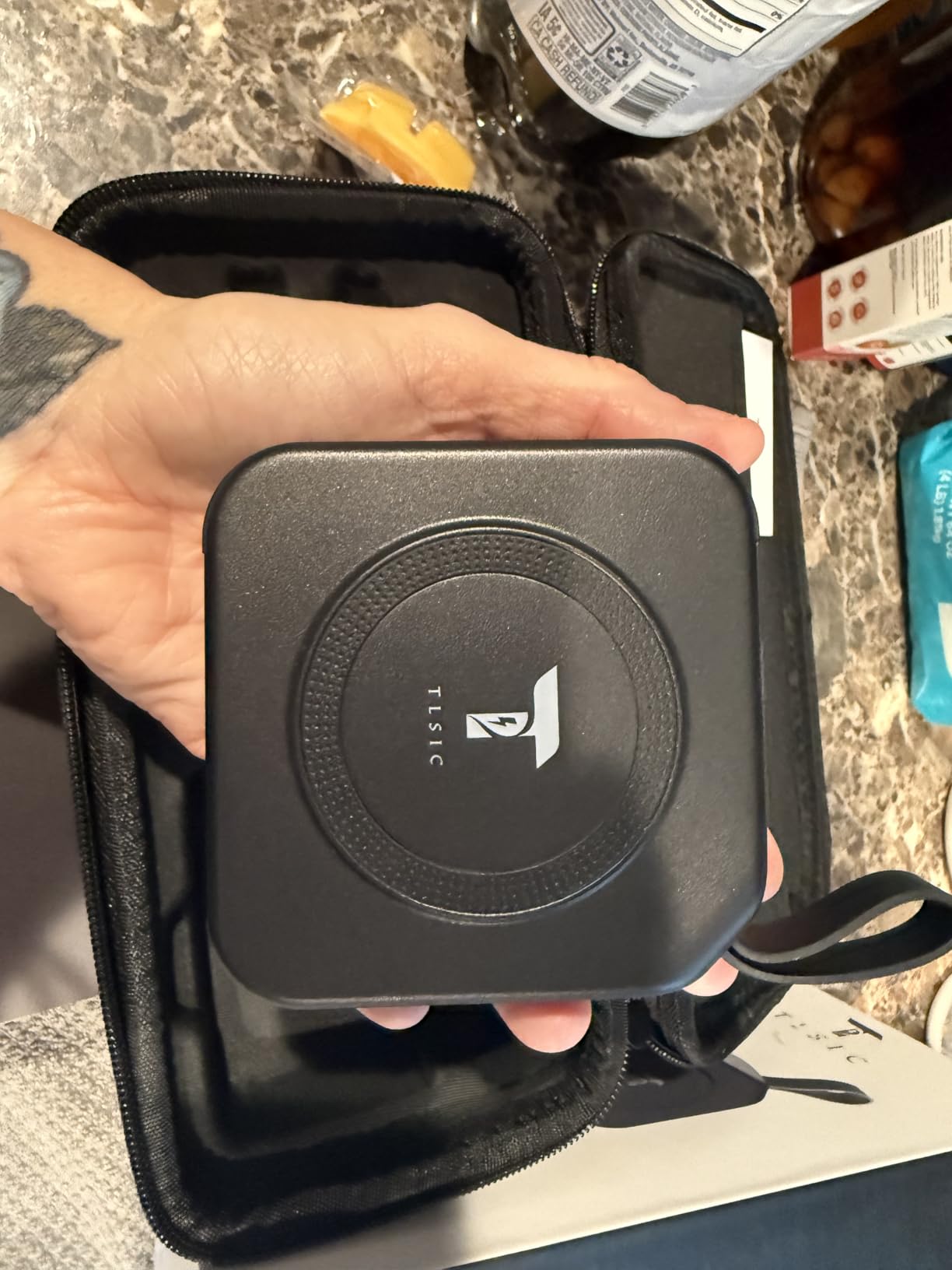
10. Tlsic Powerpack 5-in-1 10000mAh – Best for Wireless Charging and Plug Adapters
Tlsic Powerpack Universal 5 in 1 Travel Power Bank – for Magsafe Battery Pack,10000mAh Power Bank with Built in Cable – Wireless Portable Charger for iPhone 15/15 Pro/ProMax, iPhone 14/13/12 Series
10,000mAh at 37Wh
MagSafe wireless pad
4 ports, built-in cables
74g, EU/AU/UK adapters
Pros
- Only pick here with a MagSafe wireless pad and a power bank
- EU AU and UK plug adapters included
- Built-in Lightning and USB-C cables
- Very light at 74g
Cons
- Lowest rating in the set at 4.2
- Slowest wireless charging and needs careful alignment
- Only 10000mAh
- Smallest review base at 281 ratings
This is the most travel-specific design in the list and the least proven. It is the only pack here that combines a Qi/MagSafe wireless charging pad with a battery, plus built-in Lightning and USB-C cables, USB ports and a 20W PD USB-C port, all in a 3.39 inch square body weighing 74g. That is genuinely pocketable, and the magnetic alignment means you can drop the phone on while walking through an airport rather than finding a cable in the dark.
The most unusual feature is the included travel adapters for EU, AU and UK outlets, which is strange on a power bank and useful anyway as a backup for recharging the pack itself. Five-fold protection covers overcharging, overheating and short circuits.
The cautions are substantial. It has the lowest rating in the set at 4.2 with 12% one-star feedback, the smallest capacity at 10,000mAh, and by far the smallest review base at 281 ratings, so there is little long-term evidence. Wireless charging is slower than wired and demands accurate pad alignment, which is a fair trade for convenience rather than a free upgrade.
It also comes with a 1-year warranty against 2 to 3 years from most rivals, which for a travel purchase you might keep for years is a meaningful difference. Buy it for the wireless pad and the adapters, not for capacity.
Is a MagSafe power bank worth it for travel?
It is worth it if you are on your feet a lot, at a gate, in a queue or between trains, because a magnetic pack means no cable management. It is worth less if you charge at a desk or in a seat, where a wired connection at 30W will beat any wireless pad on speed.
For a traveller whose phone battery dies at inconvenient moments, the snap-on convenience is a real quality-of-life gain. For a traveller who charges overnight, look at a wired pack instead.
What are the bundled plug adapters actually for?
They recharge the power bank from a mains socket in Europe, Australia or the UK without a separate adapter, which saves a small bag item on a multi-country itinerary. They do not charge your phone directly from the wall, so they are a convenience rather than a second charging method.
Because the pack’s own input is USB-C, it also works with any USB charger you already own in any country, so the adapters are a fallback rather than a requirement. That makes this a reasonable choice for a light traveller who wants the fewest objects possible.
How to Choose a Portable Charger for International Travel
Most people choose on capacity, then regret it on weight or charging speed. Work through these in order instead.
1. Start with the watt-hours, not the mAh
Find the Wh rating on the casing first, because that is the number that decides whether you fly with the pack. If only mAh is printed anywhere, multiply by 3.7 and divide by 1000. Anything under 100Wh flies in the cabin; 100Wh to 160Wh needs airline approval in advance; above 160Wh is not permitted in passenger baggage at all.
For reference, 5,000mAh is 18.5Wh, 10,000mAh is 37Wh, 15,000mAh is 55.5Wh, 20,000mAh is 74Wh, and 26,800mAh is about 99.2Wh. That single line of arithmetic resolves most of the anxiety that shows up in traveller questions online.
2. Match output wattage to your heaviest device
A phone tops up acceptably at 20W and quickly at 30W or more. A tablet wants 30W. A thin and light laptop wants 45W to 65W, a 14-inch laptop wants 65W or more, and a handheld gaming PC is happiest at 45W to 65W so it charges while you play.
Output wattage is not the same as total output. A pack advertising 87W across three ports may deliver only 30W to any single device, so read the single-device figure when a laptop is involved. If the trip also involves a rental car and long drives, our picks for the best portable EV chargers cover that side of the itinerary.
3. Weigh capacity against the weight you will actually carry
The packs in this list run from 74g to 313.5g, and the difference is felt in a jacket pocket within a day. A 10,000mAh pack is 182g and gives about two phone charges. A 20,000mAh pack gives about four and weighs over 300g. Rule of thumb: two days and a phone means 10,000mAh; a week or a laptop means 20,000mAh or more.
Also check thickness, because a slim pack slides into a pocket and a thick one lives in a bag. Personal-item rules on low-cost carriers are stricter than people expect, and a slim bank is less likely to push you over.
4. Decide how much cable convenience is worth
A built-in cable removes a packing decision and a failure point, a detachable cable can be replaced when it wears, and multi-cable packs serve groups and mixed-device households. Travellers on r/MagSafe asked for one charger covering phone, tablet and watch, which is why three packs here carry built-in leads.
Be aware that detachable cables are the better long-term choice, and that built-in leads are usually short, which matters for anything larger than a phone.
5. Check pass-through charging if you fly overnight
Pass-through means charging a phone from the bank while the bank is plugged into a wall, which is the ideal red-eye setup. Not every pack supports it well, and the speed is often a fraction of normal output, so a bank that throttles pass-through to 10W is only useful for a slow trickle overnight.
If your main use is a long night flight, prioritise a pack with a clear pass-through mode over one with a slightly larger cell.
6. Understand voltage before you worry about it
Almost every pack in this list is USB-only, which means it works anywhere in the world because 5V is 5V regardless of the local mains supply. The universal 100-240V question only applies to the rarer bank with a built-in AC socket, which behaves like a travel adapter and needs a matching plug type for the country you are in. Ferries and small boats run their own DC systems instead, where a marine charger is the relevant accessory rather than a mains pack.
If you are considering a bank with an AC outlet, check that it accepts 100-240V input and carry a plug adapter for your destination. Otherwise, skip this entire category of concern and buy a USB-C pack.
7. Buy from a brand that supports your region
Support coverage varies a great deal outside the US, and one common thread in buyer feedback is frustration with brands that are less established in the UK and EU. Warranty terms of 1 year against 3 years is a reasonable proxy for how long the company expects the product to exist, and for a pack you will fly with for years that is worth reading before you buy. If you also charge a car at home between trips, our guides to the best home EV chargers and the best level 2 EV chargers cover that side of the equation.
8. Plan the top-up before you board
Fill the bank completely the night before, because a pack at 40% in your bag is a pack you will not use. Once airborne, budget roughly what your devices draw per hour and compare that to the bank’s remaining capacity, and check whether your airline provides seat power before assuming you will have any.
Finally, treat a swollen or dented pack as unsafe rather than merely disappointing. Heat in a parked car and altitude both accelerate degradation, and a pack bought for a decade of travel should be stored at partial charge, out of direct sun, and retired if its casing ever deforms.
Frequently Asked Questions
Can I carry a 20000mAh power bank in an international flight?
Yes. A 20,000mAh lithium-ion pack is about 74Wh at the 3.7V nominal cell voltage, which is under the 100Wh cabin limit applied by the TSA and the IATA-based international rules most carriers follow. It must travel in your carry-on or personal item, never in checked luggage, and the Wh marking should stay readable on the casing.
Has TSA banned portable chargers?
No. Power banks remain permitted in carry-on baggage as long as each one is under 100 watt-hours and protected from damage. Nothing has changed in recent years for compliant packs; confusion usually comes from listings using the phrase TSA approved as if it were a product certification, which no agency issues.
Is a 160Wh power bank TSA approved?
Not automatically. A pack between 100Wh and 160Wh falls into the conditional-approval band, meaning you can carry it only with airline approval obtained in advance, and you may be asked for that approval at check-in. Anything above 160Wh is not allowed in passenger baggage at all.
Can I bring a 10000mAh power bank on an international flight?
Yes, and it is the most common travel size. 10,000mAh converts to roughly 37Wh, less than half the 100Wh ceiling, so it clears screening on virtually any international route. Keep it in your cabin bag with the Wh label visible and it should pass without questions.
How strict are airlines with power banks at the gate?
It varies by carrier and by officer. Compliant packs under 100Wh with a readable Wh marking are normally waved through, while packs with missing or damaged labels can be held for inspection. If a pack is refused or removed, airlines generally do not return it, so keep it in your personal item where you can present it quickly.
The Bottom Line on Portable Chargers for International Travel in 2026
For most travellers, the INIU 10000mAh 45W Fast Charging Portable Charger is the correct answer: 37Wh, 182g, 45W, three ports and a three-year warranty, with enough margin under the 100Wh limit that no route is a problem. Add the INIU 20000mAh 22.5W pack if you are away for a week, and switch to the Anker 737 140W if a laptop or handheld gaming PC has to survive the flight.
Do the arithmetic before you fly, keep the pack in your cabin bag where you can see the label, and fill it the night before you leave. Those three habits remove nearly all of the risk that the best portable charger for international travel is supposed to solve.