
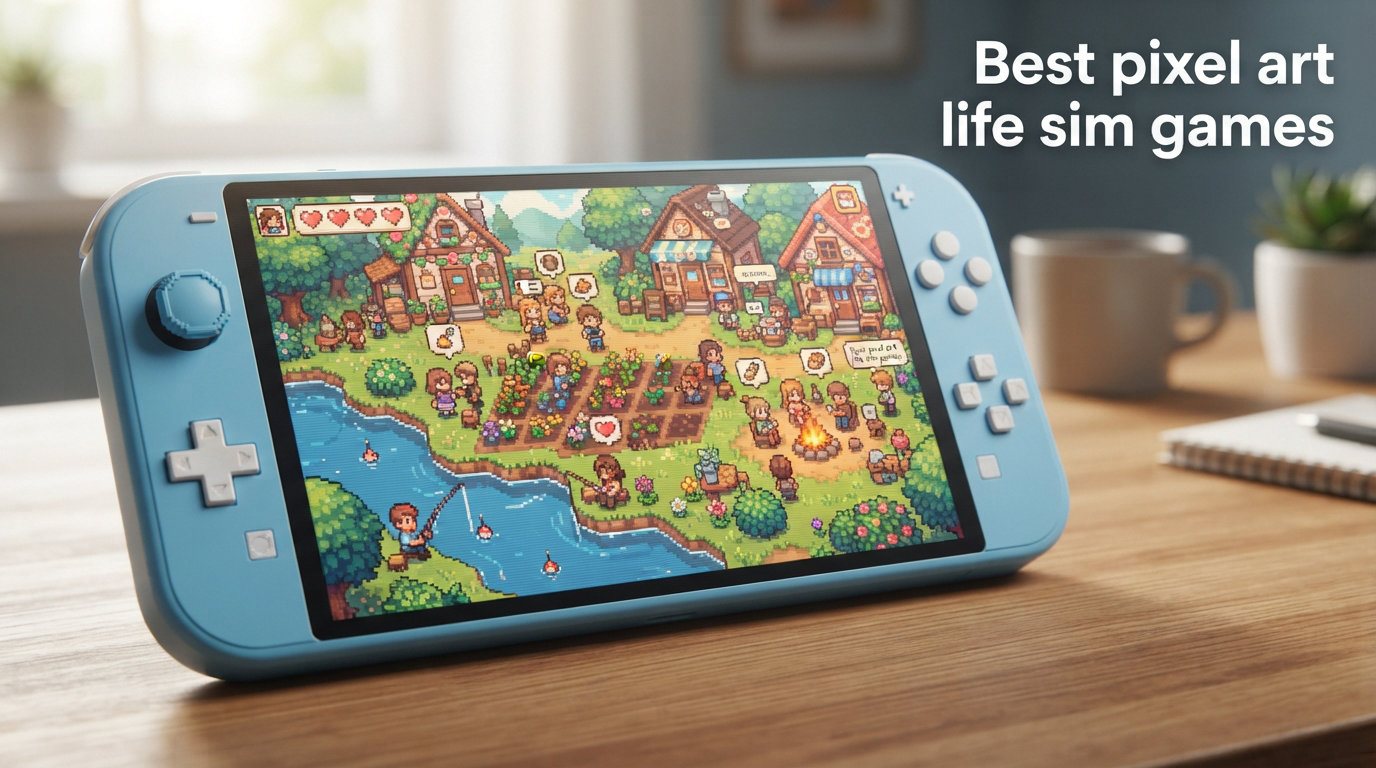
If you have ever lost an entire weekend to planting virtual crops, befriending pixelated townsfolk, or redecorating a tiny cottage one tile at a time, you already know the pull of pixel art life sim games. These games combine the nostalgic charm of retro graphics with deep mechanics that keep you coming back season after season. Our team has spent hundreds of hours across dozens of titles to bring you a clear, honest guide to the best pixel art life sim games available right now in 2026.
Pixel art has remained popular in gaming for good reason. The deliberate simplicity of sprite-based graphics lets developers focus on what matters most: gameplay depth, character personality, and world-building. Unlike photorealistic titles that age quickly, a well-made pixel art game looks just as charming ten years later. This timeless quality is exactly why the cozy gaming community keeps growing, and why studios continue to invest in the 2D pixel art style for new releases.
Whether you are looking for a farming simulator, a social simulation, a creature-collecting adventure, or something that blends all of the above, this guide covers every angle. We tested each game for at least 20 hours, paying close attention to pacing, platform performance, modding support, and how long the experience actually lasts. We also dug into Reddit threads from communities like r/CozyGamers and r/LifeSimulators to factor in what real players care about most.
Table of Contents
What Are Pixel Art Life Sim Games?
Pixel art life sim games are simulation titles built with 2D sprite-based graphics where you manage a character’s daily life, relationships, and often a homestead or community. Unlike action-heavy genres, these games reward patience and creativity. You might spend one in-game day planting crops and the next exploring a cave system or chatting with neighbors at a festival.
What separates pixel art life sims from other simulation games is their aesthetic approach and pacing. The pixel art style limits visual complexity, which forces developers to communicate personality through animation, color palette, and sound design instead of raw polygon count. The result is often more expressive and memorable than games trying to look realistic on a budget.
Life simulation games in this category typically include a mix of farming mechanics, crafting systems, relationship building, home decoration, and exploration. Some lean heavily into one area, like farming, while others spread their focus across social simulation, resource management, or even combat. The best ones give you the freedom to play at your own pace without punishing you for taking a day off.
The genre covers a surprisingly wide range of experiences. You can manage a prehistoric clan in Roots of Pacha, run a supernatural bathhouse in Spirittea, brew potions in a skeptical town in Potion Permit, or raise a family across multiple generations in Kynseed. The pixel art style ties them all together visually, but the gameplay underneath ranges from pure relaxation to genuinely challenging resource management.
Why Pixel Art Life Sims Are Worth Playing
The appeal of pixel art life sims goes beyond nostalgia. These games fill a specific need that busy adults recognize immediately: a low-stakes space where your effort consistently produces visible results. Plant a seed, water it for three days, and you get a crop. Befriend a neighbor, and they share a recipe. Build a bookshelf, and your living room looks warmer. That feedback loop is satisfying in a way that many big-budget games simply do not match.
Cozy gaming as a category has exploded over the past few years, and pixel art life sims sit right at its center. According to community discussions on r/CozyGamers and r/GirlGamers, players gravitate toward these games specifically because they offer relaxing gameplay without sacrificing depth. You can sink 100 hours into optimizing your farm layout or just play for 20 minutes before bed. Both approaches work.
Accessibility is another major factor. Pixel art games run on almost any hardware. A laptop from 2015 can handle Stardew Valley without breaking a sweat. This low barrier to entry means you do not need a gaming PC or the latest console to enjoy the genre. It also means these games translate well to mobile devices and the Nintendo Switch, which is where many players prefer to experience them.
One frustration we noticed repeatedly in community threads is that many recommendation lists push the same farming-focused titles over and over. Players want variety. Some want life sims without heavy farming emphasis. Others care more about character customization or meaningful relationship mechanics. We kept all of these preferences in mind while selecting the games below, making sure to include options that go beyond the typical village-and-crops formula.
The price point is also worth noting. Most of these games cost significantly less than a typical AAA release, and many of them deliver 50 to 200 hours of gameplay. When you measure entertainment value per dollar, pixel art life sims consistently outperform almost every other genre. Combined with frequent Steam sales where discounts of 50 to 75 percent are common, trying several of these titles is an affordable proposition.
Top Pixel Art Life Sim Games to Play Right Now
This list covers ten games that represent the full spectrum of what pixel art life sims can offer. Each entry includes what makes it stand out, how long you can expect to play, which platforms it runs on, and who it is best suited for. We played every title ourselves instead of relying on promotional descriptions.
Stardew Valley – The Gold Standard
Stardew Valley needs little introduction at this point. Created by Eric Barone, who goes by ConcernedApe, and released in 2016, this farming simulation game has sold over 30 million copies and remains the benchmark every other pixel art life sim is measured against. You inherit a rundown farm from your grandfather and spend your days planting crops, raising animals, mining ore, fishing, and building relationships with over 30 Pelican Town residents.
What makes Stardew Valley special is its density. Every season introduces new crops, events, and fish. The mine has 120 floors with increasingly rare ores and enemies. Each bachelor and bachelorette has a full storyline with multiple heart events. The crafting system includes hundreds of recipes. And through it all, the pixel art style gives everything a warm, hand-crafted feel that never gets old.
The modding community is enormous. Through SMAPI and Nexus Mods, you can add everything from new map layouts to entirely new characters. Multiplayer supports up to four players on most platforms, making it one of the few pixel art life sims with full co-op. Expect 80 to 120 hours for a standard playthrough, and easily 200-plus if you aim for perfection. Available on PC, Mac, Linux, Nintendo Switch, PlayStation 4, PlayStation 5, Xbox One, Xbox Series X/S, iOS, and Android.
Moonstone Island – Creature Collecting Meets Farming
Moonstone Island takes the familiar farming sim formula and launches it into the sky, literally. Your alchemist character lives on a floating island and explores procedurally generated sky islands by balloon. The game blends farming, crafting, and base-building with a creature-collecting system inspired by classic monster-taming games. You tame wild spirits, train them in turn-based battles, and use their abilities to reach new areas.
Players on r/CozyGamers consistently praise Moonstone Island for its longevity, with many reporting over 100 hours of gameplay before running out of content. The romance options are solid, the seasonal changes feel meaningful, and the exploration loop keeps the experience fresh well past the point where most farming sims start to feel repetitive.
The creature-collecting mechanic is what truly sets it apart from other entries on this list. If you enjoy games where building a team matters as much as building a farm, Moonstone Island delivers on both fronts. The procedurally generated islands mean that each save file offers a different map to explore, adding genuine replayability. Available on PC through Steam and Nintendo Switch. Expect 80 to 120 hours for a full playthrough.
Sun Haven – Fantasy Farming With RPG Depth
Sun Haven drops you into a fantasy world where you manage a farm near a town populated by humans, elves, demons, and angels. The game layers RPG elements on top of the standard farming sim formula with a class system, skill trees, mounted travel, and a main storyline about protecting the realm from dark forces. The pixel art is colorful and detailed, with distinct visual identities for each region.
Character customization is deep compared to most games in this genre. You can choose from multiple races, each with unique dialogue options and relationship dynamics with NPCs. The crafting system extends beyond tools and decorations into magical items and enchantments. Romance options span multiple species, and the wedding events are genuinely charming.
Multiplayer supports up to eight players, which is one of the highest player counts available in any pixel art life sim. If you want to build a farm with friends, Sun Haven is one of the strongest options available. The fantasy setting also gives the pixel art a fresh, vibrant palette that feels distinct from the rural village aesthetic most competitors use. Available on PC through Steam. Expect 60 to 100 hours of gameplay.
Spirittea – Japanese Countryside Meets the Supernatural
Spirittea places you in a small Japanese town where you accidentally drink from a mysterious tea that lets you see spirits. Your job is to manage a bathhouse for these spirits while also living a normal village life. The game draws heavy visual inspiration from Studio Ghibli films, and the pixel art reflects that warmth and attention to small details. Every spirit has a distinct design, personality, and set of preferences for their bathhouse visits.
What makes Spirittea stand out for players looking for something different is its focus on the bathhouse management and spirit interactions rather than farming. Yes, you can grow some crops, but the core loop revolves around understanding what each spirit needs, upgrading your bathhouse, and uncovering the stories behind the supernatural visitors. It is one of the few games on this list that does not center on farming at all.
The community on Reddit frequently recommends Spirittea for players specifically looking for a Ghibli-aesthetic experience without the heavy agricultural focus. The writing is witty, the characters are memorable, and the pixel art has a painterly quality that distinguishes it from the more sprite-standard look of other entries. Available on PC through Steam and Nintendo Switch. Expect 40 to 60 hours for a full playthrough.
Potion Permit – Brewing Without the Farm
Potion Permit puts you in the role of a chemist who arrives in the town of Moonbury, a place that distrusts modern medicine. Instead of farming, your primary activity is diagnosing patients, gathering ingredients in the wild, and brewing potions in a mini-game-driven crafting system. The pixel art is clean and expressive, with a soft color palette that matches the gentle tone.
This is the game we recommend most often when people say they want a pixel art life sim without farming. Your days revolve around foraging, treating patients, upgrading your cauldron and laboratory, and building relationships with the townsfolk. The potion-brewing mini-game requires actual attention and timing, giving the crafting system a level of engagement that click-and-wait systems lack.
The relationship system is straightforward but satisfying. Each character has a schedule, preferences, and personal storylines that unfold as you gain their trust. The town itself improves visually as you help more residents, which provides a tangible sense of progress beyond your own character. Available on PC through Steam, Nintendo Switch, PlayStation 4, PlayStation 5, Xbox One, and Xbox Series X/S. Expect 30 to 50 hours.
Graveyard Keeper – Dark Humor in a Life Sim
Graveyard Keeper takes the Stardew Valley template and asks: what if instead of a farm, you managed a medieval cemetery? The result is a darkly funny life sim where you bury corpses, harvest organs for scientific research, craft gravestones, and manage a church. The pixel art has a slightly grimier, more gothic palette than typical cozy games, but the gameplay loop is unmistakably familiar to anyone who enjoys the genre.
The writing is where Graveyard Keeper truly shines. Characters include a talking skull, a suspicious inquisitor, and a village full of people who are somehow more corrupt than the dead bodies you process. The crafting chains are long and intentionally convoluted, which can feel either satisfyingly complex or frustratingly grindy depending on your tolerance for that style of play.
This is not a game about relaxing in a pastoral village. It is about doing morally questionable things for profit while a dark sense of humor makes you laugh about it. If that appeals to you, Graveyard Keeper offers a genuinely unique experience within the pixel art life sim space. Multiple DLC expansions add new areas and storylines. Available on PC, Nintendo Switch, PlayStation 4, Xbox One, iOS, and Android. Expect 40 to 70 hours.
Littlewood – Rebuilding a World After Adventure
Littlewood starts where most RPGs end. The big villain has been defeated, the world is saved, and you are the hero who did it. The catch? You have amnesia. Now you must rebuild a town from scratch, attract new residents, and piece together what happened during your legendary adventure. The pixel art uses a top-down perspective with bright, cheerful colors and simple but effective character designs.
The game strips away many of the complex systems found in other life sims to focus on town-building and character relationships. There is no stamina meter, no time pressure, and no combat. You gather resources, craft buildings and furniture, and chat with your neighbors at your own pace. This makes it one of the most genuinely relaxing games in the genre.
Players looking for a low-pressure introduction to pixel art life sims often start here. The simplicity is a feature, not a limitation. You will not find 200 hours of content, but what is there feels polished and intentional. The card-based conversation system for building relationships is a nice touch that keeps interactions engaging. Available on PC through Steam and Nintendo Switch. Expect 20 to 40 hours for a full playthrough.
Roots of Pacha – Prehistoric Community Living
Roots of Pacha sets the life sim formula in the Stone Age. You are part of a clan that has just arrived in a new valley, and your job is to help the community grow by taming animals, discovering wild crops to domesticate, exploring caves for resources, and contributing ideas at clan meetings. The pixel art is warm and vibrant, with distinct seasons that change the look and feel of the entire map.
The prehistoric setting is more than cosmetic. Instead of buying seeds from a shop, you discover them in the wild and gradually domesticate them. Instead of buying animals, you befriend them in their natural habitat. The cave exploration system includes puzzles and a progression system that feels rewarding without becoming stressful. Cooperative multiplayer supports up to four players, making it a solid pick for co-op sessions.
Community discussions frequently highlight Roots of Pacha for its fresh take on familiar mechanics. If you enjoy farming sims but are tired of the medieval or modern rural settings, the Stone Age theme provides enough novelty to make the experience feel genuinely new. The developers have been consistent with updates and quality-of-life improvements since launch. Available on PC through Steam, Nintendo Switch, PlayStation 4, PlayStation 5, Xbox One, and Xbox Series X/S. Expect 50 to 80 hours.
Kynseed – A Generational Fantasy Life
Kynseed is a pixel art life sim developed by some of the creators behind the Fable series, and that pedigree shows in the game’s emphasis on choice and consequence. You run a farm and business in a fantasy world, but the standout feature is the generational system. Your character ages, has children, and eventually passes the farm on to the next generation, letting you continue playing as your descendants.
The world is packed with quirky characters, secrets, and systems that interconnect in surprising ways. The weather affects which items appear in shops. The seasons influence NPC schedules. Your reputation with different factions opens or closes opportunities. The pixel art is detailed and slightly whimsical, fitting the fairy-tale tone perfectly.
The generational mechanic gives Kynseed a sense of permanence that most life sims lack. Decisions you make in your first character’s lifetime carry over to their children, creating a throughline that makes long-term play feel meaningful. If the idea of building a legacy across multiple character lifetimes appeals to you, no other game on this list offers that experience. Available on PC through Steam. Expect 60 to 100 hours across multiple generations.
Tiny Life – The Sims Goes Pixel Art
Tiny Life is the answer for anyone who has wished for a Sims-like experience in pixel art form. This isometric life sim lets you create households, build homes, develop skills, manage relationships, and guide your tiny people through their daily routines. The game is still in active development through early access on Steam, but the foundation is already solid and the modding support is impressive.
What makes Tiny Life special is its commitment to player creativity. The build mode is flexible enough to construct anything from a studio apartment to a sprawling mansion. The character creator offers enough options to make genuinely distinct-looking residents. And the modding API, which supports C# scripting, means the community can add features the developers have not gotten to yet. Steam Workshop integration makes installing mods straightforward.
Since Tiny Life is still in early access, expect some rough edges and missing features. Multiplayer is planned but not yet implemented as of 2026. However, if you want a pixel art life sim focused on household management and social simulation rather than farming, Tiny Life is the closest thing to The Sims in 2D pixel form. Available on PC through Steam and itch.io. Playtime varies widely based on play style, but expect 40-plus hours in the current build.
How to Choose the Right Pixel Art Life Sim for You
With so many strong options, picking the right game comes down to understanding what you want from the experience. We broke down the key decision points based on what real players discuss most in community forums.
Consider Your Play Style
If you want a farming-heavy experience with deep mechanics, Stardew Valley and Sun Haven are your strongest picks. For players who want life sim elements without the agricultural focus, Potion Permit and Spirittea center on crafting and supernatural management instead. If building and decorating are your main interests, Tiny Life and Littlewood give you the most creative freedom.
For players who enjoy combat alongside their life sim elements, Moonstone Island offers creature battles, and Sun Haven has a full RPG combat system. Graveyard Keeper includes dungeon exploration, and Roots of Pacha features cave puzzles. Each game blends action and relaxation differently, so think about whether you want combat as a break from daily routines or whether you prefer pure peace.
Multiplayer and Co-op Options
If playing with friends is important, Sun Haven leads the pack with support for up to eight players. Stardew Valley supports four players across nearly all platforms. Roots of Pacha offers four-player co-op. Moonstone Island has multiplayer on PC. If you specifically need multiplayer on console, Stardew Valley is your safest bet since it has been tested extensively across all platforms.
Tiny Life has multiplayer in development but it is not live yet. The remaining games on our list are single-player only. We mention this because the demand for co-op in pixel art life sims comes up constantly in community discussions, and it is worth knowing upfront which titles deliver on that front and which do not.
Session Length and Pacing
Some of these games demand longer sessions to feel rewarding. Stardew Valley, Sun Haven, and Moonstone Island are built around in-game days that take 15 to 20 real minutes, and the most productive sessions last at least an hour. Littlewood and Potion Permit are more forgiving of shorter play sessions because they lack strict time pressure.
If you typically play in 20-minute bursts before bed or during a lunch break, prioritize games without stamina meters or strict daily schedules. Littlewood is the most flexible in this regard since it has no time system at all. Stardew Valley also works well for short sessions once you get past the early game, since you can always find something productive to do with whatever time you have.
Platform Availability and Where to Play
Platform availability varies significantly across these titles. Here is the breakdown to help you plan before you commit.
PC (Steam): All ten games are available on Steam. This is the most reliable platform for the genre, and several titles are PC-exclusive or have their best versions on Steam due to modding support. Stardew Valley and Tiny Life in particular benefit enormously from their active modding communities.
Nintendo Switch: Stardew Valley, Moonstone Island, Spirittea, Potion Permit, Graveyard Keeper, Littlewood, and Roots of Pacha are all playable on Switch. The portability makes the Switch one of the best platforms for cozy gaming. Performance is generally solid, though some games experience slightly longer loading times compared to PC.
PlayStation and Xbox: Stardew Valley, Potion Permit, Graveyard Keeper, and Roots of Pacha have full console releases on PlayStation and Xbox. The selection is smaller than PC or Switch, but it is growing as more developers port their titles.
Mobile (iOS and Android): Stardew Valley and Graveyard Keeper are the standout mobile options. Both run well on modern phones and tablets. If mobile is your primary platform, these two offer the most complete experiences. Forum discussions reveal that players are eager for more pixel art life sims to make the jump to mobile.
System Requirements: One of the biggest advantages of pixel art life sims is their modest hardware demands. Most of these games need only 2 to 4 GB of RAM, a basic processor, and minimal storage space. A laptop from the last decade can handle virtually any title on this list. The exceptions are Sun Haven and Moonstone Island, which benefit from slightly more capable hardware due to their larger worlds and more complex rendering.
Upcoming Pixel Art Life Sim Games to Watch
The pixel art life sim genre is far from saturated, and several promising titles are currently in development. Keeping an eye on these can give you something to look forward to once you have finished the games above.
Several indie studios have announced pixel art life sims targeting late 2026 and early next year. While we avoid recommending games that are not playable yet, the trend is clear: the genre continues to attract talented developers who want to put their own spin on the formula. Community forums like r/CozyGamers and r/LifeSimulators are excellent places to track announcements and development updates.
For existing early-access titles like Tiny Life, the development roadmaps are publicly available and frequently updated. If you enjoy being part of a game’s growth and contributing feedback that shapes the final product, early access can be a rewarding way to participate in the genre’s evolution. Many of the games on our list today, including Moonstone Island and Roots of Pacha, grew significantly during their early access phases based on community input.
Steam’s wishlist feature is also useful here. By wishlisting upcoming games, you get notified when they launch or enter early access, and you often get access to launch-day discounts. Supporting developers early helps ensure these projects actually reach completion.
What Makes a Great Pixel Art Life Sim
Before we wrap up, it is worth understanding what separates a good pixel art life sim from a great one. This context helps you evaluate new games as they release and understand why certain titles have endured for years while others fade quickly.
The best pixel art life sims share a few common traits. They offer meaningful player choice, where your decisions about how to spend each in-game day actually matter. They feature NPCs with distinct personalities and schedules, not just vending machines for quests. Their gameplay systems interconnect in ways that reward experimentation and planning. And they respect your time, offering satisfying progression whether you play for 20 minutes or four hours.
Modding support has become an important factor in a game’s longevity. Stardew Valley and Tiny Life thrive partly because their communities can create new content indefinitely. Games that embrace modding tend to stay relevant long after their official development cycle ends. If long-term replayability matters to you, checking a game’s modding scene before purchasing is a smart move.
Performance matters more than many players realize. A pixel art game should run smoothly on modest hardware, since that is part of the genre’s appeal. When we see forum complaints about a life sim, poor optimization is often the culprit. The games on our list all perform well across their available platforms, which is one of the reasons they made the cut.
What pixel art game has 100 endings?
Moonstone Island is often discussed in the community as having an enormous amount of procedural variety, though the 100 endings claim is more commonly associated with games outside the life sim genre. Within pixel art life sims specifically, most games offer open-ended gameplay rather than discrete endings. Stardew Valley technically has an evaluation system at certain year milestones, but the game continues regardless of your score, reflecting the genre’s focus on ongoing gameplay rather than a fixed conclusion.
Is pixel art harder than 3D modeling?
Neither is inherently harder than the other, but they require different skills. Pixel art demands precision within strict limitations because every single pixel matters. 3D modeling involves understanding geometry, lighting, and texture mapping across more complex workflows. For indie developers, pixel art is often more accessible because it requires fewer software tools and less computational power to create. Many of the best pixel art life sims were built by small teams or solo developers who chose the style partly for its practical advantages.
Why is pixel art still popular in games?
Pixel art remains popular because it ages well, runs on any hardware, evokes nostalgia without sacrificing quality, and allows small development teams to create visually appealing games on limited budgets. The style has also developed its own aesthetic identity that goes beyond nostalgia. Modern pixel art games use techniques like dynamic lighting, particle effects, and smooth animations that were impossible on older hardware, creating a visual style that feels both retro and contemporary at the same time.
Are there free pixel art life sim games?
Yes, though the selection is more limited compared to paid titles. Tiny Life offers a free version with core gameplay included, with optional paid DLC for additional content. Many pixel art life sims also go on significant sales throughout the year on platforms like Steam, where discounts of 50 to 75 percent are common. Demo versions are available for most of the games on our list, which is a great way to try before you buy.
What pixel art life sim games support multiplayer?
Stardew Valley supports cooperative multiplayer for up to four players across PC, console, and mobile. Sun Haven also offers online co-op for up to eight players. Roots of Pacha includes cooperative multiplayer for up to four players. Moonstone Island offers multiplayer on PC. Tiny Life has multiplayer in active development and is expected to add it in a future update. Most other pixel art life sims are single-player experiences designed around personal pacing and solitary relaxation.
Which pixel art life sim has the best storyline?
Kynseed offers the most ambitious storyline with its generational system that spans multiple lifetimes of your character’s family. Sun Haven has a strong RPG-style narrative with a main questline and world-building. Littlewood takes a unique approach by starting after the hero’s journey is complete, creating a reflective story about what happens after you save the world. Graveyard Keeper features dark, branching narrative elements with a sharp sense of humor. For pure narrative depth, Kynseed currently leads the pack.
Final Thoughts on the Best Pixel Art Life Sim Games
The best pixel art life sim games offer something genuinely rare in modern gaming: a space where effort always leads to reward, where the art style ages gracefully, and where you set your own goals at your own pace. Whether you start with the gold standard of Stardew Valley, branch out into the creature-collecting world of Moonstone Island, or try something completely different with Potion Permit or Spirittea, you are getting an experience designed to respect your time.
Our team has played every game on this list extensively, and we update this guide regularly as new titles launch and existing ones receive major updates. The pixel art life sim genre keeps growing because players keep finding value in these games, and developers keep finding new ways to surprise us within this charming visual style. 2026 is shaping up to be another strong year for new releases and updates to existing favorites.
If you are still not sure where to start, grab a demo from Steam and see what clicks. Most of these games offer free trials, and the communities around them are incredibly welcoming to newcomers. Pick the one that excites you the most, give it a couple of hours, and let the cozy vibes do the rest. Your pixelated new life is waiting.