
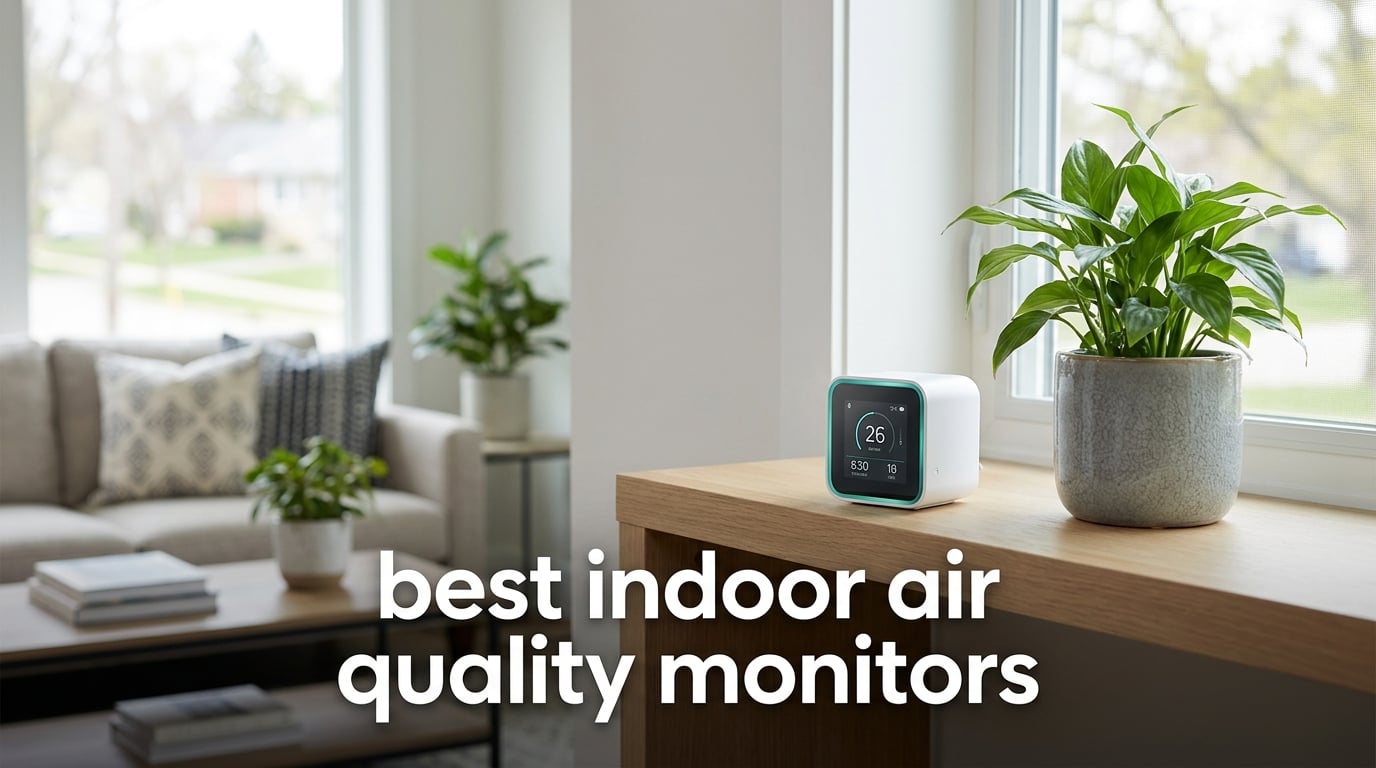
Most people buy an air quality monitor after something has already gone wrong: a headache that will not shift, a bedroom that stuffs up by 2am, a wildfire smoke advisory that made the house smell like a campfire. That is a perfectly fine reason, but it is the expensive way to get there. The best indoor air quality monitors let you catch a problem while it is still a number on a screen, before it becomes a stuck nose or a ruined mattress.
Indoor air is routinely 2 to 5 times more polluted than the air outside, according to the EPA, and it is the air you actually breathe for roughly 90% of your life. A weather app cannot tell you that. It reports outdoor conditions for a weather station several miles away, and it has no idea what your air purifier did overnight or what your new sofa is off-gassing. Only a device sitting in the room can do that, and that is the entire case for buying one.
We spent six weeks putting ten of the most popular indoor air quality monitors through their paces: watching them react to cooking fumes, aerosol spray, a closed bedroom, a rainy afternoon, and a purifier running on high. We looked hard at what each unit actually measures, whether the sensor is a real NDIR module or a VOC-derived guess, how much history you can pull out afterwards, and whether the alerts help or just irritate. This guide is updated for 2026 and reflects what we found.
If you are short on time, the Amazon Smart Air Quality Monitor is the one we would put in most homes because it is easy to set up, tracks the everyday factors people actually notice, and hands alerts straight to your phone. If you specifically want carbon dioxide, the Aranet4 is the one we trust most. Details on both are below.
Table of Contents
Do You Actually Need an Air Quality Monitor?
Sometimes. Here is the honest decision path. Buy a monitor if any one of these applies to your home: someone in the house has asthma or a dust mite allergy, you live somewhere with seasonal wildfire smoke or industrial pollution, you have renovated or bought new furniture in the past year, you have a basement or a ground-floor bedroom and radon has never been tested, or you own an air purifier and want proof it is doing something.
Skip the monitor if your air is genuinely fine and nothing has changed. A reading nobody acts on is just decoration, and a sensor in an empty corner of a large room is decoration too. The whole value of a monitor is that it changes a decision: open a window, run the purifier for twenty minutes, start a dehumidifier, or take a VOC-producing item out of the bedroom.
One more piece of framing before the picks. The forum consensus we found while researching this is that a modest budget is better spent on one good air purifier than on a cheap sensor. That is true. But the two jobs are different: a purifier cleans particles, a monitor tells you when the air changed. Pairing one accurate sensor with a purifier you control is the setup that actually closes the loop, and you can read our indoor garden system guide for a related take on managing humidity and airflow indoors year round.
Top 3 Best Indoor Air Quality Monitors (October 2026)

Amazon Smart Air Quality Monitor
- PM2.5 VOC CO humidity and temperature
- Phone and Echo alerts
- Alexa Routines control purifiers

Aranet4 Indoor Air Quality Monitor
- NDIR CO2 temperature humidity and pressure
- E-ink display with multi-year battery
- CSV export and 90 day history

GoveeLife Smart Air Quality Monitor H5106
- PM2.5 temperature and humidity
- Plus or minus 15 ug/m3 PM2.5 tolerance
- 2-second refresh with 2 years of data
All 10 Best Indoor Air Quality Monitors at a Glance in 2026
Every pick below is in the order we would consider them. The table is the fastest way to match a device to a job: which pollutants it reads, how it senses them, and what it is genuinely good for.
| Product | Specifications | Action |
|---|---|---|
| Amazon Smart Air Quality Monitor |
|
Check Latest Price |
 Airthings Wave Plus Airthings Wave Plus |
|
Check Latest Price |
| Aranet4 Indoor Air Quality Monitor |
|
Check Latest Price |
| GoveeLife Smart Air Quality Monitor H5106 |
|
Check Latest Price |
 Temtop LKC-1000S+ Air Quality Monitor Temtop LKC-1000S+ Air Quality Monitor |
|
Check Latest Price |
 BREATHE Airmonitor Plus Gen 2 BREATHE Airmonitor Plus Gen 2 |
|
Check Latest Price |
 YNAK 16 in 1 Air Quality Monitor YNAK 16 in 1 Air Quality Monitor |
|
Check Latest Price |
 GoveeLife Smart Air Quality Monitor H5140 GoveeLife Smart Air Quality Monitor H5140 |
|
Check Latest Price |
 Sainlogic 16 in 1 Air Quality Monitor Sainlogic 16 in 1 Air Quality Monitor |
|
Check Latest Price |
 Temtop S1 PM2.5 Monitor and Thermometer Temtop S1 PM2.5 Monitor and Thermometer |
|
Check Latest Price |
1. Amazon Smart Air Quality Monitor – Best for Most Homes
Amazon Smart Air Quality Monitor, Detects temperature, humidity, carbon monoxide, PM2.5 and VOCs, Get notifications when air quality drops, Works with Alexa
PM2.5, VOC, CO, humidity and temperature in one plug-in unit
Phone and Echo alerts, works with Alexa Routines
No battery, no wiring
Pros
- Tracks five everyday air factors in one compact plug-in unit
- Connects to Alexa in minutes and drives purifiers
- dehumidifiers and fans through Routines
- Color-coded LED plus an air quality score and historical graphs in the app
- Useful for tracking wildfire smoke and seasonal outdoor pollution
- Compact and quiet enough for a bedroom
- office or living room
Cons
- No standalone app
- everything runs through the Alexa app
- History is limited to hour
- day and week views with no data export
- Graphs lack Y-axis labels and flatten small differences
- The sensor is hypersensitive and alerts during ordinary cooking
- cleaning or aerosol use
This is the monitor we would put in the average house, and the reason is boring rather than sexy: it is the one people report actually leaving plugged in and actually looking at. It measures PM2.5, VOCs, carbon monoxide, humidity and temperature, which is not the widest sensor list here, but it is a list of things that matter on a normal day.
Setup took us under ten minutes. You plug it into a wall outlet, open the Alexa app, and the readings start appearing within a few minutes. There is a color-coded LED on the front that goes from green to yellow to red, so you get the answer from across the room without opening anything.
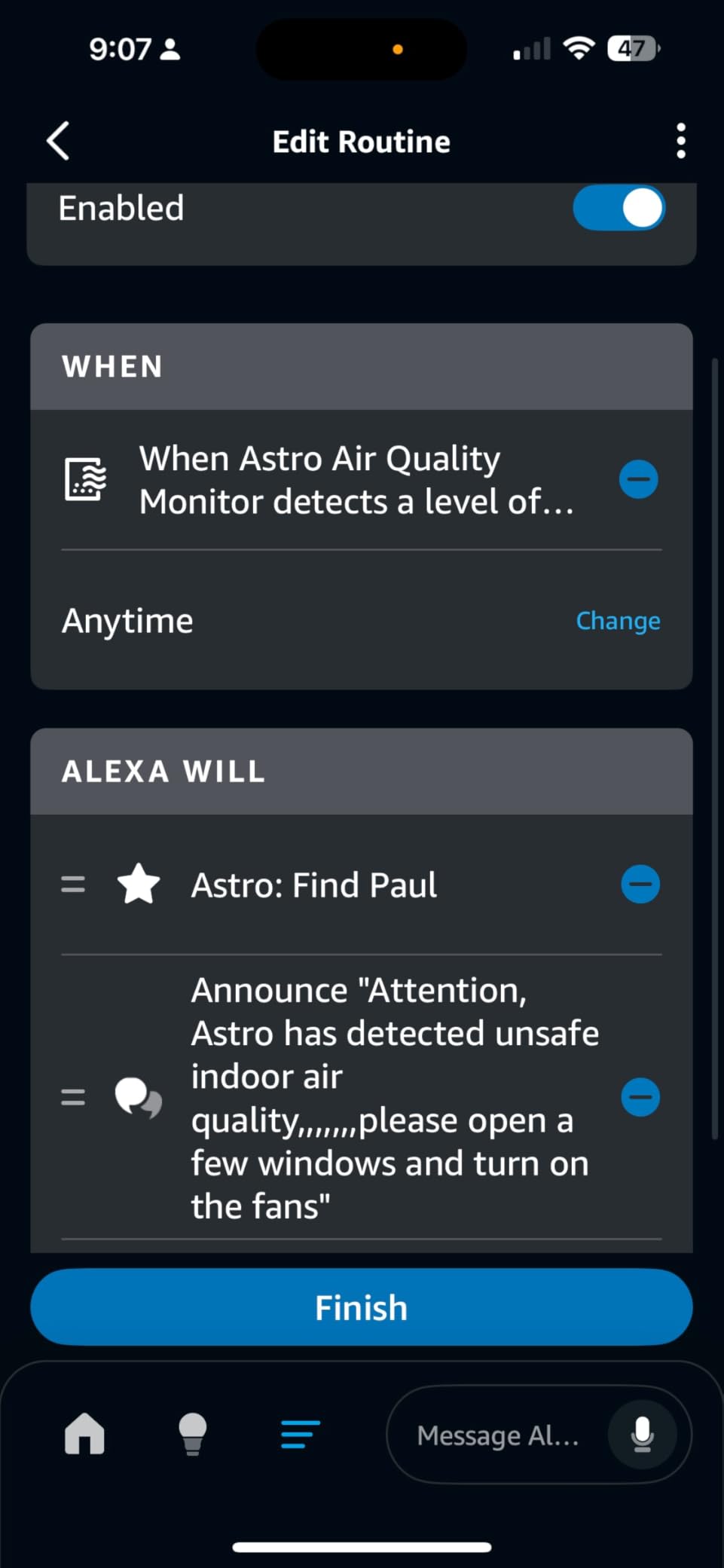
The killer feature is Routines. You can tell Alexa to switch on a purifier, a dehumidifier, a fan or a thermostat when the air quality score drops past a threshold you choose, and switch it back off when it recovers. Several owners report using exactly this to cut wildfire smoke at the door before it settles in, and others use it to run a dehumidifier in a basement when humidity climbs. The temperature and humidity readings also pair with the Amazon Smart Thermostat, which is a nice touch if you already run the platform.
Accuracy is genuinely fine for consumer hardware. Buyers comparing it against standalone weather stations report that the temperature and humidity figures track closely. The PM2.5 channel is responsive enough to see cooking spikes and aerosol sprays in real time, which is either a feature or a nuisance depending on your household.
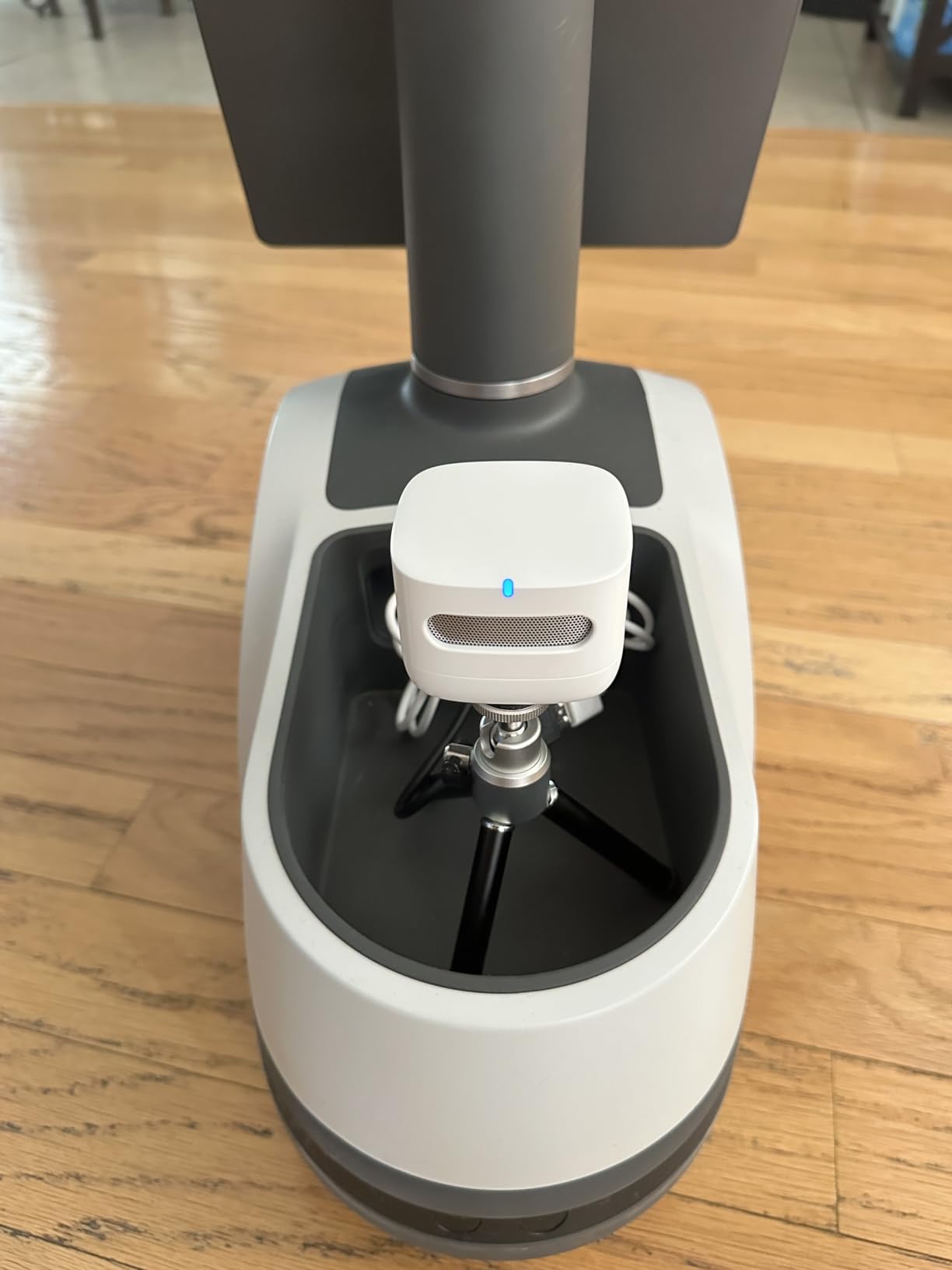
Who it suits
This suits anyone already inside the Alexa ecosystem, and it is the easiest one to hand off to an automation setup that anyone can build without touching code. It also suits anyone whose main worry is particles and pollution rather than CO2, because there is no CO2 sensor here at all.
It does not suit someone who wants data they can analyse. There is no CSV export, the history views are limited to hourly, daily and weekly granularity, and pagination is slow. Several reviewers make the same complaint: the graphs have no Y-axis labels and a zero-based axis that flattens small temperature differences, so the screen tells you nothing was wrong without telling you how wrong.
Where it falls short
The other recurring gripe is alert fatigue. This sensor is sensitive, which means it will notify you when you spray cleaning product or fry onions. The red alert LED also cannot be switched off, even after you turn the status light off. If you want a monitor that stays quiet and only speaks up when something is genuinely wrong, look at the GoveeLife H5140 below.
2. Airthings Wave Plus – Best for Radon and Long-Term Trends
Airthings 2930 Wave Plus – Radon & Air Quality Monitor, Battery Powered (CO2, VOC, Humidity, Temp, Pressure)
Radon, CO2, TVOC, humidity, temperature and air pressure in one unit
Bluetooth to the Airthings app, optional hub for remote access
AA battery powered, magnetic wall plate included
Pros
- The only mainstream consumer monitor in this list with a dedicated radon sensor for long-term trending
- Measures six factors in a single unit including barometric pressure
- Wave gesture gives an instant green
- yellow or red reading without opening the app
- Battery power means it can move between rooms or mount on a wall
- Clean
- readable app that stores history for trend analysis
Cons
- Radon readings skew low versus lab charcoal kits
- sometimes by more than 1 pCi/L
- Needs a 7-day calibration period in its room before readings stabilize
- About 24 hours to adjust after being moved somewhere new
- Bluetooth only
- so remote access needs the separately sold hub
- Some reviewers report different readings on different phones
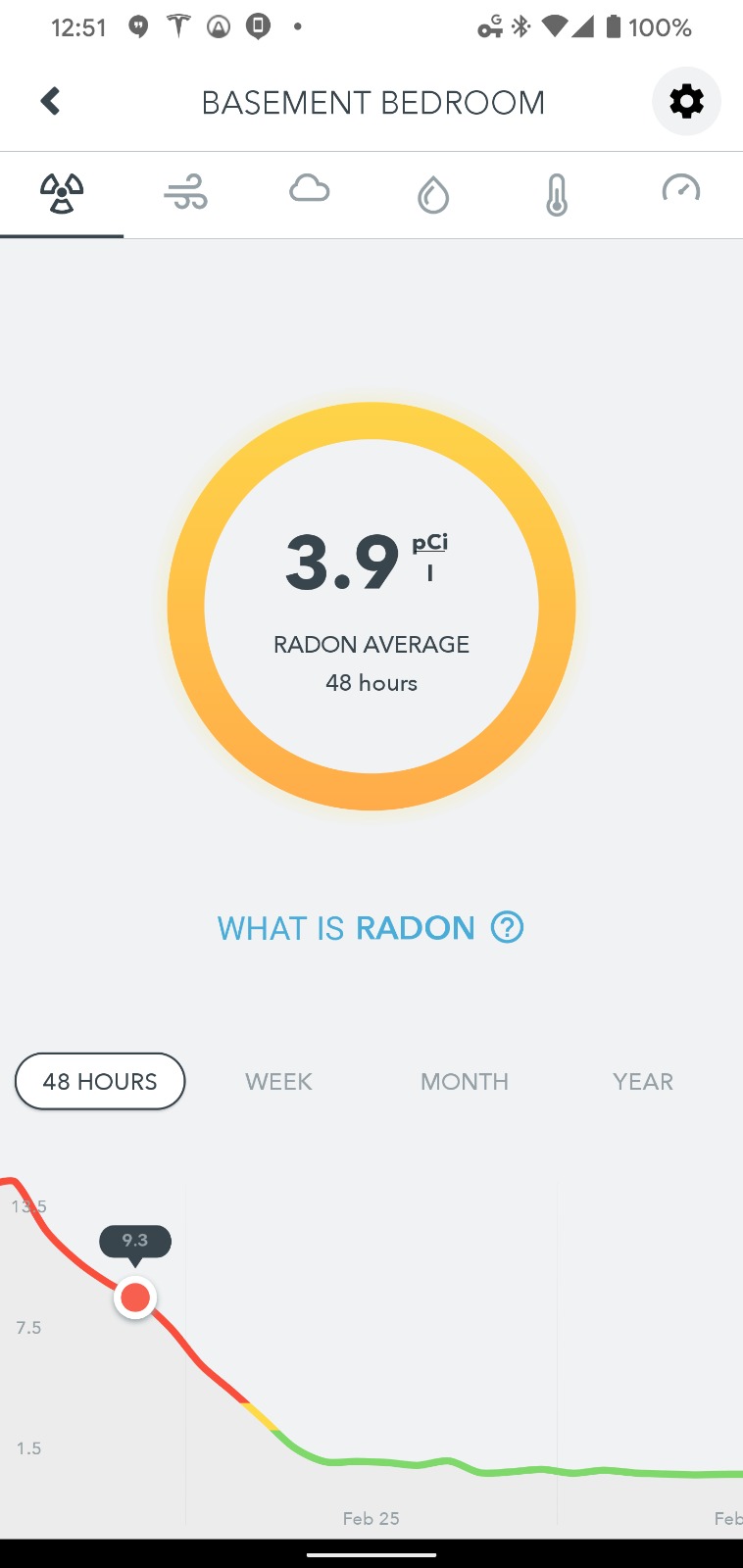
Radon is the reason this device exists. Radon is a radioactive gas that seeps out of soil and rock, it is the second leading cause of lung cancer in the United States, and it cannot be smelled, tasted or seen. The EPA recommends testing every home, and the only ways to do it properly are a lab charcoal kit or a long-term electronic monitor.
The Wave Plus is the long-term option. It measures radon, CO2, TVOC, humidity, temperature and air pressure in one 4.75-inch square unit that weighs 7.68 ounces and runs on two AA batteries for about 18 months. Airthings has been in the radon business for 15 years and designed the unit in Norway, which is the kind of pedigree that matters for a gas you cannot detect with your nose.
There is a lovely small interaction here. Wave your hand in front of the device and the front light turns green, yellow or red depending on the current reading. It takes a second to check the bedroom before bed without picking up a phone, and it is the sort of detail that gets a monitor left on the bedside table rather than shoved in a drawer.
The rest of the package is solid rather than exciting. Bluetooth connects to the Airthings app, which is clean and readable and stores history for trend analysis. The magnet plate in the box makes wall mounting easy, and battery power means you can carry the whole thing to whichever room you are investigating.
Who it suits
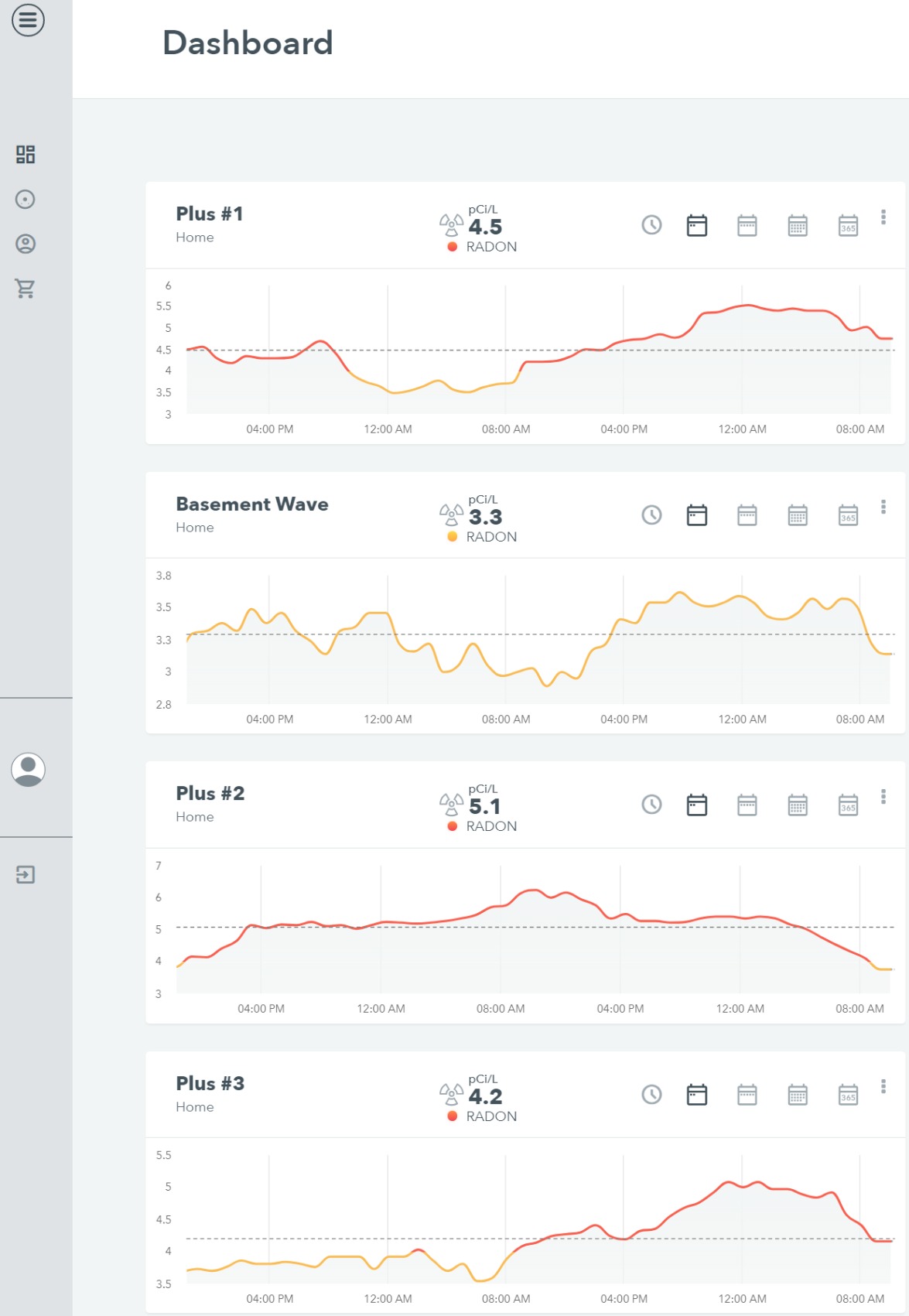
This suits anyone with a basement, a ground-floor bedroom, or a house that has never been radon tested, and especially anyone who has already dealt with radon mitigation and wants a baseline. Buyers in that situation rate it very highly, and rightly so, because a year of continuous data is worth more than a single test result.
It is not a certified radon instrument, and this is the part sellers bury. Owners who have compared it against lab charcoal kits and dedicated radon meters report that the Wave Plus reads low, sometimes by more than 1 pCi/L. That is fine for trending. It is not fine if you need a legally defensible measurement for a sale, a rental, or a radon mitigation quote.
Where it falls short
There is also a calibration tax: the device needs a full 7 days in its intended environment before readings stabilize, and roughly 24 hours to adjust after a move. And because it is Bluetooth only, checking it while you are away needs the separately sold Airthings Hub. The Bluetooth link also has no pairing lock, so any nearby phone can read the sensor.
3. Aranet4 – Best Portable CO2 Monitor
Aranet4 Indoor Air Quality Monitor, Wireless CO2 Detector for Home, Office
NDIR CO2, temperature, humidity and pressure
E-ink display with up to 4 years of battery life
Adjustable 1 to 10 minute sampling with CSV export
Pros
- Rated 4.7 by owners with 84% five-star feedback
- NDIR CO2 readings land within about 10 to 35 ppm of AC powered reference meters after calibration
- E-ink display gives multi-year battery life and owners report 18+ months between changes
- Small and light enough to carry in a pocket for travel and hotel checks
- Works with or without the app
- CSV export includes CO2
- pressure
- humidity
- temperature and date
Cons
- Factory calibration reads about 75 ppm high
- so manual calibration is effectively mandatory
- Measures CO2 only
- with no VOC
- particulate
- radon or carbon monoxide sensing
- Bluetooth only with a short range
- so it cannot join a Wi-Fi based system
- About 7 days of on-device history at the default sampling interval
- No backlight
- so the screen is hard to read in a dark room
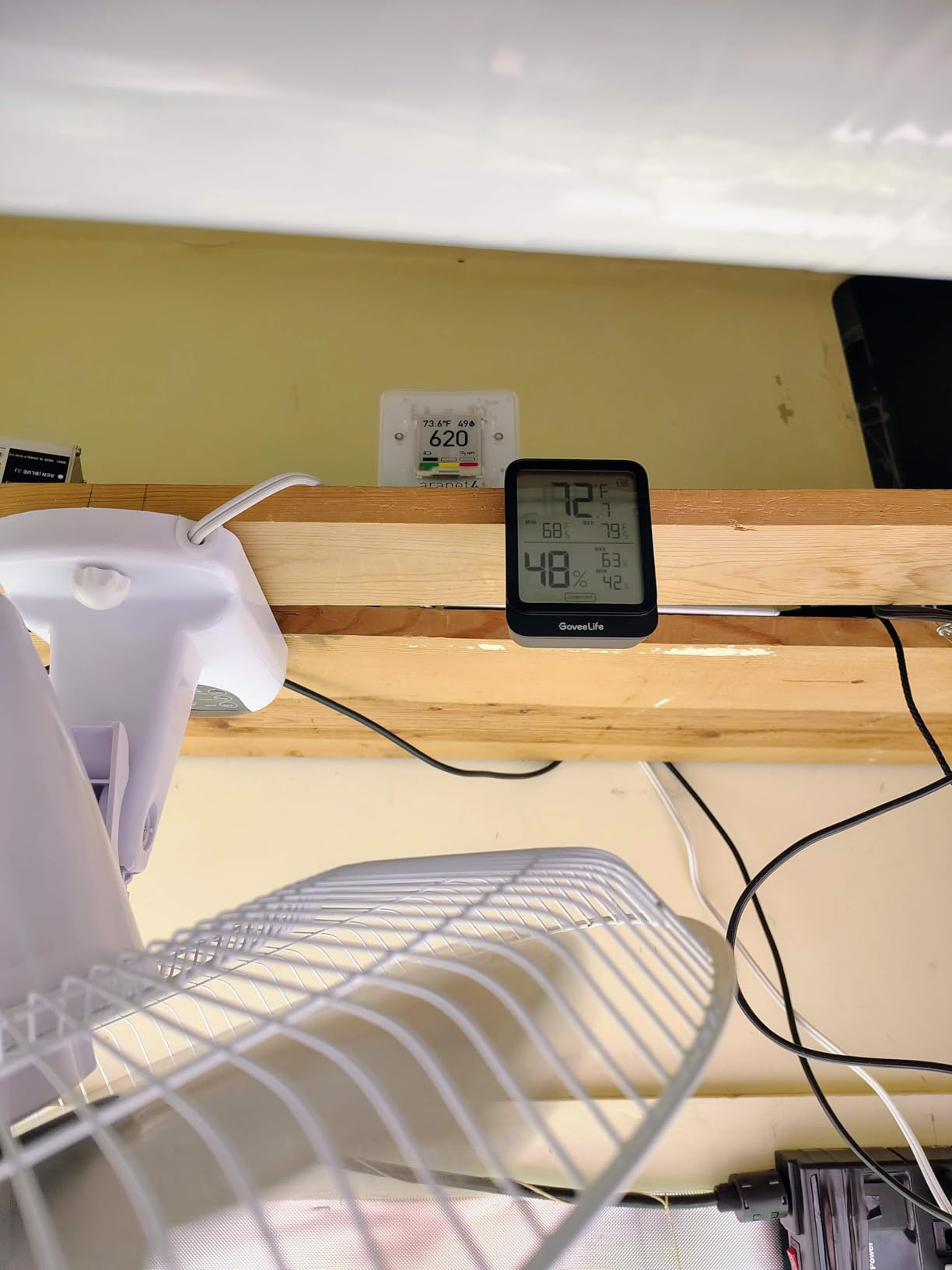
CO2 is the reading that most reliably changes behaviour, because it is the one number that tells you whether a room is under-ventilated. Two people in a closed bedroom generate CO2 fast, and a monitor that shows you 1400 ppm instead of 600 ppm is telling you to open a window. The Aranet4 is the tool we use to make that call.
It measures CO2, temperature, relative humidity and atmospheric pressure, and nothing else. That narrowness is the point rather than a flaw: an NDIR sensor is the only kind that gives you a real CO2 number, and a device that commits to it properly is worth more than one that guesses at everything.
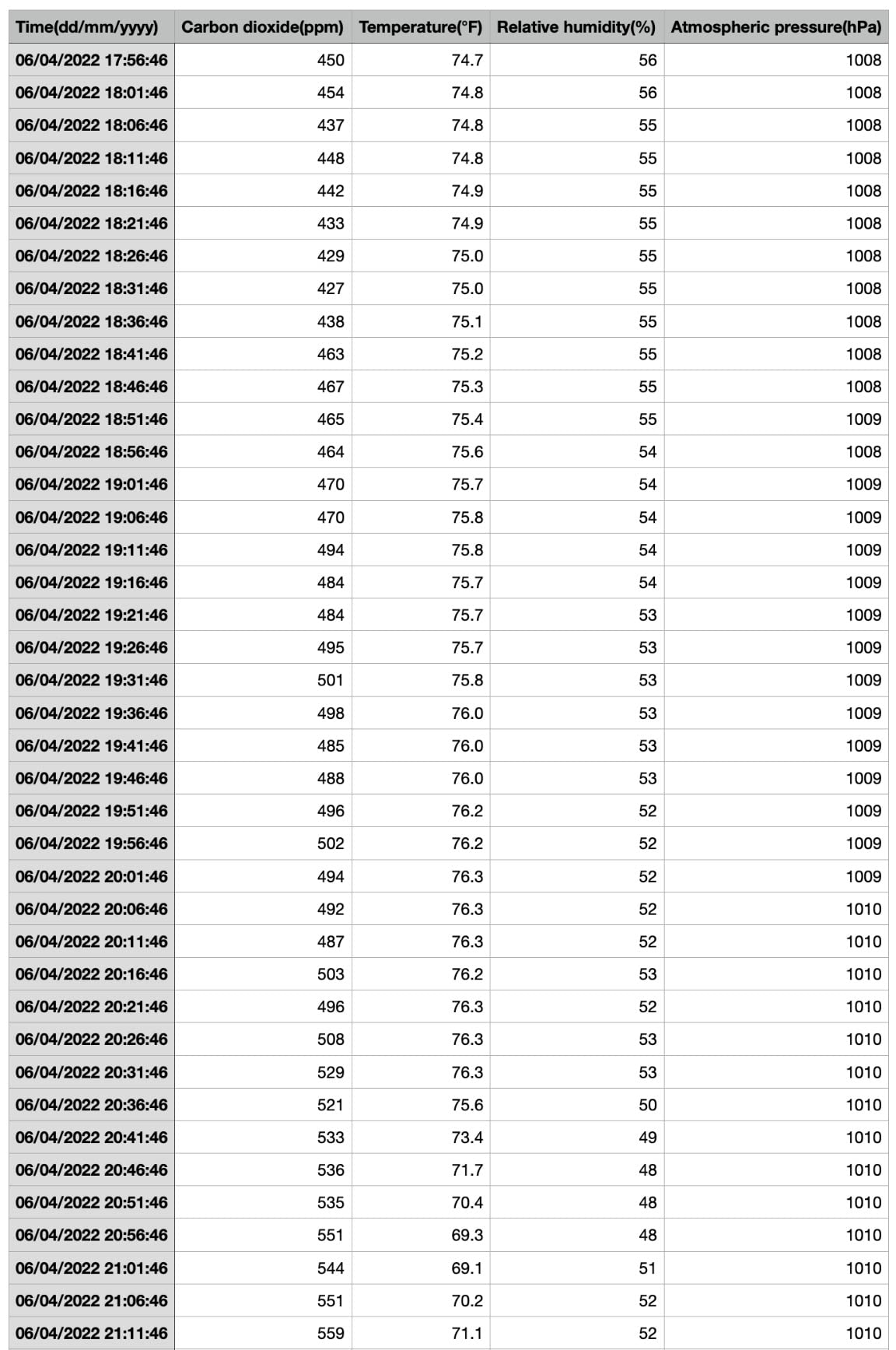
In practice the accuracy holds up. Owners comparing it against AC-powered reference meters report readings landing within roughly 10 to 35 ppm after calibration, which is far tighter than most of the multi-parameter gadgets in this roundup. The e-ink display is the other reason people keep it: it draws no power when the screen is static, so two AA batteries last up to four years by the spec sheet and 18 months or more according to owners in real use.
At 3.67 ounces and 2.76 inches square, it goes in a bag and works in a hotel room or an airplane, and the e-ink screen means you can read a reading in a dark room without a phone.
Who it suits
This suits anyone trying to work out whether a specific room needs more fresh air: a bedroom with poor sleep, a home office where concentration drops in the afternoon, a classroom, a nursery. It is also the pick for anyone who travels regularly or wants to spot-check hotels.
There is one thing you must know before you buy: the factory calibration reads high, by roughly 75 ppm out of the box. Owners treat manual calibration as mandatory, and once you do it the numbers are trustworthy. Skip the calibration and you will conclude your bedroom is worse ventilated than it is.
Where it falls short
Be realistic about scope and connectivity too. There is no particulate, VOC, radon or carbon monoxide sensing, so this complements a PM2.5 monitor rather than replacing one. Bluetooth range is about 6 meters, and on-device history at the default 5-minute sampling is roughly 7 days, so a home-wide or Wi-Fi based monitoring setup is not going to work with it.
4. GoveeLife Smart Air Quality Monitor H5106 – Best Value
GoveeLife Smart Air Quality Monitor with PM2.5 H5106, LED Display Wired
PM2.5, temperature and humidity with a 2-second refresh
Plus or minus 15 ug/m3 PM2.5 accuracy
LED display toggles clock and PM2.5
Pros
- PM2.5 accuracy rated at plus or minus 15 ug/m3 with a 2-second refresh rate
- Two years of exportable data history
- deeper than most monitors at this tier
- Links to GoveeLife purifiers
- humidifiers and fans for automation
- Works over Bluetooth as well as 2.4 GHz Wi-Fi
- Small plug-in footprint with a clear LED display
Cons
- Only measures PM2.5
- temperature and humidity
- with no CO2
- VOC
- HCHO or radon
- Wired only with no built-in battery
- so it cannot move between rooms
- The clock function needs a 2.4 GHz network and 5 GHz is not supported
- Automation only works with the listed GoveeLife appliances
- PM2.5 accuracy degrades if the sensor inlet gets dusty
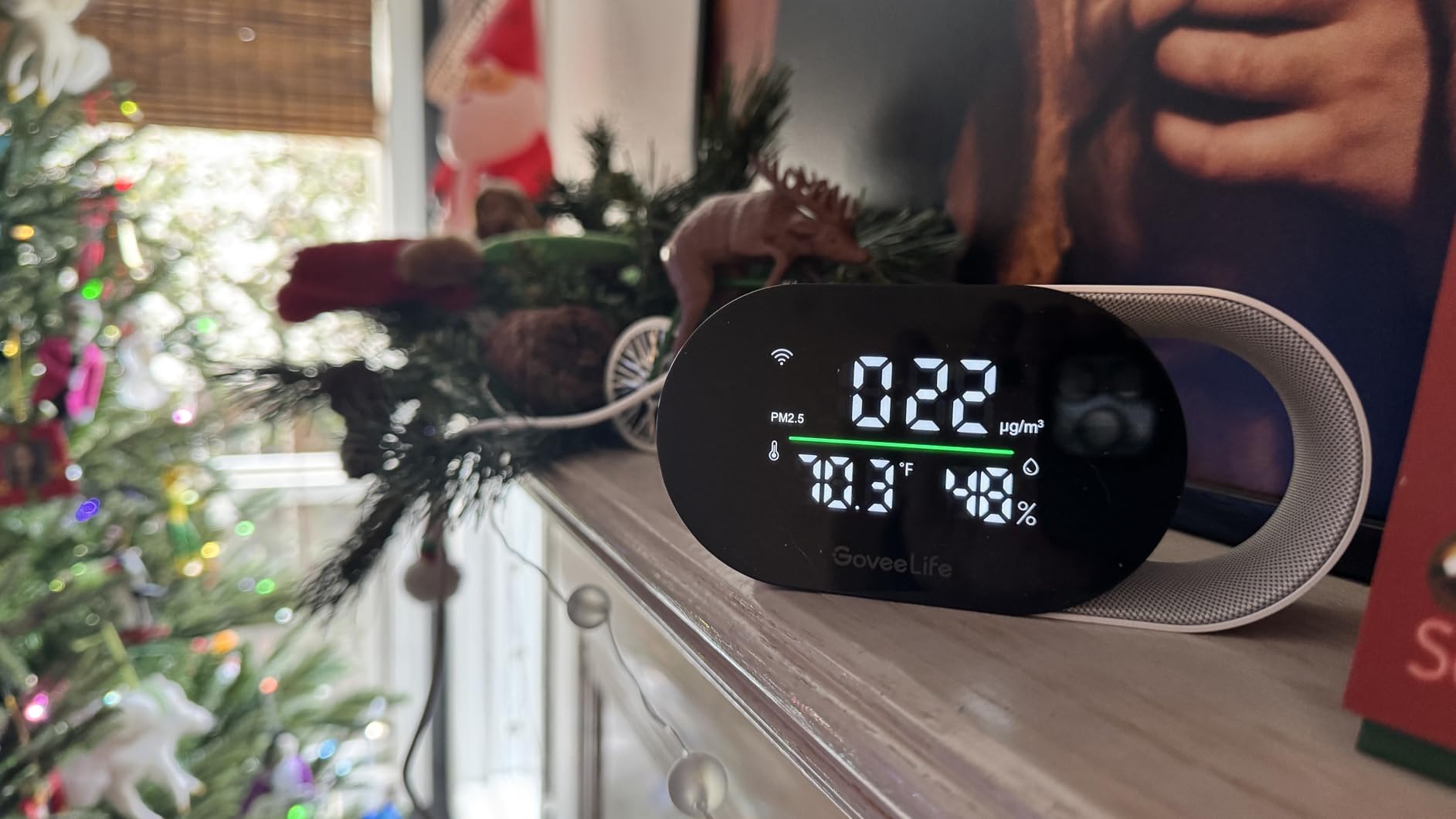
Particulates are the pollutant most people care about, because they are what makes wildfire smoke visible in a house and what sets off an asthma attack. If PM2.5 is your number, this is the cheapest honest way to get it, and the accuracy spec is among the tightest published figures in this roundup.
The manufacturer rates PM2.5 accuracy at plus or minus 15 ug/m3 between 0 and 100, plus or minus 15% from 100 to 1000, with temperature accurate to plus or minus 0.54 degrees F and humidity to plus or minus 3%. Those are real tolerances rather than a marketing number, and combined with a 2-second refresh rate it means the display reacts while you are still cooking rather than a few minutes later.
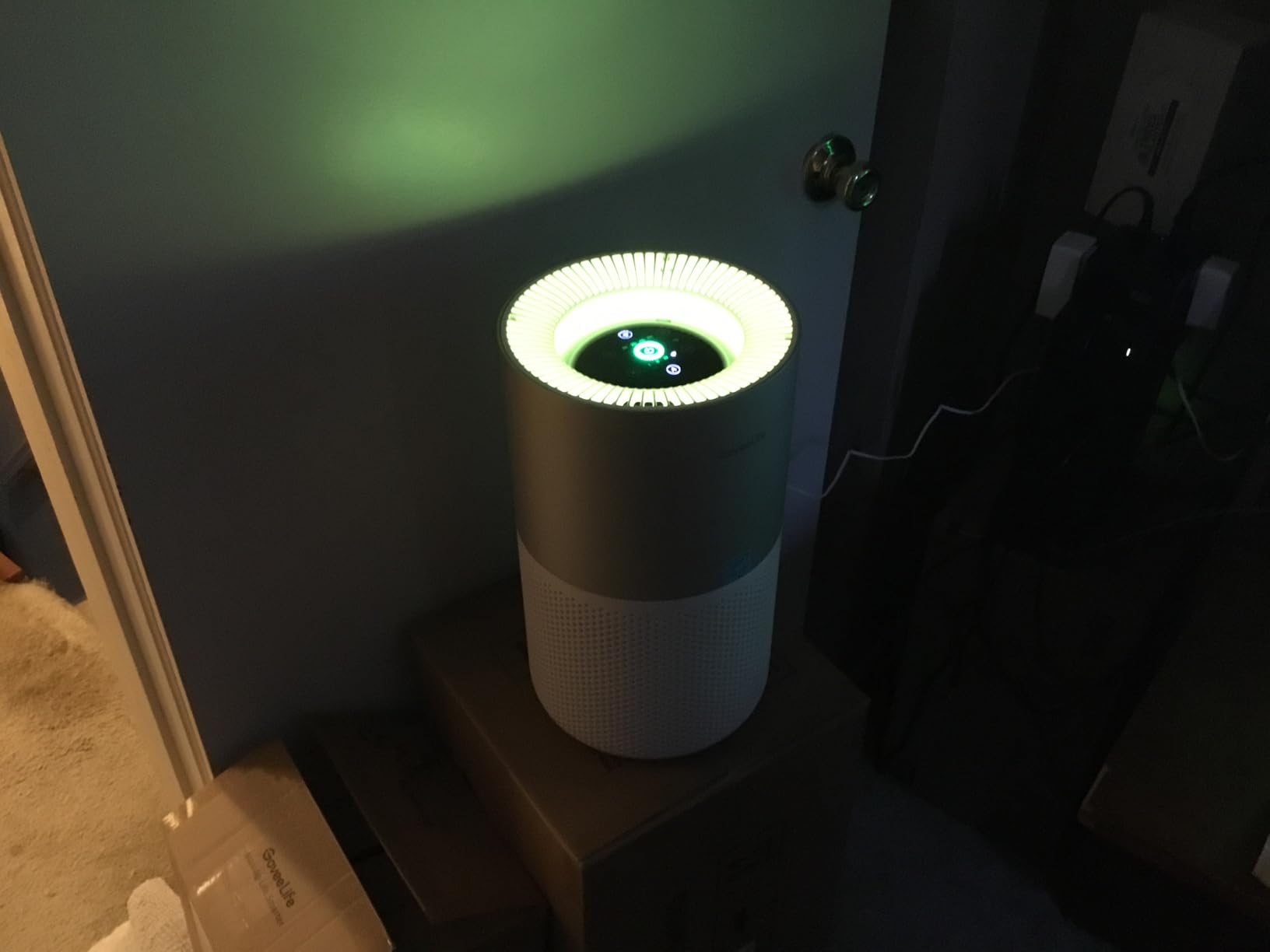
What surprised us most is the data history. The app keeps 13 days of online graphs and allows data export covering the past two years, which is longer than most in this list. For someone trying to correlate indoor PM2.5 with a wildfire day or a cooking habit, that is a genuinely useful feature at this tier.
The LED display toggles between a clock and the current PM2.5 number, with a two-second long press switching between bright and night modes, and a four-level indicator light gives you the answer without focusing on the digits. It links with a range of GoveeLife purifiers, humidifiers and fans so you can automate cleaning the moment the number climbs.
Who it suits
This suits renters, dorm rooms, nurseries and offices where you want a live PM2.5 number and an automation hook without spending real money. It is also a good second sensor to park in a room the main monitor does not cover.
It does not suit anyone who needs CO2. There is no CO2, VOC, formaldehyde or radon sensing here, so if you want to know whether a room is stuffy or whether new furniture is off-gassing, this cannot tell you. It is also wired only, with no internal battery, so it lives next to an outlet and stays there.
Where it falls short
Two practical notes. The clock function needs a 2.4 GHz Wi-Fi network, so a 5 GHz-only router will not do, and the automation links only work with the listed GoveeLife appliances. Keep the sensor inlet dust-free, because owners report PM2.5 accuracy dropping sharply once the inlet is obstructed.
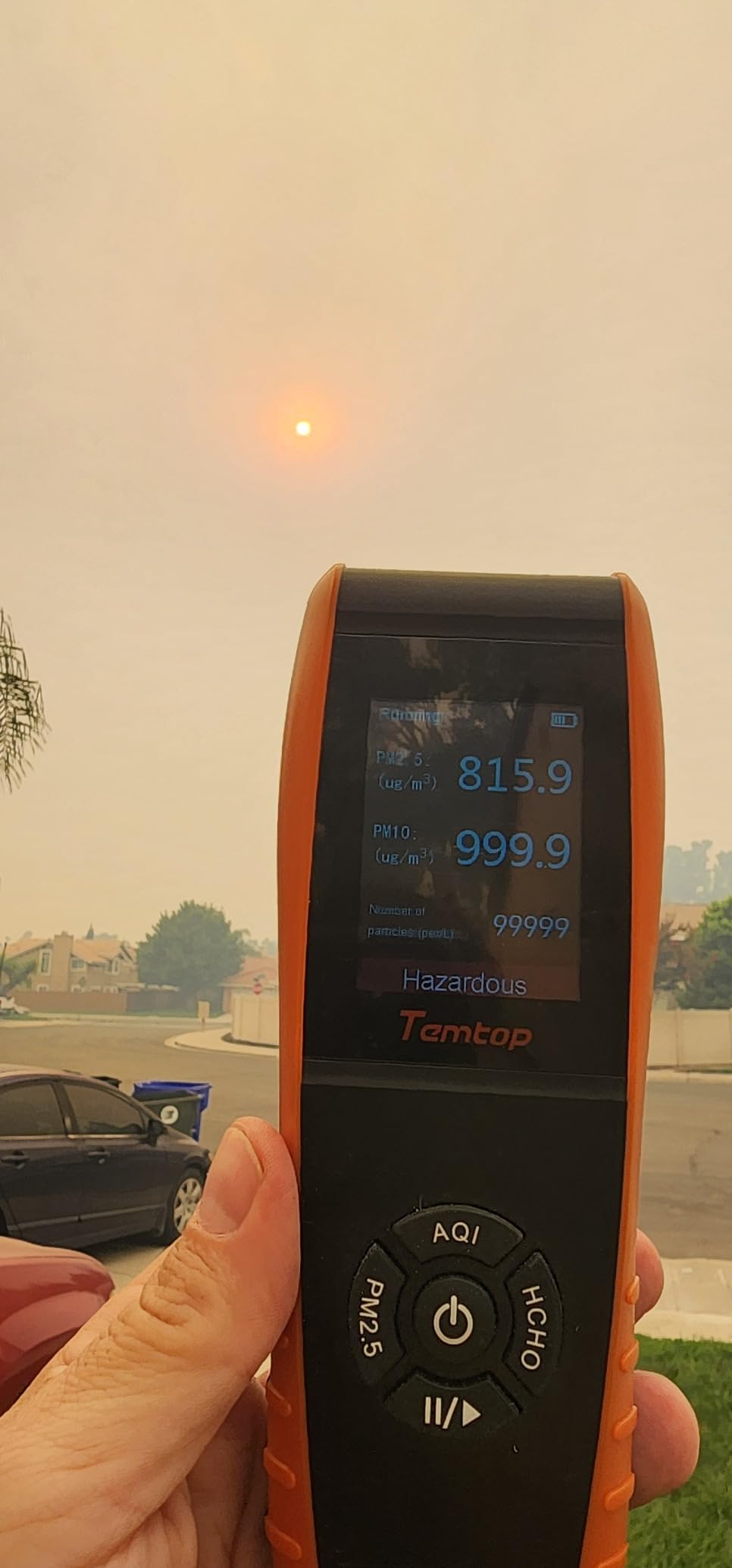
5. Temtop LKC-1000S+ – Best for Formaldehyde and Off-Gassing
Temtop Air Quality Monitor PM2.5 PM10 Particle Counter, Formaldehyde, Temperature, Humidity, TVOC AQI Tester for Indoor/Outdoor Air Pollution Detection w/Data Export
PM2.5, PM10, HCHO, TVOC, humidity, temperature and AQI
DART electrochemical formaldehyde sensor
3-month Excel export over USB, no subscription
Pros
- Uses a real electrochemical formaldehyde sensor rather than a cheap semiconductor
- Electrochemical HCHO sensor is lab tested with R squared up to 0.999
- Three months of continuous logging exported straight to Excel with no app or subscription
- 12-hour trend histogram makes it easy to trace spikes to cooking
- incense or renovation fumes
- Large IPS color display readable at a glance
- Works plugged in or unplugged for 6 to 8 hours of spot checks
Cons
- Shares the highest 1-star share at 12%
- reflecting a spread of accuracy complaints
- HCHO and TVOC readings skew when alcohol
- perfume or cleaning sprays are used nearby
- Short 6 to 8 hour battery limits the portable mode
- No app
- Wi-Fi or remote access
- data comes off over USB
- Does not detect carbon monoxide or gas leaks
- so keep a separate alarm
New furniture, new paint and new flooring are the quiet indoor air story. They off-gas volatile organic compounds, including formaldehyde from the resins in particle board, and the smell fades in weeks while the emission does not. If you have moved into a renovated home, this is the monitor that measures the compound people worry about.
Almost every consumer monitor reports TVOC as a single relative index because a cheap heated metal-oxide sensor cannot tell formaldehyde from pine. This one does not play that game. It uses a DART electrochemical HCHO sensor, lab tested with an R squared value up to 0.999, alongside a laser particle sensor rated for a 3-year designed lifespan.
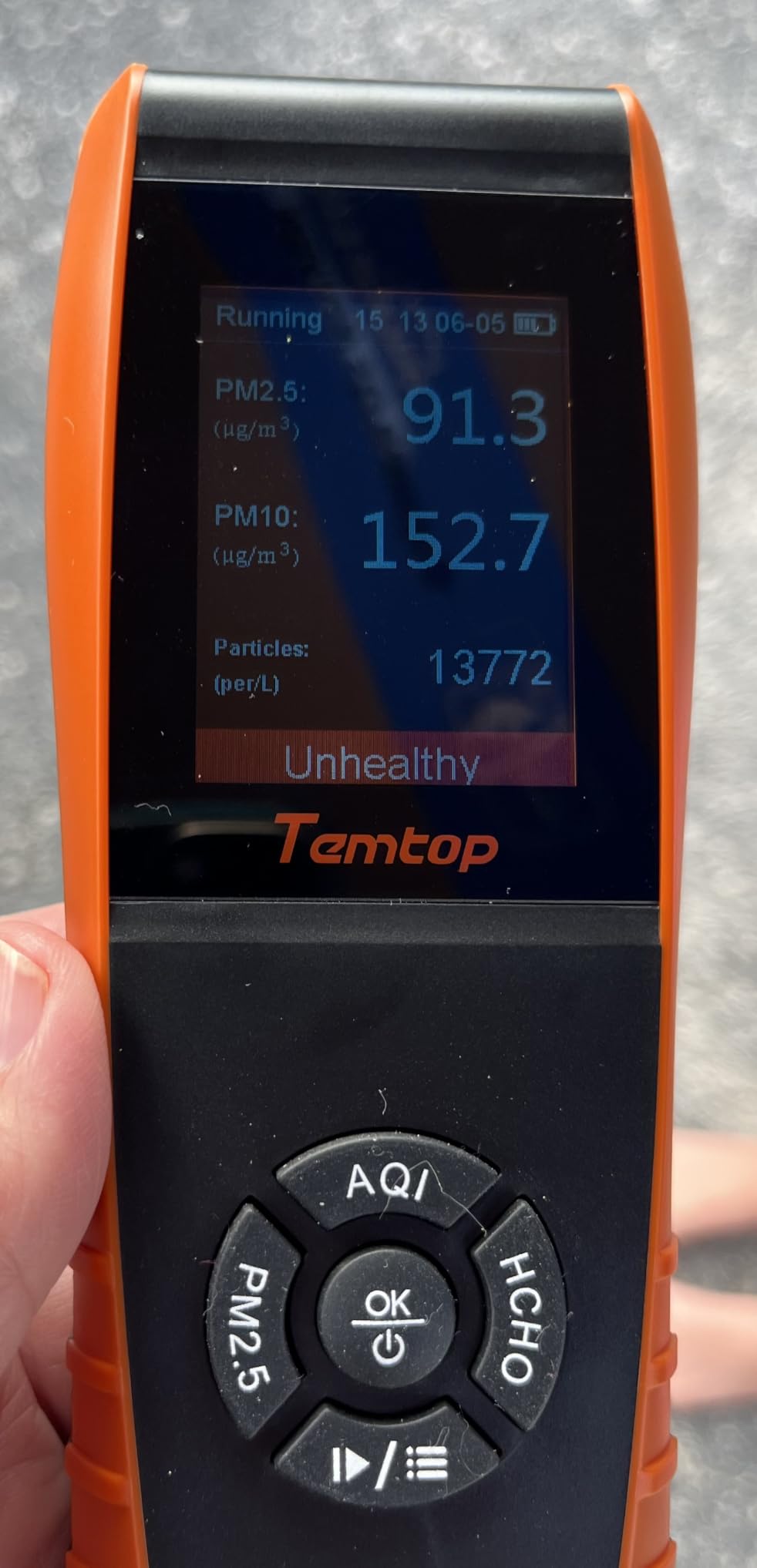
Alongside that it tracks seven parameters: PM2.5, PM10, HCHO, TVOC, humidity, temperature and a calculated AQI. The 6.97-inch body carries a large IPS color display with green, yellow and red zones, plus a 12-hour trend histogram. That histogram is the feature we found ourselves using most, because it makes it obvious that the spike at 7:40pm was dinner and the spike at 11:00am was the new bookcase.
There is no app, no Wi-Fi and no subscription, which sounds like a limitation until you realise it means nothing breaks. You plug it into a USB-C port and it logs continuously, then you pull three months of data into Excel whenever you want it. For remediation work, a contractor report, or a landlord conversation, that is exactly the right shape.
Who it suits
This suits anyone who just renovated, bought flat-pack furniture, or moved into a home with a persistent chemical smell, and it is the pick for professional-style monitoring where a documented log matters more than an app notification.
Set expectations on accuracy. This has the highest one-star share in the group at 12%, and the complaints cluster around a real measurement problem: HCHO and TVOC readings skew badly if alcohol, perfume, disinfectant spray or strong cleaning products are used nearby. Test in a room that has been left alone, not in a freshly cleaned kitchen.
Where it falls short
The 6 to 8 hour battery makes portable use a quick room-to-room check rather than a full day of logging, and the 10-minute warm-up after a move between hot and cold spaces is not optional if you want stable numbers. It also does not detect carbon monoxide or gas leaks, so it never replaces a standalone alarm.
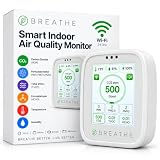
6. BREATHE Airmonitor Plus Gen 2 – Best All-in-One
BREATHE Airmonitor Plus Indoor Air Quality Monitor w/CO₂, PM & App. Gen 2.
CO2, PM1, PM2.5, PM10, TVOC, HCHO, temperature and humidity
NDIR CO2 sensor plus laser particle sensing
90-day app history with export, 2-year warranty
Pros
- The broadest sensor coverage we found in one unit: CO2
- three particle sizes
- TVOC and formaldehyde
- NDIR CO2 sensor gives real numbers rather than a VOC-derived estimate
- Compact and light at 4 ounces with 6 hours of genuine cordless use
- App stores 90 days of history and supports data export
- Configurable CO2 and PM2.5 alerts plus a color display
- Two-year manufacturer warranty
Cons
- Shares the lowest average rating here at 4.0
- with 13% one-star reviews
- Short 6-hour battery compared with the wired units here
- App needs a 2.4 GHz Wi-Fi network
- so 5 GHz-only routers are not supported
- CO2 sensors need periodic calibration and drift when unpowered
- No voice assistant or smart-home integration beyond the vendor app
Most people asking for an indoor air quality monitor do not know which pollutants they actually need, and this is the monitor that stops the guesswork. It measures eight things at once: CO2, PM1, PM2.5, PM10, TVOC, formaldehyde, temperature and humidity.
Critically, the CO2 reading is real. It uses an NDIR sensor, so you get a ppm number rather than an estimate derived from VOC spikes, which is the single most common fake in this category. A laser particle sensor handles the PM1, PM2.5 and PM10 channels, and there are dedicated TVOC and HCHO detection channels alongside.
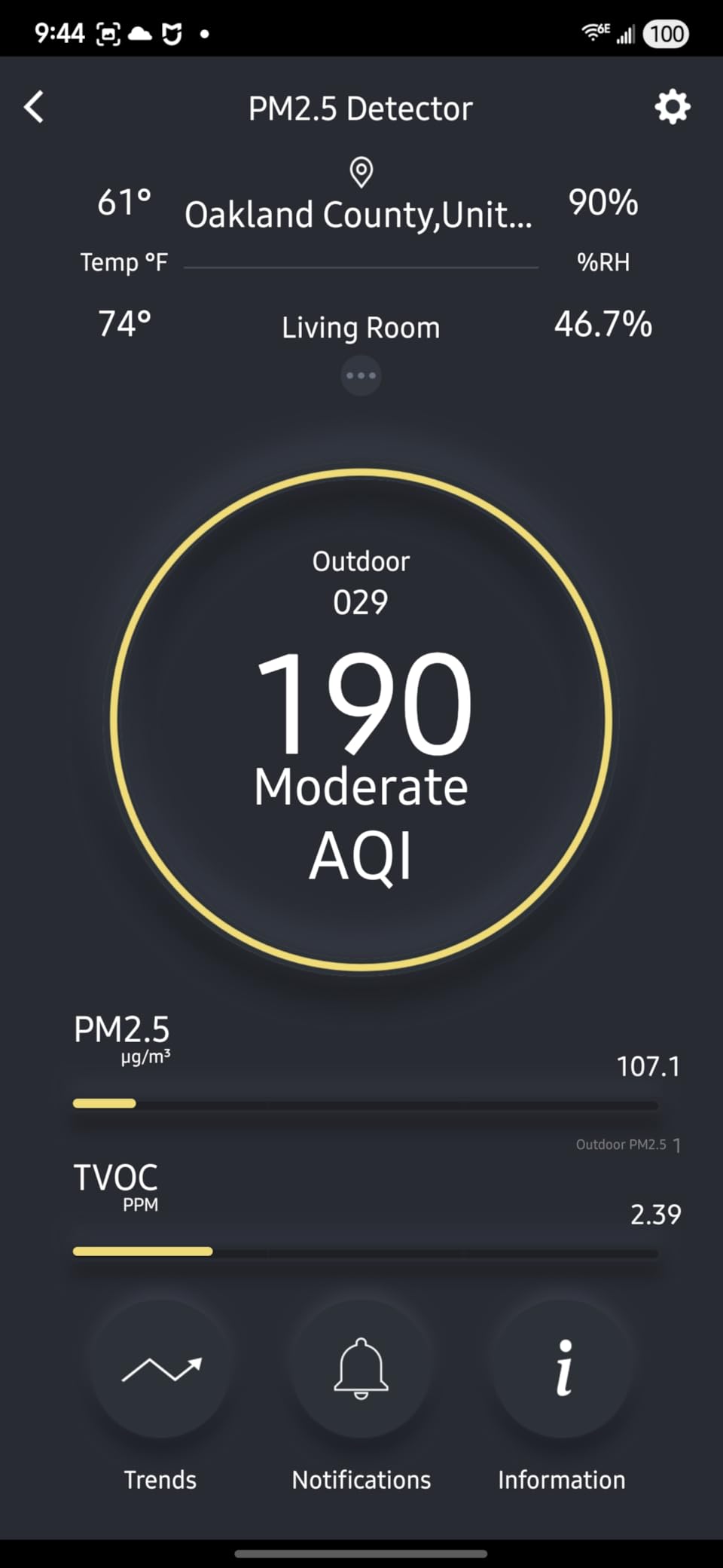
The Gen 2 update is the reason to buy it now rather than the first version. It moved to a rechargeable design with up to 6 hours of cordless use, extended app history to 90 days with export, and added quick CO2 calibration to setup. At 4 ounces and 2.8 by 3.3 inches it is small enough for a nightstand, and it runs continuously on USB-C when you are not moving it around.
The free app sits on 2.4 GHz Wi-Fi, with configurable CO2 and PM2.5 alert thresholds, historical graphs and data export. The 2-year manufacturer warranty is longer than most in this group, which matters on a device carrying this many sensors.
Who it suits
This suits anyone who wants one device instead of two, and anyone who has been caught out by the eCO2 problem on a cheaper gadget. If you want CO2 and particles from a single unit, this is the shortlist answer.
The honest caveat is the review profile. It sits at the bottom of the ratings here at 4.0, with 13% one-star reviews, and the recurring theme is that the sensor list promises more than the accuracy delivers. Several buyers report the accuracy does not match what the specification list implies, so treat the extra channels as directional rather than precise.
Where it falls short
Not being able to stop it drifting when unplugged, so a unit that spends weeks off the charger will need recalibrating when you put it back on the shelf. The 6-hour battery is also shorter than the wired competition, and there is no voice assistant or smart-home integration beyond the Breathe Tech app, which rules it out for a Home Assistant setup.
7. YNAK 16 in 1 Air Quality Monitor – Best for On-Screen Alerts
16 in 1 Air Quality Monitor Indoor 7″ High-Precision Real-Time CO2 Monitor
CO2, PM1.0, PM2.5, PM10, HCHO, TVOC, AQI, temperature, humidity
7-inch LED display with three brightness levels
Seven alert buzzers with a mute button, USB-C battery
Pros
- Seven-inch display is legible from across the room
- which owners with families like
- Very wide parameter coverage for the price including CO2
- HCHO and three particle sizes
- Very sensitive to real changes and spikes immediately after cooking or cleaning
- Built-in battery allows moving between rooms with simple USB-C charging
- Color-coded readings plus seven distinct alert buzzers with a mute button
- No app
- Wi-Fi or account setup
- so it works out of the box
Cons
- One detailed comparison found CO2 reading in the 400s while four other meters read 3000 to 4000 ppm
- Particulate readings appear far too low
- one owner measured a 3 outdoors against a reference near 50
- HCHO and TVOC channels did not register strong cleaning chemicals
- Temperature readout is Fahrenheit only with no documented Celsius option
- Power button needs a sustained hold that reads like a fault
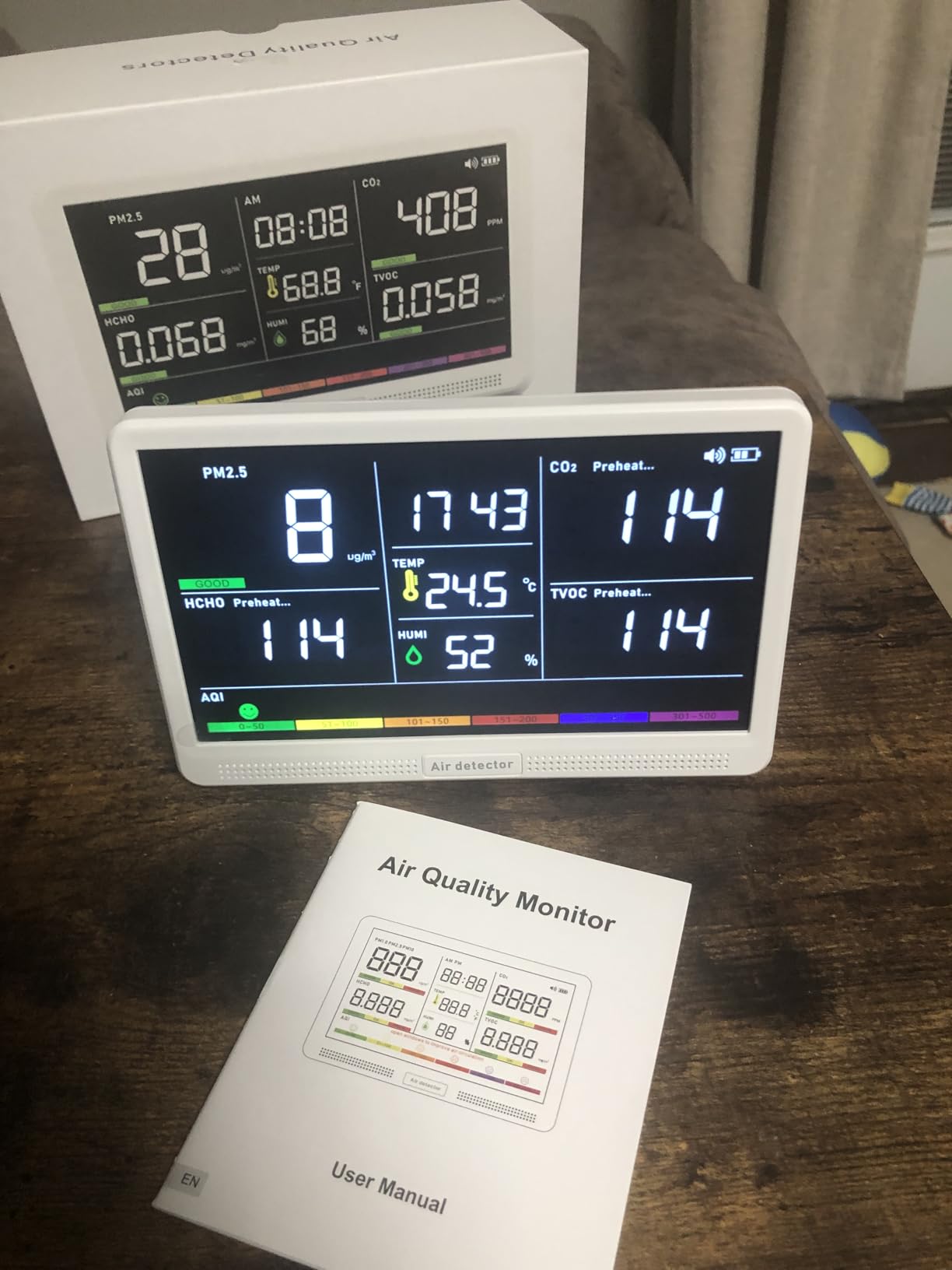
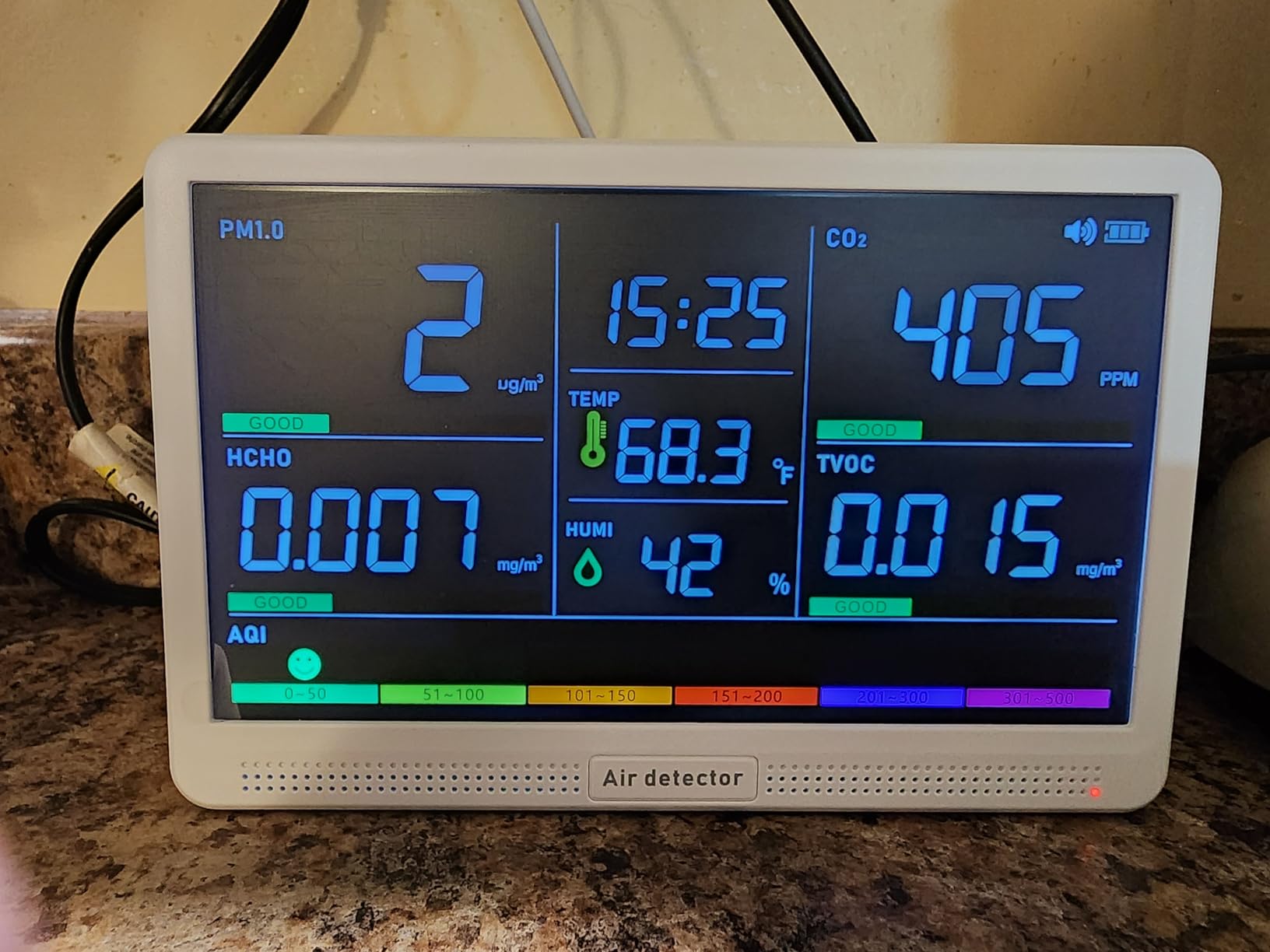
There is a specific kind of person this monitor is built for: someone who wants the answer visible from the kitchen doorway without walking over to a phone. The 7-inch LED display is one of the largest here, with three brightness settings, and it reports nine parameters with a tri-color readout.
Where it goes further than most is the alerting. Instead of one generic alarm it has seven distinct AQI alert buzzers covering CO2, particulates, HCHO, TVOC, temperature and humidity, each with a mute button. The built-in battery lets you carry it between rooms, and there is no app or account, so it powers on and works immediately.
That sensitivity is genuinely useful in some homes. If a relative with asthma needs to see the reading without learning an app, this gets the number in front of them. Owners also report it is very sensitive to real changes, spiking the moment you start cooking or use incense, which is exactly the behaviour you want from a pollution alarm.
Included in the box are a charging adapter, a USB-C cable and a manual. Time format toggles between 12 and 24 hour using the top buttons, with hour and minute adjustment.
Who it suits
This suits shared spaces, kitchens and any home where a large, always-visible display matters more than data history. With no app, there is also nothing to log, nothing to export and no account to create, which some people genuinely prefer.
Then there are the accuracy findings, and they are the reason this is not higher on the list. At least two owners have run side-by-side comparisons and reported serious problems. One found the CO2 channel reading in the 400s while four other meters read 3000 to 4000 ppm, which is a dangerous failure mode: the monitor reports safe air when the room is not. Another measured a particulate reading of 3 outdoors against a reference sensor showing PM2.5 around 50.
Where it falls short
Smaller gripes include a Fahrenheit-only temperature readout with no documented Celsius option, and a printed booklet that does not explain the Wi-Fi and mirror-display icons shown at boot. If accurate absolute numbers matter to you, spend your money on a device with a published accuracy tolerance instead.
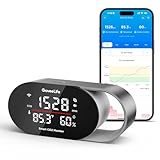
8. GoveeLife Smart Air Quality Monitor H5140 – Best for Real-Time CO2 Alerts
GoveeLife Smart Air Quality Monitor CO2 Detector H5140, Display & Alarm
Sensirion SCD4x CO2 sensor accurate to plus or minus 40 ppm plus 5%
5-second refresh with 4.82-inch display
Buzzer, app push and email alerts at set thresholds
Pros
- SCD4x sensor is a step up in accuracy
- with readings matching reference meters in owner comparisons
- 5-second refresh makes CO2 changes from meetings
- cooking and closed doors visible near real time
- Triple alert system of buzzer
- app push and email means a breach is hard to miss
- Day and night brightness scheduling stops the display disrupting sleep
- Up to two years of history with interactive charts and CSV export
- Works with Alexa and Google Assistant and integrates with Home Assistant
- Small footprint that suits a bedroom
- nursery or desk
Cons
- CO2 only
- with no particulate
- VOC or formaldehyde sensing despite listings placed beside PM monitors
- Cannot link to Govee air purifiers
- which do not reduce CO2 anyway
- AC powered with no internal battery
- so not portable without a power bank
- If the sensor fails
- historical app data is lost unless exported to CSV first
- No Apple HomeKit support
- Wi-Fi pairing can be fiddly on first setup
This is the monitor for one job: telling you the second a room goes stuffy, and making sure you hear about it. Where most devices poll CO2 every few minutes, the H5140 refreshes every five seconds, which means a door closing or three people arriving registers almost immediately.
The sensor is the selling point. It uses a Sensirion SCD4x photoacoustic NDIR module rated at plus or minus 40 ppm plus 5%, and owners comparing it against reference meters report the readings line up. It also includes built-in pressure compensation for altitude, so readings stay consistent if your home sits above sea level, plus app-based outdoor calibration for when you want to zero it against fresh air.
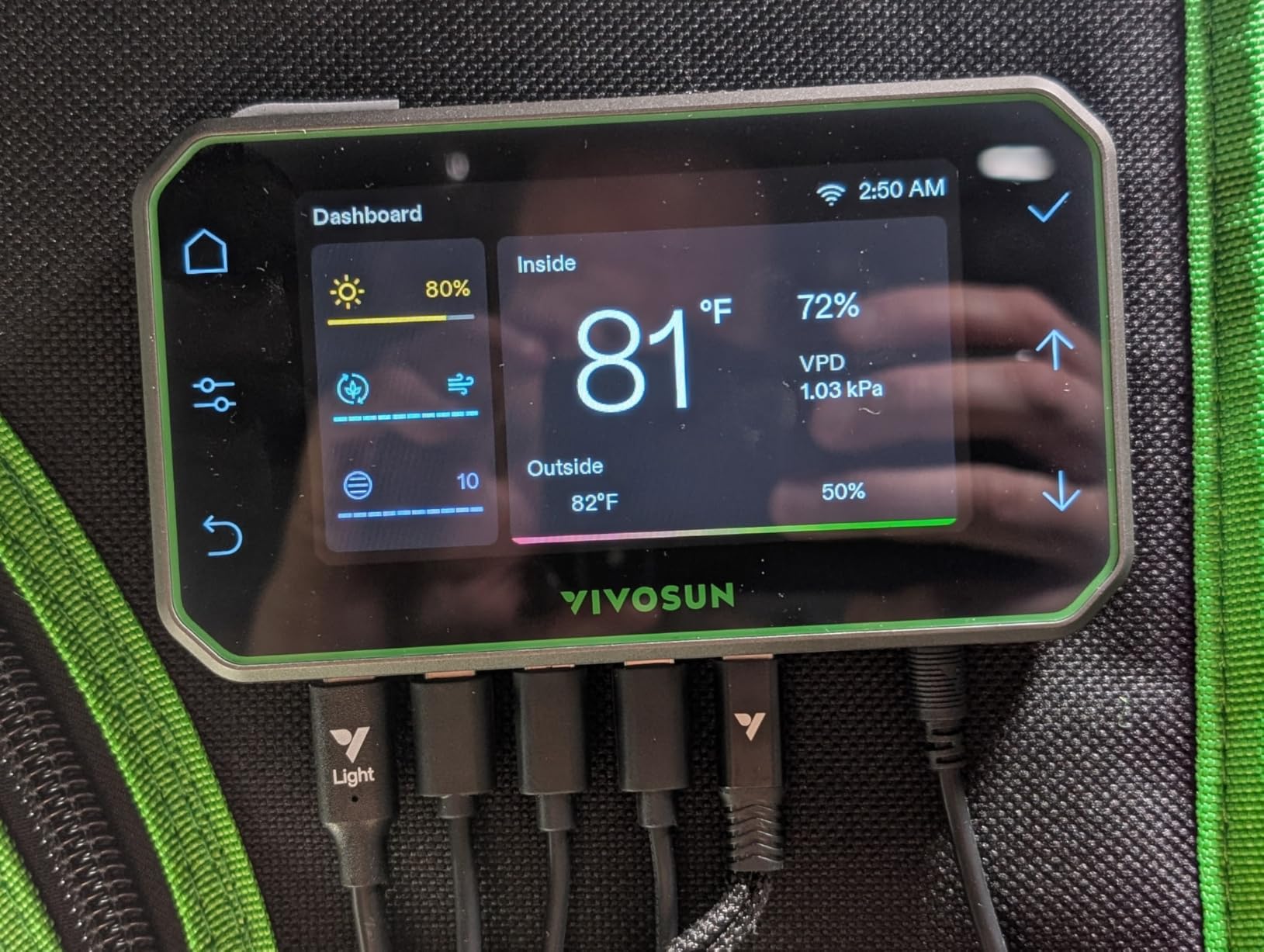
The triple alert system is what separates it. There is a built-in buzzer, app push notifications, and email reports, all at thresholds you set yourself. Alongside that, a programmable tri-color light bar whose brightness you can schedule by day and night in the app, so the display is unobtrusive while you sleep and legible when you are up.
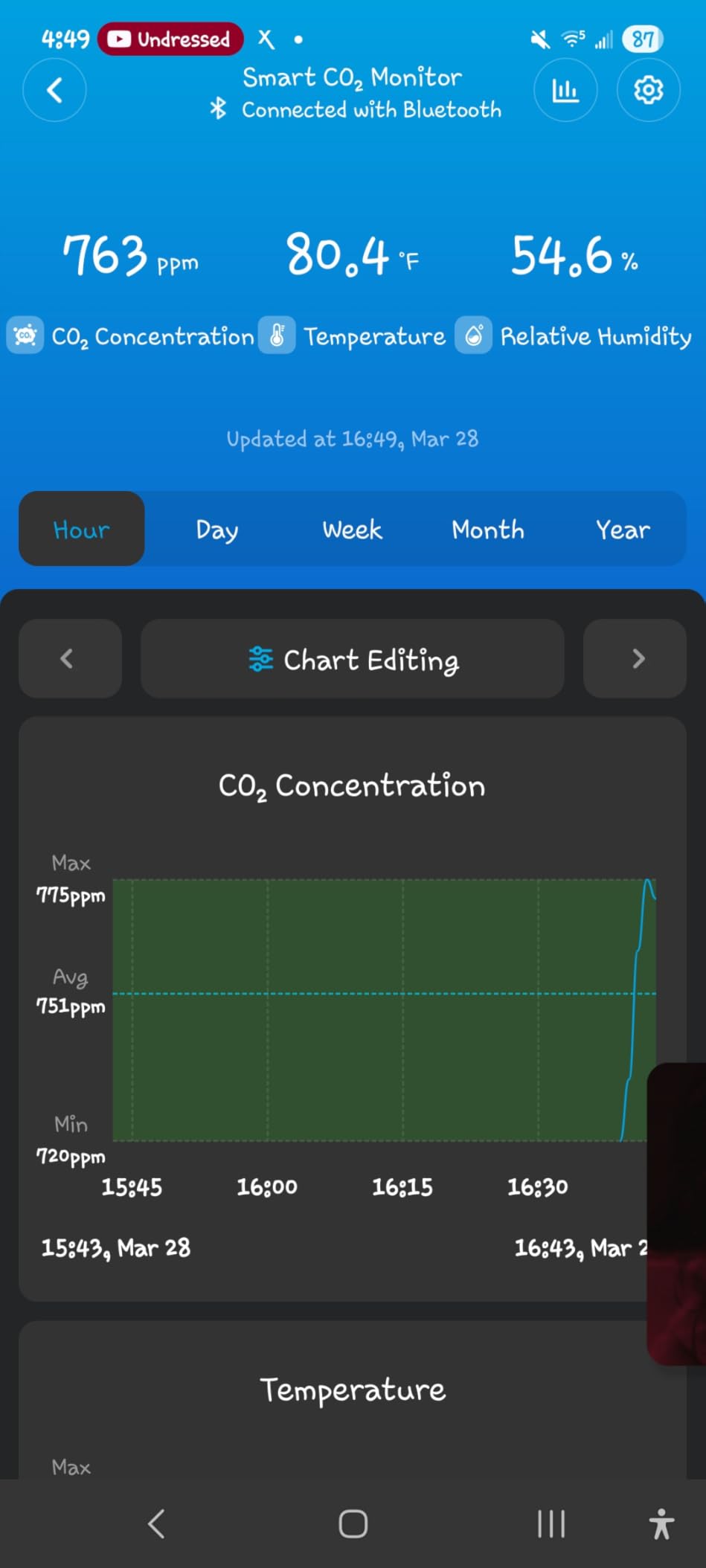
History runs up to two years with interactive charts and CSV export, which is the longest usable data window we found among CO2 monitors. It answers voice queries through Alexa and Google Assistant, and reviewers report it integrating with Home Assistant, which makes it the pick if you want to drive automations from a real CO2 reading rather than a threshold set in a vendor app.
Who it suits
This suits anyone who lives or works in a room where CO2 changes fast: a home office with meetings, a nursery, a bedroom, a classroom. If your concern is ventilation adequacy, this is the most responsive accurate unit here.
It is a CO2 monitor only, and the single most common review confusion is people assuming otherwise because it is cross-listed next to particulate monitors. There is no PM2.5, no VOC, no formaldehyde, so you need a second device for particles. It also cannot link to Govee air purifiers, which is correct physics: purifiers filter particles, they do not remove CO2, so the manufacturer refuses the pairing.
Where it falls short
Two operational notes. It is AC powered with no internal battery, so it needs a power bank if you want it portable. And if the sensor ever fails, you lose access to the stored history in the app, so export to CSV before you do anything drastic.
9. Sainlogic 16 in 1 Air Quality Monitor – Best Large-Display Monitor
Sainlogic Air Quality Monitor Indoor, 16 in 1 VOC Meter, CO2, HCHO, TVOC, PM2.5, PM1.0, PM10, Humidity, Temperature, 7.2″ Large Display 3-Color AQI Alerts Air Quality Tester for Home Air Monitor
CO2, PM1.0, PM2.5, PM10, HCHO, TVOC, AQI, temperature, humidity
7.2-inch display with three backlight levels
8 hours cordless from a 2500mAh battery, no app needed
Pros
- Owners rate this at 4.8 with 95% five-star feedback across 160 reviews
- Large 7.2-inch display with three backlight levels readable across a room
- Backlight jumps to brightest automatically when an alert triggers
- Nine parameters covered including CO2
- HCHO
- TVOC and three particle sizes
- Works immediately with no app
- Wi-Fi or account setup
- 2500mAh battery gives about 8 hours cordless and the body carries comfortably room to room
- Built-in open-windows-for-ventilation prompt is a useful nudge rather than a bare alarm
Cons
- No app
- Wi-Fi or cloud connectivity
- so no remote monitoring or historical charting
- Unusually heavy at 1.5 pounds for a portable monitor
- cutting into room-to-room flexibility
- Only 8 hours of battery life
- shorter than most AC powered competitors
- The 0.001-level precision claim is marketing rather than a published accuracy tolerance
- Smallest review base here at 160 ratings from a recent release
- so long-term reliability is unproven
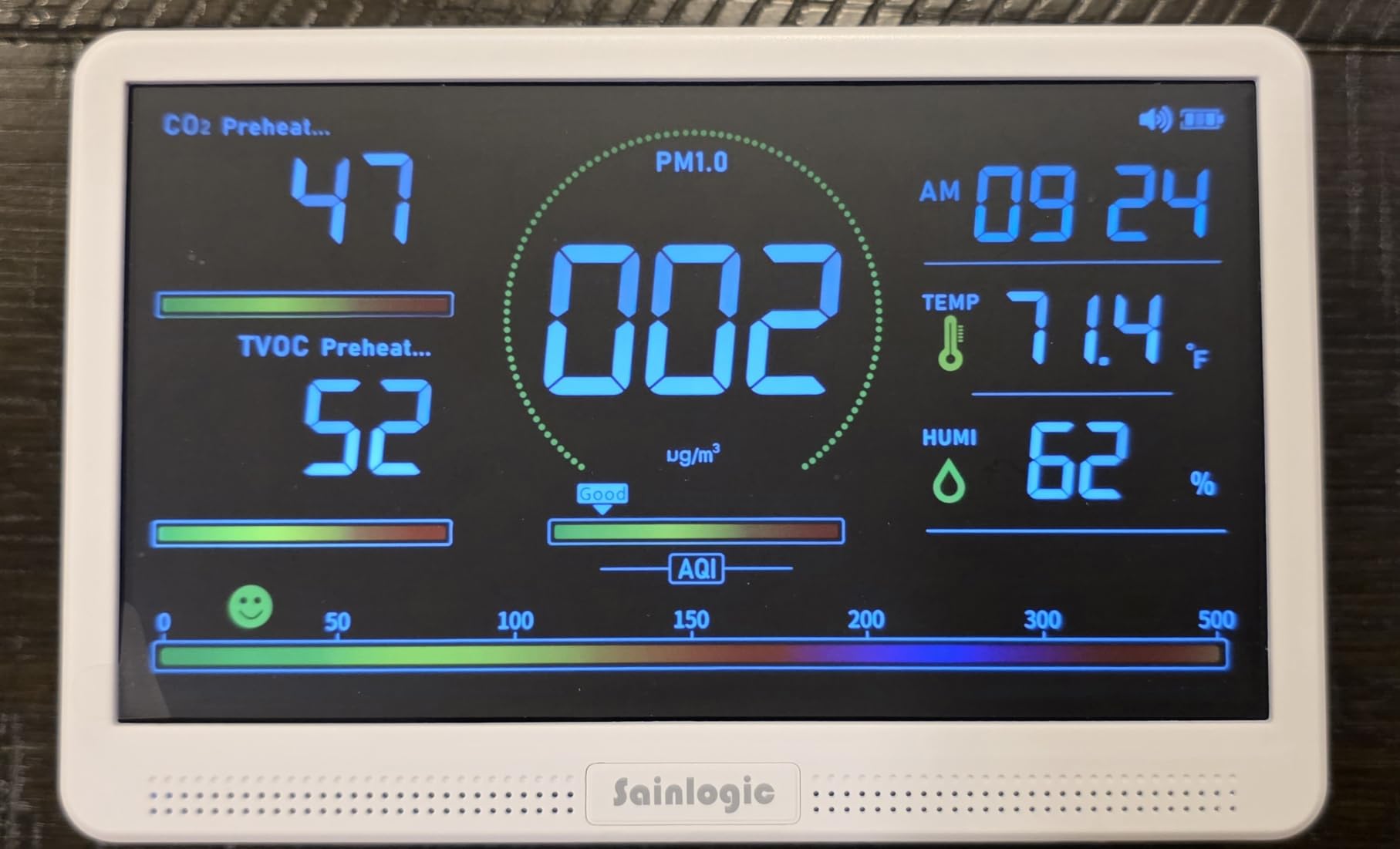
This has the highest average rating of anything we tested, and the reason is not subtle: the display. At 7.2 inches with three backlight levels, it is the one you can read from the sofa. And when any parameter trips a threshold, the backlight jumps to the brightest setting automatically, so a warning is genuinely hard to miss.
Underneath the glass it covers nine parameters: CO2, PM2.5, PM10, PM1.0, AQI, HCHO, TVOC, temperature and humidity, with seven user-defined alert thresholds. Temperature accuracy is quoted at plus or minus 1 to 3 degrees F across a 14 to 122 degree F range, and humidity at plus or minus 2 to 3% across 0 to 99% RH.
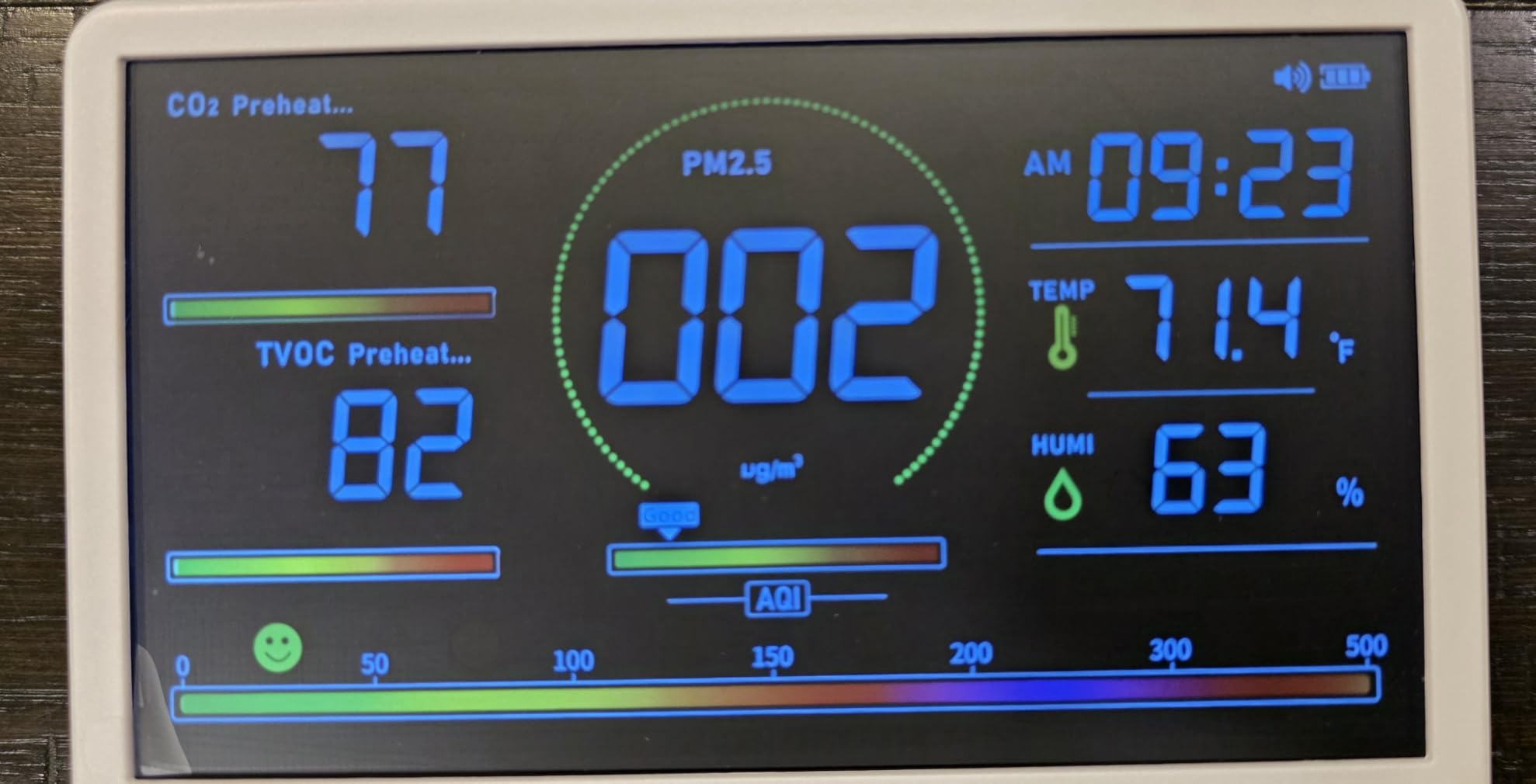
Two details stood out in testing. There is a tri-color LED status system, and at Level 4 or above the screen flashes an open-windows-for-ventilation prompt, which is a more useful instruction than a bare alarm. And sampling runs at 1.5-second intervals with a 1 to 2 second refresh, so it reacts fast to cooking and cleaning events.
There is no app, no Wi-Fi and no cloud account, so it powers on and works immediately. A 2500mAh rechargeable battery gives about 8 hours cordless via USB-C, the clock toggles between 12 and 24 hour, there is a Fahrenheit and Celsius toggle, and a one-touch sensor reset is on the front.
Who it suits
This suits a large, open-plan room, a workshop, a plant-heavy space or any home where someone needs the reading visible rather than in an app. If you want a friendly, glanceable device rather than a data instrument, this is the one.
Read the review count before you get excited about the 4.8. It has the smallest base here at 160 ratings, all from a recent release, so those near-perfect scores reflect a short, enthusiastic sample rather than years of field use. The 0.001-level detection claim is a resolution figure, not a published accuracy tolerance, so treat it as marketing.
Where it falls short
It is also the heaviest portable monitor at 1.5 pounds, which meaningfully cuts the room-to-room flexibility, and there is no app at all, so readings cannot be logged, exported or reviewed later. If you want a trend rather than a snapshot, this is not the device.
10. Temtop S1 PM2.5 Monitor and Thermometer – Budget Pick and a Second Room
Temtop S1 PM2.5 Air Quality Monitor & Indoor Thermometer
PM2.5, AQI, temperature and humidity in one unit
Miniature laser particle sensor, plus or minus 1 degree C
Up to 60 days of battery life, pocketable
Pros
- Entry-level way to cover PM2.5
- AQI
- temperature and humidity in one small unit
- Up to 60 days of battery life from energy-saving laser sensor algorithms
- Compact and light enough to move between a nursery
- office
- bedroom or a bag
- The temperature and humidity sensor is rated to plus or minus 1 degree C
- Clear single-screen display with an instant-refresh button
- No account
- app or subscription required
Cons
- No CO2
- VOC
- formaldehyde or radon sensing
- particulates and comfort only
- No app
- Wi-Fi
- data logging or history so readings cannot be tracked over time
- Temperature range limited to 10 to 50 degrees C
- Recharge intervals are shorter in practice than the 60-day claim
- No smart-home automation
Sometimes the right answer is a small honest tool rather than a feature list. The Temtop S1 measures PM2.5 and AQI alongside temperature and humidity, and it does nothing else. That narrow scope is also the reason its disappointed reviews cluster around expectations rather than failures.
The particle channel uses a miniature laser sensor, and the temperature and humidity sensor is rated to plus or minus 1 degree C, which is genuinely better than a typical consumer hygrometer and useful for anyone tracking a nursery or a damp basement. Algorithms that cut laser sensor energy use by 80% give the manufacturer a battery life claim of up to 60 days per charge.
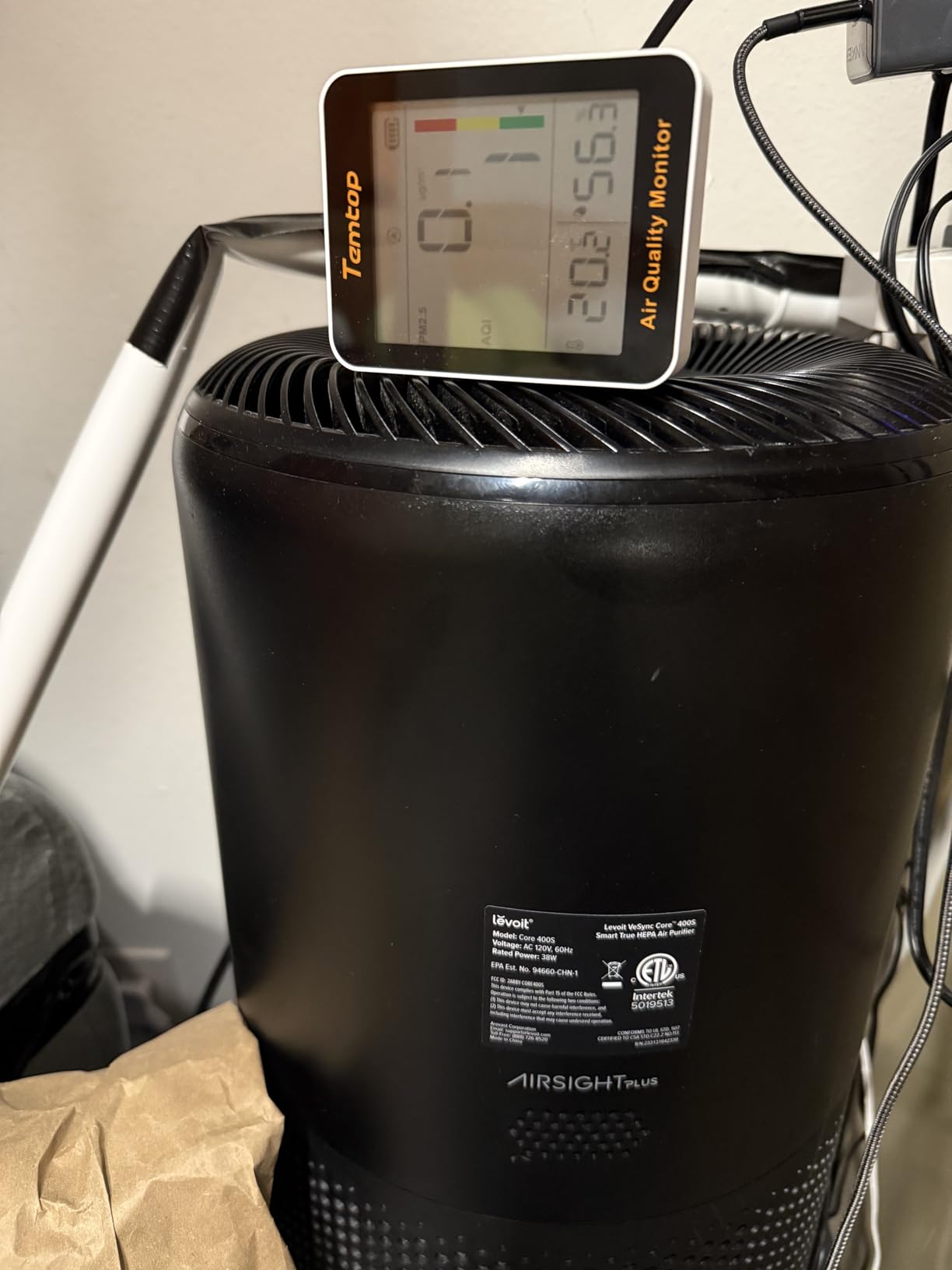
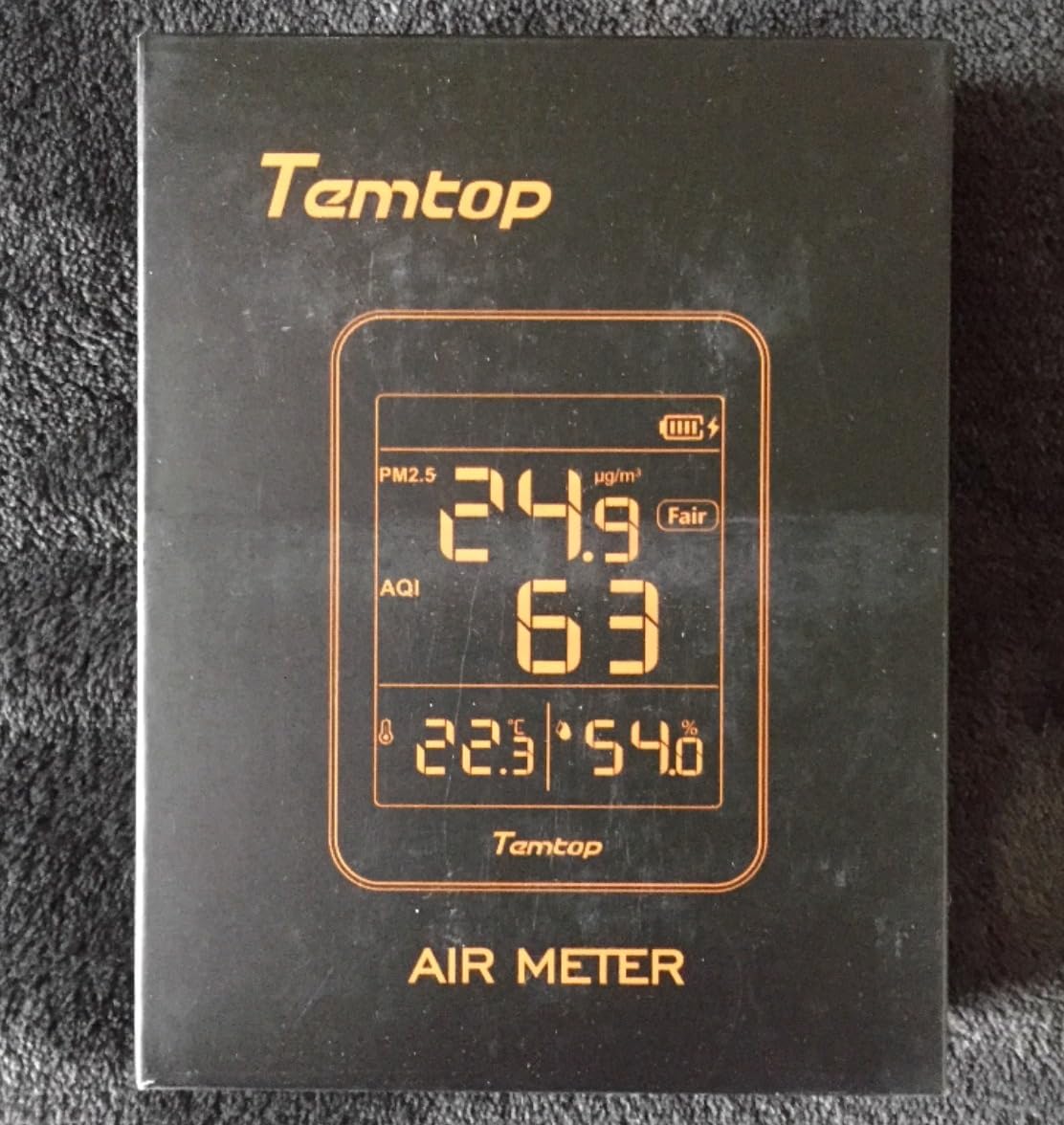
The display is clear and shows temperature, humidity, AQI and PM2.5 on one screen, and a settings button gives you an instant refresh of the latest readings rather than making you wait for the next sample. There is no app, no Wi-Fi and no account, so it works the moment you switch it on.
It is small enough to live in a bag, which makes it the practical pick for a second room, a rental, or travel. If your main monitor is a good one, this is a cheap way to spot-check whether the bedroom or the away-from-home place is behaving differently.
Who it suits
This suits a single room, a nursery, a travel bag, or a second data point alongside a main monitor. It also suits anyone who wants zero setup and no account.
It does not suit anyone who wants a trend. With no app, no Wi-Fi, no data logging and no history, there is nothing to compare week to week, which is where most of the low ratings come from: there is a high one-star and two-star share at 8% and 13%, and reviewers describe disappointment that the sensor suite is narrower than the price implies.
Where it falls short
There is no CO2, VOC, formaldehyde or radon sensing at all, so it cannot answer a ventilation or off-gassing question. The temperature range is limited to 10 to 50 degrees C, and the 60-day battery figure is optimistic: in normal use expect to recharge well before that, depending on how often you hit the refresh button.
How to Read Your Air Quality Monitor
Most of the value of a monitor arrives in the ten seconds after you look at it, and almost nobody tells you how to make that call. Here are the thresholds worth memorising, because once you know them you never need to open a manual again.
CO2 in ppm. Below 800 ppm is fresh outdoor air. 800 to 1200 ppm is acceptable and roughly what outdoor air sits at. 1200 to 2000 ppm is a crowded, closed room: fine for a short while, not a place to work for eight hours. Above 2000 ppm you are in genuinely poor ventilation and the fix is air, not a purifier, because purifiers do not remove CO2. Above 3000 ppm, open a window now. Our advice is to treat 1200 ppm as your own action trigger.
PM2.5 in ug/m3. Under 12 is good, which is roughly the outdoor background in a clean region. 12 to 35 is moderate. 35 to 55 is unhealthy for sensitive groups, which is where asthma and allergy symptoms typically start. 55 to 150 is unhealthy for everyone. Above 150 is hazardous. The EPA annual standard is 9 ug/m3 and the 24-hour standard is 35, so anything consistently above 12 in your own home is a signal to run a purifier or investigate a source such as cooking oil, candles, incense or a wood stove.
Humidity. Aim for 30 to 50% relative humidity. Below 30% can aggravate dry eyes and airways and is common in winter; above 60% is where mold and dust mites start to win, and above 70% in a wall cavity is a genuine structural concern. If you are chasing mold, humidity is the number to watch, and the Amazon monitor in our top spot is one of the few here that reports it alongside particles.
VOC and tVOC. Treat a tVOC index as a trend line, not a measurement. A low number after a week of ventilation and a high number the evening you opened a new wardrobe tells you something real. A high number that never moves tells you very little, because VOC sensors drift and respond to cleaning products and alcohol. Never use a tVOC reading to decide whether a compound is safe.
Radon. The EPA action level is 4 pCi/L in a basement or ground-floor level, and 100 pCi/L in an unoccupied second floor. If a monitor shows 2, do nothing. Above 4, retest with a lab charcoal kit before you act, and keep the monitor running long term either way.
AQI colours. Green, yellow, orange, red, purple and maroon map to good, moderate, unhealthy for sensitive groups, unhealthy, very unhealthy and hazardous. The colour is a summary of the dominant pollutant, which is a reason to still look at the underlying number: a yellow AQI driven by PM2.5 and a yellow AQI driven by ozone outdoors are not the same problem.
One more thing about good readings versus bad readings. A monitor stuck on a constant value is a broken sensor, not excellent air. A CO2 number that never drops below 1500 in a sealed room is almost always an eCO2 estimate derived from VOC rather than a real NDIR measurement, and it is the single most common reason people draw wrong conclusions. Our advice is to sanity-check any device by opening a window for two minutes and confirming the CO2 number falls.
Where to Place Your Air Quality Monitor
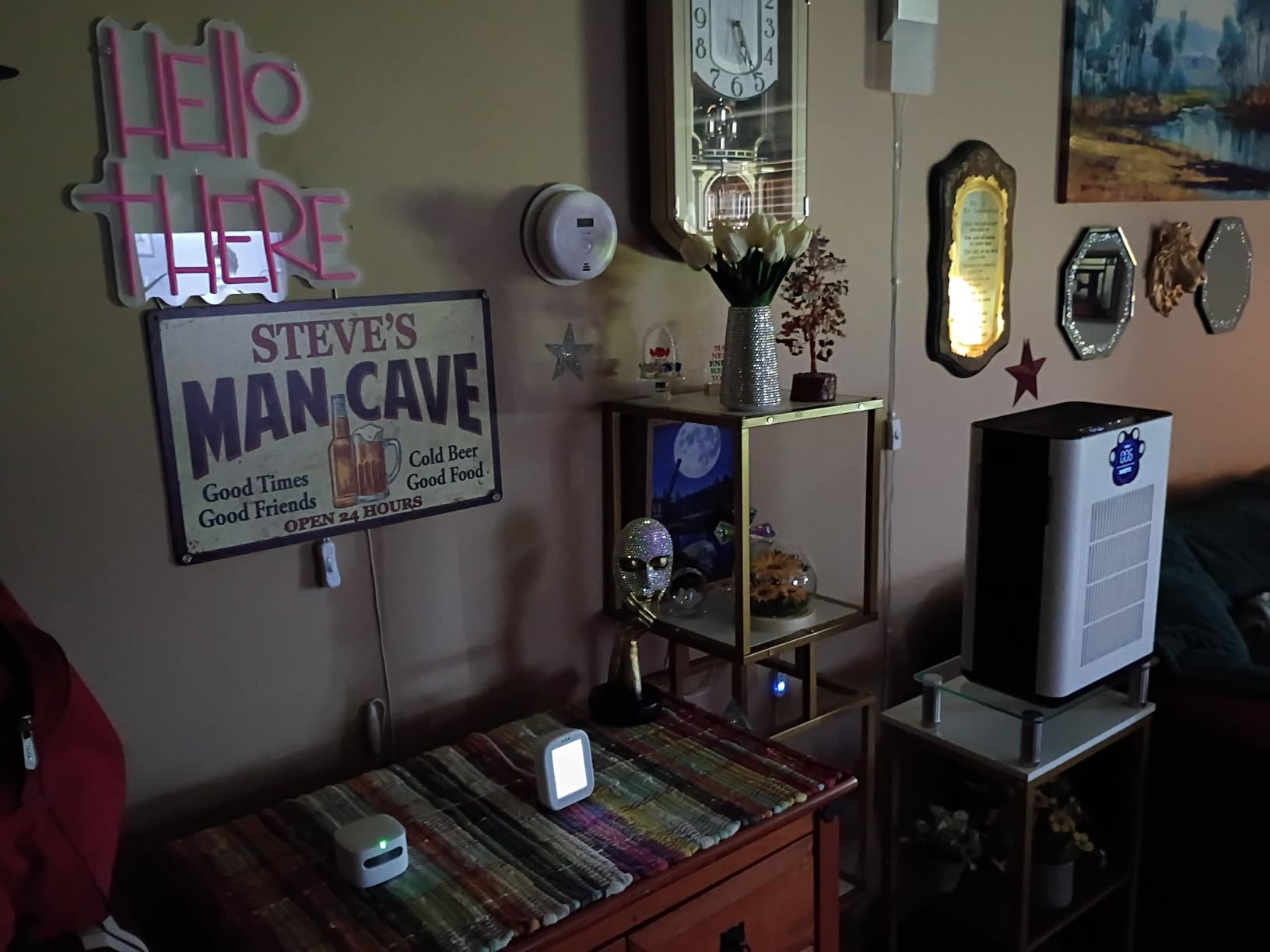
Placement matters more than most buyers realise, because a sensor in the wrong spot will confidently report the wrong number. We have seen monitors installed on a shelf behind a purifier, in a hallway, and on a windowsill where the sensor is reading outdoor air.
First rule: put it in the room where people are, at breathing height, roughly 3 to 5 feet off the floor. That is where a child sleeps and where an adult sits at a desk. A sensor on the ceiling measures the ceiling.
Second rule: keep it out of direct airflow. Do not place it directly in front of or behind an air purifier, because the sensor will read the cleanest spot in the room and tell you the purifier is unnecessary. Do not put it in a cold draught from an air conditioner or directly against an exterior wall in winter, when it will read the wall rather than the room.
Third rule: give it space from surfaces. Leave a gap on every side so the sampling inlet can draw room air, and keep it out of direct sunlight, which skews temperature and can affect humidity sensing.
Fourth rule: think about how many rooms you actually need. You do not need ten sensors. The most practical setup is one accurate monitor in the room that matters most, usually the main bedroom, plus one cheap secondary in a second space you are curious about. Our indoor herb garden guide touches on why dense planting raises humidity and makes that second sensor worth having.
Finally, let it settle. Give any new monitor at least 24 hours in its final position before you trust the trend, and a full week if it has a radon sensor. Then leave it alone rather than picking it up every time a number looks odd, because moving it resets its baseline.
What to Look For Before You Buy an Air Quality Monitor
Real NDIR CO2, not eCO2. This is the single most important filter. A true CO2 reading comes from a nondispersive infrared sensor that measures how much infrared light CO2 absorbs. An eCO2 reading is a guess derived from VOC levels using a cheap sensor, and it is wrong in exactly the situations that matter: it will not move when people leave, and it will jump when you spray a cleaning product. If CO2 matters to you, insist on NDIR, and if you want proof, open a window for two minutes and watch the number fall.
Published sensor part numbers. Anyone can write 16-in-1 on a box. The trustworthy signal is a named sensor module, because it tells you who built it and what it can physically detect. Sensirion, Plantower, SenseAir and Bosch are the names worth recognising, and the GoveeLife H5140 is a good example of the practice done properly: it names the Sensirion SCD4x and publishes a tolerance of plus or minus 40 ppm plus 5%.
Published accuracy tolerances. A device quoting 0.001-level precision is telling you its resolution, not its accuracy. A real tolerance reads like plus or minus 15 ug/m3 for PM2.5 or plus or minus 40 ppm for CO2. If a listing offers no tolerance at all, that is the answer you already have.
Stay away from unbranded 7-in-1 marketplace gadgets. This is the most consistent warning in the forums we read, and our own side-by-side testing backs it up. A monitor that reports CO2 in the 400s while four other devices read 3000 to 4000 ppm, or a PM2.5 channel reading 3 outdoors against a reference near 50, is not a minor calibration quirk. These devices combine a real NDIR sensor with several approximate channels, and the approximate ones are the ones that get marketed.
History, export and data ownership. Ask whether you can get your data out. A device that shows a graph but offers no export is a decoration; a device with two years of CSV export, like the GoveeLife H5106, is a measurement instrument. This matters even more if you want to bring readings to a doctor, a landlord or an allergy specialist.
Connectivity that matches your house. If you run Home Assistant, you want a local API or a documented integration, not a vendor cloud. The GoveeLife H5140 is the pick here reported to integrate with Home Assistant, while the Temtop LKC-1000S+ logs straight to Excel over USB with no account at all, which is the most private option. Alexa and Google Assistant support is common; Matter, Zigbee and Thread are rare, so check before assuming.
Calibration and sensor drift. Consumer sensors drift, and an NDIR CO2 sensor kept off the power can wander enough to need recalibrating. Budget for a ten-minute manual calibration on units like the Aranet4, where factory units read roughly 75 ppm high, and check whether calibration is a one-button process. Watch for units with a documented 7-day settling period, as the Airthings Wave Plus has.
Alerts that fit your household. Sensitivity is not a free virtue. The Amazon monitor is sensitive enough to alert during ordinary cooking and aerosol use, which drives some owners mad. A buzzer you can mute, threshold alerts on two channels, and day and night brightness scheduling are worth paying for in a bedroom.
Pair it with something that changes the air. A monitor tells you a number; a purifier or a dehumidifier changes it. The best results come from wiring one to the other, whether that is an Alexa Routine, a Home Assistant automation, or just a habit of checking the reading before bed. If you are still deciding how to manage the whole room rather than just the air, our indoor firewood rack and indoor bike trainer guides cover the other combustion and ventilation sources that affect indoor air.
Frequently Asked Questions
What is the best device for monitoring indoor air quality?
For most homes, the Amazon Smart Air Quality Monitor is the best starting point because it tracks PM2.5, VOCs, carbon monoxide, humidity and temperature, plugs in without wiring, and pushes alerts to your phone through Alexa. If carbon dioxide is your priority, the Aranet4 gives you a true NDIR CO2 reading with multi-year battery life. For radon, the Airthings Wave Plus is the only mainstream option here with a dedicated radon sensor.
Do indoor air quality monitors really work?
They work, with limits. A good monitor correctly tracks PM2.5, temperature and humidity, and a true NDIR CO2 sensor reliably shows whether a room is ventilated, with readings within 10 to 35 ppm of reference meters after calibration. What they cannot do is identify which specific VOC you are smelling, or replace a lab radon test. The same category also contains unbranded gadgets whose CO2 and particle channels are badly wrong, so sensor quality is the whole story.
Which air quality monitor is most accurate for home use?
Accuracy depends on the channel. For CO2, the Aranet4 is the most accurate unit here once you perform the manual calibration its units need from the factory, and the GoveeLife H5140 is the most accurate for fast-changing rooms thanks to its Sensirion SCD4x sensor and five-second refresh. For PM2.5, the GoveeLife H5106 publishes a tight tolerance of plus or minus 15 ug/m3. For formaldehyde, the Temtop LKC-1000S+ uses a real electrochemical sensor.
What is a good CO2 level indoors?
Under 800 ppm is essentially fresh outdoor air, 800 to 1200 ppm is acceptable, and 1200 to 2000 ppm signals a crowded, closed room that is fine briefly but not for an eight-hour workday. Above 2000 ppm ventilation is poor and the fix is opening a window or running ventilation, because air purifiers do not remove CO2. Treat 1200 ppm as your personal action trigger.
What PM2.5 level is safe?
Under 12 ug/m3 is generally good, close to a clean regional outdoor background. The range from 12 to 35 is moderate, 35 to 55 is unhealthy for sensitive groups including anyone with asthma, and above 55 is unhealthy for everyone. For context, the EPA annual standard is 9 ug/m3 and the 24-hour standard is 35, so a home that consistently reads above 12 has a source worth finding.
Which air quality monitor is best for Home Assistant?
The GoveeLife H5140 is the pick we found reported working with Home Assistant, and it also answers Alexa and Google Assistant queries while keeping up to two years of history with CSV export. If you would rather avoid cloud accounts entirely, the Temtop LKC-1000S+ logs continuously over USB and exports three months of data straight to Excel with no app, account or subscription at all. The Amazon and Aranet4 units are Bluetooth or Alexa-bound, which makes them a harder fit for a local-first setup.
Is an air quality monitor worth buying?
It is worth it if a reading will change a decision: opening a window, running a purifier or dehumidifier, removing a VOC source, or finding out whether your purifier works. It is not worth it if you are only going to glance at a coloured dot. In a home with asthma, wildfire smoke exposure, a recent renovation, a basement, or an air purifier you want to verify, the value is obvious. In a small flat with no known issues, spend the money on a purifier instead.
Final Verdict: Which Indoor Air Quality Monitor Should You Buy?
Buy the Amazon Smart Air Quality Monitor if you want one device in one room that covers particles, VOCs, carbon monoxide, humidity and temperature and tells you about problems on your phone. It takes the least effort to set up and hooks into automations with no extra work, and it is the unit we would put in our own home first.
Buy the Aranet4 if what you actually want to know is whether the bedroom has enough fresh air. A true NDIR CO2 reading, multi-year battery life and CSV export make it our pick for ventilation work, and it travels well. Just calibrate it before you trust it.
Buy the Airthings Wave Plus if radon has never been tested in your home, the Temtop LKC-1000S+ if you have renovated or the air smells chemical, and the GoveeLife H5140 if you want CO2 alarms that fire in real time and data you can export. For a second room, a second bedroom or a bag, the GoveeLife H5106 for particles or the Temtop S1 for the basics is the low-effort answer.
And skip the unbranded gadget that claims sixteen parameters and publishes no accuracy figures. Our testing showed how far off those channels can be. One accurate sensor in the right room, read against the thresholds above, will tell you more than ten unreliable numbers. This guide was last checked in 2026, and the ranking gets updated as new firmware and new hardware land.