
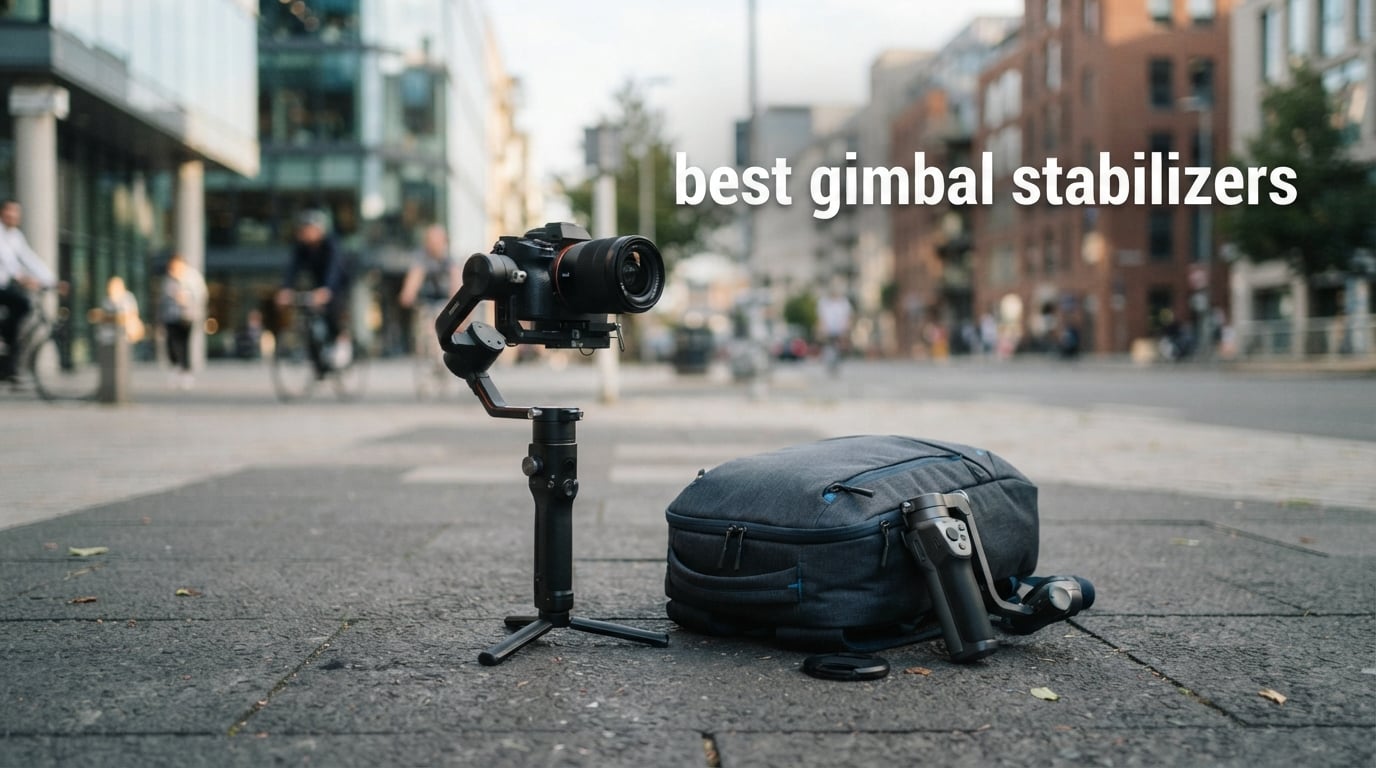
The best gimbal stabilizers make walking shots, pans, and vertical clips look calmer because brushless motors correct movement on the pitch, roll, and yaw axes. They do not turn every shot into cinema automatically, but a properly balanced 3-axis gimbal gives a phone or camera a far steadier starting point than handholding alone.
I divided this guide by the job rather than pretending one size fits all. A phone gimbal needs quick deployment, tracking, and an easy vertical-video workflow; a gimbal for mirrorless camera work needs a verified payload, room for the lens, and controls that do not slow a shoot down.
The ten picks below cover smartphone, action-camera, compact-camera, mirrorless, and DSLR setups. If your priority is a dedicated camera rig, our best camera gimbals guide is a useful next read; for a pocketable self-contained option, see these DJI Osmo Pocket alternatives.
A gimbal stabilizer is a motorized handheld device that uses sensors and brushless motors to hold framing steady as you move. Electronic image stabilization can reduce shake too, but it often crops the frame; a gimbal physically moves the device instead.
Table of Contents
The three leading picks answer the main phone, travel, and camera needs
For a mirrorless or DSLR setup within a 3 kg payload, the DJI RS 4 is my all-round camera choice because it combines Teflon-coated axis arms, an extended tilt axis, and native vertical shooting. For a phone, DJI Osmo Mobile 8 has the broadest ready-to-shoot feature set here, including 360-degree pan rotation, an extension rod, tripod, and stated 10-hour battery life.
The hohem iSteady X3 SE is the straightforward travel pick for lighter phones: it folds down, weighs 0.79 lb, includes a detachable magnetic remote, and has a stated 11-hour runtime. Choose by what you will mount, not by a badge alone; camera payload and phone dimensions are hard limits.
These best gimbal stabilizers in 2026 cover ten different shooting setups
This overview makes the dividing lines clear: the DJI RS 4 and Zhiyun Weebill 3E carry up to 3 kg, while the FeiyuTech SCORP-C2 lists the largest camera payload at 7.72 lb. Phone models trade that capacity for built-in tripods, extension rods, remotes, and tracking features.
| Product | Specifications | Action |
|---|---|---|
 DJI RS 4 DJI RS 4 |
|
Check Latest Price |
 Hohem iSteady M7 Hohem iSteady M7 |
|
Check Latest Price |
 DJI Osmo Mobile 8 DJI Osmo Mobile 8 |
|
Check Latest Price |
 FeiyuTech SCORP Mini-3-Pro FeiyuTech SCORP Mini-3-Pro |
|
Check Latest Price |
 Zhiyun CINEPEER Weebill 3E Zhiyun CINEPEER Weebill 3E |
|
Check Latest Price |
 DJI RS 3 Mini DJI RS 3 Mini |
|
Check Latest Price |
 Insta360 Flow Insta360 Flow |
|
Check Latest Price |
 hohem iSteady V3 Ultra hohem iSteady V3 Ultra |
|
Check Latest Price |
 FeiyuTech SCORP-C2 FeiyuTech SCORP-C2 |
|
Check Latest Price |
 hohem iSteady X3 SE hohem iSteady X3 SE |
|
Check Latest Price |
1. DJI RS 4 is the strongest all-round choice for cameras up to 3 kg
DJI RS 4, Gimbal Stabilizer for Camera, Canon/Sony/Nikon/Fujifilm
3 kg payload
12-hour battery
Native vertical shooting
Pros
- 3 kg payload
- Teflon axis arms
- Native vertical shooting
- Two-mode joystick
Cons
- Android app availability issue
- Battery grip separate
The DJI RS 4 is the model I would start with for a compatible mirrorless or DSLR camera when a 3 kg payload is enough for the complete body-and-lens setup. Its extended tilt axis gives useful clearance, while the Teflon-coated arms are intended to make the balancing adjustment less resistant.
DJI lists three-axis stabilization, PF, PTF, and FPV shooting modes, plus a 1.8-inch screen. The two-mode switch joystick is a practical detail for a run-and-gun operator who changes framing behavior often instead of hunting through menus.
Native vertical shooting is built in rather than added with a separate bracket, so this is a sensible fit for creators delivering both horizontal and vertical footage. The listing states 12 hours of battery life, though any long shooting day still calls for a charged backup plan.
The DJI RS 4 suits balanced mirrorless and DSLR rigs
Check the total mounted weight, not the camera body weight. Add the lens, plate, microphone, filter, and any cable before comparing the package with the 3 kg maximum recommendation.
The RS 4 is made for a camera rather than a phone, and it is not water resistant. I would balance it with the exact lens planned for the scene, then use the same configuration throughout the take.
The DJI RS 4 needs an app and accessory check before filming
DJI’s supplied data flags that its app was removed from Google Play because of a platform compatibility issue. Android owners should verify the current installation route and the controls available for their specific phone before committing to an app-led workflow.
The BG70 battery grip is listed as an optional separate accessory, so it is not part of the baseline package. The RSA communication port may matter to shooters building a wider control setup, but it is unnecessary for a simple handheld rig.
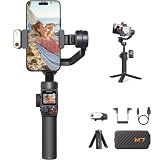
2. Hohem iSteady M7 is the feature-rich phone gimbal for remote-operated tracking
Hohem iSteady M7 Gimbal Stabilizer for Smartphone, Magnetic AI Tracker Fill Light, Detachable Touchscreen Remote Controller, Built-in Extension Rod, 500g Payload Gimbal Stabilizer for iPhone Android
500 g payload
Magnetic AI tracker
Detachable touchscreen remote
Pros
- Magnetic AI tracker
- Touchscreen remote
- Extension rod
- RGB fill light
Cons
- Phone-only payload limit
- Not water resistant
The Hohem iSteady M7 is built around self-shooting control rather than minimal carry weight. Its magnetic AI tracker, detachable 1.4-inch color touchscreen remote, extension rod, and CCT/RGB fill light put several creator tools in one phone-focused device.
The stated 500 g maximum recommendation gives it headroom for a phone setup, but it is not a substitute for a mirrorless-camera gimbal. Three expansion ports add options for accessories, which makes more sense for seated explainers, fitness clips, or small productions than for a pocket-only travel kit.
I like the separation of the remote from the handle for solo work. A remote can let the person in front of the camera start or adjust a shot without repeatedly walking back to the gimbal.
The iSteady M7 works best for phone creators who film themselves
The 7.6-inch built-in extension rod creates more distance between the lens and subject, which is helpful for a wider selfie composition. Its photo, video, portrait, and night modes give a basic starting set, while the tracker is the feature that sets this model apart.
Tracking should be treated as assistance, not a guarantee. Fast movement, obstructions, and a busy background can still challenge any AI system, so I would rehearse the path before recording a one-take scene.
The iSteady M7 needs room in a carry bag
At 629 g with a folded size listed at 12.8 inches, this is not the smallest phone gimbal in the roundup. The extra hardware is the trade-off for its remote, light, rod, and higher 500 g capacity.
It is also not water resistant. Keep it dry and detach the magnetic tracker before packing if a crowded bag could press against the moving parts.
3. DJI Osmo Mobile 8 is the complete phone gimbal for fast everyday video
DJI Osmo Mobile 8 Gimbal Stabilizer for Phone, 3-Axis Stabilization
10-hour battery
360 degree pan
Tripod and extension rod
Pros
- 360 degree pan
- Built-in tripod
- Native tracking
- Phone charging
Cons
- Android app availability issue
- Phone-only design
The DJI Osmo Mobile 8 is a strong default phone gimbal because it keeps the physical basics together: three-axis stabilization, built-in extension rod, built-in tripod, and direct phone connection. The supplied specification also lists 360-degree pan rotation and a 10-hour battery.
At 370 g, it is substantially easier to carry than a camera gimbal. That makes it a practical gimbal stabilizer for phone vlogs, walking tours, and social clips where you want to move from bag to recording quickly.
Native tracking with audio and lighting integration sounds useful for solo content, but the real value depends on the phone and the workflow you use. One-tap editing tutorials can shorten the first-day learning curve for a beginner.
The Osmo Mobile 8 makes vertical and moving phone shots easier
The comfortable grip and built-in tripod support simple walk-and-talk, static, and low-angle options without extra gear. A gimbal helps most when the operator walks smoothly too; bend your knees, take short steps, and let the motors make small corrections.
It can charge a phone, which is welcome during long sessions. I would still begin a recording day with both devices fully charged, since tracking and screen brightness can affect phone battery use.
The Osmo Mobile 8 requires Android app research
The data identifies a Google Play availability issue for the DJI app. That mirrors a repeated forum concern: iPhone users often report fewer app-compatibility complications than Android users.
Before buying, check that your exact handset fits the clamp and that the functions you need are available outside a proprietary app if necessary. The device is listed for cellphones, not cameras or action cameras.
4. FeiyuTech SCORP Mini-3-Pro is the flexible option for small cameras and phones
FeiyuTech SCORP Mini-3-Pro Gimbal Stabilizer for Camera Mirrorless/Compact/Action Cameras,Smartphone,18m AI Tracking,Detachable Remote Handle,4.4lbs Payload,3-axis Gimbal for Canon Sony Nikon
2 kg payload
18 m AI tracking
Four-device design
Pros
- Supports four device types
- 18 m tracking
- Detachable handle
- 2 kg payload
Cons
- Small review sample
- No listed audio recording
The FeiyuTech SCORP Mini-3-Pro aims at the person who switches among a mirrorless camera, compact camera, action camera, and smartphone. Its four-in-one design is unusually broad, and the 2 kg maximum recommendation offers meaningful capacity for smaller camera builds.
The listing claims AI Tracking 4.0 with a 0.003-second response time and an 18 m tracking distance. It also lists 360-degree infinite tracking and a detachable remote handle, features that suit a creator who wants more than a basic stabilizer.
At 1 kg, it sits between pocket phone gimbals and heavier camera supports. I would see it as a flexible compact kit, not as the first choice for a full-frame body with a large zoom lens.
The SCORP Mini-3-Pro fits mixed-device creators
Using a single gimbal across several devices can simplify packing, but every device still needs a new balance check. Moving from a phone to a camera changes the center of gravity enough that skipping this step can reduce stabilization quality.
The stated 4.4 lb payload is the number to work from when planning a camera build. Include a cage or receiver in that calculation, particularly if the lens projects far forward.
The SCORP Mini-3-Pro has a shorter review record than major rivals
This model has 133 listed reviews, fewer than several alternatives here. That does not invalidate its feature set, but I would weigh the smaller review base when choosing it for paid work or a one-time event.
Its one-year manufacturer warranty and lack of water resistance also favor careful indoor or fair-weather use. Carry the gimbal powered off and locked, then inspect each axis before filming.
5. Zhiyun CINEPEER Weebill 3E is the endurance-minded camera pick
ZHIYUN CINEPEER Weebill 3E, 3-Axis Lightweight Gimbal Stabilizer for DSLR & Mirrorless Camera Canon/Sony/Panasonic/Nikon, 3KG Payload, Native Vertical Shooting, Bluetooth Shutter Control
3 kg payload
16-hour battery
2.5 sling mode
Pros
- 3 kg payload
- 16-hour battery
- Sling mode
- Native vertical shooting
Cons
- Control cables not included
- Not water resistant
The Zhiyun CINEPEER Weebill 3E combines a 3 kg capacity with a listed 16-hour maximum battery life. It is a strong candidate for long camera days where a compact rig and fewer battery interruptions matter more than advanced app-led phone features.
Native vertical shooting and Bluetooth shutter control give it a current social-video workflow, while the 2.5 Sling Mode is designed to reduce fatigue. Zhiyun claims more than a 50 percent fatigue reduction with that mode; treat that as a brand claim rather than a universal result.
The listed body weight is 990 g, and its folded dimensions are 12 by 8 by 2.8 inches. I would pack it in a structured camera bag so the arms and lock points are protected in transit.
The Weebill 3E supports long shoots with a balanced camera build
Battery claims are measured under particular conditions, so a 16-hour figure is best read as a ceiling. Motor effort, camera control, temperature, and repeated balancing can lower real-world runtime.
For a wedding, documentary, or event, build in breaks to rebalance after a lens change. The best gimbal is only as steady as its setup, and a quick balance test saves footage later.
The Weebill 3E needs cable planning for some camera controls
The supplied cons state that Canon and Sony control cables are not included. Confirm the control method required by your particular camera if start-stop operation from the handle is part of your shooting plan.
It is listed for DSLR and camera compatibility rather than phones. If your work combines a mirrorless kit with an action camera, the SCORP Mini-3-Pro may be the more flexible comparison.
6. DJI RS 3 Mini is the light camera gimbal for a 2 kg setup
DJI RS 3 Mini, Camera Gimbal Stabilizer, Canon/Sony/Nikon/Fujifilm
2 kg payload
795 g body
Native vertical shooting
Pros
- 795 g lightweight body
- 2 kg payload
- Bluetooth shutter
- Vertical shooting
Cons
- Android app availability issue
- Not water resistant
The DJI RS 3 Mini is the compact camera choice for creators who can keep their rig below its 2 kg tested payload. DJI identifies the gimbal itself as 795 g, giving it a clear travel advantage over larger camera-oriented models.
It has three-axis image stabilization, a 1.4-inch full-color touchscreen, Bluetooth shutter control, and native vertical shooting. Those are the core features I want from a light mirrorless gimbal: steady framing, uncomplicated camera control, and quick movement into portrait orientation.
The 3rd-generation RS stabilization algorithm is another reason to consider it for an appropriately light lens. Do not interpret the 2 kg rating as a reason to mount a nearly 2 kg package; headroom makes balancing and motor behavior less stressful.
The RS 3 Mini is best with compact lenses and light camera bodies
Wide-angle and compact prime lenses tend to be friendlier to a smaller gimbal than long, front-heavy zooms. Test physical clearance as well as total weight, especially during tilt moves.
A 2 kg payload can work for many mirrorless rigs, but it does not promise support for every body-and-lens shape. I would check DJI’s compatibility information for the exact camera before relying on Bluetooth shutter control.
The RS 3 Mini asks for careful travel protection
Its low weight helps when flying or hiking, but it is still a precision motorized device and is not water resistant. Lock the axes for travel and avoid leaving it loose in a bag where other equipment can force an arm sideways.
As with the RS 4, the supplied data notes a Google Play compatibility issue for the DJI app. Android users should test the intended phone-control path early, not on the morning of a shoot.
7. Insta360 Flow is the foldable phone gimbal with long stated battery life
Insta360 Flow Gimbal Stabilizer for Smartphone, AI-Powered Gimbal, 3-Axis Stabilization, Built-in Tripod, Portable & Foldable, Auto Tracking Phone Stabilizer, Video Recording, Stone Gray
Deep Track 3.0
12-hour battery
Tripod and selfie stick
Pros
- Deep Track 3.0
- 12-hour battery
- Foldable design
- Tripod and power bank
Cons
- Android features vary
- 500 g phone limit
The Insta360 Flow is an appealing travel gimbal because its design combines a foldable body, a built-in selfie stick, tripod, and power bank. It lists Deep Track 3.0 AI tracking, three-axis stabilization, and 12 hours of battery life.
Its stated folded size is 3.1 by 6.4 by 1.4 inches, which is one reason I would choose it for a day when the gimbal has to stay in the bag until needed. One-step rapid deployment also fits spontaneous travel footage and family videos.
The 500 g maximum recommendation gives it capacity for a phone, but do not carry over camera-gimbal expectations. It is designed for a cellphone workflow and benefits most from a phone that works well with its companion features.
The Insta360 Flow is a practical all-in-one travel companion
Tripod mode is valuable for a group clip, a time-lapse, or a static explanation, while the selfie-stick function helps frame a wider view. These built-in parts reduce the number of small accessories I would otherwise need to pack.
If you are also choosing an action camera for travel, compare the wider setup separately with our guide to Insta360 cameras. A handheld gimbal and an action camera solve different stabilization problems.
The Insta360 Flow needs phone-specific feature verification
The listing says some features are not available on all Android phones because of protocol differences. That is a meaningful caution, not fine print: app reliability can matter as much as the quality of the motors.
Check handset support, camera access, and tracking behavior with your version of Android or iOS before basing client work on an automated feature. Manual tracking and straightforward joystick control remain useful fallbacks.
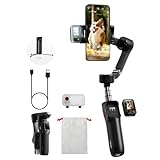
8. hohem iSteady V3 Ultra is the phone gimbal for remote framing and fill light
hohem iSteady V3 Ultra 3-Axis Gimbal Stabilizer for iPhone & Android
10 m touchscreen remote
Fill light
9-hour battery
Pros
- AI tracking
- 10 m remote
- Extension rod
- Adjustable fill light
Cons
- 14.11 oz payload limit
- Not water resistant
The hohem iSteady V3 Ultra stands out because the 1.22-inch detachable touchscreen remote has a stated 10 m range. That makes it a good fit for solo phone shooting where the subject wants to change framing without asking another person to handle the gimbal.
It pairs iSteady 9.0 stabilization with AI tracking for faces, pets, and objects, plus 360-degree panning. The smart fill light offers adjustable brightness and color temperature, which is more useful for close indoor speaking clips than for trying to light a large outdoor scene.
The unit folds to 6.3 inches and includes an 8-inch extension rod and tripod. Its listed runtime is up to nine hours, a solid figure for a phone gimbal but still one to budget around on a travel day.
The iSteady V3 Ultra helps solo creators control a shot from a distance
A separate remote can be more practical than gesture control when you need to make a clear change at a particular moment. I would position the tripod on a stable surface and test the remote range before recording a long take.
The gimbal supports iPhone, Samsung Galaxy, OnePlus, and Huawei phones in its compatibility listing. Check the exact handset and case thickness, particularly if you use a heavy protective case.
The iSteady V3 Ultra is limited by phone payload rather than features
Its 14.11 oz maximum recommendation is intended for a phone setup. Remove add-on lenses or bulky accessories if they bring the setup close to the limit or make balancing awkward.
The gimbal is not water resistant. The fill light, screen remote, and moving axes all make a dry storage pouch a sensible part of the kit.
9. FeiyuTech SCORP-C2 is the high-payload camera option for heavier rigs
FeiyuTech SCORP-C2 Camera Gimbal Stabilizer with Built-in AI Tracking
7.72 lb payload
Built-in AI sensor
14-hour battery
Pros
- 7.72 lb payload
- Built-in AI sensor
- Quick-release plate
- 14-hour battery
Cons
- Smaller review base
- Not water resistant
- No audio recording
The FeiyuTech SCORP-C2 has the largest stated capacity in this roundup at 7.72 lb, making it the obvious model to inspect when your camera body, lens, cage, monitor, or receiver push past lightweight-gimbal limits. Its 2.9 lb gimbal weight is the trade-off for that support.
The built-in AI tracking sensor is specified for face and gesture recognition, while the one-piece handle and upgraded quick-release plate focus on physical handling. An OLED display and claimed 14-hour battery round out a feature set aimed at longer camera work.
Its detailed compatibility list includes many Canon, Fujifilm, and Sony models, but a list is not a substitute for checking your exact body, lens, and cable configuration. Heavy payload does not remove the need for precise balancing.
The SCORP-C2 accommodates larger mirrorless and DSLR packages
Start with the full shooting configuration on a scale, including the quick-release plate and all accessories. Then test each axis through its range, looking for a lens hood, cable, or monitor that could hit an arm.
The ergonomic integrated grip should appeal to operators who carry a rig for extended takes. I would still use breaks and a support solution for all-day shoots, because operator fatigue affects shot quality even when motors have capacity.
The SCORP-C2 needs more buyer due diligence than established high-volume picks
This product has 54 listed reviews, which is a much smaller feedback pool than the DJI and Hohem models in this guide. Read the compatibility and warranty details closely when it will support equipment you depend on professionally.
It has no listed audio recording and is not water resistant. Audio normally comes from the camera or a separate recorder, so plan cable routing before you balance the rig.
10. hohem iSteady X3 SE is the light budget-friendly gimbal for travel phones
hohem iSteady X3 SE 3-Axis Gimbal Stabilizer for iPhone & Android, Black
0.79 lb foldable body
Magnetic remote
11-hour battery
Pros
- 0.79 lb body
- Magnetic remote
- 11-hour battery
- Easy vertical switching
Cons
- 300 g payload limit
- No audio recording
The hohem iSteady X3 SE is the simple travel option for a phone that stays under its 300 g maximum recommendation. It weighs 0.79 lb, folds down to 3.86 by 1.73 by 6.32 inches, and provides three-axis stabilization without the size of a camera rig.
The detachable magnetic remote has a stated range of 32.81 ft, while the Hohem Joy app provides AI tracking, gesture control, and creative templates. Its listed 11-hour battery life is strong on paper for a small travel gimbal.
This is a good starting point for someone who wants smoother holiday footage, short vlogs, and basic horizontal-to-vertical switching. It is not intended to hold a camera or a heavily accessorized phone.
The iSteady X3 SE fits light phones and small travel bags
Its iPhone, Samsung Galaxy, OnePlus, and Huawei compatibility list is broad, but physical weight still decides suitability. A large phone with a battery case, lens attachment, or microphone may exceed the 300 g guidance.
The compact folded design is its main strength. I would choose it when it is better to have a modest gimbal with me than a larger system left at home.
The iSteady X3 SE keeps the workflow basic
There is no listed audio recording, so record audio with the phone or an external microphone. A gimbal stabilizes video; it does not solve wind noise, weak voice capture, or poor exposure.
Take time to learn the remote and screen-switching controls before traveling. A few practice shots at home make the first outing more productive and reveal whether tracking works well in your preferred app.
The right buying criteria start with what you are mounting
Payload capacity is the first filter for a camera gimbal. Weigh the complete rig, then choose a model with room below its stated limit; balance, lens length, and physical clearance affect performance alongside the number on the specification sheet.
For a phone gimbal, check the clamp fit, handset weight, case thickness, and the features supported on your operating system. Android compatibility concerns and app availability are recurring forum pain points, so a compatible phone is more important than a long feature list.
Three-axis stabilization means pitch, roll, and yaw correction
Pitch controls up-and-down tilt, roll keeps the horizon level, and yaw manages left-right panning. The gimbal’s sensors detect unwanted movement and drive brushless motors to oppose it while you guide the intended motion.
That motorized correction is why a gimbal can produce a smoother walking shot than electronic stabilization alone. It will not fix bad operating technique, so keep movements slow and do not force an axis by hand while it is powered on.
Battery claims should be treated as planning figures
Models here list runtimes from nine to 16 hours, but actual use changes with payload, temperature, motor effort, screen use, and charging a phone. For an event, start charged and carry the appropriate charging option instead of treating a maximum figure as a promise.
Cold conditions can affect batteries and stiffen your hands, which makes smooth walking harder. Keep the gimbal dry, use a case during transport, and allow a device moving from cold outdoors to warm indoors to acclimate before storing it.
Vertical shooting matters when social video is the destination
Native vertical shooting on the DJI RS 4, Zhiyun Weebill 3E, DJI RS 3 Mini, and FeiyuTech SCORP-C2 makes it simpler to change deliverable orientation. Phone gimbals are naturally built around quick portrait use, but check how the app behaves in that mode.
Record the key action with enough framing room when one shoot must serve both horizontal and vertical edits. A gimbal helps hold the composition steady, but it cannot restore a subject cropped out of the original footage.
AI tracking is useful only when the scene allows it
Trackers on the Hohem M7, Insta360 Flow, iSteady V3 Ultra, SCORP models, and X3 SE can help a solo creator stay in frame. They can also lose a subject when someone passes in front, the scene is dim, or the background looks similar.
Set up a manual fallback before the important take. I recommend recording a short test in the real location, watching it back, and deciding whether tracking improves the shot or adds an avoidable risk.
Balancing is the step beginners should not skip
Turn the gimbal off, mount the exact shooting setup, and adjust the axes until the device can remain reasonably level without the motors fighting it. Then power on and run the manufacturer’s balance or calibration routine when available.
Rebalance after changing lenses, adding a microphone, or moving a monitor. Users often describe a learning curve, but the repeatable habit is simple: change the rig, rebalance, and test every axis before recording the real scene.
Maintenance extends the useful life of a gimbal
Lock the arms before carrying the device, keep sand and moisture away from joints, and use a padded compartment that does not press on the motors. Wipe the contact areas and plate clean with a dry cloth after a dusty day.
Do not put a wet gimbal into a sealed case. Let it dry in a safe place, inspect its locks and screws, and keep firmware or app changes away from the start of an important job whenever possible.
A gimbal differs from a Steadicam and a tripod
A gimbal uses powered motors and sensors to correct position; a Steadicam uses a mechanical balance system and operator technique. A tripod holds a static shot, while a gimbal is for controlled movement.
Many creators need more than one tool. A tripod is still better for a fixed interview, and in-body or electronic stabilization can be enough for a short, casual clip; use a gimbal when moving smoothly is part of the visual goal.
The most common gimbal questions have practical answers
What is the best gimbal stabilizer for phone?
The DJI Osmo Mobile 8 is the most complete phone pick here for a built-in tripod, extension rod, 360-degree pan rotation, three-axis stabilization, and a stated 10-hour battery. Choose the Insta360 Flow for a foldable all-in-one design, or the hohem iSteady X3 SE for a lighter basic travel setup. Verify your exact phone fit and app compatibility first.
Is a gimbal worth it for videography?
A gimbal is worth it when you regularly walk, pan, follow a subject, or make moving vertical video. Its motors physically correct pitch, roll, and yaw movement, which can create smoother footage than handholding alone. It does not replace good walking technique, correct balance, or a tripod for static shots.
What is the difference between a gimbal and a Steadicam?
A gimbal uses sensors and powered brushless motors to keep a camera level along three axes. A Steadicam is a mechanical stabilization system that uses counterweights, a vest, and operator technique. A gimbal is generally simpler to learn for a small phone or camera setup, while both tools need practice.
Can you use a gimbal with any phone?
No. A phone must physically fit the clamp and remain within the manufacturer’s payload recommendation. App features can also differ by Android handset and iPhone model, so check compatibility, case thickness, and the tracking or camera controls you need before choosing a phone gimbal.
How long do gimbal batteries last?
The products in this guide list maximum runtimes from nine to 16 hours, depending on the model. Actual runtime depends on payload, motor effort, temperature, screen use, and whether the gimbal charges a phone. Begin long shoots charged and carry a suitable charging option.
The best gimbal stabilizers depend on the device and shot you need
Choose the DJI RS 4 for a camera rig within 3 kg, the DJI Osmo Mobile 8 for a full-featured phone setup, or the hohem iSteady X3 SE for a compact light-phone travel kit. The SCORP-C2 deserves attention when payload is the deciding factor, while the Insta360 Flow makes sense when a foldable tripod-and-selfie-stick design is more useful.
Before choosing from the best gimbal stabilizers in 2026, weigh your complete setup, confirm compatibility, and practice balancing with the gear you will actually use. For moving subjects and sports-oriented video plans, pair this research with our guide to cameras for sports photography; for aerial footage, review our best drones picks as well.