
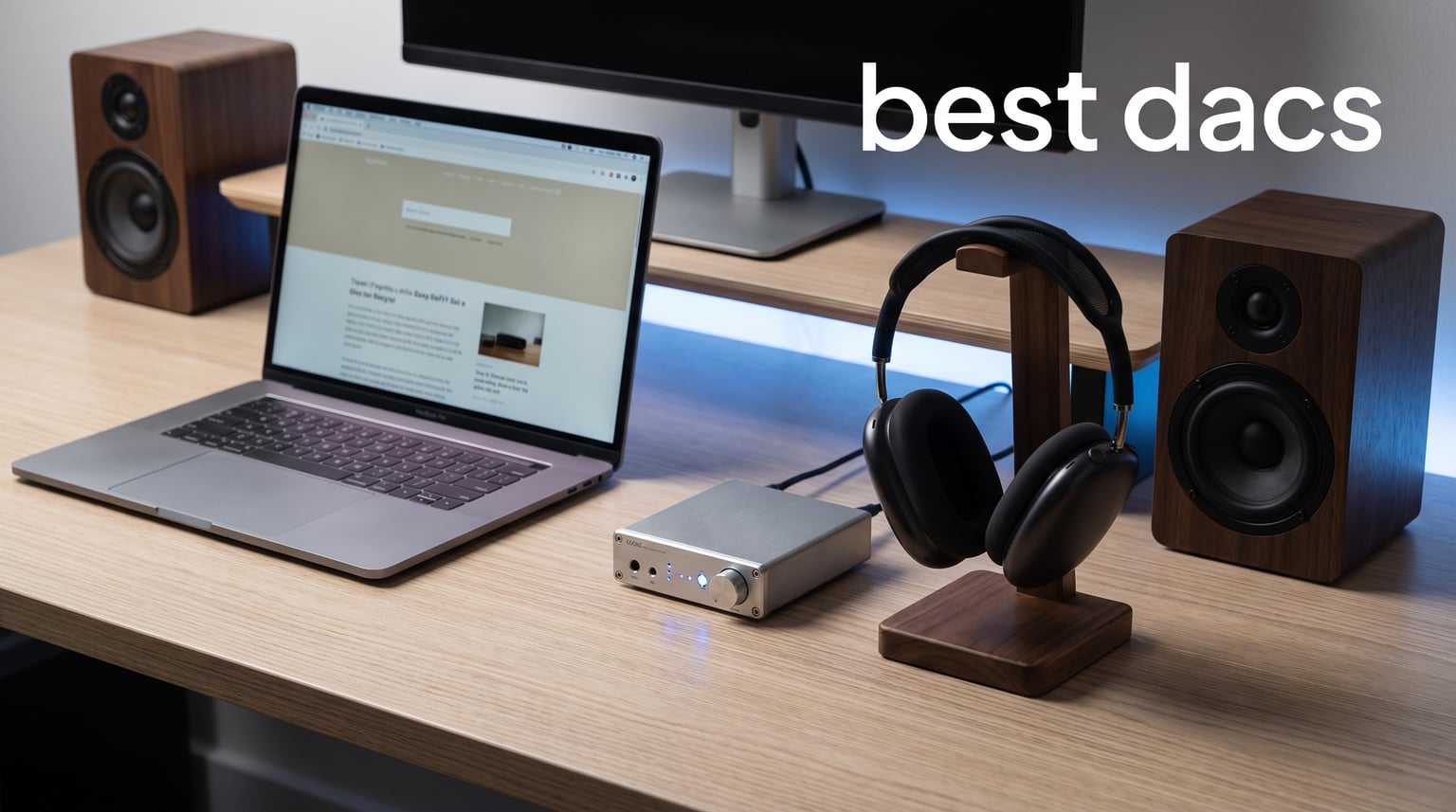
The best DACs solve a simple problem: they turn the digital audio from a computer, console, or phone into the analog signal your headphones, amplifier, or powered speakers need. A DAC is not magic, but a well-matched external DAC can give you cleaner connections, lower background noise, better source switching, and—in a DAC amp—enough power for headphones that a laptop struggles to run.
For this 2026 guide, I compared the eight supplied models by their documented converter chips, supported formats, outputs, input choices, output power where stated, and customer feedback. The result covers a small component DAC for a stereo system, desk-friendly DAC amps, a gaming hub with microphone input, and USB-C dongles that make a phone or laptop more useful with wired headphones.
Start with the job, not a chip name. Someone connecting powered speakers needs an RCA or balanced line output; someone using headphones needs the correct jack and enough amplifier power; and someone moving between a phone and an IEM needs a compact USB-C DAC with dependable device support.
That distinction matters because community discussions repeatedly make the same point: capable DACs can sound very similar once the system is already quiet and working correctly. I would first fix hiss, a noisy onboard output, missing optical input, or inadequate headphone drive, then choose the smallest unit that supplies the ports and controls I will actually use.
If headphones are the next part of your system, our guides to planar magnetic headphones and noise cancelling wired headphones can help frame the output and connector choice. For gaming, a DAC can clean up the listening chain, but it does not create surround processing or improve a headset microphone unless the device specifically provides that function.
These Top 3 DAC Picks Cover Most Setups (October 2026)
The Q6 is the clean component-DAC pick for a compact desk or speaker chain, the K11 is the broadest headphone-centered desk solution, and the DS2 gives portable listeners a balanced-output option. Each has a different role, so the cards are a starting point rather than a one-size-fits-all ranking.
These Are the Best DACs in 2026 at a Glance
This overview puts every reviewed DAC in one place. Notice the split between component DACs, DAC amps, and dongles: the right category matters more than chasing the largest sample-rate number on the box.
| Product | Specifications | Action |
|---|---|---|
 Fosi Audio Q6 Fosi Audio Q6 |
|
Check Latest Price |
 FiiO K11 FiiO K11 |
|
Check Latest Price |
 Fosi Audio ZD3 Fosi Audio ZD3 |
|
Check Latest Price |
 Fosi Audio K7 Fosi Audio K7 |
|
Check Latest Price |
 Fosi Audio DS2 Fosi Audio DS2 |
|
Check Latest Price |
 iFi Zen DAC 3 iFi Zen DAC 3 |
|
Check Latest Price |
 SMSL SU-1 SMSL SU-1 |
|
Check Latest Price |
 FiiO KA11 FiiO KA11 |
|
Check Latest Price |
1. The Fosi Audio Q6 Is the Best Compact Desktop DAC
Fosi Audio Q6 Mini Desktop DAC for Headphone Amp USB C Analog Converter
AK4493S
32-bit/768kHz
USB optical coaxial
RCA and sub out
Pros
- AK4493S and XMOS XU316
- USB optical and coaxial inputs
- RCA and sub outputs
- 121dB SNR
- compact aluminum body
Cons
- Two-channel design
- No headphone output is listed
The Fosi Audio Q6 is the cleanest choice here when the task is converting a digital source for a stereo amplifier, powered speakers, or a separate headphone amplifier. Its 4.7 rating from 110 reviews is the highest in this group, and the feature set is unusually focused: USB, optical, and coaxial inputs feed RCA and subwoofer outputs.
I like that focus for a desk where a computer, TV, or CD player may all need to reach one analog system. The Q6 does not try to be a headphone DAC amp, so there is no confusion about where it belongs: it sits between digital sources and the next analog component.
Its documented conversion hardware is an AKM AK4493S DAC, XMOS XU316 processor, and OPA1612 op-amp. Fosi specifies PCM up to 32-bit/768kHz and DSD512, along with a 121dB signal-to-noise ratio and 0.00012% distortion.
Those figures are useful as a noise-and-conversion baseline, but I would not treat resolution support as a reason to replace a system that is already quiet. The better practical reason is that the Q6 adds optical and coaxial inputs plus a dedicated sub output in a small aluminum unit weighing 2.2 pounds.
The Q6 Fits a Separate Amplifier or Powered Speakers
Choose the Q6 if your headphones already connect to a dedicated amplifier or if your main destination is an amp or active speakers with RCA inputs. The sub output is also relevant for a compact 2.1 arrangement, where the DAC needs to feed a subwoofer as well as the stereo chain.
It supports PCs, Macs, TVs, CD players, tablets, Linux, Windows, and macOS according to the supplied compatibility information. That makes it a strong desktop DAC for listeners who rotate between more than one digital source without wanting a front-panel headphone socket.
The Q6 Is Not the Answer for Direct Headphone Drive
Skip the Q6 when the immediate need is to plug headphones directly into the device. Its listed outputs are RCA and sub out, which means a separate headphone amp or an integrated amplifier is part of the setup.
Also remember that it is a two-channel DAC. That is appropriate for conventional stereo music and speaker systems, but it is not a multichannel home-theater processor or a gaming mixer.
2. The FiiO K11 Is the Best DAC Amp for Headphones at a Desk
FiiO K11 DAC and Headphone Amplifier for Home Audio or PC, 6.35mm and Balanced 4.4mm, RCA, Coaxial, Optical, 1400mW, 384kHz/24Bit DSD256 (Silver)
1400mW output
4.4mm and 6.35mm
USB optical coaxial
status display
Pros
- Up to 1400mW output
- Balanced and single-ended headphone jacks
- USB optical and coaxial inputs
- clear VA status display
- RCA line out
Cons
- No Bluetooth is listed
- No HDMI input is listed
The FiiO K11 is the straightforward recommendation for a listener who needs one desktop box to convert audio and drive headphones. It pairs a DAC with 4.4mm balanced and 6.35mm headphone outputs, RCA line out, and a stated maximum output of 1400mW.
That is the point at which the best dacs discussion becomes more about amplification than conversion alone. The K11 is specified for headphones from 8 to 350 ohms, so it gives a more direct path for people with harder-to-run headphones than a line-level component DAC.
USB, optical, and coaxial inputs cover the common PC, console, TV, and digital-player routes. FiiO also includes a USB Type-C to Type-A cable, while the front VA display reports sampling rate, volume, gain, and output mode.
I would use that display more often than I would use headline format support, because it answers the ordinary desk questions: what source is active, what gain is selected, and how loud is the unit set. The 4.6 rating across 738 reviews and its stated #5 headphone-amp category rank add useful confidence, though ratings never replace checking your own plug type.
The K11 Works When Headphone Power Is the Missing Piece
Pick the K11 for a PC headphone setup when you want 6.35mm or 4.4mm output and documented power in the same chassis. It can also pass signal to an external amplifier through RCA line out, which leaves room for a speaker system later.
The manufacturer states that it can drive high-impedance Hi-Fi headphones up to 350 ohms. Impedance is not the whole power story, but that stated range gives the K11 a clearer target than a phone dongle intended mainly for portable earphones.
The K11 Leaves Out Wireless and TV ARC Convenience
Do not choose the K11 expecting Bluetooth, HDMI ARC, or a microphone input; none is listed in its supplied specifications. A wired source and wired headphones are its clearest use case.
It is also a desktop product at 2.1 pounds, not a pocket DAC. If you want a device that stays attached to a phone, the DS2 and KA11 further down are more natural fits.
3. The Fosi Audio ZD3 Is the Best DAC Preamp for TV and Stereo Systems
Fosi Audio ZD3 Desktop DAC Preamp, Fully Balanced Digital to Analog Audio Converter with ES9039Q2M for Home Stereo Amplifier, Bluetooth/USB/Optical/Coax/TV HDMI ARC Input, XLR/RCA Output with Remote
ES9039Q2M
HDMI ARC
Bluetooth
XLR and RCA outputs
Pros
- HDMI ARC input
- Fully balanced XLR and RCA outputs
- ES9039Q2M chipset
- remote and OLED display
- 12V trigger
Cons
- No headphone output is listed
- No microphone input is listed
The Fosi Audio ZD3 is the most connection-rich component DAC in this list for a living-room or speaker-led system. It combines USB, optical, coaxial, Bluetooth, and HDMI ARC inputs with balanced XLR and unbalanced RCA outputs, then adds a remote and 1.5-inch OLED display.
HDMI ARC is the reason this one stands apart. If TV sound is the main source, ARC avoids treating the television as an afterthought and gives the DAC a direct role in a stereo amplifier or powered-speaker setup.
The ZD3 uses an XMOS XU316, ES9039Q2M, QCC3031, and LME49720 chipset combination. Its stated decoding reaches DSD512 and PCM 32-bit/768kHz, while the preamp bypass switch lets owners decide whether volume control belongs here or farther downstream.
I would also pay attention to the 12V trigger in and out if the setup uses separate components. That feature can synchronize power behavior with compatible gear, making a multi-box desk or rack less fussy in daily use.
The ZD3 Solves a TV-to-Stereo Connection Problem
Choose the ZD3 when a TV, computer, and wireless source all need to enter the same two-channel system. HDMI ARC, Bluetooth, USB, optical, and coaxial make it the broadest source hub among the component DACs reviewed here.
Its XLR and RCA outputs are helpful when the downstream equipment changes over time. The fully balanced design and preamp bypass give it a defined place with either a balanced amplifier or a conventional RCA-input component.
The ZD3 Does Not Replace a Headphone Amp
Leave the ZD3 out of a setup that needs a headphone jack directly on the DAC. Its listed outputs are XLR and RCA, so headphones require a separate amp or an integrated device with a headphone stage.
The 2.65-pound chassis, remote, display, and trigger also make more sense as a fixed system hub than as a travel device. For direct headphones, the K11, K7, Zen DAC 3, DS2, or KA11 are better aligned with the task.
4. The Fosi Audio K7 Is the Best Gaming DAC Amp in This Group
Fosi Audio K7 DAC Headphone Amp, Desktop Headphone Amplifier for Gaming PC PS5 Switch, PCM 384kHz/32bit, 2100mW, USB C/Bluetooth aptX HD LL/Optical/Coaxial/Mic Input, 4.4mm Balanced/3.5mm/RCA Output
2100mW output
Mic input
Bluetooth aptX HD LL
4.4mm and 3.5mm
Pros
- 2100mW output
- 3.5mm microphone input
- 4.4mm balanced and 3.5mm outputs
- USB optical coaxial and Bluetooth
- display and dual knobs
Cons
- No HDMI ARC input is listed
- Desktop power supply required
The Fosi Audio K7 is the clearest DAC for gaming pick because it is designed around a desktop headset workflow rather than only music playback. It has a 3.5mm microphone input, 3.5mm and 4.4mm headphone outputs, RCA output, and a stated 2100mW of output power.
That microphone input matters for a wired gaming headset or a separate mic path. Most simple DACs in this group convert audio only, so they cannot accept the mic connection that many PC players still need at the desk.
Fosi lists USB-C, optical, coaxial, Bluetooth aptX HD/LL, and microphone inputs, plus USB-A/C to USB-C and Y-splitter cables in the box. The documented chip chain includes an AK4493S DAC, XMOS XU208 USB processor, and TPA6120 headphone amplifiers, with PCM 384kHz/32-bit and DSD256 support.
The angled aluminum chassis, dual large knobs, five shortcut buttons, and high-resolution display are practical controls rather than decoration. I would choose those controls over menu-driven switching in a gaming setup, where source, volume, and mic routing need to be easy to see during a session.
The K7 Supports Headsets, Headphones, and Desktop Speakers
Choose the K7 if a gaming PC, PS5, Switch, or studio-style desk needs a central wired audio box with a mic input. Its compatibility list specifically names PCs, PS5, studio setups, headphones, powered speakers, and amplifiers.
The 2100mW claim gives it the largest listed headphone output in this group. That does not mean every headphone needs that much power, but it creates headroom for demanding full-size models and allows the K7 to serve both entertainment and work duties.
The K7 Is Not a Surround Processor or HDMI Switch
Do not read the gaming label as a claim that the K7 supplies proprietary virtual surround features. The supplied details list stereo and surround-sound output modes, but they do not describe dedicated positional-audio software or HDMI ARC.
It also needs its included 12V power supply and belongs on a desk rather than in a pocket. Console compatibility should always be checked against the console’s available USB or optical route and the headset connector before ordering.
5. The Fosi Audio DS2 Is the Best Portable DAC for Balanced Headphones
Fosi Audio DS2 USB C to AUX Headphone Amp DAC Dongle 3.5mm Jack Audio Portable Amplifier Dual Output DSD256 4.4mm Balanced High Resolution CS43131 for iPhone 15 Pro Max Plus iPad Android Phone
Dual CS43131
USB-C portable
3.5mm and 4.4mm
170mW at 32 ohms
Pros
- Dual CS43131 DAC chips
- 3.5mm and 4.4mm outputs
- 170mW per channel at 32 ohms
- 60-step volume memory
- works with phones and computers
Cons
- USB-C source connection required
- Lower five-star share than other Fosi picks
The Fosi Audio DS2 is the portable DAC to choose when a phone, tablet, or laptop needs both 3.5mm and 4.4mm headphone support. Its CNC-machined metal body weighs 1.92 ounces, yet it carries two Cirrus Logic CS43131 DAC chips and a separate 60-step volume control with memory.
That independent volume control can be genuinely useful with sensitive IEMs, because it separates the device’s level from the phone’s controls. Fosi states a 1μV noise floor, 0.0001% THD, 130dB signal-to-noise ratio, and 109dB SINAD.
The DS2 supports DSD256 and PCM 32-bit/384kHz, with a stated 170mW at 32 ohms for each channel. Those details tell us it is more than a passive adapter, but its portable format still puts it in a different category from a mains-powered desktop amplifier.
It is listed as compatible with iPhone 15 models, iPads, Android phones, computers, laptops, and Macs. For mobile use, I care more about that range and the dual outputs than about theoretical format limits, since the goal is to carry one small device with wired earphones.
The DS2 Makes Sense for Mobile IEM and Headphone Listening
Pick the DS2 when you own a 4.4mm balanced headphone or IEM cable but still need a normal 3.5mm option. It gives both sockets in a tiny form, so there is no need to own separate dongles for those two connector types.
Its portability also makes it a useful laptop DAC when onboard audio has a noisy headphone output. The product information describes simple connection without complicated settings, and the volume memory can reduce repeated adjustment between listening sessions.
The DS2 Does Not Offer Desktop Source Switching
Skip the DS2 if you need optical, coaxial, RCA, XLR, HDMI ARC, or Bluetooth inputs. It is a USB-C portable headphone DAC amp, not a control center for a TV and multiple stationary sources.
The 4.5 rating from 449 reviews is solid, though its supplied feedback shows a 72% five-star share that is lower than several other reviewed products. That is a reason to keep expectations practical and confirm the USB-C connection your phone or tablet supports.
6. The iFi Zen DAC 3 Is the Best Desktop DAC Amp for Sound Shaping Controls
iFi Zen DAC 3 Desktop Digital Analog Converter (Black Stealth)
Burr-Brown DAC
PowerMatch
TrueBass
4.4mm and 6.3mm
Pros
- Burr-Brown True Native chipset
- full MQA decoding
- Balanced and single-ended outputs
- PowerMatch control
- TrueBass control
Cons
- USB is the only listed input
- Customer feedback includes mixed ratings
The iFi Zen DAC 3 is a desktop DAC amp for listeners who want familiar headphone connections plus controls designed around different headphones. Its stated feature list pairs a Burr-Brown True Native chipset with a 4.4mm balanced output, 6.3mm single-ended output, PowerMatch, and TrueBass.
PowerMatch is the feature to focus on if your headphone collection includes models with different sensitivity needs. TrueBass is a separate sound-shaping control, so it gives users an intentional way to alter low-end presentation rather than pretending every headphone calls for the same setting.
The Zen DAC 3 supports PCM 32-bit/768kHz, DSD512, and full MQA decoding. It offers variable and fixed line-out modes as well as balanced and single-ended headphone output, allowing it to act as a headphone DAC or feed another analog component.
I would treat the Zen DAC 3 as a USB-centered listening station. The matte black aluminum enclosure and USB-C connectivity suit a tidy desk, while its 4.4 rating over 318 reviews shows generally positive feedback with a visible minority of lower ratings.
The Zen DAC 3 Helps When You Want Headphone-Specific Control
Choose the Zen DAC 3 if 4.4mm and 6.3mm headphones are part of one computer-based setup and you value its PowerMatch and TrueBass functions. It is also suitable when a line output must feed a downstream amplifier in either fixed or variable mode.
For people who enjoy comparing headphones, the ability to keep a balanced and single-ended jack at the desk is convenient. The documentation lists both output paths rather than requiring an adapter for every connection change.
The Zen DAC 3 Is Not a Multi-Input System Hub
Leave this one aside if a TV optical signal, coaxial player, HDMI ARC source, or Bluetooth receiver must be connected. USB is the listed interface, so the product is best understood as a computer or USB-source DAC amp.
The review distribution deserves a clear mention: 73% of its 318 ratings are five-star, but the supplied data also shows 7% one-star and 7% three-star ratings. Check the connection plan and desired controls instead of assuming it matches every desktop setup.
7. The SMSL SU-1 Is the Best Simple DAC for a Basic Digital Chain
SMSL SU-1 MQA MQA-CD Audio Decoder AK4493S XU316 768kHz/32Bit DSD512 Hi-Res DAC
AK4493S
XU316
USB and coaxial
MQA and DSD512
Pros
- AK4493S DAC chip
- XU316 USB platform
- USB and coaxial connection
- DSD512 support
- wide operating-system compatibility
Cons
- No headphone output is listed
- Customer feedback shows reliability concerns
The SMSL SU-1 is the stripped-back component DAC for a user who wants a digital source converted for an existing amplifier or headphone amp. It uses an AKM AK4493S DAC chip, supports USB and coaxial input, and is specified for DSD512 and 32-bit/768kHz playback.
Its small dimensions—3.78 by 3.07 inches—and 195-gram weight make it easy to place beside a computer or digital transport. The included Type-A to Type-C USB cable means a basic USB connection is already accounted for in the supplied component list.
The SU-1 supports MQA over USB and MQA CD with a compatible CD player, according to the product data. It also lists distortion lower than 0.00013% and compatibility with Windows, Mac OS X, Linux, Android, and iOS; Windows may require a driver.
There is a trade-off for its simple approach. The supplied data names speakers and headphones as compatible devices, but it does not list a headphone output, so direct headphones need an external amplifier in the signal chain.
The SU-1 Works in a Minimal Computer or CD Setup
Pick the SU-1 when USB or coaxial is all you need and the analog amplification is already handled elsewhere. It can be a neat digital-to-analog converter between a computer or compatible CD player and a separate amp.
Its wide operating-system list is reassuring for mixed-device households. Linux and the listed mobile platforms are included alongside desktop operating systems, though the Windows-driver note means installation requirements should be checked before setup.
The SU-1 Requires Careful Expectations About Direct Use
Skip the SU-1 if a front headphone jack, balanced line output, Bluetooth, optical, HDMI ARC, remote, or display is required. Those features are not in the supplied information, so this is the least complicated product rather than the most flexible one.
It has the highest review count here at 1,735, but its 4.2 average and 12% one-star share are also the clearest reliability caution in the group. That feedback does not prove a particular issue for every unit; it does mean the simpler spec list should not be mistaken for zero trade-offs.
8. The FiiO KA11 Is the Best Tiny USB-C DAC for Console and Phone Use
FiiO KA11 USB C to 3.5mm Audio Adapter 32bit/384KHz, USB Type C Dongle HiFi DAC Amplifier for Android/iOS/Windows/Mac (Black, TC)
CS43131 DAC
8.5g
USB-C
UAC1.0 for Switch and PS5
Pros
- Only 8.5g
- CS43131 DAC chip
- 200mW at 32 ohms
- UAC1.0 console support
- works with phones and computers
Cons
- 3.5mm output only
- Mixed customer ratings
The FiiO KA11 is the smallest best DAC for a phone, laptop, Switch, or PS5 user who only needs a 3.5mm jack. At 44 by 9.7 by 10.5mm and 8.5 grams, it is the genuine cable-and-dongle option in this lineup rather than a mini desktop component.
Its CS43131 DAC with op-amp supports up to 32-bit/384kHz. FiiO specifies 245mW at 16 ohms and 200mW at 32 ohms, which is substantial documented output for this weight class but should still be matched to the sensitivity and demands of the headphones you own.
The especially useful feature for players is UAC1.0 support for Switch and PS5. That stated compatibility makes the KA11 more relevant to console use than a generic phone adapter, provided the console and headset connection plan are checked first.
It is also listed for Android, iOS, Windows, and Mac devices. I would see it as a direct upgrade path for a device with USB-C and wired headphones, not as a replacement for a desk DAC with multiple digital inputs or analog line outputs.
The KA11 Is Right for a Single 3.5mm Headphone Connection
Choose the KA11 when portability has priority and your headphones, gaming headset, or IEM uses a 3.5mm plug. The tiny body creates almost no carrying burden, and UAC1.0 support gives it a defined console angle.
It is also a sensible companion to IEM headphones for gaming, where a compact USB-C DAC is easier to manage than a full desktop amplifier. The 125dB SNR and below-1.7uV noise specification offer useful context for sensitive earphones.
The KA11 Does Not Cover Balanced or Multi-Source Systems
Do not choose the KA11 if you have a 4.4mm balanced cable, need RCA output for speakers, or want optical and coaxial inputs. It is a single-purpose USB-C-to-3.5mm device, and that simplicity is both its strength and its limit.
Its 4.0 rating from 939 reviews, including a 14% one-star share, is the weakest customer-feedback result among these eight. I would put extra weight on device compatibility and cable strain relief for a dongle that will travel in a pocket or bag.
The Right DAC Depends on the Connections and Headphones You Already Own
A DAC is a digital-to-analog converter: it receives digital audio data and creates the analog voltage signal that an amplifier, headphone driver, or speaker system can use. An external DAC is most useful when onboard audio is noisy, missing an input you need, poorly placed for your desk, or unable to work with the next component in your system.
That answer is deliberately less dramatic than marketing copy. Forum discussions often show that listeners hear little difference between capable units once noise, level matching, and amplification are already under control, so a purchase should solve a specific connection or power problem first.
A DAC Converts Audio While an Amplifier Supplies Drive
A DAC converts the signal; a headphone amplifier supplies the electrical drive required by headphones. Some products here are DAC-only components, such as the Q6, ZD3, and SU-1, while the K11, K7, Zen DAC 3, DS2, and KA11 include headphone amplification.
That division prevents a common mismatch. A clean line-level DAC can improve how sources connect to an existing amp, but it cannot directly power headphones unless a headphone stage is included.
Your Source Inputs Should Decide the First Shortlist
For a computer-only desk, USB is enough for the K11, Zen DAC 3, SU-1, DS2, or KA11. For a TV that needs a direct route, the ZD3’s listed HDMI ARC is the standout; optical is available on the Q6, K11, ZD3, and K7.
For a CD player or other coaxial source, the Q6, K11, ZD3, K7, and SU-1 list coaxial capability. Bluetooth is listed for the ZD3 and K7, but a wireless input should not be used as a reason to overlook the output connection needed by the rest of the system.
Your Headphone Plug and Power Need Decide the DAC Amp
First identify the plug: the K11 offers 4.4mm and 6.35mm, the K7 offers 4.4mm and 3.5mm, the Zen DAC 3 offers 4.4mm and 6.3mm, the DS2 offers 4.4mm and 3.5mm, and the KA11 is 3.5mm only. An adapter can change a physical plug, but it does not add a missing balanced circuit or additional power.
Then look for documented power and your headphone maker’s sensitivity information. The K7 lists 2100mW, the K11 lists 1400mW and an 8-to-350-ohm recommendation, the DS2 lists 170mW per channel at 32 ohms, and the KA11 lists 200mW at 32 ohms.
Impedance alone does not tell you how loud a headphone will play, so do not treat one number as a universal rule. If you use demanding full-size headphones, a mains-powered desktop DAC amp such as the K11 or K7 gives a more clearly documented power path than a phone dongle.
Balanced Connections Are Useful When Both Ends Support Them
Balanced headphone and line connections are physical connection standards, not an automatic promise of a better sound result. Use the 4.4mm balanced outputs on the K11, K7, Zen DAC 3, or DS2 only with a properly terminated compatible cable; use the ZD3’s XLR outputs when the downstream equipment has balanced XLR inputs.
For most setups, an ordinary single-ended connection that is quiet, correctly wired, and sufficiently powered is a better outcome than buying adapters to force a balanced route. This is another place where the community’s emphasis on clean power and compatibility is more practical than spec-sheet one-upmanship.
Mobile Listening Calls for a Dongle Instead of a Desktop Box
The DS2 and KA11 are the mobile choices because they are USB-C devices with very low physical weight. Pick the DS2 when 4.4mm and 3.5mm outputs or independent volume memory matter; pick the KA11 when the smallest 3.5mm-only connection and listed Switch/PS5 UAC1.0 support matter more.
Phone compatibility should be read literally. The DS2 names certain iPhone 15 models, iPad, Android, computer, laptop, and Mac support, while the KA11 lists Android, iOS, Windows, and Mac; neither product should be assumed to solve every connector, case-clearance, or power-management issue without checking the source device.
Gaming DAC Choices Should Keep the Microphone Path in View
For a wired headset with a separate microphone plug, the K7 is the only product here that explicitly lists a 3.5mm microphone input. Its physical controls, wired source choices, Bluetooth aptX HD/LL, RCA output, and stated 2100mW output make it the fuller desk hub for someone who plays, listens, and works in one place.
The KA11 has a different gaming role: it lists UAC1.0 support for Switch and PS5, but it does not list a microphone input. Readers comparing full-size headsets can also see our open back gaming headsets guide before deciding whether a DAC amp needs to support a separate mic cable.
Measurements Explain Clean Signal Behavior, Not Personal Preference
Terms such as THD+N, signal-to-noise ratio, SINAD, bit depth, and sample rate describe portions of DAC behavior. Lower distortion and noise figures can indicate a cleaner output, while a higher signal-to-noise ratio indicates more signal compared with background noise; they do not tell you whether a product has the ports, gain, or controls you need.
The DS2 provides the most complete published set in this group: a 1μV noise floor, 0.0001% THD, 130dB SNR, and 109dB SINAD. The Q6 lists 121dB SNR and 0.00012% distortion, while the SU-1 lists distortion lower than 0.00013%.
Measurements are valued in audio communities for good reason, especially when trying to avoid hum or audible hiss. Still, I would put them after physical compatibility: a technically excellent DAC that cannot accept your source or connect to your headphones is not a good fit.
A Separate DAC Can Pair Well With the Rest of Your Audio Chain
Component DACs make most sense when you already own or plan to use an amplifier. The Q6 and SU-1 can feed an external headphone amp, while the ZD3 offers both XLR and RCA connections plus preamp bypass for a more involved two-channel system.
If you want to explore a separate amplification route, our coverage of headphone tube amplifiers is a useful next read. Keep the roles clear: the DAC handles conversion, and the amplifier determines how the headphone or speaker load is driven.
These Common DAC Questions Have Direct Answers
What is the best DAC for a beginner?
The Fosi Audio Q6 is the simplest beginner pick for a stereo amplifier or powered speakers because it has USB, optical, and coaxial inputs with RCA and subwoofer outputs. Choose the FiiO K11 instead if beginner means plugging headphones directly into a desktop DAC amp, since it has 4.4mm and 6.35mm headphone outputs plus stated 1400mW output.
Do expensive DACs really sound better?
Not always in a clearly audible way. A DAC upgrade is most likely to help when it fixes noise, adds a needed source input or output, or supplies a capable headphone amplifier; community discussions frequently report small differences between already competent DACs. Match the connections and power to your equipment before expecting a dramatic sound change.
What DAC do audiophiles recommend?
Audiophile recommendations vary by system. In this group, the Fosi Q6 offers an AK4493S, XMOS XU316, optical and coaxial inputs, and RCA/sub outputs; the Fosi ZD3 adds ES9039Q2M conversion, HDMI ARC, Bluetooth, and XLR/RCA outputs; and the iFi Zen DAC 3 adds a Burr-Brown chipset with PowerMatch and TrueBass for headphone listening.
Are portable DACs worth it?
Portable DACs are worth it when a phone, tablet, or laptop has no suitable headphone output, has audible noise, or cannot power your wired headphones comfortably. The Fosi DS2 adds dual CS43131 DAC chips and 3.5mm plus 4.4mm outputs, while the tiny FiiO KA11 offers a 3.5mm output and listed UAC1.0 support for Switch and PS5.
The Best DAC for You Is the One That Completes Your Existing System
The Fosi Q6 is my first choice for a small component DAC feeding speakers or a separate amplifier, while the FiiO K11 is the broad headphone-first desk pick. Choose the ZD3 for HDMI ARC and speaker-system flexibility, the K7 for a microphone-aware gaming desk, the DS2 for balanced portable listening, the Zen DAC 3 for PowerMatch and TrueBass, the SU-1 for a pared-down digital chain, or the KA11 for tiny USB-C gaming and phone use.
The best dacs in 2026 are not defined by one converter chip or the highest number on the format list. Confirm the source input, output connector, headphone needs, physical placement, and whether a separate amplifier is already in the system; that checklist will lead to a more satisfying choice than a generic ranking alone.