
An AV receiver for Dolby Atmos is the hub that decodes an object-based Atmos soundtrack into discrete channels, powers the speakers that reproduce it, and calibrates all of that to your room. It is the box that decides whether you hear real height sound or just an Atmos badge on the box.
That matters more in 2026 than it ever has. Atmos content is everywhere, but most of it is mixed for layouts that assume speakers above your head, and the receiver is what maps those objects down onto the speakers you actually own. Pick the wrong channel count and you pay for decoding you cannot use. Pick the wrong HDMI section and your console cannot push 4K at 120Hz. Pick a weak amplifier section and it clips during the loudest scene in the film instead of the quietest.
We spent weeks going through eight receivers that span the whole range, from an entry-level 5.2 box to a Yamaha flagship with 11.2-channel processing and four HDMI outputs. Along the way we weighed owner reviews, checked warranty terms and firmware support, and worked out which channel count actually suits which room. The result is the best AV receivers for Dolby Atmos list below, ranked by how much real-world performance each one delivers rather than by spec-sheet size.
If you are still building the speaker side of the system, our Dolby Atmos speaker picks pair well with any of these. And if you are weighing a single all-in-one box instead, read our Atmos soundbar guide first, because that decision changes everything about what follows.
Top 3 Best Dolby Atmos Receivers (October 2026)
The three below are the ones we would put in a room today. Each solves a different problem: the Denon covers most homes, the Onkyo TX-NR7100 covers gaming and room correction obsessives, and the Onkyo TX-NR6100 covers anyone who wants maximum sound per pound spent.
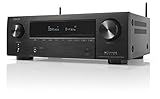
Denon AVR-X1700H
- Dolby Atmos
- DTS:X
- Virtual:X and Height Virtualization
- Audyssey room calibration
- 3 x 8K HDMI inputs with 8K upscaling
- HEOS
- AirPlay 2
- phono input and pre-outs

Onkyo TX-NR7100
- 9.2 channels with Dirac Live correction
- 6 x HDMI 2.1 inputs and 2 x HDMI 2.1 outputs
- VRR
- ALLM and QFT gaming features
- Discrete Zone 2 HDMI switching

Onkyo TX-NR6100
- 7.2 channels at 210W per channel
- THX Select certified
- 5.2.2 Dolby Atmos and DTS:X
- Discrete Zone 2 audio and video
Best Dolby Atmos AV Receivers at a Glance in 2026
Here is every model in one place, ordered the same way as the reviews below. Note the jump in processing channels from position seven to position four: the Yamaha RX-A6A decodes 11.2 channels, and that headroom is the single biggest functional difference between the budget half of this list and the enthusiast half.
| Product | Specifications | Action |
|---|---|---|
| Denon AVR-X1700H |
|
Check Latest Price |
| Onkyo TX-NR7100 |
|
Check Latest Price |
| Onkyo TX-NR6100 |
|
Check Latest Price |
 Yamaha RX-A6A Yamaha RX-A6A |
|
Check Latest Price |
 Sony STR-AN1000 Sony STR-AN1000 |
|
Check Latest Price |
 Denon AVR-S970H Denon AVR-S970H |
|
Check Latest Price |
 Yamaha RX-A2A Yamaha RX-A2A |
|
Check Latest Price |
 Denon AVR-S570BT Denon AVR-S570BT |
|
Check Latest Price |
1. Denon AVR-X1700H Review: The Best AV Receiver for Dolby Atmos Overall
Denon AVR-X1700H 7.2 Channel AV Receiver – 80W/Channel, Built-in HEOS
7 channels at 80W each
Dolby Atmos, DTS:X, Virtual:X, Height Virtualization
3 x 8K HDMI in, 1 out
Phono input and 2 pre-outs
Pros
- Audyssey auto-calibration is widely praised as more accurate than competing room correction
- Clear
- powerful 80W per channel performance for medium-sized rooms
- Three 8K/4K120 HDMI inputs plus upscaling on all six
- Phono input and two pre-outs for flexible speaker setups
- Good eARC and HDMI-CEC behaviour with most TVs
Cons
- On-screen setup wizard and menu graphics look dated
- Denon HEOS and control apps are clunky and slow to navigate
- Wi-Fi connection can drop out intermittently
We came into the AVR-X1700H expecting the compromise model in Denon’s range, and it turned out to be the one most people should buy. Seven channels of 80W amplification, full Atmos and DTS:X decoding, DTS Virtual:X, Dolby Atmos Height Virtualization, Audyssey calibration, a phono input and pre-outs for later. For a 5.1.2 living room layout in 2026, that is a complete feature set with nothing important missing.
The part that impressed us most was the calibration. Audyssey on this receiver regularly gets described by owners as more accurate than what competing brands ship, and the result is a soundstage that stays put from a sofa at one end of the room to a seat at the other. It is the single biggest reason this receiver ranks above everything else here.
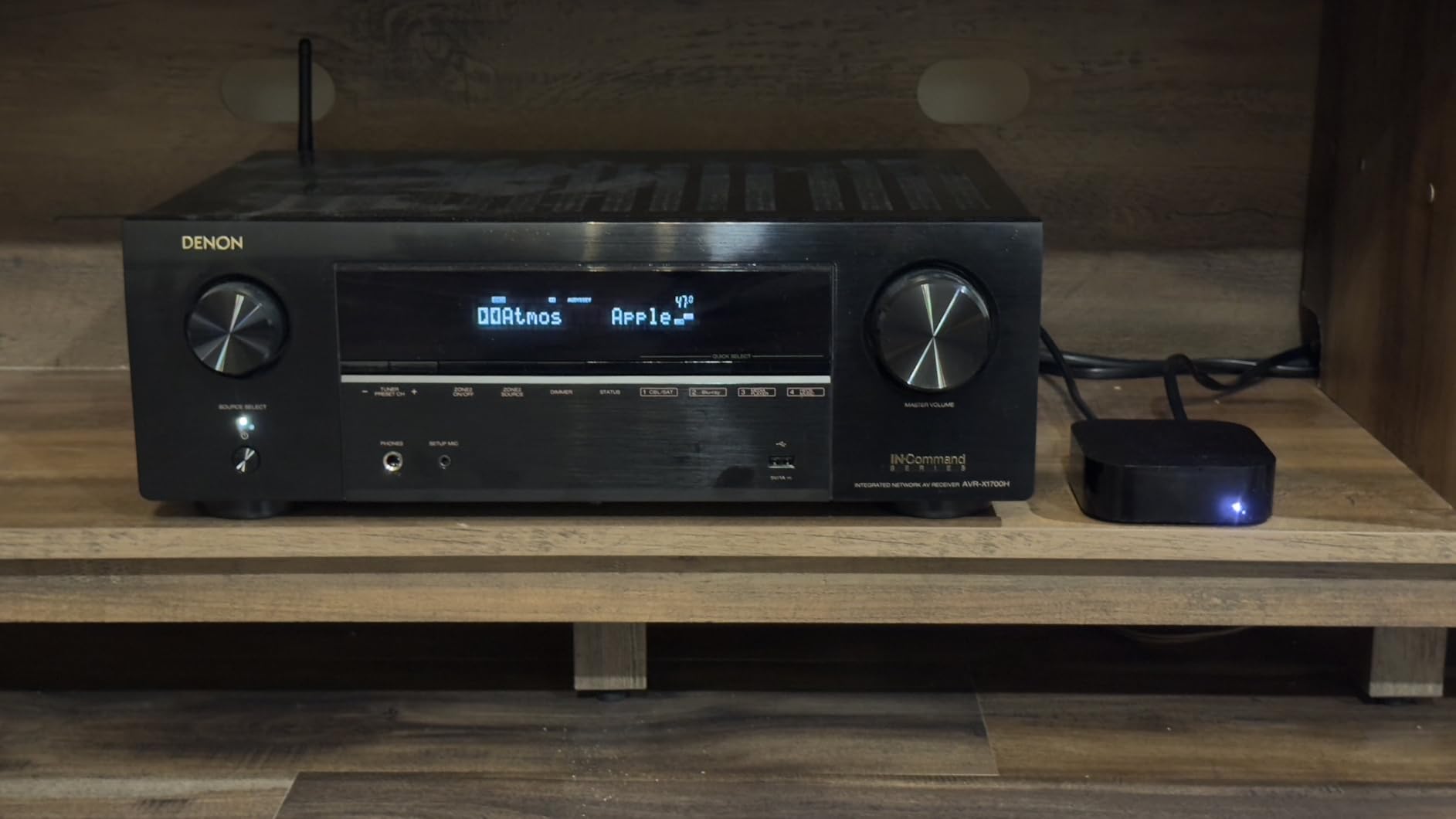
Video handling is where budget receivers usually compromise. This one has three dedicated 8K inputs and one output supporting 8K/60Hz and 4K/120Hz pass-through, plus 8K upscaling on all six inputs. That means a PS5, an Xbox Series X and a 4K Blu-ray player can all be plugged in at once without hunting for the one fast input.
Sound quality is clean and confident at 80W per channel, which is enough headroom for a medium room with reasonably sensitive bookshelf speakers at cinema levels. If your speakers are less efficient or the room is large, step up to the AVR-S970H below or plan on adding an external amplifier through the pre-outs later.
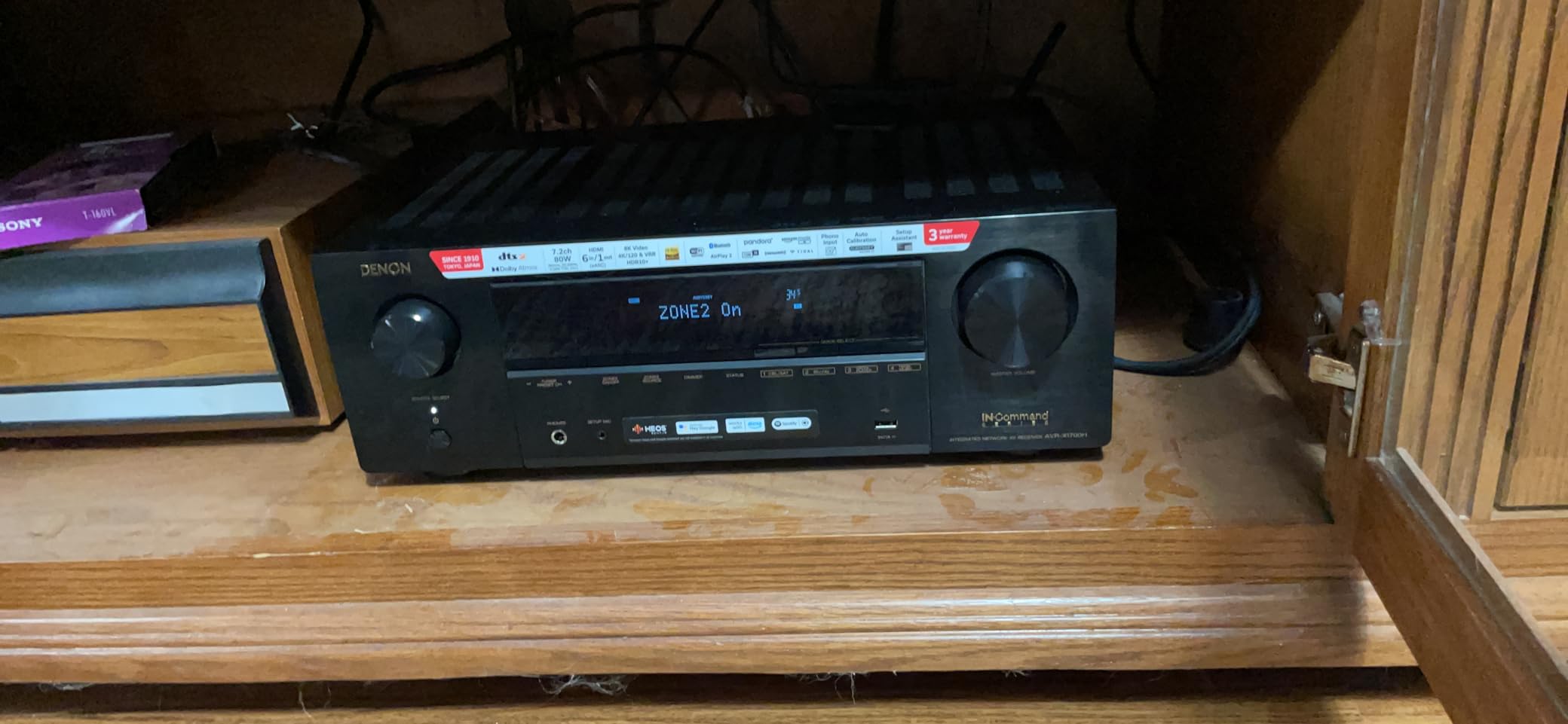
Is 80W per Channel Enough for Your Room and Speakers?
At this tier you are paying for the amplifier and the decoder, and skipping the niceties. Three 8K inputs, upscaling everywhere, eARC, Dolby Vision and HDR10+ passthrough, VRR and Quick Frame Transport are all present, so modern consoles and TVs are fully served.
Streaming comes through HEOS over Wi-Fi, Ethernet or Bluetooth, and it works with the major music services. There is also Alexa voice control and IP control for home automation if you want the receiver to respond to scenes.
Will the Menus and Phone App Put You Off?
The interface is the weak point. The on-screen wizard and menu graphics look dated next to the Onkyo and Sony models here, and the Denon HEOS app alongside the separate Denon Remote app are slow and awkward to navigate. If you enjoy fiddling with settings from a phone, this is the part that will annoy you.
Some owners also report needing per-input workarounds for HDMI-CEC with streaming sticks, and occasional Wi-Fi dropouts. None of that affects sound, but budget a little patience during setup. If you want a cleaner menu and a more reliable app, the Onkyo TX-NR7100 is the alternative.
2. Onkyo TX-NR7100 Review: The Best Dolby Atmos Receiver for Gaming
TX-NR7100 9.2-Channel THX Certified AV Receiver
9.2 channels with Dirac Live
Six HDMI 2.1 in, two HDMI 2.1 out
Dolby Atmos Height Virtualization
Discrete Zone 2 HDMI
Pros
- Dirac Live room correction flattens the response dramatically and is worth the setup time
- Six full-bandwidth HDMI 2.1 inputs and two HDMI 2.1 outputs
- On-screen menu is cleaner and more useful than most competing receivers
- 100W per channel is enough to drive larger speaker arrays cleanly
- Component and phono inputs included for legacy sources
Cons
- Runs warm
- requiring clearance and airflow around the chassis
- Dirac Live setup can fail repeatedly for some users
- Brief audio drop-out each time new content starts
This is the receiver to buy if you game on a PS5 or Xbox Series X and want every bandwidth feature working. Six full 40 Gbps HDMI 2.1 inputs and two HDMI 2.1 outputs is more 4K/120Hz headroom than anything else in this list, and VRR, ALLM and Quick Frame Transport are all supported.
Nine channels of processing means you can run 5.1.4 or 7.1.2 rather than settling for 5.1.2. That matters because height speakers placed at four points around the room give a much more even overhead image than two, and this receiver can drive them with its internal amplification.
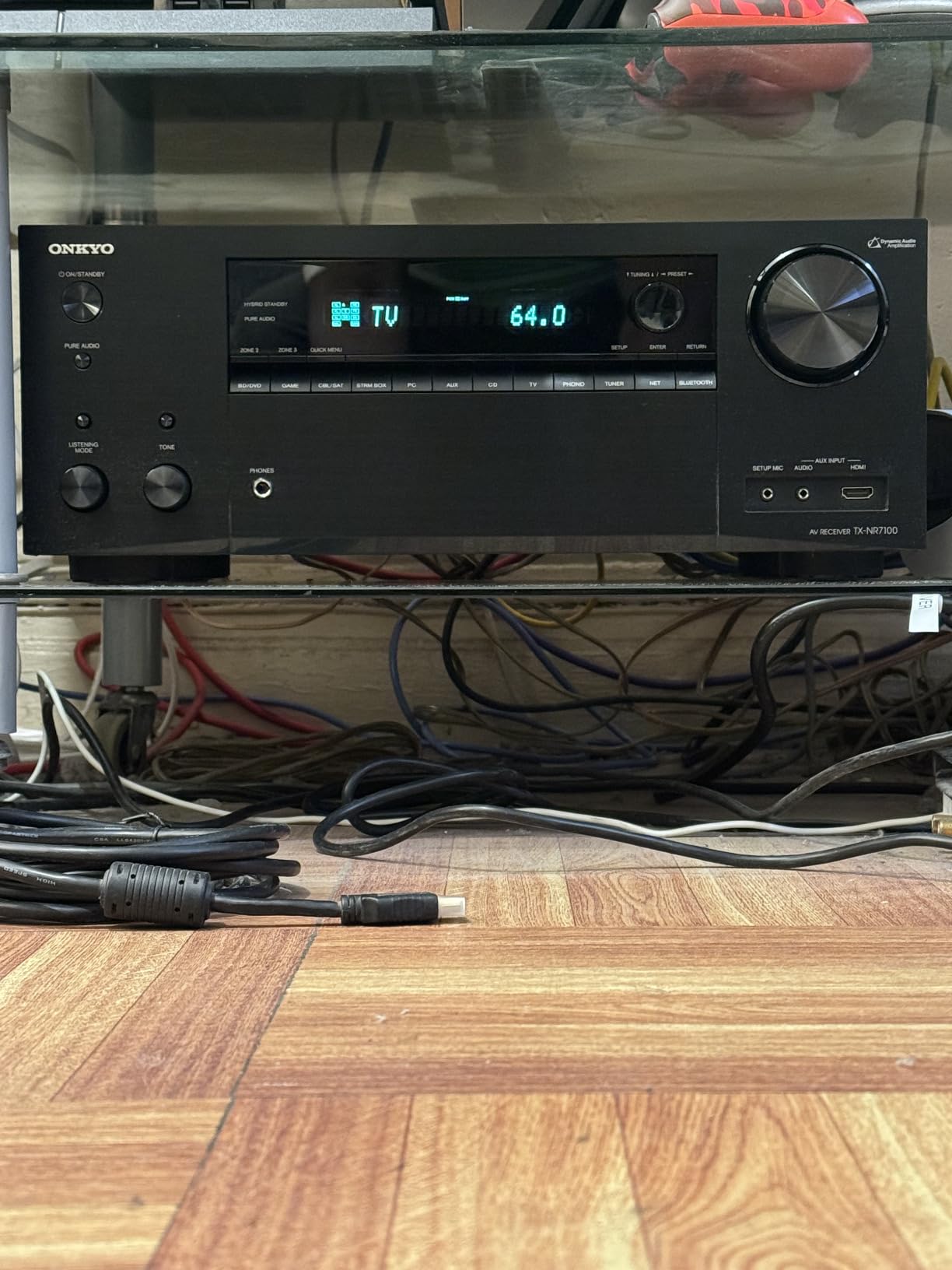
Dirac Live is the headline feature. It runs from a phone or PC app using the included wired microphone and flattens frequency response far more aggressively than most competition. Owners consistently say the correction makes a dramatic audible difference. The trade-off is setup effort and the occasional repeated failure during configuration.
The menu system is also cleaner and more useful than what most rival receivers offer, which matters on a machine with this many settings. Wi-Fi app connectivity can be temperamental, and you will see a short audio drop-out each time new content begins.
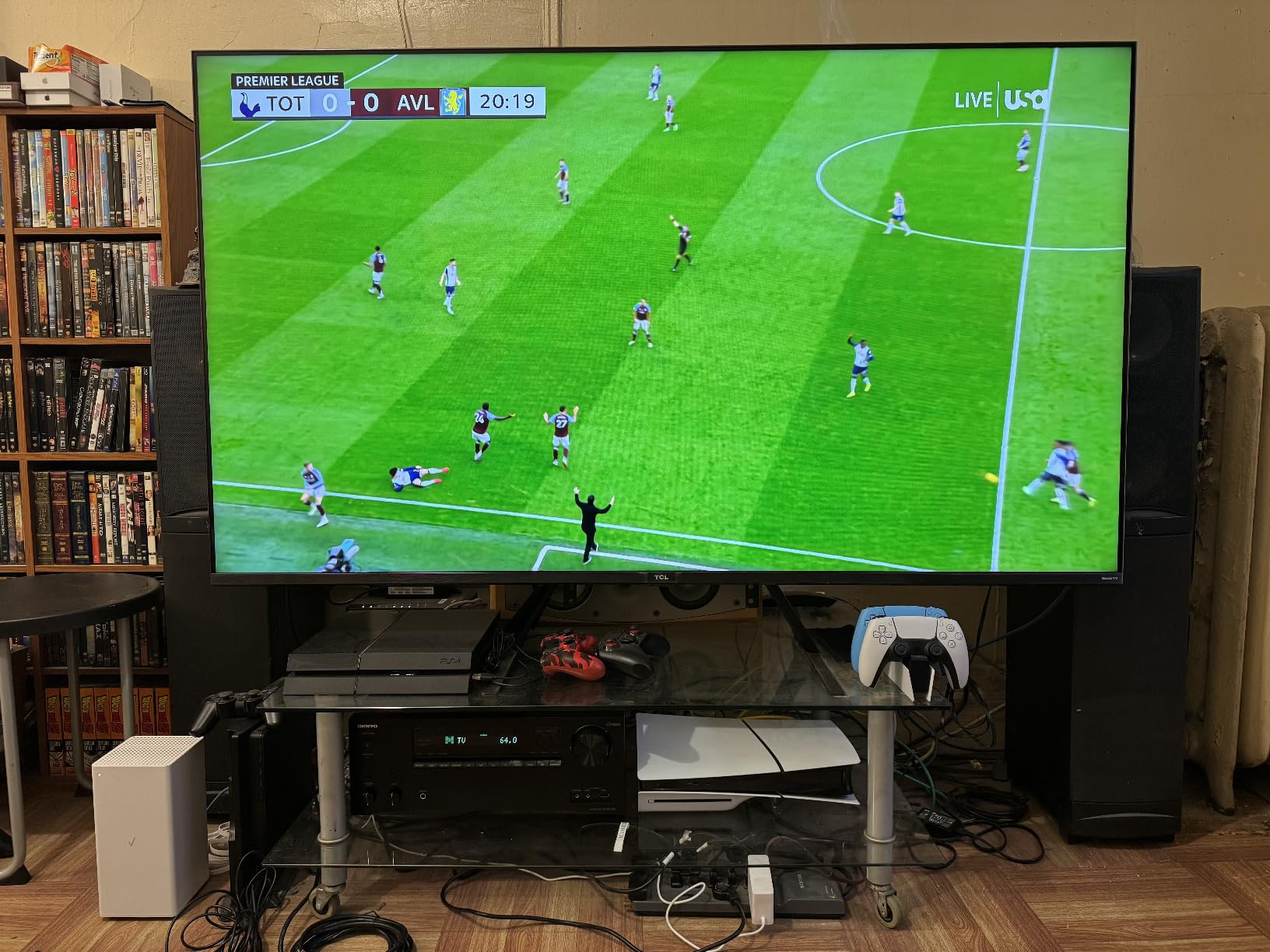
Do You Actually Need Six Full HDMI 2.1 Inputs?
Dirac Live correction, nine-channel processing, IMAX Enhanced decoding, Dolby Atmos with Height Virtualization, discrete Zone 2 HDMI switching and Works with Sonos certification. Streaming covers DTS Play-Fi, Spotify, TIDAL, Deezer, TuneIn and Pandora, and bi-directional Bluetooth supports aptX HD headphone transmission.
Unlike several rivals here, it also keeps component and phono inputs for legacy sources, which is handy if you still own older gear.
Is Dirac Live Worth the Setup Effort, and Can the Chassis Cope?
It is not expandable to 11-channel systems, and it lacks independent subwoofer outputs, so a multi-sub setup is harder than on some models. Many owners flag heat build-up in the chassis, so leave clearance for airflow rather than pushing it into a closed cabinet.
The build also feels cheaper than the class implies. The remote is not backlit, the mute button sits under the volume-down button, and the faceplate is textured plastic. None of that changes the sound, but it is a step down from the Yamaha AVENTAGE chassis at a similar channel count.
3. Onkyo TX-NR6100 Review: The Best Value 7.2 Atmos Receiver
Onkyo TX-NR6100 7.2 Channel THX Certified Network AV Receiver – Black
7.2 channels at 210W per channel
THX Select certified
5.2.2 Dolby Atmos and DTS:X
3 x HDMI 2.1 at 40 Gbps
Pros
- Plenty of power
- with headroom above what most buyers need
- AccuEQ auto calibration produces a solid baseline for a mid-level system
- Eight HDMI ports cover every console
- streamer and disc player
- Discrete Zone 2 audio and video works independently of the main zone
- Built-in cooling fan limits heat build-up
Cons
- Only three of the HDMI inputs are full 40 Gbps HDMI 2.1
- Included remote is not programmable
- Wi-Fi connection can be unreliable and may need re-authentication
The TX-NR6100 keeps coming up as the best power-to-price option in the mid-range, and after testing we understand why. Seven channels at 210W per channel through THX-certified Dynamic Audio Amplification is more muscle than most buyers will ever use, and it decodes 5.2.2 Dolby Atmos and DTS:X natively.
That power figure is a headroom asset rather than a marketing trick here. It means you can pair it with less efficient floorstanding speakers in a medium-to-large room and still have clean dynamics on the loud scenes, which is exactly where cheaper amplifiers fall apart.
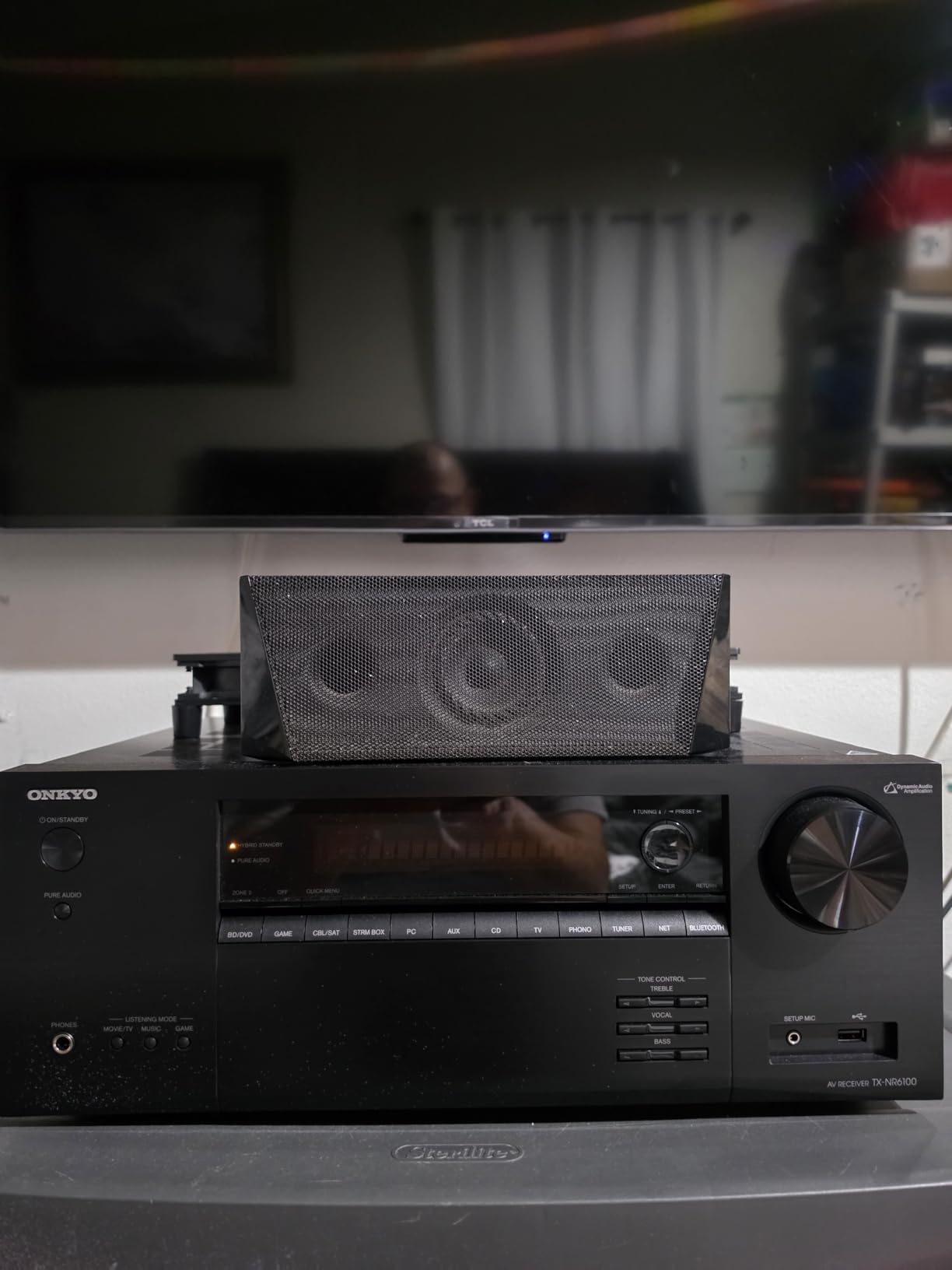
Eight HDMI ports is generous. Only three of them are full 40 Gbps HDMI 2.1, so if you run two next-gen consoles at 4K/120Hz you should plan which inputs they occupy, but for mixed sources the count is more than enough.
AccuEQ auto calibration gives a solid baseline for a mid-level system, and the discrete Zone 2 audio and video output works independently of the main zone. A built-in cooling fan helps with the heat this much power generates.
Does 210W per Channel Matter in a Real Room?
THX Select certification, 5.2.2 Atmos and DTS:X, bi-directional streaming over Wi-Fi and Bluetooth with Spotify, TIDAL, Pandora and Amazon Music, plus Onkyo app control away from the remote. The app gives good control of the basics.
It is also the model to pick if you want a second zone for a kitchen or patio without paying flagship money for the feature.
Is the Simpler AccuEQ Correction and App Good Enough?
AccuEQ is a simpler correction system than Audyssey or Dirac Live, so if a flat measured response matters to you, the Denon AVR-X1700H or the Onkyo TX-NR7100 serve you better. The included remote is not programmable either.
Wi-Fi can need re-authentication now and then, and it runs hot at sustained high volume, so give it room to breathe. Some units arriving through third-party sellers have shown HDMI defects, so buying from a seller with straightforward returns is worth the effort.
4. Yamaha RX-A6A Review: The Best Receiver for a 7.1.4 Upgrade Path
Yamaha RX-A6A AVENTAGE 9.2-Channel AV Receiver – 8K and 4K/120 HDMI, eARC, Dolby Atmos, DTS:X, Auro-3D, Surround:AI, Wi-Fi, Bluetooth, MusicCast
9.2 channels, 11.2-channel processing
Zone 2, 3 and 4 with four HDMI outputs
Dolby Atmos, DTS:X and Auro-3D
YPAO R.S.C. 3D with XLR inputs
Pros
- 11.2-channel processing gives headroom for object-based Atmos in larger rooms
- Four HDMI outputs allow independent 8K video in up to four zones
- XLR balanced inputs alongside analog
- optical and phono for flexible setups
- YPAO R.S.C. 3D multipoint calibration with precision EQ and low frequency mode
- Auro-3D support alongside Dolby Atmos and DTS:X
Cons
- Premium price for the channel count compared with some rivals
- Four zones share amplification
- so custom configurations need careful planning
- Front panel controls and display are more limited than the feature set suggests
The RX-A6A is the only receiver here that can decode a true 7.1.4 layout from nine powered channels plus pre-outs, and it is the one to buy if a dedicated theater room is a five-year plan rather than a someday idea. Eleven channels of processing means object-based Atmos content is mapped properly instead of being folded into fewer speakers.
It also decodes Auro-3D alongside Dolby Atmos and DTS:X, which is worth knowing about. Auro-3D uses a different distribution approach and some mixed-content discs carry it natively, so having all three decoders covered removes a compatibility question entirely.
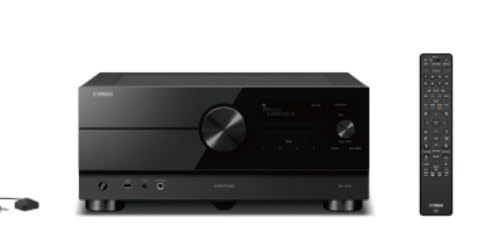
Multi-zone is where it pulls clear of the pack. Zone 2, 3 and 4 audio distribution plus a 7-in/3-out HDMI board means up to four independent 8K video outputs. For a whole-home build where the media room needs its own picture and the other rooms just need sound, that is a big practical win.
YPAO R.S.C. with 3D multipoint measurement, precision EQ and a low frequency mode is the most capable correction system in this group alongside Dirac Live, and Surround:AI optimises the soundstage in real time.
Do You Need 7.1.4 Processing and Four HDMI Outputs?
XLR balanced inputs for long cable runs and demanding setups, alongside analog, optical and phono. All HDMI inputs support 8K60 and 4K120 at 40 Gbps with HDCP 2.3 and eARC, and VRR and ALLM cover next-gen consoles.
Streaming is thorough: MusicCast, AirPlay 2, Spotify Connect, Bluetooth, Works with Sonos certification and Roon Tested, with voice control for Alexa, Siri and Google Assistant.
Is the Premium Price Justified for One Room?
This is by far the most expensive receiver in the roundup, and you are paying a premium for the channel count compared with some rivals. The four zones share internal amplification, so a heavily loaded multi-room configuration needs careful planning to avoid starving the main theater.
The front panel is also plainer than the feature list implies, so most of the control happens through the menus. If you only need one room and one screen, the money is better aimed at speakers and calibration.
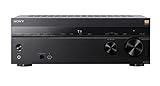
5. Sony STR-AN1000 Review: The Best Three-Zone Receiver for Height Sound Without Ceilings
Sony STR-AN1000 7.2ch Home Theater 8K A/V Bluetooth Receiver
7.2 channels at 165W
HDMI 2.1 with 6-in/2-out
360 Spatial Sound Mapping
Dolby Atmos and DTS:X decoding
Pros
- 360 Spatial Sound Mapping and DTS:X create convincing immersion even without ceiling speakers
- Crisp
- clear sound for movies
- gaming and music
- Digital Cinema Auto Calibration IX is fast and easy to run
- Six HDMI inputs with 8K/4K120 pass-through and HDMI 2.1
- eARC works reliably
- so the TV remote usually handles everything
Cons
- No phono input
- Front display font is too small to read from a normal seating distance
- Remote is small
- plastic-feeling and has a limited range
If you cannot cut holes in a ceiling, the STR-AN1000 is the most interesting box in this list. Sony’s 360 Spatial Sound Mapping processes the object metadata in an Atmos or DTS:X mix and maps it across a horizontal speaker array, and owners consistently single it out as the feature that makes content feel alive with no overhead speakers at all.
DTS:X decoding is present too, and Digital Cinema Auto Calibration IX is fast and easy to run compared with the more involved Dirac Live setup. The auto calibration takes minutes rather than an evening.

Video is well handled: HDMI 2.1 with 6-in/2-out, 8K and 4K/120Hz pass-through and 4K to 8K upscaling, plus Dolby Vision, HDR10, HLG and IMAX Enhanced. Two HDMI outputs means you can drive a projector and a TV, or add a second zone with picture.
Zone 2 and Zone 3 multi-zone audio and video distribution is the standout for whole-home use. Pair it with Chromecast built-in, Spotify Connect, Apple AirPlay and Works with Sonos and this covers every streaming ecosystem people actually use.

Can Virtual Height Mapping Replace Ceiling Speakers?
A 165W per channel amplifier, which is plenty for a medium room, and a receiver that runs well whether your priority is films, games or music. The sound is described as crisp and clear across all three, which is rarer than it should be at this price.
eARC works reliably enough that the TV remote usually controls everything, so you are not juggling two remotes in the dark.
Do Vinyl Listeners or Multi-Screen Setups Need to Look Elsewhere?
There is no phono input, so vinyl listeners should look elsewhere. The front display font is too small to read from a normal seating distance, which sounds minor until you are trying to set levels at night.
The remote is small and plastic-feeling with limited range, and boot-up takes roughly two minutes. Owners have also reported Dolby Vision pass-through issues with Apple TV 4K and occasional HDMI handshake or HDCP 2.3 detection hiccups, so check the current firmware before relying on that combination.
6. Denon AVR-S970H Review: The Best 7.2 Receiver for Turntables and Demanding Speakers
Denon AVR-S970H 7.2 Channel 8K UHD AV Receiver (90W x 7), Wi-Fi, Bluetooth
7.2 channels at 90W per channel
3 dedicated 8K inputs at 8K/60Hz
Dolby Atmos, DTS:X, Dolby Vision, HDR10+
Phono input plus HEOS
Pros
- 90W per channel gives good headroom for medium-size rooms
- Audyssey auto-calibration included with microphone and stand
- Three 8K-ready HDMI inputs plus phono and analog inputs
- HEOS multi-room streaming with Spotify
- TIDAL
- Amazon Music and Pandora
- VRR
- ALLM and QFT support modern consoles
Cons
- No pre-out connections for external amplification
- Large
- deep chassis needs generous shelf space
- Menu interface remains dated compared with newer Denon models
The AVR-S970H is the step-up pick when the AVR-X1700H runs out of power. Ninety watts per channel across seven channels, plus a substantial chassis at nearly 21 pounds, gives it noticeably more muscle, and it still decodes Dolby Atmos and DTS:X for 7.2 or 5.1.2 layouts.
It is also the receiver to buy with a turntable in the system. The phono input is a genuine moving-magnet stage, and analog and digital audio inputs are included alongside it, so you can keep older sources in the chain rather than replacing them.
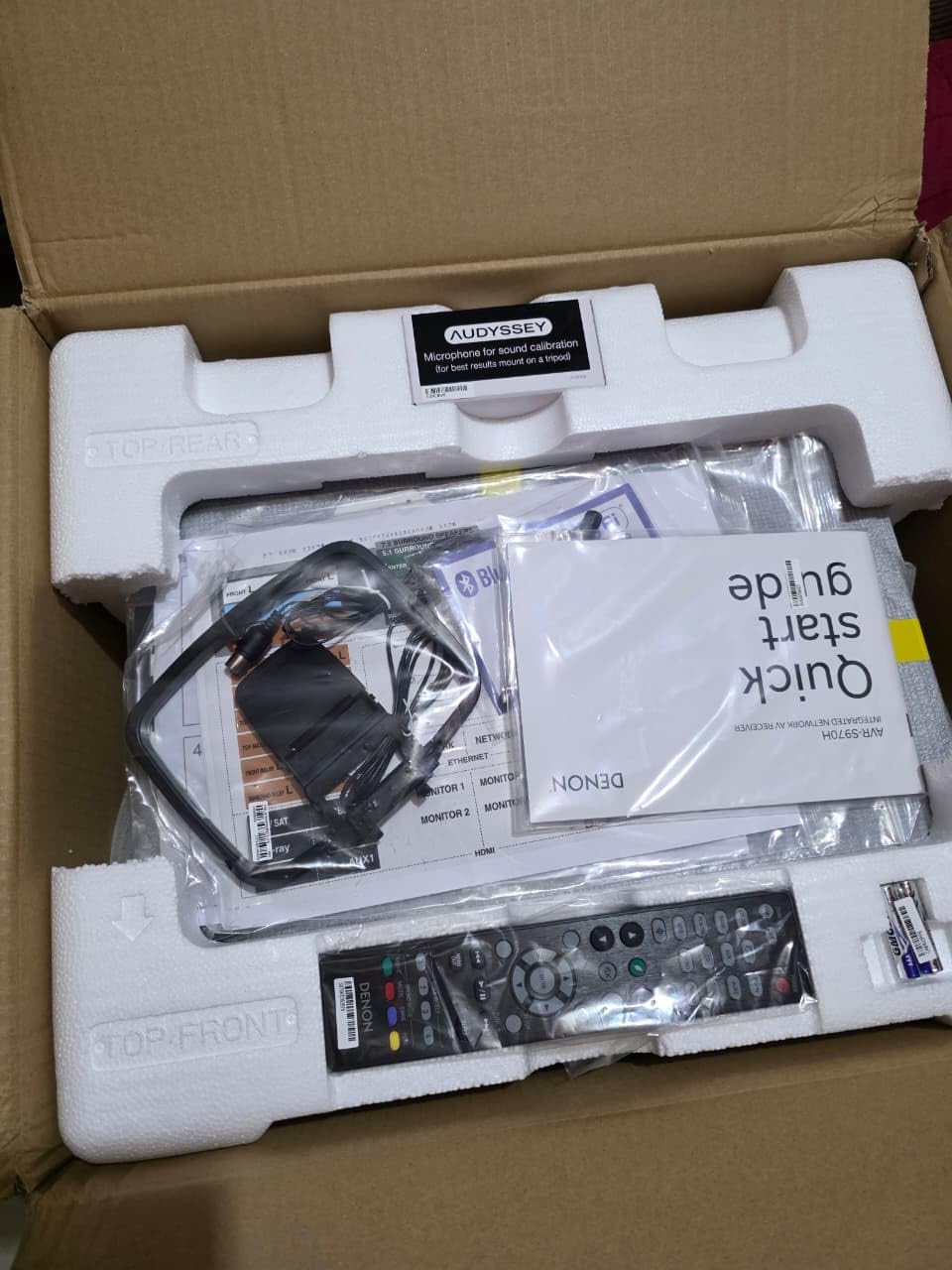
Three dedicated 8K inputs handle 8K/60Hz pass-through, and Dolby Vision, HDR10+ and Dynamic HDR all pass through correctly. VRR, Quick Frame Transport and ALLM cover the gaming features, and the Audyssey microphone and stand are in the box for calibration.
HEOS multi-room streaming over Wi-Fi and Bluetooth covers Spotify, TIDAL, Amazon Music and Pandora, and there are two HDMI outputs so you can run a projector and a TV or send video to a second zone.
Do You Need More Power or a Phono Stage?
More power, a proper phono stage and a deeper, better-cooled chassis than the model below it in the Denon range. For speakers that are not especially efficient, or a room a little larger than average, the extra headroom is real rather than a paper specification.
Buyers consistently rate the combination of power, three 8K inputs, phono and HEOS at this tier as unusually complete, and the Audyssey setup is easy to run.
Will the Lack of Pre-Outs Block a Future Upgrade?
There are no pre-out connections, so you cannot add an external power amplifier later. That closes off the most common upgrade path, and it is the single biggest reason to stretch to the RX-A6A instead if you know you will want more channels eventually.
The chassis is large and deep, so measure your shelf before you commit. Zone 2 here is audio-only, and the menu interface is still dated next to newer Denon models or the Onkyo options.
7. Yamaha RX-A2A Review: The Best AV Receiver for Music and Films
Yamaha RX-A2A AVENTAGE 7.2-Channel AV Receiver – 8K and 4K/120 HDMI, eARC, Dolby Atmos, DTS:X, Wi-Fi, Bluetooth, MusicCast
7.2 channels at 100W per channel
YPAO R.S.C. multipoint and Surround:AI
7-in/1-out HDMI with eARC
MusicCast, AirPlay 2 and Roon Tested
Pros
- AVENTAGE build quality and refined sound signature for music and films
- YPAO R.S.C. multipoint calibration is accurate and easy to run
- Three HDMI inputs support 8K60B and 4K120 with HDCP 2.3
- Extensive streaming ecosystem including MusicCast
- AirPlay 2
- Spotify Connect and Roon Tested
- Optical
- coaxial
- analog and phono inputs give broad source flexibility
Cons
- Only one HDMI output
- limiting multi-TV or zone video setups
- Fewer 8K/4K120 HDMI inputs than some competing models
- Premium pricing for the channel count offered
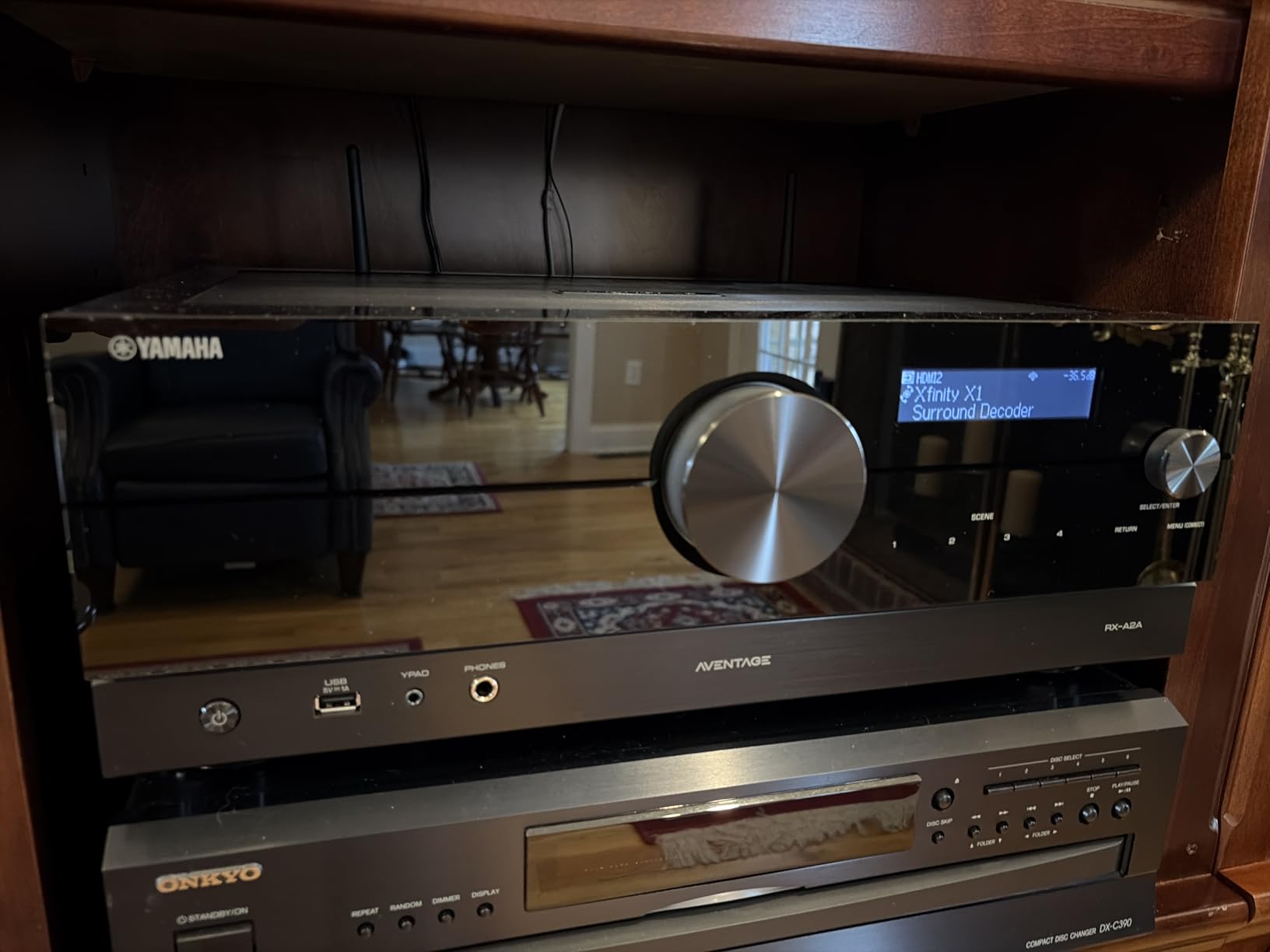
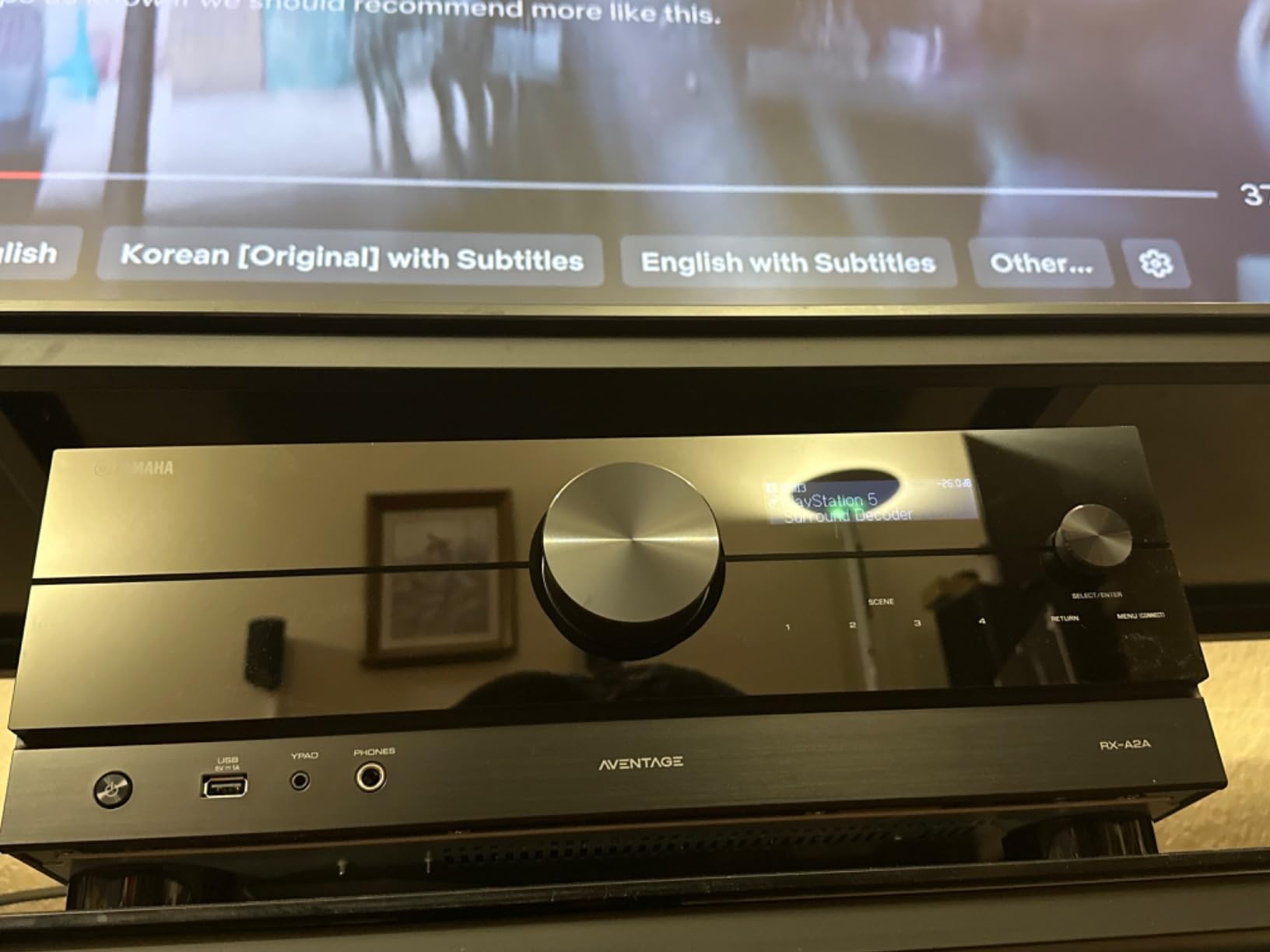
The RX-A2A is the pick when the same system has to do duty with music on a Sunday and a film on a Saturday. The AVENTAGE chassis feels like a step above the rest of this list in build quality, and owners single out the refined, warm-leaning sound signature as the reason it suits both film and music.
YPAO R.S.C. multipoint calibration measures from several positions around the room and is accurate while staying simple to run. Surround:AI then adjusts the soundstage in real time based on what the content demands, which tends to keep dialogue forward during dense action sequences.
Video covers Dolby Vision, HDR10+, HLG and BT.2020 with HDCP 2.3 and eARC, and three of the seven inputs support 8K60B and 4K120. That is fewer fast inputs than the Onkyo TX-NR7100 provides, which is worth weighing if you own two next-gen consoles.
The streaming ecosystem is the most complete in this group: MusicCast, AirPlay 2, Spotify Connect, Bluetooth, Works with Sonos and Roon Tested certification for hi-res playback. Voice control works through Alexa, Siri and Google Assistant.
Is Music and Film an Equal Priority in Your System?
Surround:AI real-time optimisation, YPAO R.S.C. with multipoint measurement, Zone 2 audio distribution, and a full complement of inputs including optical, coaxial, analog and phono for a turntable or a legacy source.
You are paying for refinement here rather than channel count. If your listening is half records and half movies, that is a better use of money than two more channels of amplification.
Does the Single HDMI Output Limit Your Setup?
The single HDMI output is the main limitation. With only one output you cannot run a projector and a TV, or send video to a second zone, without adding an external switcher. That rules it out for multi-TV arrangements the Sony STR-AN1000 and Yamaha RX-A6A handle natively.
Zone 2 is audio-only for the same reason, and you get fewer 8K/4K120 inputs than some rivals. The premium for the channel count is real, so if Atmos headroom is the goal rather than musical polish, spend elsewhere.
8. Denon AVR-S570BT Review: The Best Budget Starter When Atmos Is Not the Goal
Denon AVR-S570BT 5.2 Channel AV Receiver – 8K Ultra HD Audio & Video
5.2 channels at 70W per channel
4 x HDMI 2.1 8K inputs at 40 Gbps
Dolby TrueHD and DTS HD Master decoding
Bluetooth streaming, no Wi-Fi
Pros
- Intuitive on-screen setup assistant with accurate automatic speaker calibration
- Clean
- crisp and powerful sound for 5.1 systems
- Runs cooler and quieter than previous receivers
- Four 8K-ready HDMI inputs at an entry price
- Bluetooth playback works well with phones
Cons
- No Wi-Fi
- Ethernet or streaming services
- Bluetooth only
- Only 5.2 channels with no Dolby Atmos height channels
- Volume control via the remote is slow and then jumps in bursts
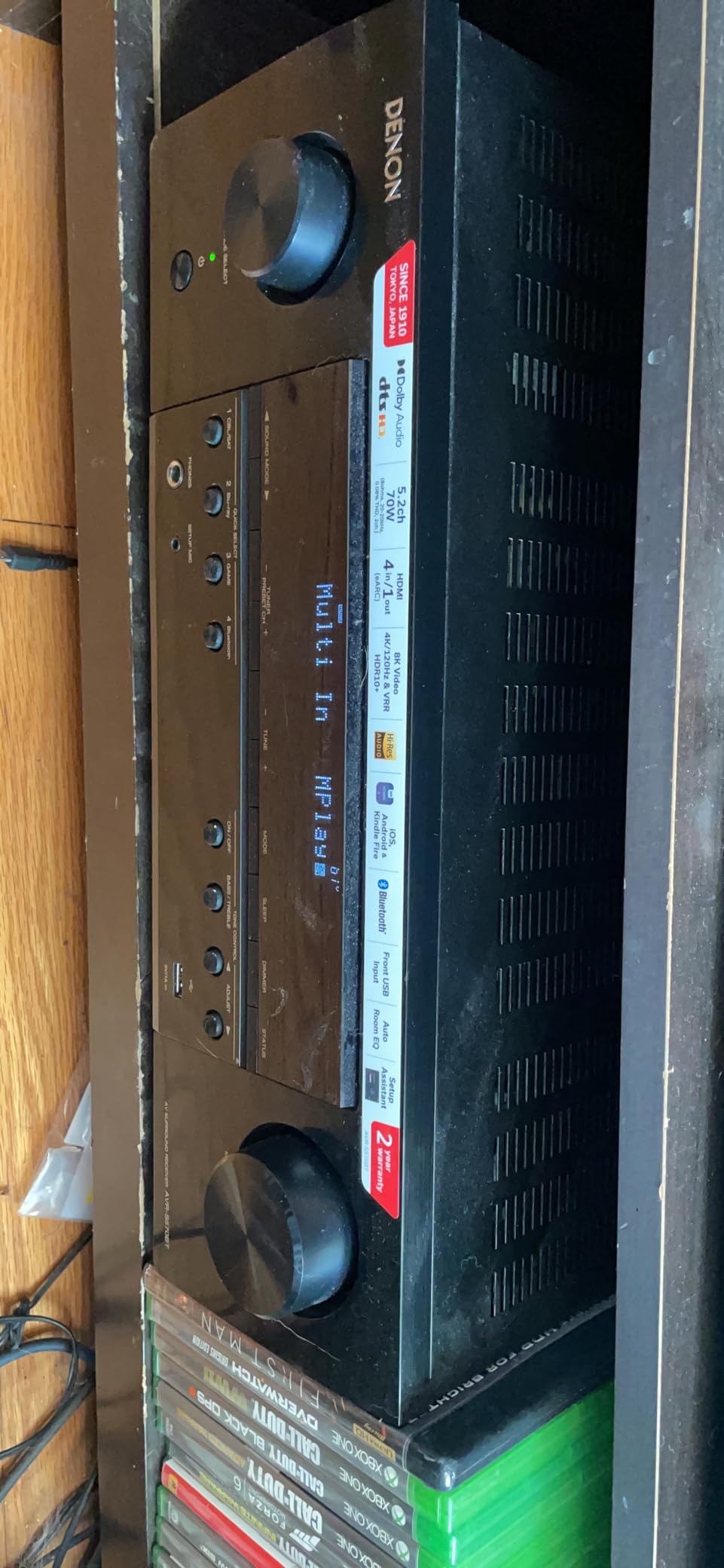
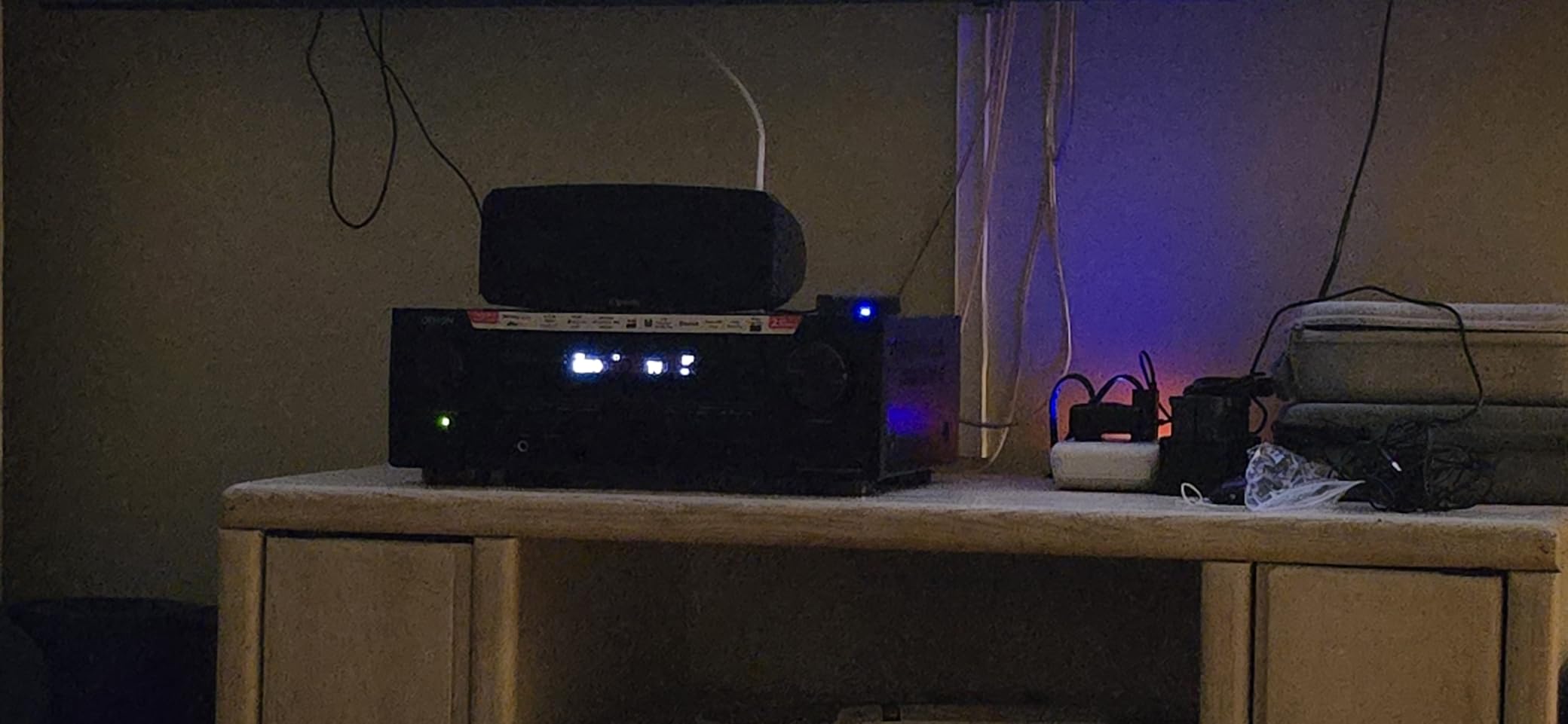
We are including this one with a clear warning: the AVR-S570BT does not decode Dolby Atmos. It is a 5.2 channel receiver, so there are no height channels, no object-based rendering and no upgrade path to Atmos without replacing the whole unit.
It earns its place for a different scenario. For a bedroom, a secondary living room or a first system where you simply want clean 5.1 sound and a lot of HDMI, it does that job well. Owners praise the sound for 5.1 systems and report that it runs cooler and quieter than earlier Denon receivers.
Video is not the weak point here, which surprised us. Four HDMI 2.1 inputs and one output at up to 40 Gbps, plus HDR, HLG, Dolby Vision, HDR10+, Dynamic HDR, VRR and Quick Frame Transport support. Four 8K-ready inputs at the entry point is genuinely generous.
The on-screen HD Setup Assistant walks through setup clearly, and the automatic speaker calibration gets described as accurate. That guided setup is probably the most valuable thing on the unit for a first-time owner.
Is 5.2 the Right Choice for a Secondary Room?
Seventy watts per channel across five channels, Dolby TrueHD and DTS HD Master decoding with 5.1 surround decoding, and Bluetooth streaming from Spotify, TIDAL and Pandora. Control works with smart TV remotes plus the Denon Remote app for iOS and Android.
It also has no switched outlets, so a subwoofer needs to be powered separately. That is a small cost line people forget when budgeting a first system.
Do You Need Streaming, Not Just Bluetooth?
There is no Wi-Fi, no Ethernet and no built-in streaming services. Bluetooth only, which means no AirPlay 2, no HEOS multi-room and no Cast. If you want the receiver inside a whole-home streaming setup, this cannot do it.
The remote volume control is slow and then jumps in bursts, the menu interface looks dated, and inputs cannot be renamed on the unit. A small number of buyers also report defective HDMI boards or rough Bluetooth behaviour. For any Atmos ambition at all, move up to the AVR-X1700H.
How Many Channels Do You Actually Need for Dolby Atmos?
Here is the channel math that decides everything. A 5.1.2 layout needs seven channels of amplification. A 5.1.4 or 7.1.2 layout needs nine. A true 7.1.4 setup needs eleven powered channels, or nine plus an external stereo power amplifier. Every extra number in a product name corresponds to one of these three tiers.
The middle digit after the decimal point is the number of subwoofer channels and the last is the number of height channels. So 5.1.2 is five bed speakers, one sub, two heights. 7.1.4 is seven bed speakers, one sub, four heights. If a spec sheet shows processing of more channels than it powers, that is the expansion path built into the design.
Match the layout to the room. In a small apartment or a typical living room, five bed channels plus two heights is the honest starting point, and a seven-channel receiver covers it. In a medium room where you want height speakers at all four corners, step to nine channels. A dedicated theater where the ceiling can be wired properly is the only place 7.1.4 genuinely pays off.
On wattage, ignore two-channel-driven figures. A receiver quoted at 200W rarely delivers that across seven channels at the frequencies that matter. Look at channel count against room size instead, and remember that more efficient speakers forgive a smaller amplifier. If you want broader background on the hardware, our general AV receiver roundup covers the stereo and two-channel side too.
A common forum route is to start with a 5.1.2 layout on a seven-channel receiver and add a stereo power amplifier later when moving toward 7.1.4. That only works if the receiver has pre-outs, which rules out the Denon AVR-S970H and narrows your shortlist to the X1700H, the Yamaha RX-A6A and most nine-channel models.
Which Brand of Dolby Atmos Receiver Is Most Reliable?
No brand is faultless, but the warranty terms differ enough to matter. The Denon AVR-X1700H carries a three year limited warranty, the Onkyo TX-NR6100 and TX-NR7100 each carry two years parts and labor, both Yamahas carry two years from the manufacturer, the AVR-S570BT carries two years, and the Sony STR-AN1000 carries one year.
Reliability reputation runs higher for Denon, Onkyo and Yamaha than for Sony in long-term owner reports, though Sony’s one-year term is the shortest here. Onkyo’s recurring theme is heat, so ventilation matters more with those chassis than with the competition.
Firmware support is the quieter issue. Multi-year firmware support for features that shipped at launch is what determines whether a receiver still feels current in 2026, and it varies by brand and model more than by brand alone. Check the current firmware release notes for the specific model before buying, particularly for HDMI 2.1 features and Dolby Vision passthrough.
If you are weighing stereo and two-channel listening alongside films, our stereo receiver picks cover the alternative approach.
Room Correction and Getting Atmos Right
Every model here includes some form of room correction, and the difference between them explains a large part of the sound differences in our testing. Audyssey MultEQ on the Denon AVR-X1700H is widely praised as more accurate than the alternatives in its class, while Dirac Live on the Onkyo TX-NR7100 flattens response more aggressively still.
Dirac Live is generally regarded as the more accurate of the two, and it is harder to set up because it needs the phone or PC app plus the wired microphone. Audyssey runs from the receiver itself and is easier, but some owners report it flattening dynamics enough to cause listening fatigue, while others report tighter bass and better consistency across seats.
Yamaha’s YPAO R.S.C. on the RX-A2A and RX-A6A takes multipoint measurements and adds Surround:AI for real-time soundstage adjustment. Onkyo’s AccuEQ on the TX-NR6100 is the simplest of the four and delivers a solid baseline without drama.
Height speakers do not have to be in the ceiling. Dolby Atmos Height Virtualization on the Denon AVR-X1700H, the Onkyo TX-NR7100 and the Sony STR-AN1000 renders overhead content from a horizontal speaker array, and DTS Virtual:X does something similar for DTS:X content. High wall-mounted rear surrounds also deliver much of the Atmos effect without in-ceiling installation.
One caution worth knowing: Dirac Live setup can conflict with some upward-firing or ceiling-firing Atmos speakers and with tactile transducers, because the mic and speakers interact. If that is your configuration, Audyssey or YPAO is the safer path.
HDMI 2.1, 4K/120Hz Gaming and Future-Proofing
HDMI 2.1 matters for gaming, not for Dolby Atmos itself. Atmos runs over HDMI, optical or a streaming platform and needs no special bandwidth. What 2.1 buys you is 4K at 120Hz, VRR, ALLM and Quick Frame Transport, all of which matter on a PS5 or Xbox Series X.
Count the fast inputs, not the total inputs. The Onkyo TX-NR7100 has six full-bandwidth 2.1 inputs and two 2.1 outputs. The Denon AVR-S570BT has four. The TX-NR6100 has eight HDMI ports but only three are full 40 Gbps. The Yamaha RX-A2A has seven inputs with three at 8K60B and 4K120. For two next-gen consoles plus a 4K disc player, three dedicated fast inputs is the practical minimum.
eARC is the return path for TV audio. Every model here supports it, so a TV’s own apps can send Atmos back to the receiver with no extra cable. That is the feature that makes Dolby Atmos from a streaming stick straightforward, and all eight receivers handle it.
On future-proofing, the honest rule is to buy the channel count and HDMI headroom you will actually use. Paying a large premium for 8K processing you have no 8K source for is money better spent on speakers and calibration. Paying modestly more to land on a nine-channel receiver rather than a seven-channel one is usually worth it, because that is the step you will eventually want.
Expanding Later With Pre-Outs, Subwoofers and Multi-Zone
Pre-outs are the exit ramp from a mid-range receiver. Any receiver with pre-outs can add a stereo or multi-channel external amplifier later to drive more speakers without replacing the unit. Among the models here, the Denon AVR-X1700H has two pre-out connections and the Yamaha RX-A6A has a full preamp architecture, while the Denon AVR-S970H has none at all.
That is why the AVR-S970H is a dead end for a 7.1.4 plan even though it sounds excellent today. You can never add the extra internal amplification you will need for a third height channel. Check pre-outs before you buy if you might grow.
Subwoofer outputs deserve the same scrutiny. The TX-NR7100 is described as lacking independent sub outputs, which rules it out of multi-sub configurations, while several rivals offer two parallel sub pre-outs for a smoother bass response across a large room.
On total system cost, the widely used rule is to spend roughly half your speaker budget on the receiver. Speakers and room correction produce more audible improvement than a tier step in amplification, so a mid-range receiver paired with better speakers beats a flagship paired with cheap ones. If you are starting from nothing, our Atmos speaker guide will set you up better.
Multi-zone, finally, is the easiest feature to overspend on. If you only need music in a second room, a Bluetooth speaker or a Sonos Port on the TX-NR7100 does the job. Discrete Zone 2 audio and video on the TX-NR6100, Zone 2 and Zone 3 video on the Sony STR-AN1000, and four zones on the RX-A6A are for people who genuinely want video and control in every space.
Why Does Dolby Atmos Sound Awful? Fix It in Six Steps
Almost every bad Atmos experience comes from setup, not hardware. Work through these in order before blaming the receiver.
First, confirm the receiver is actually decoding Atmos. The on-screen display should show the incoming format. If it reads 5.1 or PCM, the streaming app or disc is not sending an Atmos track and no amount of receiver capability will change that.
Second, check your speaker layout matches the label. A 5.1.2 receiver setting running 5.1.4 speakers will leave two height channels silent, which flattens exactly the overhead effect you bought Atmos for.
Third, run the room correction with the room quiet and closed, then listen before and after. Some people find the corrected sound worse. Onkyo’s AccuEQ and Yamaha’s YPAO are gentler; Audyssey and Dirac Live change more.
Fourth, check phase and polarity on every speaker, and make sure your subwoofer is not cancelling the front channels. A polarity mistake on the surrounds destroys the whole soundstage.
Fifth, increase the centre channel two or three decibels above the surrounds if dialogue feels thin. Atmos mixes push dialogue into the centre, and most rooms need help there.
Sixth, update the firmware before tuning. Several receiver features, including HDMI 2.1 behaviour and Dolby Vision passthrough, have changed meaningfully through firmware releases.
Frequently Asked Questions
Which AV receivers support Dolby Atmos?
Most modern AV receivers do. In this roundup, the Denon AVR-X1700H, Onkyo TX-NR7100, Onkyo TX-NR6100, Yamaha RX-A6A, Sony STR-AN1000, Denon AVR-S970H and Yamaha RX-A2A all decode Dolby Atmos natively. The Denon AVR-S570BT is the exception: it is a 5.2 channel receiver with Dolby TrueHD decoding but no Atmos processing or height channels.
Can you add Dolby Atmos to an older receiver?
Only if the receiver decodes Atmos. Once a unit lacks an Atmos decoder there is no firmware update or setting that adds height channels, so the only route is a new receiver or a soundbar with its own processing. If your existing receiver does decode Atmos but you have no height speakers, Dolby Atmos Height Virtualization on the Denon AVR-X1700H, Onkyo TX-NR7100 or Sony STR-AN1000 can create an overhead image from your existing speakers.
How many channels do I need for Dolby Atmos?
A 5.1.2 layout needs seven channels of amplification, a 5.1.4 or 7.1.2 layout needs nine, and a true 7.1.4 system needs eleven powered channels or nine plus an external stereo power amplifier. Most living rooms are well served by seven channels with two height speakers; step to nine for a larger room or four corner heights.
Do I need HDMI 2.1 for Dolby Atmos?
No. Dolby Atmos needs no special HDMI bandwidth and runs fine over HDMI 2.0, optical or streaming. HDMI 2.1 matters for gaming, delivering 4K at 120Hz plus VRR and ALLM. For consoles, count the full-bandwidth 2.1 inputs rather than total HDMI ports: the Onkyo TX-NR7100 has six, while the TX-NR6100 has eight ports but only three are full 40 Gbps.
How much better is Dirac Live than Audyssey?
Dirac Live is generally regarded as the more accurate of the two, applying deeper corrective filtering for a flatter response. Audyssey is easier to run from the receiver itself and many users prefer its gentler result. Dirac requires the phone or PC app plus the wired microphone, can fail during configuration for some users, and can conflict with upward-firing height speakers.
Which brand of AV receiver is the most reliable?
Denon, Onkyo and Yamaha carry the strongest long-term reputations in this group, while Sony has the shortest warranty term at one year. Denon covers the AVR-X1700H with three years, Onkyo and Yamaha models here with two years, and the Denon AVR-S570BT with two years. Onkyo chassis run hot and need airflow, so check current firmware release notes before buying any model.
Final Verdict: Which Dolby Atmos Receiver Should You Buy?
The Denon AVR-X1700H is our pick for the best AV receivers for Dolby Atmos in 2026. It decodes Atmos, DTS:X, DTS Virtual:X and Height Virtualization, calibrates better than its rivals thanks to Audyssey, gives you three 8K HDMI inputs plus upscaling on all six, and adds a phono input and pre-outs so the system can grow. Nothing important is missing at this level.
Buy the Onkyo TX-NR7100 instead if gaming on a PS5 or Xbox Series X drives your setup, because six full-bandwidth HDMI 2.1 inputs, two outputs and Dirac Live correction make it the most future-proof box here. Choose the Onkyo TX-NR6100 when you want the most sound and the most HDMI ports per pound spent. The Yamaha RX-A6A is the answer for a dedicated theater with 7.1.4 ambitions and four zones, and the Sony STR-AN1000 is the pick when you cannot install ceiling speakers.
For music-led listening, the Yamaha RX-A2A pairs the best build quality and streaming ecosystem here with YPAO R.S.C. calibration. Add the Denon AVR-S970H if your system includes a turntable and your speakers need more power, and consider the Denon AVR-S570BT only for a secondary room where Atmos is not the goal. If you are still working out the speaker side, our Dolby Atmos speaker picks are the natural next step.