
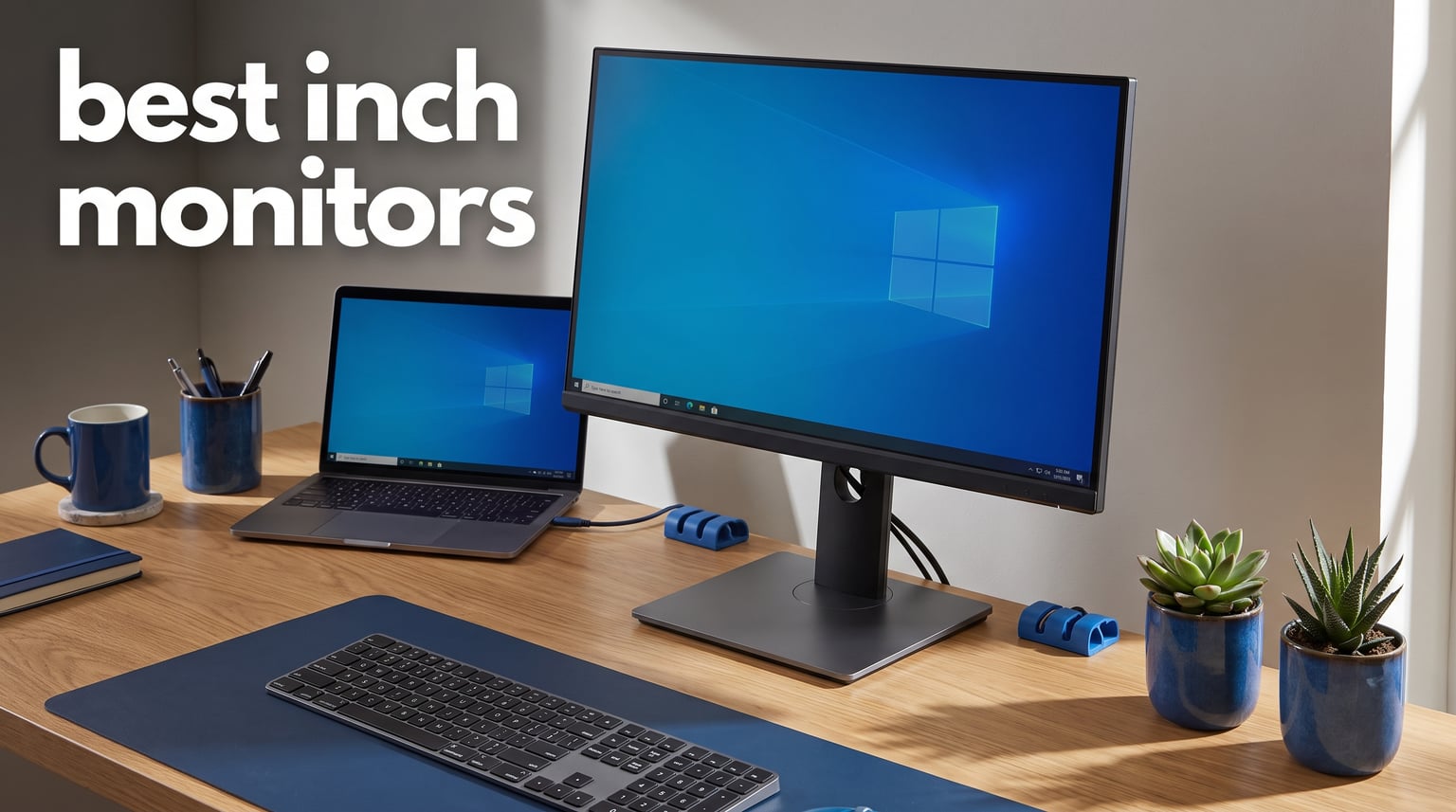
A 27-inch screen is the desktop sweet spot for many of us: large enough for two documents side by side, yet compact enough to fit a normal desk. The best 27 inch monitors in 2026 split into two useful groups—1440p high-refresh models for responsive gaming and 4K USB-C displays for text, creative work, and laptop desks.
I started with the product listings and compared what actually matters at this size: native resolution, panel type, refresh rate, inputs, laptop charging, stand adjustment, color claims, and review feedback. That matters more than a long spec sheet, because a fast QHD gaming display and a color-focused 4K work screen solve very different problems.
My short answer is simple. Choose a 1440p IPS monitor at 144Hz or above when fast PC gaming is the priority; choose 4K when text sharpness, photo detail, or work space matters most; and pick USB-C power delivery only after checking how much power your laptop requires.
The selections below cover both routes without pretending one specification suits every desk. Each review flags the compromises that buyers repeatedly raise in monitor discussions, including non-adjustable stands, reflective screens, limited HDMI inputs, OLED text clarity concerns, and USB-C charging limits.
If your focus is competitive play, our guide to the best gaming monitors for FPS games narrows the field further. If a 4K console or PC display is the goal, see the best 4K gaming monitors after reading this comparison.
Table of Contents
The top 3 picks for 27-inch monitors answer the main work and gaming needs
These three are the clearest starting points from the 12 verified listings. They cover a balanced 4K option, a flexible QHD work-and-play option, and a straightforward high-refresh gaming option.
- Best overall: Dell S2725QC — 4K IPS, 120Hz, 99% sRGB, FreeSync Premium, USB-C charging up to 65W, speakers, and a fully adjustable stand.
- Best balanced QHD: Dell S2725DC — 2560 × 1440 IPS, 144Hz, FreeSync, USB-C charging up to 65W, speakers, and height, tilt, pivot, and swivel adjustment.
- Best high-refresh gaming: Acer Nitro KG271U — 2560 × 1440 IPS, up to 180Hz, 0.5ms GTG, FreeSync, and 95% DCI-P3 coverage.
The Dell S2725QC is the broadest pick because 4K and 120Hz avoid the usual choice between crisp work output and smoother everyday motion. The S2725DC makes more sense when QHD is enough and stand flexibility plus a one-cable laptop connection rank higher than maximum pixel density.
The best 27-inch monitors in 2026 include every verified pick at a glance
This overview uses manufacturer-listed and retailer-listed specifications, so it is a quick way to match resolution and connection needs before reading the longer notes. Ratings reflect the available product listing data and are not our own lab scores.
| Product | Specifications | Action |
|---|---|---|
 Dell S2725DC Dell S2725DC |
|
Check Latest Price |
 Acer Nitro KG271U Acer Nitro KG271U |
|
Check Latest Price |
 AOC Q27G41ZE AOC Q27G41ZE |
|
Check Latest Price |
 Samsung ViewFinity S8 Samsung ViewFinity S8 |
|
Check Latest Price |
 ASUS TUF VG27AQ3A ASUS TUF VG27AQ3A |
|
Check Latest Price |
 LG 27US500-W LG 27US500-W |
|
Check Latest Price |
 LG 27UP850K-W LG 27UP850K-W |
|
Check Latest Price |
 Samsung Odyssey G5 G53F Samsung Odyssey G5 G53F |
|
Check Latest Price |
 Dell S2725QC Dell S2725QC |
|
Check Latest Price |
 ASUS ProArt PA279CRV ASUS ProArt PA279CRV |
|
Check Latest Price |
 Philips 27E1N5900R Philips 27E1N5900R |
|
Check Latest Price |
 Acer CB272K Acer CB272K |
|
Check Latest Price |
1. Dell S2725DC is the balanced QHD choice for a laptop and desktop desk
Pros
- 144Hz QHD IPS
- 65W USB-C charging
- Full ergonomic stand
- Built-in speakers
Cons
- One HDMI port
- 65W may not suit every laptop
The Dell S2725DC combines 2560 × 1440 resolution with a 144Hz refresh rate, which is a practical middle ground for work during the day and games afterward. Its listed 1,500:1 contrast ratio is also higher than the 1,000:1 figure shown on many IPS gaming choices here.
I would put this model at the top of a shared laptop-and-desktop setup because USB-C provides data and up to 65W charging, while HDMI and DisplayPort cover other devices. The pop-out quick-access area adds a USB-C port rated up to 15W and a USB Type-A port.
Dell lists 99% color gamut coverage, dual 3W speakers, a matte anti-glare screen, and TÜV-certified eye-comfort features. Those are useful desk details, though speakers are best treated as convenient audio rather than a replacement for dedicated desktop speakers.
The Dell S2725DC fits people who need one display for work and moderate-speed gaming
The stand supports height, tilt, pivot, and swivel adjustment, so it is one of the easier screens to position at eye level or rotate for long documents. Its 144Hz panel and FreeSync support make scrolling and compatible gaming smoother than a basic 60Hz work monitor.
Its 65W USB-C ceiling is appropriate only if that matches your laptop’s needs. Check the laptop charger label before expecting the monitor to replace it fully.
The Dell S2725DC asks buyers to accept a limited HDMI setup
There is only one HDMI port, so a console, streaming box, and computer may need cable swapping or another connection plan. The listing also calls out 1ms MPRT rather than a 1ms GTG response result, so do not treat the two measures as identical.
For someone whose first priority is an all-in-one 27 inch monitor for work, the port mix and adjustable stand carry more weight than chasing the highest refresh-rate number.
2. Acer Nitro KG271U is the straightforward QHD pick for fast PC gaming
Acer Nitro 27in QHD 2560×1440 IPS 180Hz Gaming Monitor KG271U N3bmiipx
QHD IPS
180Hz
0.5ms GTG
Pros
- 180Hz refresh rate
- 0.5ms GTG
- FreeSync
- 95% DCI-P3
Cons
- Tilt-only stand
- 250-nit brightness
The Acer Nitro KG271U is built around a 27-inch IPS panel at 2560 × 1440, up to 180Hz, and a listed 0.5ms GTG response time. That is a focused spec set for players who want more motion headroom than 144Hz without stepping up to 240Hz.
AMD FreeSync is included to reduce tearing with compatible hardware, and the monitor has one DisplayPort 1.2 input plus two HDMI 2.0 inputs. The zero-frame design is useful when you want the screen to sit beside another display with less visual interruption.
Acer also lists 95% DCI-P3 coverage and HDR10 support. Treat HDR10 support as format compatibility, not a promise of bright HDR impact, because the specified brightness is 250 cd/m².
The Acer Nitro KG271U suits gamers who want QHD resolution and a high refresh rate
The QHD resolution gives more workspace and finer detail than 1080p at 27 inches, while 180Hz gives compatible games frequent frame updates. It is a sensible fit for PC gaming where the graphics card can actually sustain high frame rates.
Its listed review data shows a 4.6 rating across more than 1,000 reviews, giving this model a much broader feedback pool than several newer work-first options in the list.
The Acer Nitro KG271U requires an external arm for full ergonomic control
The included stand offers tilt adjustment, not height, swivel, or pivot adjustment. A wall mount is listed, so an appropriate mount or monitor arm can solve that desk-positioning limitation.
DisplayPort 1.2 also deserves attention if you are planning a specific PC configuration. Confirm the refresh rate your GPU, cable, and selected input can deliver before buying.
3. AOC Q27G41ZE is the high-refresh choice for competitive QHD play
AOC 27″ Gaming Monitor QHD 260Hz Overclocked IPS NVIDIA G-SYNC Q27G41ZE
QHD IPS
240Hz to 260Hz
0.3ms MPRT
Pros
- 240Hz native refresh
- 260Hz overclock via DisplayPort
- G-Sync compatible
- VESA support
Cons
- Glossy finish
- Tilt-only stand
The AOC Q27G41ZE takes the speed route: a 2560 × 1440 IPS panel with a 240Hz refresh rate, with an overclock option to 260Hz through DisplayPort. Its listed 0.3ms MPRT specification and Adaptive-Sync support target players who value quick motion handling.
It is G-Sync Compatible and supports FreeSync, which gives buyers with either major GPU family a clearer starting point. DisplayPort 1.4 and two HDMI 2.0 ports provide a better multi-device arrangement than several single-HDMI work models.
The three-sided frameless design and VESA support make it attractive in a dual-display arrangement. AOC also lists a three-year zero-bright-dot warranty, a detail some buyers will value when choosing a gaming panel.
The AOC Q27G41ZE is best for players who can use its 240Hz class refresh rate
At 27 inches, QHD retains a familiar 16:9 layout while keeping the GPU load lower than 4K. A 240Hz target makes most sense for esports and other games where your PC produces frames at a similarly high rate.
The monitor includes Shadow Control, game presets, and an on-screen display menu. Those are practical adjustment tools, but they do not replace setting the correct output resolution and refresh rate in the operating system.
The AOC Q27G41ZE needs thoughtful placement in a bright room
The listing describes a glossy screen finish, which can show room reflections more readily than a matte surface. Its stand only tilts from -3 to +21 degrees, so height adjustment will require a VESA arm or a suitable riser.
For a player prioritizing speed over USB-C laptop docking or fully adjustable ergonomics, that trade-off is easy to understand before the monitor arrives.
4. Samsung ViewFinity S8 is the 4K USB-C workspace choice with a KVM switch
Samsung 27″ ViewFinity S8 (S80UH) High-Resolution Monitor
4K IPS
90W USB-C
KVM switch
Pros
- 4K resolution
- 90W USB-C charging
- Built-in KVM and LAN
- Picture-by-Picture
Cons
- 60Hz refresh rate
- One HDMI port
The Samsung ViewFinity S8 pairs a 3840 × 2160 IPS panel with USB-C charging up to 90W, a meaningful figure for many higher-powered laptops. It also adds a built-in LAN port and KVM switch, features that directly address a desk shared by two computers.
At 60Hz and 5ms, this is not the gaming-focused Samsung on the list. It is instead a 4K monitor intended for business, photo, and video tasks where sharp text, split-screen use, and connection convenience matter most.
Samsung lists HDR10+, a 350 cd/m² brightness figure, 99% color gamut coverage, and Picture-in-Picture and Picture-by-Picture functions. The ergonomic stand supports tilt and swivel, while Samsung Display Manager is included for arranging windows.
The Samsung ViewFinity S8 is right for two-computer desks and USB-C laptops
A KVM switch can reduce keyboard and mouse clutter when a desktop and laptop share the same monitor. The LAN port also gives a compatible laptop a wired network path through the display setup.
For long spreadsheets, code, and documents, 4K at 27 inches presents a dense workspace. You may need operating-system scaling for comfortable text size, especially at a close viewing distance.
The Samsung ViewFinity S8 is not the answer for high-frame-rate gaming
The 60Hz refresh rate and 5ms response time put it in a different category from the 180Hz, 200Hz, and 240Hz QHD monitors above. One HDMI input can also be restrictive when several entertainment devices need permanent connections.
Its listing has a relatively small review count, so I would treat the detailed port and KVM requirements as the deciding factor rather than relying on popularity alone.
5. ASUS TUF VG27AQ3A is the feature-rich Fast IPS option for QHD gaming
ASUS TUF Gaming VG27AQ3A 27 Inch 1440p 180Hz G-SYNC Gaming Monitor
QHD Fast IPS
180Hz
ELMB Sync
Pros
- 180Hz Fast IPS
- ELMB Sync
- G-Sync compatible
- 130% sRGB
Cons
- No stated height adjustment
- One USB port
The ASUS TUF VG27AQ3A is a QHD Fast IPS gaming monitor with 180Hz refresh, 1ms response time, and ASUS ELMB Sync. It supports FreeSync Premium and G-Sync Compatible operation, so it covers the usual variable-refresh paths for modern PCs.
ASUS lists 130% sRGB gamut coverage and HDR10 support, with two HDMI inputs and DisplayPort. Built-in speakers and a 3.5mm audio connection make it easier to get a basic setup running without another box on the desk.
The matte screen and frameless design are practical for varied room lighting and paired displays. It also includes a DisplayPort cable, power cable, adapter, and documentation according to the listing.
The ASUS TUF VG27AQ3A fits gamers who want blur-reduction tools
ELMB Sync is the standout feature because it is designed to work with variable refresh operation while reducing perceived motion blur. The right choice is still to test your preferred mode with your own games, since image settings are personal.
The 180Hz rate is easier for a midrange gaming PC to approach than 240Hz or 260Hz. QHD helps preserve fine detail without requiring 4K-level rendering output.
The ASUS TUF VG27AQ3A gives up some desk flexibility
The available product details list a 100 × 100 mounting option but do not state height adjustment for the included stand. Plan for a VESA arm if screen height is a firm requirement.
There is only one USB port, so this is not a USB hub replacement. Buyers who want a single cable for a laptop should look at the Dell, Samsung, LG, ASUS ProArt, Philips, or Acer USB-C models instead.
6. LG 27US500-W is the simple 4K IPS monitor for general media and documents
LG 27US500-W Ultrafine Monitor 27-Inch 4K UHD (3840×2160) HDR10 IPS Borderless Design Reader Mode Flicker Safe Switch App HDMI DisplayPort – White
4K IPS
HDR10
90% DCI-P3
Pros
- 4K detail
- 90% DCI-P3
- HDR10
- Two HDMI ports
Cons
- 60Hz only
- 300-nit brightness
The LG 27US500-W puts 4K IPS resolution, HDR10, and a listed 90% DCI-P3 gamut into a simple 60Hz display. It is suited to text-heavy work, streaming, and general multimedia rather than high-speed gaming.
Two HDMI ports plus DisplayPort make it easier to leave multiple devices attached than on a one-HDMI model. The borderless white design will appeal to a clean home-office setup, and LG includes OnScreen Control for workspace customization.
Reader Mode and Flicker Safe are included to support longer screen sessions. Its listed 300 cd/m² brightness and 5ms response time define the limits: this is a standard 4K desktop screen, not an HDR showcase.
The LG 27US500-W suits users who want 4K clarity with uncomplicated connections
4K delivers four times the pixels of 1080p, so fine UI elements and high-resolution photos have more detail at this size. The two HDMI inputs are useful for a computer plus console, media device, or second computer.
The 90% DCI-P3 specification is a helpful wide-color claim for general media. Color-critical work still benefits from a display with a stated calibration result, such as the ProArt or Acer CB272K below.
The LG 27US500-W does not replace a laptop dock or gaming panel
No USB-C input or charging is listed, so laptop users will need a separate power connection and likely an adapter or dock. The 60Hz refresh rate also makes it a less natural pick for fast competitive games.
The stand is described with tilt adjustment, while wall mounting is listed. Check your desired eye height before choosing it for a long workday.
7. LG 27UP850K-W is the 4K creative-work choice with 90W USB-C power
LG 27UP850K-W 27-inch Ultrafine 4K UHD IPS DisplayHDR 400 Computer Monitor
4K IPS
90W USB-C
95% DCI-P3
Pros
- 90W USB-C
- 95% DCI-P3
- DisplayHDR 400
- Full ergonomic stand
Cons
- 60Hz refresh rate
- Limited availability
The LG 27UP850K-W is a 4K IPS display that focuses on creative and laptop-desk features: 95% DCI-P3 coverage, DisplayHDR 400, and USB-C power delivery up to 90W. Its height, tilt, and pivot adjustments make it more adaptable than a tilt-only 4K screen.
There are two HDMI ports, DisplayPort, USB-C, and two USB 3.0 ports. Built-in stereo speakers with Waves MaxxAudio provide convenient audio, while the Switch app is intended to help organize multitasking.
LG also lists FreeSync, Dynamic Action Sync, and Black Stabilizer. Those features can support casual play, but the native 60Hz refresh rate is the defining boundary for a gaming purchase.
The LG 27UP850K-W works for laptop creators who need color coverage and power delivery
A 90W USB-C connection can suit laptops that need more charging capacity than a 65W monitor provides. The 4K canvas and 95% DCI-P3 claim are useful starting specifications for photo and video workflows.
The pivot-capable stand is handy for portrait documents, coding, and vertical social content. For specialized drafting needs, compare these characteristics with our best monitors for CAD work guide.
The LG 27UP850K-W requires a 60Hz mindset for games
Its 5ms response time and 60Hz refresh rate are appropriate for general use and slower-paced games, not for a 180Hz-plus competitive target. DisplayHDR 400 is a recognized HDR tier, but it does not make every HDR source look the same.
The listing also reports limited stock status. Availability can change, so it is smart to confirm the exact model number, 27UP850K-W, before completing a purchase.
8. Samsung Odyssey G5 G53F is the 200Hz QHD IPS option for responsive play
Samsung 27” Odyssey G5 (G53F) Series QHD Gaming Monitor
QHD IPS
200Hz
FreeSync Premium
Pros
- 200Hz refresh
- FreeSync Premium
- Black Equalizer
- HDR10
Cons
- Limited stand adjustment
- No USB-C
The Samsung Odyssey G5 G53F uses a 2560 × 1440 IPS panel with a 200Hz refresh rate and 1ms MPRT response time. It sits neatly between the 180Hz options and AOC’s 240Hz class monitor for buyers who want a high refresh target without that last step.
FreeSync Premium is included, along with HDR10, Black Equalizer, and Auto Source Switch+. The latter can make a desk with multiple connected sources more convenient by detecting an active input.
Two HDMI ports and DisplayPort cover common PC and console arrangements. The matte finish and 178-degree viewing angle are useful baseline IPS characteristics for a shared room or a side-by-side setup.
The Samsung Odyssey G5 G53F is for gamers who want 200Hz QHD without extra workstation features
The 200Hz panel gives a higher ceiling for compatible PC games than the many 144Hz or 165Hz categories. FreeSync Premium is designed to coordinate refresh behavior with compatible AMD hardware and reduce visible tearing.
Black Equalizer is intended to make dark areas easier to see. Use it as an in-game visibility control, not as a substitute for accurate HDR or display calibration.
The Samsung Odyssey G5 G53F leaves ergonomics and USB-C to other equipment
The listing names tilt adjustment but does not list height, swivel, or pivot functions. A monitor arm may be the cleaner answer when the desk and chair cannot put the panel at the right height.
There is no listed USB-C laptop input, so this is best viewed as a PC or console display. Anyone planning a single-cable notebook desk should select one of the USB-C models in this roundup.
9. Dell S2725QC is the best all-round 4K monitor when 120Hz matters too
Dell 27 Monitor S2725QC, 4K UHD IPS, 120Hz, 99% sRGB, 4ms, FreeSync Premium
4K IPS
120Hz
65W USB-C
Pros
- 4K at 120Hz
- 99% sRGB
- Full ergonomic stand
- Speakers
Cons
- 65W USB-C limit
- Noticeable bezels
The Dell S2725QC stands out because it marries 3840 × 2160 resolution with a 120Hz refresh rate, rather than asking you to choose between 4K work detail and basic 60Hz motion. It also lists FreeSync Premium, 99% sRGB coverage, and a 1,500:1 contrast ratio.
USB-C provides up to 65W power delivery, and the display has two HDMI ports plus four USB ports. Integrated speakers and ComfortView Plus add helpful everyday conveniences for a desk that does not need an external dock for every task.
Dell’s adjustable stand supports height, tilt, swivel, and pivot. This is a broad feature mix for an office, study, creative hobby, or slower-paced game library.
The Dell S2725QC is the most balanced option for sharp work and smoother general motion
At 120Hz, window movement and compatible games can look smoother than on a standard 60Hz 4K monitor. The 4K panel still gives the dense text and detailed image space many people want from a 27-inch work monitor.
For general photo work, the listed 99% sRGB coverage is directly relevant. It is not the same as a stated factory DeltaE result, so professional color workflows may favor the ProArt or Acer CB272K.
The Dell S2725QC is not a universal one-cable answer for every laptop
The USB-C charging limit is 65W, which may be below the requirement of some large performance laptops. Check charging behavior with your exact computer rather than assuming any USB-C monitor can supply full power.
The product listing mentions larger bezels as a drawback. That is most noticeable when two screens are placed directly beside each other, though it has no effect on the panel’s 4K resolution.
10. ASUS ProArt PA279CRV is the color-focused 4K choice for creative production
ASUS ProArt PA279CRV 27 Inch 4K UHD USB-C HDR Professional Monitor for Mac
4K IPS
Delta E under 2
96W USB-C
Pros
- Calman Verified color
- 99% DCI-P3 and Adobe RGB
- 96W USB-C
- Daisy-chain support
Cons
- 60Hz refresh
- Higher-end creative focus
The ASUS ProArt PA279CRV is the specialized color pick because its listing states Calman Verified factory calibration and Delta E under 2, alongside 99% DCI-P3 and 99% Adobe RGB coverage. That is more directly useful for color-managed creative work than a broad gamut claim alone.
This 4K IPS display also has USB-C power delivery up to 96W and DisplayPort daisy-chain support. It combines those connectivity features with two HDMI ports, four USB ports, speakers, and a stand that adjusts for height, tilt, swivel, and pivot.
ASUS includes low-blue-light and flicker-free Eye Care features. The listing also names a five-year warranty and a three-month Adobe Creative Cloud inclusion.
The ASUS ProArt PA279CRV is for creators who need stated color accuracy credentials
Delta E is a measurement of color difference; lower values indicate a closer match to a target. The stated Delta E under 2 result and named coverage for DCI-P3 and Adobe RGB make this the most explicit color-work proposition in this group.
The 96W USB-C connection is useful for a powerful laptop workflow, while DisplayPort daisy chaining can simplify certain multi-monitor arrangements. Confirm your computer and operating system support the intended connection layout.
The ASUS ProArt PA279CRV prioritizes color and connectivity over speed
Its 60Hz refresh rate and 5ms response time do not target high-refresh gaming. A creator who plays occasionally may be fine with that, but an esports-focused buyer should use one of the QHD gaming monitors instead.
The monitor’s stated 4.3 rating comes from more than 500 listing reviews. I would still make the decision on the real requirement: reliable color-focused specifications, USB-C wattage, and daisy-chain compatibility.
11. Philips 27E1N5900R is a practical 4K laptop monitor with HDR400 and a long warranty
Philips 27″ Computer Monitor 4K UHD IPS USB-C Charging HDR400, 27E1N5900R
4K IPS
65W USB-C
HDR400
Pros
- 4K IPS
- 65W USB-C
- HDR400
- Four-year replacement warranty
Cons
- One USB port
- Glossy finish
The Philips 27E1N5900R combines 4K IPS resolution, USB-C charging up to 65W, and VESA DisplayHDR 400 certification. It is a clear home-office option for users who need sharper text, a notebook connection, and a display that can be adjusted for height, pivot, and tilt.
It has HDMI, DisplayPort, and USB-C inputs, plus MultiView for showing two sources. LowBlue Mode and Flicker-Free technology support comfortable extended viewing, while the manufacturer lists a four-year advance replacement warranty.
The screen has a listed 350-nit brightness and 4ms response time. That puts it firmly in the productivity and media category, even though the listing notes G-Sync Compatible adaptive sync.
The Philips 27E1N5900R makes sense for laptop users who value adjustment and warranty coverage
Height adjustment and pivot are worthwhile when your desk serves multiple tasks or users. A 65W USB-C connection can reduce cable clutter for notebooks whose power needs fit within that limit.
MultiView is relevant if you regularly keep a work computer and personal device on the same display. It is also a useful alternative to physically moving cables through the day.
The Philips 27E1N5900R needs a reflection check before a bright-room purchase
The listed glossy finish may show stronger reflections than a matte monitor. Place a glossy display away from a window or direct lamp when possible, or choose a matte alternative if reflections are already an issue.
Only one USB hub port is listed, so plan on a separate hub for several peripherals. The 60Hz panel remains better suited to productivity than high-frame-rate gaming.
12. Acer CB272K is the precise 4K USB-C option with an unusually flexible stand
Acer 27in 4K 3840×2160 IPS 60Hz Office Monitor CB272K bmiprux
4K IPS
Delta E under 1
90W USB-C
Pros
- Delta E under 1
- 99% sRGB
- 90W USB-C
- Full ErgoStand
Cons
- Single HDMI port
- Smaller review pool
The Acer CB272K is a 27-inch 4K IPS monitor with a stated Delta E under 1 accuracy figure, 99% sRGB coverage, and USB-C charging up to 90W. That trio makes it worth a close look for home office and creator desks that do not require a high refresh rate.
Its ErgoStand offers -5 to 35 degree tilt, 178 degree swivel, 90 degree pivot, and 6.5 inches of height adjustment. HDMI, DisplayPort, USB-C, FreeSync, HDR10, and 2 × 2W speakers give it a varied everyday feature set.
Acer lists 350 nits brightness, a 2,000:1 contrast ratio, a matte finish, and a three-year parts-and-labor warranty. The 60Hz and 4ms specifications keep the role clear: accurate-looking general and creative work, not maximum-speed gaming.
The Acer CB272K is for detail-oriented workspaces that need stated color accuracy and stand range
A stated Delta E under 1 figure is the strongest accuracy claim among the verified listings, while 99% sRGB aligns with common web and office color spaces. The 90W USB-C connection can also cover many larger laptops than a 65W display can.
The stand’s range is unusually extensive for this category. It gives more chances to position a 4K panel correctly before spending extra on a monitor arm.
The Acer CB272K has a few connection and feedback limits to weigh
Only one HDMI port is listed, so multi-console or multi-device setups may need DisplayPort or cable changes. The product data also shows fewer reviews and a lower rating than several entries here, so compare the exact connectivity needs carefully.
Its matte finish helps reduce reflected light, and VESA mounting is available if the generous stand range still does not suit your desk.
The buying guide answers which 27-inch monitor specifications matter most
The right screen starts with your primary task, not a single headline number. A 27 inch monitor for productivity needs a different balance from a 27 inch gaming monitor, and the best choice is the one whose limits do not conflict with your desk, devices, and daily software.
1440p is usually the best resolution for 27-inch gaming, while 4K favors detail work
1440p QHD at 2560 × 1440 is the most balanced resolution for a 27-inch PC gaming display. It is sharper than 1080p at this size and is generally easier for a graphics card to drive at 180Hz, 200Hz, or 240Hz than 4K.
4K at 3840 × 2160 is not overkill if you value tight text, high-resolution photos, spreadsheets, or a dense desktop. It can require display scaling for comfort, and it places a much higher demand on a gaming PC when games are rendered at native resolution.
1080p still works for less demanding play, but its lower pixel density is more apparent at 27 inches from a normal desk distance. In this roundup, the 1080p route is absent because every selected gaming pick offers QHD and every work-first pick offers 4K.
IPS is the all-purpose panel type here, while OLED needs a productivity caution
Every listed product in this guide uses IPS or Fast IPS technology rather than OLED. IPS panels are a common choice for wide viewing angles and general work, while Fast IPS models pair that approach with high refresh rates.
OLED can provide deep blacks and quick pixel response, but community discussions frequently raise text clarity and burn-in questions for static productivity use. If your day includes fixed toolbars, spreadsheets, or many hours of documents, read the warranty terms and pixel-care guidance before selecting an OLED.
IPS Black is another LCD variation some buyers will encounter. It is not represented in these product listings, so do not assume an IPS monitor has that feature unless the exact model says so.
120Hz and above matter for gaming, but refresh rate must match your hardware
A 60Hz display is adequate for office work, movies, and many casual games. For responsive gaming, 144Hz is a sensible starting point, while 180Hz to 240Hz gives a higher frame-update ceiling when the PC can provide enough frames.
Response-time labels require context. MPRT and GTG are different measurements, so an advertised 1ms MPRT number should not be directly equated with a 1ms GTG number.
FreeSync, FreeSync Premium, and G-Sync Compatible are intended to coordinate the panel’s refresh behavior with compatible GPUs. Check the exact GPU, cable, port, and target refresh rate rather than assuming every input handles every advertised mode.
USB-C power delivery must match the laptop’s actual charging requirement
A USB-C monitor can carry video, data, and charging through one cable, which is genuinely useful on a laptop desk. The listed options here range from 65W on the Dell S2725DC, Dell S2725QC, and Philips to 90W on Samsung, LG, and Acer, with 96W on the ASUS ProArt.
More wattage is not automatically better for every computer, but it matters when the laptop normally uses a larger adapter. Verify the laptop’s charging requirement and whether it supports video over USB-C before treating the monitor as a dock.
A built-in KVM switch, as listed on the Samsung ViewFinity S8, is different from USB-C charging. It lets one keyboard and mouse serve more than one connected computer, which may be more useful than extra wattage on a shared desk.
Color claims should match the work you actually deliver
sRGB is the common reference for web graphics, general office content, and much consumer content. DCI-P3 is a wider gamut often discussed for video and media, while Adobe RGB is especially relevant to some photo workflows.
A stated Delta E result provides more direct information about color accuracy than gamut coverage alone. The ASUS ProArt PA279CRV lists Delta E under 2, and the Acer CB272K lists Delta E under 1; neither statement replaces a workflow-specific calibration process when color is business-critical.
For a design or engineering desk, pixel density, color management, port layout, and stand position are all part of the decision. Our best monitors for trading guide is also relevant if your work needs many simultaneous windows.
Ergonomics and desk geometry are as important as resolution in a dual-screen setup
Two 27-inch monitors need substantial horizontal desk space, especially when their stands sit side by side. A VESA arm can reclaim desk depth and make it easier to angle both displays inward toward your viewing position.
For a dual setup, favor narrow bezels, matching panel height, and at least height adjustment or VESA support. Dell’s S2725DC and S2725QC, LG’s 27UP850K-W, the ASUS ProArt, Philips, and Acer CB272K all list meaningful adjustment features.
Mac and Windows users should check connector type, available ports, scaling preferences, and the refresh rate supported by their specific machine. A monitor may be capable of high refresh or USB-C charging, but the computer and cable must support the same mode.
If this display is part of a whole desk refresh, the gaming setup under $1000 guide can help place the monitor choice alongside the rest of the hardware.
The FAQ gives direct answers about 27-inch monitors
Is 4K overkill for a 27-inch monitor?
No. A 4K 27-inch monitor is a strong choice for dense text, photo detail, spreadsheets, and general productivity. It is less practical when your main goal is very high-frame-rate PC gaming, because rendering games at 4K demands more from the graphics card than 1440p.
Is 1080p or 1440p better for a 27-inch monitor?
1440p is generally better at 27 inches because it provides higher pixel density and more workspace than 1080p. It is also a practical gaming resolution for 144Hz through 240Hz panels. Choose 1080p only when a lower rendering load matters more than image sharpness.
What are the top 3 monitor brands?
Dell, ASUS, and LG are three well-represented brands in this guide, each offering distinct strengths. Dell has USB-C work-and-play monitors, ASUS covers ProArt color work and TUF gaming, and LG offers 4K USB-C creative displays. The right model matters more than the badge.
Do I need USB-C on a 27-inch monitor?
You need USB-C when you want a compatible laptop to send video, transfer data, and possibly charge through one cable. Check the monitor’s power-delivery wattage against your laptop requirement. Desktop-only and console-only setups can work well with HDMI and DisplayPort instead.
What refresh rate do I need for a 27-inch monitor?
For work, 60Hz is adequate and 120Hz makes general movement smoother. For gaming, 144Hz is a good starting point, while 180Hz, 200Hz, and 240Hz suit players whose computer can sustain high frame rates. Resolution, GPU output, cable, and adaptive-sync support all affect the result.
The best final choice depends on whether you value 4K detail, refresh rate, or USB-C desk simplicity
For the widest mix of work detail and fluid everyday motion, I would start with the Dell S2725QC. Choose the Dell S2725DC when QHD, 144Hz, and a flexible stand are enough, the Acer Nitro KG271U or AOC Q27G41ZE for high-refresh play, and the ASUS ProArt PA279CRV when stated color credentials are the main requirement.
The best 27 inch monitors in 2026 are not interchangeable. Match the resolution to your tasks, the USB-C wattage to your laptop, the refresh rate to your GPU, and the stand to your desk before selecting the model that fits your routine.