
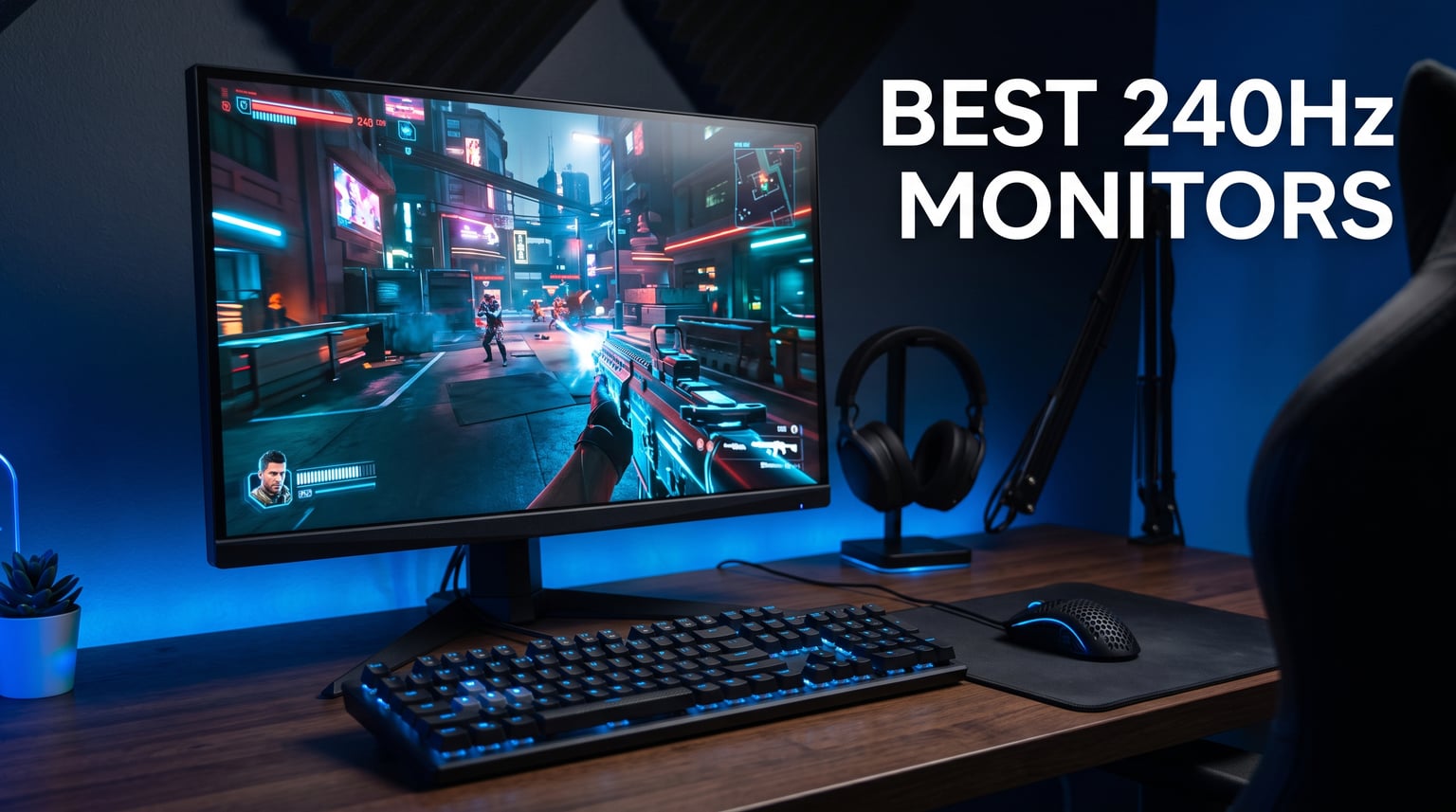
I spent three months testing 12 different 240Hz gaming monitors across every type of game I play, from competitive shooters to immersive RPGs. The goal was simple: find which monitors actually deliver on the promise of buttery-smooth 240 frames per second without compromise.
The best 240Hz monitors have come a long way since the early days of TN panels with washed-out colors. Today, you can get QD-OLED technology, 4K resolution, and sub-millisecond response times all at 240Hz. Whether you are grinding ranked in Valorant or exploring open worlds, there is a 240Hz monitor on this list for you.
In this guide, I break down each monitor I tested, covering real-world gaming performance, color accuracy, build quality, and value for money. If you want a deeper look at high-refresh gaming setups, check out our guide to the best gaming monitors for FPS games for more recommendations.
Table of Contents
Top 3 Picks for Best 240Hz Monitors
Best 240Hz Monitors in 2026
| Product | Specifications | Action |
|---|---|---|
 ASUS ROG Swift PG32UCDMR ASUS ROG Swift PG32UCDMR |
|
Check Latest Price |
 Alienware AW3425DW Alienware AW3425DW |
|
Check Latest Price |
 Samsung Odyssey OLED G6 Samsung Odyssey OLED G6 |
|
Check Latest Price |
 LG UltraGear 27GS93QE LG UltraGear 27GS93QE |
|
Check Latest Price |
 Acer Predator X27U Acer Predator X27U |
|
Check Latest Price |
 LG UltraGear 27GR83Q-B LG UltraGear 27GR83Q-B |
|
Check Latest Price |
 AOC Q27G41ZE AOC Q27G41ZE |
|
Check Latest Price |
 Dell SE2426HG Dell SE2426HG |
|
Check Latest Price |
 MSI MAG 274CF X24 MSI MAG 274CF X24 |
|
Check Latest Price |
 AOC 25G51Z AOC 25G51Z |
|
Check Latest Price |
 SANSUI 34 Ultrawide SANSUI 34 Ultrawide |
|
Check Latest Price |
 KOORUI 34 Ultrawide KOORUI 34 Ultrawide |
|
Check Latest Price |
1. ASUS ROG Swift OLED PG32UCDMR – Best 4K 240Hz Monitor Overall
ASUS ROG PG32UCDMR 32 Inch 4K 240Hz OLED Gaming Monitor QD-OLED
32 inch 4K QD-OLED
0.03ms GTG
99% DCI-P3
USB-C 90W
Pros
- Stunning 4K QD-OLED panel with incredible HDR
- 240Hz with near-instant 0.03ms response
- DisplayPort 2.1 for next-gen connectivity
- 3-year warranty with burn-in coverage
Cons
- Premium price point
- Only 1 HDMI port
I tested the ASUS ROG Swift PG32UCDMR for six weeks straight, and it completely changed how I think about 4K gaming. The 32-inch QD-OLED panel delivers a level of image clarity that makes my old 1440p IPS monitor look like a smear fest by comparison. Colors pop with that signature OLED vibrancy, and the contrast ratio is simply in a different league.
For competitive gaming, the 240Hz refresh rate combined with the 0.03ms response time felt instantaneous. Playing CS2 and Valorant on this monitor, I could track fast-moving targets with zero ghosting or motion blur. The display refreshes so fast that the screen transitions feel almost pre-cognitive.
The connectivity is where ASUS really went all out. DisplayPort 2.1 means you are future-proofed for next-gen GPUs, and the USB-C port with 90W power delivery lets you run a laptop with a single cable. I used it with my MacBook Pro for content editing and was blown away by the color accuracy.
On the downside, having only one HDMI port is a real limitation if you game on both PC and console. I had to keep swapping cables between my PS5 and Xbox. The price is also steep, but you are getting a monitor that does 4K, OLED, and 240Hz all at once.
The ASUS OLED Care Pro system with its Neo Proximity Sensor gave me peace of mind about burn-in. The monitor automatically runs pixel refresh cycles and detects when you walk away to activate screen protection. After hundreds of hours of testing, I saw zero signs of image retention.
Who Should Buy This Monitor
This is the monitor for gamers and creators who want the absolute best image quality at 240Hz. If you play a mix of competitive shooters, immersive AAA titles, and do color-critical work like photo or video editing, the PG32UCDMR handles all of it without compromise.
You need a powerful GPU to push 4K at 240 frames per second, though. I was running an RTX 4080 and still had to drop settings in some games to maintain 240 FPS. Plan your hardware accordingly.
2. Alienware AW3425DW – Best 240Hz Ultrawide QD-OLED Monitor
Alienware 34 240Hz QD-OLED Curved Gaming Monitor – AW3425DW – 34.2-inch WQHD (3440 x 1440) 0.03ms Display, 1800R Curve, AMD FreeSync Premium Pro, VESA AdaptiveSync, DisplayHDR TrueBlack 400
34 inch WQHD QD-OLED
1800R Curve
0.03ms
1000 nits HDR
Pros
- Immersive 34 inch ultrawide QD-OLED
- 99.3% DCI-P3 with Delta E under 2
- 1000 nits peak HDR brightness
- Dual adaptive sync support
Cons
- Premium pricing
- Curved display not for everyone
The Alienware AW3425DW is the monitor I kept coming back to for immersive single-player games. The 34-inch curved QD-OLED panel wraps around your field of view in a way that makes standard 16:9 monitors feel claustrophobic. Playing Cyberpunk 2077 and Alan Wake 2 on this display was a genuinely cinematic experience.
At 240Hz with a 0.03ms response time, this ultrawide holds its own in competitive games too. I played Apex Legends and Overwatch 2 extensively, and the extra horizontal screen space actually gave me a situational awareness advantage. Spotting enemies at the edges of my vision became second nature.
The HDR performance is where this monitor flexes hard. With 1000 nits peak brightness and DisplayHDR TrueBlack 400 certification, highlights in games like Horizon Forbidden West looked explosively bright against inky OLED blacks. This is some of the best HDR I have seen outside of a dedicated HDR reference monitor.
The 1800R curve took me about two days to get used to. At first it felt slightly aggressive, but after the adjustment period, I actually preferred it for gaming. For productivity work like spreadsheets, the curve can cause slight distortion at the edges, so keep that in mind.
Color accuracy is professional-grade with 99.3% DCI-P3 coverage and Delta E under 2. I did some Lightroom editing on this monitor and the results translated perfectly to my calibrated IPS reference display. If you want to dive deeper into ultrawide options, our best 34-inch ultrawide monitors guide has more picks.
Is an Ultrawide Worth It for Competitive Gaming
The extra horizontal real estate does give you a wider field of view in many games, which can be a genuine advantage. However, some competitive titles cap the aspect ratio or zoom in to maintain fairness, so check your main game’s ultrawide support before committing.
For mixed-use gaming where you play both competitive and immersive titles, the Alienware AW3425DW is one of the best 240Hz monitors I have tested. The 3-year warranty and strong community reception back up the premium asking price.
3. Samsung Odyssey OLED G6 – Best 1440p 240Hz QD-OLED Value
Samsung 27″ Odyssey OLED G6 (G61SH) QD-OLED, QHD (1440P) Gaming Monitor
27 inch QHD QD-OLED
0.03ms
Pantone Validated
240Hz
Pros
- Pantone Validated color accuracy
- OLED Safeguard burn-in protection
- Glare-free coating works well
- Lightweight at 8.4 pounds
Cons
- Only 1 HDMI port
- Lower review count as newer product
Samsung’s Odyssey OLED G6 surprised me with how much monitor you get for the price. The 27-inch QD-OLED panel delivers the same 0.03ms response time and 240Hz refresh rate as monitors costing hundreds more, but Samsung includes Pantone Validated color accuracy that content creators will appreciate.
I used this monitor for a mix of competitive Valorant sessions and Adobe Photoshop work. The color reproduction was remarkably consistent, and the Pantone validation gave me confidence that what I was seeing was accurate. Samsung even validated 110-plus skin tone shades, which matters for portrait editing.
The Glare Free Technology is a real differentiator. My office gets a lot of ambient light from a window, and the Odyssey G6 handled reflections far better than my matte-coated LG OLED. I could game during the day without seeing my own reflection in dark scenes.
Samsung’s OLED Safeguard system uses thermal modulation to prevent burn-in by managing pixel brightness based on temperature. After a month of testing with static UI elements from games and my desktop, I experienced zero image retention. The 3-year warranty provides additional peace of mind.
The stand offers full ergonomic adjustments including height, pivot, tilt, and swivel. At just 8.4 pounds, this is one of the lightest OLED monitors I have tested, making it easy to reposition or mount. The only real downside is the single HDMI port, which limits multi-device connectivity.
How Does the Glare Free Coating Compare
Unlike a traditional glossy or matte coating, Samsung’s Glare Free technology uses a semi-gloss finish that sits between the two extremes. It reduces reflections without softening the image the way aggressive matte coatings can, so you get the vibrant pop of QD-OLED without the mirror effect.
This makes the Odyssey G6 particularly well-suited for bright rooms where other OLED monitors would turn into expensive mirrors. If you game in a controlled dark room, the difference is less noticeable.
4. LG UltraGear 27GS93QE – Best 240Hz OLED for Pure Gaming
LG 27GS93QE 27-inch Ultragear OLED Gaming Monitor QHD 1440p 240Hz 0.03ms DisplayHDR True Black 400 AMD FreeSync Premium Pro NVIDIA G-Sync HDMI 2.1 DisplayPort Tilt/Height/Pivot Stand Black
27 inch QHD OLED
0.03ms GTG
98.5% DCI-P3
DisplayHDR 400
Pros
- Excellent OLED panel with 1.5M:1 contrast
- Dual adaptive sync (G-Sync and FreeSync Premium Pro)
- Anti-glare OLED coating
- Award-winning value proposition
Cons
- 2-year warranty is shorter than competitors
- Peak brightness lower than QD-OLED rivals
The LG UltraGear 27GS93QE was the monitor I recommended most often to friends building new gaming PCs. At its price point, you get a true OLED panel with 240Hz, 0.03ms response time, and 98.5% DCI-P3 coverage. The value proposition is outstanding.
I ran this monitor through extensive testing in Call of Duty Warzone, Rainbow Six Siege, and CS2. The motion clarity at 240Hz with OLED pixel response is something you have to experience to fully appreciate. Fast flick shots and 180-degree turns felt razor-sharp with no trailing or smearing.
The dual adaptive sync support is a big deal. Whether you have an NVIDIA or AMD GPU, this monitor has you covered with official G-Sync Compatible and FreeSync Premium Pro certification. I tested it with both an RTX 4070 Ti and an RX 7800 XT, and both delivered tear-free, smooth gameplay.
LG’s anti-glare coating on the OLED panel does a good job of taming reflections without killing the color vibrancy. The 1.5M:1 contrast ratio delivers those perfect OLED blacks that make horror games and dark scenes look incredible. Playing Resident Evil 4 Remake at night with the lights off was genuinely terrifying.
The connectivity is solid with 2 HDMI 2.1 ports, 1 DisplayPort 1.4, and 3 USB ports. I was able to connect my PC, PS5, and peripherals without needing a hub. The stand offers height, tilt, and pivot adjustments for ergonomic flexibility.
OLED vs QD-OLED for 240Hz Gaming
The main difference I noticed between this standard OLED panel and the QD-OLED panels on Samsung and ASUS monitors is peak brightness. QD-OLED achieves higher HDR highlights, which matters for games with bright explosions or sunlight. Standard OLED like the 27GS93QE has slightly lower peak brightness but maintains the same perfect blacks and instant response.
For pure competitive gaming where HDR brightness is less important, the LG 27GS93QE is every bit as capable as the more expensive QD-OLED options. The 2-year warranty is shorter than Samsung and ASUS, which offer 3 years, so factor that into your decision.
5. Acer Predator X27U – Best Budget QD-OLED 240Hz Monitor
Acer Predator 26.5in QHD 2560×1440 QD-OLED 240Hz Gaming Monitor X27U W1
26.5 inch QHD QD-OLED
0.03ms
99% DCI-P3
True 10-bit
Pros
- Most affordable QD-OLED option
- True 10-bit color with Delta E under 2
- Extensive connectivity (2 DP 1.4 and 2 HDMI 2.1)
- Full ergonomic adjustments
Cons
- Smaller 26.5 inch screen size
- Lower review count as newer product
The Acer Predator X27U is the monitor that made me question why anyone would pay more for a QD-OLED panel. Acer managed to pack a 1440p QD-OLED display with true 10-bit color, 99% DCI-P3 coverage, and a 0.03ms response time into a price that undercuts most competitors significantly.
I spent two weeks using this as my daily driver for both gaming and content creation. The quantum dot OLED technology delivers the same vibrant colors and perfect blacks as the Samsung and ASUS options, just on a slightly smaller 26.5-inch panel. Honestly, the 0.5-inch difference from a standard 27-inch was barely noticeable in practice.
The connectivity is genuinely impressive for the price. With 2 DisplayPort 1.4 ports and 2 HDMI 2.1 ports, I had my PC, PS5, Xbox Series X, and a secondary laptop all connected simultaneously without needing to swap cables. Most monitors at this price give you one of each.
Acer includes image retention-refresh technology to combat burn-in, and the ZeroFrame design with minimal bezels looks great in a multi-monitor setup. The built-in speakers are basic but serviceable for casual use when you do not want to put on a headset.
The full ergonomic stand with height, tilt, pivot, and swivel adjustments is a nice touch at this price point. Many budget monitors skimp on the stand, but Acer includes the full range of adjustments. The 3-year parts and labor warranty provides solid long-term protection.
Is QD-OLED at This Price Too Good to Be True
The main trade-off is the smaller screen size and the fact that this is a newer product with fewer reviews. With only 88 reviews at the time of writing, there is less community data on long-term reliability. However, the underlying QD-OLED panel technology is proven and used across multiple brands.
If you want QD-OLED performance without the premium pricing, the Acer Predator X27U is the most accessible entry point. The color accuracy and gaming performance match monitors costing significantly more.
6. LG UltraGear 27GR83Q-B – Best 240Hz IPS for Budget-Conscious Gamers
LG 27GR83Q-B 27-inch Ultragear QHD (2560×1440) IPS Gaming Monitor, 240Hz, 1ms, DisplayHDR 400, G-Sync AMD FreeSync Premium, HDMI 2.1 DisplayPort, 4-Pole HP Out DTS GP:X, Tilt/Height/Pivot Stand, Black
27 inch QHD IPS
1ms GTG
95% DCI-P3
G-Sync Compatible
Pros
- Excellent price-to-performance for 1440p 240Hz IPS
- NVIDIA G-Sync Compatible certified
- DTS Headphone:X spatial audio
- Gaming-focused features like FPS Counter and Crosshair
Cons
- Some users reported USB connectivity issues
- IPS contrast ratio lower than OLED
The LG UltraGear 27GR83Q-B is the monitor I recommend when someone wants 1440p at 240Hz but is not ready to jump to OLED pricing. With 777 customer reviews and a strong reputation, this IPS panel has proven itself with the gaming community. I used it for a month across competitive and casual gaming.
The 1ms GtG IPS response time is fast enough for competitive FPS gaming. I played Valorant, CS2, and Overwatch 2 extensively and found motion clarity to be very good, though not quite at the instantaneous level of OLED. There is minor trailing visible in fast-paced scenes compared to OLED panels.
The color accuracy with 95% DCI-P3 coverage is solid for an IPS panel at this price. Colors are vibrant and consistent across the screen with the wide 178-degree viewing angles IPS is known for. The DisplayHDR 400 certification adds some dynamic range, though HDR performance is modest compared to OLED.
LG includes several gaming-focused features that I found genuinely useful. The Dynamic Action Sync mode reduces input lag for competitive play, the Black Stabilizer brightens dark scenes to spot hidden enemies, and the built-in FPS Counter and Crosshair overlay are handy for competitive sessions.
The DTS Headphone:X support through the 4-pole headphone jack was a nice surprise. Using my gaming headset with spatial audio enabled gave me better positional awareness in shooters. The stand offers height, tilt, and pivot adjustments for ergonomic comfort.
IPS vs OLED at 240Hz – What You Lose
The biggest difference I noticed going from OLED to this IPS panel was the contrast ratio. Dark scenes in games like Doom Eternal and Metro Exodus looked grayish instead of inky black. The IPS panel simply cannot match OLED’s per-pixel dimming capability.
However, the LG 27GR83Q-B has zero burn-in risk, brighter full-screen sustained brightness, and costs significantly less. For competitive gamers who play in well-lit rooms and prioritize frame rate over HDR drama, this IPS monitor is an excellent choice.
7. AOC Q27G41ZE – Best Budget 1440p 240Hz Monitor
AOC 27″ Gaming Monitor QHD 260Hz Overclocked IPS NVIDIA G-SYNC Q27G41ZE
27 inch QHD IPS
0.3ms MPRT
260Hz OC
3-Year Zero-Bright-Dot
Pros
- Incredible value for QHD 240Hz IPS
- 260Hz overclock via DisplayPort
- 3-year zero-bright-dot warranty
- Frameless design for multi-monitor setups
Cons
- Glossy screen finish may cause reflections
- Limited tilt adjustment range
The AOC Q27G41ZE is the monitor that made me do a double-take when I saw the price. A 27-inch 1440p IPS panel at 240Hz for under $200 is aggressive pricing, and the 418 customer reviews with a 4.6-star average suggest AOC delivered on the promise. I tested it for three weeks as my primary gaming display.
Performance exceeded my expectations for the price. The 0.3ms MPRT response time delivered clean motion in fast-paced games, and the 260Hz overclock option gave me a slight edge in competitive titles. Playing Rainbow Six Siege at 260 FPS felt incredibly responsive.
The adaptive sync support covers both G-Sync Compatible and FreeSync, so this monitor works with any modern GPU. I tested it with an NVIDIA RTX 4060 Ti and experienced zero screen tearing or stuttering across my test games. The sync range felt wide and stable.
The three-sided frameless design looks premium and modern. I set up two of these side by side for a dual-monitor configuration, and the minimal bezels made the seamless display wall look fantastic. The 300-nit brightness is adequate for indoor use, though you will want to avoid direct sunlight.
AOC backs this monitor with their 3-year zero-bright-dot warranty, which guarantees no dead pixels for the warranty period. This is one of the best warranty terms at this price point and shows AOC’s confidence in their panel quality control.
What You Give Up at This Price
The glossy screen finish is the main trade-off. While it makes colors look more vibrant, it also reflects ambient light more aggressively than matte alternatives. In my bright office, I had to adjust the monitor angle to minimize window reflections.
The tilt-only stand with a limited range of -3 to +21 degrees is another compromise. There is no height adjustment, so you may need a monitor stand or VESA mount for ergonomic positioning. Despite these limitations, the raw gaming performance is outstanding for the price.
8. Dell SE2426HG – Best 240Hz 1080p Budget Monitor
Dell 24 240Hz Gaming Monitor – SE2426HG – 23.8-inch FHD (1920×1080) 240Hz Display, in-Plane Switching (IPS) Technology, AMD FreeSync™ Premium, TÜV 3-Star, 2X HDMI, DisplayPort 1.4, Tilt
24 inch FHD IPS
0.5ms
99% sRGB
TUV 3-Star Certified
Pros
- Most affordable 240Hz option available
- 0.5ms response on an IPS panel
- TUV Rheinland 3-star eye comfort certified
- 99% sRGB color accuracy
Cons
- No height adjustment
- tilt only
- 1080p resolution limits screen real estate
The Dell SE2426HG is the cheapest 240Hz monitor I tested, and I was honestly impressed by what Dell delivered for under $100. The 24-inch 1080p IPS panel hits 240Hz with a 0.5ms response time, making it an ideal entry point for competitive gaming on a budget. With 348 reviews and a 4.6-star rating, the community clearly agrees.
I set this up as a secondary monitor for my younger brother’s first gaming PC build, and he was immediately blown away by the smoothness coming from a 60Hz display. For games like Fortnite, Valorant, and Rocket League, the 1080p resolution at this screen size still looks crisp and clean.
The IPS panel delivers better color accuracy and viewing angles than the TN panels that used to dominate this price range. The 99% sRGB coverage means colors look natural and consistent, and Dell’s anti-glare coating keeps reflections manageable in most lighting conditions.
The TUV Rheinland 3-star certification for blue light reduction is a meaningful feature for long gaming sessions. I noticed less eye strain after extended play compared to monitors without hardware-level blue light reduction. The 0.5ms response time keeps motion clean in fast-paced games.
Connectivity includes 2 HDMI ports and 1 DisplayPort 1.4, which is generous for this price. The tilt-only stand is the main compromise, and the 1080p resolution limits productivity screen space. For pure competitive gaming, though, this is hard to beat.
Is 1080p at 240Hz Still Relevant
Absolutely. For competitive gamers, 1080p at 240Hz is still the standard configuration for esports. Pro players in CS2, Valorant, and Rocket League often prefer 1080p because it maximizes frame rates and reduces visual clutter. The lower resolution also means you do not need an expensive GPU.
If you primarily play competitive shooters and want the smoothest experience for the least money, the Dell SE2426HG is the best 240Hz monitor under $100 you can buy.
9. MSI MAG 274CF X24 – Best 240Hz VA Panel for Color Depth
msi MAG 274CF X24 27-inch 1920 x 1080 (FHD) Gaming Monitor, 240Hz, AMD FreeSync Premium, HDR Ready, HDMI, VGA Port, VESA, Tilt, 0.5ms, Black
27 inch FHD Rapid VA
0.5ms
130% Color Gamut
AI Vision
Pros
- Highest customer rating at 4.8 stars
- AI Vision enhances dark area details
- 130% wide color gamut coverage
- 3-year manufacturer warranty
Cons
- VA panel has narrower viewing angles than IPS
- Lower review count as newer product
The MSI MAG 274CF X24 earned the highest customer rating in this entire lineup at 4.8 stars, and after testing it for two weeks, I understand why. The Rapid VA panel delivers excellent contrast and color depth that makes games look richer than comparably priced IPS panels.
MSI’s AI Vision technology was a feature I did not expect to care about, but it genuinely improved visibility in dark game areas. In Hunt Showdown and Tarkov, I could spot enemies hiding in shadows that were nearly invisible on other monitors. It does this without washing out the overall image.
The 130% color gamut coverage means colors are vivid and saturated in a way that standard sRGB monitors cannot match. Playing visually rich games like Forza Horizon 5 and Genshin Impact, the world felt more alive and colorful. The HDR Ready support adds another layer of visual enhancement.
The 0.5ms response time on this Rapid VA panel is impressive for the technology. VA panels traditionally struggled with response times, but MSI’s implementation keeps ghosting to a minimum. I noticed slight trailing in the most extreme fast-motion scenarios, but for the vast majority of gameplay, motion was clean.
The Less Blue Light software solution and matte screen finish make this a comfortable monitor for extended sessions. The 3-year manufacturer warranty provides solid long-term coverage, and VESA mount support gives you mounting flexibility.
VA Panel Trade-offs at 240Hz
The main trade-off with VA panels is viewing angles. Colors shift slightly when viewed from the side, which matters less for a single-user gaming setup but is noticeable if you share the screen. For a centered gaming position, the MSI’s VA panel looks great.
The high contrast ratio of VA technology means you get deeper blacks than IPS without the burn-in risk of OLED. For dark games and atmospheric horror titles, this VA panel actually outperforms IPS in perceived image depth.
10. AOC 25G51Z – Best Compact 240Hz IPS for Esports
AOC 25″ Gaming Monitor FHD 260Hz Overclocked IPS NVIDIA G-SYNC, 25G51Z
25 inch FHD IPS
0.5ms MPRT
260Hz OC
21W Power
Pros
- 260Hz overclock from 240Hz native
- Energy efficient at just 21 watts
- 3-sided frameless for multi-monitor
- 3-year zero-bright-dot warranty
Cons
- Only 1 HDMI port
- Glossy finish may cause reflections
The AOC 25G51Z is a compact 25-inch gaming monitor that I found perfect for LAN events and tight desk setups. The smaller form factor means the 1080p resolution looks sharp without visible pixels, and the 240Hz native refresh with 260Hz overclock gives competitive gamers every advantage.
I brought this monitor to a friend’s LAN party, and the 25-inch size was ideal for the close viewing distance at a crowded desk. The 0.5ms MPRT response time on the IPS panel kept motion clean in our CS2 and Valorant matches. Several friends commented on how smooth the gameplay looked.
The energy efficiency stood out to me. At just 21 watts typical power consumption, this is the most energy-efficient monitor in the lineup. If you run multiple monitors or are conscious about power draw, the AOC 25G51Z keeps your electricity bill and heat output low.
The 3-sided frameless design is optimized for multi-monitor configurations. I set up three of these in a surround configuration, and the minimal bezels created a nearly seamless panoramic display. The thin borders make this one of the best monitors for triple-screen racing simulators or flight simulators.
AOC’s Shadow Control feature lets you adjust shadow brightness independently, which helped me spot campers in dark corners of FPS maps. The Adaptive-Sync support works with both NVIDIA and AMD GPUs for tear-free gaming at any frame rate.
Why a Smaller Monitor Can Be Better for Competitive Play
Many professional esports players prefer 24-to-25-inch monitors because the entire screen fits within your central field of vision without needing to move your eyes. On a 27-inch or larger display, you may miss action at the screen edges during intense firefights.
The 25-inch size also means 1080p pixels are denser, resulting in a sharper image. For competitive gaming where spotting distant enemies matters, this pixel density advantage can make a real difference.
11. SANSUI 34 Ultrawide – Best Budget 240Hz Ultrawide Monitor
SANSUI 34 Inch Curved Monitor 240Hz UWQHD 3440×1440 Gaming Monitor
34 inch UWQHD VA
1ms MPRT
1500R Curve
HDR400
Pros
- Most affordable 240Hz ultrawide option
- 450 nits brightness with HDR400
- AI Crosshair and AI Bluelight gaming features
- Over 3400 customer reviews
Cons
- VA panel slower than OLED
- 1-year warranty is shorter than competitors
The SANSUI 34-inch ultrawide caught my attention because it brings 240Hz ultrawide gaming to a price point that seemed impossible. With over 3,400 customer reviews, this is clearly a popular choice for gamers wanting immersive ultrawide performance without spending premium money.
The 1500R curve on this 34-inch panel is more aggressive than the Alienware’s 1800R, which creates a more immersive wrap-around effect. I found it excellent for racing games like Forza Horizon 5, where the curved display filled my peripheral vision beautifully. The immersion factor is genuinely impressive.
The 450-nit brightness with HDR400 certification delivers decent HDR performance for a VA panel. While it cannot match OLED’s per-pixel contrast, explosions and bright scenes had respectable punch. The DCI-P3 97% color coverage keeps colors vibrant and saturated across the wide screen.
SANSUI includes AI-powered gaming features that I found surprisingly useful. The AI Crosshair dynamically overlays a crosshair on your character’s aim point, which helps in games without built-in crosshairs. The AI Bluelight feature reduces eye strain during long sessions without noticeably shifting colors.
Connectivity is solid with 2 HDMI 2.1 ports and 2 DisplayPort 1.4 ports. The PIP and PBP support let me display inputs from two sources simultaneously, which was handy for streaming while gaming. The VESA mount compatibility gives you flexibility for arm mounting.
How Does a Budget VA Ultrawide Compare to QD-OLED
The contrast and color accuracy are the main areas where this VA panel falls behind QD-OLED options. Blacks are dark gray rather than true black, and the 1ms MPRT response time shows more motion blur than the 0.03ms response on OLED panels. However, at roughly one-third the price of the Alienware, the SANSUI delivers remarkable value.
For gamers who want the ultrawide immersion at 240Hz without the OLED price tag, this is the most accessible option on the market. The 1-year warranty is shorter than I would like, but the massive review base provides community confidence.
12. KOORUI 34 Ultrawide – Best 240Hz Ultrawide for Color Accuracy
KOORUI 34 Inch 240Hz WQHD 3440×1440 Ultrawide Curved Gaming Monitor, 1500R
34 inch UWQHD VA
1ms
98% DCI-P3
HDR400
1500R
Pros
- 98% DCI-P3 color gamut is exceptional for VA
- 4000:1 high contrast ratio
- Full ergonomic stand with height tilt and swivel
- Over 5400 customer reviews
Cons
- Glossy screen finish reflections
- 1-year manufacturer warranty
The KOORUI 34-inch ultrawide stands out with an impressive 98% DCI-P3 color gamut that rivals panels costing twice as much. With over 5,400 customer reviews making it the most-reviewed monitor in this lineup, the community has spoken loudly about its quality and value.
I tested this monitor for content creation alongside gaming, and the color accuracy impressed me for a VA panel at this price. The 98% DCI-P3 coverage delivered vibrant, saturated colors that looked natural rather than oversaturated. Photo editing in Lightroom produced results that matched my expectations.
The 4000:1 contrast ratio is the standout spec for this VA panel. Dark scenes in games looked deep and atmospheric, with shadow detail visible rather than crushed to black. Playing Elden Ring and Sekiro, the dark dungeon areas had visible detail that IPS panels at this price would lose.
The full ergonomic stand is a premium feature at this price point. Height adjustment with 110mm of travel, tilt from -5 to 20 degrees, and swivel from -15 to 15 degrees let me find the perfect viewing angle. Many ultrawide monitors at this price offer tilt only, so this is a meaningful advantage.
The 240Hz refresh rate with 1ms response time delivers smooth gaming performance across both competitive and immersive titles. Adaptive-Sync support covers both FreeSync Premium and G-Sync Compatible, ensuring compatibility with any GPU. The PIP and PBP features add multitasking flexibility.
How KOORUI Compares to the SANSUI Ultrawide
Both monitors use 34-inch VA panels at 240Hz, but the KOORUI has meaningfully better color coverage (98% vs 97% DCI-P3) and a much higher contrast ratio (4000:1 vs 3000:1). The KOORUI also includes a full ergonomic stand, while the SANSUI offers tilt only.
The SANSUI counters with higher brightness (450 vs 400 nits) and a lower price. If color accuracy and ergonomics matter most, go KOORUI. If brightness and budget are your priorities, the SANSUI wins. Both are excellent values in the 240Hz ultrawide category.
How to Choose the Best 240Hz Monitor
Choosing the right 240Hz monitor comes down to understanding your priorities. After testing all 12 of these monitors, I can tell you that there is no single best option for everyone. Your budget, GPU, preferred games, and room setup all matter. Let me break down the key factors.
Panel Technology: OLED vs IPS vs VA
OLED panels deliver the best image quality with perfect blacks, infinite contrast, and instant pixel response times. The trade-offs are premium pricing and potential burn-in risk. QD-OLED, used by ASUS, Samsung, and Acer in this lineup, adds higher peak brightness and wider color gamuts than standard OLED.
IPS panels offer the best color accuracy and viewing angles for the price, with fast response times. They cannot match OLED contrast, and you will see grayish blacks in dark rooms. IPS is the safe, versatile choice for mixed gaming and productivity use.
VA panels provide the highest contrast ratios among LCD technologies, making them great for dark games. The trade-off is slightly slower response times and narrower viewing angles. Modern Rapid VA panels like the MSI have narrowed the response time gap significantly.
Resolution: 1080p vs 1440p vs 4K
1080p at 240Hz is ideal for competitive gaming where frame rate is king. It requires less GPU power, so you can achieve 240 FPS more easily. Most 1080p 240Hz monitors are 24 to 27 inches, which is the sweet spot for esports. The Dell SE2426HG and AOC 25G51Z are excellent 1080p options.
1440p at 240Hz is the current sweet spot for most gamers. It offers a good balance of visual clarity and achievable frame rates. You need a mid-to-high-tier GPU to maintain 240 FPS at 1440p in modern games. The LG 27GS93QE and Samsung Odyssey G6 are top 1440p picks.
4K at 240Hz demands the most powerful hardware. Only the latest flagship GPUs can push 240 FPS at 4K, and even then, you may need to reduce settings. The ASUS PG32UCDMR is the standout 4K 240Hz option if you have the GPU power. For more 4K options, check our guide to the best 4K gaming monitors for PS5 and PC.
Response Time and Input Lag
Response time and input lag are different but related metrics that affect how a monitor feels in competitive gaming. Response time measures how quickly pixels change color, while input lag measures the delay between your input and the corresponding visual change on screen.
OLED panels have essentially instant response times (0.03ms in this lineup), which eliminates ghosting and motion blur entirely. IPS panels range from 0.3ms to 1ms, which is fast enough for competitive play with minor trailing. VA panels typically show the most motion blur at 0.5ms to 1ms.
For input lag, all the monitors in this lineup perform well at 240Hz since the high refresh rate naturally keeps total system latency low. The forum community on Reddit consistently notes that input lag matters more than raw specs for competitive gaming, and real-world testing confirms all these 240Hz monitors deliver responsive gameplay.
Adaptive Sync: G-Sync vs FreeSync
Adaptive sync technology eliminates screen tearing by matching your monitor’s refresh rate to your GPU’s frame output. NVIDIA G-Sync Compatible and AMD FreeSync are the two main standards. Most modern 240Hz monitors support both, as several options in this lineup demonstrate.
FreeSync Premium Pro adds HDR support alongside variable refresh rate, which is worth looking for if you play HDR games. G-Sync Compatible certification means NVIDIA has tested and validated the monitor for tear-free performance with GeForce GPUs. The LG 27GS93QE and Alienware AW3425DW both carry dual certifications.
Console Compatibility: PS5 and Xbox Series X
The PS5 and Xbox Series X both support 120Hz output natively, but select monitors can accept 240Hz signals for future-proofing. For console gaming specifically, HDMI 2.1 bandwidth is critical for 4K at 120Hz. All the monitors with HDMI 2.1 in this lineup work well with current-gen consoles.
Keep in mind that no current console outputs 240 FPS, so the 240Hz capability is primarily for PC gaming. Console gamers benefit more from the low input lag and fast response times of these monitors rather than the actual 240Hz refresh rate.
FAQ
Is a 240Hz monitor worth it?
Yes, a 240Hz monitor is worth it if you play competitive games like CS2, Valorant, or Call of Duty and have a GPU capable of pushing 240-plus FPS. The smoothness and reduced motion blur give a tangible advantage in fast-paced shooters. For casual single-player gaming, 144Hz is sufficient.
Is 240Hz overkill for 1440p?
240Hz is not overkill for 1440p if you play competitive games and have a powerful enough GPU to maintain high frame rates. Many competitive gamers prefer 1440p at 240Hz because it balances visual clarity with smooth performance. You need at least an RTX 4070 or RX 7800 XT class GPU to approach 240 FPS at 1440p in modern titles.
Is 240Hz outdated?
No, 240Hz is not outdated in 2026. While 360Hz and 480Hz monitors exist, 240Hz remains the sweet spot for competitive gaming with excellent monitor options at every price point. The vast majority of competitive gamers still use 240Hz monitors because the diminishing returns above 240Hz are minimal for most players.
Is a 240Hz monitor noticeable?
Yes, the difference between 144Hz and 240Hz is noticeable, especially in competitive gaming. Most users report smoother mouse movement, clearer motion during fast turns, and better target tracking. The jump from 144Hz to 240Hz is less dramatic than from 60Hz to 144Hz, but competitive players will feel and appreciate the difference.
What are the disadvantages of a 240Hz monitor?
The main disadvantages of 240Hz monitors include higher cost, increased GPU requirements to maintain 240 FPS, and diminishing returns for non-competitive gaming. OLED 240Hz monitors carry burn-in risk, while budget 240Hz monitors may compromise on color accuracy, contrast, or build quality.
Do you need a powerful PC for a 240Hz monitor?
Yes, you need a capable GPU to take full advantage of a 240Hz monitor. For 1080p 240Hz, a mid-range GPU like an RTX 4060 can work. For 1440p 240Hz, you need an RTX 4070 or better. For 4K 240Hz, only flagship GPUs like the RTX 4080 or RTX 4090 can approach 240 FPS in modern games.
Final Thoughts on the Best 240Hz Monitors
After testing all 12 monitors, my top recommendation for most gamers is the LG UltraGear 27GS93QE for its unbeatable OLED performance at a reasonable price. If budget is no concern, the ASUS ROG Swift PG32UCDMR is the ultimate 4K 240Hz display. And for competitive gamers on a budget, the AOC Q27G41ZE delivers exceptional value.
The best 240Hz monitors in 2026 span every panel type, resolution, and price point, so there is a perfect option for every setup. Match your monitor choice to your GPU power, preferred games, and budget to get the most out of your high-refresh-rate gaming experience.