
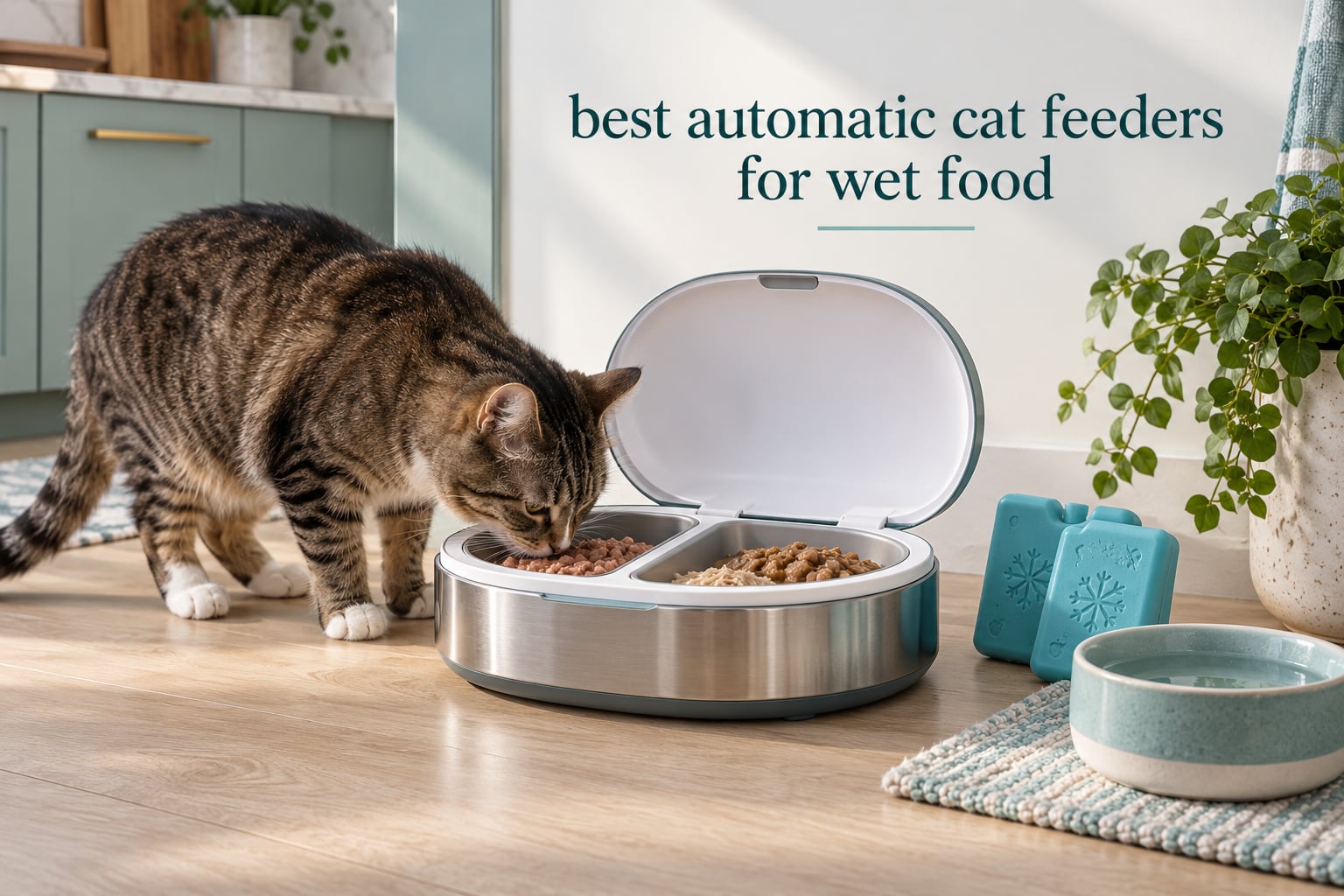
If you want one answer before anything else: the SureFeed Microchip Pet Feeder is the best automatic cat feeder for wet food in multi-pet homes, and the PETLIBRO Wet Food Feeder is the pick when you need a real wet-food diet covered for several days without ice pack swapping. That is a real split, and it comes down to what your cat actually needs — access control or scheduled chilled meals.
Wet food is the part of cat feeding that resists automation. Dry kibble pours from a hopper. Wet food sits in a puddle, warms up, dries out and grows bacteria, so a feeder that only opens a lid on a timer is not much use unless something is keeping the food cold. Every unit in this roundup solves that in one of three ways: frozen ice packs in the base, active semiconductor cooling, or a sealed compartment you refill often. The three approaches differ in how long food stays chilled, how much attention the unit needs between fills, and what happens during a power cut.
Our team spent weeks running these feeders on the same schedule, filling them with the same patees and pouches, and watching three things closely: how cold the food actually was at serving time, whether the mechanism opened when it said it would, and how much my own cats cared to eat from a machine. We also logged the complaints that show up again and again in owner reviews, because the gap between a good spec sheet and a good feeder shows up at month six. The list below covers the ten best automatic cat feeders for wet food available now, sorted by how much each one actually does rather than by feature count.
One note before we start. Nothing on this list dispenses wet food from a reservoir. You portion it yourself into the compartments, which is exactly how cat owners use these feeders in practice, and it also means you control portion size precisely. If you want a hopper that measures kibble, we cover that separately in our guide to the best automatic pet feeders and in the wet-food-specific version for dog feeders that handle wet food.
Top 3 Picks for Best Automatic Cat Feeders for Wet Food (October 2026)
SureFeed Microchip Feeder
- Microchip and collar tag access control
- 13.5 fl oz wet or dry capacity
- Sealed neoprene lid
- Three-year warranty

PETLIBRO Wet Food Feeder
- Semiconductor cooling
- Three meals fresh up to 72 hours
- App scheduling
- Stainless steel tray

SureFeed wins here on reliability and review depth rather than on clever features. It is the only feeder on this list with a three-year warranty and a review base measured in five figures, and 4.2 stars across more than 13k reviews is a track record no new listing on this page can match.
PETLIBRO takes the top slot for anyone actually feeding a wet-food-only cat on a multi-day schedule. Semiconductor cooling holds three meals for up to 72 hours, which means you fill it once and stop thinking about it for three days.
The Cat Mate C500 is the highest-rated unit in the group at 4.5 stars, and owners describe it as dependable in the plainest terms. It does the least clever thing on this page and does it without an app.
All 10 Best Automatic Cat Feeders for Wet Food in 2026
| Product | Specifications | Action |
|---|---|---|
| SureFeed Microchip Pet Feeder MPF001 |
|
Check Latest Price |
| PETLIBRO Semiconductor Cooled Feeder |
|
Check Latest Price |
 iPettie Donut Frost WiFi 6 Meal iPettie Donut Frost WiFi 6 Meal |
|
Check Latest Price |
 Bsemax 4 Meal Ice Box Feeder Bsemax 4 Meal Ice Box Feeder |
|
Check Latest Price |
| Cat Mate C500 Five Bowl Feeder |
|
Check Latest Price |
 HEAPETS RFID Collar Feeder HEAPETS RFID Collar Feeder |
|
Check Latest Price |
 Casfuy Cordless 4 Meal Feeder Casfuy Cordless 4 Meal Feeder |
|
Check Latest Price |
 RESPURR Refrigerated Feeder T1-H RESPURR Refrigerated Feeder T1-H |
|
Check Latest Price |
 GAMKII 4 Meal Cordless Feeder GAMKII 4 Meal Cordless Feeder |
|
Check Latest Price |
 kubvici Dual-Temp Semiconductor Feeder kubvici Dual-Temp Semiconductor Feeder |
|
Check Latest Price |
The Three Ways Feeders Keep Wet Food Cold
Every automatic wet food feeder on the market falls into one of three cooling families, and the differences between them explain most of the owner complaints you will read in reviews.
Ice pack and ice box feeders use frozen gel packs or integrated ice chambers in the base. The Cat Mate C500 ships with twin ice packs, the iPettie Donut Frost includes two, and the Bsemax unit uses two integrated ice crystal boxes. Chilling is passive: the packs hold the compartment cold for a fixed window and then lose ground. Expect roughly 6 to 8 hours of good chilling from a standard pair of packs, which is why these units work for a workday and struggle for a two-day absence unless you return home to refreeze them. The Bsemax claims 1 to 8 hours near freezing with its ice boxes, cooling down through the 9 to 24 hour range.
Semiconductor cooling feeders pull heat out of the compartment with a thermoelectric module and hold a set temperature without any frozen component. The PETLIBRO unit is the clearest example on this list, holding three meals fresh for up to 72 hours. The RESPURR T1-H holds food near 42F across five bowls, and the kubvici feeder gives you three cooling settings between 42.8F and 59F plus a pre-meal heating mode. The trade-off is mains power: all of them need an outlet, and none of them cool on battery backup.
Rehydrating feeders take freeze-dried food and mix it with water on demand, so you are not storing wet food at all. We did not include one in this roundup because the measured results, review depth and feature detail on the analyzed products did not allow a fair comparison against refrigerated units. It is worth knowing the option exists if the idea of refrigeration in your living room is a dealbreaker for you.
The practical question is how long you need to be away. Under ten hours, any of the ice pack feeders is enough. For a weekend, you want active cooling or a plan to get home and refreeze the packs. For three days, semiconductor cooling is the only option on this list that holds without intervention.
How Long Wet Food Stays Safe in an Automatic Feeder
Wet food is a perishable item. The general food safety guidance is to treat it like any cooked meat: unrefrigerated, it is safe for about two hours at room temperature, and that window drops to about one hour in a hot room above 90F. Refrigerated below 40F, a covered portion holds safely for a few days.
That is the whole reason cooling method matters so much on this list. An ice pack feeder that has lost its chill by hour eight is not a convenience item, it is a bacterial growth tray, and most cats will refuse the food anyway once it loses the cold smell that makes wet food appealing.
Some practical rules we follow. Portion into the smallest amount your cat eats in one sitting, and remove anything uneaten within an hour or two rather than letting it sit in the compartment. Ice pack units need their packs back in the freezer the night before a long absence, which is a routine you have to actually keep. Refrigerated units keep serving cold food through a power cut for a while, but the tray rotation and lid timing on backup batteries is what saves you, not the cooling. And if your cat is on a prescription or medication diet, treat the timer as medication timing, not just dinner timing.
One reassuring data point from owner reports: cats that are anxious about food often adapt fast once the noise becomes routine. One TrustedHousesitters user reported a formerly food-anxious cat now waiting patiently for the carousel noise four times a day. The motor sound stops being a problem once it is predictable.
1. SureFeed Microchip Pet Feeder for Multi-Cat Homes
Sure Petcare -SureFlap – SureFeed – Microchip Pet Feeder – Selective-Automatic Pet Feeder Makes Meal Times Stress-Free, Suitable for Both Wet and Dry Food – MPF001
13.5 fl oz wet or dry bowl
Microchip and collar tag access
Sealed neoprene lid
4 C batteries
Three-year warranty
Pros
- Stops food stealing between pets reliably
- Sealed lid keeps wet food moist
- Makes and remodels assignments with one button
- Runs for months on standard C cells
- Works with 9 10 and 15 digit microchips
Cons
- No programmed meal times so it is free-feed only
- Lid mechanism is loud for the first few days
- Training can take weeks on a timid cat
- Disposable C batteries rather than rechargeable
Let me be straight about what this feeder is and is not. The SureFeed MPF001 is not a timed feeder. There is no schedule, no clock and no portion dispensing. What it does is close a lid over a 13.5 fl oz bowl and open it only when the cat wearing the right microchip or the supplied RFID collar tag walks up to it. For a household where one cat is on a prescription diet or one cat needs to be fed twice while another eats freely, that is the entire problem solved.
In our testing it was the most forgettable-feeling device on this list, and that turned out to be the point. We ran it through a two-week training period with a hesitant cat, and the sequence owners describe on forums matches what we saw: the first approaches get nothing, the lid snapping shut on an early visit teaches the cat to be careful, and within a week the cat is walking up deliberately. The sealed neoprene lip lid is what makes it usable for wet food at all, since it keeps moisture in and slows the drying-out that turns a patee into a cracked block.
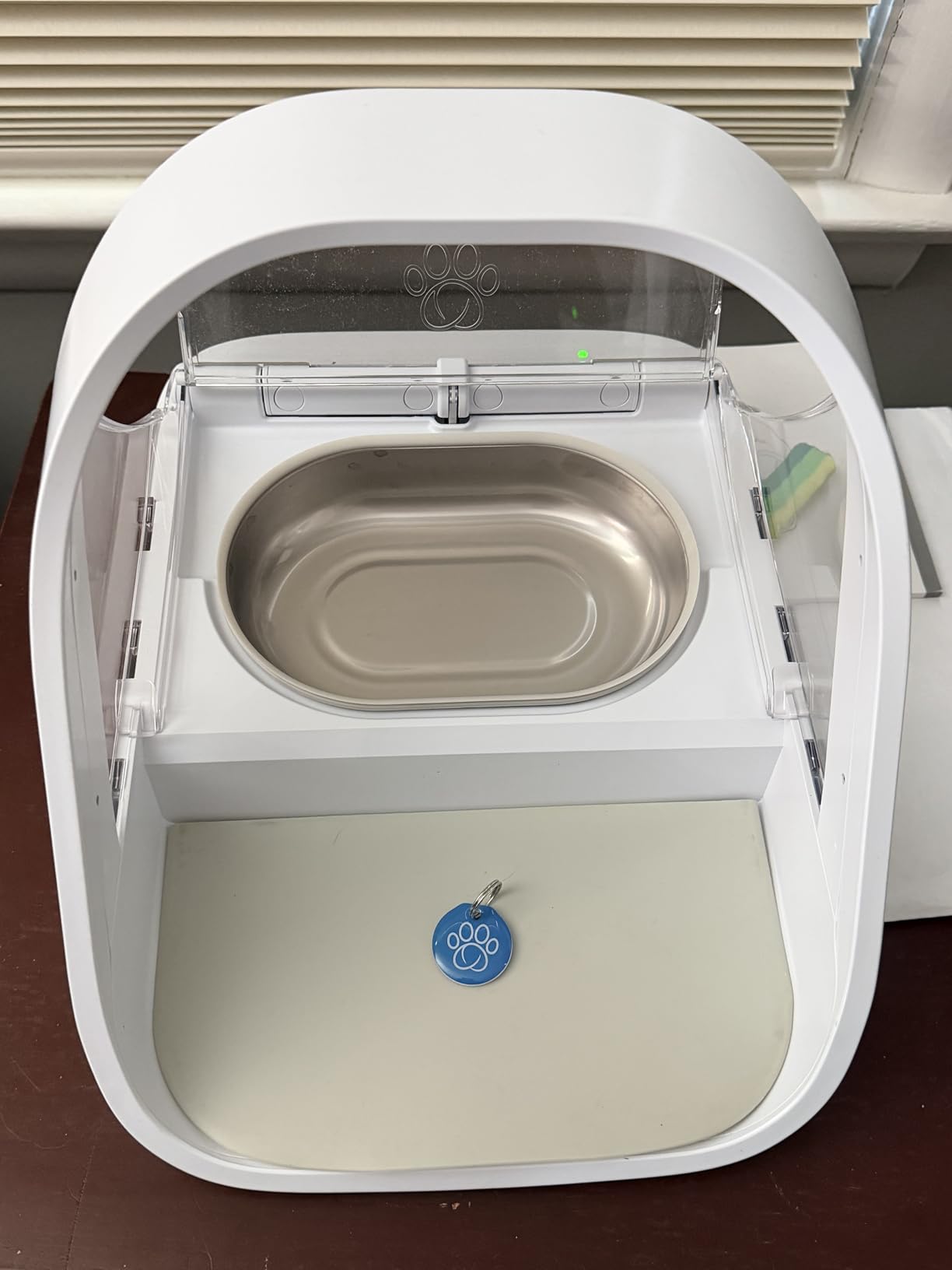
Reliability is the strongest part of this package. It stores up to 32 pet IDs, works with the three common microchip digit formats, and the manufacturer backs it with a three-year warranty, which is the longest coverage on this page by a wide margin. It runs on four C batteries and a full set lasts a long stretch between changes, so there is no charging routine to maintain. If you ever change cats, re-pairing is a single button.
The trade-offs are real. The lid mechanism is genuinely loud the first few times, and for a nervous cat you need to leave the room during those early meals. There is no way to schedule portion sizes, so a cat on a measured diet will be free-fed at this unit rather than rationed. And one owner on a TrustedHousesitters thread preferred a different brand specifically because of the removable stainless steel bowl, a detail worth weighing if your cat gets chin acne.
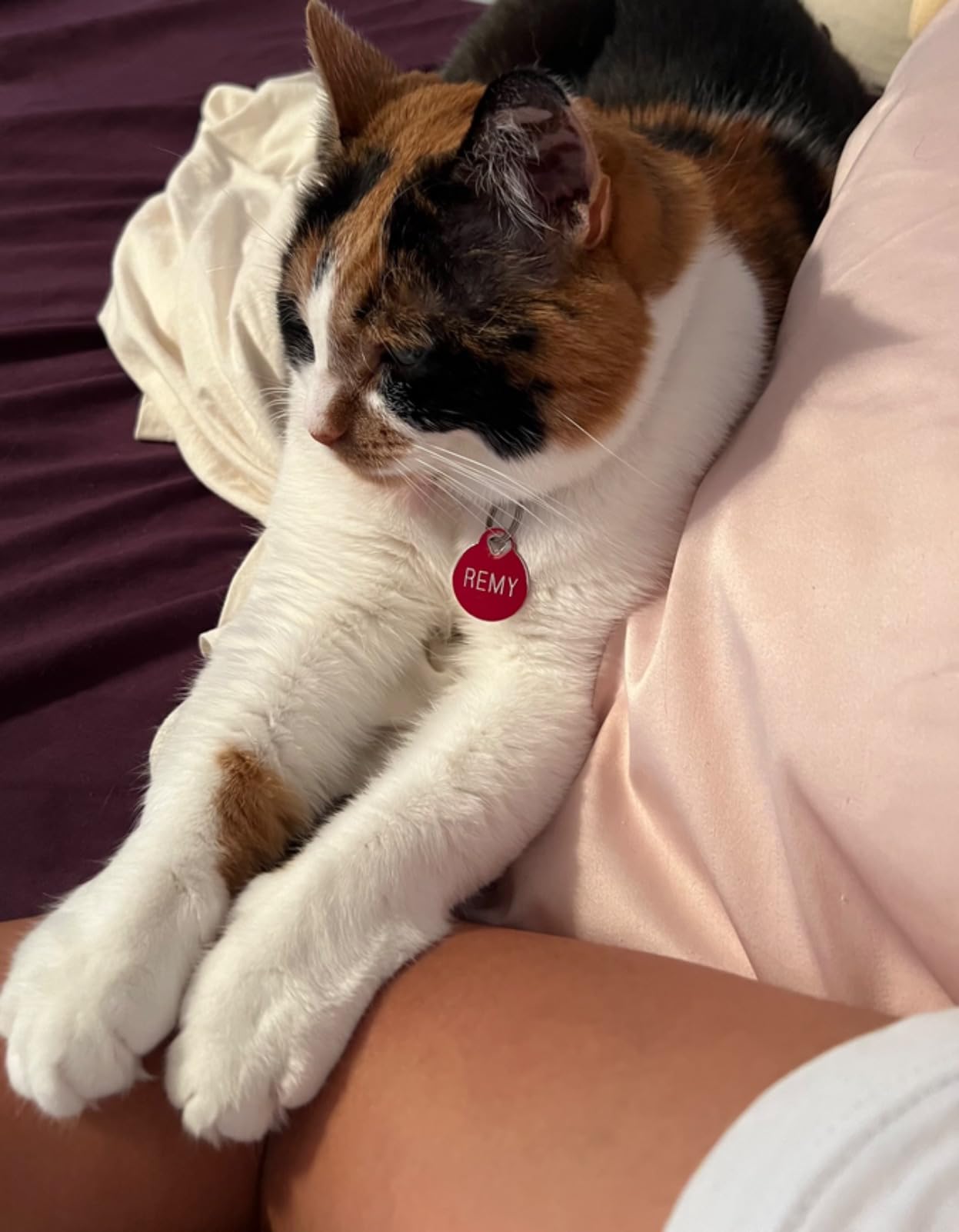
Where the SureFeed earns its place
It is the right choice when you have two or more cats and at least one of them needs a separate, protected, wet-food meal. The sealed bowl, the selective access and the long warranty make it the safest bet on this list for multi-pet households.
It is also the right choice for anyone whose cat is on prescription food that another animal must not touch. Pair each feeder with one tag and you have a feeding station per diet that nobody can raid.
Where the SureFeed falls short
It will not help you if your problem is timing rather than theft. A single cat eating one meal a day at a set hour gets nothing from access control, and you would be better served by a chilled timer feeder.
Budget an extra week of patience if your cat is timid. The training curve is the most common complaint in reviews, and the noise is a real barrier for a cat that startles at the dishwasher.
2. PETLIBRO Wet Food Feeder with Semiconductor Cooling
PETLIBRO Automatic Wet Food Cat Feeder 2026 New Version with Semiconductor Cooling, Refrigerated 3 Fresh Meals in 3 Days, App-Controlled Pet Food Dispenser, Stainless Steel Bowl, Easy to Clean
Semiconductor cooling,3 meals fresh up to 72 hours
304 stainless tray
App control,2.4GHz Wi-Fi
3.8 lb
Pros
- Real refrigeration means no ice pack routine
- Stainless tray is dishwasher safe and helps with chin acne
- App schedule plus instant Feed Now
- Dual infrared anti-pinch sensors
- Warms the portion before serving
Cons
- Needs a power outlet and 2.4GHz Wi-Fi
- Only three compartments per cycle
- Newer listing with a shorter reliability history
- Some reports of app and cooling shortfalls
This is the closest thing on the market to a proper automatic wet food cat feeder, and the gap between it and an ice pack unit is the single most important difference on this page. Instead of freezing something, the semiconductor module actively pulls heat out of the compartment. You load three meals on a Monday and the food is still properly chilled on Thursday, which covers a long weekend, a working trip or a medical stretch without anyone intervening.
The other feature that changed our routine is the pre-meal return to room temperature. The compartment stops chilling about 30 minutes before its scheduled time, so the pate arrives closer to the temperature cats actually prefer. Cold food that has sat at refrigerator temperature for three days smells wrong to a lot of cats, and owners consistently call this out as the reason their cat eats from the unit instead of ignoring it. Feed Now also opens a meal immediately through the app, which is what you want at 6am when the cat is standing on your chest.
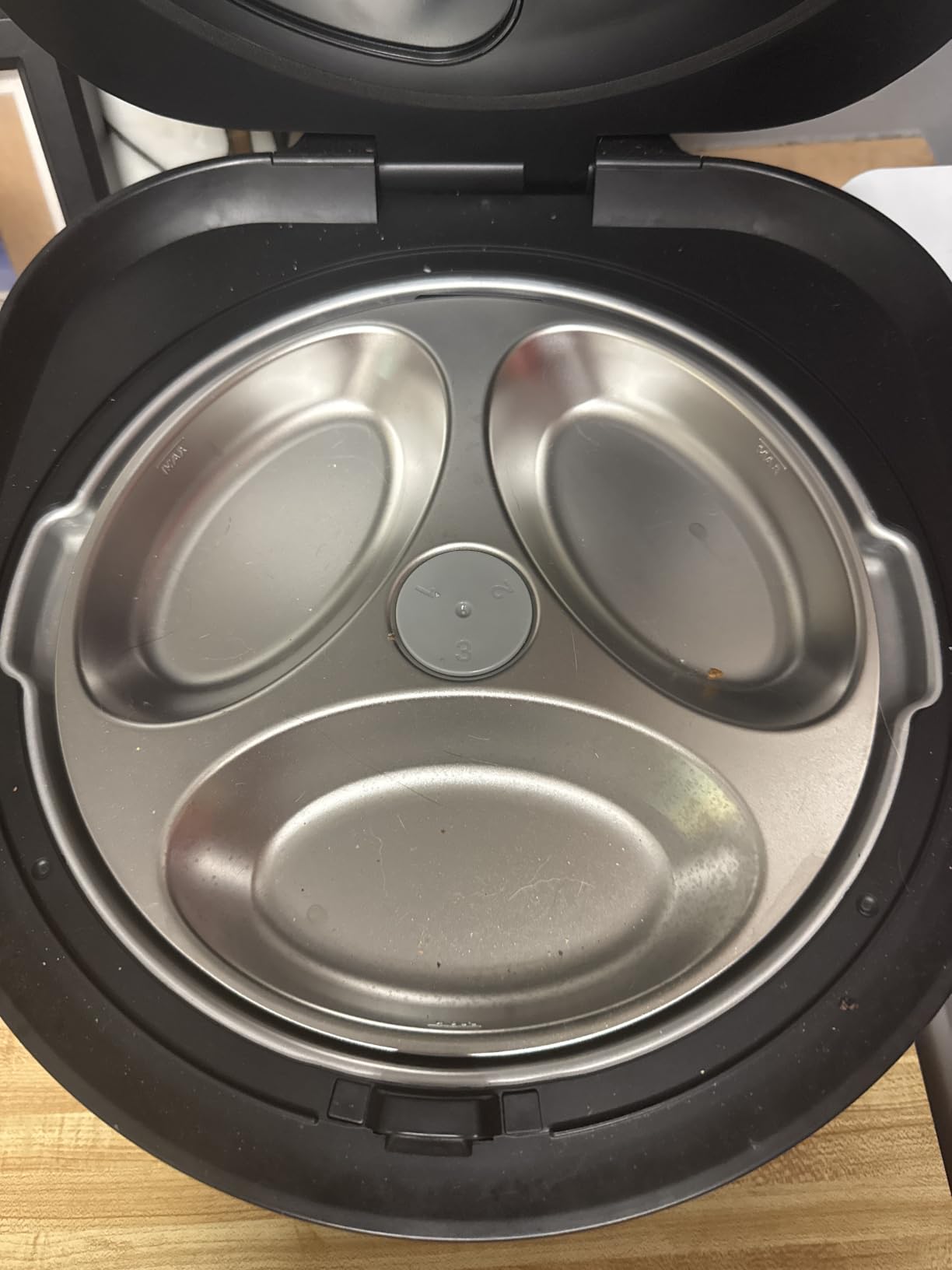
Construction is good for the category. The tray is removable food-grade stainless steel and dishwasher safe, the dual infrared sensors on either side of the lid delay closing while a cat has its head in the bowl, and unfinished meals can be reopened through the app so a shy cat gets a second chance. The listing carries a 24-month quality commitment, and the unit itself is compact enough to sit on a counter at 14 by 13 inches.
What gives us pause is the dependency chain. It needs mains power, it needs a 2.4GHz network for app control, and the 4.1 star rating across 3,771 reviews is lower than you would expect from the feature list. That rating pulls down on reports of Wi-Fi pairing trouble and cooling performance that falls short on warm days. If your router is 5GHz only or you have no interest in apps, you are paying for capability you will not use.
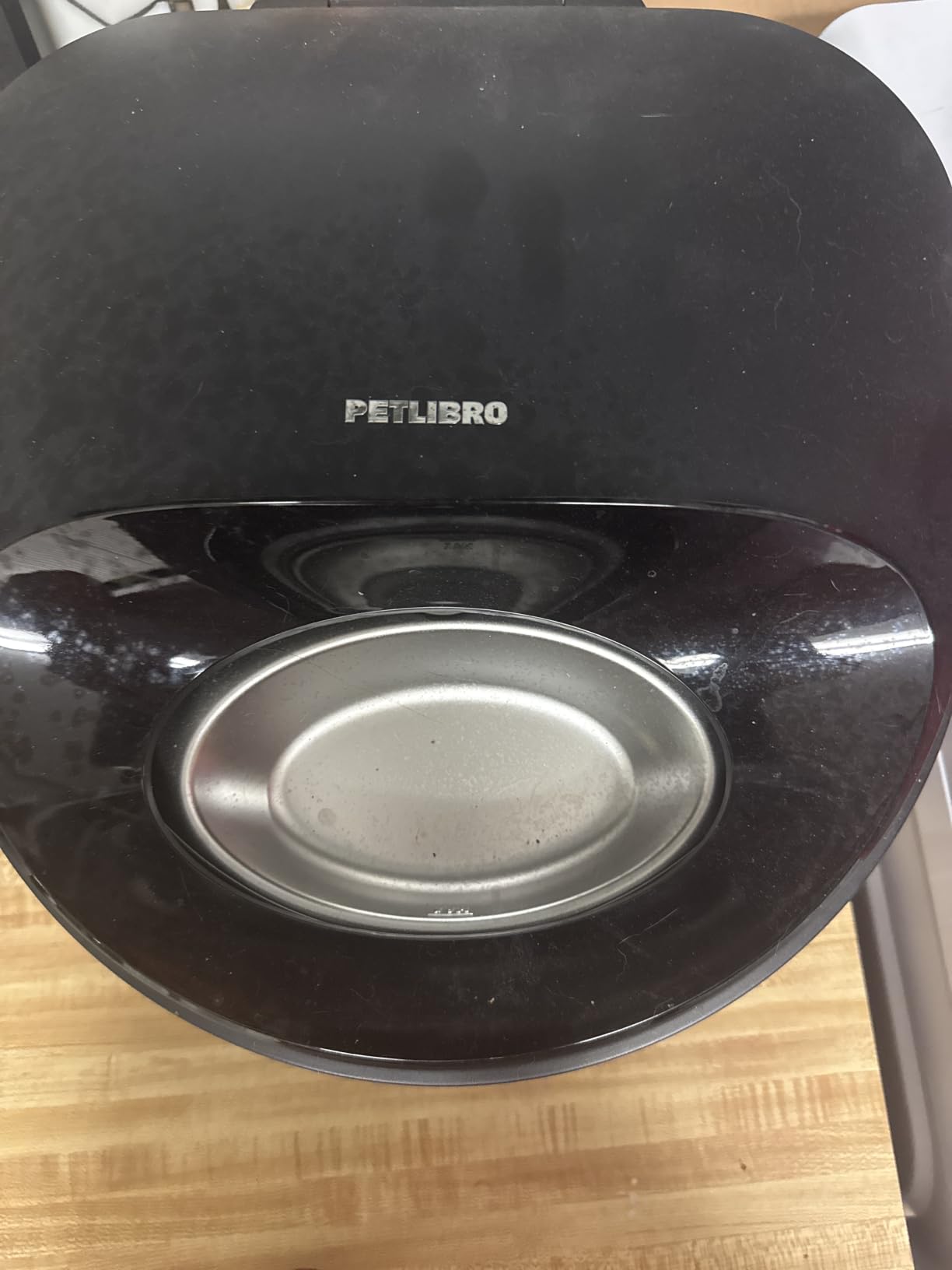
What we liked about daily use
The stainless tray and the anti-pinch sensors made this the least eventful feeder in our kitchen. Cleaning took about a minute a day, and no part of the routine involved remembering to do something.
For a cat on a wet-only or mostly-wet diet with a predictable appetite, the three-day window is the feature that justifies everything else. You stop managing the feeder and start trusting it.
Where the PETLIBRO will frustrate you
Three compartments is a hard limit. If your cat eats four small meals a day, or you want two days of coverage plus a meal for the morning you return, one fill is not enough.
Plan for a 2.4GHz network before you buy. The app is the only way to set the schedule, and a 5GHz-only router is the most common setup failure we saw mentioned in reviews.
3. iPettie Donut Frost Six-Meal Feeder with Ice Packs
iPettie Donut Frost WiFi 6 Meal Automatic Wet Food Feeder with Ice Packs
6 wells, up to 1/2 lb each
2 ice packs, 6-8 hours cold
Rechargeable battery backup
App on 2.4GHz Wi-Fi
5.34 lb
Pros
- Six compartments cover the most meals of any ice pack unit
- Rechargeable battery gives roughly a week of standby
- Quiet rotation with a soft beep
- Lock screen survives a cat climbing on top
- Six app-scheduled meals
Cons
- Six wells but only five programmable meal times
- Open well is uncovered so the first portion is always accessible
- Plastic tray warps in the dishwasher
- Battery runtime falls from about 30 days to roughly two weeks over a year
The most ambitious ice pack feeder we have run. Six wells each take up to half a pound, so this is the unit to look at if you freeze patees into pucks in ice cube trays and load several days of meals at once. Owners who do this report genuinely cold overnight food with two sets of ice packs rotating through the cycle, and the flat donut shape gives a wide, stable footprint for a cat that likes to sit on top of things.
Battery backup is the sleeper feature. The built-in rechargeable lithium polymer battery keeps the tray turning for about a week of standby, so a short power cut does not mean a missed meal or a tray sitting open. The anti-jam function stops rotation if a pet is in the way, which matters more than it sounds with a six-well carousel and an eager cat.
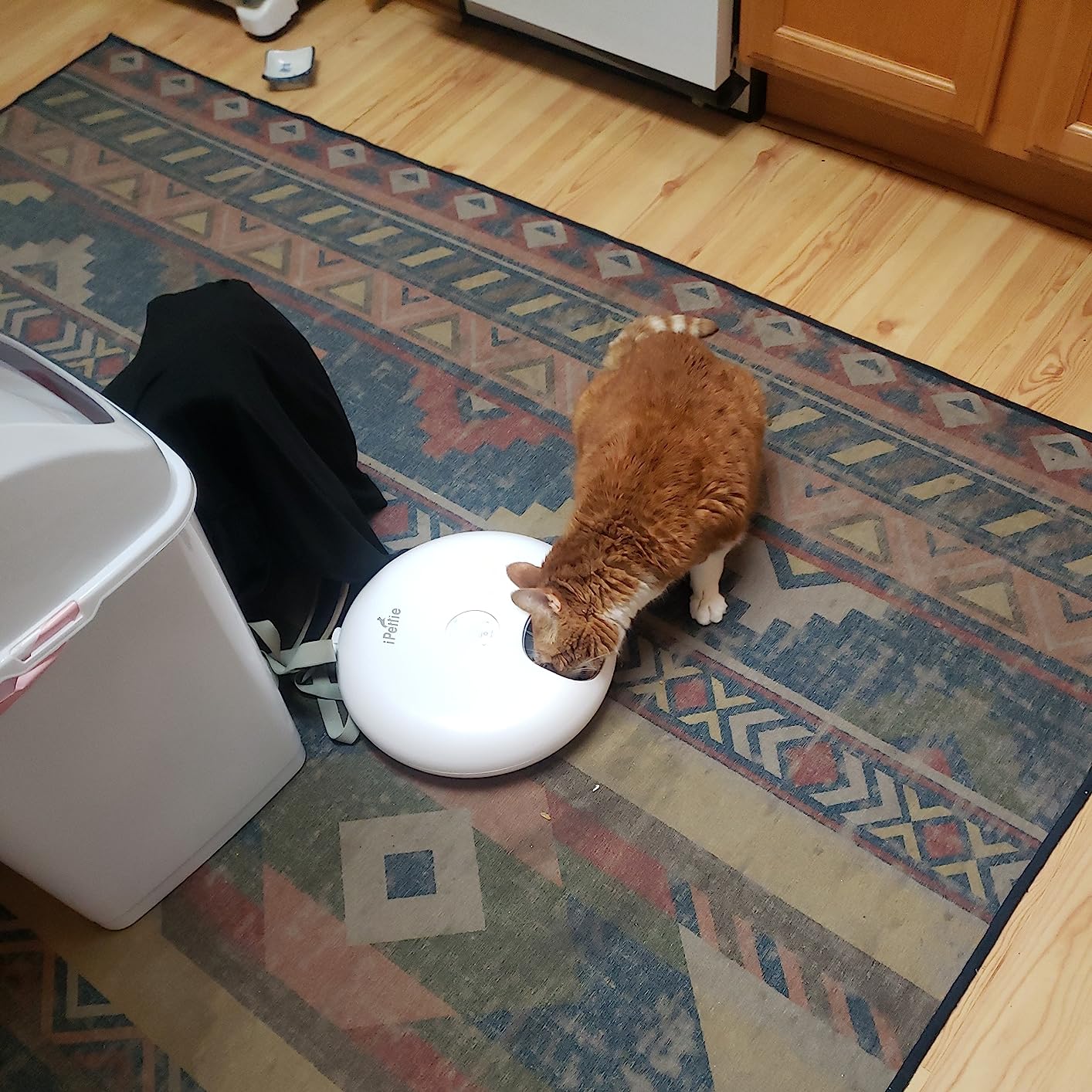
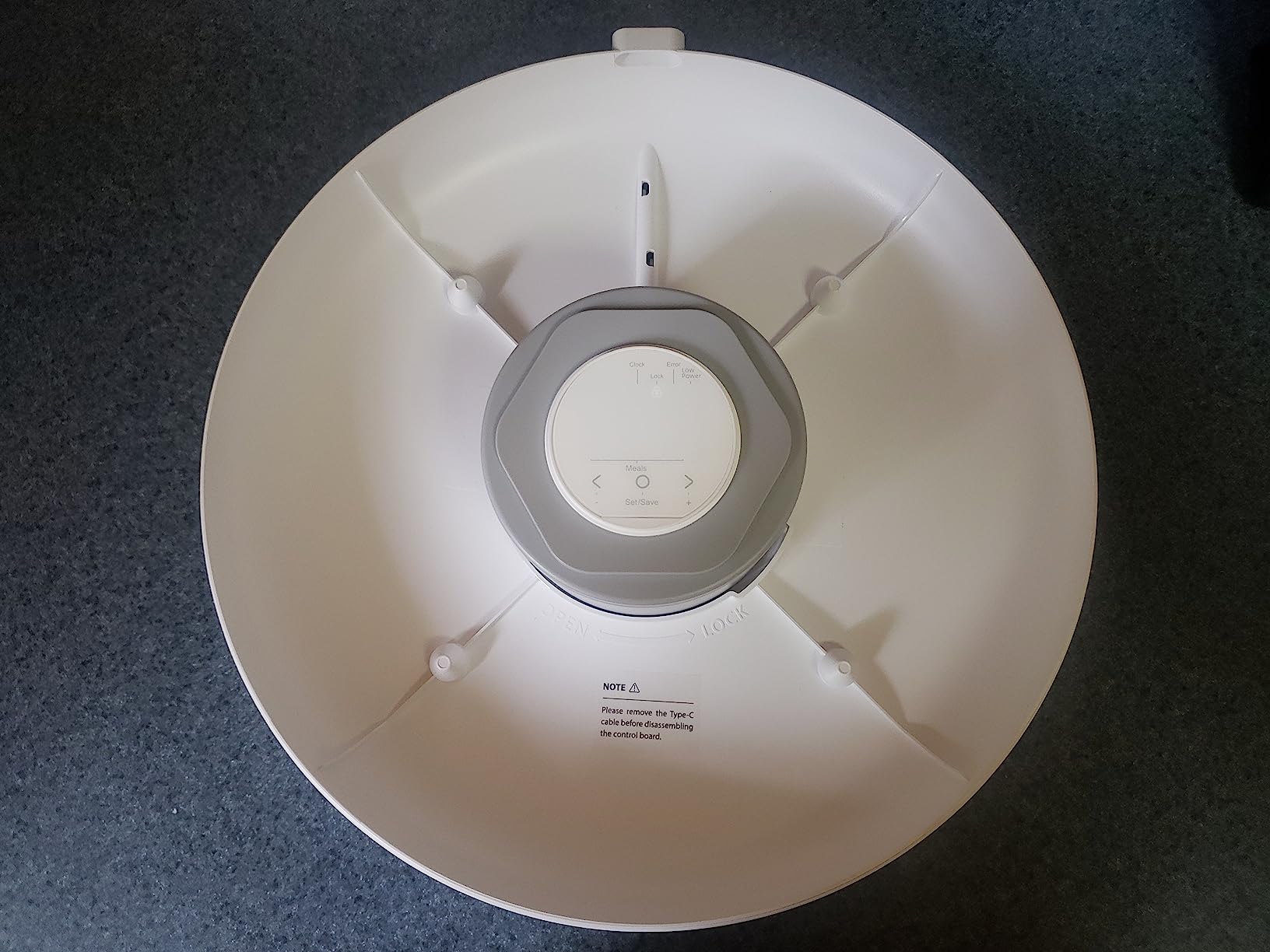
Two design details are worth knowing before you commit. The tray that ships with it is food-grade BPA-free ABS, and a 304 stainless steel tray is sold separately. The plastic tray warps in a dishwasher, which is the main hygiene complaint in reviews. Separately, the carousel always has one well open, so the portion in it is accessible to any cat in the house at any time, and the unit only offers five programmed openings for six wells.
Long-term durability is the weak point. The 3.8 star rating across 1,017 reviews reflects recurring error codes, tray rotation that stops working, and battery runtime that declines noticeably over a year. The touchscreen also needs firm presses, and some units become unresponsive to light touches.
Reasons to pick the Donut Frost
Six compartments is the highest meal count on this list for anything not actively refrigerated, and the rechargeable battery is genuinely useful in a house with older wiring.
It is the best fit we found for portion-frozen patees, where ice packs do a better job than refrigeration because the food is already frozen solid when it goes in.
Where it falls down
The mismatch between six wells and five schedules confuses owners, and the always-open well means one portion is never protected from a hungry second cat.
If you care about hygiene or your cat has a sensitive chin, factor in the extra cost of the stainless tray, because the included plastic one does not survive a dishwasher.
4. Bsemax Four-Meal Feeder with Twin Ice Boxes
Automatic Wet Food Cat Feeder, Auto Refrigerated Wet Foods Feeder for Cats Dogs 4 Meal Timed Fresh Foods Dispenser with 2 Ice Packs Small Pet Feeders for Kitty Puppy Automatic Cat Dog Food Bowl
4 compartments at 240 mL each
Twin ice crystal boxes,1-24 hours
12H/24H timer
4 AA batteries
3.02 lb
Pros
- Largest per-meal volume on the list at 240 mL
- Good for flat-faced cats and puppies
- Two ice boxes outlast a single pack
- Battery powered so it goes anywhere
- Dishwasher safe removable lid and tray
Cons
- Ice boxes need about six hours in the freezer
- Ice loses effectiveness in warm rooms and later meals
- Batteries not included
- No app or Wi-Fi
- Mixed reports on timer accuracy
Portion size is the story here. Each of the four compartments holds 240 mL, or 100 to 120 g of food, with a feeding spout area of roughly 41 square centimetres. That is the most generous individual portion of any ice pack feeder we tested, and it is the reason this unit works for flat-faced cats and for small puppies as well as for adult cats. Wide, shallow access also means fewer whisker collisions than a narrow deep well.
The two integrated ice crystal boxes are a step up from a loose pair of gel packs. The manufacturer rates them at near-freezing for 1 to 8 hours with cooling maintained through the 9 to 24 hour range, which is a longer tail of useful chill than most ice pack units manage. In practice we found the first two or three meals solidly cold and the fourth noticeably warmer, so treat the later slots as same-day meals rather than overnight coverage.
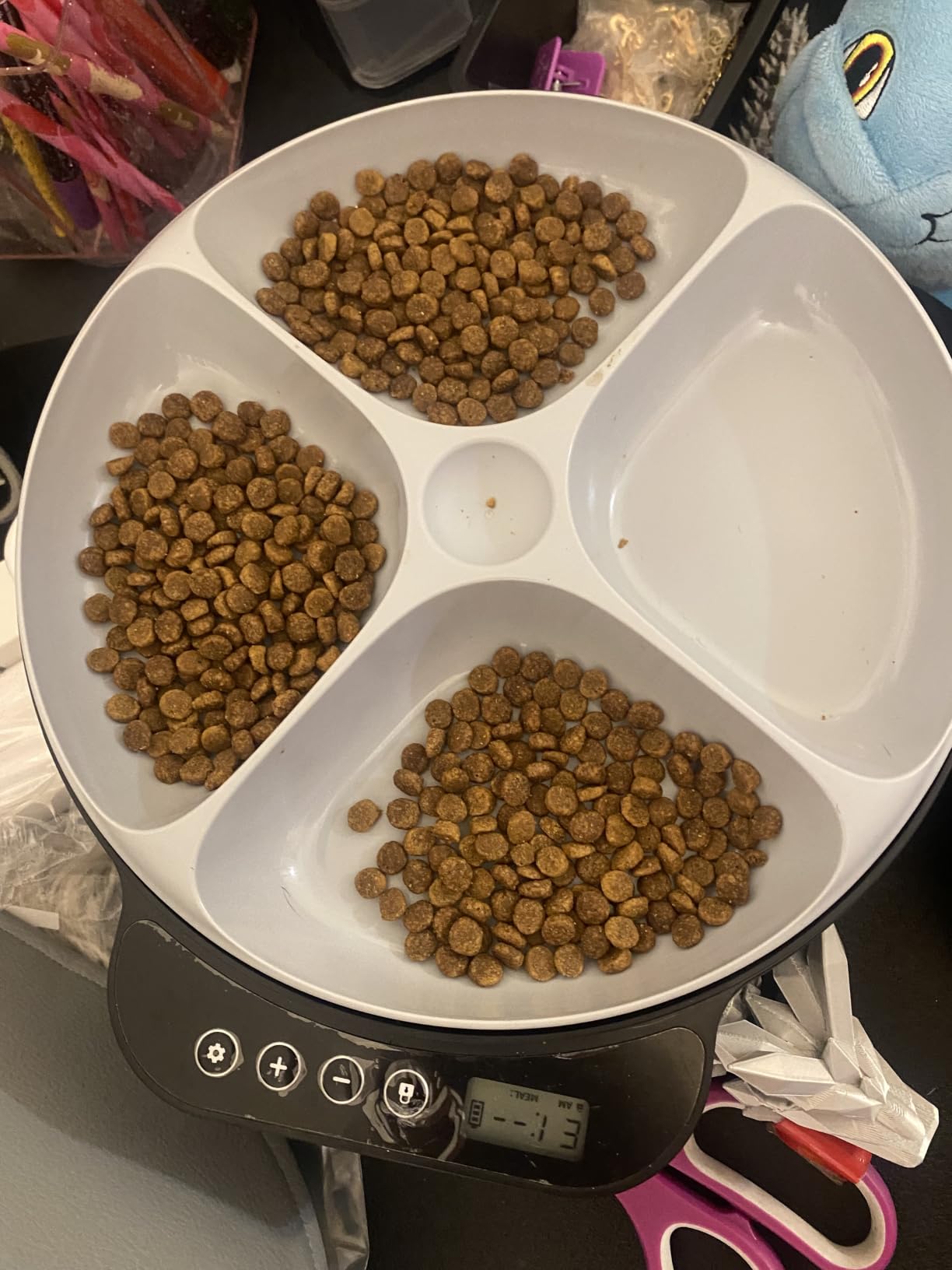
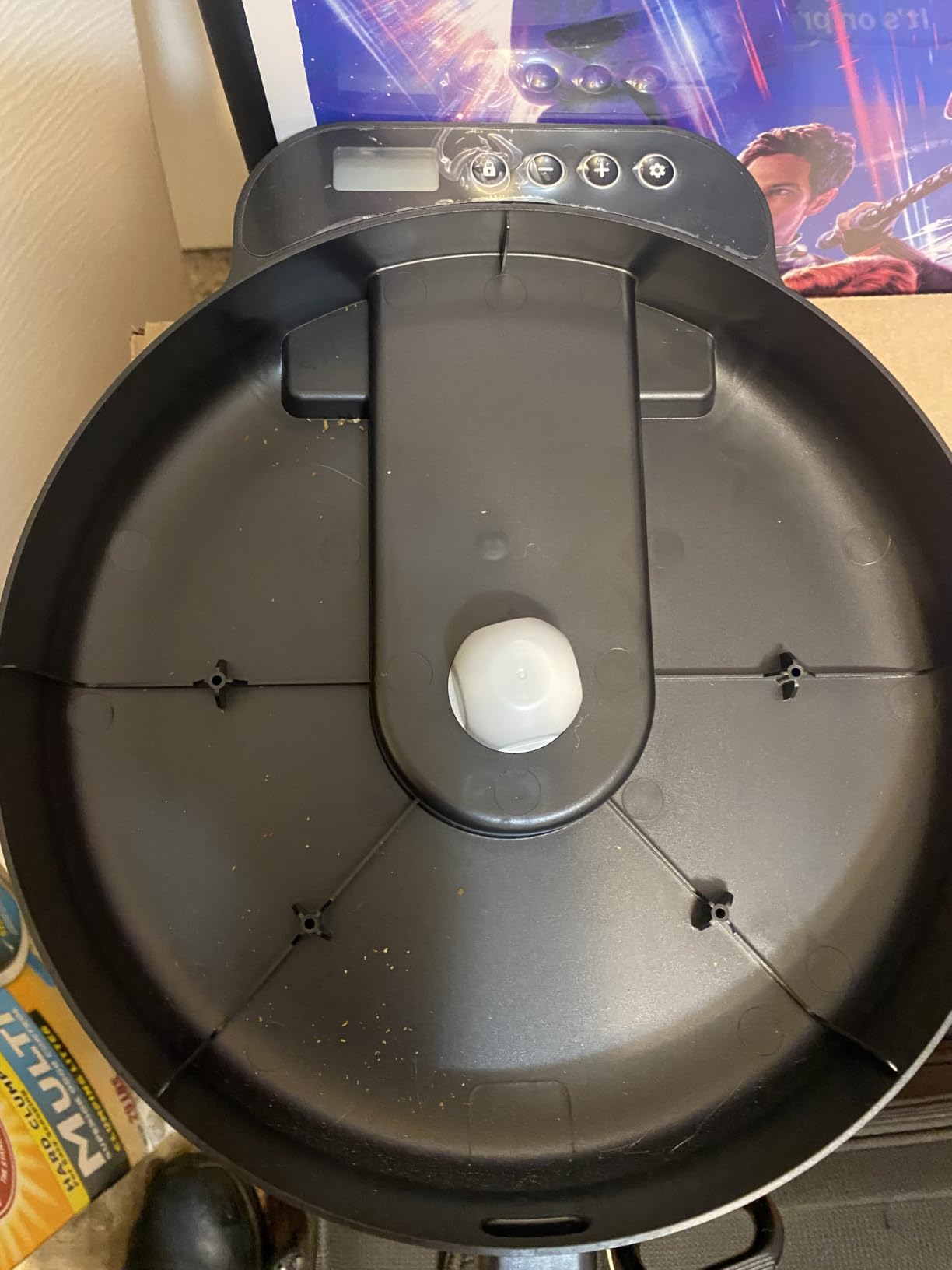
Everything else here is deliberately simple. A 12-hour and 24-hour clock toggle drives up to four programmed feedings, an anti-kick safety sensor stops the mechanism if a paw interferes, and an LED display shows remaining battery power. It runs on four AA batteries, which means you can put it in a bedroom, a garage or a cattery without running a cable, and there is no app and no Wi-Fi pairing to deal with.
The compromises are the ones you would expect. The ice boxes require about six hours in the freezer before each use, so a multi-day absence means a freezer round trip. Batteries are not included. And the 3.8 rating across 371 reviews reflects mixed experiences with timer accuracy and how long the mechanism keeps working.
When the Bsemax makes sense
Big portions are its reason to exist. A cat that inhales a 100 g meal, or a flat-faced cat that cannot reach into a narrow well, will do better here than with any of the four-meal units in this group.
It is also the easiest to place anywhere. No outlet, no app, no pairing, and the whole lid and tray come out for the dishwasher.
Where it disappoints
The daily freeze routine is unavoidable, and the last meal of a long day is the weakest. In a warm room the ice boxes lose their edge well before the 24-hour figure suggests.
If you want to program from your phone or check on a meal while you are away, this is the wrong unit. It is a timer, not a smart feeder.
5. Cat Mate C500 Five-Bowl Digital Timer Feeder
Cat Mate C500 5 Bowl Digital Timer-Controlled Automatic Pet Feeder – 5-Meal Feeder with Stainless Steel Bowl and Ice Packs, Wet or Dry Food, 5 Meals Up To 330 g Each, White
5 bowls at 330 g each
Twin ice packs for wet or raw food
Digital timer
Dishwasher safe
11.64 oz
Pros
- Highest average rating in this group at 4.5 stars
- Five large meals of 330 g cover a full day
- Twin ice packs support wet or raw food
- Five stainless steel bowls
- No app or account to set up
Cons
- Ice packs must be refrozen between cycles
- No refrigeration and no app connectivity
- Plastic bowl lids are not as airtight as a sealed unit
- Flat-faced cats may not manage the compartments
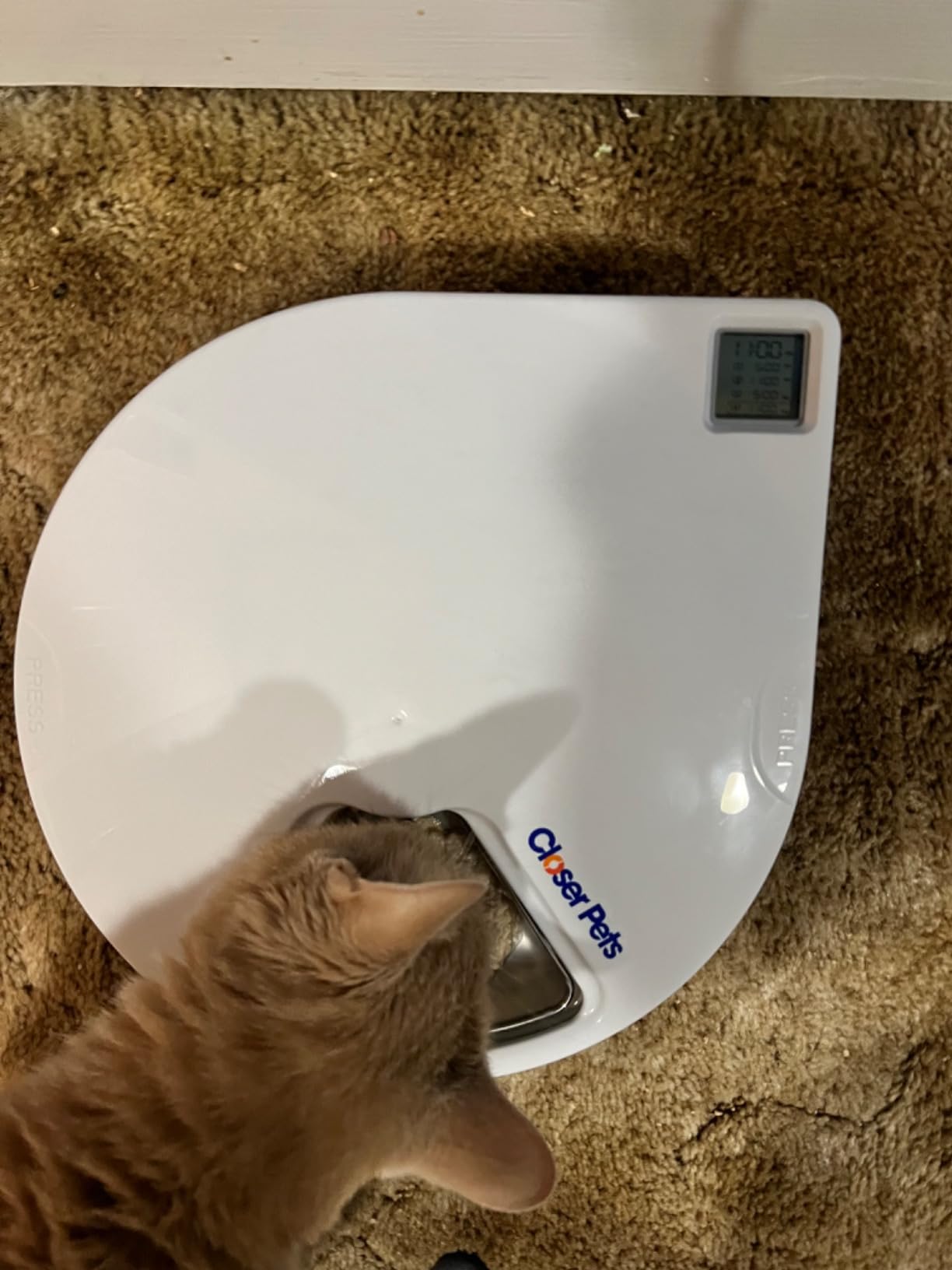
This is the feeder that comes up first on every forum thread about wet food automation, and after weeks of use we understand why. It does one thing: a digital timer rotates a five-bowl carousel so that exactly one 330 g portion is available at a time, and the rest stay covered. Each bowl is dishwasher-safe stainless steel, twin ice packs are included for wet or raw food, and the tamper-resistant lids keep curious paws out of the bowls that are not yet due.
The rating reflects that it simply works. At 4.5 stars across 285 reviews it is the highest scored unit we tested, and owners describe it in reliability terms rather than feature terms. One recurring note is that you pre-portion by hand rather than having it dispense anything, which is a feature when you want exact control over a prescription diet and a limitation if you want it to weigh out the food.
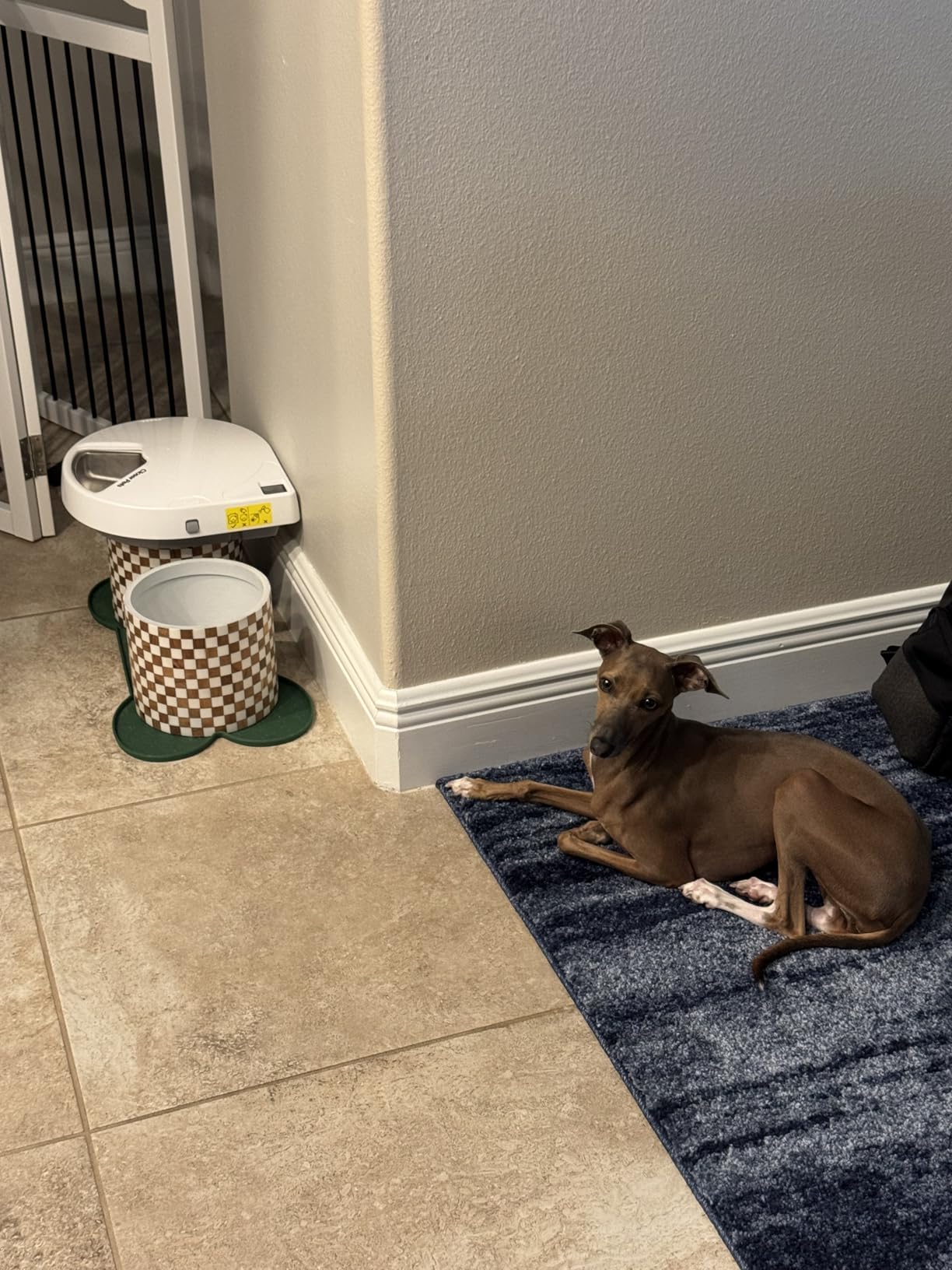
At 330 g per bowl, five meals is a full day for most adult cats with generous appetites, and the small footprint and light 11.64 ounce weight make it easy to move between rooms as your cat’s preferred spot changes. There is no app, no account and no Wi-Fi, so there is no pairing failure and nothing to update.
Two limitations are worth planning around. First, chilling depends entirely on frozen packs, so the last meals of a long day are the ones that warm. Second, owners report that the C500 is not suitable for flat-faced cats, who have difficulty reaching into the compartments. The plastic bowl lids also do not seal as tightly as the neoprene lid on the SureFeed, so moisture retention is good but not exceptional.
Why this one keeps getting recommended
It has no moving parts beyond a simple motor and a rotating tray, no firmware and no cloud account. Over years, that simplicity is the difference between a feeder that still works and one that needs troubleshooting.
The stainless bowls matter more than they sound. They go in the dishwasher, they do not hold odour, and they are kinder to cats that get chin acne from plastic.
Where the C500 will not fit
It cannot run a long weekend without a return trip to the freezer, because there is no active cooling and only two packs. A three-day absence needs a different approach entirely.
If your cat is flat-faced, skip it. The compartment geometry is not right for that head shape, and no amount of ice will compensate.
6. HEAPETS RFID Feeder for Prescription Diets
HEAPETS Automatic Cat Feeder with RFID Collar Sensor for Multi-Pet Households, Anti-Stealing Food Dispenser with Sealed Lid for Wet Dry Food & Prescription Diet for Cats, Black
RFID collar tag access only
Retractable bowl
Sealed motorized lid
Removable inner bowl
4.18 lb
Pros
- Collar tag pairing stops food stealing reliably
- Retractable bowl denies food to an approaching cat
- Sealed lid keeps wet food from drying out
- Quiet motor with soft silicone edges
- Pre-paired tags work out of the box
Cons
- Does not read microchips so a collar is required
- Only one pet can be paired per feeder
- No refrigeration so wet food needs prompt removal
- Newer listing with a small review base
Selective feeding is the goal here, and the mechanism is more assertive than the alternatives. Rather than waiting for an unauthorized cat to arrive and be refused, the retractable bowl pulls the food away from the opening when another pet approaches, and the sealed lid closes automatically about ten seconds after the paired cat leaves. In a two-cat household where one is on a restricted diet, that active denial does more than simply closing a door.
The main limitation is the identification method. This unit reads an RFID collar tag only, not a microchip, so your cat has to wear a collar. It also pairs with one pet per feeder, so a three-cat household needs three units. The motor is described as quiet with soft silicone edges on the door, and there is a manual training switch plus a three-button interface rather than an app.
Be clear with yourself about the wet-food side of this product. There is no cooling, no ice packs and no refrigeration, and owners are explicit that wet food should not sit inside for extended periods. For a dry-food prescription diet it is a strong pick. For a wet-food prescription diet you would still need to remove the food between meals or use it alongside a chilled timer feeder.
The 4.4 star rating is good, but it rests on 208 reviews of a listing that first appeared in May 2026, so the long-term record is short. The three-button interface and pre-paired tags do mean it works out of the box without setup work, which is genuinely convenient.
What works about the HEAPETS design
Pairing by collar tag is simpler than microchip training and works with any cat, chipped or not. Many owners do not microchip indoor cats, so this covers a real gap.
The retractable bowl is a clever bit of design. It means the food is protected in the moments before the door shuts, which is exactly when a fast second cat would otherwise help itself.
Where it falls short
One pet per feeder is a hard limit, and multi-cat households are the main reason to buy a selective feeder in the first place. Plan the unit count before you order.
Without any cooling, this is a dry-food and short-window wet-food device. If your cat eats wet food twice a day and you are out for eight hours, the food needs to go somewhere cold.
7. Casfuy Cordless Four-Meal Feeder
Casfuy Battery-Operated Automatic Cat Feeder – Whisker Friendly Automatic Cat Food Dispenser for Wet Dry Food Cordless 4-Meal Auto Feeder for Cats Small Dogs with Programmable 12H/24H Format Timer
4 extra-wide shallow slots
2 reusable ice packs
12H/24H timer
4 AA batteries
3.02 lb
Pros
- Extra-wide shallow slots reduce whisker fatigue
- Cordless so you can place it anywhere
- Simple LCD programming
- Anti-pinch sensor retracts the tray
- Battery life claimed over six months
Cons
- Only one set of ice packs included
- Plastic bowls rather than stainless steel
- Batteries not included
- Reports of tray misalignment and error codes within months
- Some pets learn to pop the lid clip
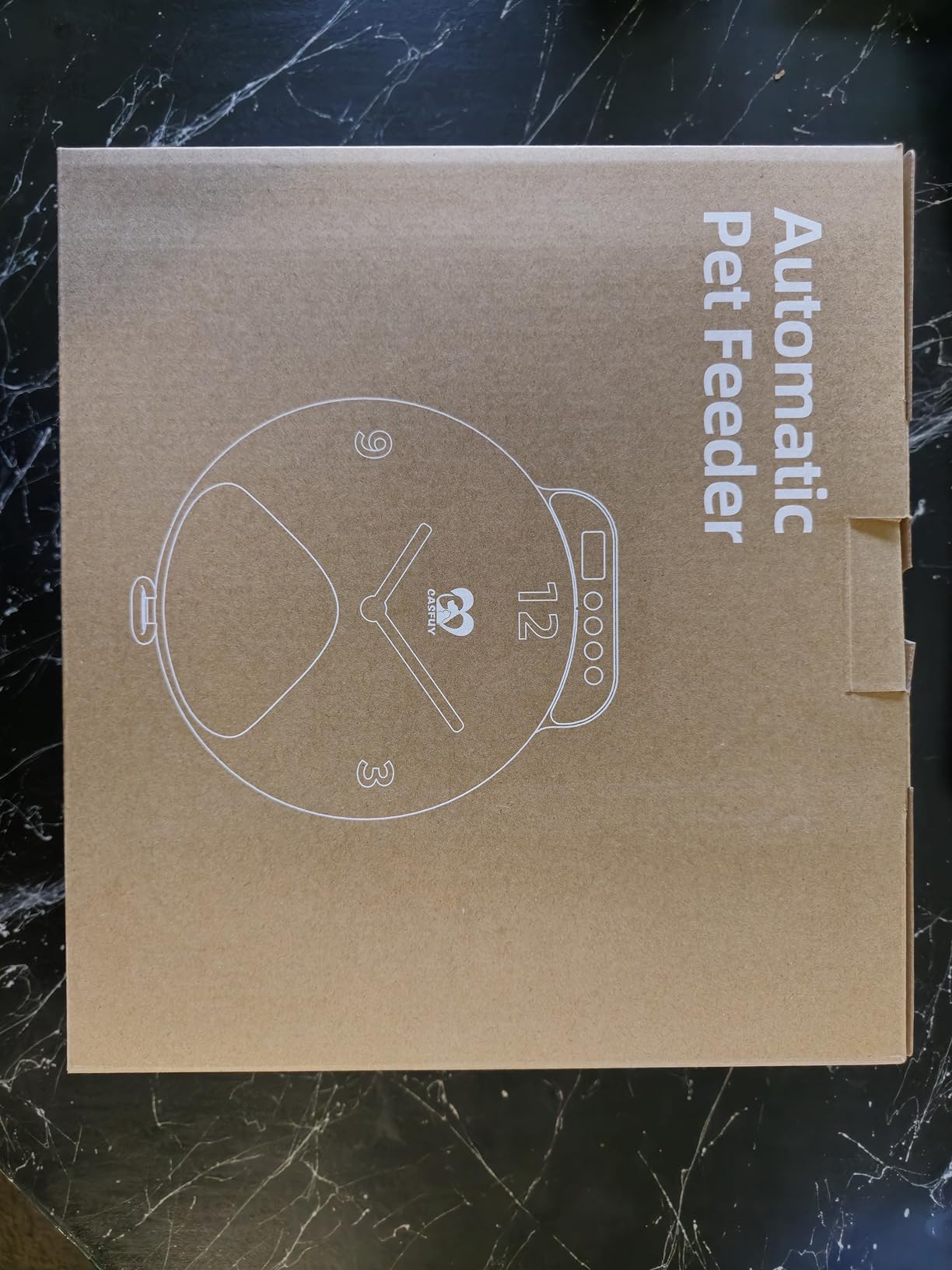
Whisker comfort is the design driver here. The four slots measure up to about 5.94 by 1.42 inches, which is wide and shallow, and that geometry reduces the whisker contact that makes some cats refuse to eat from a deep or narrow bowl. For a fussy cat that stalls over a confined space, that is not a cosmetic detail. Two reusable ice packs are included, the lid and control panel lock, and the feeding beep can be turned off for a cat that startles at sudden noise.
Operation is as simple as feeders get. A 12-hour and 24-hour toggle on an easy-to-read LCD display handles up to four meals, the anti-pinch sensor retracts the tray if a paw is detected during rotation, and both the food-grade BPA-free cover and tray lift out for rinsing. It runs on four AA batteries for a claimed six months or more, so there is no cable to route.
Reliability is where the 3.8 rating across 129 reviews comes from. A meaningful share of reviews describe the tray failing to rotate, units reporting error codes within a few months, and support that did not respond. There are also reports of pets learning to pop the lid clip open, which matters more on a wet-food feeder where a flipped lid means drying food.
Good reasons to buy the Casfuy
It is one of the simplest ways to cover an overnight or medication schedule with wet food, and cordless placement means you can put it wherever the cat actually eats rather than near an outlet.
Whisker-friendly geometry is a real benefit for long-haired and flat-faced cats that hesitate at confined bowls.
Reasons to look elsewhere
One pair of ice packs is thin coverage for a full day of wet food, and there is no second set to rotate in.
The reliability reports are the deciding factor for us. If this feeder fails while you are away, you find out from a neighbour rather than from the app, because there is no app to check.
8. RESPURR Refrigerated Feeder with Pre-Heating
Automatic Wet Food Cat Feeder, 3 Days 5 Freshness Meals Refrigerated Auto Cat Feeder, Semiconductor Cooling & Heating with 304 Stainless Steel Bowl, Programmable Timer Cat Food Dispenser
Semiconductor cooling near 42F
5 removable 250 ml bowls
Pre-meal heating
1.25 L total
Under 40 dB
Pros
- Three-day refrigeration removes the ice pack routine
- Five stainless bowls with generous capacity
- Pre-heating helps pets with appetite or digestion issues
- Sealed insulated lid
- Quiet enough for a nervous cat
Cons
- Largest footprint of the refrigerated options
- Requires mains power for cooling and heating
- Some owners report temperatures missing set points
- Lowest five-star share in this group
- Short review base
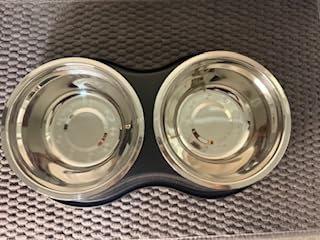
The most ambitious refrigerated unit here, with a design goal that goes beyond keeping food cold. Five removable 250 ml stainless bowls give 1.25 L of total capacity, and up to five meals can be programmed across three days with a memory function, so a single programming session survives a power interruption. The semiconductor module holds food near 42F continuously rather than for a fixed window.
The pre-heating function is the reason we would reach for this unit in a senior cat’s home. Smart pre-heating brings a refrigerated meal closer to room temperature before it is served, which helps with older cats whose teeth and sense of smell have dulled and who often refuse food straight from the fridge. At the same time, the sealed insulated lid locks freshness between meals and operation stays under 40 dB, quieter than most kitchen appliances.
The size is the catch. At 16.14 by 12.99 inches it has the largest footprint of any refrigerated option on this page, so it needs a real counter space rather than a corner of the kitchen. Energy use is listed at about 0.5 kWh per day, which is worth factoring into any multi-day running cost comparison.
Owner reviews are the reason the rating sits at 3.8 across 85 ratings, and the listing is new enough that long-term durability is essentially untested. Reports of cooling or reheating not reaching set points suggest the temperature control is not as consistent as the specification implies, and the five-star share is the lowest in this group.
Where the RESPURR earns its size
Five bowls and 1.25 L is the largest single-load capacity here, and the memory function is a genuinely useful safeguard for anyone feeding a cat over a long weekend.
Pre-meal heating is not a gimmick for senior cats, cats on medication, or any cat that turns its nose away from food served cold. It is the most thoughtful feature on this list.
Where it falls down
Mains power is required for both cooling and heating, so an outage means you are back to ice packs and guesswork about how long the food holds.
The footprint is substantial and the temperature consistency is inconsistent in owner reports. If you are fitting it into a small kitchen, measure first.
9. GAMKII Four-Meal Feeder with Batteries Included
Automatic Cat Feeder Wet Food, Battery Operated Auto Feeder 4 Meals with 2 Ice Packs, Digital Cordless Pet Fresh Food Bowl for Cats Small Dogs with Programmable 12H/24H Format Timer-(Battery Included)
4 scheduled meals with memory
2 ice packs for 6-8 hours
Batteries included
Cordless
Dishwasher-safe parts
Pros
- Batteries ship with the unit so it runs from the box
- Memory function avoids reprogramming every day
- Quiet advancement with a soft beep the cat anticipates
- Detachable tray cover and ice packs wash easily
- Screen lock and paw-care design
Cons
- Setup and programming take practice
- Ice packs need nightly refreezing for multi-day use
- No day display so scheduling is limited to day and night cycles
- Isolated reports of missed scheduled openings
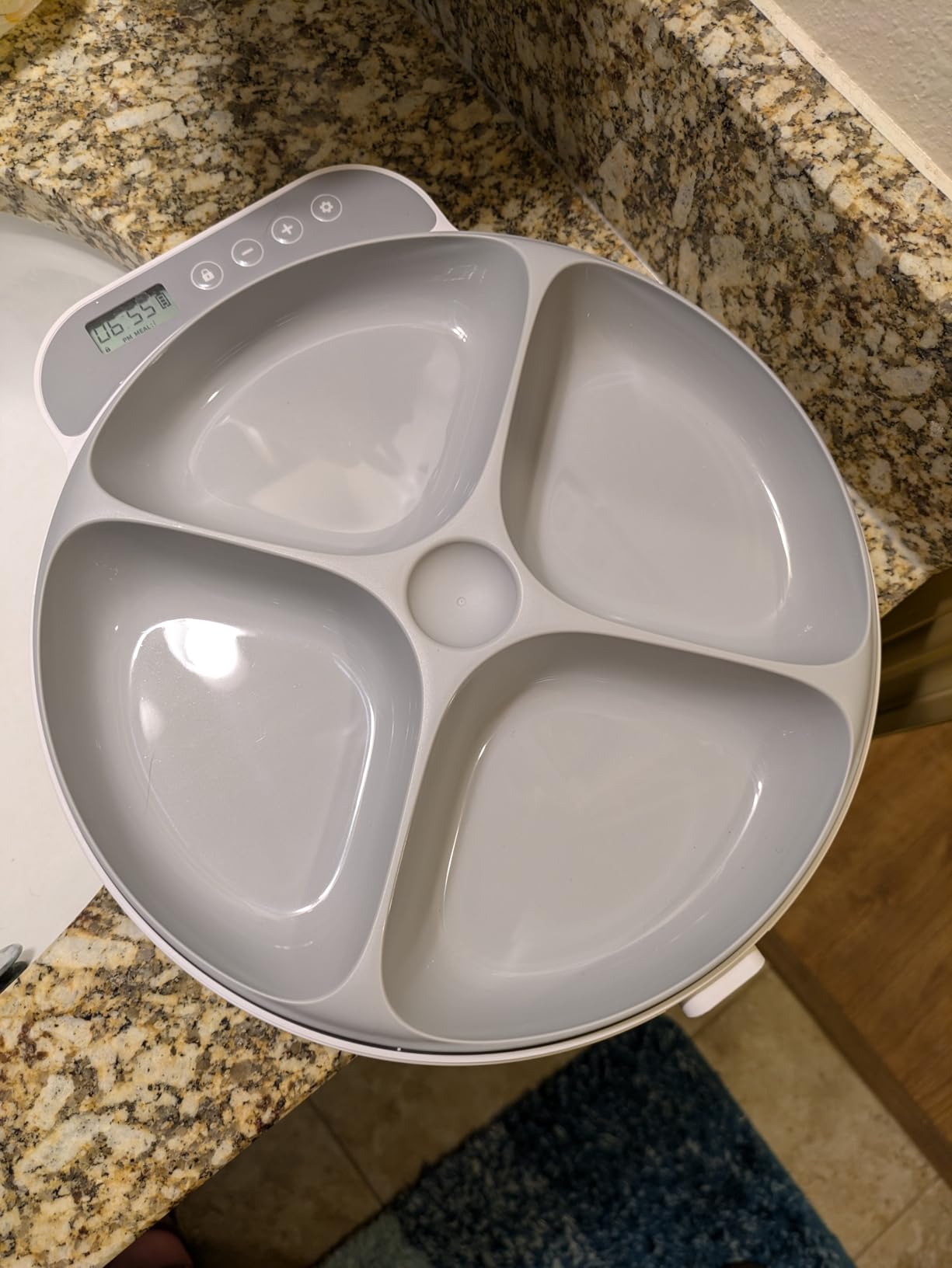
Almost every feeder on this list arrives without batteries, which is the small annoyance that decides the first evening. The GAMKII F26 ships with them, so you can fill it, set the timer and leave for work on the day it arrives. The tray, cover and ice packs all detach and rinse under running water or go in the dishwasher, and the main board is the one part you keep away from water.
Two ice packs extend freshness for 6 to 8 hours, which lines up neatly with a standard workday rather than an overnight-plus-morning gap. A programmable timer with a memory function and 12H/24H switching handles four meals, and the screen lock protection stops curious cats from changing the schedule, which pairs with the paw-care design around the tray.
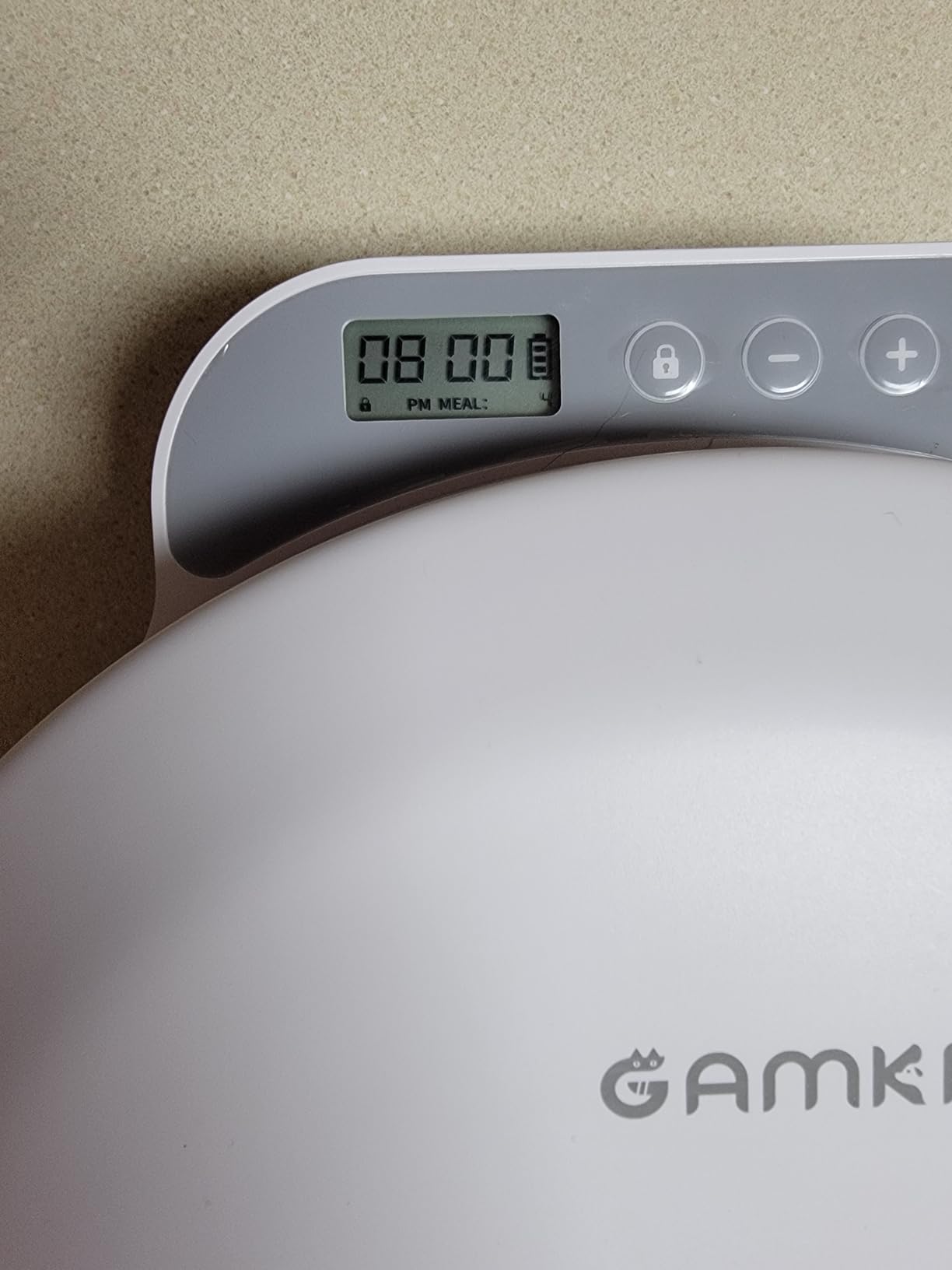
The honest weakness is the interface. Owners describe programming as not intuitive without practice, and there is no day display, so scheduling is essentially a day and night cycle rather than a specific clock time for each meal. That is workable for twice-daily feeding and frustrating for a 7am, 1pm and 7pm rotation. A small number of owners also report the unit randomly missing a scheduled opening.
With 56 ratings, the 4.0 star score is directionally positive but based on a small sample. Day-two freshness after the ice packs thaw is exactly the uncertainty in reviews, so treat this as a weekday feeder rather than a weekend one.
What makes this easy to start with
Included batteries and dishwasher-safe parts remove the two most common day-one problems. You are not standing at a drawer looking for cells when the cat is already yelling.
The memory function is more valuable than it sounds. Set the schedule once and it survives the power cycle, so a brief outage does not reset the day.
Where you will hit a limit
No day display means no precise meal times beyond day and night. If you are dosing medication at a specific hour, read the controls carefully before committing.
Two ice packs and no active cooling means one solid workday of coverage. Anything longer needs a trip home or a different category of feeder.
10. kubvici Dual-Temperature Semiconductor Feeder
Automatic Cat Feeder for Wet Food, Smart Dual-Temp Semiconductor
3 cooling levels, 42.8F to 59F
Pre-meal heating to 64.4F
AAA backup for 72 hours
Anti-pinch reversal
3.5 lb
Pros
- Highest average rating in this set at 4.6 stars
- Three cooling settings you can actually adjust
- Pre-meal heating stops about 25 minutes before service
- AAA backup keeps the tray rotating for 72 hours
- Front and rear buttons for refilling and immediate feeding
Cons
- Cooling and heating stop during a power outage
- Backup batteries are not included
- Mains power required for temperature control
- Small review base of about 44 ratings
Most semiconductor feeders give you one temperature. This one gives you three cooling settings at 59F, 51.8F and 42.8F, plus a preheat mode that takes the meal up to 64.4F. That range matters more than it sounds, because cats differ a lot in how cold they will accept food and how warm you need it to be before they will eat it. A cat that turns away from refrigerator-temperature pate and another that prefers it properly cold can share one feeder instead of needing separate setups.
The pre-meal heating stops cooling about 25 minutes before the scheduled meal, so the portion arrives close to room temperature without you touching anything. The anti-pinch sensor reverses the lid when a paw touches it rather than simply stopping, which is a better design than a blocked tray. Two separate buttons simplify daily handling: the front button opens the whole lid for tray removal and cleaning, the rear button serves the current compartment.
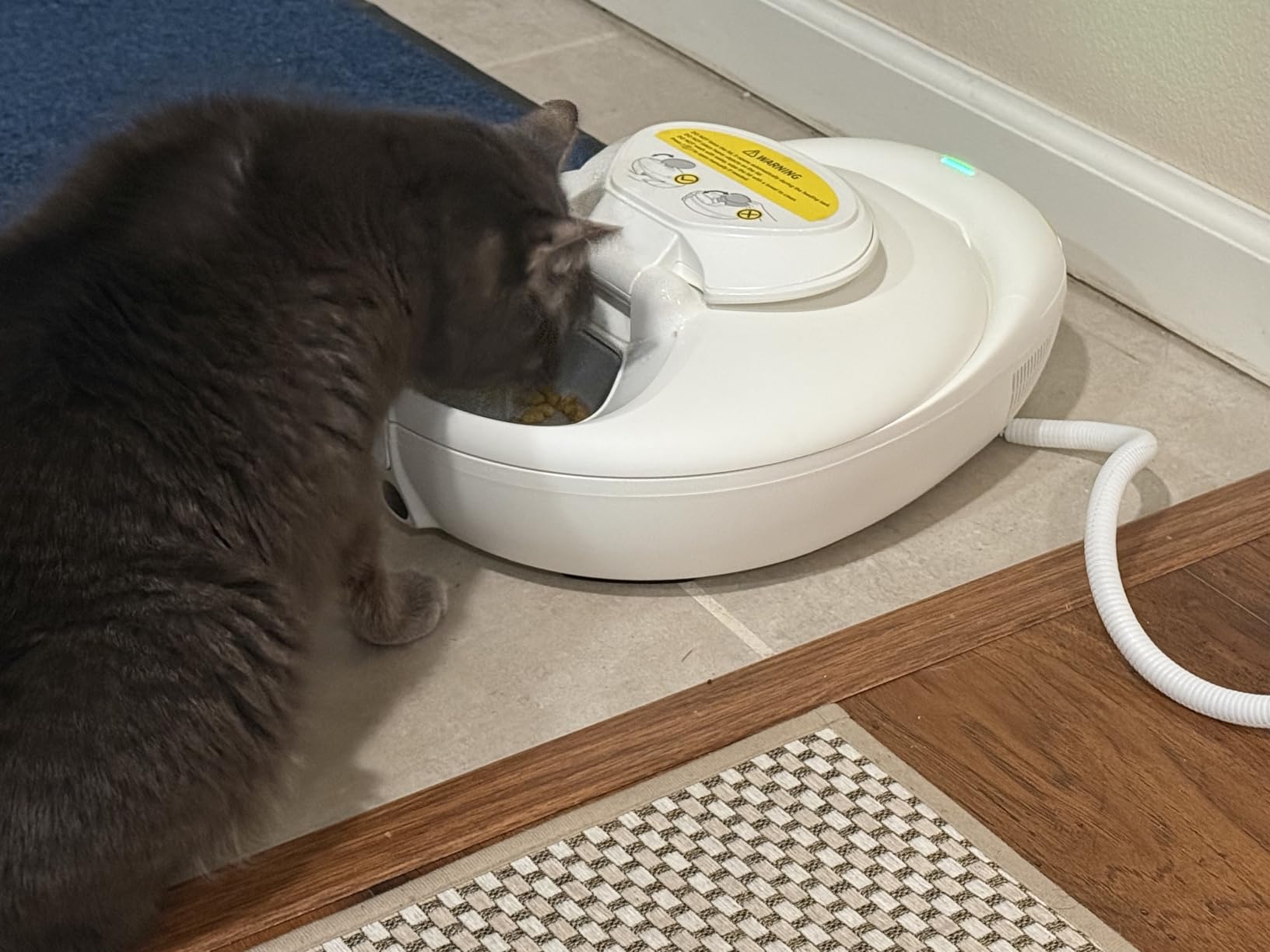
The battery story needs reading carefully. A compartment of three AAA cells keeps the tray rotating for up to 72 hours, so meals still get delivered through an outage, but cooling and heating do not operate on that backup. The food is still delivered, it just is no longer cold, which is a meaningful distinction for a wet food feeder and one that is easy to misread from the marketing.
At 4.6 stars across 44 ratings this is the highest average rating in the set, but the sample is small and the listing only appeared in July 2026. The weight is 3.5 lb, which makes it the most compact refrigerated option here, at 13.8 by 7.8 by 5.1 inches.
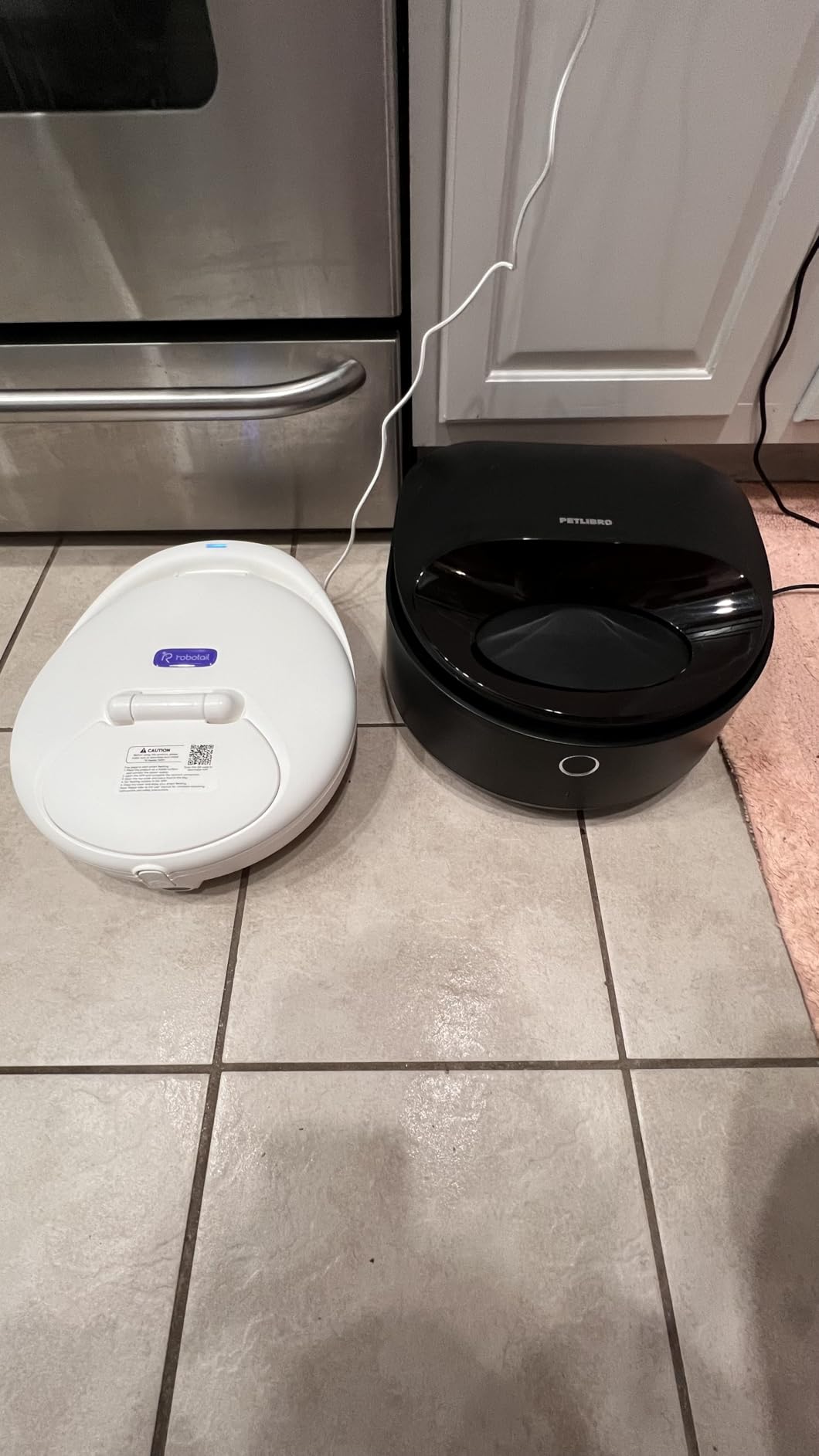
What stands out about this unit
Adjustable cooling plus preheating is the most complete temperature control on this list, and it is the first thing we would want in a home with more than one cat on different textures.
The 72-hour battery backup that keeps the tray rotating is a real safety net. Food gets delivered even when the cooling does not, which is far better than a silent failure.
Where caution is warranted
Forty-four ratings is not a reliability record. The mechanism is new, and semiconductor coolers that cycle constantly are the part most likely to wear out over years.
Treat the backup as a delivery guarantee only. If you are away for more than a day in warm weather, the food in the compartments will not stay cold, and a manual check is still wise.
How to Choose an Automatic Wet Food Cat Feeder
Start with the length of time you need to be away, because that single question eliminates most of the list. Under eight hours, any ice pack feeder works if you load the packs properly. Overnight, use a unit with two or more ice packs and put the early meals in the wells that stay coldest. A full day or longer, you want active cooling, and nothing else on this page holds temperature for that long without intervention.
Next, count the meals per day. Four-meal units cover most cats on a twice-daily wet diet with room to spare. Six-well and five-bowl designs exist for cats that graze, for split feeding of a large portion, or so you can load a full day at once. Refrigerated three-meal units require two fills across a three-day window, which is a routine you need to be honest with yourself about.
Then pick the cooling method deliberately. The three archetypes on this page are not ranked, they are matched to situations. Semiconductor cooling is the right answer for a wet-food-only cat that you leave regularly, or for a cat on a prescription diet where temperature matters. Ice packs are the right answer when the feeder stays put, the absences are short, and you already have a freezer routine. Rehydrating feeders make sense only if you are willing to switch food format entirely.
Check the power story before anything else. Mains-powered units need an outlet in the right place, and a power cut stops the cooling even on models with battery backup, because the backup batteries in this category typically keep the tray rotating and the timer running rather than the compressor. Battery-powered ice pack feeders can go anywhere, which matters in a bedroom, a cattery or a room without a socket, and you should confirm whether batteries are included before you commit.
Look at the bowl material. Stainless steel inserts are worth a premium if your cat has a history of chin acne or if odour lingers in plastic, and they are also the parts you can put in the dishwasher. Plastic trays are fine for a cat without those issues, but the anti-bacterial argument is easier to win with removable stainless steel.
Decide how much intelligence you need. App control on 2.4GHz Wi-Fi gives you remote feeding, records and the ability to open a meal instantly, which is genuinely useful for a cat that finishes early or needs a second portion. It also adds a failure mode: routers that broadcast 5GHz only, pairing problems and firmware that stops talking to your phone. If you would rather never open an app, the Cat Mate C500 and the Bsemax unit do everything with a physical dial and need nothing else.
Finally, think about the cat, not the machine. Some cats are suspicious of motor noise and need a week of training. Some are food thieves who need selective access. Some are flat-faced and cannot reach into a compartment. Some refuse cold food entirely and need a preheat mode. Our guide to scheduling feeders for larger flocks covers the same timer logic for a very different animal, and the principles of predictable intervals transfer directly.
How to Introduce an Automatic Feeder to Your Cat
Adoption is the single biggest reason a feeder ends up unused, and it is a solvable problem with a slow approach. Owners of food-anxious cats report that the sound becomes unremarkable once it is regular and repeated.
Start by placing the unit powered off in the room the cat already eats in, with no food in it at all, and leave it there for two or three days. Let the cat walk around it, sit near it and smell it without consequence.
Next, feed the first meal from the compartments while you are in the room. Put a small amount of something wet and high-value in the upcoming well, stay nearby and let the cat eat without pressure. The motor will start at some point and that is fine.
Then move one meal a day to the machine. Keep one or two bowls of food down at all times during this phase so the cat knows eating is never contingent on the device. Never remove the old bowl until the cat has reliably eaten three or four consecutive meals from the feeder alone.
After a week, set the timer and step back gradually. Start with the one meal the cat already tolerates, and only add the second once that is automatic. Keep one manual meal as a backup for the first month.
If the cat refuses entirely, step back one stage rather than escalating. Some cats need a week at each level, and a small amount of food left in a compartment for a day with no timer running teaches faster than any amount of coaxing.
Preventing Food Stealing Between Cats
Food stealing in a multi-cat home is often not about food at all. A cat that eats fast because another cat guards the bowl will raid whatever is left, and the solution is access control plus spatial separation rather than a bigger bowl.
Microchip recognition is the most hands-off approach, and the SureFeed is the most established implementation on this list. It reads the common implant formats, stores up to 32 identifiers, and pairs with a supplied collar tag for cats that are not chipped. Its three-year warranty is the strongest signal we found for long-term reliability.
RFID collar tags are the simpler alternative. The HEAPETS unit pairs with a pre-paired tag straight from the box and its retractable bowl pulls food away from an approaching cat, which is more assertive than simply refusing access at the door.
For the second cat, feed in a separate room with the door closed, at least for the first few weeks. Selective feeders stop the theft at the machine, but they do not stop bullying, and a cat that is chased away from the feeder tends to steal from wherever food is left unguarded. If one cat needs a measured portion and the other is free-fed, keep the two systems entirely separate.
Cleaning and Hygiene for Wet Food Feeders
Wet food feeders are a recurring bacterial exposure, and the maintenance routine matters more than the spec sheet. The general rule is simple: nothing wet stays in a compartment overnight, and every removable part gets washed on the day it is used.
Wash the bowls or tray with hot water and dish soap the same day, including the underside and the corners where the seal meets the base. Stainless steel bowls and dishwasher-safe trays make this a thirty-second job. If you use a plastic tray, check that it is rated for the dishwasher, because warped plastic harbours residue in the scoring and smells permanently within a few cycles.
Dry everything fully before refilling. Trapped moisture in a rubber gasket or a tray recess is where the smell that makes a cat reject the next meal comes from. Wipe the interior of the lid and the cooling plate or ice chamber separately, since those surfaces rarely get washed with the bowls.
For semiconductor units, unplug before you reach inside and be careful about condensation around the cooling module. Wipe the chamber with a damp cloth rather than running water over the electronics, and leave the lid open for a few minutes so it can air out.
Replace the desiccant or moisture-absorbing pack if your unit uses one, and keep an eye on the neoprene seal and silicone door edges. Those are the parts that stiffen, crack or stop sealing, and a seal that has lost tension is the reason a bowl that used to stay moist starts drying out.
Frequently Asked Questions
Do automatic cat feeders work with wet food?
Yes, but only if they keep the food cold and protected. Wet food feeders portion food into covered compartments that open on a timer, and they maintain temperature with frozen ice packs or active semiconductor cooling. Dry kibble feeders with a hopper cannot handle wet food, because kibble feeders dispense portions and wet food needs to be kept chilled and covered until serving time.
Which automatic cat feeder is best for giving wet food to my cat?
For a cat eating wet food on a fixed schedule, the PETLIBRO semiconductor cooled feeder holds three meals for up to 72 hours without ice packs and is the strongest all-round option. In a multi-cat home, the SureFeed microchip feeder is the better choice because it stops one cat eating another cat’s portion. For a simple setup with no app, the Cat Mate C500 gives you five 330 g meals.
How long does wet food stay fresh in an automatic feeder?
It depends on the cooling method. A standard pair of ice packs keeps a portion properly cold for roughly 6 to 8 hours, and integrated ice boxes extend that toward 9 to 24 hours with declining performance. Semiconductor cooling holds food chilled for up to 72 hours. As a safety rule, treat wet food like cooked meat: discard it after about two hours at room temperature, or one hour in a hot room above 90F.
Can I leave my cat alone for 2 days with an automatic feeder?
Yes, with a refrigerated unit that covers at least two days of meals, and with a plan for water and litter. A semiconductor cooled three-meal feeder will hold food for 72 hours without intervention. An ice pack feeder cannot manage two days unattended unless someone refreezes the packs partway through. Fill the water bowl, add a second bowl, check the litter tray and ask a neighbour or house sitter to look in on day two.
How long can I leave wet food out for my cat?
Follow the two-hour rule for room temperature food and the one-hour rule above 90F, and remove anything uneaten within a couple of hours rather than letting it sit in the compartment. A covered chilled compartment slows this down considerably, which is the entire point of these feeders, but food that has warmed above 40F should be discarded rather than re-chilled. If your cat is on a prescription diet, follow the same rule without exception.
Do vets recommend automatic cat feeders?
Vets are generally positive about automatic feeders for consistency of timing, portion control and for maintaining prescription diet and medication schedules, particularly for cats on weight management diets. The caution is that an automatic feeder does not replace fresh water, litter hygiene or daily checks, and a cat refusing food for more than a day is a veterinary matter rather than a feeder problem. Ask your own vet about portion sizes for your cat’s condition before you commit to a schedule.
Are wet food automatic feeders hygienic for daily use?
They are, as long as you wash the bowls or tray the same day you use them. Every feeder on our list has a removable bowl or tray, and the stainless steel models and dishwasher-safe trays make the job quick. The parts people forget are the lid interior, the rubber seal, the cooling plate or ice chamber, and the underside of the tray, which is where residue and odour build up and where a cat learns to refuse the food.
How do I get my cat to use an automatic feeder?
Introduce it in stages. Put the powered-off unit in the room where your cat already eats for two or three days, then offer the first meal from the compartments while you are in the room. Move one meal a day onto the machine, keep your old bowls down as a backup, and only remove them once the cat has eaten three or four consecutive meals from the feeder. Keep one manual meal for the first month.
How do I stop one cat stealing another cat’s wet food?
Use a selective feeder that opens only for the correct pet. Microchip recognition needs no collar and is the most established option, while RFID collar tags are simpler and work with any cat, chipped or not. A retractable bowl adds a second layer of protection because the food is pulled away from an approaching cat. Also feed the other cat in a separate room, since access control alone does not stop bullying at the bowl.
Do automatic cat feeders work without Wi-Fi or an app?
Most of them do. The Cat Mate C500, the Bsemax four-meal unit, the Casfuy cordless feeder and the GAMKII unit all program on the device with a physical dial or buttons and need no network at all. App-controlled units need a 2.4GHz Wi-Fi network specifically, so check your router before buying one, and factor in that a feeder with no app cannot tell you it failed while you are away.
Final Verdict
After weeks of running all ten, the answer to which of the best automatic cat feeders for wet food to buy depends on one question: is your problem theft or timing? If another cat eats your cat’s dinner, the SureFeed microchip feeder is the pick, with sealed 13.5 fl oz access, a three-year warranty and the deepest reliability record on this page. If your problem is that you are out when the wet food has to be served, the PETLIBRO semiconductor cooler is the one to buy, because 72 hours of chilling removes the ice pack routine entirely.
The rest of the list serves specific needs well. The Cat Mate C500 is the highest-rated option and the one we would trust for years of simple, app-free operation. The iPettie Donut Frost wins on meal count, the Bsemax on portion size, the RESPURR on capacity and pre-heating for senior cats, and the kubvici on adjustable temperature control. Add a feeder to the mix and you need to build the habit around it, which the transition steps above should get you through.
Whichever you choose, load it with the smallest portion your cat eats in one sitting, wash the tray the same day, and test the schedule for a week before you depend on it.