
If you are diving into Loop Hero for the first time or pushing through later chapters, picking the right class makes a massive difference. Loop Hero is a deckbuilding roguelike where your hero automatically battles through dungeon loops while you place field tiles, buildings, and environmental cards to shape each run. The class you choose determines your stats, equipment slots, unique mechanics, and overall strategy.
In this Loop Hero class tier list, I am ranking all three classes — Necromancer, Rogue, and Warrior — based on hundreds of hours of gameplay, community feedback from Reddit, and hard stat comparisons. Whether you want the strongest class, the fastest clears, or the easiest learning curve, this guide has you covered for 2026.
Table of Contents
Quick Picks — Best Loop Hero Classes at a Glance
Before we get into the details, here are our top picks if you want a fast answer:
Best Overall: Necromancer — dominates with skeleton scaling and the strongest late game of any class
Best for Beginners: Warrior — forgiving survivability with vampirism and counterattack mechanics
Best for Speed: Rogue — clears loops fast with high crit and dual wielding, but requires good equipment RNG
Understanding Loop Hero Classes
Loop Hero uses an auto-battler system, which means your hero moves and fights on their own. Your job is to place field tiles from your deck to spawn enemies, build terrain bonuses, and manage resources. The class you pick changes how your hero fights, what stats matter, and which equipment you can equip.
Each class has unique passive abilities, different equipment slots, and specific stat priorities. Understanding these differences is the key to surviving deeper loops and clearing later chapters.
How to Unlock Each Class
You start the game with the Warrior. The other two classes unlock through camp building upgrades:
Warrior: Available from the start — no unlock needed
Rogue: Build the Refuge in your camp (requires 31 Stable Wood, 21 Food Supply, and 11 Metal Scrap along with a Smelter and a Gulch)
Necromancer: Build the Crypt in your camp (requires 16 Stable Wood, 16 Food Supply, and 16 Metal Scrap along with a Cemetery)
I recommend unlocking the Necromancer first since it has the highest power ceiling, then the Rogue for a different playstyle.
Loop Hero Class Tier List — Our Rankings
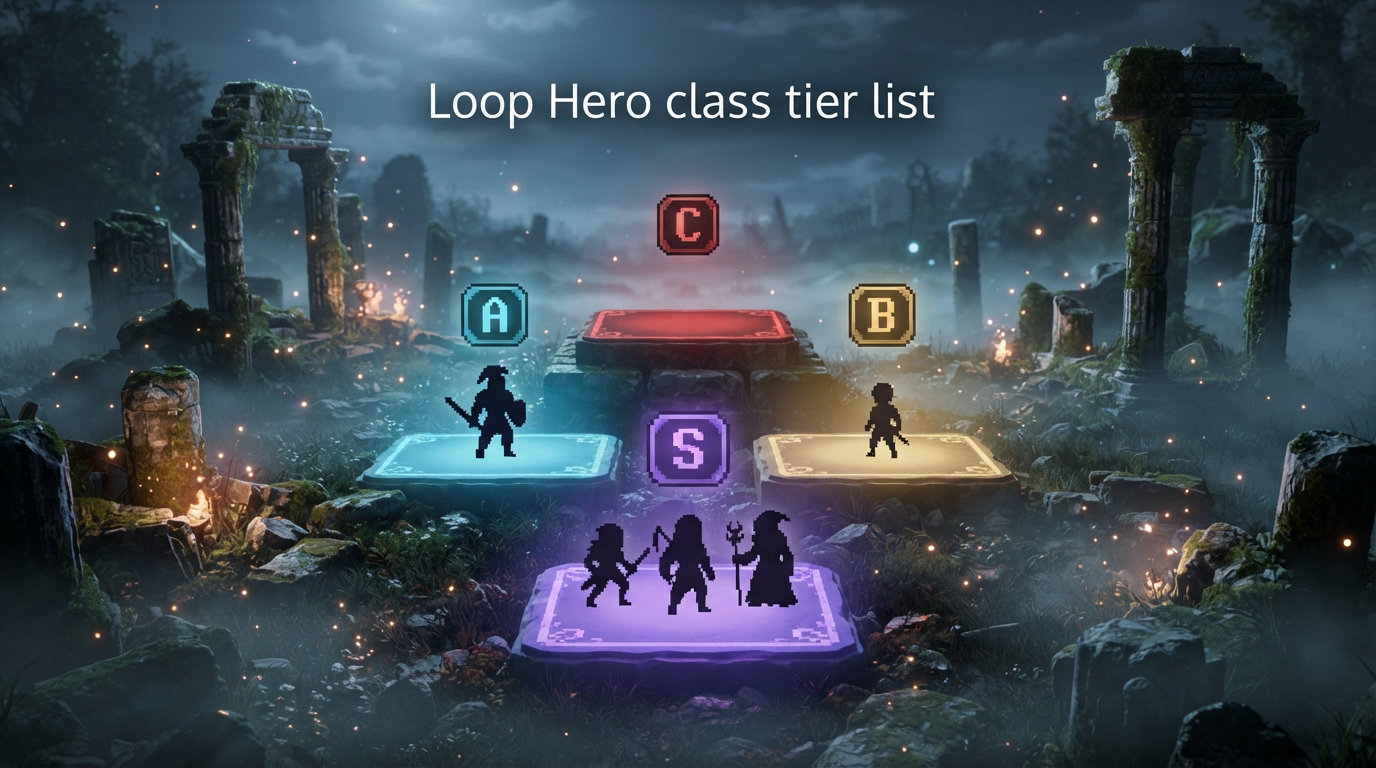
Here is our final tier ranking for all Loop Hero classes in 2026, from strongest to weakest:
S-Tier — Necromancer: The strongest class overall thanks to skeleton scaling, flexible builds, and dominant late game performance
A-Tier — Rogue: Fastest loop clears with high damage output, but fragile and dependent on good equipment drops
B-Tier — Warrior: Most forgiving and beginner-friendly, but lower power ceiling and slower clears compared to the other two
This ranking lines up with the broader community consensus on Reddit. Most experienced players agree that Necromancer sits at the top, Rogue offers a high-risk high-reward option, and Warrior provides a safe but slower experience.
S-Tier: Necromancer — The Best Overall Class
The Necromancer is the strongest class in Loop Hero, period. Instead of fighting directly, you summon skeletons to fight for you. This sounds simple, but the depth of skeleton management, trait synergy, and equipment optimization makes the Necromancer the most rewarding class to master.
How the Necromancer Works
Instead of attacking with a weapon, the Necromancer summons skeleton allies during combat. You can raise skeleton warriors, skeleton archers, and skeleton mages. Each type has different strengths — warriors are tanky, archers deal ranged damage, and mages hit hard with magic attacks. The quality and level of your skeletons depends on your summon quality and skeleton level stats.
The Necromancer also uses a unique resource called Magic HP. When your skeletons land kills, you gain Magic HP that acts as a shield buffer above your normal HP. This gives the Necromancer an extra layer of survivability that scales with how aggressively you spawn enemies on the loop.
Stat Priorities for Necromancer
Focus on these stats in this order:
Summon Quality: Directly improves the type and power of skeletons you summon — this is your most important stat
Skeleton Level: Raises the base level of your summons, making each skeleton stronger
Max Skeletons: More skeletons means more bodies on the field, which means more damage and more Magic HP generation
Magic HP: Increases the shield buffer from skeleton kills
Attack Speed: Faster summoning means your army fills out quicker each fight
Best Necromancer Traits
These are the traits I prioritize when playing Necromancer:
Art of Control: The community considers this the number one Necromancer trait. It lets you control which skeleton type spawns, giving you full control over your army composition
Unseen Care: Grants extra damage reduction per summon on the field — stacks with a full skeleton army for massive tankiness
Field Practice: Boosts skeleton level, which directly increases all skeleton stats
Blood Lightning: Adds AoE lightning damage that triggers from skeleton attacks — scales incredibly well with many skeletons
Equipment Slots
The Necromancer has two weapon slots and one armor slot, but instead of a standard weapon, you equip items that boost summon stats. Your equipment pool focuses on items that increase summon quality, skeleton level, max skeletons, and Magic HP.
Field Tile Synergy
The Necromancer benefits heavily from placing lots of enemy-spawning tiles. More enemies mean more kills from your skeletons, which means more Magic HP. Vampires and vampire mansions are excellent because vampire enemies give extra Magic HP on death. Forest tiles that spawn ratwolves also work well since ratwolves die fast and feed your Magic HP sustain.
Pros and Cons
Pros: Highest power ceiling in the game, scales into late game better than any other class, skeleton army does massive damage, Magic HP provides strong sustain, flexible army composition
Cons: Hardest class to master, requires understanding of summon quality and skeleton types, vulnerable in early loops before army builds up, skeleton AI can be unpredictable
A-Tier: Rogue — The Fast Clear Specialist
The Rogue is the speed demon of Loop Hero. With dual wielding, high crit chance, and an evade mechanic, the Rogue tears through enemies faster than any other class. But that speed comes at a cost — the Rogue is a glass cannon with low base defense and HP.
How the Rogue Works
The Rogue dual wields weapons, attacking with both hands. Instead of earning equipment from defeated enemies like the Warrior, the Rogue uses a unique Trophy system. After each fight, you earn trophies that fill a meter, and once full, you receive a random piece of equipment. This means your gear quality is heavily dependent on RNG — sometimes you get amazing drops, and sometimes you get junk.
The Rogue also has a natural evade stat that gives a chance to completely avoid incoming attacks. This creates a high variance playstyle where you either dodge everything and shred enemies, or take a bad string of hits and die quickly.
Stat Priorities for Rogue
Focus on these stats for the best Rogue performance:
Attack Speed: More attacks means more crits and faster kills — the single most important Rogue stat
Crit Chance: The Rogue already has high base crit, but stacking more turns every fight into a burst damage fest
Evade: Your main defensive mechanic — the more you dodge, the longer you survive
Damage: Raw damage boosts scale well with your fast attack speed
Vampirism: Helps sustain HP between fights since your base defense is low
Best Rogue Traits
These are my top trait picks for Rogue runs:
Old Scars: Increases your max HP every time you enter a new loop — scales well for longer runs
Blade of Doom: Adds extra damage to every attack — straightforward and strong with dual wielding
Backstab: Increases damage when attacking enemies from behind — synergizes with the Rogue’s fast movement
Counterattack: Gives a chance to strike back when hit — extra damage is always welcome on a glass cannon
Equipment Slots
The Rogue equips two weapons (dual wielding), one armor piece, and additional accessory slots. Having two weapon slots means you can stack attack speed and crit across both weapons for massive burst potential. But it also means you need twice the good RNG to get decent weapons.
Field Tile Synergy
The Rogue thrives with tiles that spawn enemies in controlled numbers. You want steady fights to fuel your trophy meter without getting overwhelmed. Forest tiles, meadows for regeneration, and vampire mansions work well. Avoid placing too many spider cocoons or other high-density spawns at once, since the Rogue struggles against large groups due to low HP and defense.
Pros and Cons
Pros: Fastest loop clears in the game, high burst damage from crits and dual wielding, evade mechanic adds survivability, exciting high-risk high-reward playstyle
Cons: Very fragile early game, heavily dependent on equipment RNG through the trophy system, gets punished hard by large enemy groups, requires good tile placement strategy to survive
B-Tier: Warrior — The Beginner-Friendly Tank
The Warrior is the default class in Loop Hero and the most straightforward to play. With strong base defense, counterattack mechanics, and a passive that increases your damage the longer you stay in combat, the Warrior is a reliable pick that teaches you the game’s core mechanics without overwhelming you.
How the Warrior Works
The Warrior has a unique passive ability: you deal an extra 2% damage for every second you spend in combat. This means longer fights actually work in your favor, since your damage ramps up over time. Combined with a high defense stat and counterattack chance, the Warrior excels at grinding through extended encounters.
The Warrior also benefits from vampirism more than any other class. Since you are taking hits and counterattacking frequently, vampirism lets you heal back a percentage of damage dealt. This creates a sustainable combat loop where you heal while you fight.
Stat Priorities for Warrior
Stack these stats to maximize Warrior performance:
Defense: Reduces incoming damage — your most important stat since you spend a lot of time in combat
Vampirism: Heals you for a percentage of damage dealt — stacks with counterattacks for double sustain
Counterattack: Gives a chance to automatically strike back when hit — extra damage during long fights
HP / Max HP: More health means you survive longer, giving your ramping damage more time to kick in
Damage: Boosts your base hits and counterattack damage
Best Warrior Traits
These traits pair best with the Warrior’s kit:
Residual Heat: Increases damage based on your max HP — the Warrior already has high HP, making this trait extremely efficient
Shield of Faith: Adds a flat damage reduction percentage — stacks with your already high defense
Strikeback: Increases counterattack damage — synergizes perfectly with the counterattack build
Bloodthirst: Increases vampirism percentage — more healing per hit keeps you alive through the longest fights
Equipment Slots
The Warrior equips one weapon, one shield, and one armor piece. The shield slot is unique to the Warrior and provides additional defense stats. Your equipment is earned directly from defeated enemies, which means you have consistent gear progression without the RNG swings of the Rogue’s trophy system.
Field Tile Synergy
The Warrior benefits most from tiles that create longer, sustained fights rather than burst encounters. Villages are excellent because they provide a healing checkpoint every loop. Forest and thicket tiles boost your attack speed, which synergizes with vampirism (more hits means more healing). Blood groves are also strong since the thorns effect adds extra damage that pairs with your ramping passive.
Pros and Cons
Pros: Most forgiving class, strong survivability from defense and vampirism, consistent gear progression from enemies, great for learning game mechanics, ramping damage passive rewards patience
Cons: Slowest loop clears of the three classes, lower power ceiling compared to Necromancer and Rogue, experienced players may find the playstyle too passive, struggles to keep up in later chapters where burst damage matters more
Loop Hero Class Stats Comparison
Here is a side-by-side look at how the three classes compare across key stats and mechanics:
Primary Damage Source: Warrior uses weapon attacks with ramping passive. Rogue uses dual wielding with crit bursts. Necromancer uses skeleton summons.
Defense Mechanic: Warrior relies on high defense and counterattack. Rogue uses evade chance. Necromancer relies on Magic HP buffer and skeleton meat shields.
Equipment System: Warrior earns gear from kills. Rogue earns gear from the trophy meter. Necromancer earns gear from kills with summon-focused stats.
Unique Mechanic: Warrior has the 2% damage ramp per second. Rogue has the trophy system and dual wield. Necromancer has skeleton army management and Magic HP.
Equipment Slots: Warrior has weapon, shield, and armor. Rogue has two weapons, armor, and accessories. Necromancer has two summon items and armor.
Learning Curve: Warrior is easy. Rogue is medium. Necromancer is hard.
Power Ceiling: Necromancer is the highest. Rogue is high but RNG dependent. Warrior is moderate.
Best Class for Each Playstyle in 2026
Picking the right class is not just about raw power — it is about matching your class to how you want to play. Here are my recommendations based on different playstyles:
Best Class for Beginners
Pick the Warrior. It is available from the start, has the most forgiving mechanics, and teaches you how Loop Hero works without punishing you for mistakes. The vampirism and defense stats give you room to experiment with tile placement while staying alive. Once you understand the game, you can branch out to the other classes.
Best Class for Speedrunning
Pick the Rogue. No other class clears loops as fast as a Rogue with good crit RNG and attack speed gear. The trophy system can be unreliable, but when it works, you shred through enemies before they can even touch you. Just be prepared for some runs to end early if you get bad equipment drops.
Best Class for Boss Fights
Pick the Necromancer. Boss encounters in Loop Hero are long and punishing, and the Necromancer excels in extended fights. Your skeleton army tanks hits while dealing consistent damage, and Magic HP gives you an extra health buffer that other classes do not have. The Art of Control trait lets you tailor your army for each boss.
Best Class for Resource Farming
Pick the Warrior or Necromancer. The Warrior is consistent and reliable for farming runs since you rarely die early, meaning more resources per expedition. The Necromancer can push into higher loop counts where enemy drops are better, netting more rare materials per run. The Rogue is too inconsistent for farming since a bad equipment streak can end your run before you accumulate resources.
Best Class for Late Game (Chapters 3+)
Pick the Necromancer. Late game content demands high burst damage and strong sustain, and the Necromancer delivers on both. Skeleton scaling means your army gets stronger the further you progress, while the Warrior’s ramping damage struggles to keep up with the damage output of late game enemies. The Rogue can work but the fragility becomes a bigger liability in later chapters.
Best Traits for Each Class in Loop Hero
Traits can make or break a run. Here is a quick reference for the top trait picks per class, based on community testing and my own experience:
FAQs
What is the best class in Loop Hero?
The Necromancer is the best class in Loop Hero overall. Its skeleton scaling gives it the highest power ceiling of any class, and the Magic HP mechanic provides strong sustain in longer fights. Community consensus from Reddit threads consistently ranks Necromancer as the strongest class.
How do I unlock all classes in Loop Hero?
The Warrior is available from the start. To unlock the Rogue, build the Refuge in your camp using 31 Stable Wood, 21 Food Supply, and 11 Metal Scrap (requires a Smelter and a Gulch). To unlock the Necromancer, build the Crypt using 16 Stable Wood, 16 Food Supply, and 16 Metal Scrap (requires a Cemetery).
Which Loop Hero class is best for beginners?
The Warrior is the best class for beginners. It has the highest base defense, benefits greatly from vampirism for self-healing, and its consistent gear progression from killed enemies means you do not have to rely on RNG. The ramping damage passive also rewards patient play, which is ideal while you learn the game.
What is the hardest boss in Loop Hero?
Many players consider the Necromancer boss fight in Chapter 3 to be the hardest encounter in Loop Hero. It summons skeletons rapidly and deals heavy magic damage. Using a Necromancer class yourself with Art of Control and Unseen Care traits gives you one of the best matchups against this boss thanks to your own skeleton army matching the boss’s pressure.
Can you change classes during a run in Loop Hero?
No, you cannot change classes during a run in Loop Hero. You select your class at camp before starting an expedition. If you want to switch classes, you need to end your current run and select a different class before starting the next expedition.
Is the Rogue worth playing in Loop Hero?
Yes, the Rogue is absolutely worth playing. It has the fastest loop clears of any class and an exciting high-risk high-reward playstyle. The dual wielding and high crit chance make it feel very different from the other two classes. Just be prepared for inconsistency since the trophy-based equipment system relies on RNG.
Conclusion — Pick Your Loop Hero Class Wisely
This Loop Hero class tier list comes down to a clear hierarchy: the Necromancer is the strongest class overall with unmatched scaling and late game power, the Rogue offers thrilling speed clears with high variance, and the Warrior provides a solid beginner-friendly experience that teaches you the ropes. Every class is viable through the entire game, so do not be afraid to try all three and find the one that fits your style.
My personal recommendation for new players: start with the Warrior, learn the mechanics, then unlock and main the Necromancer once you feel comfortable. You can always come back to the Rogue when you want a faster, more adrenaline-fueled challenge. Good luck out there on the loop.