
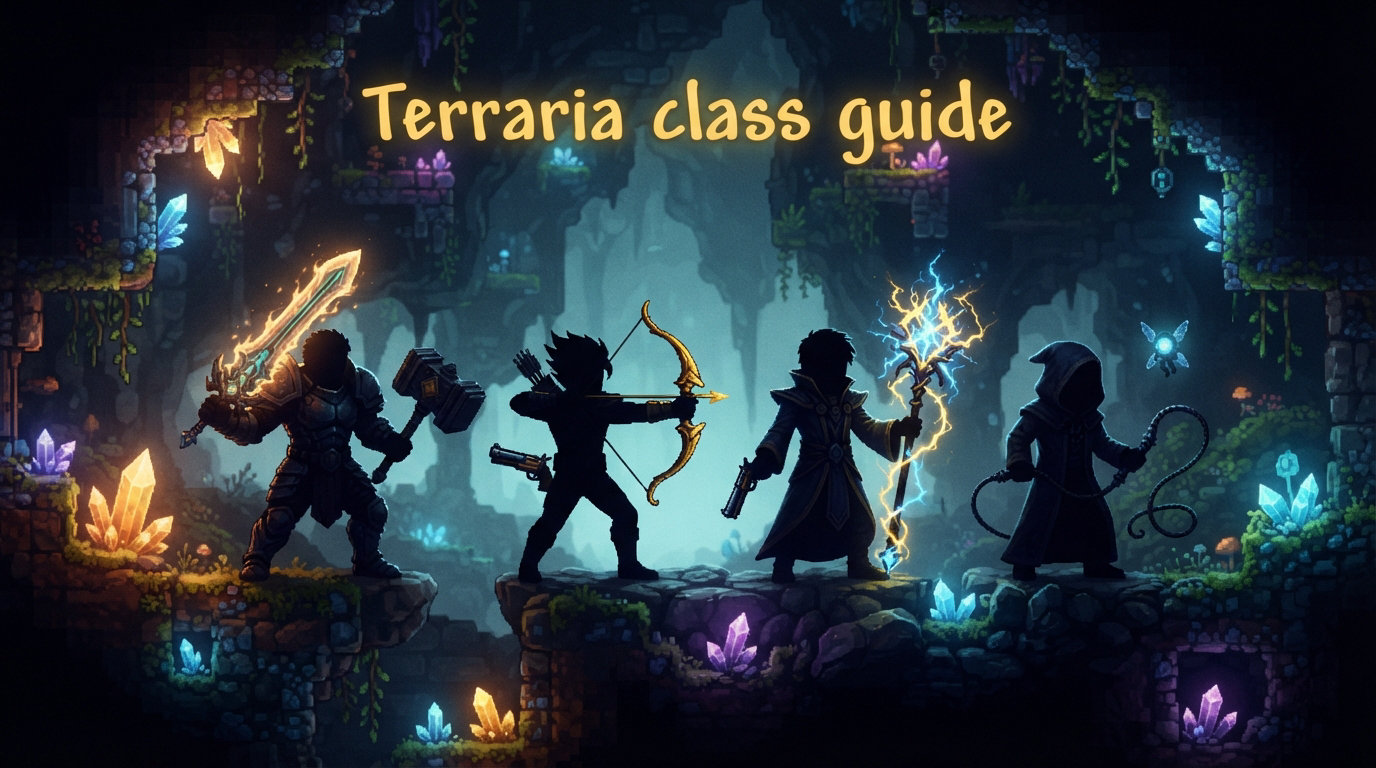
If you are starting a new playthrough in Terraria, choosing the right class shapes everything about your experience. This Terraria class guide covers all four classes, their strengths and weaknesses, and which ones work best for different playstyles.
Terraria gives you the freedom to play however you want, but the class system adds real depth to character builds. The four classes each have unique armor sets, weapons, and mechanics that reward different types of players.
In this guide, our team breaks down Melee, Ranged, Magic, and Summoner classes in detail. You will learn about progression paths, endgame gear, and get honest recommendations based on hundreds of hours of gameplay across all four classes.
Table of Contents
How Classes Work in Terraria
Terraria divides weapons into four distinct damage types: melee, ranged, magic, and summoning. Each type pairs with matching armor sets that boost damage output when worn together. This bonding system means your equipment choices directly amplify your chosen combat style.
The armor bonding system works by granting bonus damage when you equip weapons matching your armor type. A set of Molten armor boosts your melee damage significantly, while wearing Nebula armor supercharges your magic spells. The bonuses stack additively, making class-specific builds deal substantially more damage than mixed approaches.
You can technically equip any weapon at any time, but doing so wastes your armor bonuses. Many players stick with one class throughout their playthrough, though switching is possible by farming new gear. The commitment becomes more important in Hardmode, where class-specific drops become more powerful.
Class emblems dropped by the Wall of Flesh provide a permanent 15% damage boost to your chosen class. This reward incentivizes players to specialize before defeating Hardmode’s first major hurdle. After that point, most players find their class identity solidified.
Melee Class: The Frontline Fighter
Melee is the tank class of Terraria, offering the highest defense and closest combat. You spend most battles right next to enemies, which sounds dangerous but your armor absorbs hits that would delete other classes. If you enjoy aggressive, in-your-face gameplay, this class delivers.
Key Melee Weapons and Armor Progression
Early game melee starts with copper swords and quickly progresses through the ore tiers. By the time you face Skeletron, Night’s Edge crafted from the Blood Moon crescent hammer becomes your go-to weapon. This blade carries you through the bulk of Pre-Hardmode content.
Your armor progression follows this path: Molten armor after defeating the Wall of Flesh, then Hallowed armor from the mechanical bosses. Beetle armor from Plantera offers excellent defensive and offensive options, while Solar Flare armor from the Lunar Events represents the ultimate Pre-Hardmode melee set.
Endgame melee revolves around the Zenith sword, which our team considers the most satisfying weapon in the game. Crafted from a dozen different swords combined at the Ancient Manipulator, Zenith homes toward enemies and delivers massive damage. The Terra Blade and True Night’s Edge also serve as excellent alternatives.
Melee Pros and Cons
Melee offers the highest survivability of any class thanks to defense bonuses and armor options. Your close range means you collect every enemy drop, and knockback effects keep swarms manageable. The Zenith sword provides arguably the highest single-target damage in the game.
However, melee requires you to be near dangerous enemies, increasing risk during boss fights. Some late-game content like the Martian Invasion favors classes that can attack from distance. Early Hardmode can feel slow if you have not upgraded your gear properly.
Ranged Class: The Damage Dealer From Afar
Ranged lets you deal consistent damage while staying safely away from enemies. Bows, guns, and launchers fill your arsenal, each with unique ammunition types that affect damage and fire rate. This class rewards precision and resource management.
Key Ranged Weapons and Armor Progression
The ranged progression begins with the Wooden Bow and improves rapidly through Pre-Hardmode. The Daedalus Stormbow, dropped by Harpies in the Sky Fortress, becomes a game-changer. It fires three arrows in a spread pattern and benefits from Holy Arrows for devastating effect.
Your armor journey takes you through Necro armor from the Clothier, then Adamantite or Titanium armors. Shroomite armor works excellently in underground areas, while Vortex armor from the Lunar Events provides the best stealth and damage boosts for endgame ranged builds.
The Phantasm bow, crafted from Luminite bars after the Lunar Events, serves as the ultimate ranged weapon. Alternatively, the S.D.M.G. machine gun offers incredible DPS with proper setup. Both weapons handle Moon Lord and other endgame content effectively.
Ranged Pros and Cons
Ranged provides safe distance combat that lets you deal damage while enemies struggle to reach you. The consistent damage output and ammo variety mean you can adapt to any situation. Many veteran players recommend this class for first-time Terraria players because of its forgiving playstyle.
The main drawback involves ammunition costs. Endgame ammo like Chlorophyte Arrows or Crystal Bullets gets expensive, requiring you to invest time in farming materials or setting up appropriate farms. Some weapons also have fire rate caps that limit DPS potential compared to other classes.
Magic Class: The Glass Cannon
Magic delivers the highest burst damage and crowd control in Terraria. Spells tear through groups of enemies with area effects, but your character remains fragile. Playing magic well means positioning carefully and managing your mana pool effectively.
Key Magic Weapons and Armor Progression
Magic starts modestly with the Space Gun found in Dungeons, but quickly becomes powerful. The Cristal Piercer from the Abyss provides excellent Pre-Hardmode damage, while the Laser Machinegun handles sustained single-target damage well.
Your armor path goes through Jungle armor for early magic, then Meteor armor after finding space rocks. Spectre armor from the Dungeon offers a choice between healing spectral set or damage-boosting mask variant. Nebula armor from the Lunar Events provides the best endgame magic damage bonuses.
The Last Prism stands as the iconic magic weapon, firing a concentrated beam that devastates anything in its path. The Lunar Flare and Rainbow Crystal staff provide excellent alternatives with different mechanics. All three weapons handle endgame content with ease.
Magic Pros and Cons
Magic offers incredible area-of-effect damage that melts groups of enemies. The variety of spell types means you can build for crowd control, single-target burst, or sustained damage. Many find the playstyle visually satisfying and mechanically engaging.
Mana management adds complexity that other classes do not have. You need to balance spell usage against your mana pool, investing in Flask and Mana Potion setups. The lowest base defense of any class means mistakes get punished severely, especially during boss encounters.
Summoner Class: The Army Commander
Summoners command an army of pets and minions that fight automatically. Your minions deal damage independently while you focus on positioning and avoiding attacks. This unique playstyle feels different from anything else in Terraria.
Key Summoner Weapons and Armor Progression
Early summoner weapons come from the Slime King and other early bosses. The Finch Staff dropped by King Slime provides your first reliable summon, though the Whipping Boy from the Tavernkeep offers stronger options before Hardmode.
Your armor progression involves Bee armor from the Queen Bee, then Spider armor from the Spider dens. Tiki armor from the Witch Doctor becomes essential before Hardmode. Stardust armor from the Lunar Events represents the ultimate summoner set, with the Stardust Guardian providing exceptional tanking.
The Terraprisma, obtained by defeating the Monthly event boss, stands as the best summoner weapon in the game. The Optic Staff and Xeno Staff provide excellent alternatives with different minion types. All summoner weapons benefit from the set bonuses that increase minion damage and count.
Summoner Pros and Cons
Summoner offers a unique experience where your minions handle combat while you focus on movement and strategy. The playstyle feels fresh even after many playthroughs, and certain endgame encounters favor the sustained DPS of multiple minions. You can invest in defensive accessories while your army deals damage.
The early game presents genuine challenges. Summoner struggles more than other classes before you unlock meaningful minion slots and decent weapons. The fragile minions die easily to strong enemies, and your own low defense means careful positioning is critical throughout the game.
Terraria Class Comparison: Which Is Best?
No single class ranks as the absolute best in Terraria. Each performs differently across game stages, and player skill matters significantly. Our team rates all four classes across key metrics to help you decide.
For early game survivability, Melee dominates thanks to high starting armor values and easy weapon drops. Ranged offers the safest damage-dealing approach. Magic and Summoner require more careful play during the first two bosses.
In Pre-Hardmode boss fights, Melee and Ranged perform best due to accessible armor upgrades. The Wall of Flesh represents the major power shift where class commitment becomes critical. Summoner gains power rapidly after this point but never fully catches up to other classes.
During Hardmode progression, all classes become more distinct. Melee handles mechanical bosses well with arena strategies. Ranged provides consistent damage without risk. Magic melts bosses quickly with proper mana setup. Summoner struggles most in this phase but improves dramatically after defeating Golem.
At endgame, Melee Zenith provides the highest theoretical single-target DPS. Magic Last Prism offers excellent sustained damage with area coverage. Ranged S.D.M.G. matches magic for raw damage output. Summoner Terraprisma delivers consistent automatic damage that requires minimal player input.
The table below summarizes our ratings across key factors.
| Class | Difficulty | Damage | Survivability | Fun Factor |
|---|---|---|---|---|
| Melee | Easy | Very High | Very High | High |
| Ranged | Easy | High | High | High |
| Magic | Medium | Very High | Low | Very High |
| Summoner | Hard | Medium | Low | Very High |
Which Terraria Class Should You Choose?
Your ideal class depends on your experience level, playstyle preferences, and goals. We recommend different classes based on different player types and situations.
For beginners, our team consistently recommends Melee or Ranged. Both classes forgive positioning mistakes through high defense or safe distance. The progression paths are straightforward, and weapon availability remains consistent throughout the game. You can focus on learning world mechanics rather than struggling with class mechanics.
Experienced players who want maximum challenge should try Magic or Summoner. These classes demand better positioning, resource management, and gear optimization. The payoff comes through higher damage ceilings and unique gameplay experiences that reward skilled play.
For solo Expert or Master mode, Melee provides the safest path through increased difficulty. The self-healing options and tankiness offset the extra enemy damage. Ranged also works well with proper arena construction. Magic and Summoner require more careful play but remain viable.
In multiplayer, any class combination works since enemies scale with player count. Having one of each class creates balanced parties, but two players running the same class works fine. The key is coordinating gear so players do not compete for limited resources like Soul of Might.
You can switch classes by farming new armor and weapons, but the process takes significant time. Committing early saves effort, though Terraria rewards experimentation. Starting a new character to try a different class takes only a few hours with practice.
Class Progression Tips for Every Game Stage
Understanding progression helps you plan gear acquisition and boss timing. Each stage requires different priorities for all classes.
Early game (Pre-Boss) focuses on gathering copper, iron, and silver ore. Build a basic house for the Guide NPC and start exploring underground. Your weapon matters less than finding better armor and accessories. Aim to defeat Eye of Cthulhu by day ten for smoother progression.
Pre-Hardmode demands class-specific armor before the Wall of Flesh. Each class needs different ores and drops, so research your preferred class early. The Night’s Edge questline benefits Melee players significantly. Ranged players should prioritize gathering Ammo boxes for unlimited arrows.
Early Hardmode begins with mining new ores. Cobalt or Palladium opens your Hardmode armor options. Defeat the three mechanical bosses in any order, but spreading out their summons helps distribute loot. This phase tests whether your class choice and accessories work well together.
Mid Hardmode centers on the Hallowed biome spreading and defeating Plantera. Clear Chlorophyte nodes for class weapons and armor. Summoners should acquire the Tiki armor here. Magic players need to stock up on mana potions and Flask of Whispers.
Endgame involves lunar events and the Moon Lord fight. Build arenas suitable for your class before attempting these challenges. The Stardust, Solar, Nebula, and Vortex armors represent the final upgrades. Once you acquire these sets and appropriate weapons, almost any content becomes manageable.
Frequently Asked Questions
What’s the most OP class in Terraria?
Melee with Zenith sword represents the highest single-target damage potential. The combination of Solar Flare armor and Zenith provides unmatched burst damage against bosses. However, OP depends on context – Magic handles groups better, Ranged offers safer gameplay, and Summoner requires less active input.
What’s the hardest class to play in Terraria?
Summoner presents the highest difficulty curve. Weak early game minions die easily, and your character has low base defense. Surviving until you unlock meaningful minion upgrades requires careful play and good positioning. The class rewards experience but punishes beginners severely.
What is the funnest class to play in Terraria?
Fun is subjective, but many players find Summoner the most unique and satisfying experience. Commanding an army of minions feels different from any other class. Magic also receives high fun ratings for its flashy spells and burst damage. Try multiple classes in different playthroughs to find your favorite.
Is summoner the worst class in Terraria?
Summoner is not the worst but faces genuine challenges early game. Once you reach Hardmode and acquire better minions, the class becomes competitive. The Terraprisma and Stardust armor provide endgame power that matches other classes. Summoner players call their class underdog, not weak.
Which Terraria class is best for beginners?
Ranged offers the best combination of safety and damage for new players. You can attack from distance while learning enemy patterns. The ammo system adds resource management without overwhelming complexity. Melee is equally viable if you prefer aggressive playstyles and higher survivability.
Can you switch classes in Terraria?
Yes, you can use any weapon regardless of your equipped armor. However, doing so wastes your class bonuses. Switching classes requires farming entirely new armor sets and weapons, which takes significant time. Most players commit to one class, though hybrid builds exist for experienced players.
Final Thoughts on Terraria Classes
This Terraria class guide covered everything you need to choose your path through the game. All four classes complete the full game successfully, so no choice locks you out of content.
Melee suits players who enjoy aggressive combat and maximum survivability. Ranged provides consistent damage with forgiving gameplay for learning the game. Magic rewards skilled players with devastating burst damage at the cost of fragility. Summoner delivers a unique army-commander experience that differs from traditional combat roles.
We suggest trying different classes across multiple playthroughs. Each class reveals new aspects of Terraria that other classes cannot match. The community considers variety part of the fun.
For detailed weapon-by-weapon recommendations, consult the official Terraria Wiki, which our team references regularly for patch-specific information. Game updates occasionally shift class balances, so check for recent changes before major grinds.