
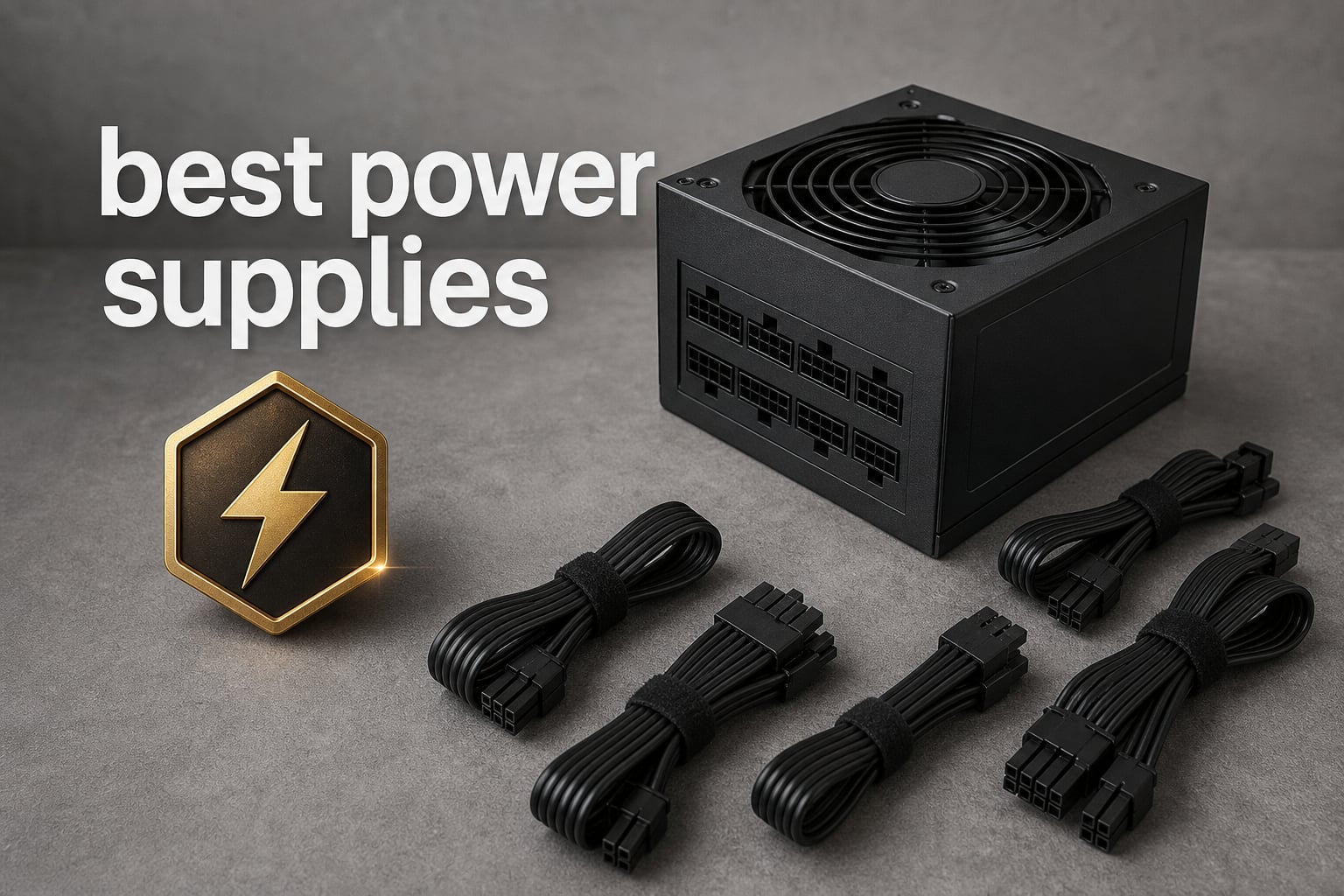
The best power supplies do far more than switch a PC on. A power supply unit, or PSU, converts wall-outlet AC power into the low-voltage DC power used by a motherboard, CPU, graphics card, storage, and fans. That conversion has to stay steady when a game scene pushes the GPU hard, when a workstation starts a render, and when the PC wakes from sleep.
We built this 2026 shortlist around the supplied product specifications, ratings, buyer feedback, connector standards, cooling designs, protections, and warranty information. The 12 choices cover 650W through 1000W, Bronze and Gold efficiency, and both older-style and native 12V-2×6 GPU cabling, so a sensible answer is available for compact mid-range builds as well as ambitious gaming systems.
A PSU is not the component to buy by wattage alone. Pick capacity with room for transient spikes, confirm your case accepts the ATX form factor, count CPU EPS and GPU PCIe connectors, and never reuse modular cables from another unit. If you are choosing a graphics card first, our RGB graphics card guide and 16GB graphics card picks can help you identify the GPU class that drives those decisions.
The short version is straightforward: a quality 750W Gold unit is a comfortable starting point for many single-GPU gaming PCs, 850W gives more upgrade room, and 1000W makes sense when the graphics card and CPU are especially demanding. Certifications describe efficiency rather than every aspect of electrical quality, so this guide also calls out cable format, fan behavior, capacitor information where supplied, and warranty length.
The top 3 best power supplies cover most modern gaming PC builds 2026
The be quiet! Pure Power 13 M is our Editor’s Choice because its 850W capacity, ATX 3.1 support, native 12V-2×6 connector, semi-passive cooling, and stated 94.4% peak efficiency combine in one current-specification unit. The Montech Century II is the feature-rich value choice with a 135mm FDB fan, full protection list, Japanese capacitors, and a 10-year warranty, while the Rosewill VSB is the practical lower-wattage pick for a build that does not need 850W.
The best power supplies in 2026 give you the right capacity and connector set
This overview includes every PSU reviewed below. Start by narrowing the field on wattage and form factor, then compare the details that affect the build experience: fully modular versus semi-modular cabling, a native 12V-2×6 lead for a compatible recent GPU, and whether a fan can stop at light load.
| Product | Specifications | Action |
|---|---|---|
 ASUS Prime 750W Gold ASUS Prime 750W Gold |
|
Check Latest Price |
 be quiet! Pure Power 13 M 850W be quiet! Pure Power 13 M 850W |
|
Check Latest Price |
 Corsair RM850e Corsair RM850e |
|
Check Latest Price |
 ASUS TUF Gaming 1000W Gold ASUS TUF Gaming 1000W Gold |
|
Check Latest Price |
 MONTECH Century II 850W MONTECH Century II 850W |
|
Check Latest Price |
 Corsair RM850x Corsair RM850x |
|
Check Latest Price |
 Rosewill VSB 650W Rosewill VSB 650W |
|
Check Latest Price |
 Rosewill VMG 750W Rosewill VMG 750W |
|
Check Latest Price |
 Seasonic CORE GX 650W Seasonic CORE GX 650W |
|
Check Latest Price |
 MSI MAG A850GL PCIE5 MSI MAG A850GL PCIE5 |
|
Check Latest Price |
 Thermaltake Toughpower GT 850W Thermaltake Toughpower GT 850W |
|
Check Latest Price |
 Thermaltake GF1 750W Thermaltake GF1 750W |
|
Check Latest Price |
One specification does not replace the others. A 650W unit can be a better match than an 850W model for a modest system if its actual connectors and physical dimensions fit, while an 850W or 1000W model can be the calmer choice when future GPU upgrades, a power-hungry CPU, or extra drives are part of the plan.
1. ASUS Prime 750W Gold is the balanced ATX 3.0 choice
ASUS Prime 750W Gold (750 Watt, ATX 3.1 Compatible, Fully Modular Power Supply, 80+ Gold Certified, Dual Ball Bearings, Two Color Options in One, 8-Year Warranty)
750W
80 Plus Gold
ATX 3.0
fully modular
Pros
- 80 Plus Gold efficiency
- ATX 3.0 with 16-pin cable
- Dual ball bearing fan
- 8-year warranty
Cons
- Check case clearance
- 750W limits high-end upgrade room
The ASUS Prime 750W Gold puts the basics of a current gaming PSU in a compact 5.9 x 5.9 x 3.3 inch ATX body. It is fully modular, rated at 750W, and carries 80 Plus Gold certification, which makes it an easy starting point for a conventional single-GPU system where unused cable clutter is unwelcome.
ASUS lists ATX 3.0 compatibility and a bundled 16-pin PCIe cable for PCIe Gen 5.0 graphics cards. Its axial-tech fan uses a barrier ring to increase downward air pressure, and the dual ball bearings are stated to last up to twice as long as sleeve-bearing designs.
The buyer record shows a 4.8 out of 5 rating from 181 reviews, with feedback frequently highlighting the ATX 3.0 compatibility and fan durability. An eight-year warranty is also meaningful for a component that normally stays in a build through several other upgrades.
The ASUS Prime 750W Gold suits a focused single-GPU build
This is the right capacity class when your calculated system draw leaves sensible spare room below 750W and you want a fully modular layout. The 16-pin cable keeps a compatible new GPU from needing an adapter, while the cable selection remains simpler than a very high-wattage unit.
It is also a tidy choice for builders who need an ATX PSU but have limited room around the shroud. Measure the PSU bay and cable-bend space before ordering, because even a short standard ATX unit needs room for its connectors.
The ASUS Prime 750W Gold needs a headroom check before purchase
Do not treat 750W as a universal answer for every high-end graphics card and overclocked processor pairing. Add the manufacturer-recommended GPU capacity, CPU demand, drives, fans, and a margin for power excursions before making this the final choice.
Also insert the supplied 16-pin connector fully and avoid a sharp bend right at the plug. The connector safety advice matters more than a badge on the box, especially with newer high-power GPUs.
2. be quiet! Pure Power 13 M 850W is the quiet current-standard pick
be quiet! Pure Power 13 M 850W, ATX 3.1, Fully Modular PSU, 80+ Gold
850W
up to 94.4% efficiency
ATX 3.1
12V-2x6
Pros
- ATX 3.1 native 12V-2x6
- Semi-passive fan
- Up to 94.4% efficiency
- Four PCIe 6+2 connectors
Cons
- One-year warranty
- Standard ATX size
The be quiet! Pure Power 13 M 850W is the clearest fit for someone who wants present-day cable support without giving up quiet-idle behavior. It is fully modular, uses an ATX 3.1 specification, and has a native 12V-2×6 connector for PCIe 5.1 graphics cards.
Its stated 80 Plus Gold efficiency reaches up to 94.4%, and the 120mm fan runs in a semi-passive zero-RPM mode at low demand. The supplied details also specify an LLC topology for voltage regulation, a single 12V rail, four PCIe 6+2-pin connectors, and tolerance for power excursions up to twice its rated power.
The listing has a 4.8 rating from 138 reviews, with 91% five-star feedback in the supplied analysis. Silent operation and ATX 3.1 readiness are the recurring strengths, which lines up with what quiet-PC builders usually want from an 850W unit.
The Pure Power 13 M 850W fits a quiet upgrade-ready gaming PC
Choose this model if 850W matches the calculated load and you want a native cable instead of an adapter for a PCIe 5.1 GPU. A zero-RPM mode is useful when browsing, streaming, or working at a light load because the fan can stay stopped during those periods.
It also provides four traditional PCIe 6+2-pin connectors, which helps when the graphics card uses the familiar eight-pin style. Fully modular cables make routing easier in a windowed case or a build with several storage devices.
The Pure Power 13 M 850W has a short stated warranty to weigh
The supplied product record lists a one-year warranty, so compare that term carefully against the longer coverage attached to several alternatives in this roundup. Warranty length is not a complete quality score, but it is an important ownership detail.
Before selecting it for a compact case, confirm the 6.3 x 5.91 x 3.39 inch dimensions and leave room for the cable exits. A quiet fan cannot compensate for poor case airflow or a connector pressed hard against a side panel.
3. Corsair RM850e is the straightforward ATX 3.1 mainstream option
CORSAIR RM850e (2025) ATX 3.1 PCIe 5.1 Ready 850W Power Supply – Black
850W
Cybenetics Gold
ATX 3.1
105C capacitors
Pros
- ATX 3.1 and PCIe 5.1
- Full modular cabling
- 105C-rated capacitors
- Seven-year warranty
Cons
- Rifle bearing fan
- No stated zero-RPM mode
Corsair’s RM850e is an 850W fully modular PSU designed around Intel ATX 3.1 and PCIe 5.1 compliance. The supplied data names Cybenetics Gold efficiency, a 12V-2×6 cable, 105C-rated capacitors, a 120mm rifle-bearing fan, and Modern Standby compatibility.
For a PC that sleeps and wakes frequently, Modern Standby support is a practical detail. The unit is also specified to withstand GPU transient excursions of up to two times rated power, which is relevant because instantaneous demand can differ greatly from an average power reading.
It has a 4.7 rating from 828 reviews, the largest review base among the high-rated Corsair entries here. The review analysis cites quiet operation, modular cables, and the rated capacitors as common positives, while the rifle-bearing fan is the point to consider for a noise-first build.
The RM850e works best when current compliance and simple cable routing matter
This PSU suits a gaming PC owner who wants 850W headroom, native contemporary GPU support, and the ability to connect only the leads the build actually uses. At 5.91 x 5.51 x 3.35 inches, it is compact for a standard ATX model.
It is a strong comparison point if you are reading our graphics card recommendations for i5-12600K systems. Match its connector set and capacity to the exact GPU rather than assuming any 850W PSU is identical.
The RM850e is less suited to someone choosing only by fan bearing type
A rifle-bearing fan is not the same design as an FDB or dual-ball-bearing fan. The product record says the RM850e is quiet at full load, but buyers with a very specific fan preference should weigh that stated construction against the alternatives here.
Its seven-year warranty is solid, though it is shorter than the 10-year coverage on certain 850W competitors. Decide whether fan design, warranty term, or the rest of the feature set is most important for your PC.
4. ASUS TUF Gaming 1000W Gold is the durable high-capacity choice
ASUS TUF Gaming 1000W Gold (1000 Watt, ATX 3.1 Compatible Fully Modular Power Supply, 80+ Gold Certified, Military-Grade Components, Dual Ball Bearing, Axial-tech Fan, PCB Coating, 10 Year Warranty)
1000W
80 Plus Gold
ATX 3.0
10-year warranty
Pros
- 1000W capacity
- Japanese capacitors
- Protective PCB coating
- 10-year warranty
Cons
- Large capacity may exceed needs
- ATX 3.0 rather than ATX 3.1
The ASUS TUF Gaming 1000W Gold is for a build where capacity and long-term component protections are higher priorities than keeping the wattage number low. It combines 1000W output, full modularity, 80 Plus Gold certification, ATX 3.0 compatibility, and a 16-pin cable that supports up to 600W to PCIe Gen 5.0 graphics cards.
ASUS specifies Japanese capacitors, military-grade-tested capacitors and chokes, a protective PCB coating, and dual ball fan bearings. The coating is intended to protect against moisture, dust, and extreme temperatures, while the bearings are stated to last up to twice as long as sleeve designs.
The supplied feedback gives it a 4.7 rating from 466 reviews, with the long 10-year warranty and protective design receiving attention. This is more capacity than many ordinary gaming PCs need, but it can be logical for a power-hungry graphics card, demanding CPU, and an upgrade plan that values margin.
The TUF Gaming 1000W is right for systems with serious power headroom needs
Use a 1000W class unit when a careful load calculation supports it, not just because larger numbers feel safer. It is particularly sensible to investigate for a high-end gaming or workstation setup with future expansion, lots of storage, or a graphics card that needs substantial capacity guidance.
Builders considering multi-GPU case layouts should also read our dual-GPU case guide. Case layout, cable routing, and cooling capacity all affect whether a high-wattage configuration is practical.
The TUF Gaming 1000W is unnecessary for a modest PC
More wattage does not improve frame rates by itself. A moderate gaming PC may be better served by a 650W, 750W, or 850W model with the right connectors, leaving more room in the budget for components that alter actual performance.
ATX 3.0 support is still a meaningful current feature, but shoppers who specifically require an ATX 3.1-labelled model should look at the 850W units elsewhere on this list. Check the exact standard requested by your GPU or build plan.
5. MONTECH Century II 850W is the protection-rich Gold and Platinum-rated pick
MONTECH Century II 850W ATX 3.1 Fully Modular 80 Plus Gold Power Supply
850W
Gold and Cybenetics Platinum
ATX 3.1
10-year warranty
Pros
- Japanese capacitors
- 135mm FDB zero-RPM fan
- Full protection suite
- 10-year warranty
Cons
- Lesser-known brand
- Not Prime eligible
The MONTECH Century II pairs 850W capacity with a striking breadth of supplied specifications: 80 Plus Gold certification, a Cybenetics Platinum rating, ATX 3.1 and PCIe 5.1 readiness, a 12V-2×6 cable, and full modular cabling. It is a particularly detailed option for shoppers who want to see both an efficiency certification and a separate Cybenetics designation.
Its listed internals and cooling are equally interesting. MONTECH specifies 100% Japanese capacitors, a 135mm FDB silent fan with zero-RPM mode, and OCP, OVP, UVP, SCP, OTP, and OPP protection. Those abbreviations cover over-current, over-voltage, under-voltage, short-circuit, over-temperature, and over-power protection.
The unit is rated 4.7 from 295 reviews, with 88% five-star feedback according to the analysis. The 10-year warranty gives this one an unusually persuasive ownership point for an 850W PSU, while the silver metallic exterior offers an alternative to the usual all-black component look.
The Century II 850W is best for builders who want documented safeguards
The complete protection list is valuable because a PSU should respond to faults rather than simply provide rated wattage. Pair that with the stated Japanese capacitors and FDB zero-RPM fan, and this model has a well-rounded feature case for a gaming PC or content-creation system.
Native 12V-2×6 support also avoids the need to use an adapter for a compatible recent GPU. That does not remove the need to check the plug: seat it completely, keep the first bend gentle, and stop if the connector does not feel properly aligned.
The Century II 850W deserves a brand-comfort check
Montech is less familiar to some shoppers than ASUS, Corsair, or be quiet!, despite the supplied feature list and warranty. That is not proof of a problem, but it is a fair reason to compare the record, coverage, retailer support, and availability before deciding.
The product data also indicates it is not Prime eligible. If delivery options are part of your decision, check the current retailer listing rather than assuming the same fulfilment conditions as every other PSU here.
6. Corsair RM850x is the cable-management-focused 850W alternative
CORSAIR RM850x ATX 3.1 PCIe 5.1 Ready Fully Modular 850W Power Supply – Low-Noise, Cybenetics Gold Efficiency, Native 12V-2×6 Connector – Black
850W
Cybenetics Gold
ATX 3.1
native 12V-2x6
Pros
- Embossed cables with combs
- Cybenetics Gold efficiency
- ATX 3.1 support
- 10-year warranty
Cons
- 850W ceiling
- Single-fan design
The Corsair RM850x is another current 850W full modular choice, but it stands apart through its cable presentation. Corsair supplies embossed cables with low-profile combs, a useful physical detail for builders who care about clean routing without adding third-party cable accessories.
The record specifies Cybenetics Gold certification with 91% efficiency, ATX 3.1 and PCIe 5.1 support, and a native 12V-2×6 connector. It also lists a 10-year manufacturer warranty, which is a substantial improvement in stated coverage compared with short-term warranty options.
This RM850x holds a 4.7 rating from 110 reviews, with 87% five-star feedback. The smaller review count gives less aggregate buyer history than the RM850e, but the supplied data still makes the intended strengths clear: standards support, tidy cables, and a long warranty.
The RM850x is ideal when the visible build matters as much as the specification
Pick this one when the case has a window, cable routing is exposed, and you prefer the supplied cables to sit neatly without bulky combs. Full modularity lets you leave unused leads in the box, which also helps airflow and troubleshooting.
It remains an 850W ATX unit, so it fits the broad middle-to-high single-GPU category rather than being a special small form factor PSU. Always measure the case bay, especially when a radiator, drive cage, or thick side-panel cables share the same area.
The RM850x is not the answer if your power calculation calls for more than 850W
Its 850W output is sufficient only when the complete system calculation permits it. Do not select it merely because the native 12V-2×6 lead is convenient; capacity, CPU leads, and the GPU manufacturer recommendation still come first.
The record states a single-fan design, which is normal for an ATX PSU but may not meet every shopper’s cooling preference. Fan acoustics depend on case ventilation and load, so compare the stated fan approach alongside your build environment.
7. Rosewill VSB 650W is the sensible Bronze semi-modular entry
Rosewill VSB 650W 80+ Bronze, ATX 3.0 & 3.1 Compatible, Semi-Modular Power Supply, PCIe 5.1 12V-2×6 Connector, 105°C/221°F Japanese Capacitor, 120mm ICB Silent Fan – 5 Year Warranty
650W
80 Plus Bronze
ATX 3.1
semi-modular
Pros
- ATX 3.1 compatibility
- Native 12V-2x6 cable
- Six-protection suite
- Five-year warranty
Cons
- Bronze efficiency
- Semi-modular cables
The Rosewill VSB 650W is the right kind of lower-capacity candidate: it does not pretend that every system needs 850W, yet it includes current ATX 3.0 and 3.1 compatibility and a native PCIe 5.1 12V-2×6 connector. It is semi-modular rather than fully modular and has 80 Plus Bronze efficiency.
The supplied feature record claims up to 235% power excursion and 300% GPU power excursion, a 120mm ICB silent fan, optimized thermal control, Japanese capacitors rated for 105C, and a six-protection suite. A five-year manufacturer warranty is also specified.
With a 4.6 rating from 186 reviews, it has solid buyer support for this category. The meaningful tradeoff is clear on paper: you gain a current connector and current ATX compatibility, but Bronze efficiency and a semi-modular cable layout are less premium than the Gold full modular choices.
The Rosewill VSB 650W fits a measured mid-range PC
Choose it only after doing the capacity math for the exact CPU and GPU. It can make sense for a system whose recommended total stays safely within 650W, particularly where native 12V-2×6 support matters but the rest of the machine is not high draw.
Semi-modular means some cables are fixed to the PSU and others can be removed. That is still easier to manage than a fully captive design, but it will not be as minimal as a fully modular PSU in a clean, small case build.
The Rosewill VSB 650W is not the efficiency-first choice
80 Plus Bronze is a real efficiency tier, but it is below Gold in the supplied product lineup. If your system runs for long periods at substantial load or you place a high value on the additional efficiency classification, compare it with the Gold-rated Rosewill VMG or Seasonic CORE GX.
Do not read the large transient-excursion claim as permission to exceed the 650W rating continuously. Sustained capacity is still 650W, and the safest choice maintains sensible headroom rather than depending on occasional spike tolerance.
8. Rosewill VMG 750W is the Gold fully modular step-up
Rosewill VMG 750W 80+ Gold, ATX 3.0 & 3.1 Compatible, Full Modular Low-Noise Power Supply, PCIe 5.1 12V-2×6 Connector, 100% Japanese Electrolytic Capacitor, 120mm FDB Silent Fan – 5 Year Warranty
750W
80 Plus Gold
ATX 3.1
fully modular
Pros
- Full modular design
- Gold efficiency
- 600W 12V-2x6 cable
- Japanese capacitors
Cons
- Five-year warranty
- Not Prime eligible
The Rosewill VMG 750W moves up from the VSB’s Bronze semi-modular formula to 80 Plus Gold and full modularity. It also maintains Intel ATX 3.0 and 3.1 compatibility and a PCIe 5.1 12V-2×6 cable rated in the supplied data to deliver 600W.
Rosewill lists 100% Japanese electrolytic capacitors and a 120mm FDB silent fan. The feature list also cites up to 235% power excursion and 300% GPU power excursion, so it shares the newer-GPU orientation of the lower-wattage VSB while offering more standard capacity for a gaming PC.
The 4.6 rating comes from 171 reviews, with 83% five-star feedback in the supplied record. For a buyer comparing the two Rosewill models, the real question is whether 750W, Gold efficiency, full modularity, and an FDB fan match the planned system well enough to justify choosing this configuration.
The Rosewill VMG 750W is good for a clean mid-range gaming system
750W is a practical category for a single-GPU PC that needs more breathing room than a 650W design but does not require an 850W recommendation. Full modularity has an immediate build benefit because every unnecessary cable stays out of the chassis.
The 5.51 x 5.9 x 3.38 inch dimensions are compact for ATX, giving it a reasonable chance of fitting cases with a tighter PSU compartment. Still measure against the manufacturer case specification and include cable space in that measurement.
The Rosewill VMG 750W requires the same cable discipline as every modular PSU
Never swap in a modular cable from a different PSU, even if the plug physically fits. Modular pinouts are not standardized across brands or models, and community builders repeatedly warn that a cable mismatch can damage components.
The supplied record lists a five-year warranty and does not list Prime eligibility. Compare warranty expectations and current fulfilment details with competing 750W models before making a final call.
9. Seasonic CORE GX 650W is the compact Gold choice for restrained builds
Seasonic CORE GX-650 650W Power Supply ATX 3.1 & PCIe 5.1 Ready
650W
80 Plus Gold
ATX 3.1
native 12V-2x6
Pros
- ATX 3.1 and PCIe 5.1
- Gold efficiency
- Native 12V-2x6
- Seven-year warranty
Cons
- 650W maximum
- Limited headroom for demanding upgrades
The Seasonic CORE GX 650W targets a carefully specified build that benefits from Gold efficiency and current GPU cabling without needing a very high capacity PSU. The supplied record lists ATX 3.1 and PCIe 5.1 readiness, a native 12V-2×6 connector, 80 Plus Gold certification, and a seven-year warranty.
It measures 5.5 x 5.9 x 3.4 inches and weighs 3.4 pounds, making it another compact standard ATX option. Seasonic also lists an OptiSink design, and the item comes with a 12V-2×6-to-dual-eight-pin PCIe cable as part of its supplied feature set.
Its 4.6 rating is drawn from 135 reviews, with 86% five-star feedback. The listing specifically identifies readiness for RTX 5060 Ti and AMD RX 9000 graphics cards, but that marketing compatibility does not replace checking the exact GPU’s recommended PSU capacity.
The Seasonic CORE GX 650W is a clean answer for efficient moderate-load PCs
This unit is a good fit when the final system draw leaves a healthy margin below 650W and you want a Gold-rated, current-standard PSU. Its native 12V-2×6 option keeps the build ready for supported new graphics card connectors without an adapter.
It can be especially attractive in an ordinary ATX case with limited PSU-shroud depth. The compact body helps, though the cable bend radius remains a separate clearance requirement.
The Seasonic CORE GX 650W has limited room for major power upgrades
Do not buy 650W for a configuration that is already close to that capacity under a realistic load calculation. A future higher-power GPU, CPU change, or extra components can turn a sensible selection into an unnecessarily tight one.
Community advice against used PSUs applies here too: a known warranty and known bundled cables are valuable. A used modular unit with missing or mixed cables adds a risk that a fresh, correctly matched set avoids.
10. MSI MAG A850GL PCIE5 is the widely reviewed 850W Gold option
MSI MAG A850GL PCIE5, Fully Modular Compact Gaming 850W Power Supply, 80+ Gold, ATX 3.1 & PCIe 5.1 Ready, Native Dual-Color 12V-2×6 Cable, 10 Year Warranty
850W
80 Plus Gold
ATX 3.1
10-year warranty
Pros
- Large review base
- ATX 3.1 and PCIe 5.1
- Native dual-color 12V-2x6
- 10-year warranty
Cons
- Dual-fan design
- 4.5 rating
The MSI MAG A850GL PCIE5 is an 850W 80 Plus Gold fully modular PSU with a substantial amount of buyer feedback behind it. The supplied record lists a 4.5 rating from 5.8k+ reviews, ATX 3.1 and PCIe 5.1 readiness, a native dual-color 12V-2×6 cable, and a 10-year limited manufacturer warranty.
That dual-color cable is a practical inspection aid. With modern high-power GPU connectors, being able to visually see whether the plug is fully inserted is useful; it encourages the careful connection routine that users should follow regardless of model.
MSI specifies a compact gaming PSU design and full modularity. The feedback record has 82% five-star ratings, but it also has a larger share of one-star reviews than several smaller-sample entries, so the broad review volume should be read as context rather than a substitute for checking fit and features.
The MSI MAG A850GL works for buyers who value a large review sample
This is a reasonable 850W shortlist candidate when you want the reassurance of thousands of recorded ratings, a current ATX 3.1 and PCIe 5.1 label, and long warranty coverage. The capacity also gives a common gaming PC more upgrade room than 650W or 750W choices.
Native 12V-2×6 support is handy for a compatible graphics card, and full modularity keeps routing manageable. Use only the included MSI cable set, label spare leads, and keep them with the PSU for later upgrades.
The MSI MAG A850GL needs a noise-preference check
The supplied record notes a dual-fan design that may be louder than single-fan alternatives. Noise perception is personal and affected by workload and case airflow, but buyers building an ultra-quiet machine should compare the fan approach with zero-RPM or semi-passive options.
At 12 x 8.75 x 4.92 inches in the stated item dimensions, verify the case’s clearance information carefully. Do not assume an 850W product is physically interchangeable with every other 850W product.
11. Thermaltake Toughpower GT 850W is the Smart Zero Fan alternative
Thermaltake Toughpower GT 850W ATX 3.1 Standard Power Supply; 80 Plus Gold Efficiency; Smart Zero Fan; Native 450W PCIe 5.1 Connector; PS-TPT-0850FNFAGU-3; 5 Year Warranty
850W
80 Plus Gold
ATX 3.1
Smart Zero Fan
Pros
- ATX 3.1 and PCIe 5.1
- Smart Zero Fan
- Flat modular cables
- Single 12V rail
Cons
- Five-year warranty
- Current stock not stated
The Thermaltake Toughpower GT 850W is a fully modular ATX 3.1 option that makes quiet low-load operation its main talking point. The record lists Smart Zero Fan technology, 80 Plus Gold efficiency up to 90%, flat black cables, and a native 450W PCIe 5.1 connector.
It also has a high-amperage single 12V rail, which Thermaltake positions for stable power delivery in high-end gaming and workstation builds. This is an 850W standard ATX PSU, so it belongs in the same capacity conversation as the be quiet!, Corsair, Montech, and MSI units above.
It holds a 4.5 rating from 417 reviews, with 81% five-star feedback in the supplied analysis. The product record gives it a five-year warranty and does not state current stock status, so availability needs a fresh check when you are ready to buy.
The Toughpower GT 850W fits a low-noise full modular build
Smart Zero Fan is intended to reduce fan activity at lower loads, a feature worth prioritizing if your PC spends much of its time on desktop work rather than sustained gaming. Flat cables can also be easier to route behind a motherboard tray than bulky sleeved leads.
The native 450W PCIe 5.1 connector is a key distinction. Confirm that 450W support matches your specific graphics card’s connector and capacity advice; a native connector should be compatible with the component requirements, not simply present.
The Toughpower GT 850W has a shorter warranty than some 850W rivals
Five years of stated coverage is still a clear warranty term, but it is not the 10 years offered by the ASUS TUF, Montech Century II, Corsair RM850x, or MSI MAG model. A long-lived PC build deserves that comparison.
Its listed dimensions are 5.9 x 3.4 x 5.5 inches. Check not just the PSU bay but the room beside the modular ports, because flat cables still need a smooth route rather than a forced turn.
12. Thermaltake GF1 750W is the quiet 140mm fan choice
Thermaltake GF1 Fully Modular ATX 750W Power Supply – 80 Plus Gold – Ultra Quiet – Zero RPM, PS-TPD-0750FNFAGU-P
750W
80 Plus Gold
fully modular
140mm fluid bearing fan
Pros
- 140mm fluid bearing fan
- Smart Zero Fan
- Gold efficiency
- 10-year warranty
Cons
- No stated ATX 3.1 label
- 750W capacity
The Thermaltake GF1 750W takes a different route from the ATX 3.1-labelled models: it emphasizes quiet cooling and established Gold efficiency. It is fully modular, uses a 140mm fluid-bearing fan, includes Smart Zero Fan behavior, and has a stated 10-year manufacturer warranty.
Thermaltake also lists Intel C6/C7 state and ErP readiness, a high-amperage single 12V rail with DC-to-DC design, and industrial-grade protections. The 5.9 x 5.5 x 3.4 inch body remains compact enough for many standard ATX cases despite the larger fan.
The rating is 4.5 from 330 reviews, with 83% five-star feedback. The product record does not state ATX 3.1 or native 12V-2×6 compatibility, which is the defining comparison point against newer GPU-oriented options in this guide.
The Thermaltake GF1 750W is for a quiet conventional 750W build
The 140mm fluid-bearing fan and Smart Zero Fan function are appealing if low noise is a chief concern. It is well matched to a carefully sized 750W system that uses the connector arrangement supplied with the unit and does not specifically require a native recent-generation GPU cable.
The full modular design is also helpful for airflow. Route only the motherboard, CPU, graphics, SATA, and peripheral cables actually needed, then retain the rest in the labelled PSU box rather than mixing them with other modular sets.
The Thermaltake GF1 750W is not the direct choice for native 12V-2×6 demand
Buyers who need an explicitly listed ATX 3.1 PSU and native 12V-2×6 connector should choose one of the models above that supplies those details. Never force an incompatible connection or assume an adapter is the same as a native lead.
As with every 750W unit, validate total demand before committing. A 750W PSU is not overkill when it provides appropriate margin for the actual parts, but it may be too little or too much depending on the exact GPU, CPU, and upgrade plans.
The right PSU comes from capacity, cables, efficiency, and installation safety
Start with capacity, because wattage is the constraint that cannot be corrected later without replacing the PSU. The following tiers are practical starting points, not universal GPU rules: compare them with the recommendation for your exact graphics card and account for every other component.
650W: A reasonable class for a measured mid-range single-GPU build when the final calculation leaves clear capacity margin.
750W: A common starting point for a stronger single-GPU gaming PC and an often-discussed fit for RTX 4070-class systems when the rest of the configuration is sensible.
850W: A useful tier for higher-end gaming PCs, more CPU or GPU headroom, and planned upgrades.
1000W: A focused option for a high-demand graphics card, workstation hardware, or a configuration whose calculated recommendation calls for substantial room.
Do not calculate from GPU board power alone. Add the CPU under its actual boost behavior, motherboard, RAM, drives, pump if present, fans, USB devices, and headroom for transient response. A PSU calculator can help, but the GPU maker’s recommendation and the exact connector count remain required checks.
80 Plus and Cybenetics describe efficiency rather than the whole PSU story
80 Plus is an efficiency certification. A Gold PSU wastes less incoming power as heat than a Bronze PSU at the tested conditions, which can help with heat output and energy use, but the label does not by itself tell you every detail about voltage regulation, ripple suppression, fan behavior, protection circuitry, or cable quality.
Cybenetics is another testing and certification framework seen on several products in this list. The Corsair RM850e and RM850x are listed as Cybenetics Gold, while the Montech Century II combines an 80 Plus Gold certification with a Cybenetics Platinum rating. Read the specific unit record, not only the brand name.
Fully modular cabling makes building cleaner, while compatibility matters more
A fully modular PSU lets you attach only the cables needed for the build. Semi-modular designs keep some leads fixed, usually including core motherboard cables, while non-modular designs keep every lead permanently attached. The difference mainly affects cable management and installation convenience rather than deciding whether the PSU is electrically safe.
The non-negotiable rule is to use the cables that came with that exact PSU model. A modular connector can look interchangeable while the pinout differs, and community builders consistently warn that mixing cables across PSUs can harm components. Keep spare cables in the original labelled packaging.
ATX 3.1 and a native 12V-2×6 lead prepare a compatible PC for newer GPUs
ATX 3.1-labelled products in this roundup include the be quiet! Pure Power 13 M, Corsair RM850e and RM850x, Montech Century II, Rosewill VSB and VMG, Seasonic CORE GX, MSI MAG A850GL, and Thermaltake Toughpower GT. Those records also call out native 12V-2×6 support, a connector intended for recent compatible graphics cards.
Connector safety is simple but important: switch off power, align the plug squarely, push it in fully, confirm it is seated, and avoid sharply bending the cable at the connector. The forum research flagged 12V-2×6 melting incidents as a real concern, so do not run a cable that is loose, damaged, strained against a panel, or combined with a questionable adapter.
Fan behavior and warranty length help separate close PSU choices
For a quiet PC, look for a stated semi-passive or zero-RPM mode and compare fan type where supplied. Examples include the be quiet! semi-passive 120mm fan, Montech’s 135mm FDB fan with zero-RPM mode, Thermaltake’s Smart Zero Fan designs, and the Thermaltake GF1’s 140mm fluid-bearing fan.
Warranty length is also a concrete ownership signal. The entries here range from the Pure Power 13 M’s listed one-year term through five-, seven-, eight-, and 10-year coverage. A long warranty cannot replace capacity and connector checks, but it is sensible to factor into a PSU intended to remain in service for many years.
The frequently asked questions give direct PSU buying answers
Which brand makes the best power supplies?
No single brand makes the best PSU for every PC. Choose the specific model that has enough continuous wattage, the right CPU and GPU connectors, current ATX support where needed, suitable efficiency, protection features, physical case fit, and a warranty you accept. This guide includes strong supplied-model options from ASUS, be quiet!, Corsair, Montech, Rosewill, Seasonic, MSI, and Thermaltake.
Is a 750W power supply overkill?
A 750W PSU is not automatically overkill. It is a common fit for a strong single-GPU gaming PC when the total calculated demand and the GPU maker’s recommendation leave suitable headroom. It may be more capacity than a modest system needs, while a high-demand GPU, CPU, or future upgrade can make 850W or 1000W more appropriate.
Which power supply company is best?
The best PSU company depends on the exact model and its documented details, not the logo alone. Compare wattage, 80 Plus or Cybenetics efficiency, ATX 3.1 and 12V-2×6 support, modular cables, cooling, protections, ratings, and warranty. Never mix modular cables between companies or models even when the plugs appear to fit.
The best power supplies match your exact PC rather than a marketing tier
For most current gaming PC buyers, the be quiet! Pure Power 13 M 850W is the most complete current-specification option in this set, while the Montech Century II 850W brings unusually detailed protections, cooling, and 10-year coverage. The ASUS TUF Gaming 1000W is the choice to study for a build that truly needs much more capacity, and the Rosewill VSB 650W and Seasonic CORE GX 650W show that a measured system does not have to start at 850W.
Choose from these best power supplies by verifying wattage headroom, case fit, connectors, cable installation, and warranty before clicking through. That disciplined check is more valuable than choosing the biggest number, and it gives your CPU, GPU, and storage a stable foundation for 2026 and beyond.