
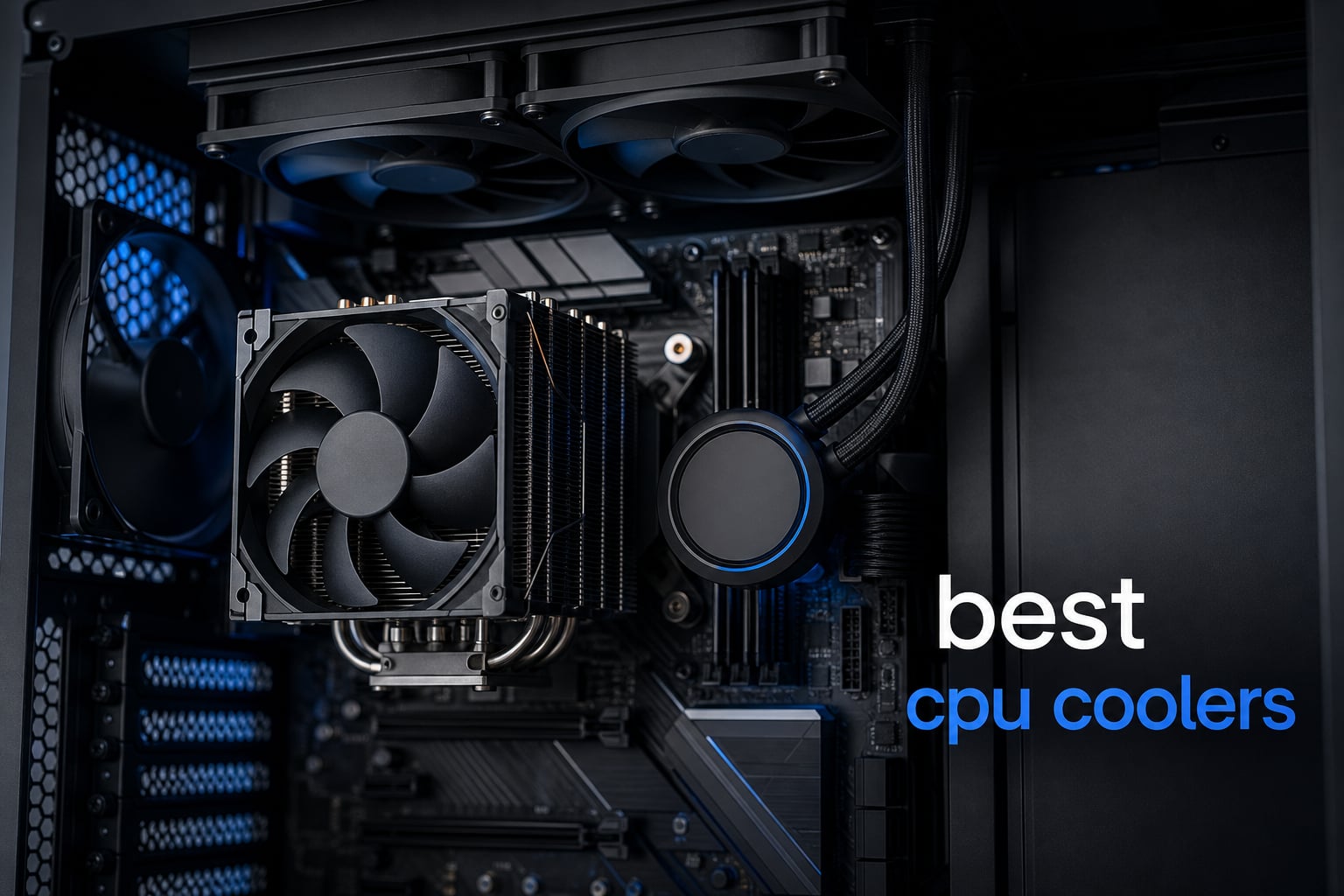
The best CPU coolers keep a processor from cutting boost clocks when a game, render, or compile job holds it under load. The right answer is not automatically the largest cooler: it is the model that fits the case, supports the socket, clears the RAM, and meets the system’s heat and noise goals.
We reviewed all 10 supplied models against their listed cooling design, fan and pump details, socket support, physical dimensions, warranty terms, and customer-feedback signals. We do not turn a manufacturer RPM or airflow figure into a made-up temperature result; a CPU temperature depends on the processor, power limits, paste application, case airflow, room temperature, and fan curve.
This guide covers air coolers and 360mm AIO liquid coolers for AM5, AM4, LGA1700, and LGA1851 systems. Start with our wider CPU cooling guides if you are learning the basics, or pair this research with our gaming CPUs hub before choosing parts.
The top three CPU cooler picks answer the most common build needs (August 2026)

ARCTIC Liquid Freezer III Pro 360 A-RGB
- 38mm radiator
- VRM fan
- Intel contact frame
- 6-year warranty
Thermalright Peerless Assassin 120 SE
- Dual tower
- 6 heat pipes
- Dual 120mm fans
- AM5 and LGA1851

Best overall: ARCTIC’s Liquid Freezer III Pro 360 A-RGB combines a thick 38mm radiator, integrated VRM fan, Intel contact frame, native offset mounting, tidy cabling, and a six-year warranty. It is the most rounded feature set here for a high-heat desktop when the case accepts its radiator depth.
Best value air cooler: Thermalright’s Peerless Assassin 120 SE uses a dual-tower heatsink, six heat pipes, and two PWM fans. Its 4.7 rating from 3.2k+ reviews gives the strongest broad feedback base among the air models, but tall RAM requires attention.
Best quiet-spec AIO: MSI’s MAG Coreliquid A13 360 lists 14.4 dB, a split-flow radiator, ceramic bearings, and out-of-box LGA1851 support. Treat that listed acoustic figure as a comparison clue rather than a cross-brand lab measurement.
These are the best CPU coolers in 2026
| Product | Specifications | Action |
|---|---|---|
 be quiet! Light Loop 360 be quiet! Light Loop 360 |
|
Check Latest Price |
 Noctua NH-D15 G2 chromax.Black Noctua NH-D15 G2 chromax.Black |
|
Check Latest Price |
| Thermalright Peerless Assassin 120 SE |
|
Check Latest Price |
| MSI MAG Coreliquid A13 360 |
|
Check Latest Price |
 be quiet! Pure Rock Pro 3 be quiet! Pure Rock Pro 3 |
|
Check Latest Price |
 Corsair Nautilus 360 RS Corsair Nautilus 360 RS |
|
Check Latest Price |
 ID-COOLING FROZN A620 PRO SE ID-COOLING FROZN A620 PRO SE |
|
Check Latest Price |
 Thermalright FW360 SE ARGB V2 Thermalright FW360 SE ARGB V2 |
|
Check Latest Price |
| ARCTIC Liquid Freezer III Pro 360 |
|
Check Latest Price |
 Thermalright Aqua Elite 360 ARGB Thermalright Aqua Elite 360 ARGB |
|
Check Latest Price |
The table is a shortlisting tool, not a thermal ranking. A 360mm radiator needs case support, while a tall dual tower needs a case height check and may change the usable RAM clearance.
1. ARCTIC Liquid Freezer III Pro 360 A-RGB is the best all-round 360mm AIO
ARCTIC Liquid Freezer III Pro 360 A-RGB – AIO CPU Cooler, Water Cooling
38mm radiator
VRM fan
Contact frame
6-year warranty
Pros
- 38mm radiator
- Integrated VRM fan
- Intel contact frame
- Single visible cable
- 6-year warranty
Cons
- Pump noise reported at high speeds
- Thick radiator needs clearance
The Liquid Freezer III Pro 360 A-RGB is the first model I would shortlist for a powerful gaming PC or workstation that has room for it. Its feature list addresses more than the CPU: ARCTIC pairs three P12 Pro 120mm fans and a 38mm radiator with an integrated VRM fan, which may help move air around the motherboard power-delivery area.
For Intel builders, the included LGA1851/LGA1700 contact frame is a meaningful setup detail because it is designed to distribute contact pressure. Native offset mounting for Intel and AMD is another heat-transfer-focused feature, but it does not replace careful paste application or a clean, flat mounting process.
The listed 77 CFM airflow figure and 3000 RPM maximum are manufacturer specifications, not a promise of a particular temperature. Customers give it a 4.5 rating across 2.5k+ reviews; positive feedback calls out cooling, the VRM fan, and cabling, while some reports mention pump noise at high speed.
That feedback makes a sensible fan-and-pump curve part of the purchase decision. A fixed maximum-speed setting is rarely the quietest way to run any AIO, and the six-year warranty is a welcome long-term reliability signal for a sealed liquid loop.
The ARCTIC fits builders who can accommodate a thick 360mm radiator
Check the case manual for radiator length, thickness, and fan clearance at the intended top or front location. The listed 15.7 by 4.7 by 2.9 inch dimensions describe a substantially deeper assembly than a thin radiator, so top-mounted RAM and motherboard clearance deserve a real measurement.
It supports AMD AM5/AM4 and Intel LGA1851/LGA1700. That makes it a strong candidate for high-TDP CPUs and sustained content-creation work, provided the chassis can carry the radiator without blocking other parts.
The ARCTIC is less suitable when simple air cooling or a compact case is the priority
A smaller case or a builder who wants fewer moving components may be better served by a tower cooler. The integrated cable routing is tidy, yet an AIO still adds a pump and radiator-placement task that air coolers do not have.
If you need a space-saving build, review our guide to low profile CPU coolers instead of trying to force a 360mm unit into an unsuitable chassis.
2. Thermalright Peerless Assassin 120 SE is the best value dual-tower air cooler
Thermalright Peerless Assassin 120 SE CPU Cooler, 6 Heat Pipes AGHP Technology, Dual 120mm PWM Fans, 1550RPM Speed, for AMD:AM4 AM5/Intel LGA 1700/1150/1151/1200/1851,PC Cooler
Dual tower
6 heat pipes
Dual 120mm fans
25.6 dB listed
Pros
- Six heat pipes
- Dual PWM fans
- Copper base
- AM5 and LGA1851 support
- Large review base
Cons
- 32mm RAM clearance with both fans
- 6.1 inch height
The Peerless Assassin 120 SE is the practical answer for builders who want strong air-cooling hardware without LCD screens, pumps, or radiator planning. Its two towers, six 6mm heat pipes, electroplated copper base, and dual TL-C12C PWM fans give it the component layout many buyers expect from a serious air cooler.
Thermalright lists 66.17 CFM, 1550 RPM, and a 25.6 dB noise level. Those figures help describe the included fan setup, but different brands measure sound differently, and actual noise changes sharply with the motherboard’s PWM curve and the resistance inside the case.
This model has a 4.7 rating from 3.2k+ reviews and ranks first in its listed computer CPU cooling fan category. The forum research also repeatedly identifies it as a strong performance-per-dollar pick, which aligns with its unusually large review sample and straightforward design.
The important limitation is physical rather than technical: the supplied data lists 32mm RAM clearance with both fans installed. Measure your installed memory height and remember that raising a front fan to clear taller modules can increase the cooler’s final height.
The Peerless Assassin suits mainstream gaming systems with normal-height memory
AMD AM4/AM5 and Intel LGA1700/LGA1851 compatibility cover current mainstream desktop sockets. It is a logical starting point for a gaming CPU running stock settings when the case accepts its 6.1 inch height.
The air-only design also avoids the pump-longevity concern raised frequently in build forums. Fans can still wear over time, but their simple service path appeals to people who prefer fewer parts in a cooling loop.
The Peerless Assassin needs a RAM and side-panel clearance check first
Dual-tower coolers claim a wide footprint around the socket. Tall RGB memory heat spreaders can meet the front fan, and a narrow case may leave no room between the cooler and side panel.
If either measurement is close, do not rely on a generic compatibility list. Compare motherboard, DIMM, and case drawings before ordering, then select a different layout if the tolerances are uncertain.
3. MSI MAG Coreliquid A13 360 is the quiet-spec 360mm AIO pick
MSI MAG Coreliquid A13 360 – AIO ARGB CPU Liquid Cooler – 360mm Radiator – LGA 1700/1851 / AM5/AM4 Compatible – Triple 120mm ARGB PWM Fans, Black
360mm radiator
Ceramic bearings
ARGB fans
LGA1851 ready
Pros
- LGA1851 ready
- Split-flow radiator
- Ceramic bearings
- 390mm tubing
- ARGB fans
Cons
- Radiator support required
- RAM clearance is not listed
MSI’s MAG Coreliquid A13 360 targets builders who want a full-size AIO with current socket support and visible lighting. It arrives LGA1851-ready and also supports AM5, AM4, and LGA1700, removing one possible bracket concern for a new build.
The unit uses a split-flow radiator with an integrated three-phase pump, ceramic bearings, and 390mm evaporation-resistant tubing with reinforced mesh sheathing. These are relevant durability-oriented design details, though only time and long-term usage can establish how any individual sealed loop will age.
MSI lists 14.4 dB and a maximum rotational-speed figure of 5200 RPM in the supplied specifications, while its technical details identify the pump at up to 3800 RPM. Because the listing does not state a shared measurement method, I would not compare that dB number directly with a rival’s fan or pump figure.
Its 4.7 rating from 320 reviews is encouraging, but it is a much smaller pool than the Peerless Assassin or ARCTIC. Treat the three-year manufacturer warranty and ceramic-bearing design as useful reassurances, then focus your final decision on case fit.
The MSI works best in a case built around a 360mm radiator location
Choose a mounting position before buying the cooler. Top mounting often avoids placing radiator-warmed air into the graphics card area, while front mounting can be the only option in some cases; each chassis layout produces its own trade-off.
Use a case that explicitly lists 360mm support rather than assuming three 120mm fans guarantee compatibility. Tube reach, motherboard heatsinks, and front-panel clearance all matter.
The MSI is not the answer when clearance information must be exhaustive
The supplied listing does not give RAM-clearance details, which is common for AIOs because the pump head replaces the tower above the DIMMs. It does not eliminate top-radiator and motherboard clearance questions, however.
Builders wanting a low-maintenance, easily visible heatsink may prefer the air coolers in this roundup. An AIO exchanges socket-area bulk for radiator and tubing planning.
4. Noctua NH-D15 G2 chromax.Black is the premium quiet air cooler
Noctua NH-D15 G2 chromax.Black, Quiet High-Performance CPU Cooler
8 heat pipes
Dual 140mm fans
24.8 dB listed
6-year warranty
Pros
- Eight heat pipes
- 20 percent more surface area
- 24.8 dB listed
- 59mm RAM clearance single fan
- 6-year warranty
Cons
- Large 6.61 inch height
- Premium positioning
The NH-D15 G2 chromax.Black is the refined high-end air alternative for builders who value acoustic tuning, mounting hardware, and a long warranty. Noctua gives it eight heat pipes, 20% more surface area than the original NH-D15, and two NF-A14x25r G2 140mm fans.
Its listed noise level is 24.8 dB, and the fans use speed-offset acoustic fine-tuning so that two fans do not simply run at the same speed. Low-Noise Adaptors are included, offering another way to tailor fan behavior when a silent build matters more than maximum airflow.
The 4.8 rating from 216 reviews and 89% five-star share support its strong build-quality reputation. Forum discussion is less unanimous on value: users consistently praise the construction but question whether the premium positioning makes sense beside very capable dual-tower alternatives.
Noctua helps installation with SecuFirm2+ mounting, an included screwdriver, and NT-H2 paste. Those small inclusions can reduce build friction, particularly when the motherboard is already in a cramped case.
The Noctua makes sense for quiet air cooling with generous case headroom
The stated 6.61 inch height is the first number to check against a case’s CPU-cooler limit. Its offset design is intended to clear the top PCIe x16 slot, which can matter on boards where the graphics card sits close to the socket.
Single-fan mode provides 59mm RAM clearance according to the listing. That flexibility is useful with tall DIMMs, though it changes the supplied dual-fan configuration and should be treated as a deliberate trade-off.
The Noctua is harder to justify when performance-per-component simplicity is the goal
This is a large, heavy 1810g cooler, so handle the motherboard carefully during installation and verify the case limit. Its dual 140mm fans and broad fin stack demand physical room.
If your build prioritizes an AIO’s clear socket area or a more compact tower, this design is not the natural fit. The six-year warranty is excellent, but it does not make clearance checks optional.
5. be quiet! Light Loop 360 is the ARGB-focused high-performance AIO
be quiet! Light Loop 360mm Black CPU Liquid Cooler for Heavily Overclocked Systems, 3X Light Wings LX 120mm PWM high-Speed ARGB Fan, Stylish ARGB Cooling Block, Extremely high Cooling Performance
360mm AIO
64 LEDs
Metal jet plate
Refill port
Pros
- 64 total LEDs
- Three high-speed fans
- Metal jet plate
- ARGB PWM hub
- Refill port
Cons
- 36.8 dB listed
- 360mm mounting required
The be quiet! Light Loop 360 is for a build that wants visible lighting without giving up the hardware expected from a 360mm AIO. It combines three Light Wings LX 120mm PWM high-speed fans, 64 LEDs across the block and fans, and a high-density fin stack cold plate.
The metal jet plate is designed to increase coolant-flow speed, while the included ARGB-PWM hub can synchronize up to six PWM fans and six ARGB components. That hub can reduce the number of headers needed on the motherboard, which is particularly helpful in an RGB-heavy case.
It has a 4.8 rating from 363 reviews, with 87% five-star feedback in the supplied analysis. Its listed 36.8 dB noise level is higher than several alternatives’ claimed figures, so it is not the first model I would pick solely for a quiet cooler.
The refill port distinguishes it from many sealed designs and is presented as an aid to maintenance. Follow the manufacturer documentation rather than opening or servicing a liquid loop casually; the three-year warranty is the verified support term supplied here.
The Light Loop suits builders who want coordinated ARGB controls
AMD AM5/AM4 and Intel LGA1851/LGA1700 support covers common modern platforms. Its 15.62 by 4.72 inch radiator dimensions still require a case with a proper 360mm location.
The ARGB-PWM hub makes the most sense where multiple compatible fans and lighting parts would otherwise create cable clutter. Plan headers and hub placement before the final cable-management pass.
The Light Loop is not the quietest-spec option in this selection
A listed noise value cannot predict every system, yet 36.8 dB signals that fan tuning deserves attention. Use PWM curves and choose a case with unrestricted intake and exhaust rather than expecting lighting hardware to run silently at full speed.
Builders who would rather avoid lighting software and extra cables can choose a plainer air tower. The best cooling arrangement is also one you will be comfortable configuring and maintaining.
6. be quiet! Pure Rock Pro 3 is the compatibility-minded air cooler
be quiet! Pure Rock Pro 3 Black CPU Air Cooler | 6 High Performance 6mm Heat Pipes with HDT Technology | 120mm Quiet PWM Fan | AMD:AM4 AM5/Intel LGA 1700/1150/1151/1200 | Black | BK042
6 heat pipes
120mm PWM fan
AM5 offset mount
6.1 inch height
Pros
- Six nickel-plated heat pipes
- Offset layout
- Adjustable fan height
- Clear mounting kit
- AM5 offset option
Cons
- 34.8 dB listed
- Single 120mm fan
The Pure Rock Pro 3 is a useful middle path for people who want a substantial air cooler but are worried about the broadest dual-tower shapes. It has six black nickel-plated copper heat pipes with heat-pipe direct-contact technology and a Pure Wings 3 120mm PWM fan.
be quiet! designed the cooler with a compact offset layout for RAM and VRM compatibility, plus an adjustable front-fan height. The supplied data also names an AMD offset mounting option for AM5, a welcome platform-specific detail when a CPU’s hotspot does not sit centrally under the heat spreader.
The model carries a 4.6 rating from 4.8k+ reviews, the largest review sample in this guide. Its popularity is a useful confidence signal, though it cannot tell us the exact temperature it will reach on a particular Core i9 or Ryzen 9.
Its 34.8 dB listed noise level suggests configuring the 2000 RPM fan through PWM rather than leaving it at an aggressive fixed speed. Clear mounting instructions, thermal paste, and the mounting kit are included.
The Pure Rock Pro 3 fits AM5 builders who value an offset mounting option
The cooler supports AM5/AM4 and Intel LGA1851/LGA1700 plus older listed Intel sockets. Its 6.1 inch height should fit many tower cases, but case specifications remain the authority.
The funnel-shaped air outlet and optimized fan blades are designed for pressure and airflow through the heatsink. Pairing it with sensible intake and exhaust fans is more useful than treating the CPU cooler as a substitute for case airflow.
The Pure Rock Pro 3 is less compelling for users seeking the lowest listed noise figure
There are quieter-spec options here, including the Noctua and ID-COOLING models. Acoustics vary with load, but the published value gives a reason to favor a gentle fan curve for everyday work.
It is also an air tower, so a case with limited CPU-cooler height may call for a low-profile solution instead. Measure from the motherboard tray to the side panel, not simply from a marketing photo.
7. Corsair Nautilus 360 RS is the tidy-wiring long-warranty AIO
CORSAIR Nautilus 360 RS Liquid CPU Cooler – 360mm AIO – Low-Noise – Direct Motherboard Connection – Daisy-Chain – Intel LGA 1851/1700, AMD AM5/AM4 – 3X RS120 Fans Included – Black
360mm AIO
20 dBA pump
Daisy-chain fans
5-year warranty
Pros
- 20 dBA pump
- Pre-applied thermal paste
- Daisy-chain fans
- Convex cold plate
- 5-year warranty
Cons
- 36 dB listed
- Needs 360mm radiator support
Corsair’s Nautilus 360 RS focuses on an uncomplicated 360mm AIO installation. Its pre-applied thermal paste, direct motherboard connection, and daisy-chain fan connections cut down on small setup steps that can make a three-fan radiator feel more intimidating than an air cooler.
The RS120 fans use AirGuide technology and Magnetic Dome bearings, while the pump is listed at 20 dBA. A convex cold plate is designed to improve contact with the CPU’s heat spreader, though mounting pressure and paste coverage still determine whether that contact is good in the finished PC.
The cooler has a 4.6 rating from 924 reviews, with 84% five-star feedback in the dataset. Customers most often praise installation and cooling effectiveness, giving this model a stronger feedback base than several newer AIOs in the roundup.
Five-year manufacturer coverage is one of the better warranty signals among the liquid options. It does not eliminate the general risk of a pump component, but it matters to builders comparing long-term ownership support.
The Nautilus is a good fit for clean motherboard-controlled cabling
It supports AMD AM5/AM4 and Intel LGA1851/LGA1700. Daisy-chaining the fans means fewer individual fan leads, which is practical in cases with little routing space behind the motherboard tray.
At 15.59 by 4.72 by 1.06 inches for the listed dimensions, confirm the complete radiator-and-fan stack, not just the radiator body. A front-mounted arrangement also needs room for tubing bends and the graphics card.
The Nautilus is not ideal where a 360mm mount is unavailable
A 360mm AIO cannot solve a compact-case limitation. If the case supports only smaller radiators or has limited roof clearance, start with a tower or an appropriately sized liquid alternative.
The listing’s 36 dB figure is also not a reason to assume silence. Set the pump and RS120 fan curves after the system is stable, then listen during the workloads you actually run.
8. ID-COOLING FROZN A620 PRO SE is the compact-height dual-tower alternative
ID-COOLING FROZN A620 PRO SE Dual-Tower CPU Cooler, Low Noise, 157mm, 260W
Dual tower
6 heat pipes
157mm height
27.2 dB listed
Pros
- 157mm height
- Six copper heat pipes
- Dual PWM fans
- 40mm RAM clearance
- 27.2 dB listed
Cons
- Tall RAM can obstruct it
- Less headroom for heavy loads
The FROZN A620 PRO SE gives budget-minded air-cooling shoppers a dual-tower layout in a stated 157mm height. That single figure makes it easier to evaluate against cases that quote a 160mm or similar CPU-cooler limit, though you should leave a margin instead of designing around a paper-thin gap.
Its hardware is familiar and useful: six 6mm copper heat pipes, two 120mm PWM fans, and automatic speed control. ID-COOLING lists 58 CFM, 2000 RPM, and 27.2 dB(A) maximum, which puts a quiet-spec focus alongside its dual-tower heat dissipation design.
The product holds a 4.6 rating from 582 reviews. Customer feedback describes it as a solid budget air cooler with good case compatibility, but the supplied analysis also warns that very demanding CPUs under heavy, sustained load may ask more of it.
The quoted RAM clearance is 40mm, with up to 63mm possible through a cut-out fin. This is more useful detail than many listings provide, but it does not mean every tall DIMM will fit with every motherboard heatsink and fan position.
The FROZN fits cases that support a 157mm CPU cooler
It supports AMD AM4/AM5 and Intel LGA1700/LGA1851 along with older listed Intel sockets. That makes it a credible choice for a mainstream system that favors air cooling and has measured case headroom.
Its dual-tower layout spreads heat across more fin area than a small single-tower cooler. In a case with clear front-to-back airflow, that can be a very sensible arrangement for gaming and routine productivity.
The FROZN needs extra attention with tall RGB RAM and extreme loads
Memory heat spreaders taller than the stated clearance can force an adjusted fan placement. Check the resulting overall height before closing the side panel.
For sustained workstation output or an aggressively configured high-TDP processor, select based on real independent testing for that CPU. Manufacturer airflow and pipe counts cannot stand in for a repeatable thermal benchmark.
9. Thermalright FW360 SE ARGB V2 is the LCD-display 360mm AIO
Thermalright FW360 SE ARGB V2 360mm AIO Liquid CPU Cooler, 2″ LCD Screen
360mm AIO
2 inch LCD
3000 RPM pump
Daisy-chain fans
Pros
- Custom LCD
- 3000 RPM pump
- Daisy-chain fans
- 68.9 CFM listed
- AM5 and LGA1851 support
Cons
- LCD software needs refinement
- Display adds setup complexity
The FW360 SE ARGB V2 is the clear pick for someone who wants CPU status or custom images on a 2 inch LCD pump display. It couples that display feature with a 3000 RPM pump and three TL-M12Q 120mm PWM daisy-chain fans.
Thermalright lists 68.9 CFM fan airflow, 2000 RPM fan speed, 2.21mmH2O static pressure, and a 28.2 dB noise level. Static pressure matters because radiator fins resist airflow; it helps describe whether a fan is designed to push air through that resistance rather than merely moving air in open space.
The AIO has a 4.6 rating from 296 reviews. Buyers appreciate the cooling and reduced cable clutter, while some feedback says the LCD software could be improved, an important distinction for anyone who considers the screen a core reason to buy.
Its supplied warranty information says three years. The specification list describes a 3 year manufacturer warranty, so the marketing claim of a longer term in a review-pros field should not be relied on over the stated warranty entry.
The FW360 is best for builders who will use an LCD display
AM5/AM4 and LGA1851/LGA1700 support cover current desktop platforms. The display can make a themed build more personal, but it also adds software and cable considerations that a plain pump block does not have.
Daisy-chained fans help reduce the routing work around a 360mm radiator. They do not change the need to confirm whether the case supports the radiator at the intended mounting position.
The FW360 is a poor fit when software-free simplicity matters most
If you only want thermal performance and quiet operation, an LCD may add little practical value. A basic air cooler or a display-free AIO often has fewer settings to manage after the PC is built.
Check the display software’s operating requirements and motherboard-header plan before purchase. A polished hardware appearance cannot compensate for a control experience you dislike.
10. Thermalright Aqua Elite 360 ARGB is the straightforward 360mm AIO
Thermalright Aqua Elite 360 ARGB Liquid CPU Cooler, 360 AIO Cooling Row Size, 3 x 120mm PWM Fans, Computer CPU Cooler,for AMD:AM4/AM5, Intel LGA1851/1150/1151/1200/1700
360mm AIO
Copper base
2600 RPM pump
ARGB fans
Pros
- Copper mirror base
- 2600 RPM pump
- 40
- 000-hour pump claim
- ARGB sync
- Wide socket support
Cons
- Smaller review sample
- Warranty details require confirmation
The Aqua Elite 360 ARGB is a straightforward full-size liquid option with a full-copper mirror-plane base, a listed 2600 RPM pump, and three TL-C12C-S ARGB fans. It supports AM5/AM4 and LGA1851/LGA1700, making it compatible with current mainstream desktop platforms.
Thermalright specifies polymer-protected, low-evaporation tubing and a pump lifespan claim of 40,000 hours. That claim is helpful context, but no lifespan figure can predict an individual unit’s service life because operating temperature, pump curve, installation, and manufacturing variation all play a role.
The listed 25.6 dB noise level, 1550 RPM fan speed, and 66.17 CFM airflow describe a calmer-spec fan setup than several competitors. Its 4.5 rating comes from 137 reviews, however, so the customer evidence is thinner than that for the more established products above.
One gap matters: the supplied listing says to contact the manufacturer for warranty information. Confirm the exact coverage for your region before treating the unit as a long-term AIO choice.
The Aqua Elite fits builders seeking a simple ARGB 360mm layout
The cooler syncs with a 5V three-pin ARGB motherboard header. Confirm that header type before connecting lighting hardware; 5V addressable RGB and 12V RGB headers are not interchangeable.
As with every 360mm radiator, compatibility starts at the case. Use our list of best airflow PC cases to find chassis options, then verify the individual case’s radiator chart and internal measurements.
The Aqua Elite needs a warranty check before long-term ownership
The listing’s stated pump-life claim is not the same as a warranty promise. Builders who place high weight on long-term coverage may prefer the ARCTIC, Noctua, or Corsair entries with explicit longer stated warranties.
Its smaller review base also means less collective user feedback on installation and sustained use. That is not proof of a fault; it is a reason to weigh documented support and fit carefully.
The right CPU cooler depends on heat load, case space, and noise goals
Start by identifying the processor and how it will be used. A gaming CPU that sees short bursts of load has different cooling needs from a processor rendering video for hours, and a high-TDP CPU or manually tuned system places more demand on heat dissipation.
TDP is not a universal promise of heat output or a direct cooler-sizing rule. Read the CPU maker’s power behavior, then consult independent thermal testing using the same processor family and realistic power limits when you need a precise performance comparison.
An air cooler is best when simple maintenance and proven physical fit matter
Air coolers transfer heat through a base, heat pipes, and a fin stack, then fans move it into the case airflow. They have no pump, no radiator mounting position, and generally fewer parts to plan around.
A dual tower can offer a large fin area, but clearance is the trade-off. Check cooler height, front-fan position, RAM height, motherboard heatsinks, and PCIe access before selecting a large tower.
An AIO liquid cooler is best when the case supports a radiator and socket-area space matters
An AIO transfers heat from a cold plate into liquid, moves it through tubes to a radiator, then uses fans to release it. A 360mm radiator provides ample surface area, but it needs a compatible location and careful tube routing.
Liquid cooling is not automatically overkill for gaming. It can be sensible for a high-heat processor, quiet fan curves, or a visual build, while a capable air cooler remains the simpler choice for many gaming PCs.
Socket support must match the exact CPU and included mounting hardware
AM5 and AM4 are AMD platforms, while LGA1700 and LGA1851 are current Intel platforms represented in this product list. Do not infer compatibility from a similar-looking bracket or an older review; verify the current product package and its support page.
An Intel contact frame, offset mount, or included paste can make installation more convenient, but it does not make a mismatched bracket safe. Read the manual before removing any stock retention hardware.
Case clearance must be measured before choosing a tower or radiator
For air cooling, compare the cooler’s total height with the case’s maximum CPU-cooler height. Allow space for a raised fan if the memory modules are taller than the stated clearance.
For liquid cooling, check radiator length, width, thickness, fans, tube path, and nearby motherboard or GPU interference. A front mount can conflict with graphics-card length, and a top mount can meet tall RAM or motherboard heatsinks.
Noise is controlled by component choice and fan-curve setup
Published dB figures are only comparable when testing conditions match, which product listings rarely establish. Use them as a starting point, then look for independent noise-normalized testing and adjust PWM curves after the build is complete.
Case airflow also affects acoustic behavior. Restrictive panels and dusty filters can force fans to work harder, so use balanced intake and exhaust and clean filters regularly.
Long-term reliability is clearer when warranty terms and service needs are explicit
Air coolers have a basic service model: clean the fins and replace a fan if needed. AIOs add a pump, tubes, and sealed coolant loop, so explicit warranty coverage and stable pump behavior carry more weight.
Our forum research found that pump longevity is a recurring concern, not an afterthought. Favor a stated warranty, avoid running a pump at an unnecessarily aggressive fixed speed, and keep the radiator free of dust.
The FAQ answers the common CPU-cooler questions directly
What type of CPU cooler is best?
An air cooler is best for simple maintenance and a case with enough height, while a 360mm AIO is best when the case supports a radiator and sustained heat output or socket-area clearance matters. Verify socket, RAM, and case fit before choosing either type.
What is the best cooling to the CPU?
The best cooling transfers heat through properly applied thermal paste to a securely mounted cold plate or heatsink, then removes it with unrestricted case airflow. A cooler alone cannot compensate for a poor fan layout, blocked filters, or an incompatible case.
Is liquid cooling overkill for gaming?
Liquid cooling is not overkill when a gaming PC uses a high-heat CPU, needs low fan speeds under sustained load, or has a case designed for a radiator. A capable dual-tower air cooler is still enough for many gaming builds and is simpler to maintain.
What company makes the best CPU coolers?
No single company is best for every build. ARCTIC, Noctua, Thermalright, be quiet!, MSI, Corsair, and ID-COOLING each offer models with different strengths in warranty, fit, lighting, airflow layout, and cooling design.
How much should I spend on a CPU cooler?
Choose by CPU heat output, socket support, case space, and desired noise rather than a fixed spending target. A well-fitting tower cooler can be right for many gaming PCs, while a 360mm AIO makes sense only when its added radiator space and features match the build.
The best CPU coolers in 2026 are the ones that fit the whole build
For the most complete feature set, choose the ARCTIC Liquid Freezer III Pro 360 A-RGB only after confirming its thick radiator fits. For a strong air-cooling layout and a large pool of customer feedback, the Thermalright Peerless Assassin 120 SE is the sensible shortlist leader.
The Noctua NH-D15 G2 chromax.Black is the premium quiet-air route, while the MSI MAG Coreliquid A13 360, Corsair Nautilus 360 RS, and Thermalright AIOs give different routes to a 360mm liquid setup. Check socket hardware, RAM height, radiator placement, and case ventilation before making the final call.