
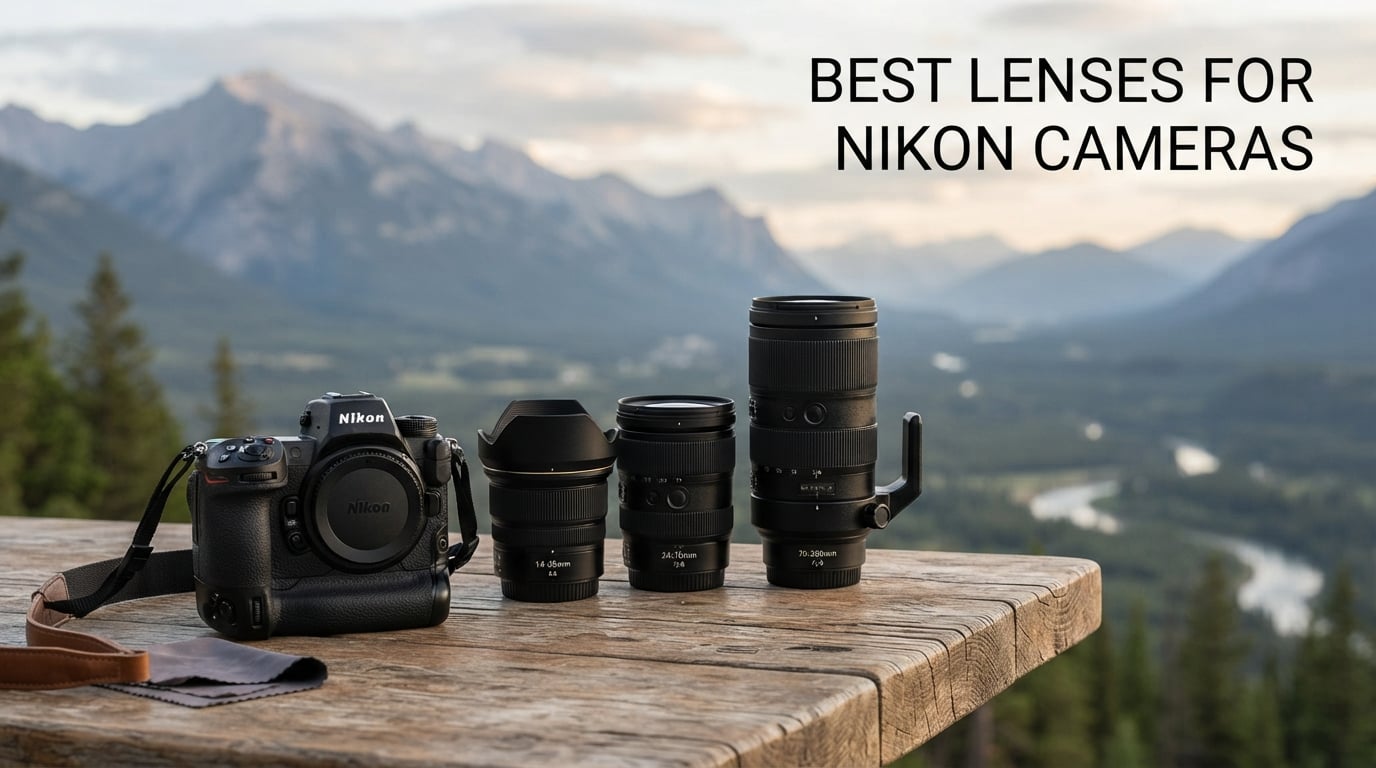
Choosing the best lenses for Nikon cameras comes down to the pictures you want to make, not the biggest focal-length number on a box. A fast 24-70mm handles events and people; a 180-600mm brings distant wildlife close; an ultra-wide changes how rooms, architecture, and big scenery feel in a frame.
This guide covers eight verified Nikon Z-mount options, including Nikon and Tamron choices for full-frame FX and APS-C DX bodies. I have separated them by the job they do best, then called out the real compromises: variable versus constant aperture, built-in stabilization, size, weather resistance, and close-focus ability.
Every lens here mounts directly to a Nikon Z camera. If you are moving from a Nikon DSLR, F-mount glass is a separate path: it needs Nikon’s FTZ adapter on a Z body, and compatibility can differ by lens, so check that pairing before treating an older lens as your next purchase.
Here is the short answer for 2026: buy the NIKKOR Z 24-70mm f/2.8 S II when you need a professional everyday zoom, the NIKKOR Z 28-400mm f/4-8 VR when one lens has to cover a trip, and the NIKKOR Z 180-600mm f/5.6-6.3 VR when wildlife is the priority. The remaining picks fill meaningful gaps rather than repeating those three roles.
Table of Contents
The top 3 picks cover professional, travel, and wildlife shooting
The three lenses below give most Nikon Z shooters a clear starting point. Pick the 24-70mm for a constant f/2.8 aperture and stable balance while zooming, the 28-400mm for reach without a lens swap, or the 180-600mm when distant subjects are the entire point.
“Budget pick” here means the most accessible route to serious long reach within this three-card comparison, not that it is a small or entry-level lens. For a lighter telephoto alternative, the Tamron 70-300mm later in this guide matters just as much.
The best lenses for Nikon cameras in 2026 match a specific shooting need
The overview makes the tradeoffs visible. Constant f/2.8 zooms give you more light and more background blur, while variable-aperture zooms often cover much more range or weigh less; neither is automatically the better choice.
| Product | Specifications | Action |
|---|---|---|
| NIKKOR Z 24-70mm f/2.8 S II |
|
Check Latest Price |
 Tamron 70-180mm f/2.8 G2 Tamron 70-180mm f/2.8 G2 |
|
Check Latest Price |
 NIKKOR Z 28-400mm f/4-8 VR NIKKOR Z 28-400mm f/4-8 VR |
|
Check Latest Price |
 Tamron 28-75mm f/2.8 G2 Tamron 28-75mm f/2.8 G2 |
|
Check Latest Price |
 NIKKOR Z 180-600mm f/5.6-6.3 VR NIKKOR Z 180-600mm f/5.6-6.3 VR |
|
Check Latest Price |
 Tamron 16-30mm f/2.8 G2 Tamron 16-30mm f/2.8 G2 |
|
Check Latest Price |
 Tamron 70-300mm f/4.5-6.3 Tamron 70-300mm f/4.5-6.3 |
|
Check Latest Price |
 NIKKOR Z DX 12-28mm PZ VR NIKKOR Z DX 12-28mm PZ VR |
|
Check Latest Price |
The NIKKOR Z 24-70mm f/2.8 S II is the professional everyday zoom
Nikon NIKKOR Z 24-70mm f/2.8 S II | The World’s First Internal Zoom f/2.8 Full-Frame 24-70mm Zoom Lens | Nikon USA Model
24-70mm f/2.8
Internal zoom
675 g
11-blade diaphragm
Pros
- Internal zoom balance
- Constant f/2.8
- Fast quiet autofocus
- 9.5 inch close focus
Cons
- No built-in stabilization
- Professional-size lens
The NIKKOR Z 24-70mm f/2.8 S II is my first recommendation for photographers who shoot people, events, editorial work, and video with one standard zoom. Its 24-70mm range starts wide enough for groups and finishes at a useful short-telephoto portrait view, while the f/2.8 maximum aperture stays available across that range.
The defining feature is internal zooming. The lens does not change length as you zoom, which Nikon says keeps the center of gravity steady for gimbals and matte boxes; that is a practical distinction for video rather than a minor spec-sheet note.
Nikon lists autofocus as five times faster and 50% quieter than the earlier model, along with less than half the previous generation’s focus breathing. Those claims point directly at hybrid shooters who need the lens to behave predictably during a push-in or a focus change.
At 675 g, it is not the smallest option here, but its 77mm filter thread keeps filter planning straightforward. The close-focus distance reaches 9.5 inches at 24mm, and the listed 0.32x magnification at 70mm gives food, details, and small products more room than a typical standard zoom expectation.
The f/2.8 aperture makes this the better event and low-light choice
A constant f/2.8 aperture gives the camera the same light-gathering ability at 70mm as it has at 24mm. That helps when a ceremony, reception, indoor interview, or late-afternoon portrait moves you from wide framing to a tighter composition without time to reset the exposure strategy.
The 11-blade rounded diaphragm is the other reason to choose it: it is designed for smooth out-of-focus areas. Subject separation will not replace good background placement, but it is much easier to create at 70mm and f/2.8 than with a slower variable-aperture superzoom.
The internal zoom design makes this the smarter video-standard zoom
On a gimbal, a lens extending toward the front can upset balance every time you zoom. This lens avoids that movement, and Nikon also supplies a control-ring click on/off switch, letting users choose tactile steps for stills or smoother adjustment for video.
There is no optical image stabilization in the lens, so handheld stability depends on the camera’s in-body stabilization where available and on your technique. I would pick this for its aperture, autofocus, and handling rather than expecting it to be the lightest walk-around lens.
The Tamron 70-180mm f/2.8 G2 is the fast telephoto for portraits
Tamron 70-180mm F/2.8 Di III VC VXD G2 for Nikon Z Mount
70-180mm f/2.8
VC stabilization
67mm filter
9-blade diaphragm
Pros
- Constant f/2.8
- VC stabilization
- Moisture-resistant build
- Fluorine coating
Cons
- Maximum range stops at 180mm
- Listed video resolution is 1080p
The Tamron 70-180mm F/2.8 Di III VC VXD G2 is the pick when a 24-70mm leaves you standing too close to a person or too near the action. The 70-180mm range gives flattering working distance for portraits and reaches into event, school-sport, and compressed-scenery work without going into supertelephoto size.
Its constant f/2.8 aperture is the central attraction. At 180mm, that combination can separate a subject from a busy background more strongly than a slower consumer telezoom, and it holds shutter-speed flexibility when available light is limited.
Tamron includes its VC optical stabilization mechanism, moisture-resistant construction, and fluorine coating. VC is useful for steadier hand-held framing, although it cannot freeze a moving athlete or child; shutter speed still does that job.
The 67mm filter size is shared with several Tamron lenses in this list, which can simplify a small filter kit. The nine-blade diaphragm and auto/manual focus options round out a focused portrait-and-events tool rather than an all-purpose wildlife lens.
The 70-180mm range gives portraits more working distance
At 70mm, this lens can frame a fuller portrait or isolate someone in a crowd. At 180mm, you can stay farther away and tighten the composition, which many people find more comfortable than putting a wide standard zoom close to a face.
It is also a good companion to a 24-70mm because the ranges meet without much duplication. That two-lens arrangement covers wide groups, normal views, portraits, and moderate distant action with f/2.8 available throughout.
The stabilization and coatings favor regular outdoor use
The reported moisture-resistant construction and fluorine coating make practical sense for photographers who move between indoor and outdoor assignments. They are not a reason to ignore weather precautions, but they are welcome when conditions change during a session.
For birds far away, 180mm is often too short, and the NIKKOR 180-600mm below is the better fit. If portraits and gatherings are the brief, I prefer the faster aperture and smaller reach target of this Tamron.
The NIKKOR Z 28-400mm f/4-8 VR is the one-lens travel answer
Nikon NIKKOR Z 28-400mm f/4-8 VR Mirrorless Lens
28-400mm f/4-8
14.2x zoom
5-stop VR
1.6 lb
Pros
- Huge 28-400mm range
- Light 1.6 lb body
- 5-stop VR
- 0.2m close focus
Cons
- Variable f/4-8 aperture
- Not water resistant
The NIKKOR Z 28-400mm f/4-8 VR is the clearest answer for travelers who want to carry one lens from morning street scenes to a distant detail at sunset. Its 14.2x range starts at 28mm and runs to 400mm, a breadth that replaces repeated swaps for many daylight trips.
Nikon lists the lens at 1.6 lb and about 5.57 inches long. Those numbers matter because a lens that stays in the bag does not help; this one is aimed at making broad coverage realistic on a day when a second lens feels like a burden.
Optical VR is rated for an equivalent 5.0-stop gain, with Synchro VR reaching up to 5.5 stops on compatible cameras. It also focuses as close as 0.2 m at the wide end and reaches 0.35x magnification at 28mm, so signs, flowers, and travel details do not need a separate close-up lens.
The compromise is visible in the f/4-8 maximum aperture. At the long end you will need more light, a higher ISO setting, or a steadier shutter-speed plan than with the fast 70-180mm.
The 28-400mm range is the strongest reason to buy this lens
Forum discussions often circle around whether a 24-200mm or 28-400mm makes the better single lens. The direct answer is that 28-400mm favors reach and removes the need to swap in a telephoto for distant subjects, while 24mm versus 28mm is a meaningful difference when you need a wide interior or group view.
Its 4K capability and linear manual-focus drive also make it relevant for travel video. Do not confuse a huge zoom range with a fast aperture, though; this is a convenience-first lens, not the low-light specialist.
The variable aperture requires realistic low-light expectations
At f/8 on the telephoto end, background blur and light intake differ markedly from an f/2.8 telezoom. VR can help steady the camera for a still scene, but it cannot stop a bird, a performer, or a child from moving.
It is also listed as not water resistant. I would use it as a flexible travel tool with sensible protection rather than as the lens to take into every rough-weather situation.
The Tamron 28-75mm f/2.8 G2 is the compact third-party standard zoom
Tamron 28-75mm F/2.8 Di III VXD G2 for Nikon Z Mount Mirrorless Cameras (6 Year Limited USA Warranty)
28-75mm f/2.8
19.4 oz
VXD autofocus
7.1 inch close focus
Pros
- Compact 19.4 oz build
- Constant f/2.8
- Quiet VXD autofocus
- Close-focus capability
Cons
- Starts at 28mm
- Digital rather than optical stabilization
The Tamron 28-75mm F/2.8 Di III VXD G2 gives Nikon Z users a smaller constant-aperture standard zoom alternative. At 19.4 oz and 4.7 inches long, it is much easier to picture as a daily carry than many professional f/2.8 zooms.
The focal range begins at 28mm rather than 24mm, which is the first question to ask yourself. If your work relies on wide interiors, architecture, or big group shots, the missing 24-27mm span may matter; if you shoot people, food, detail, and everyday scenes, the 28-75mm spread is highly practical.
Tamron states that its VXD linear motor is fast, quiet, and high precision. The lens supports 4K capture, and the close-focus specification of 7.1 inches at the wide end with 1:2.7 magnification opens up close product shots and creative foreground work.
The moisture-resistant construction and fluorine coating add useful day-to-day protection. This is one of the strongest examples of why third-party Nikon Z-mount lenses deserve a fair look instead of being dismissed as a compromise by default.
The compact size makes this the better f/2.8 travel standard zoom
Weight and length are not glamorous specifications, yet they directly affect whether a camera goes with you. A 550 g lens can give a Nikon Z body a more manageable balance for walks, city days, and trips where a large professional zoom would be left behind.
The constant f/2.8 aperture gives that smaller package a creative advantage over many kit zooms. You can keep exposure and background separation more consistent as you move from the wide end toward 75mm.
The close focus creates a useful near-subject option
The 7.1-inch minimum object distance at 28mm is not a replacement for a dedicated macro lens, but it lets you move close for a broad, detailed perspective. If close-up work becomes a major interest, our macro lens buying guide explains the different requirements of true macro photography.
The listed stabilization is digital rather than optical, so body stabilization and handling matter for hand-held shooting. I would choose this lens for its compact f/2.8 design, not for in-lens stabilization.
The NIKKOR Z 180-600mm f/5.6-6.3 VR is the wildlife specialist
NIKON NIKKOR Z 180-600mm f/5.6-6.3 VR
180-600mm f/5.6-6.3
5.5-stop VR
Internal zoom
Teleconverter compatible
Pros
- Reach to 600mm
- 5.5-stop VR
- Internal zoom balance
- Teleconverter compatibility
Cons
- 4.72 lb weight
- Variable maximum aperture
The NIKKOR Z 180-600mm f/5.6-6.3 VR is the best match in this group for birds, wildlife, and field sports because 600mm gives distant subjects a much larger share of the frame. This is not a casual reach upgrade; it is a purpose-built telephoto zoom with a serious physical footprint.
Nikon says the zoom ring needs only 70 degrees of rotation to travel from 180mm to 600mm. Its internal zoom design keeps the external length and center of gravity steady, which is helpful when tracking action and when supporting the lens on a monopod or tripod.
Built-in optical VR is rated to an equivalent 5.5 stops, and the lens has a quick-release tripod foot plus a strap eyelet. The minimum focusing distance is 4.27 feet at 180mm, with 0.25x reproduction, so a nearby animal does not automatically make the lens unusable.
The 95mm filter thread and 4.72 lb weight are clear signs of the commitment. Plan for a supportive strap, monopod, or tripod on longer outings instead of treating it like a small telephoto.
The 600mm end is why this lens suits wildlife photography
Wildlife photographers often cannot step closer without changing animal behavior or breaking field rules. The 180-600mm range lets you frame distant birds and animals from a more respectful working distance, and the 180mm end remains useful when a subject approaches.
Nikon lists compatibility with the Z TC-1.4x and TC-2.0x teleconverters, extending the stated reach to 840mm or 1200mm respectively. That option matters for specialists, although teleconverters also affect aperture and require careful technique.
The internal zoom and VR help with field handling
Changing focal length without the lens extending can make it easier to maintain a balanced support setup. The wide zoom-ring throw is also a practical field benefit when a subject changes distance before you have time for slow, repeated turns.
Its f/5.6-6.3 aperture is slower than f/2.8, so early mornings and moving subjects demand attention to shutter speed and ISO. For a broader look at reach, handling, and focal-length choices, see our telephoto zoom lens buying guide.
The Tamron 16-30mm f/2.8 G2 is the full-frame ultra-wide choice
Tamron 16-30mm F/2.8 Di III VXD G2 for Nikon Z Cameras
16-30mm f/2.8
15.9 oz
VXD autofocus
67mm filter
Pros
- Constant f/2.8
- Compact 15.9 oz body
- High-precision VXD AF
- Moisture-resistant build
Cons
- No image stabilization
- 30mm is not a normal focal length
The Tamron 16-30mm F/2.8 Di III VXD G2 is for full-frame Nikon Z photographers who want an ultra-wide zoom without adding a very heavy lens to the bag. At 16mm it captures a 107-degree stated angle of view, while 30mm moves closer to an everyday wide perspective.
Its constant f/2.8 aperture is useful for interiors, night scenes, architecture, environmental portraits, and video. Tamron lists the lens at 15.9 oz with a 67mm filter thread, an unusually friendly combination for an ultra-wide f/2.8 zoom.
VXD autofocus is described as high speed, high precision, and quiet. The lens also has moisture-resistant construction, fluorine coating, and a nine-blade diaphragm, making it a practical wide tool rather than a niche special-effect lens.
There is no image stabilization in the lens. Nikon bodies with in-body stabilization can help for hand-held still subjects, but fast motion and long exposures still call for appropriate shutter speed or a tripod.
The 16mm end gives interiors and big scenery room to breathe
Sixteen millimeters is wide enough to change the story of an image. It can show an entire room, put an interesting foreground close to the lens, or include the sweep of a location that 24mm cannot always fit.
Wide lenses reward careful edge awareness. Keep people away from the frame edges when possible and pay attention to upright lines in architecture, since perspective choices become much more obvious at 16mm.
The 67mm filter thread helps keep a wide kit simple
Shared filter sizes can reduce the number of filters a traveling photographer packs. This Tamron shares a 67mm thread with the Tamron 70-180mm and 70-300mm in this roundup, which is helpful if you use compatible filters across a small kit.
For a wider category comparison beyond Nikon Z mount, visit our wide-angle lens buying guide. I would pair the 16-30mm with a standard zoom when I need both dramatic width and normal focal lengths in one outing.
The Tamron 70-300mm f/4.5-6.3 is the lightweight telephoto pick
Tamron 70-300mm F/4.5-6.3 Di III RXD for Nikon Z Mirrorless Cameras (Model A047Z) Black
70-300mm f/4.5-6.3
20.5 oz
Quiet RXD autofocus
67mm filter
Pros
- Light 20.5 oz body
- 70-300mm range
- Quiet RXD motor
- Moisture-resistant build
Cons
- No image stabilization
- Slower variable aperture
The Tamron 70-300mm F/4.5-6.3 Di III RXD is the sensible telephoto for photographers who want more reach but do not want to carry the NIKKOR 180-600mm. It weighs 20.5 oz and covers the classic 70-300mm range, making it easier to pack for day trips, casual sports, and distant details.
Tamron describes it as the world’s lightest and most compact telephoto zoom for full-frame mirrorless cameras. It uses 15 elements in 10 groups and an RXD stepping motor that the manufacturer calls exceptionally quiet.
The focus distances are listed as 31.5 inches at the wide end and 59.1 inches at telephoto. That gives it useful close-subject flexibility even though it is not a dedicated macro lens, and the 67mm thread can match the two Tamron zooms above.
The most important limitation is the lack of image stabilization. A Nikon Z body with in-body stabilization can assist in certain situations, but owners of bodies without it should plan around shutter speed, particularly toward 300mm.
The 20.5-ounce weight makes long walks more realistic
Weight concerns appear repeatedly in photographer discussions because they are practical, not theoretical. A 70-300mm that is comfortable to carry may capture more than a larger lens that stays at home, particularly for travel, hiking, or family outings.
The 70mm starting point also pairs naturally with a 24-70mm or 28-75mm. Together, those two lenses cover most everyday compositions without the bulk of a supertelephoto setup.
The variable aperture suits daylight telephoto work best
The f/4.5-6.3 maximum aperture means this lens is most comfortable in good light or when you can accept higher ISO settings. It is a different tool from the Tamron 70-180mm f/2.8, whose faster aperture is better suited to indoor action and stronger subject separation.
Moisture-resistant construction and Tamron Lens Utility compatibility add welcome practical features. I would select it when light carrying weight and 300mm reach matter more than maximum aperture or in-lens VR.
The NIKKOR Z DX 12-28mm PZ VR is the DX ultra-wide video choice
Nikon NIKKOR Z DX 12-28mm PZ VR | Wide-Angle Power Zoom Lens with Image stabilization for APS-C Size/DX Format Z Series mirrorless Cameras | Nikon USA Model
12-28mm DX
4.5-stop VR
Power zoom
205 g
Pros
- DX ultra-wide coverage
- 4.5-stop VR
- 11 power zoom speeds
- Only 205 g
Cons
- Variable f/3.5-5.6 aperture
- Not water resistant
The NIKKOR Z DX 12-28mm PZ VR is the dedicated APS-C answer in this lineup for Z50, Z30, and Zfc photographers who want a genuinely wide view. Its 12-28mm DX range moves from immersive 12mm scenes to a more natural 28mm view without carrying a full-frame ultra-wide lens.
Nikon lists the lens at 205 g, or 0.45 lb, and gives it a 67mm filter thread. The low weight makes sense on smaller DX bodies, where a large full-frame zoom can make the whole setup front-heavy.
The PZ in its name means power zoom. Nikon states that users can select from 11 speeds, from slow and subtle to nearly instant, and can control zoom through the lens ring, camera controls, a Bluetooth remote, or SnapBridge.
Built-in optical VR is rated at 4.5 stops, and the close-focus distance is 11 inches. Those features make it especially appealing for hand-held video, vlogging-style framing, interiors, and dramatic foreground compositions.
The DX design gives APS-C Nikon Z bodies the right size and view
A DX lens is made for Nikon’s APS-C Z cameras, so it is the direct match for photographers using a Z50, Z30, or Zfc. On a full-frame Z body, a DX lens invokes crop mode, reducing the available image area; choose a full-frame lens instead if that is your main camera.
This is why format must come before focal length in a lens search. A 12mm DX view is very wide, but it should not be treated as identical to a 12mm full-frame view.
The power zoom offers a video control advantage
Eleven selectable zoom speeds are useful when you want a controlled focal-length change rather than a quick manual twist. The feature is particularly relevant to creators who shoot video as well as stills, even though the listed capture resolution is 1080p.
The f/3.5-5.6 aperture is variable and the lens is listed as not water resistant. I would choose it for its small DX format, VR, and power-zoom control rather than for rough-weather work or shallow-depth-of-field shooting.
The right Nikon lens depends on mount, format, aperture, and distance
Start with your camera mount. Every product reviewed here is a Nikon Z-mount lens and fits Nikon Z mirrorless bodies directly; an F-mount DSLR lens needs an FTZ adapter on a Z camera, and its autofocus behavior can depend on the specific lens and camera combination.
Then identify your sensor format. FX lenses work on full-frame Z cameras and can also work on DX bodies, though their angle of view becomes narrower because of the crop; DX lenses are compact matches for APS-C bodies but trigger crop mode on full-frame bodies.
The aperture choice should follow your light and background needs
Choose a constant f/2.8 zoom when you frequently photograph indoors, at events, or with deliberate background blur. The NIKKOR 24-70mm, Tamron 28-75mm, Tamron 70-180mm, and Tamron 16-30mm hold f/2.8 throughout their ranges.
Choose a variable-aperture zoom when a lighter body, broader focal range, or simpler one-lens packing list matters more. The 28-400mm and 70-300mm trade maximum aperture for reach or portability, while the 180-600mm prioritizes reach and VR for wildlife.
The stabilization choice matters most at long focal lengths
VR helps counter camera shake with stationary subjects, especially at long focal lengths. The NIKKOR 28-400mm offers stated 5-stop VR, the 180-600mm offers stated 5.5-stop VR, and the DX 12-28mm offers stated 4.5-stop VR.
Stabilization does not stop a moving subject. For birds in flight, running children, or athletes, use a shutter speed appropriate for the motion first, then treat VR or in-body stabilization as help with your own hand movement.
The focal-length choice should begin with your usual subject distance
For people and events, begin around 24-28mm and reach toward 70-75mm. For portraits with more distance and stronger compression, look at 70-180mm; for wildlife, 180-600mm is the clear specialist; for rooms and dramatic views, choose 16-30mm full-frame or 12-28mm DX.
Prime lenses remain another route when you want a smaller setup and a wider aperture, but none are among the eight verified products in this roundup. Our 35mm lens buying guide and 50mm lens guide can help you compare those familiar everyday focal lengths.
The two-lens kit often makes more sense than one extreme zoom
A 16-30mm plus 28-75mm combination covers ultra-wide through short telephoto with constant f/2.8 apertures. A 24-70mm plus 70-180mm combination creates a different two-lens kit that gives event and portrait photographers f/2.8 from 24mm through 180mm.
For a travel-first kit, the 28-400mm alone keeps baggage simple. For a DX creator kit, the 12-28mm PZ VR paired with a normal or short-telephoto DX lens adds wide video and interior coverage without upsetting the balance of a small body.
The most common Nikon lens questions have practical answers
What is the best Nikon lens for portrait photography?
The Tamron 70-180mm f/2.8 G2 is the strongest portrait choice in this list because its 70-180mm range gives comfortable working distance and its constant f/2.8 aperture supports subject separation. Choose the NIKKOR Z 24-70mm f/2.8 S II instead when you also need groups, events, and wider environmental portraits.
Which Nikon Z lens should I buy first?
Start with the NIKKOR Z 24-70mm f/2.8 S II if you need a professional standard zoom and work in varied light. Choose the NIKKOR Z 28-400mm f/4-8 VR if one-lens travel coverage is more important, or the NIKKOR Z DX 12-28mm PZ VR if you use a DX body and need ultra-wide video capability.
What is the best Nikon Z lens for wildlife photography?
The NIKKOR Z 180-600mm f/5.6-6.3 VR is the wildlife choice because it reaches 600mm, has internal zooming, and includes VR rated at 5.5 stops. Its stated teleconverter compatibility can extend reach further, while its 4.72-pound weight means it benefits from a supportive carrying or tripod plan.
Which Nikon lens is best for landscape photography?
For full-frame Nikon Z bodies, the Tamron 16-30mm f/2.8 G2 is the wide choice here, offering 16mm coverage and a constant f/2.8 aperture in a 15.9-ounce body. For DX bodies, the NIKKOR Z DX 12-28mm PZ VR gives an immersive ultra-wide view with 4.5-stop VR.
Is the Nikon Z 24-70mm f/2.8 worth it over the f/4?
The f/2.8 model is worth choosing when you need more light at every focal length, more potential background blur, internal zooming, and video-focused autofocus claims. An f/4 option makes more sense when smaller size and lighter carrying weight matter more than the f/2.8 aperture. Match the choice to how often you shoot indoors, events, or moving subjects.
The best final choice is the lens that removes your current limitation
For most demanding all-around work, choose the NIKKOR Z 24-70mm f/2.8 S II. Choose the Tamron 28-75mm f/2.8 G2 when compact constant-aperture shooting is the goal, the NIKKOR Z 28-400mm f/4-8 VR for one-lens travel, and the NIKKOR Z 180-600mm f/5.6-6.3 VR for dedicated wildlife reach.
The best lenses for Nikon cameras in 2026 are not one-size-fits-all purchases. Match the mount, sensor format, focal length, aperture, stabilization, and carry weight to the work you actually do, then choose the lens that makes those images easier to make.