
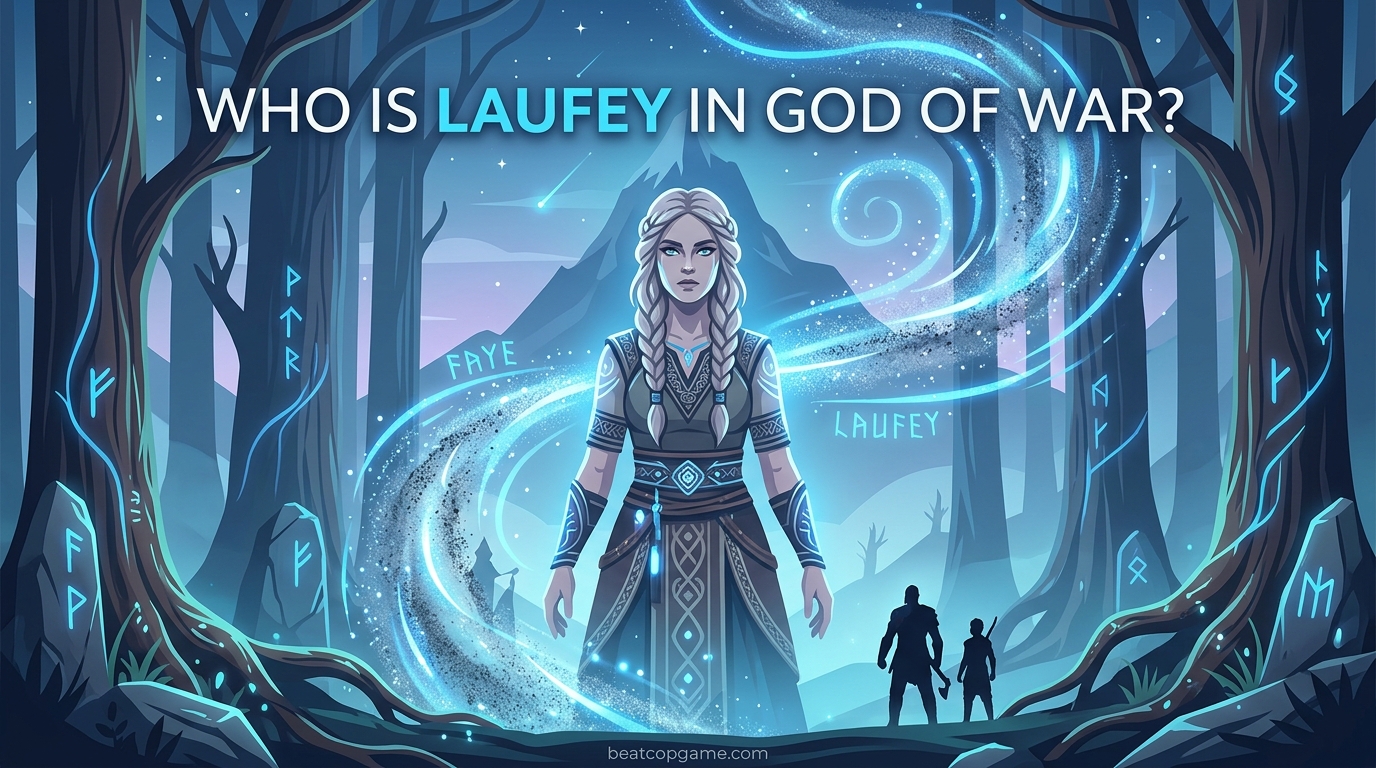
Laufey, also known as Faye, is Kratos’ second wife and Atreus’ mother in the God of War Norse saga. She is a Jötunn warrior from Jötunheim, honored among her people as “Laufey the Just.” Her death before the events of God of War (2018) sets the entire story in motion, making her the hidden architect of Kratos and Atreus’ path.
She chose the name Faye to hide her true identity while living with Kratos and Atreus in the forest of Midgard. Our team replayed God of War Ragnarök multiple times to piece together every clue about her identity. Despite her secret, she shaped the fate of the worlds through careful planning and prophecy. Players who finished God of War Ragnarök know her true name, but many newcomers still ask: who is Laufey in God of War, and why does she matter so much?
Her influence extends far beyond her physical presence in the games. Every major event in the Norse saga traces back to her decisions. The journey to scatter her ashes, the battles with Baldur and Thor, and the eventual arrival of Ragnarök all unfolded according to her design. Understanding who she is unlocks the full meaning of the story.
Table of Contents
Who Is Laufey in God of War? Explained
Faye and Laufey are the same person. Faye is the name she used while living with Kratos and Atreus in the forest of Midgard. Laufey is her true name among the Jötnar, the race of Giants who inhabit Jötunheim.
She kept her heritage hidden from Kratos for years. In God of War (2018), players find her ashes at the end of the adventure, and Kratos learns she was a Giant all along. The reveal changes how he views his wife and his son’s destiny.
Laufey earned the title “Laufey the Just” among her people. She opposed Odin’s cruelty and the Aesir’s oppression of the Giants. This reputation made her a legendary figure long before she met Kratos. Our team noticed that her title appears in several murals and lore markers across both games. The name signals that she was not merely a survivor but a leader who stood for her people.
Her name change was not just about hiding. It was about building a new life away from the war between Giants and gods. By choosing Faye, she stepped away from the prophecy and the weight of her title. She wanted to protect her family from the endless cycle of violence that consumed the Nine Realms.
She understood the danger of her identity better than anyone. Odin hunted the Giants to extinction, and her name alone would have drawn his attention. Her choice to live as Faye was a sacrifice of her legacy for the safety of her son. That decision defines her character more than any battle she fought.
Laufey’s Norse Mythology Connection
In the original Norse myths recorded in the Prose Edda and Poetic Edda, Laufey is Loki’s mother. Her partner is Fárbauti, and she is sometimes called Nál, which means “Needle.” These texts describe her as slender and poor, a very different image from the warrior we see in God of War.
In the Prose Edda, Laufey is mentioned briefly as Loki’s mother, with little detail about her personality or actions. The God of War writers took this blank slate and built one of the most compelling characters in the series. Her mythological name connects the games to centuries of storytelling tradition.
The Nál connection is easy to miss. The nickname “Needle” likely refers to her thin frame in the original myths. Santa Monica Studio did not incorporate this detail directly, but the choice of Laufey as her name was deliberate. It ties Atreus to Loki through bloodline, just as the myths connect Loki to Laufey.
Santa Monica Studio reimagined her completely. Instead of a passive background figure, she became a powerful warrior who fought gods and protected her people. This creative choice gives her strength and agency that the original myths never gave her. The writers saw an unnamed mother in the Eddas and asked what kind of person could raise the god of mischief.
The connection to Loki is still present, though adapted. In God of War, Atreus is Loki, making Faye the mother of the god of mischief. This reimagining ties the game to its mythological roots while building something fresh for players. The developers kept the family tree intact but changed every branch around it.
The Poetic Edda mentions Loki as “Loki Laufeyjarson,” which means “Loki, son of Laufey.” This naming convention is common in Norse tradition, where children often carry their mother’s name. The game mirrors this by showing Atreus as a reflection of his mother’s intelligence and cunning rather than Kratos’ raw rage.
Her Relationship with Kratos and Atreus
Kratos met Faye after leaving Greece and arriving in the Norse lands. She became his second wife and taught him to control his rage. Their love is one of the few peaceful chapters in Kratos’ violent life.
She understood Kratos better than anyone because she shared his pain of being hunted by gods. This mutual understanding formed the foundation of their marriage. It also explains why she trusted him with Atreus after her death. Both of them had been running from divine cruelty before they found each other.
She gave birth to Atreus, who she named Loki in her native tongue. She raised him in the forest, teaching him hunting, languages, and the old stories. Atreus never knew his mother’s true name or heritage until after her death. The name she gave him carried the weight of prophecy, though she kept that secret even from her son.
Faye loved Kratos deeply. She saw past his god-killing past and recognized the man trying to change. Her trust in him is proven by the fact that she left their son in his care after her death. This was not a small act. She knew Kratos’ history and still believed he could be a father.
Her parenting style balanced Kratos’ harsh discipline. Where Kratos taught Atreus survival and restraint, Faye taught him compassion and curiosity. This combination shaped Atreus into the complex young man we see in the games. Without her influence, he would have become either too cold or too reckless.
Their family life in the Midgard forest was deliberately isolated. Faye knew that contact with the outside world would bring danger. She trained Atreus to hunt, read runes, and speak multiple languages. These skills would later save his life during the journey with Kratos.
The Leviathan Axe and Her Connection to Brok and Sindri
Faye played a direct role in creating one of the most iconic weapons in the series. She commissioned the Leviathan Axe from the dwarf brothers Brok and Sindri. This weapon was designed to rival Thor’s Mjölnir and serve as a tool of protection rather than destruction.
The Leviathan Axe is not just a weapon. It is a symbol of Faye’s philosophy. Where Mjölnir was built to crush and dominate, the Leviathan Axe was built to defend and preserve. The frost powers embedded in the axe reflect her Giant heritage and her connection to the cold lands of Jötunheim.
Brok and Sindri respected her deeply. Their conversations about Faye in the game reveal that they saw her as a rare client who valued craftsmanship over violence. The dwarfs mention her with reverence, which is unusual for their sarcastic tone. That respect tells us she treated them as equals rather than servants.
Her ability to forge alliances with Brok and Sindri shows she was more than a simple warrior. She understood the value of friendship and trust in a world ruled by fear. The Leviathan Axe became Kratos’ signature tool in the Norse games, and every time he throws it, he is using his wife’s gift.
Her Giant Heritage and Powers
Faye belongs to the Jötnar, a race of beings often called Frost Giants in popular culture. In God of War, the Jötnar are not simple monsters. They are a proud people with magic, prophecy, and strength that rivals the gods.
She fought Thor in a legendary battle outside her home. She survived the encounter, which few beings can claim. This fight proves her combat abilities match those of the most powerful Aesir gods. The battle left visible scars on the landscape, and the game shows the aftermath in the form of cracked earth and shattered trees.
Her fighting style combined raw strength with strategic thinking. She did not rely on brute force alone, which sets her apart from Kratos. This difference in approach will likely shape the gameplay of the new 2026 title. Based on the trailer, her combat appears to blend Giant magic with agile movement and precise strikes.
The Jötnar were nearly wiped out by Odin’s genocidal campaign. Faye survived this purge by hiding in Midgard, but she never stopped fighting for her people. Her resistance was not just physical. She used prophecy and knowledge to undermine Odin’s plans from the shadows.
She possessed prophetic abilities that allowed her to see possible futures. This power is common among the Jötnar, but Faye’s skill was exceptional. She painted murals in Jötunheim that showed events decades ahead. The accuracy of these predictions proves her mastery over fate.
The Giants were not a unified race in the way the Aesir were. They came in many forms, with different abilities and cultures. Faye represented the noble branch of the Jötnar, those who sought knowledge and peace rather than conquest. Her heritage is a source of pride, not shame, despite the persecution she faced.
How Did Faye Die and What Legacy Did She Leave?
Faye died before the opening scene of God of War (2018). The game never shows her death directly, but players learn she knew it was coming. She prepared her body for cremation and left instructions for Kratos and Atreus.
Her final request was for her ashes to be scattered from the highest peak in the worlds. This adventure forces Kratos and Atreus to travel across worlds, fight gods, and bond as father and son. Every step of their path was part of her design. The journey was never just about the ashes. It was about forcing Kratos to become a father and Atreus to become a man.
Her ashes were carried across dangerous worlds, through battles with Baldur and Thor, to their final resting place. The act of scattering them fulfilled her last prophecy and protected her family from Odin’s schemes. Even in death, she was fighting for her son’s future. The location she chose had meaning beyond its height. It was a place where her presence could shield Atreus from Odin’s sight.
She painted prophecy markers in Jötunheim that showed the future. She knew Kratos would die, Atreus would become Loki, and Ragnarök would come. Her planning shows she understood fate on a level that even the gods feared. The murals she created are among the most haunting visuals in the series. They show moments of joy and tragedy with cold accuracy.
Her legacy is embedded in every relationship Kratos builds after her death. The patience she taught him allows him to connect with Freya, Mimir, and even his enemies. She planted the seeds of his redemption before he knew he needed it. That is the power of her legacy. She changed the Ghost of Sparta without ever raising a hand against him.
The prophecy she painted was not a curse. It was a warning. She gave her family the knowledge they needed to face their fate with open eyes. That choice is the ultimate act of love in a world controlled by divine tyranny. She could not stop the future, but she could prepare them for it.
God of War Laufey (2026): What We Know About the New Game
Santa Monica Studio revealed God of War Laufey at the State of Play showcase in June 2026. For the first time, players will control Faye as the main protagonist. The story takes place in the Everywhen, an afterlife dimension where she awakens after death.
I was skeptical when I heard Kratos would not be the main character in the new game. After watching the State of Play reveal, I believe Santa Monica Studio has earned the benefit of the doubt. The trailer showed her waking in the Everywhen with new abilities and a fresh purpose.
The Everywhen is a realm that exists outside normal time. It allows the story to explore events from the past, present, and possible futures simultaneously. This setting is perfect for a character who spent her life manipulating prophecy. She can now interact with the threads of fate directly.
The announcement surprised many fans. Kratos has been the face of the series since 2005, so shifting to Faye is a bold move. The developers confirmed Cory Barlog is involved, which gives the community confidence in this new direction. His creative vision shaped the best entries in the franchise, so his presence is a strong signal of quality.
The community has discussed this shift heavily on forums like Reddit and ResetEra. Many fans trust Santa Monica Studio’s track record, especially with Cory Barlog’s involvement. Players are excited about finally controlling Faye after years of hearing about her strength. The skepticism is real, but so is the excitement.
The Everywhen setting lets the team explore parts of the Norse world we have never seen. Faye’s combat style will differ from Kratos’ brute force, focusing on her Giant magic and agility. The game is scheduled for PS5 and promises to expand the story in unexpected ways. The trailer hinted at new enemies and allies that have not appeared in the previous games.
The shift to Faye is not a rejection of Kratos. It is an expansion of the universe. The developers have stated that the Norse saga is far from over. By focusing on Laufey, they are filling in the gaps of a story that players have only seen from the outside. We are finally going inside the mind of the architect.
Why Is the New Game Called Laufey? Understanding the Title
The title God of War Laufey raised eyebrows across the community. Some fans expected a traditional subtitle like Ragnarök. Using her true name instead of a continuation of the old naming scheme signals a genuine shift in identity. The title honors her Giant heritage and rejects the secrecy that defined her life.
The name change from Faye to Laufey in the title is thematically loaded. She spent her life hiding her true name to protect her family. Now the game proudly places that name at the center of the franchise. It is a form of posthumous justice for a character who was forced to live in shadows.
Forum discussions reveal that many players appreciate this thematic depth. The title is not just marketing. It is a statement about the story’s focus. The community trust signals are strong. Santa Monica Studio has not delivered a weak mainline entry since the franchise began. That track record gives players reason to believe this risk will pay off.
Cory Barlog’s involvement specifically addresses fan concerns about quality. He directed the 2026 reboot and shaped the narrative that made Faye so intriguing. Having him attached to her standalone story feels like the natural conclusion of the arc he started. The title is a promise that her story will be treated with the same care as Kratos’.
Frequently Asked Questions
Is Faye a god in God of War?
No, Faye is not a god. She is a Jötunn, a Giant from Jötunheim. While she possesses powers that rival the gods, she belongs to a separate race called the Jötnar.
Are Faye and Laufey the same person?
Yes, Faye and Laufey are the same person. Faye is the name she used while living with her family. Laufey is her true Giant name among the Jötnar.
Who was Faye in Norse mythology?
In the original Norse myths, Laufey is Loki’s mother. She is also called Nál and is partnered with Fárbauti. The myths describe her as slender and poor, unlike the warrior version in God of War.
Did Kratos know Faye was a giant?
No, Kratos did not know Faye was a Giant until after her death. She kept her true identity hidden from him during their entire marriage. He discovered the truth during their adventure to scatter her ashes.
How did Faye die in God of War?
Faye died of an unknown illness before the events of God of War (2018). She knew her death was coming and prepared for it. The game never shows her death directly, but her ashes and instructions set the entire plot in motion.
Why is the new God of War called Laufey?
The new game is called Laufey because she is the main protagonist. The title honors her true Giant name and signals a shift in focus from Kratos to Faye’s story. It was revealed at the State of Play showcase in June 2026.
Did Faye know she was dying?
Yes, Faye knew she was dying. She prepared her body for cremation, left detailed instructions for Kratos and Atreus, and painted prophecy markers in Jötunheim. Her entire plan shows she understood her fate before it happened.
Did Faye actually love Kratos?
Yes, Faye loved Kratos deeply. She saw past his violent past and taught him to control his rage. Her trust in him is proven by the fact that she left their son in his care after her death.
Did Kratos marry Laufey?
Yes, Kratos married Laufey, though he knew her as Faye. She was his second wife after Lysandra from his Greek life. Their marriage was built on mutual respect and shared pain.
What is God of War Laufey about?
God of War Laufey is set in the Everywhen, an afterlife dimension where Faye awakens after her death. Players control her as the main protagonist in a new chapter of the Norse saga. The game was revealed in 2026 and is scheduled for PS5.
Conclusion
Laufey is one of the most important characters in the God of War Norse saga, even though she dies before the first scene. She is Kratos’ wife, Atreus’ mother, a Jötunn warrior, and the architect of the entire path. With God of War Laufey coming in 2026, players will finally get to experience her story firsthand.
In our view, Laufey is the most important hidden character in the entire series. Her legacy is built on love, sacrifice, and the courage to stand against gods. She changed Kratos without ever raising a hand against him. She guided Atreus without ever revealing her true name. That is a different kind of power, and it is the kind that makes great stories unforgettable.
If you have been asking who is Laufey in God of War, she is far more than a memory. She is the heart of the entire saga. Her name was hidden for years, but her impact was visible in every battle, every choice, and every moment of growth. The new game gives her the spotlight she earned, and we cannot wait to see what happens when the architect finally steps out of the shadows.