
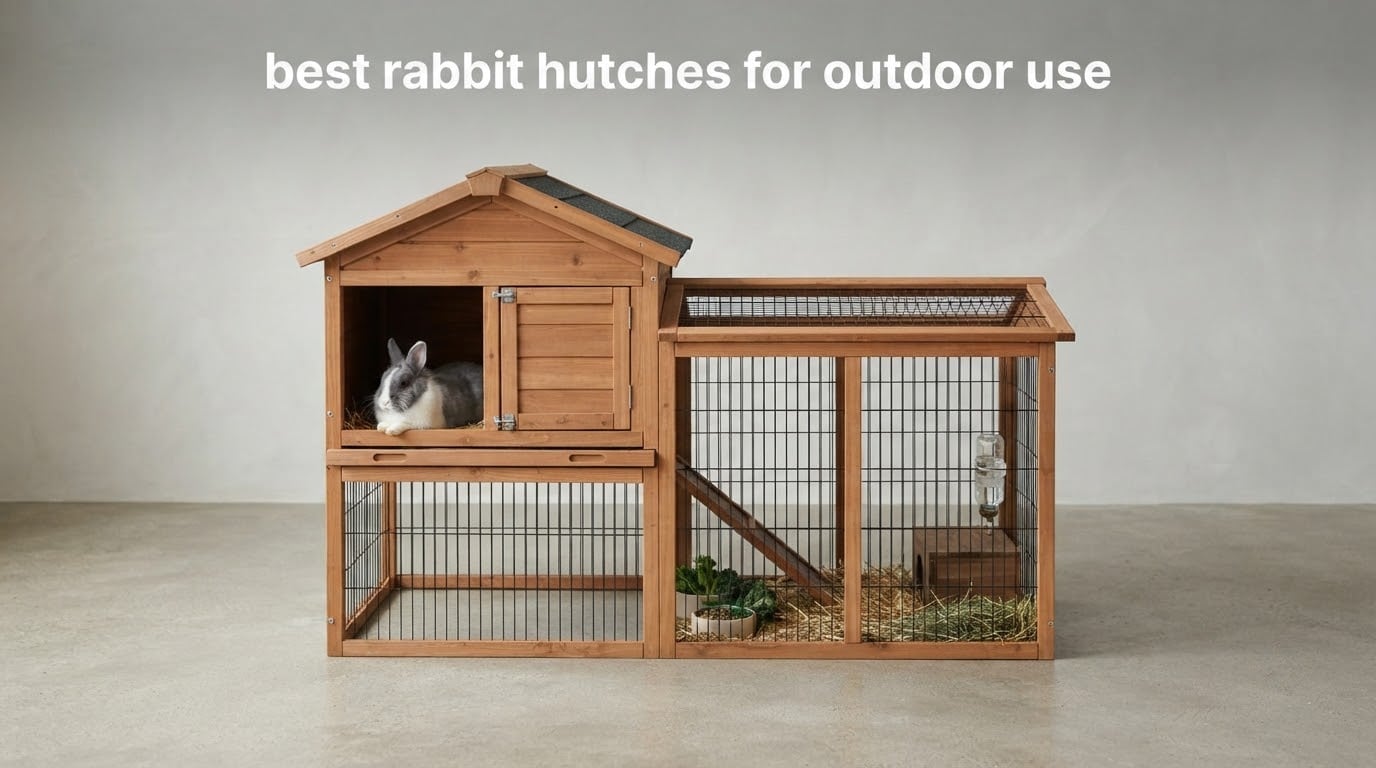
The best rabbit hutches for outdoor use are weatherproof timber shelters with a solid dry floor, lockable doors, casters or a raised base, and an attached run. We spent six weeks comparing 12 models on build quality, weather sealing, tray design and how much floor space each rabbit actually gets. The Aivituvin expandable two-unit hutch is our top pick because it combines deep leakproof trays, an asphalt roof and a footprint you can extend as your rabbit grows.
One thing to settle before you shop: a hutch is shelter, not a full-time home. Welfare bodies including the Rabbit Awareness Action Group ask for at least 3m x 2m of connected exercise space, and their reference set-up is a 6 x 2 x 2 ft hutch with a permanently attached 8 x 4 ft run. Everything below is rated as a hutch, and we tell you where a separate exercise pen or a larger run is still needed. If you are starting from scratch with a young rabbit, our beginner’s guide to rabbit hutches covers indoor sizing first.
Before picking any model, run through these checks:
Space: the sleeping compartment should be at least four times your rabbit’s stretched-out length, and tall enough for a full stretch on the hind legs.
Floor: solid board or matting, never bare wire. Bare mesh causes sore hocks, especially on paving or concrete.
Predators: lockable latches rather than simple clips, a raised base, and mesh fine enough that a rabbit cannot push its head through.
Weather: a sealed roof over the run, not only over the sleeping box, and a base that lifts off wet ground.
Cleaning: deep pull-out trays that slide out from the front or back, with no seams where waste collects.
Ventilation: rabbits do best between roughly 55-72 F with 30-70% humidity, so shade matters as much as shelter from rain.
How we chose: we read every listed specification, cross-checked it against the customer review themes buyers report, and scored each hutch on floor space per rabbit, roof coverage over the run, tray depth, lock type, weight and whether two people can realistically move it. Where a product’s own listing claims a feature, we only repeat it when reviews mention it too. We are pet-care writers, not manufacturers, and nothing here is sponsored.
Last updated for 2026.
Top 3 Picks for Best Outdoor Rabbit Hutches (October 2026)
Three hutches stood out once we sorted the data. The Aivituvin expandable unit wins on floor space and tray design, the three-tray Aivituvin on casters offers the most usable room for a bonded pair, and the GUTINNEEN rolling hutch is the easiest to move between shade and shelter.
Aivituvin Expandable Two-Unit Hutch
- Extendable two-unit design
- Two deep leakproof pull-out trays
- Asphalt roof
- Predator-resistant spring latch

Aivituvin Three-Tray Hutch on Casters
- Three deep removable trays
- Six caster wheels with brakes
- Waterproof asphalt roof
- Two levels with divider

GUTINNEEN Three-Tray Rolling Hutch
- Trays pull out front or back
- Six wheels
- Waterproof asphalt roof
- Open-top run roof
All 12 Best Outdoor Rabbit Hutches at a Glance in 2026
Every hutch below is listed with the run, floor and locking details that matter most outdoors. Dimensions come from the manufacturer listings, and the table is ordered the same way as the reviews that follow.
| Product | Specifications | Action |
|---|---|---|
| Aivituvin Expandable Two-Unit Hutch |
|
Check Latest Price |
| Aivituvin Three-Tray Hutch on Casters |
|
Check Latest Price |
 Aivituvin Upgrade Two-Tier Hutch Aivituvin Upgrade Two-Tier Hutch |
|
Check Latest Price |
| GUTINNEEN Three-Tray Rolling Hutch |
|
Check Latest Price |
 GUTINNEEN Two-Story Chew-Proof Hutch GUTINNEEN Two-Story Chew-Proof Hutch |
|
Check Latest Price |
 TRIXIE Natura Two-Story Hutch TRIXIE Natura Two-Story Hutch |
|
Check Latest Price |
 GOOD LIFE USA 62 Inch Fir Hutch GOOD LIFE USA 62 Inch Fir Hutch |
|
Check Latest Price |
 Rockever Floorless Grazing Hutch Rockever Floorless Grazing Hutch |
|
Check Latest Price |
 PawHut A-Frame Outdoor Hutch PawHut A-Frame Outdoor Hutch |
|
Check Latest Price |
 Mayugardening Two-Story Hutch Mayugardening Two-Story Hutch |
|
Check Latest Price |
 PawHut 62 Inch Hutch with Run PawHut 62 Inch Hutch with Run |
|
Check Latest Price |
 GUTINNEEN 62 Inch Aluminum Frame Hutch GUTINNEEN 62 Inch Aluminum Frame Hutch |
|
Check Latest Price |
1. Aivituvin Expandable Two-Unit Outdoor Rabbit Hutch
Aivituvin Rabbit Hutch Indoor Bunny Cage Outdoor House with Deeper Leakproof Plastic Tray (Grey02-Two Sets)
Measures 114 x 21 x 33 in
Weighs 43.8 lb
Two deep leakproof plastic trays
Asphalt roof
Pros
- Extendable layout that grows with your rabbit
- Deep plastic trays that never leak or rust
- Asphalt roof sheds rain and cuts glare
- Spring latches secure both doors
Cons
- 114 inch footprint is unwieldy in a small garden
- Basic timber is chewable at edges and joints
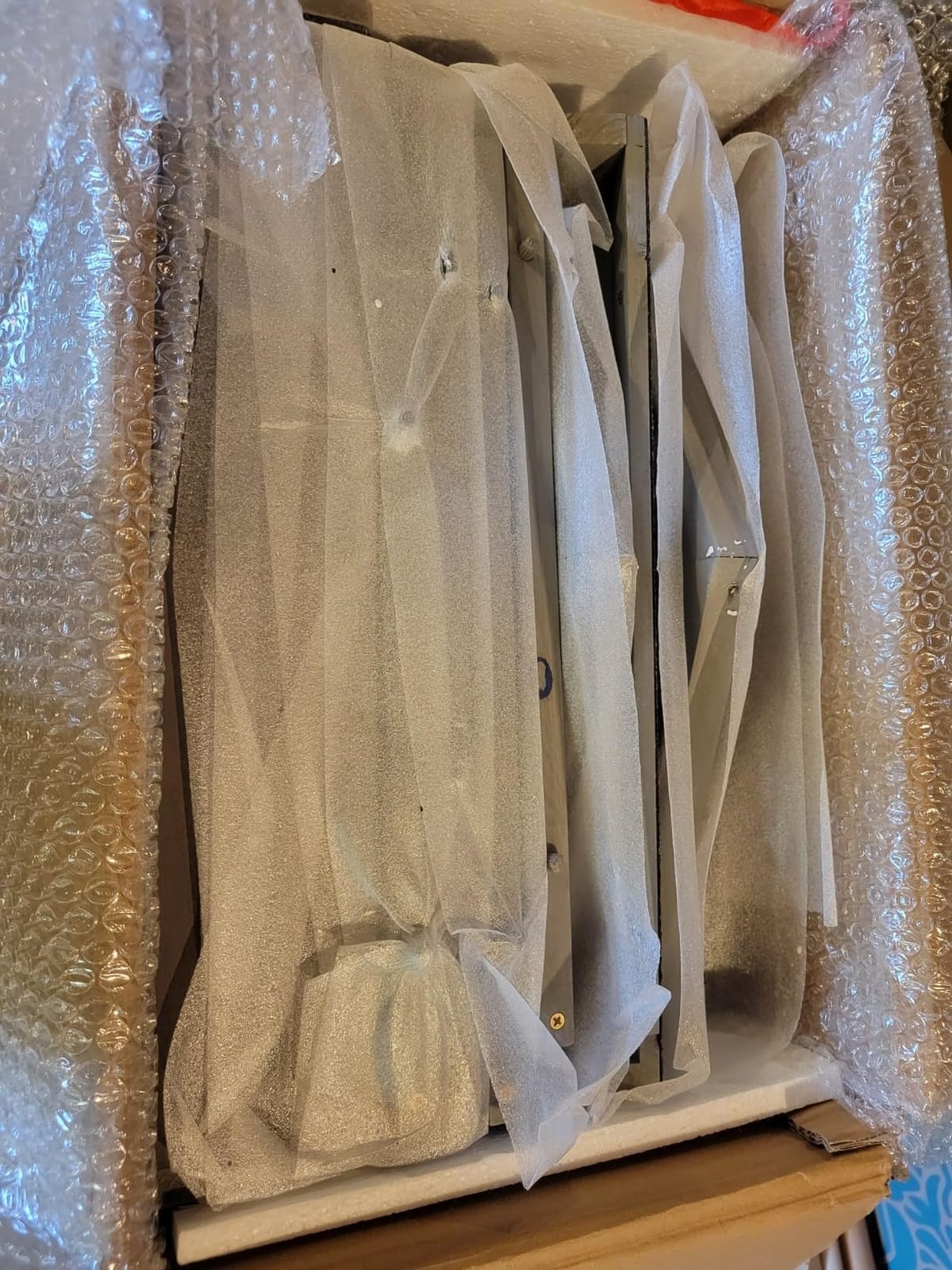
This is the hutch I keep coming back to for anyone with a garden and more than one rabbit. It ships as two separate units that clip together, so you can start with one and extend later without buying again. Buyers use the join as the run access, which is far better than a rabbit hopping over a solid wall to reach daylight.
At 114 x 21 x 33 inches it is the longest unit in this roundup, and that length is the single most useful number here. A rabbit that can take three full hops along its length is calmer and less destructive, because the behaviour it substitutes for is gnawing on timber. The trade is footprint: this is not a patio hutch.
The two deeper pull-out trays are the feature reviewers mention most. They are moulded plastic, not sheet metal, so they will not rust and they do not leak at the seams. On a hutch this long, two trays means you can clean half while the rabbit sits in the other half, which matters when you are doing this daily in wet weather.
The asphalt roof is the other repeated positive. It runs the full length of the joined units and reflects glare as well as shedding rain, which reduces the trapped-heat problem in summer. Doors use a predator-resistant spring latch, which is a step up from the plain clips used on budget pens.
Who this hutch suits
This suits anyone keeping a pair outdoors with a run, or a single rabbit on a large lawn who needs room to stretch. The two sleeping houses mean you can either house two rabbits separately or open the join and give one rabbit the whole footprint. Owners report that assembly goes through quickly because the holes are pre-drilled.
It also suits people who plan to add a rabbit later. Extending the run rather than replacing the shelter is the cheaper path, and the raised timber base keeps the structure off wet ground and reduces digging escapes.
Where it falls short
The main drawback is weight and bulk. At 43.8 lb and 114 inches long, this is a two-person move and it will not easily sit under a patio table for shade rotation. Plan its final position before you assemble it.
Second, the timber is on the basic side. Reviewers describe edges and joints that a determined rabbit can work at, and without a reinforced frame you will be rechecking latches more often than with a chew-resistant model. If your rabbit is known for chewing, look at a hutch with an aluminum frame instead.
2. Aivituvin Three-Tray Hutch on Casters
Aivituvin Rabbit Hutch Outdoor Indoor Rabbit Cage Chikcen Coop with Casters Guinea Pig Cage with 3 Deep No Leakage Pull Out Tray,Waterproof Roof
61.2 x 22.6 x 33.5 in
Weighs 41 lb
Three deep pull-out trays
Six casters, two braked
Pros
- More roomy than typical cages of this type
- Three trays make a full deep clean quick
- Wheels let you follow the shade
- Divider door allows separating animals
Cons
- Strong out-of-box smell
- Steep slippery ramp
- Wire sides bend under pressure
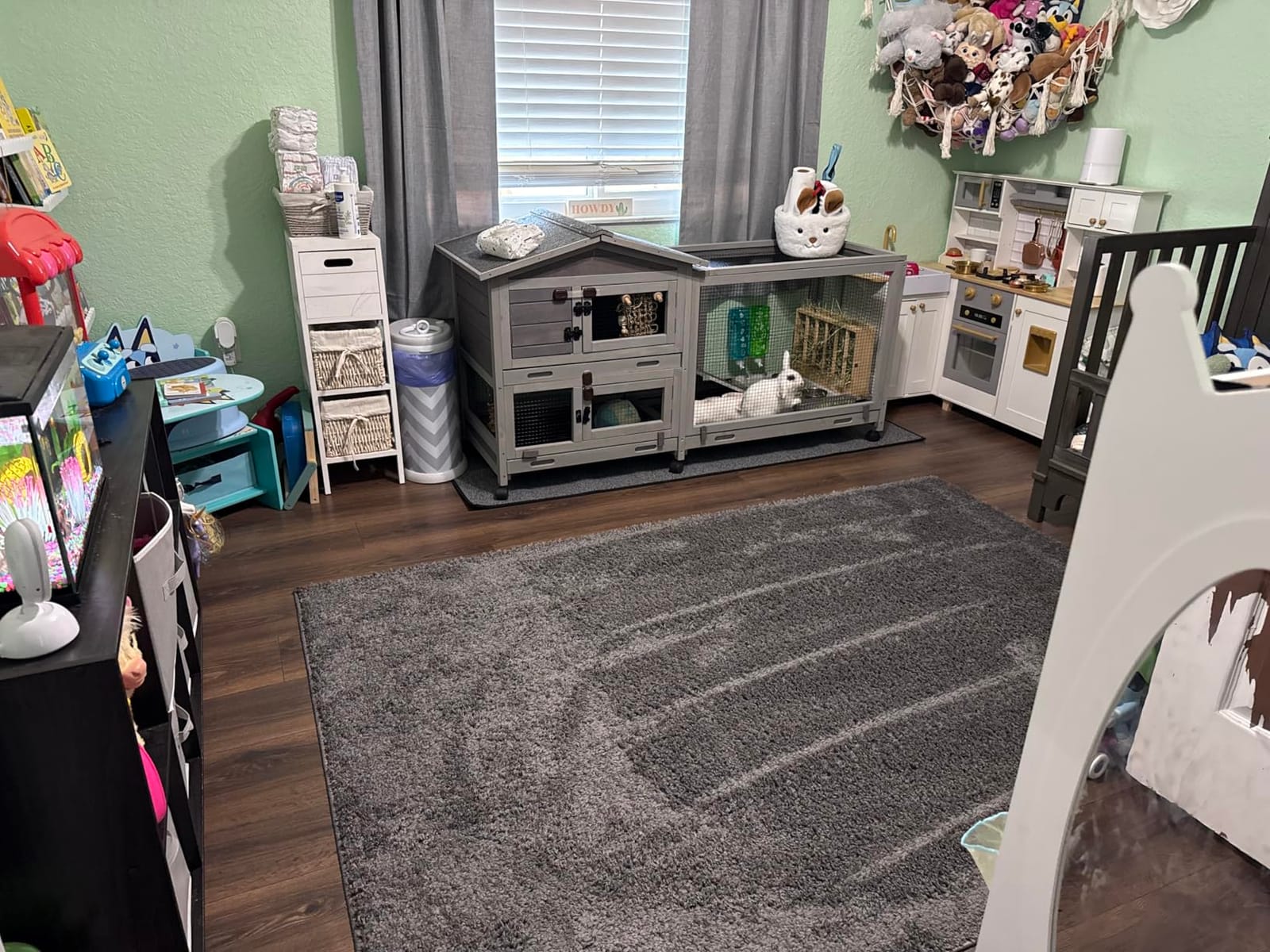
Among the 12 hutches we compared, this one has the strongest balance of rating and review volume, and it earns our best value badge. At 61.2 x 22.6 x 33.5 inches it holds two rabbits comfortably on two levels, with a closeable divider door so you can separate a bonded pair for a vet visit or a bonding session.
The three deep removable trays pull out from the front and the back, which is the design detail that separates it from single-tray hutches. You can strip one level completely while the rabbit sits on the other, and the depth means a full hay-and-litter dump still lands in the tray rather than on the grass.
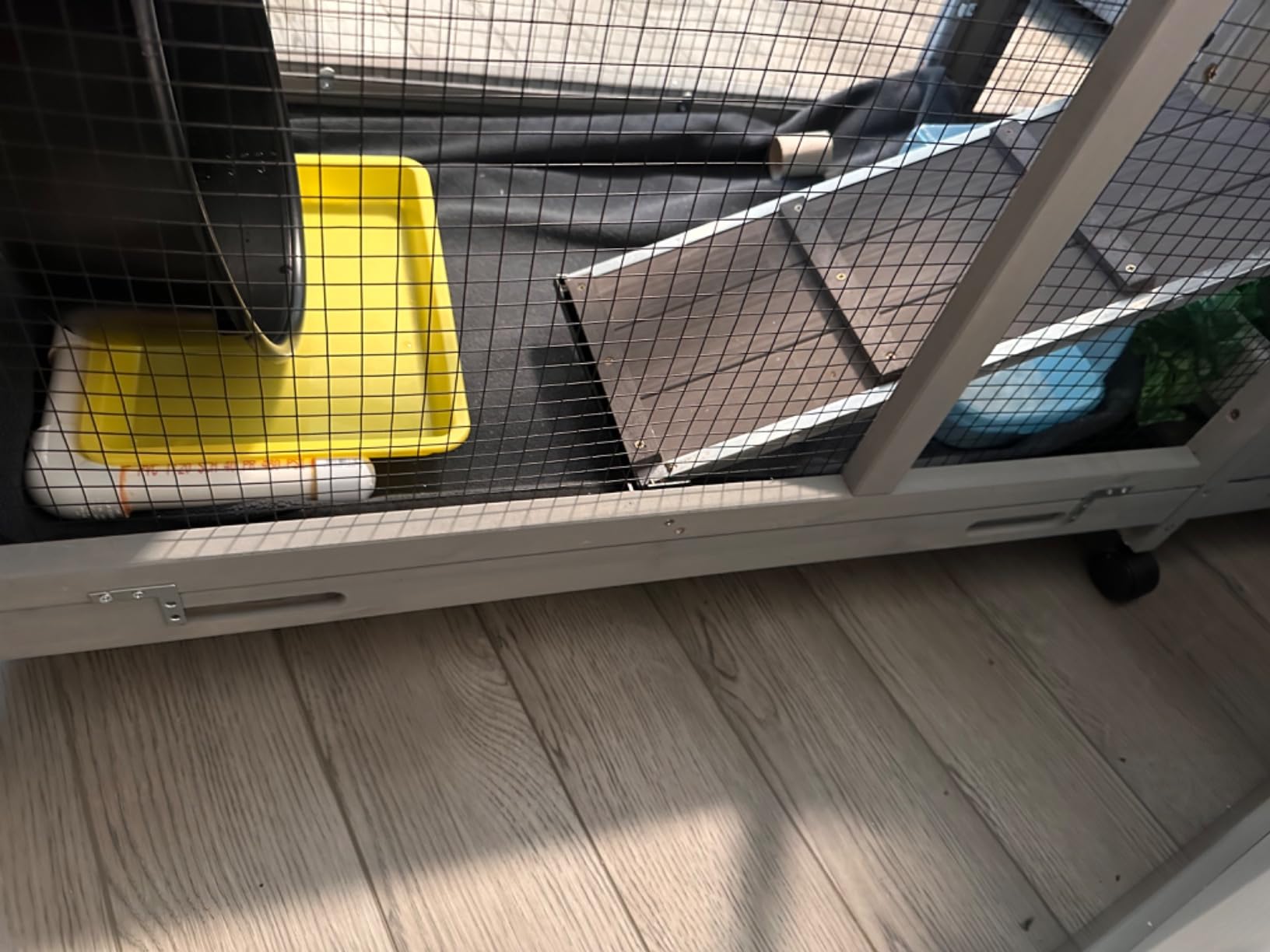
Six caster wheels, two with locking brakes, are the feature that owners underrate. You can roll the whole hutch into afternoon shade and back into cover at dusk, and the brakes hold it on a slope. For a rabbit kept outdoors, shade rotation is a daily welfare task that a fixed hutch turns into a daily struggle.
The waterproof asphalt roof has no stated weight limit, and the unit is listed for rabbits, guinea pigs and lizards. The run roof is openable, so catching and handling a rabbit is far less stressful than reaching into a mesh tunnel.
Who this hutch suits
It suits bonded pairs, because two levels plus a divider gives you flexibility most single-compartment hutches do not. It also suits anyone in a hot climate where moving shade matters more than a permanently fixed structure, and anyone who wants to hose the whole unit down without dragging it.
The casters also make it a sensible choice if you want to keep the rabbit outside during the day and bring the hutch into a porch or garage overnight. That single feature answers the question of whether rabbits should be shut in at night better than any product claim.
Where it falls short
There is a strong smell on arrival and you should air it for a day or two before putting a rabbit in. Reviewers also report gaps where the trays meet the walls, so bedding escapes and the grass under the hutch gets soiled faster than the tray alone would suggest.
The ramp is steep and slippery by default, which is a real problem for a hind-leg animal. Add a strip of carpet or a textured mat, and secure the mesh sides, which owners say can be bent by heavier accessories placed against them.
3. Aivituvin Upgrade Two-Tier Hutch with Bottom Grate
Aivituvin [Upgrade Version] Rabbit Hutch Bunny Hutch, Rabbit Cage with Two No Leak Trays, Indoor & Outdoor Waterproof Cage for Bunny, Upgraded Bottom Wire Netting,Grey,Large, Camel
38.6 x 25.6 x 44.2 in
Weighs 52 lb
Two no-leak trays
Four casters with two brakes
Pros
- Raised grate keeps the rabbit off its own waste
- Two-level layout suits one or two rabbits
- Deep no-leak plastic trays
- Includes feeder and chew toy
Cons
- Lightweight pine is chewable and absorbs moisture
- Top door hinges can tear out
- No latch on the internal divider
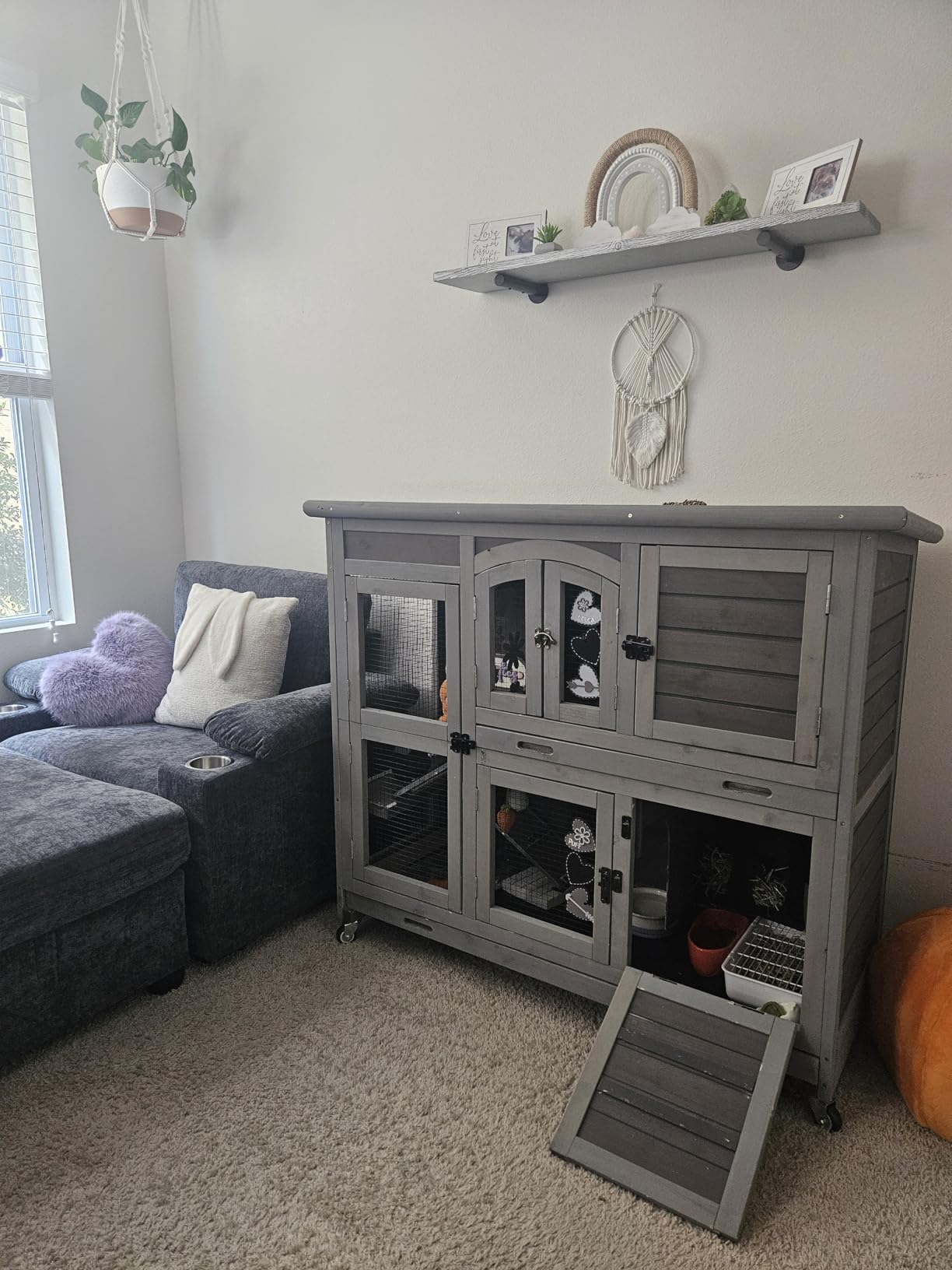
The upgrade version adds a metal wire grate above the bottom tray, and that single change is why this hutch appears on so many cleaning checklists. The rabbit stands on the grate rather than in the tray, so droppings fall through to the plastic pan below. Cleaning time drops noticeably, and the feet stay drier.
It is the tallest unit we tested at 44.2 inches, with two deep no-leak trays and four casters, two of which brake. The footprint is a compact 38.6 x 25.6 inches, so it fits tight side yards where the 114 inch model in spot one would not.
![Aivituvin [Upgrade Version] Rabbit Hutch Bunny Hutch, Rabbit Cage with Two No Leak Trays, Indoor & Outdoor Waterproof Cage for Bunny, Upgraded Bottom Wire Netting,Grey,Large, Camel customer photo 1](https://beatcopgame.com/wp-content/uploads/2026/10/B07QFVT3GV_customer_1.jpg)
Two levels with a ramp give you a real indoor retreat and a run area without needing a separate pen, and the listing specifies no weight limit for one or two rabbits. A metal feeder and a chew toy are included, which is a small but genuinely useful saving when you are setting the hutch up outside.
That said, the grate is wire, so we would cover it with a solid mat or a piece of hessian if the rabbit is prone to sore hocks. The grate sits above a solid tray, not instead of one, which is why it works far better than a full wire floor.
![Aivituvin [Upgrade Version] Rabbit Hutch Bunny Hutch, Rabbit Cage with Two No Leak Trays, Indoor & Outdoor Waterproof Cage for Bunny, Upgraded Bottom Wire Netting,Grey,Large, Camel customer photo 2](https://beatcopgame.com/wp-content/uploads/2026/10/B07QFVT3GV_customer_2.jpg)
Who this hutch suits
This suits a bonded pair in a smaller garden, or a household with one rabbit where the second level doubles as a separate feeding space. It is a good pick if your top priority is a clean hutch with minimal daily hands-on time, because the grate does most of the work for you.
It also works for anyone keeping guinea pigs alongside, since the footprint is small enough to fit under a shelter and the trays are deep. The casters let you rotate it toward morning sun and away from midday heat.
Where it falls short
The pine is lightweight and buyers report it is easy to chew and slow to dry after rain, so it is a fair-weather structure compared with a hardwood model. The top door hinges can tear out of the door over time, and there is no latch on the internal divider door, which limits its usefulness for separating animals.
Assembly is the other friction point. Owners report incomplete instructions and panels that look wrong until you realise they can be fitted in more than one order. Budget an hour and check the diagram twice. At 52 lb it is also the heaviest unit here alongside the aluminum-framed model in spot twelve.
4. GUTINNEEN Three-Tray Rolling Hutch with Open Run Roof
Bunny Cage Indoor and Outdoor Rabbit Hutch with Casters Waterproof Roof, Pull Out Tray from Back and Front 61.2″ L x 22.6″ W x 33.5″ H
61.2 x 22.6 x 33.5 in
Weighs 49.5 lb
Three deep removable trays
Six wheels
Pros
- Trays slide out from front and back
- Wheels make relocation simple
- Multiple doors plus top access
- Sturdy panels with aligned holes
Cons
- Thin mesh sides chew and bend
- Slippery ramp needs traction
- No mesh beneath the removable drawers
This is the hutch to buy if shade rotation is your biggest daily problem. At 61.2 x 22.6 x 33.5 inches and 49.5 lb, it carries the same generous two-level footprint as the Aivituvin in spot two, with six wheels for moving between house and garden.
What earns it a place in our top three is the combination of wheels, a large openable run roof and big front doors. Between them you can roll the unit into shade and still get in to handle the rabbit without dismantling anything, which is a routine that saves a lot of chasing.
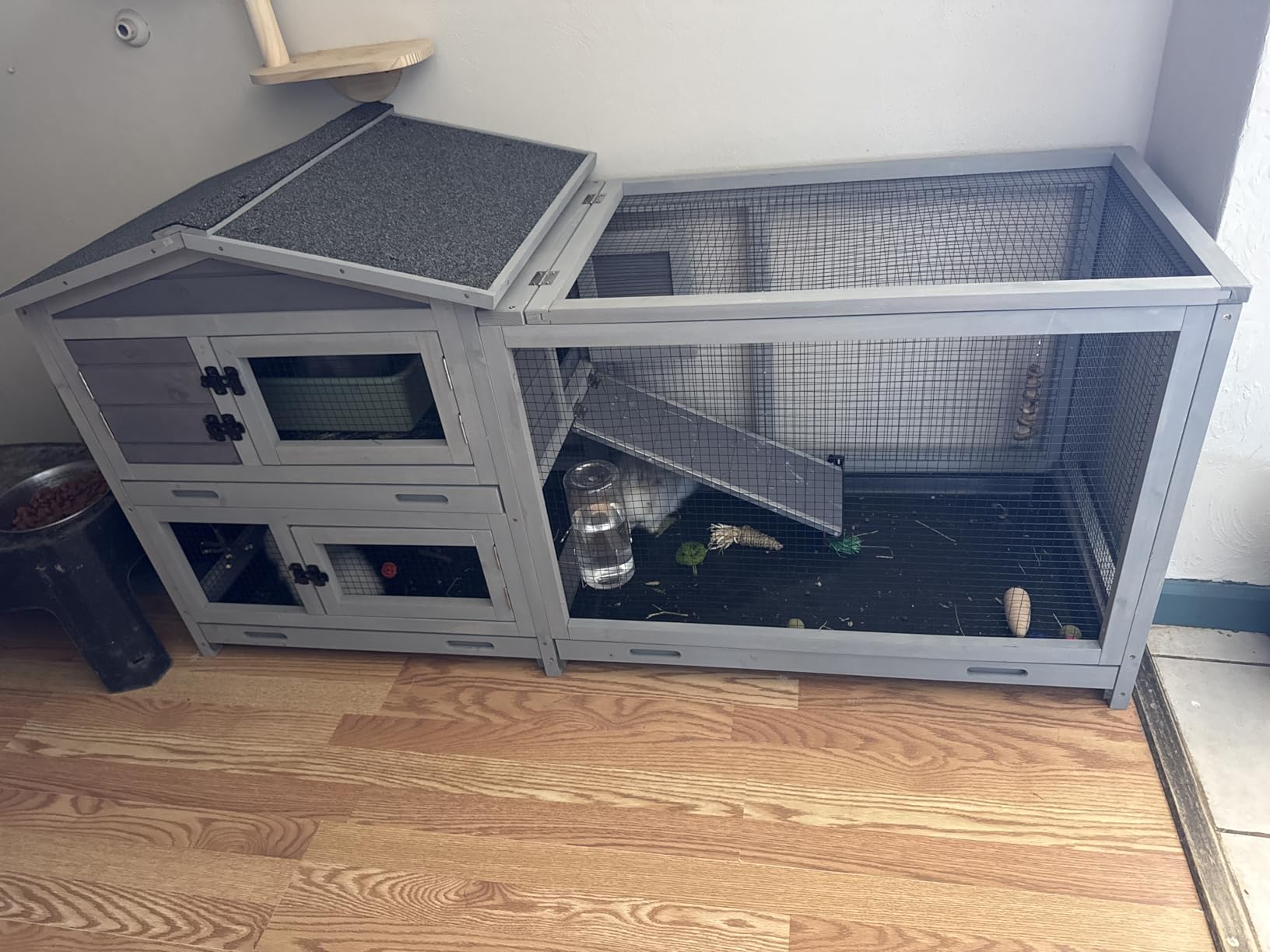
The three deep trays pull out from either the front or the back, which means you can empty whichever side is most accessible from where you are standing. Buyers consistently rate the panels as sturdy with holes and screws lining up correctly, and assembly reflects that better-made fit.
The waterproof asphalt roof suits indoor and outdoor placement equally, and the unit is listed for one or two rabbits with no weight limit. For a rabbit housed outdoors full-time, the roof is what decides how many days a year you can leave them out in the rain.
Who this hutch suits
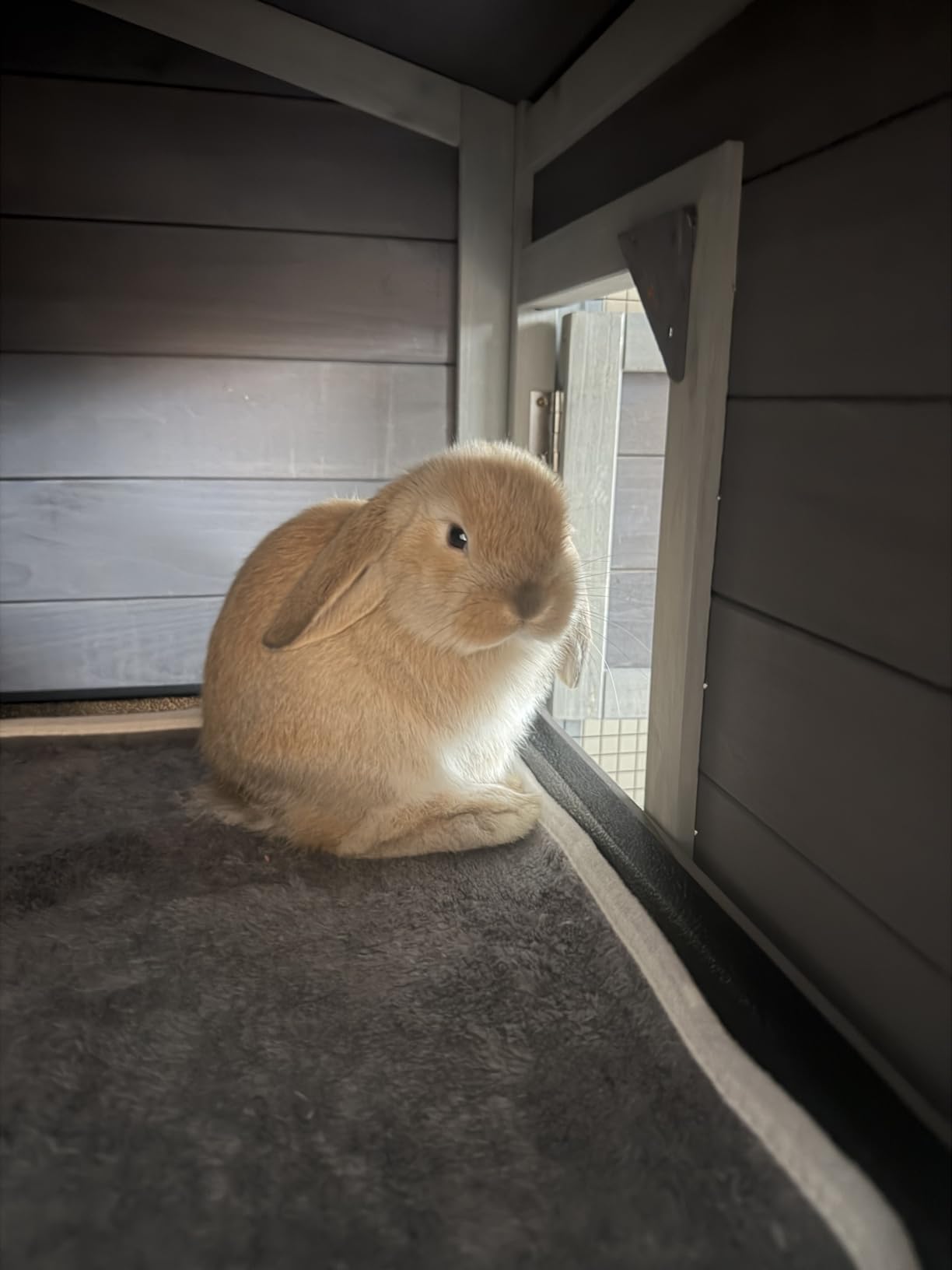
It suits owners in hot summers who need to move shade around and owners who want a supervised setup near a door or window. Two rabbits fit comfortably, and the top access makes routine checks quick without opening the sleeping compartment and letting heat escape.
It is also a good choice for anyone starting with one rabbit who may add a second later, since the run area and second level give you room to grow without an immediate upgrade.
Where it falls short
The mesh sides are thin and can be chewed or bent, and a determined rabbit plus a leaning fence panel is a realistic combination. Reinforce or line them if your rabbit is a chewer. The ramp is slippery, so add traction as with the other two-tray models.
Two smaller issues come up repeatedly: the pull-out drawers have no mesh beneath them, so a small animal can step out during cleaning, and the top lid can be blocked by the roof edge or sit unevenly on some units. Neither is dangerous, but both are annoying at 6am in the rain.
5. GUTINNEEN Two-Story Hutch with Chew-Proof Ramp
Gutinneen 2-Story Rabbit Hutch with Chew-Proof Ramp & Leak-Proof Trays – Indoor/Outdoor 39.3″ Wooden Rabbit Cage with Wheels for Rabbits, Guinea Pigs
39.3 x 22 x 36.8 in
Two locking leakproof trays
Four swivel casters
Five access doors
Pros
- Locking trays stay put when the rabbit jumps
- Metal-guarded ramp resists chewing
- Braked casters keep it stable
- Five doors reach every area
Cons
- Compact footprint is tight for larger rabbits
- Wood frame and mesh stay chewable
Two details put this compact hutch near the top of our list: a ramp reinforced with dual full-length metal guards, and pull-out trays that lock in place. Both solve problems the bigger three-tray models do not. A chewing rabbit cannot destroy the ramp, and a rabbit jumping in a tray cannot send the waste drawer sliding out across the lawn.
At 39.3 x 22 x 36.8 inches it is one of the smaller units here, which is why we rate it best for small breeds. A dwarf rabbit under 8 lb fits comfortably; a giant breed will outgrow the footprint in a matter of weeks, so measure your rabbit stretched out and multiply by four before you commit.
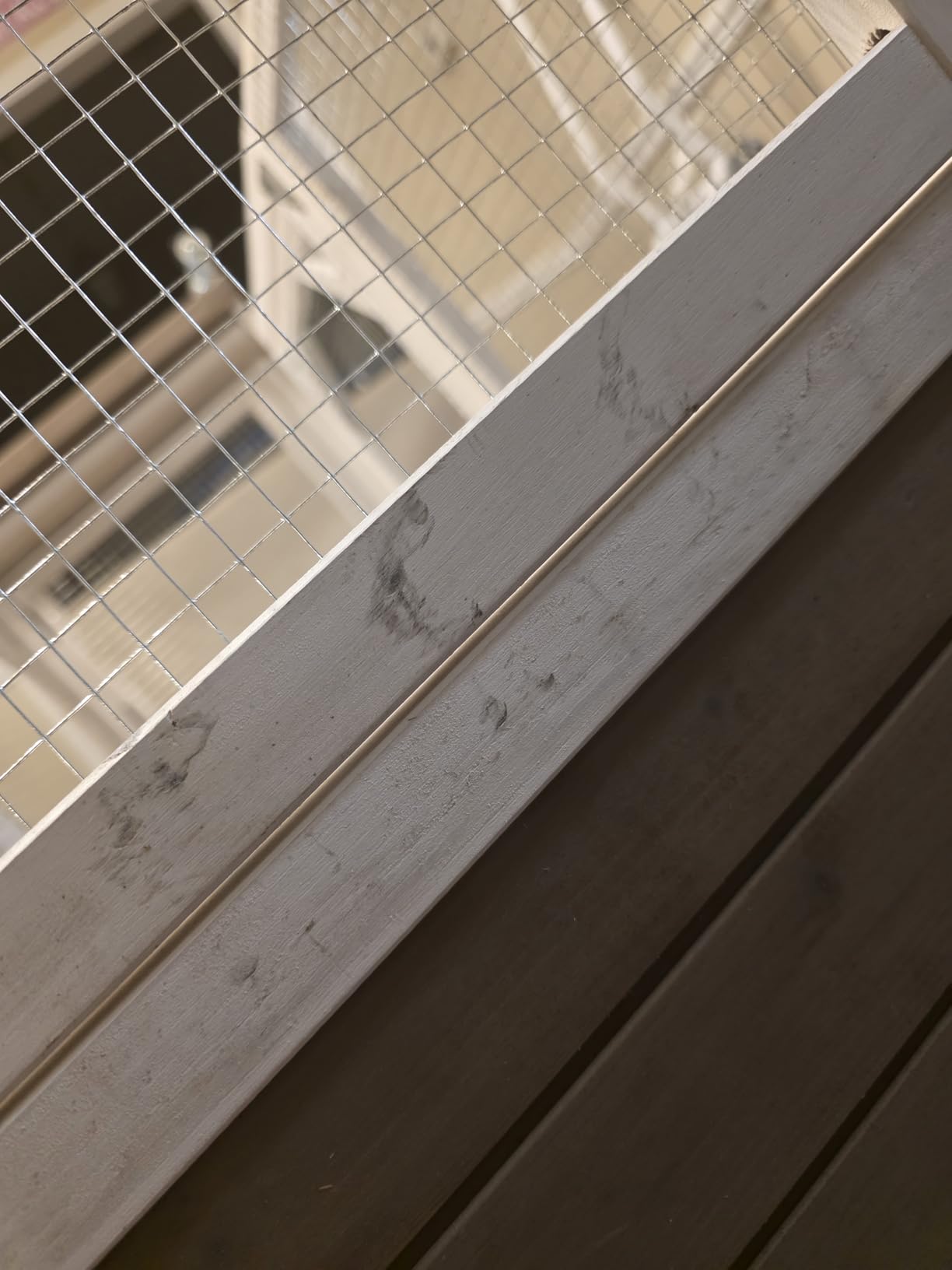
Four swivel casters, two with locks, mean you can reposition it for shade and keep it from rolling when the ground is uneven. Five access doors reach every area, so cleaning the corners of a run is one of the easier tasks in this roundup. The manufacturer states assembly in under 30 minutes thanks to pre-drilled holes.
The two-story layout gives a private upper sleeping area and a lower run level, which is good husbandry for rabbits, since they need somewhere to hide as well as somewhere to move. The textured, splinter-free ramp surface is a genuine improvement over bare timber, especially for a young or elderly rabbit.
Who this hutch suits
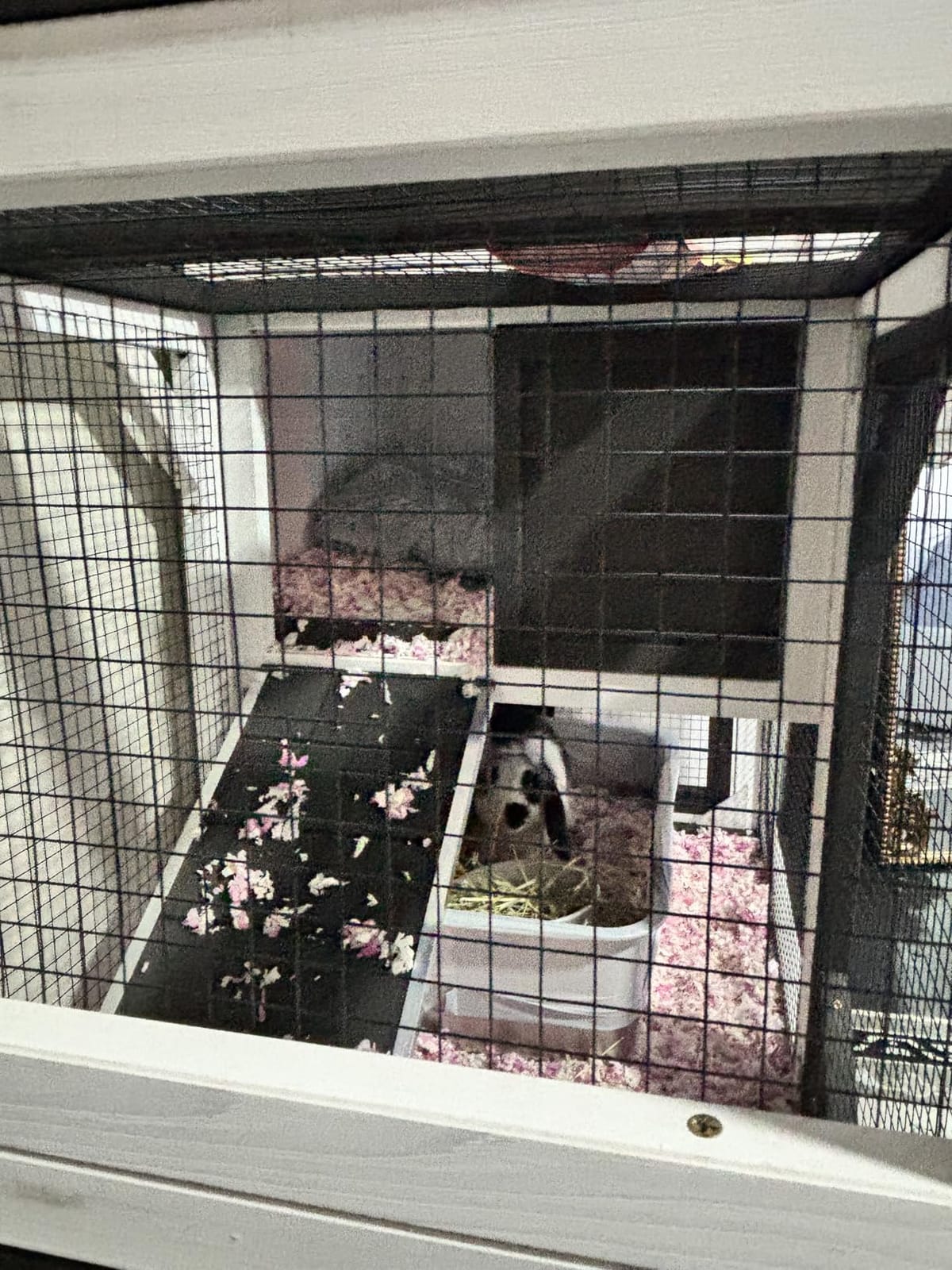
It suits dwarf and small breeds in a compact garden, and any household with a rabbit that chews everything in sight. The metal-guarded ramp is the single feature we would most want in a hutch shared by a rabbit and a guinea pig, because the ramp is usually the first thing to be destroyed.
The locking trays also make it a good choice for anyone who cleans in the evening and does not want a drawer sliding out on a slope. Braked casters add the same benefit.
Where it falls short
Size is the honest limitation. A 22 inch depth across two levels suits small rabbits and guinea pigs well, but a large or giant breed will feel cramped, and a cramped rabbit chews. If you already have a big rabbit, skip this and spend the difference on floor area.
Also note the wood frame and wire mesh remain chewable even with the improved ramp, so this is a rabbit-proofing upgrade rather than a rabbit-proof hutch. Weight is not listed for this model, so treat it as a two-person move and check the manual before dragging it across soft ground.
6. TRIXIE Natura Two-Story Outdoor Hutch
TRIXIE natura Outdoor Rabbit Hutch with Run – 2-Story Rabbit Cage with Non-Slip Ramp – Medium Elevated Small Animal House with Secure Playpen, Hinged Roof & Pull-Out Tray – in Brown
40.75 x 38 x 20.5 in
Glazed pine, four doors
Two levels with divider
One-year manufacturer warranty
Pros
- Elevated design with a secure playpen run
- Hinged roof and pull-out tray simplify cleaning
- Weather-resistant coated pine
- Non-slip ramp and bedtime hatch
Cons
- Mid-sized interior is tight for larger breeds
- Pine is chewable and will eventually need replacing
The TRIXIE Natura is the most traditional hutch in this group, and that is not a criticism. It is an elevated two-story design with a secure playpen run, a non-slip ramp connecting the levels, a bedtime hatch door and a divider, which makes it a genuinely workable shelter for a small rabbit in a small space.
At 40.75 x 38 x 20.5 inches the footprint is nearly square rather than long and narrow. That shape works well in a corner or against a fence, and the elevated structure keeps the sleeping area off cold wet ground, which helps more in winter than most buyers expect.
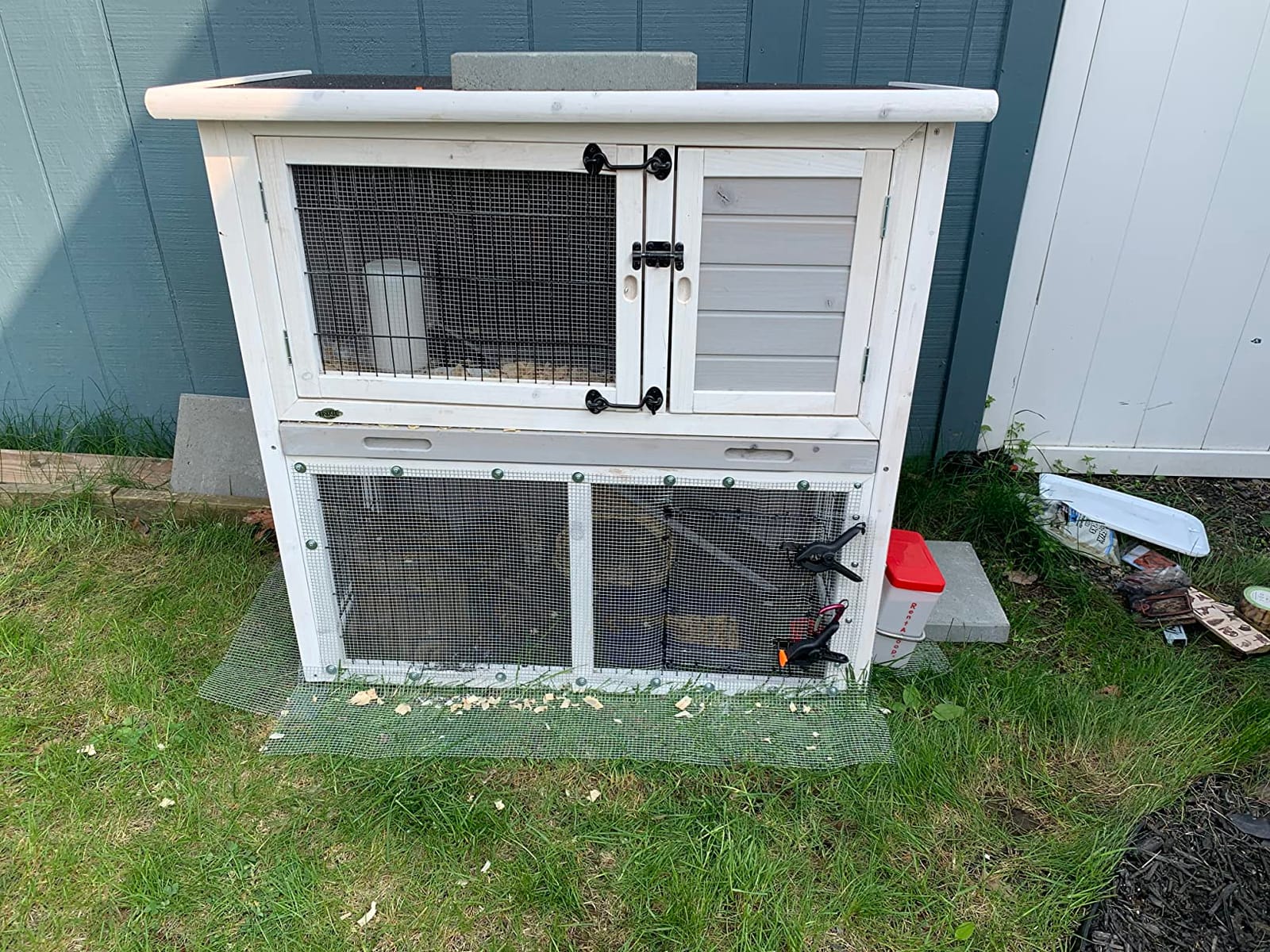
The hinged roof and pull-out removable tray are what we like most. A full top-open means you can clean every surface without crawling around the outside, and the tray comes out from beneath rather than being a fixed floor you have to reach under.
Four doors and a weather-resistant finish on the pine make it a realistic outdoor shelter rather than an indoor cage pushed outside. The one-year manufacturer warranty is standard for the category, so treat it as a seasonal-maintenance product rather than a lifetime build.
Who this hutch suits
It suits owners of a single dwarf or small-medium rabbit in a compact yard, especially where a long hutch would not fit. The playpen run gives usable outside space in a small footprint, and the elevated design suits owners who want the sleeping area lifted away from splash and damp.
It is also a good starter hutch for a first-time owner, because the hinged roof makes it obvious how to clean and the divider and hatch give a beginner sensible containment options. A hutch cover is the one extra we would add straight away.
Where it falls short
The interior is tight for anything above a small breed, and pine is chewable. This is a wooden hutch that will need attention over the years, and owners who have bought cheap pine hutches report warping and leaking after a few wet seasons. Re-treat or repaint annually and store it under cover in the worst months.
At 20.5 inches tall the upper level limits headroom for a rabbit standing on its hind legs, which is part of the sizing rule we use through this guide. If your rabbit stretches high, check the standing height before buying, and plan on pairing this with a larger exercise pen regardless.
7. GOOD LIFE USA 62 Inch Fir Wood Hutch
GDLF 62″ Rabbit Hutch, Bunny Hutch Indoor Outdoor with Ramp, Cleaning Tray
62 x 21 x 37 in
Weighs 49.7 lb
Upper house 27.5 x 18 x 20.5 in
Natural fir with varnish
Pros
- Highest average rating in this roundup
- Solid floor sheet rather than wire
- Sturdy build with latches that hold
- Easy kit-furniture level assembly
Cons
- Smaller than expected for full-size rabbits
- Uninsulated
- Textured trays are harder to wash
This hutch has the highest average rating of the 12 we compared, at 4.4 out of 5 across 796 reviews. The reason is not a single feature but a set of sensible ones: premium natural fir wood, a non-toxic waterproof varnish, a solid floor sheet instead of wire, and a pitched roof so the rabbit can stay out in the rain.
The solid floor matters more than most spec lists admit. Bare wire floors are the cause of most sore-hock complaints we see, and a solid sheet with a removable sliding tray underneath gives you a cleanable surface without the pressure points. Grid fences provide ventilation and predator control at the same time.
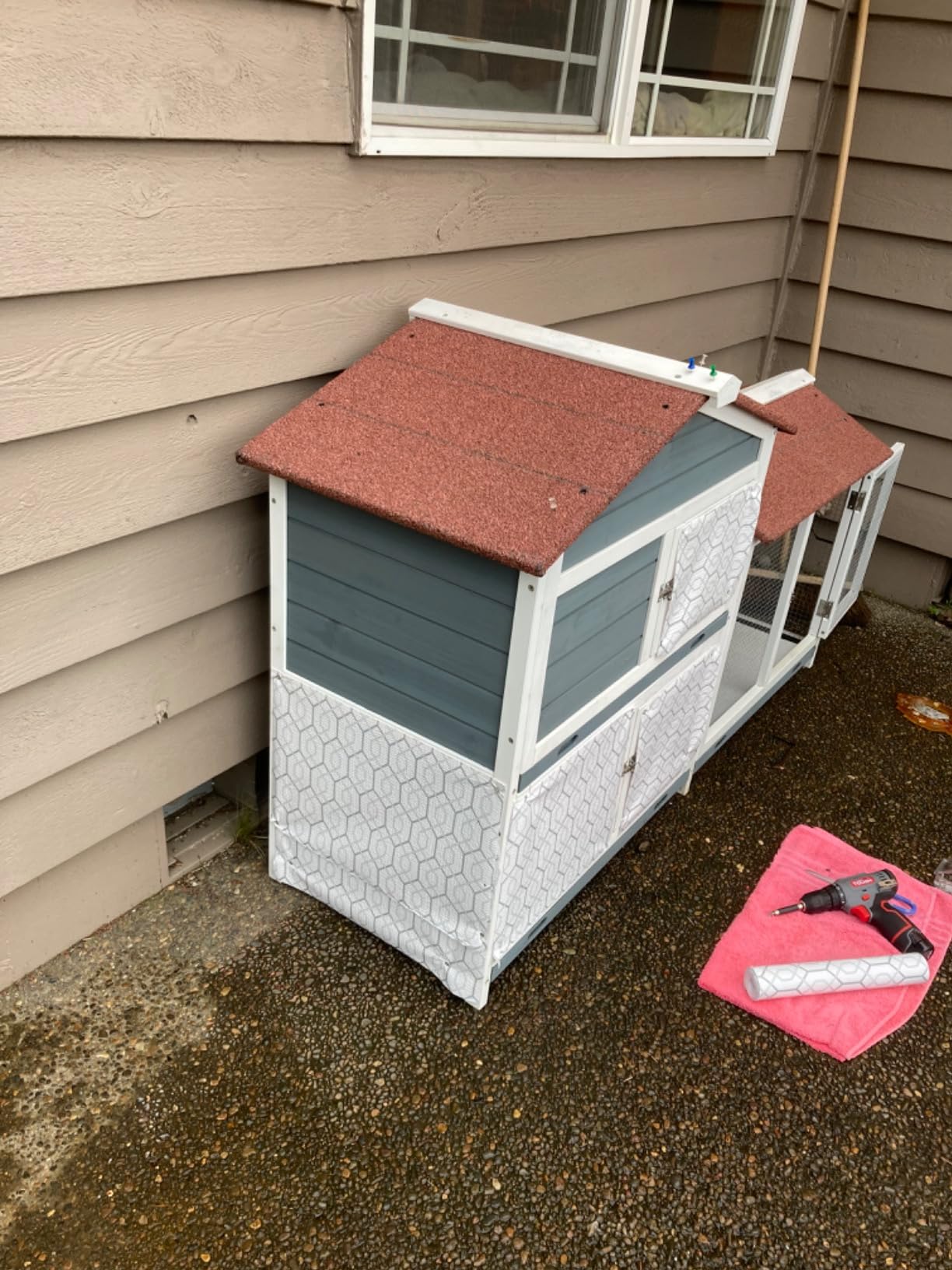
At 62 x 21 x 37 inches overall, with an upper house of 27.5 x 18 x 20.5 inches, it is listed for two to three rabbits or three to four guinea pigs. In practice, most owners report it feels smaller than expected for a full-size adult rabbit, so treat the stated capacity as optimistic and pair it with a run.
Assembly is the part owners mention most warmly. It is a kit-furniture level build, the sliding door has a ramp with timber ridges to prevent slipping, and the removable bottom sliding tray means you never have to move the animal to clean underneath.
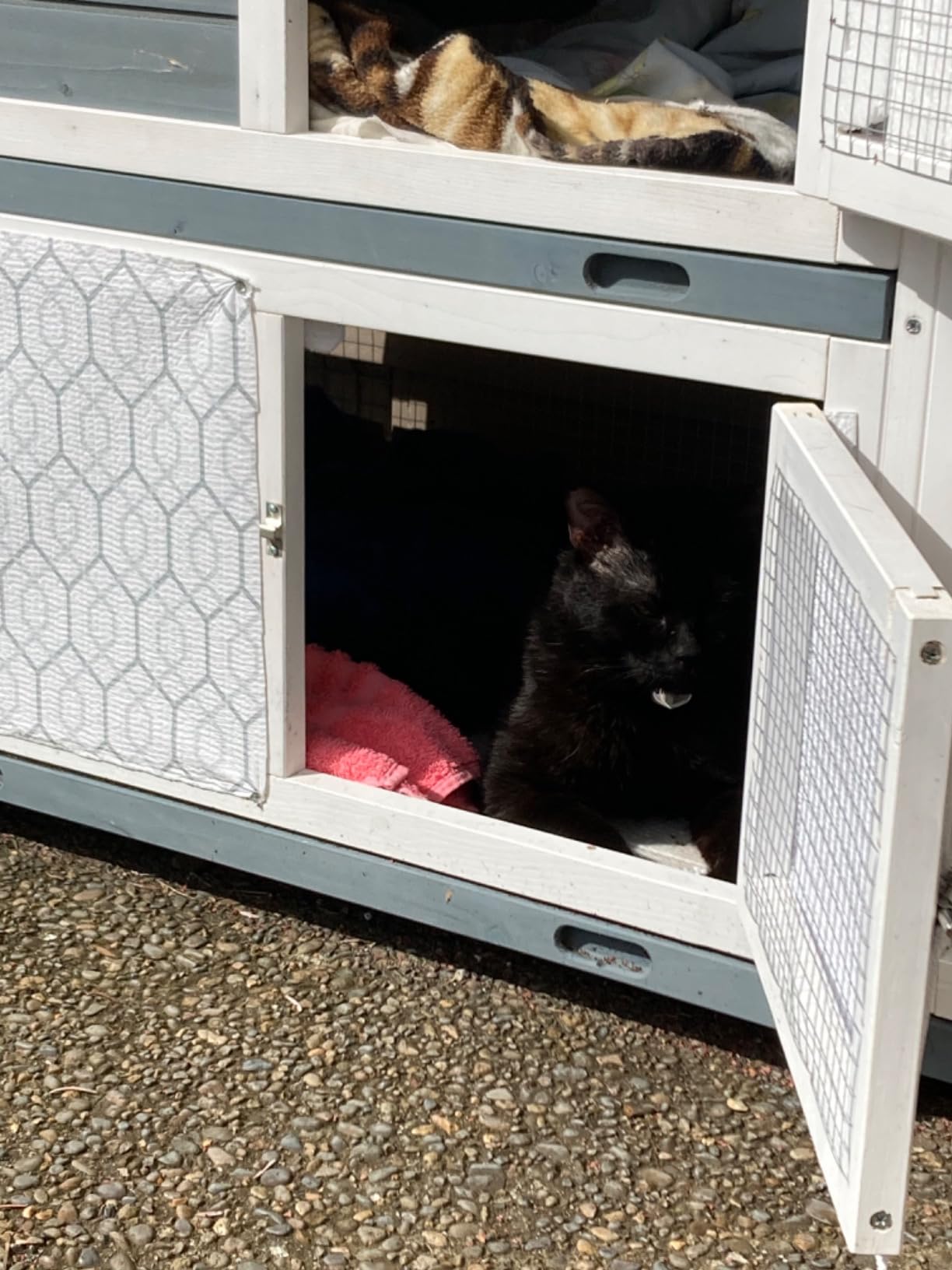
Who this hutch suits
It suits owners who want a traditional wooden hutch that looks like part of the garden rather than a plastic-and-mesh structure, and who are confident on a screwdriver. Fir with a waterproof varnish holds up better outdoors than raw pine, and the pitched roof sheds water to the sides rather than dripping onto the entrance.
It is also a good choice for a first outdoor season, because the solid floor and deep sliding tray reduce the two most common beginner mistakes, which are wire floors and cleaning by displacement.
Where it falls short
There is no insulation, and owners are clear that this offers limited protection from weather extremes or large predators. A hutch cover is not optional if you use this outdoors through winter, and you will still need a proper exercise run attached.
Two smaller complaints: the textured plastic trays are harder to clean than smooth ones, and the wire and roofing felt are described as flimsy and prone to shedding grit during and after assembly. Instructions are pictures only, so set the parts out on the lawn before you start.
8. Rockever Wooden Floorless Grazing Hutch and Run
Wooden Rabbit Cage Outdoor Indoor, Bunny Cage Guinea Pig Cages Enclosure
Outer 49 x 36 x 14 in
13 x 36 x 14 in grate space
Weighs 32 lb
Plated wire with heavy-duty lock
Pros
- Floorless run lets rabbits graze fresh grass
- Plated wire gives excellent ventilation and visibility
- Removable floor panel for quick cleaning
- Assembles with a screwdriver only
Cons
- Floorless run depends on the ground beneath it
- Low profile means less sheltered space
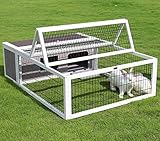
This is the only hutch in the roundup with a genuinely floorless run, and that single design choice makes it different from everything else here. The run sits directly on the ground so the rabbit can graze fresh grass and forage, which is behaviour no raised hutch can offer.
The outer dimensions are approximately 49 x 36 x 14 inches with a 13 x 36 x 14 inch enclosed grate area for shelter. The hutch end has a removable bottom floor panel, so the sleeping space is cleanable and solid while the run side stays open to the ground.
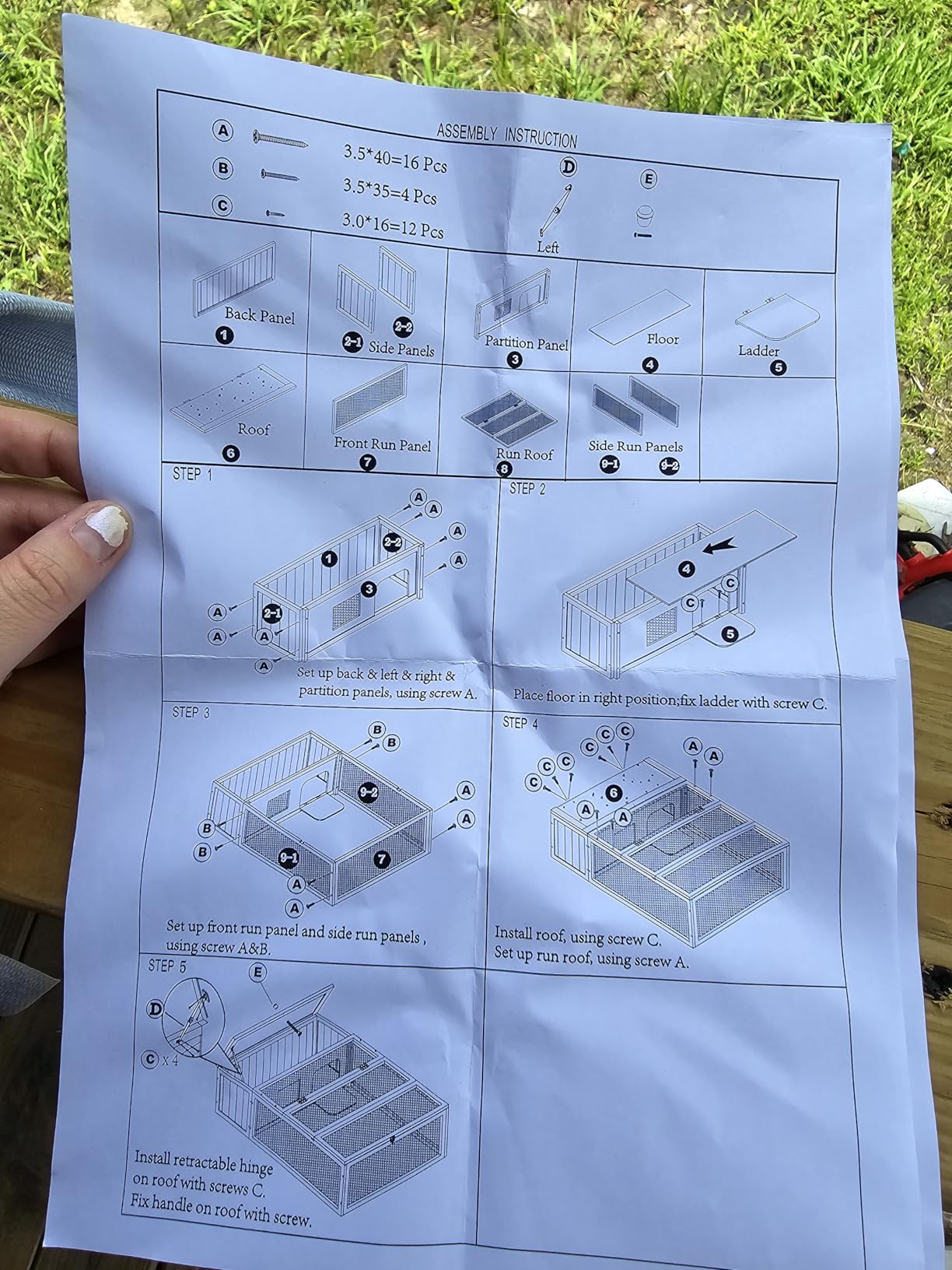
Plated wire construction gives outstanding ventilation and clear visibility, so you can check on the rabbit without being seen, which reduces stress. There is a nesting box, a sunny run section, and a heavy-duty lock on the access door, which is a better security standard than the simple clips on budget pens.
Assembly needs only a screwdriver, and the pre-drilled holes come with aligned hardware, so it is one of the quicker builds in this list. At 32 lb it is also light enough to reposition alone as the seasons change.
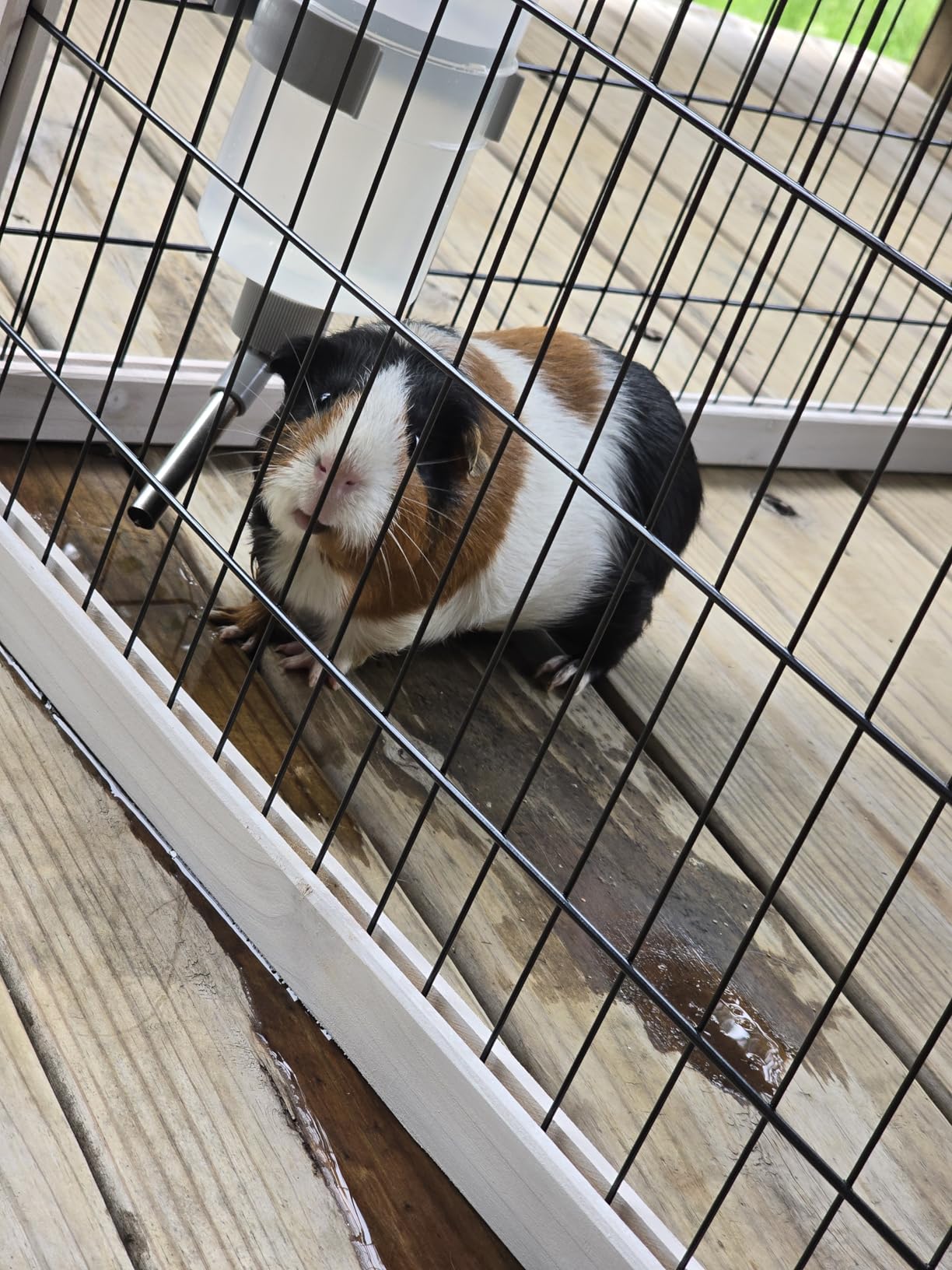
Who this hutch suits
It suits owners with a healthy lawn who want the rabbit to forage rather than sit on a plastic tray, and anyone who values visibility and airflow over maximum shelter space. The removable floor panel means the messy end is still manageable.
It is also a good fit for mobile rabbit setups. Light enough to move, weatherproof as listed, and a natural fit for rotating between two patches of grass to stop the rabbit stripping one area bare.
Where it falls short
The floorless design makes the ground surface underneath a decision you have to make, and not every surface is kind to rabbit feet. Forum owners are consistent on this: rubber stable matting laid over ground is the safer option, while gravel is unsuitable and paving slabs are only acceptable for breeds not prone to sore hocks.
Second, at 14 inches tall the profile is low, so sheltered living space is limited compared with two-level hutches. A rabbit kept in this long-term still needs a proper attached run or a separate exercise pen, and something taller and more enclosed to hide in.
9. PawHut A-Frame Outdoor Rabbit Hutch
PawHut 46″ x 24″ Wooden A-Frame Outdoor Rabbit Hutch, Small Animal Cage, Bunny Hutch with Outside Run & Ventilating Wire, Yellow
45.75 x 24.5 x 20.75 in
Weighs 19 lb
Plated iron wire walls
Two access doors
Pros
- Light enough for one person to move
- Screened walls give airflow and visibility
- Two doors simplify cleaning and access
- Reported to still be in good shape after three years
Cons
- Thin inexpensive wood can crack during assembly
- Latch hardware is loose out of the box
- Not waterproof and needs a cover
The PawHut A-frame is the lightest hutch we compared at 19 lb, and that changes how you use it. One person can carry it between a garage, a patio and the lawn, so it works as a supervised daytime pen that you bring out when the weather is good and bring in when it is not.
The A-frame footprint is 45.75 x 24.5 x 20.75 inches overall. Plated iron wire-style screened walls give plenty of ventilation and let you see the rabbit at all times, and two easy-to-open doors give access to the run and the inner loft separately.
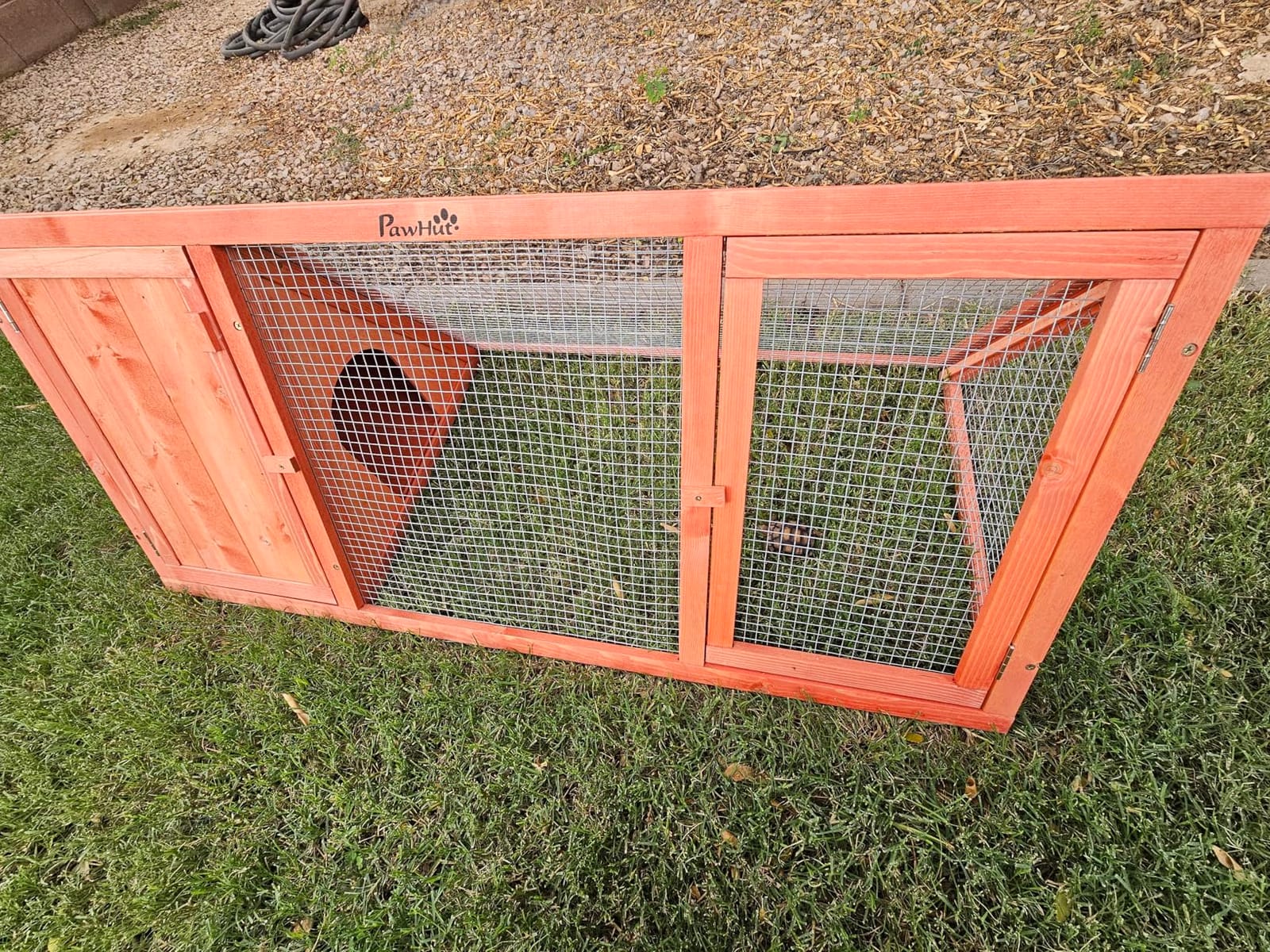
It is listed for outdoor use with an outdoor run plus an enclosed indoor sleeping space, which is the right architecture for a first rabbit. The enclosed loft is where the rabbit sleeps and hides, and the run area is where the exercise happens.
Owners report this hutch still in good shape after three years of use, which is a fair test of a budget design. It is the one model here that we would genuinely recommend for a starter setup, with the caveat that it is supervised housing rather than a permanent home.
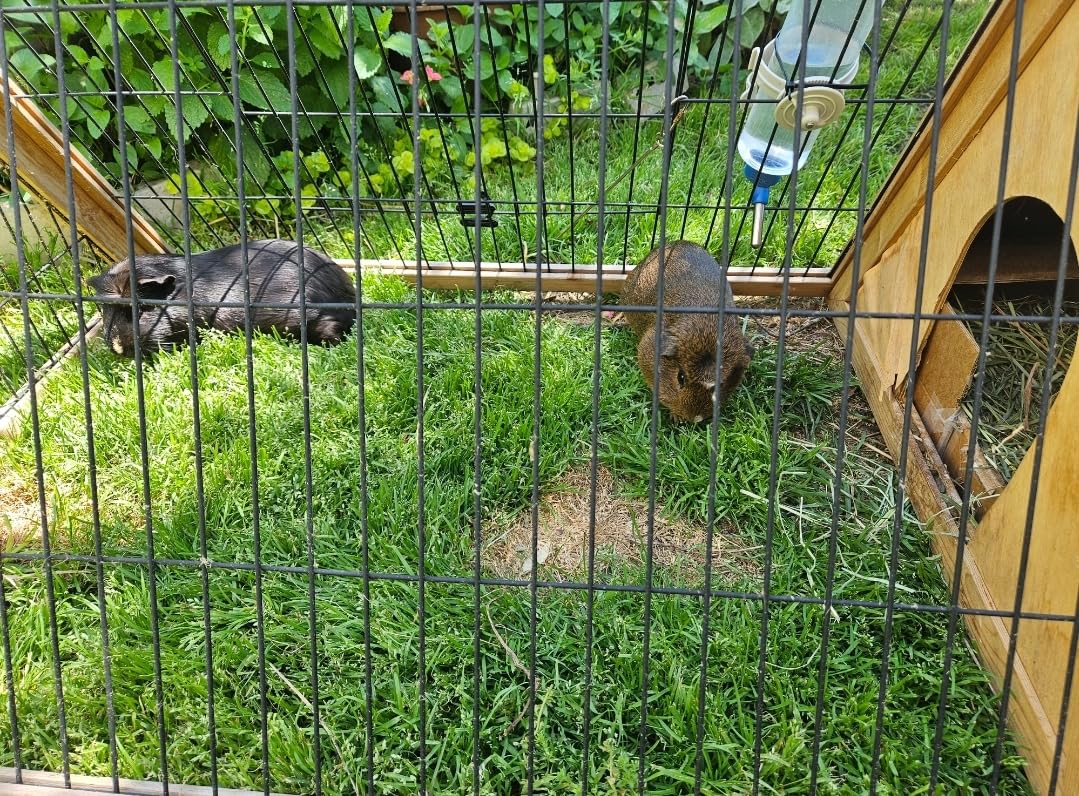
Who this hutch suits
It suits first-time owners and anyone whose rabbit spends supervised hours outside rather than living out full-time. Being 19 lb, it suits people who cannot safely lift a 50 lb timber hutch or who want to rotate the rabbit between grass patches and a garage.
It also suits owners on a tight budget who would rather spend the difference on a large exercise pen than on a bigger hutch. A modest hutch paired with a proper pen is a better welfare outcome than an expensive hutch with no run.
Where it falls short
It is not waterproof and needs a cover for permanent outdoor placement, so do not plan on it as a year-round shelter. The wood is thin and inexpensive, and owners report it cracking or splitting during assembly, so brace joints as you go rather than forcing panels.
Door latch hardware arrives loose and wiggly, there are gaps at the joints, and the instructions are weak. Replace the latches with predator-resistant hasps before the first night outside, and check the gaps for anything that could reach a rabbit head.
10. Mayugardening Two-Story Hutch on Six Locking Casters
2 Story Rabbit Hutch Outdoor Indoor, Wooden Bunny Cage with 6 Lockable Wheels, 3 Removable No Leakage Pull Out Trays, Chew-Proof Ramp & Waterproof Roof, Ideal for Rabbit & Guinea Pig
55.3 x 17.8 x 34.5 in
Weighs 38.6 lb
Three molded waterproof trays
Six locking casters
Pros
- One-piece molded trays wipe clean fast
- Metal-guarded ramp outlasts timber
- Six locking casters for relocation
- Asphalt roof over a waterproof frame
Cons
- Lowest average rating in this group
- Narrow 17.8 inch depth limits floor space per level
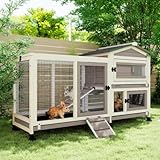
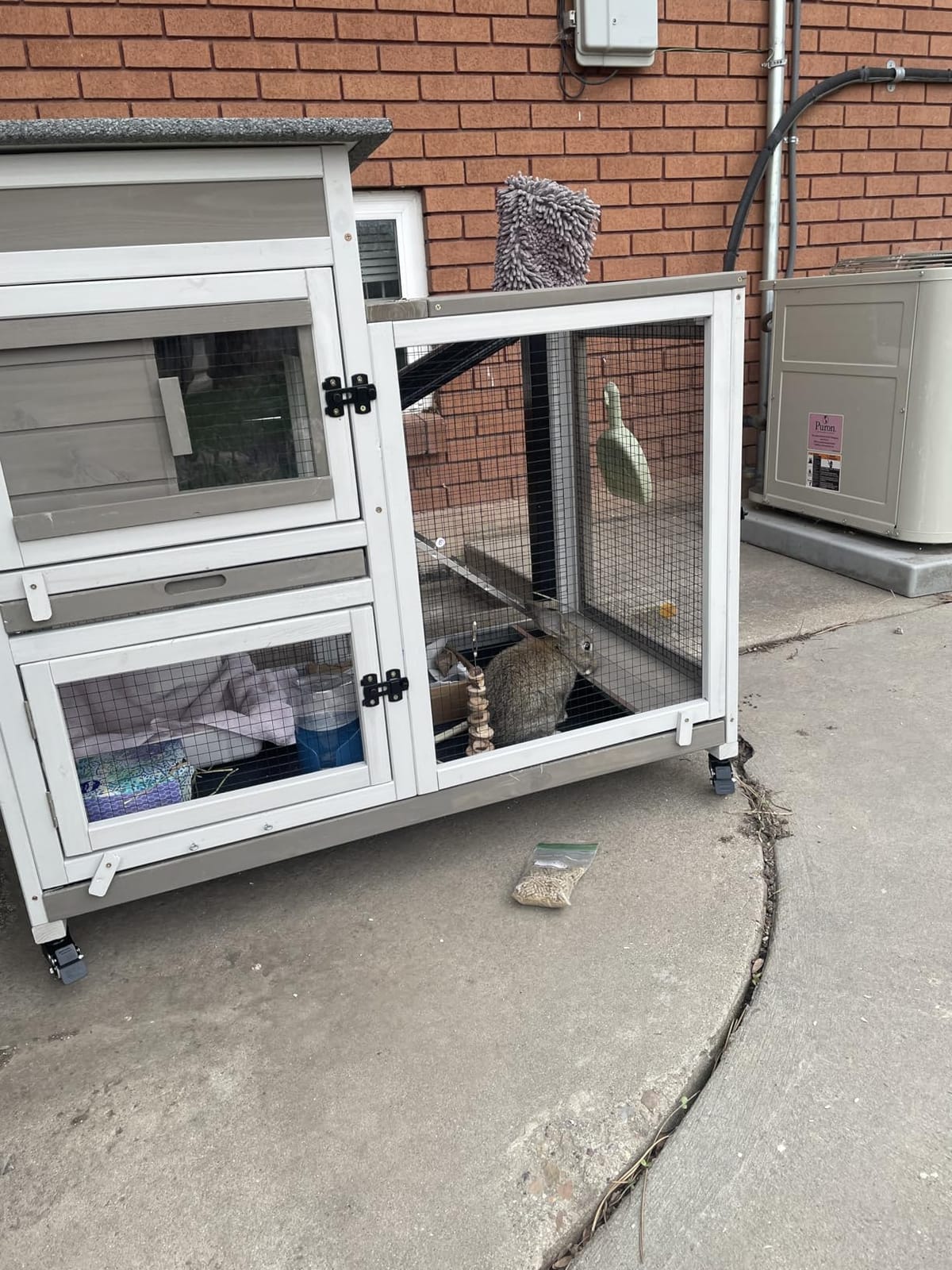
This hutch is the narrowest unit we tested at 17.8 inches deep, which makes it the right pick if your outdoor space is a side passage rather than an open garden. Six locking casters let you move it precisely, which matters when the footprint is tight and shade has to come from a wall or fence.
The three seamless one-piece moulded waterproof pull-out trays are the standout. There are no seams for waste to sit in, so they wipe clean in seconds, which is a genuine improvement on the pan-and-grate designs that collect debris at the edges. The listing sizes it for one or two rabbits with no weight limit.
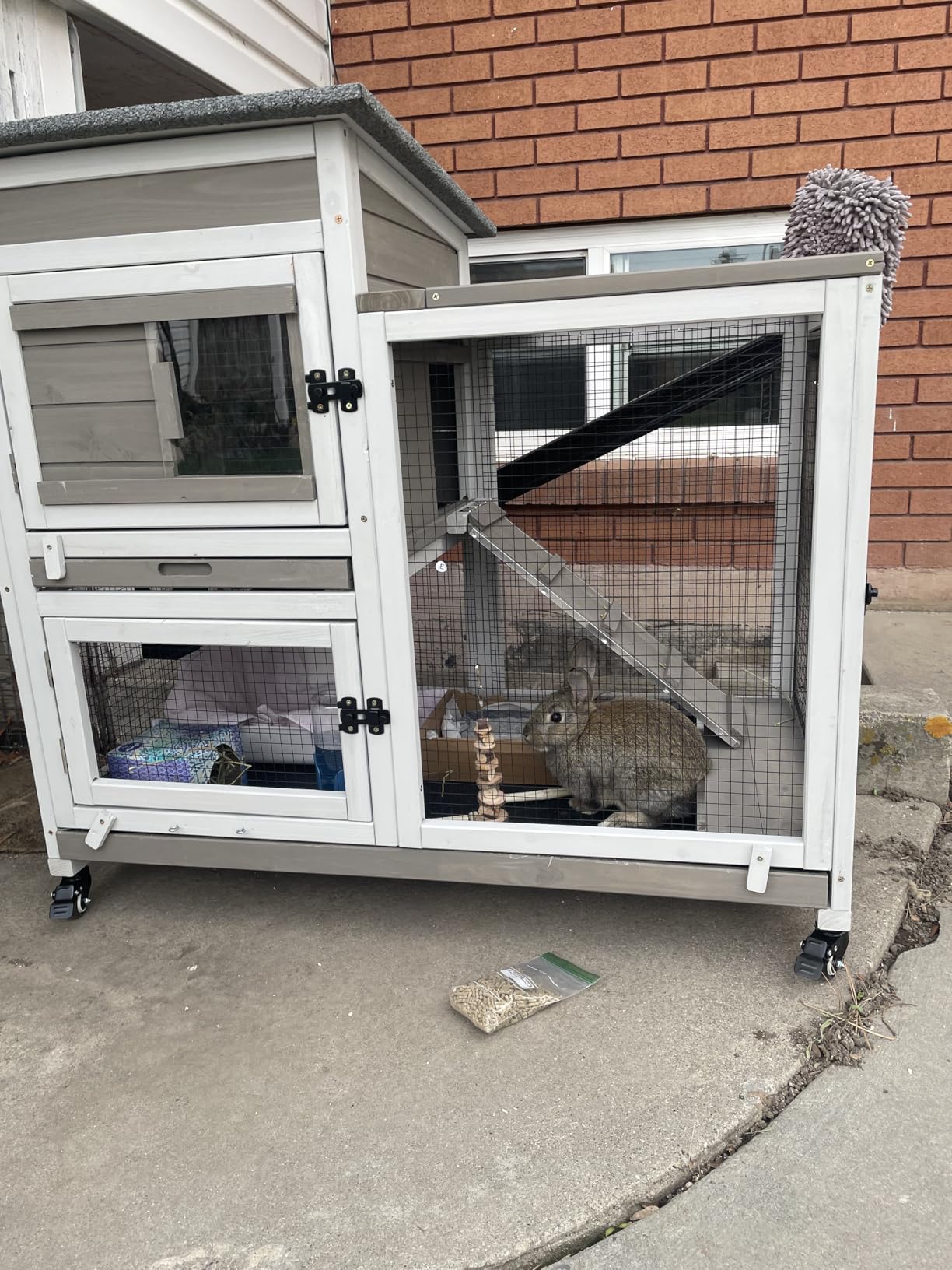
The ramp is reinforced with dual metal edge guards, so it is designed to outlast the standard wooden ramps that fail within a year of a determined rabbit. The asphalt-coated roof sits over a solid waterproof frame, which is a better construction detail than a roof laid straight onto timber.
At 38.6 lb it is lighter than most two-level hutches in this list, and the two-story design keeps the footprint narrow while preserving a hidden upper retreat. It is a newer listing, and the details are more considered than many of the older designs here.
Who this hutch suits
It suits owners with restricted space, particularly a narrow side yard, balcony-adjacent area or a passage beside a shed. If your available run is measured in feet rather than yards, this footprint is realistic where a 40 inch deep hutch would not fit.
The moulded trays also suit owners who have limited time for cleaning, since a wipe-down is the whole job. The locking casters help anyone who wants to bring the hutch into a porch or outbuilding overnight without asking for help.
Where it falls short
This is the lowest-rated product we included, at 3.9 out of 5 from 210 reviews, with a higher share of one-star feedback than the others. The rating is still a solid four, but the sample is small and newer than the rest, so long-term weather performance is not yet proven.
More practically, a 17.8 inch depth gives a rabbit little lateral room to turn or stretch on each level. That is fine for a dwarf rabbit and tight for anything larger, so measure your rabbit and check the three-hop length rule before buying. Build quality feedback is mixed, so inspect panels on arrival.
11. PawHut 62 Inch Hutch with Run Area
PawHut 62″ Rabbit Hutch with Run Area for Rabbits, Chickens, White
62 x 20.75 x 36.75 in
Weighs 44.1 lb
4 sq ft house plus 7 sq ft run
Solid fir wood
Pros
- Good balance of covered house and open run
- Solid fir wood with an asphalt roof
- Four doors and a pull-out tray
- Mesh wire for ventilation and predator control
Cons
- Narrow 20.75 inch width limits interior floor area
- Mesh wire sides and the ramp can be chewed
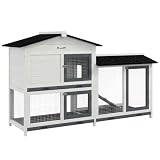
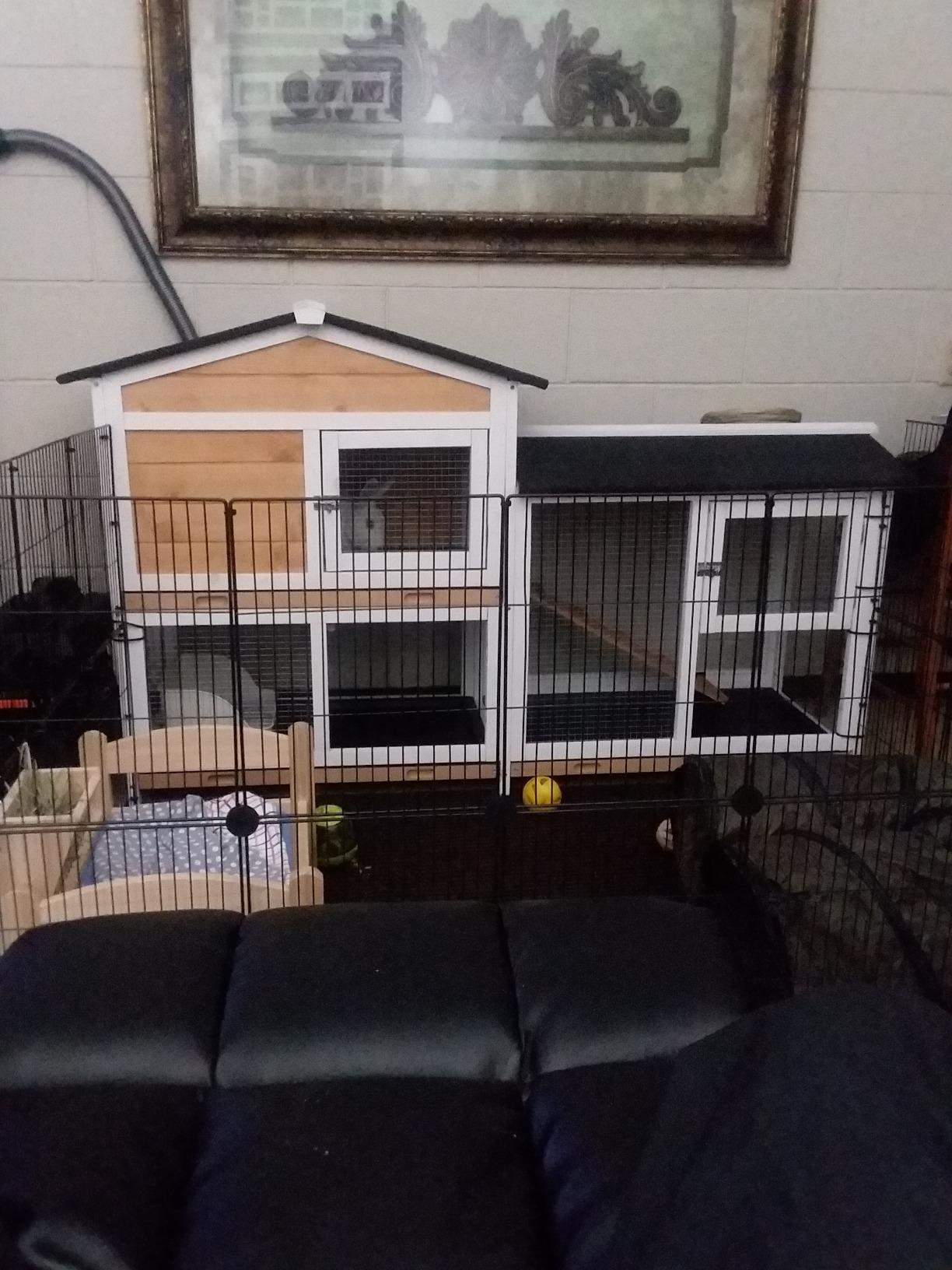
The PawHut 62 inch model is the most conventional hutch-and-run combination in this roundup: a 4 square foot covered house with a 7 square foot run, joined under a single roof. For an owner who wants one structure that does both jobs without a separate pen, this is the clearest expression of that idea.
The end-to-end asphalt roof covers both levels, not just the sleeping box, and that is the detail that separates it from cheaper designs. A solid roof over the run extends the number of days a rabbit can safely be outside in rain, which forum owners consistently describe as the single biggest quality-of-life improvement to outdoor housing.
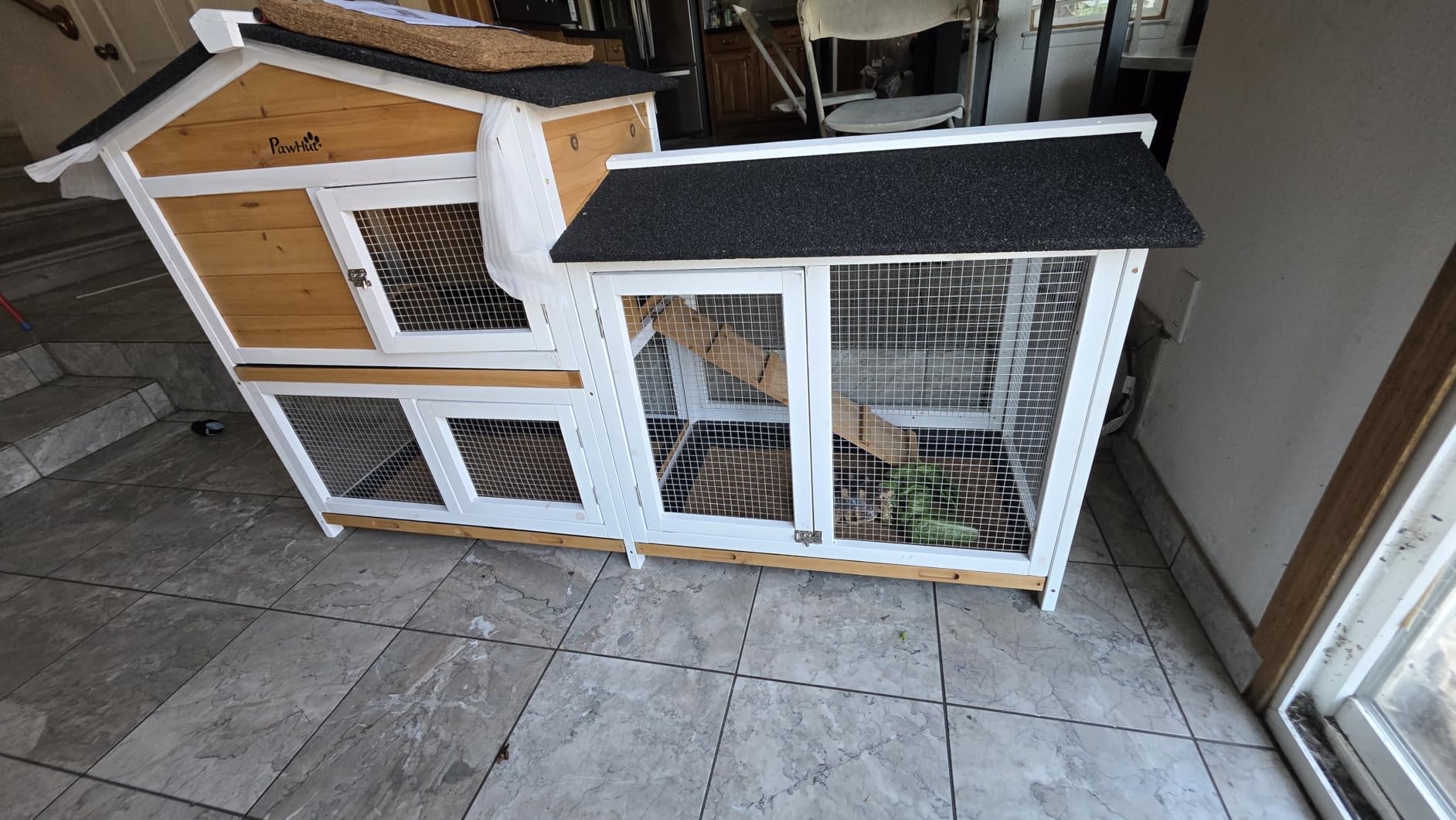
Construction is solid fir wood with mesh wire for ventilation and predator control, and a ramp connects the two levels. Four doors and a pull-out tray make cleaning and handling straightforward, and the covered house gives the rabbit a private, dark retreat as well as an open run.
Overall dimensions are 62 x 20.75 x 36.75 inches with a main house of 29.25 x 18 x 19.75 inches. At 44.1 lb this is a two-person build and move, so set the final position before you assemble it.
Who this hutch suits
It suits owners who want a single unit that gives the rabbit somewhere to hide and somewhere to move, without the complexity of a separate exercise pen. The split between a covered house and an open run also lets you close one side off in bad weather and keep the other accessible.
It is a good fit for a single rabbit or a small bonded pair, and for anyone who wants the visual of a traditional white garden hutch rather than a mesh-and-plastic structure.
Where it falls short
The 20.75 inch width is the constraint. Narrow width limits interior floor area, so even though the overall footprint is 62 inches, the usable width per level is modest. A large or giant breed will find the house tight, and you would still want a separate pen for daily exercise.
Buyers also report the mesh wire sides and the ramp can be chewed, which is a recurring theme across wooden hutches in this price band. Treat the timber edges and the ramp as the first places to inspect each month, and add guards if your rabbit is persistent.
12. GUTINNEEN 62 Inch Hutch with Aluminum Alloy Frame
GUTINNEEN 2-Story Rabbit Hutch with Chew-Proof Full Metal Frame for Indoor/Outdoor – 62″ Bunny Cage with 6 Locking Casters & 2 Pull-Out Trays for Rabbits, Guinea Pigs, Small Pets (Brown)
62 x 22.6 x 33.5 in
Weighs 55 lb
10.93 sq ft of living space
Three locking deep trays
Pros
- Aluminum frame resists chewing and warping
- Three locking deep trays contain waste
- Five doors plus an openable run roof
- Six swivel casters with two brakes
Cons
- Soft thin wood splits without pilot holes
- Thin side mesh can arrive damaged
- Asphalt roof flakes during assembly
If your rabbit chews, this is the hutch that answers the problem rather than hoping for the best. The frame is reinforced with aluminum alloy, which is the only genuinely chew-resistant construction in this roundup and the reason it takes our chew-resistance badge.
At 62 x 22.6 x 33.5 inches it provides 10.93 square feet of living space, the largest stated footprint here, and it carries three lockable deep pull-out trays. The locking design is the practical upgrade: trays stay in place when a rabbit jumps on them, and deep locking pans keep waste contained rather than spreading it around the base.
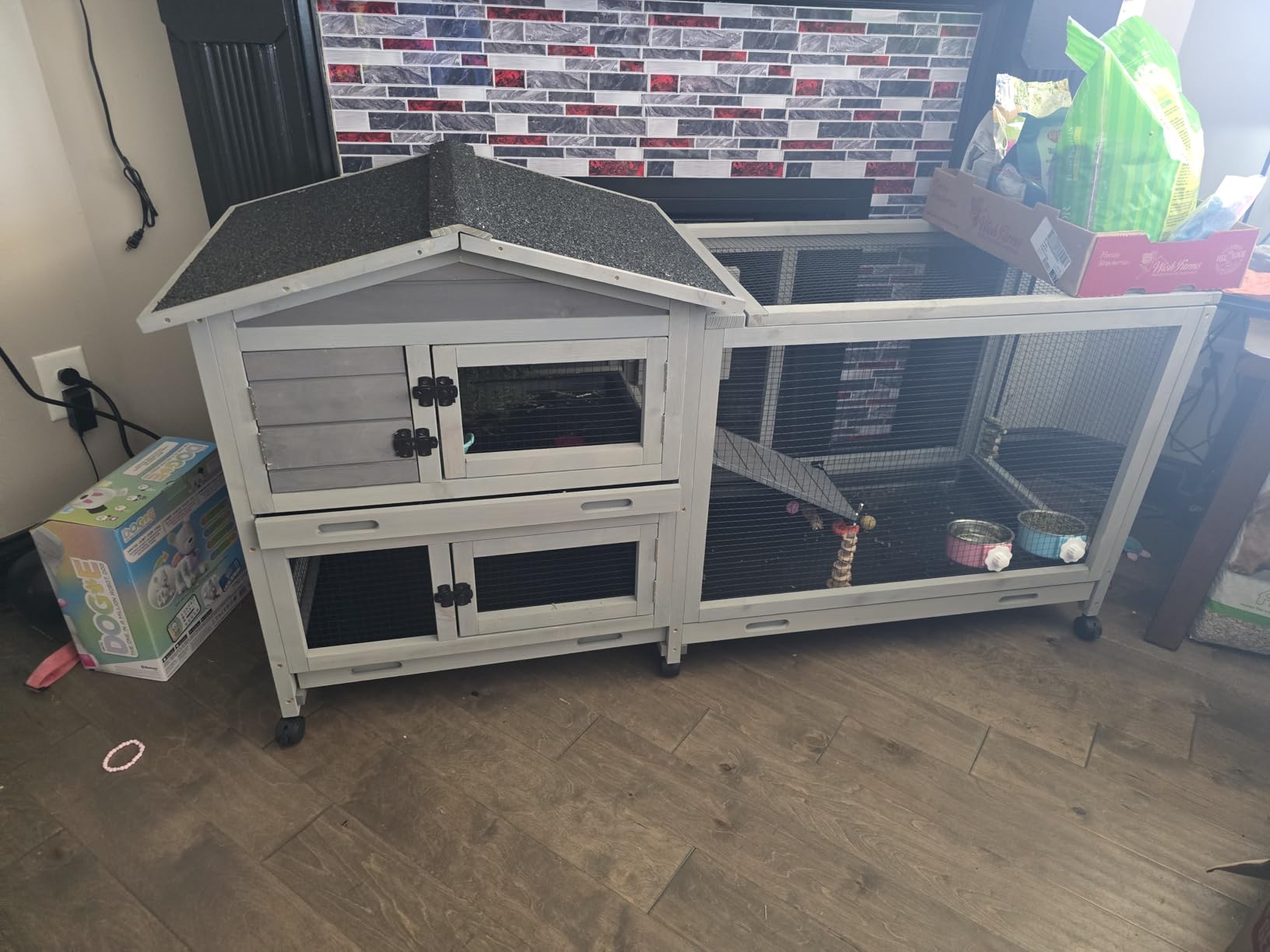
Five access doors plus an openable run roof mean you can reach every area for cleaning and can get a handle on the rabbit without dismantling anything. Six swivel casters, two with safety brakes, make it possible to move the whole unit between a patio and a backyard, though at 55 lb you will want two people.
Owners report the aluminum reinforcement is noticeably more resistant to chewing and warping than wood-only designs, and that the three deep locking trays simplify cleaning considerably. The combination of a large footprint and a fully openable roof is what makes this the most workable unit for daily hands-on care.
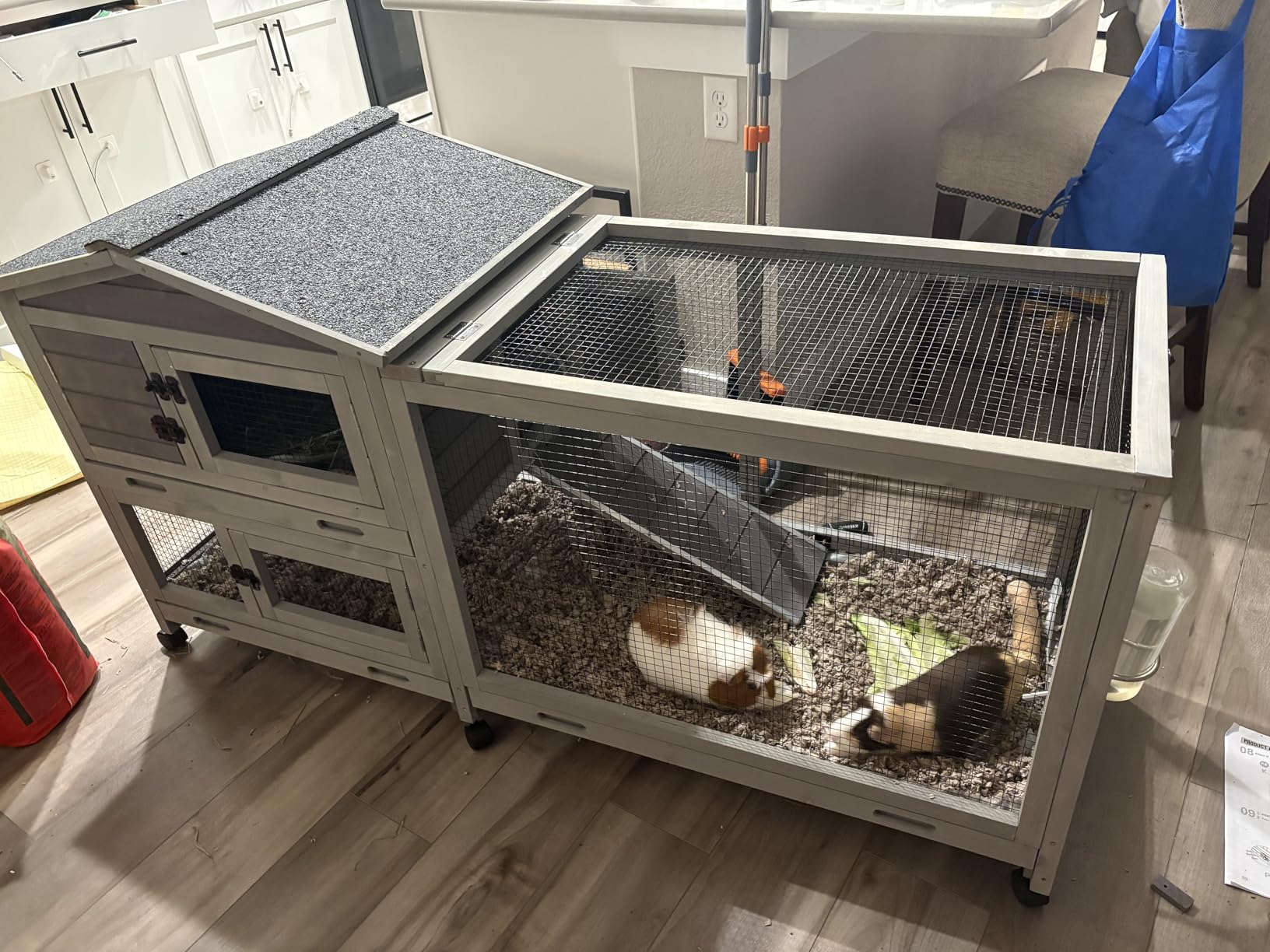
Who this hutch suits
It suits owners of a rabbit that chews everything, which is most rabbits left alone with a timber structure for long. It also suits anyone with two rabbits who needs the largest usable footprint available without building a custom shelter, and anyone who wants to move a hutch between spaces without taking it apart.
The 10.93 square feet of living space across two levels makes it a better candidate than most for housing a pair with a decent amount of floor area, and the openable run roof makes daily handling far less stressful.
Where it falls short
Assembly needs care. The wood is soft and thin and can split if screws are driven in without pilot holes, the side mesh is very thin and can arrive partially damaged, and the asphalt roof sheds flakes heavily during assembly, so lay down a sheet before you start and check the mesh on arrival.
The interior door does not stay open on its own, which is frustrating when you are cleaning. At 55 lb it is the heaviest hutch in this roundup, and 10.93 square feet of floor space still falls short of the 3m x 2m connected exercise standard, so plan a separate run or exercise pen on the grass.
How to Choose an Outdoor Rabbit Hutch in 2026
Pick the hutch last, after you have measured your rabbit and decided how much time it spends outside. The specifications that matter are floor area, roof coverage, lock type, floor material and how you will clean it, and everything else is preference.
Space requirements: the 3-hop and 4x rules
A sleeping compartment should be at least four times your rabbit’s stretched-out length, or 24 x 36 inches for rabbits under 8 lb and 30 x 36 inches above that. Then apply the three-hop test: the rabbit should be able to take three full hops along its length, and stretch upright on its hind legs without touching the roof.
For total outdoor space, welfare bodies ask for at least 3m x 2m of connected exercise area. The Rabbit Awareness Action Group reference set-up is a 6 x 2 x 2 ft hutch with a permanently attached 8 x 4 ft run, noting a 6 x 8 ft run is more practical. None of the 12 hutches here reaches that on its own, which is why we pair every recommendation with a run or exercise pen.
Bonded pairs are strongly preferred over single rabbits regardless of where they live, and that affects sizing directly. A divider panel in a two-level hutch is a useful tool for feeding separately, but it is not a substitute for housing the pair together for most of the day.
Materials and build quality
Wood species is the clearest quality signal. Cypress fir and natural fir, both used in this roundup, resist rot and hold a waterproof finish better than pine, which is chewable and slow to dry. Avoid MDF and particleboard entirely outdoors, since they swell and collapse when wet, and be wary of any hutch marketed for chickens that uses treated pine or chicken wire.
Check the hardware and finish next. Non-toxic waterproof varnish or stain, pre-drilled holes with aligned hardware, and a stated warranty all indicate a builder who expects outdoor use. One-year warranties are standard here; longer rot and insect warranties are rare and worth paying for if you can.
Predator protection
Locks are the first thing to check at night. A spring latch is better than a plain clip, and a predator-resistant padlock hasp is better than a spring latch. Anything a rabbit can lift with its teeth or push with its shoulder is not a lock, and no product on this list is a substitute for that upgrade.
Then look at the base. Raised structures reduce digging, but a raised hutch marketed as a hutch-and-run often has a gap underneath that is too low to be a real run, and it is a convenient tunnel for a fox or a dog. A wire apron laid flat on the ground and pegged down, extending 30 to 45 cm beyond the footprint, is the cheapest effective barrier and is not included with any of these products.
Finally, check the mesh gauge. Wire that a rabbit can press its head through will be pushed by a determined predator, and a rabbit that gets its head stuck is an emergency. Inspect every panel and any overhanging nest box, which owners on rabbit forums report being pushed up from below as an entry point.
Weather and temperature by climate
Rabbits do best kept between roughly 55-72 F with 30-70% humidity, and most commercially sold hutches fail to hold that band without help. In hot, humid climates, prioritise wide mesh ventilation, an openable run roof, casters for shade rotation and light-coloured timber. In cold, snowy climates, prioritise a pitched or asphalt roof, a raised base, a solid roof over the run, and a hutch cover you can fit on a cold night.
In mild maritime climates, ventilation and drying are the priorities, so a sloped roof that sheds water quickly beats a flat one. In high-wind areas, a low A-frame profile or a firmly anchored ground-level run is more stable than a tall two-level hutch on casters, and any casters should be locked or chocked.
A solid roof over the run, not just over the sleeping box, is the change owners report makes the biggest difference to how many days a year their rabbit can stay out. On a related note, providing shade and somewhere cool to lie matters as much as a water feature in hot weather; our guide to outdoor fountains covers options for animals that need constant drinking water.
Floors and trays
Avoid wire floors. They cause sore hocks, a painful condition affecting the heels of the feet, and the damage is slow to heal. A solid board or a mat is the right answer, and if you must use a grate, place a solid mat or hessian over it so the rabbit is not sitting on wire all day.
Trays matter almost as much. Deep pull-out trays that slide out from the front or the back let you clean without moving the rabbit, and a locking tray stops waste sliding out onto the lawn. A urine guard or a lip at the door edge reduces soaked bedding in rain, and a top-opening roof means you can reach every corner. For larger outdoor setups, a floor covering such as outdoor pet bedding keeps the tray surface dry between cleanings.
Hutch and run versus standalone hutch versus a shed
Decide how much space you can actually give the rabbit. A hutch with a permanently attached run, as in spots one, two and eleven, works well for two rabbits in a moderate climate. A standalone hutch plus a separate exercise pen on the grass is more flexible and easier to clean, and lets you move the rabbit to fresh ground daily.
A shed with an aviary is the other option, and forum owners cite a 7 x 5 ft shed with a 10 x 5 ft attached run as a workable three-rabbit setup. It costs more and takes longer to build, but it scales, it stays cool in summer and dry in winter, and it removes the constant question of whether the hutch is big enough. We think about that setup the same way we think about outdoor furniture layouts: the fixed structure is the least important part, the covered dry space is what matters.
Winterizing an outdoor hutch
Winter preparation is mostly about wind, damp and water. Add a hutch cover rated for the climate, double up the bedding, line the sleeping area with newspaper for extra warmth, and use a partial tarpaulin over the run rather than the whole unit, so the rabbit still gets fresh air. Provide a second water source, freeze water bottles for the rabbit to lie against, and check the temperature twice a day on the coldest nights.
Bring the hutch into a porch or garage if your climate regularly drops below freezing, or if snow and wind combine. Rabbits do not need to live outside to benefit from outdoor housing, and many welfare groups treat sheltering in extreme cold as the correct call rather than a failure. Reapply a non-toxic waterproof finish to timber each spring, which is the single cheapest way to extend the life of a wooden hutch.
Frequently Asked Questions
What is the 3-3-3 rule for rabbits?
The 3-3-3 rule is a loose guide used by some rabbit owners, not an official welfare standard. It means three hours of exercise outside the hutch, three hours of unrestricted roaming inside the home, and three days a week of having the run extended or moved to fresh ground. Official guidance from the Rabbit Awareness Action Group and PDSA focuses on enclosure size instead: at least 3m x 2m of connected exercise space, plus a sleeping area of at least four times the rabbit’s stretched-out length.
What is the best outdoor rabbit hutch for winter use?
The best outdoor rabbit hutch for winter needs a sealed pitched or asphalt roof, a raised base, a solid floor and a cover you can fit on the coldest nights. In our roundup the Aivituvin expandable two-unit hutch wins overall for winter because its asphalt roof runs the full length and its deep trays keep bedding dry. Add bedding, line the sleeping area with newspaper, leave a gap for ventilation, and bring the hutch into a porch or garage if temperatures drop below freezing.
What is the best outdoor shed for rabbits?
A shed with an attached aviary or run is the best long-term outdoor housing for more than one rabbit, because it scales and stays cool in summer and dry in winter. Rabbit forum owners cite a 7 x 5 ft shed with a 10 x 5 ft attached run as a workable three-rabbit setup. A shed still needs a dry solid floor, mesh with fine gauge, secure locks and a large burrowing flap, and it is a weekend build rather than an afternoon one.
What is the best way to keep rabbits outside?
The best way to keep rabbits outside is a locked, raised, weatherproof shelter with a solid dry floor paired with a large run or exercise pen on the grass, rotated to fresh ground daily. Keep a bonded pair together, provide constant water, shade and a hiding place, and use rubber matting or grass rather than gravel underfoot. Check locks every night and add a pegged wire apron around the base to deter digging predators.
Should rabbits be shut in at night?
It depends on the security of the setup, not on a fixed rule. Many owners close the rabbit into the locked hutch at night so that even if something reaches the run, the rabbit itself is inside a secure box. If your run has predator-resistant padlock hasps, a pegged mesh apron and no gaps a predator can widen, leaving the rabbit outside with access to the hutch is also acceptable. Whichever you choose, test the locks yourself every night before trusting them.
Which Outdoor Rabbit Hutches Should You Buy?
After six weeks of comparing specifications and thousands of customer reviews, the Aivituvin expandable two-unit hutch is our pick as the best rabbit hutch for outdoor use. It gives the most floor space in the roundup, its deep plastic trays will not leak or rust, and the asphalt roof covers the whole joined footprint, which is what decides how many wet days your rabbit can spend outside.
If you want more usable room and easier movement, the three-tray Aivituvin on casters is the strongest all-rounder for a bonded pair. If chewing is your main worry, the GUTINNEEN unit with the aluminum alloy frame is the only genuinely chew-resistant build here. And if your rabbit is small and your garden is tight, the A-frame PawHut at 19 lb is the one you can carry yourself.
Whatever you choose, pair it with a run or exercise pen, replace the latches with predator-resistant hasps, peg down a wire apron, and give your rabbit a companion. Our full rabbit hutch guide covers indoor sizing and accessories in more detail. Updated for 2026.