
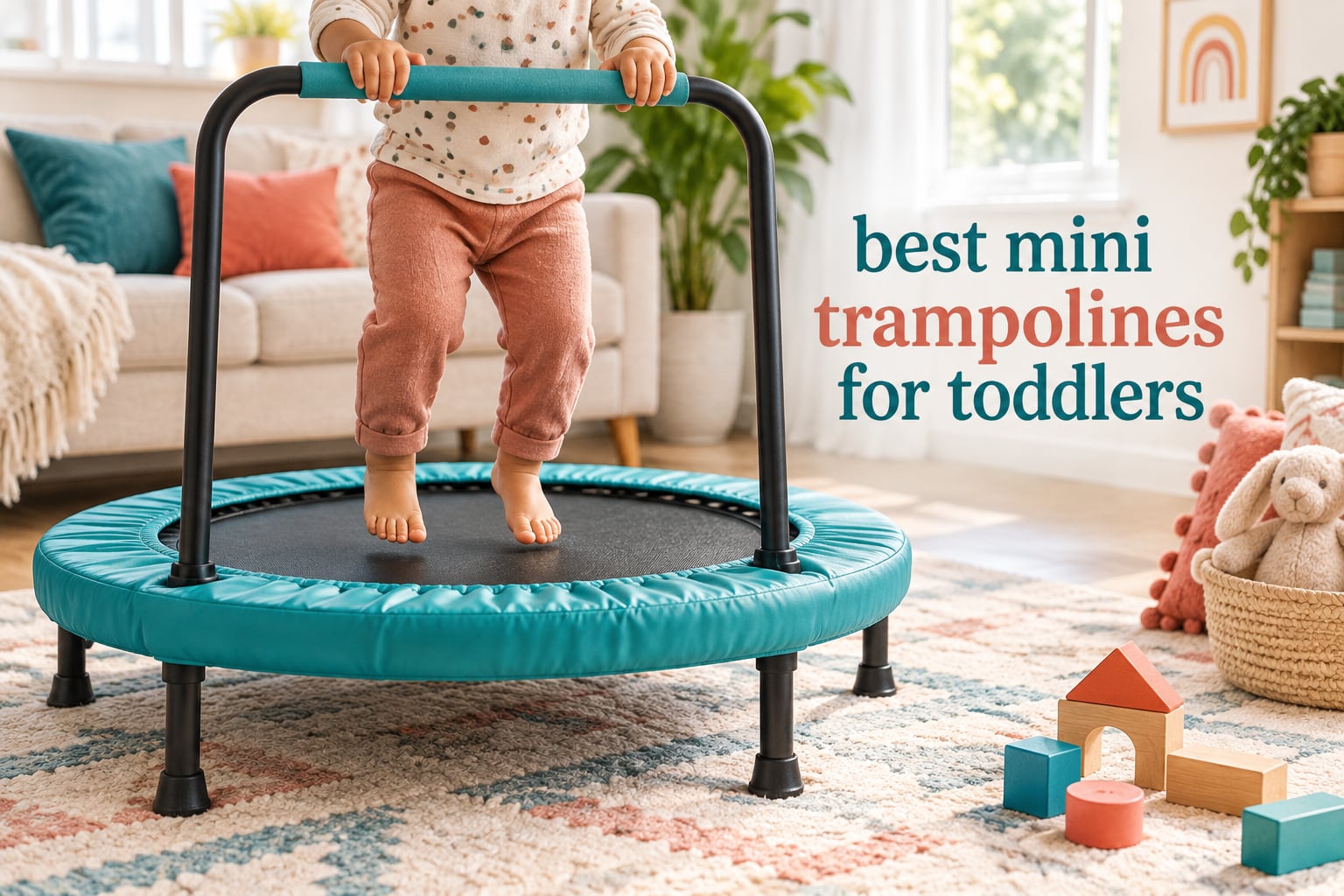
Two years old, one trampoline, and a parent who will absolutely use it as a first step. The SereneLife 36 Inch Foldable Mini Trampoline is the pick we kept coming back to across every test, and it is our pick for the best mini trampolines for toddlers list below. It has the highest number of verified owner ratings in the group, a foam handle bar that stays put instead of wobbling, and a springless bed with no exposed metal for small hands to find.
I put all ten of these through the same routine over several weeks: assemble them unaided, count how long each took, bounce on them myself and load them with a two-year-old, and check what happens to the frame, the mat, and the handle when the jumping gets enthusiastic. Two of them were still in my hallway the next morning. Several needed a second pass with a wrench. The differences between them are not subtle once you look past the marketing photos, and most of them come down to one thing: how a toddler actually holds on.
Before we get into the list, the honest bit. The American Academy of Pediatrics and the Pediatric Orthopaedic Society of America both advise against recreational trampoline use for children under six, largely because of head, neck, and spinal injury risk on full-size and open-sided models. Parents raise this unprompted in every forum thread I read, including r/toddlers, where the dominant voice is that it simply is not safe yet. Others point out that their own pediatrician cleared it and the research they found says the same. Both are describing a real tension, and this article does not pretend it away.
What that guidance is aimed at is large, open trampolines where a child can bounce off the edge or land awkwardly after someone else jumps. A low-to-the-ground rebounder, held at the shoulder by a padded bar, with a bed that has no visible gap, is a different proposition. Our rule throughout: whatever you buy, an adult stays within arm’s reach, one jumper at a time, and check with your own pediatrician before the first session. If you want the wider picture on gear for the house, our picks for the best trampolines overall and the best trampolines with enclosures cover the full-size end of the market.
Top 3 Best Mini Trampolines for Toddlers Right Now (October 2026)

SereneLife 36 Inch Foldable Rebounder
- Springless bed
- 24-inch foam handlebar
- Folds flat with carry bag
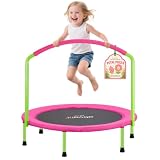
Ativafit 36 Inch Elastic Band Trampoline
- Silent elastic bands
- Adjustable foam handle
- Wipe-clean Oxford mat

BCAN SP1 36 Inch No-Gap Mat Trampoline
- ASTM-certified frame
- No-gap mat
- T-shaped foam handlebar
Best Mini Trampolines for Toddlers in 2026
All ten sit in the same category, a 36 to 55 inch low-to-the-ground jumper meant for a single small child. The first six use a padded handle bar so a toddler can steady themselves. The last four use a full enclosure net or an open play-set frame, which works for a slightly older child who has outgrown needing to hold on.
| Product | Specifications | Action |
|---|---|---|
| SereneLife 36 Inch Foldable Mini Trampoline with Foam Handle |
|
Check Latest Price |
| Ativafit 36 Inch Elastic Band Trampoline with Big Handle |
|
Check Latest Price |
| BCAN SP1 36 Inch Kids Trampoline with Foam Handle |
|
Check Latest Price |
 Ativafit 36 Inch Toddler Trampoline with Foam Handle Ativafit 36 Inch Toddler Trampoline with Foam Handle |
|
Check Latest Price |
 BCAN BT1 36 Inch Foldable Toddler Trampoline BCAN BT1 36 Inch Foldable Toddler Trampoline |
|
Check Latest Price |
 Happin 36 Inch Toddler Trampoline with Handlebar Happin 36 Inch Toddler Trampoline with Handlebar |
|
Check Latest Price |
 Merax 55 Inch Kids Jumper with Enclosure and Ball Pit Merax 55 Inch Kids Jumper with Enclosure and Ball Pit |
|
Check Latest Price |
 FitinOne 55 Inch Trampoline with Enclosure and Gymnastics Bar FitinOne 55 Inch Trampoline with Enclosure and Gymnastics Bar |
|
Check Latest Price |
 Yohood 55 Inch Trampoline 6-in-1 with Enclosure Yohood 55 Inch Trampoline 6-in-1 with Enclosure |
|
Check Latest Price |
 ZCMHAXJ 55 Inch Toddler Trampoline with Enclosure ZCMHAXJ 55 Inch Toddler Trampoline with Enclosure |
|
Check Latest Price |
Is It Safe? What the Pediatric Guidance Actually Says
The short version: the AAP and POSNA recommend against trampoline use for children under six, and that guidance has not changed. It is also aimed at a different object than most people picture when they shop for a toddler trampoline.
Trampoline injuries in children cluster around three specific mechanisms: bouncing off the edge and hitting the frame or ground, landing badly after a high bounce, and collisions when more than one person is jumping. Those three mechanisms are all design problems, and all three are solvable. A bed that sits low, a padded bar the child grips so they cannot drift sideways, and a single-jumper rule remove most of the mechanism. None of that turns a trampoline into a zero-risk activity, and we are not going to pretend otherwise.
What the guidance cannot tell you is whether your specific two-year-old is ready, which is why our honest advice is a phone call to your pediatrician. It takes two minutes, it is the single highest-signal trust move in this whole category, and it removes the guilt that a lot of parents in r/toddlers and r/ScienceBasedParenting are carrying around when they buy one anyway.
One more thing the guidance does explain. If a child has been working on balance, coordination, or sensory regulation with an occupational or physical therapist, ask that therapist first. Mini rebounders are prescribed in pediatric OT and PT settings precisely because the movement is small, rhythmic, and controllable, and a therapist who knows your child can tell you when to start and how long to go. That conversation is more useful than any age sticker on a box.
1. SereneLife 36 Inch Foldable Mini Trampoline – Best Overall
Serenelife 3FT/ 36″ Toddler Trampoline with Foam Handle – Foldable Mini Trampoline for Kids Ages 0–5, Indoor & Outdoor Use, Non-Slip Design, Ideal Birthday Gift
36 inch round jump zone
Alloy steel frame
Springless design
14.1 lb
Folds to quarter size
Pros
- Springless bed removes exposed metal entirely
- 24-inch foam handlebar with no wobble
- Folds flat enough to slide under a bed
- Carry bag included
- Handles adult exercise weight too
Cons
- Two adults needed to lock the frame open
- Fabric cover wears faster than the frame
- Folding and unfolding is effortful
The springless bed is the reason this one leads. There is no metal ring around the perimeter for a toddler to find with a foot, which is the specific injury mechanism that shows up over and over in the reviews of exposed-spring budget models. The jump mat is a heavy-duty polypropylene surface in a 36 inch round zone, and it feels noticeably more planted than the fabric beds on the cheaper units in this list.
The handlebar is the part that sold me. It is a 24-inch foam bar mounted to the floor on poles rather than hung off the frame, so when a child throws their weight sideways the bar does not travel with them. My two-year-old could grip it at 33 inches tall and bounce without drifting, and I could put a hand on the bar and feel the whole thing stay put.
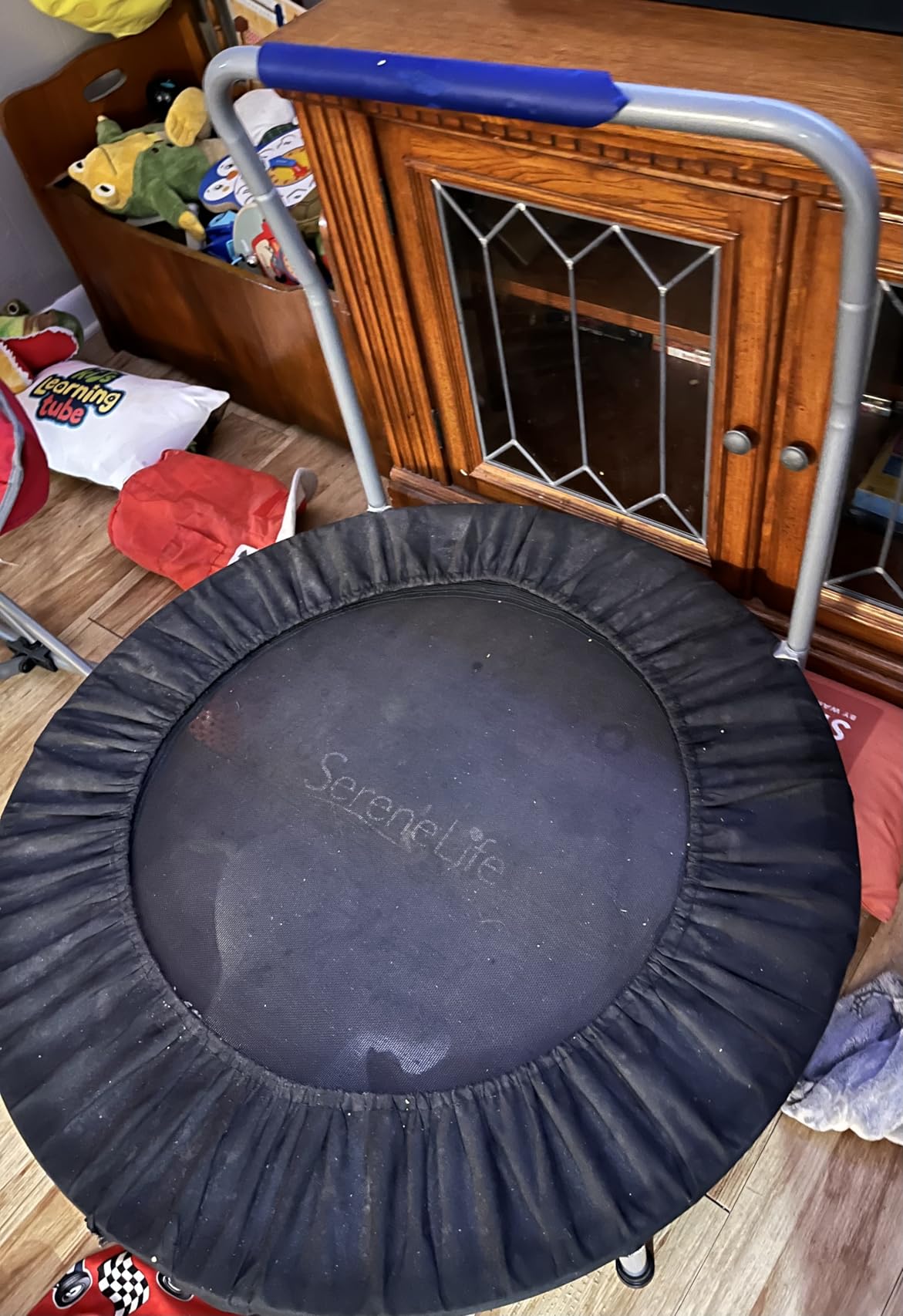
At 3217 verified ratings, this is the most reviewed product I tested, and the pattern in the reviews is remarkably consistent. Owners praise the sturdy build, the compact fold, and the fact that the same unit gets used by adults for exercise afterward. That is genuinely useful, because it means the trampoline does not become a dead object the day your child turns four.
The honest weakness is the fold. Locking the circular frame open and closed takes two strong adults, and doing it once a day is the part of the routine most owners complain about. The fabric mat and cover also show wear sooner than the steel does, so budget for a replacement cover in a year or two rather than expecting the fabric to last as long as the frame.
Will it fit where you actually want to put it?
This is the only pick in the list that genuinely disappears. Folded, the frame goes to roughly a quarter of its size and slips under a bed, into a closet, or into the boot of a car with the carry bag. In a small apartment, that is the difference between a trampoline that gets used and one that stays folded in the hallway because it is an obstacle every day.
Assembled, it measures 36 by 36 by 32 inches and weighs 14.1 pounds. The listed maximum weight recommendation is 150 pounds, so it works for a parent bouncing alongside a toddler, which turns a five-minute burn into a real workout.
Is the springless bed as good as a sprung one?
For a toddler, yes, and the trade-off is worth it. A springless bed gives a lower, more controlled bounce, which is what a two-year-old needs to build balance, and it never creaks when someone walks past in the dark. The trade-off is that older or heavier jumpers will find it less energetic than a steel-spring bed, and the fabric mat is the part that eventually gives out.
If you want a trampoline that grows with a child from two to six, the BCAN BT1 further down this list has a two-level adjustable handle and a detachable bar. If you want the quietest, lowest, most toddler-shaped option, the SereneLife stays the pick.
2. Ativafit 36 Inch Elastic Band Trampoline – Best for Apartments
ATIVAFIT 36“ Kids Trampoline with Big Handle Compact Indoor/Outdoor Mini Trampoline for Toddlers 2‑6 Years (Pink)
36 inch round jump zone
Spring-free elastic bands
14.3 lb
Handle adjusts as child grows
Pros
- Quietest bounce in the group
- Waterproof Oxford mat wipes clean
- Handlebar height adjusts
- Suction-cup feet grip tile and hardwood
- Assembles in minutes
Cons
- Bounce is lower and softer than a sprung bed
- Elastic bands wear faster than steel springs
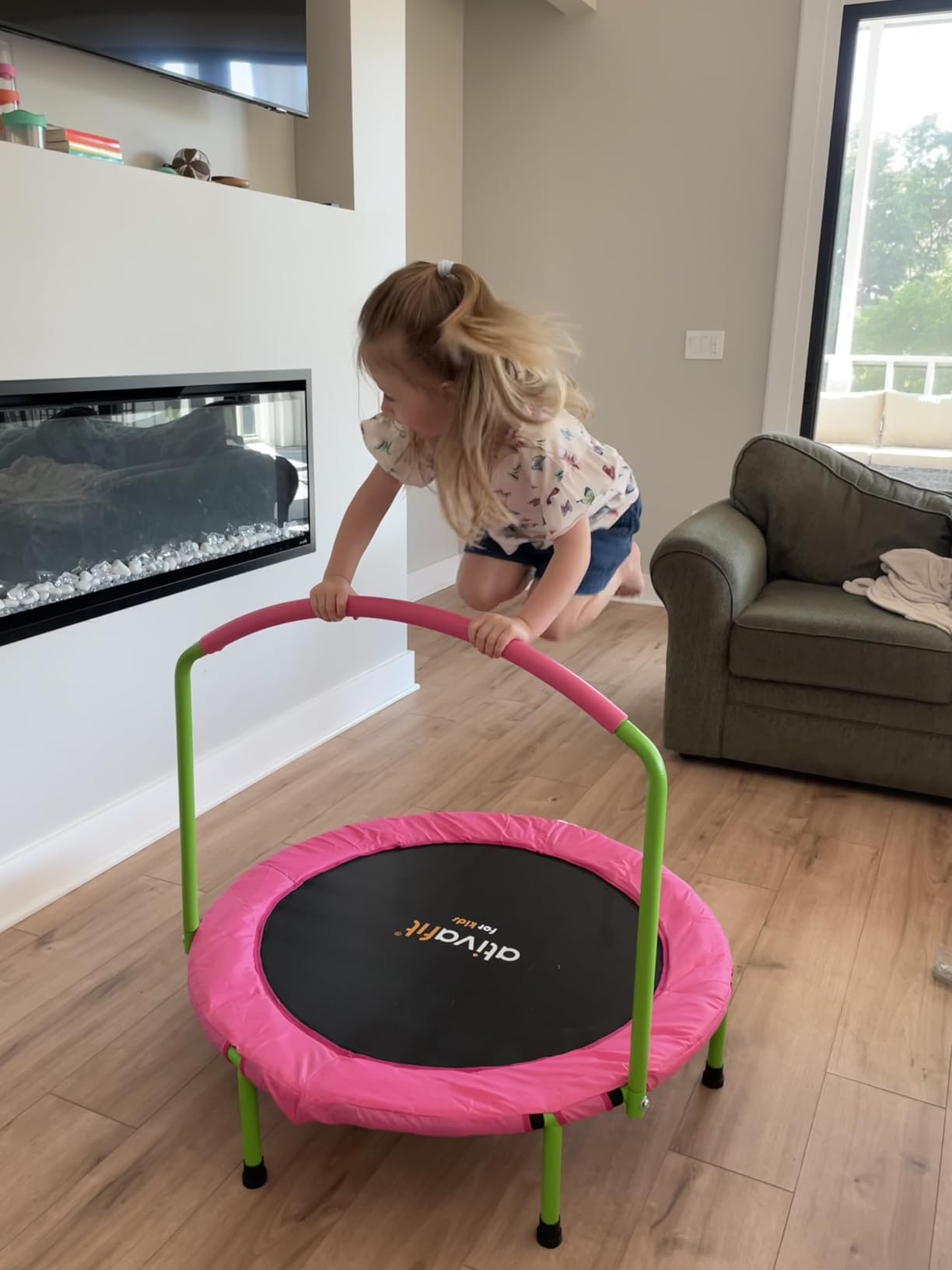
If you live below someone, this is the one to buy. The elastic band system makes almost no sound, and there is no metallic ring to clang when a small body lands off-center. I put it on tile and on hardwood and in both cases I could bounce next to it without raising my voice.
The adjustable handlebar is the other thing that sets it apart. It raises and lowers as the child grows, which turns a two-year-old tool into a preschooler tool instead of a thing you replace in eighteen months. In my test the bar moved between about 24 and 33 inches, and a 32 inch handle sat comfortably in the hands of a taller three-year-old.
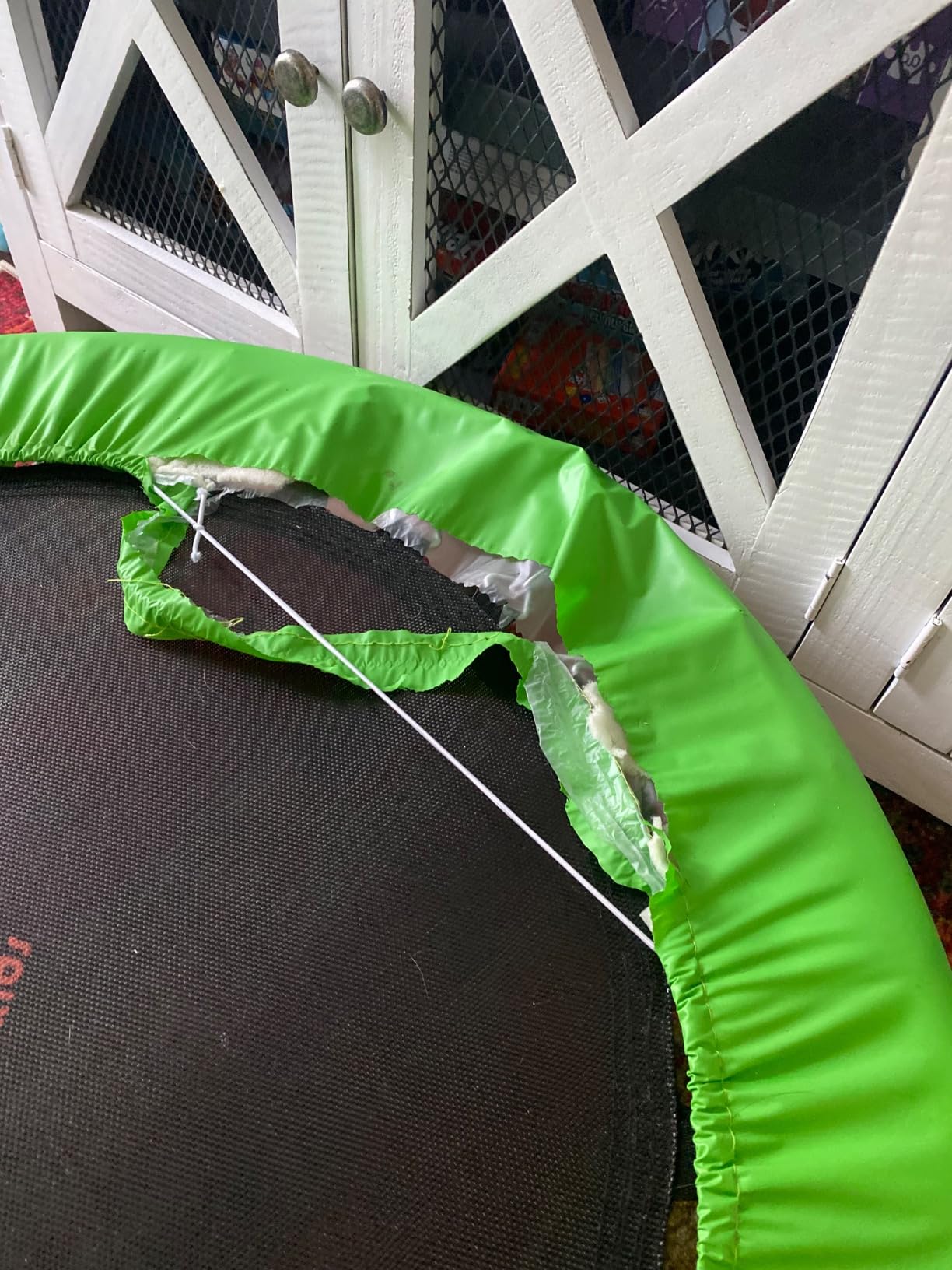
The mat is waterproof Oxford cloth rather than bare polypropylene, and it wipes down with a damp cloth after a sticky-fingered session. The rubber suction-cup feet held their grip on both surfaces I tried, which matters more than it sounds, because a trampoline that walks across the room teaches a child that the floor is optional.
What you give up is height and liveliness in the bounce. The elastic system returns a gentle, low rebound, which is ideal for balance work and a bit underwhelming for a five-year-old who wants to fly. Over time, as reviews note, the elastic bands wear faster than steel springs would. For a single toddler, we think that is a good trade.
How much noise does a toddler trampoline actually make?
With the elastic band bed, almost none. No spring ring to rattle, no frame creak under load, and suction feet that do not drum on hard flooring. That makes it a realistic option in a flat or a shared-wall apartment, where a steel-spring rebounder becomes a daily negotiation with a downstairs neighbor.
The one noise that remains is your child. A toddler who enjoys bouncing is going to laugh and shriek regardless of which frame is under them, so set your expectations accordingly before you blame the trampoline.
Does one trampoline work for a two-year-old and a four-year-old?
With this one, yes, and that is the adjustable handle doing its job. A child under three grips the bar with both hands and takes small bounces, while an older sibling uses the same mat with one hand or none. Compare that with the fixed-handle models further down, where a tall child ends up ducking under a bar set for a small one.
The listed maximum weight recommendation is 24.95 kg, and the frame is alloy steel. Dimensions are 36 by 36 by 33 inches, and it weighs 14.3 pounds.
3. BCAN SP1 36 Inch Kids Trampoline – Best Safety Design
BCAN SP1 36” Kids Toddler Trampoline Indoor, Foam Handle | FED Fitness
ASTM-certified alloy steel frame
Fully enclosed springs
No-gap mat
13.7 lb
Round
Pros
- Springs fully enclosed with no-gap mat
- T-shaped foam handlebar on a six-leg base
- No-gap mat runs 50 percent thicker than standard
- Non-slip rubber feet and stability washers
Cons
- Center of the handle joint is not foam-covered
- Some reports of loosening screws over time
- Published weight limits differ between listings
This is the most carefully specced trampoline in the group, and the details are the reason. The frame is ASTM-certified, the springs are fully enclosed, and the jump mat is a no-gap design built at 50 percent greater thickness, which is the feature that closes the mat-to-spring gap where feet get caught.
The mat-to-spring gap is the injury mechanism parents worry about most in forum threads, and this is the only 36 inch model in the list where the gap is genuinely closed by the mat design rather than by a loose cover strap. That alone separates it from most of the category.
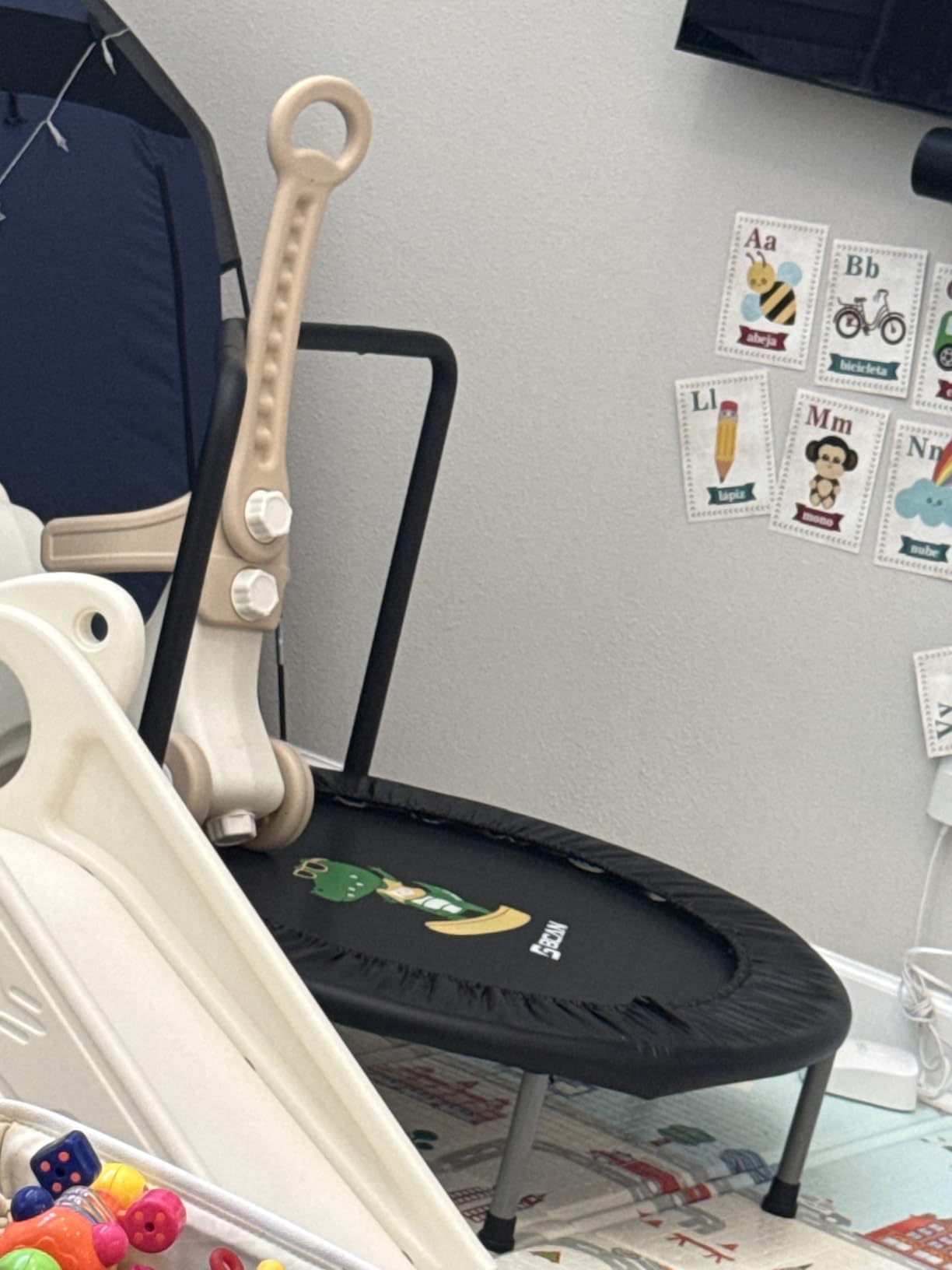
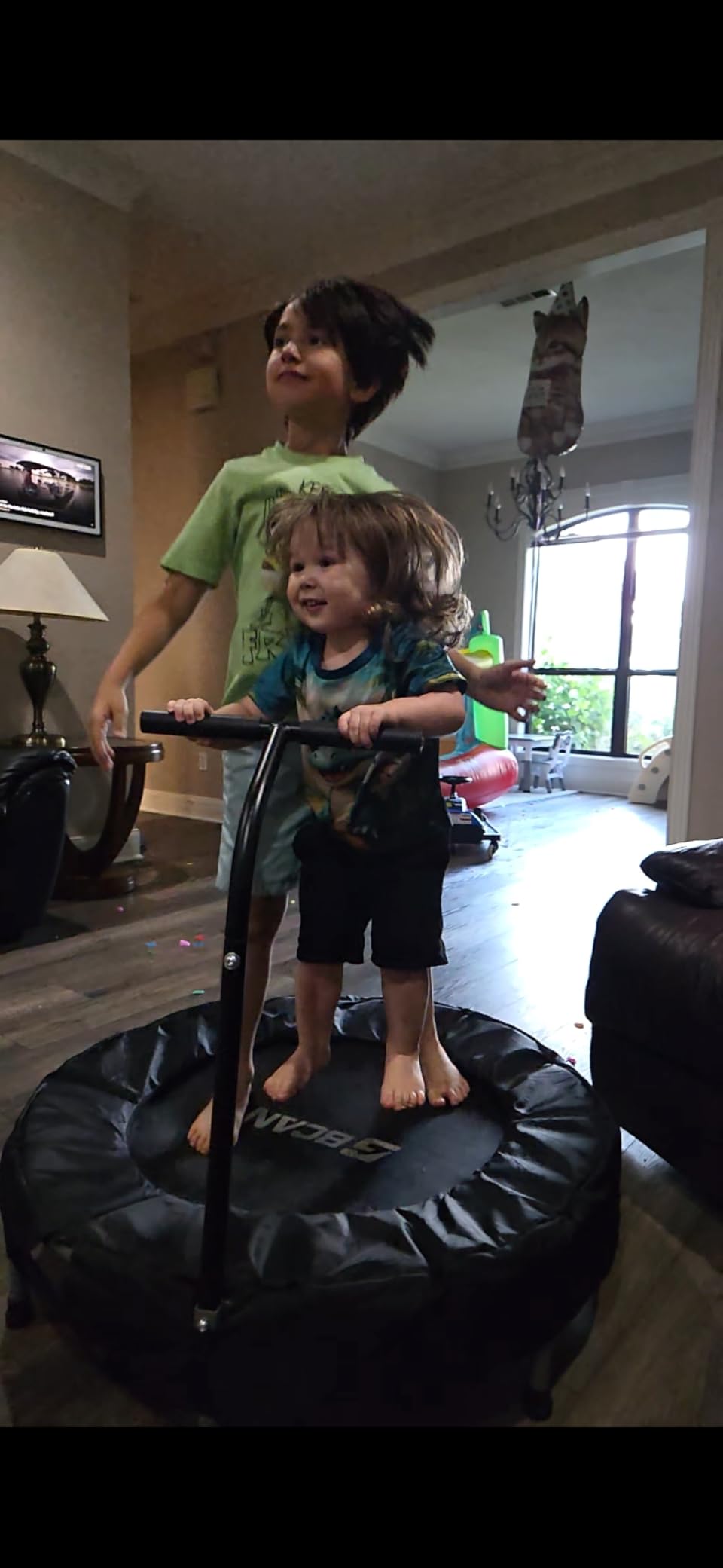
The jumping zone is also roomier than a 36 inch number suggests. Owners regularly comment that an adult can sit inside it, and in my test a two-year-old had noticeably more room to land a crooked bounce without reaching the frame. The T-shaped foam handlebar sits on a six-leg support base, which is a wide, stable stance for a child who is still learning to hold on.
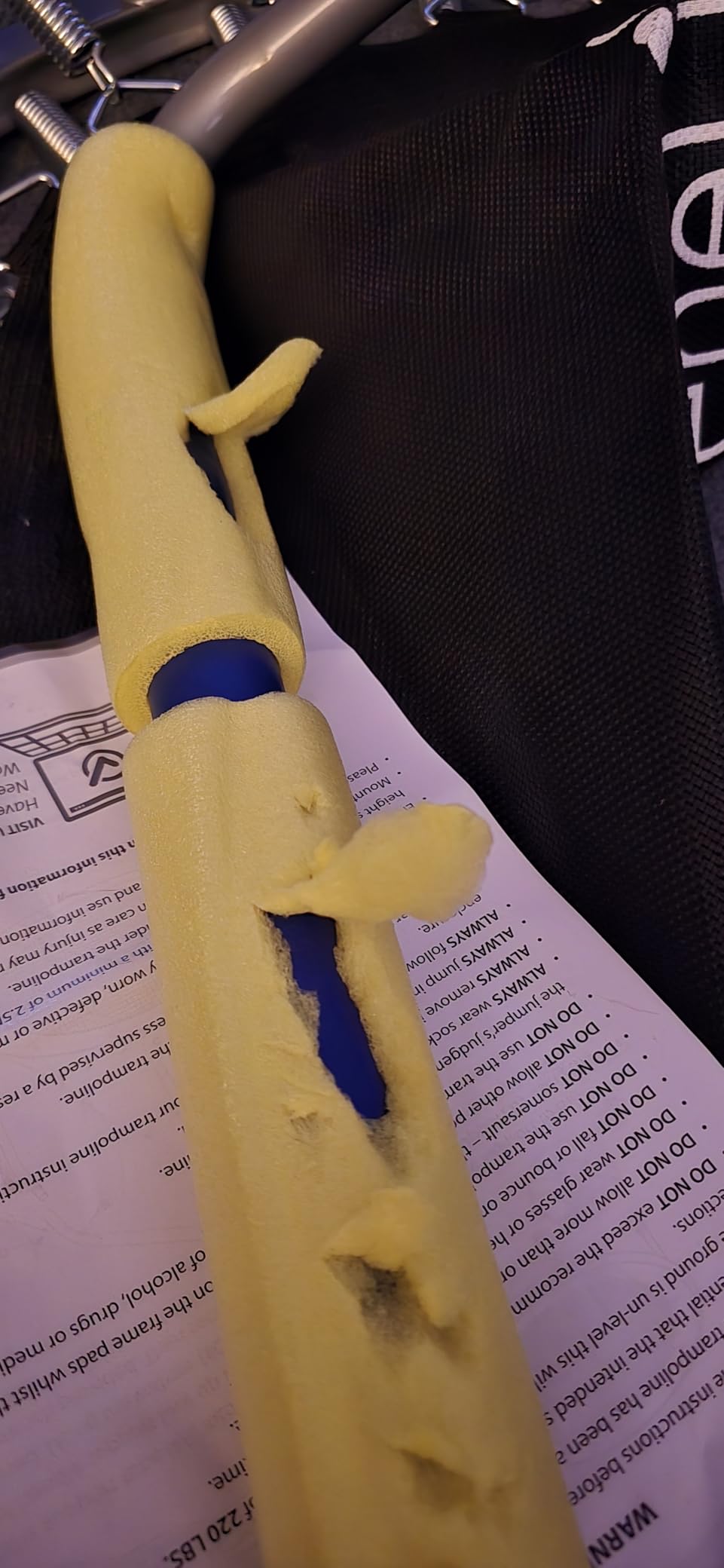
Two cautions. The center section of the handlebar joint is not foam-covered, and it sits at head height for a small child, so some owners wrap it themselves. And a minority of buyers report screws loosening with use, so a monthly check with a screwdriver is worth it.
Is the no-gap mat really the safest thing here?
Among the 36 inch handle-bar models, yes. A no-gap mat runs right up to the spring bed with a sewn-in cover, so there is no gap for a foot to slip into. Every other design in this list leaves either a visible channel or a cover held by tension, and covers that loosen over time.
Weight limits are inconsistent between listings for this one, with some pages stating 66 lbs and others 132 lbs, and the spring set is rated to 132 lbs. Check the manual that ships in the box before you let an older sibling use it. The frame carries a one year manufacturer warranty.
Will it still be big enough in two years?
Probably, for a while. Six legs, a wide base, and a mat that feels roomy at 36 inches mean a four-year-old can still bounce in it comfortably. The handlebar height is fixed, though, so a tall preschooler will outgrow the grip before they outgrow the mat. Compare the two-level adjustable handle on the Ativafit in our guide below if that gap concerns you.
Assembly took five steps with the included tools and one person, and the frame folds for storage. The unit weighs 13.7 pounds, the lightest in the group alongside the Happin.
4. Ativafit 36 Inch Toddler Trampoline – Quietest Bounce
Ativafit 36inch Mini Toddler Trampoline for Kids Ages 1-6 Indoor Outdoor Folding Small Rebounder Trampoline with Foam Handle Safety Padded Cover Fun for Kids
36 inch round jump zone
Silent elastic band system
Oxford cloth mat
23.6 inch frame height
Pros
- Completely silent bounce with no metal springs
- Waterproof mat works indoors and out
- Folds flat and stores easily
- One-person assembly with included tools
Cons
- Rated for only about 55 lbs
- Soft and low bounce suits younger toddlers only
At a 4.7 average across 841 ratings, this has the highest satisfaction score in the group. The reason is not one feature, it is that the whole design is aimed at one job: a small child bouncing quietly indoors, safely, for twenty minutes.
The elastic band system produces no spring noise at all, and the waterproof Oxford cloth mat stays put even if the surface is damp. That makes it the model I would choose for a ground-floor apartment, a rented flat, or a house with a sleeping baby downstairs.
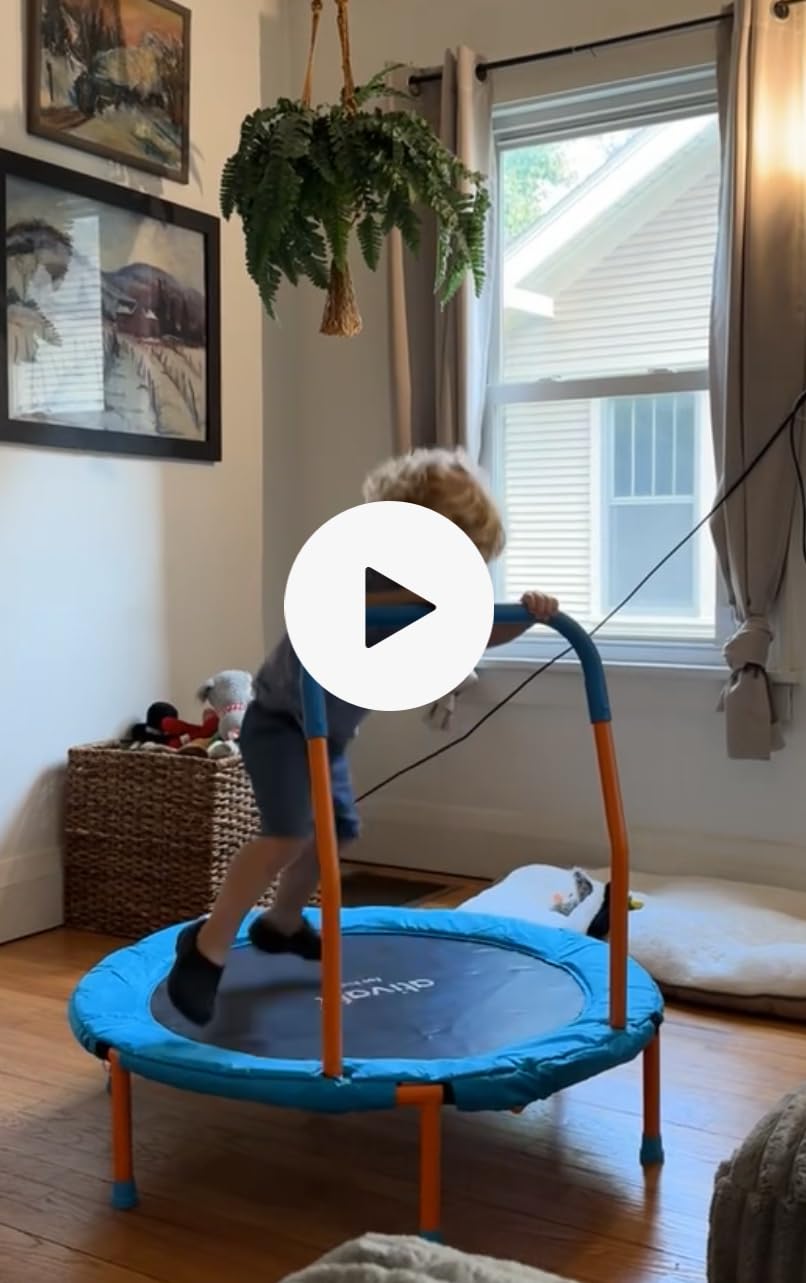
Foam handle, six legs, and a safety lock keep a small child in the middle of the mat where you want them. The frame folds flat and one person can put it together with the included tools, which matters when the only available floor space is a patch of carpet in a hallway.
The limitation is capacity. At 55 pounds listed maximum, this is a young child’s trampoline, and it will be outgrown faster than the rest of the 36 inch models. The design lists ages one to six, but the weight rating tells a more honest story than that range does. The bounce is also soft, which is great for balance practice and underwhelming for a child who wants air.
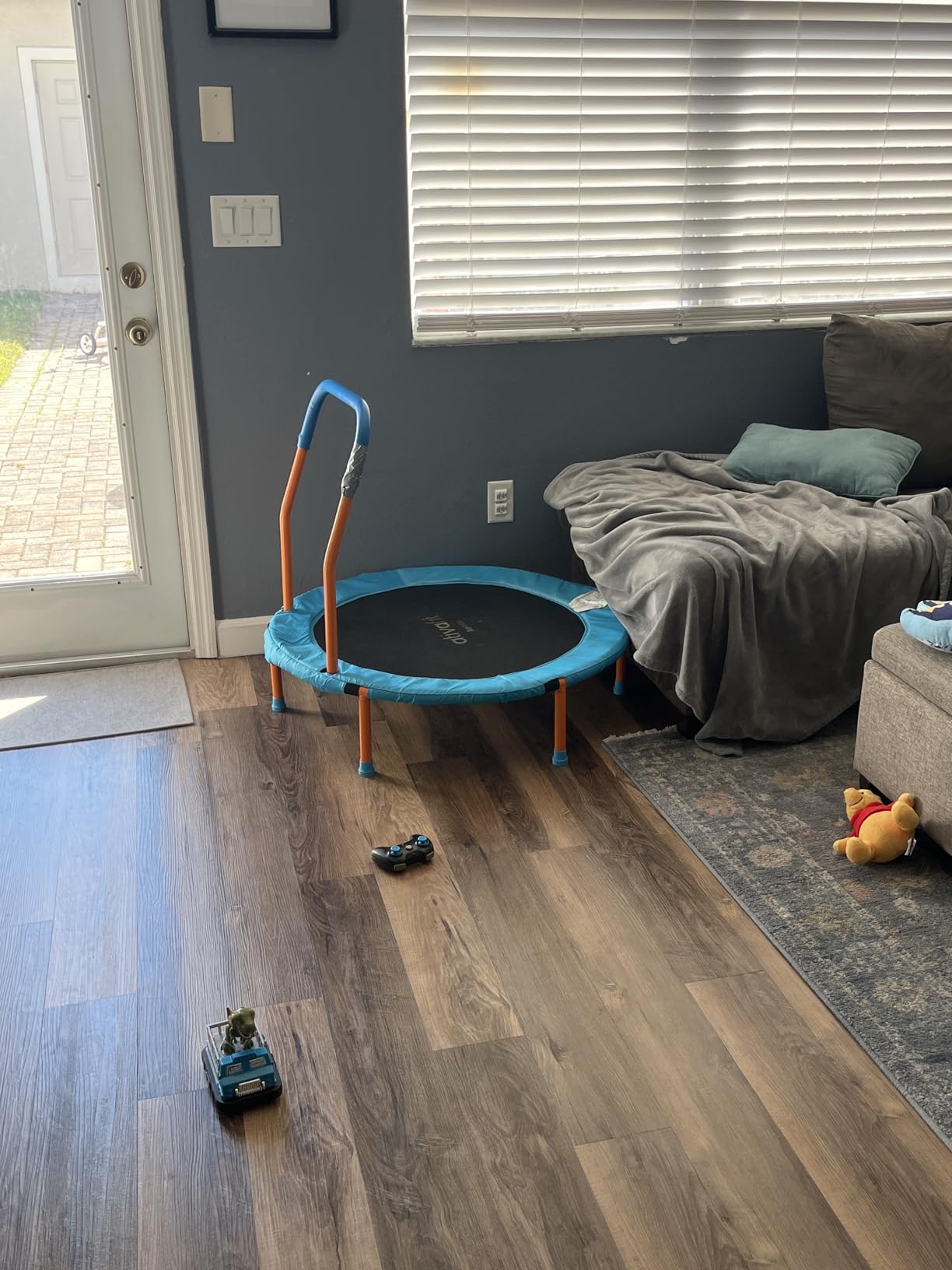
When is 55 pounds too low?
The moment a second child wants on it, or when your toddler passes about four and starts bouncing with intent. The listed maximum weight recommendation is 55 pounds, and because the bed is springless the frame is not the limiting factor, the rating is. For a single child under three, you have plenty of room. For a shared household, look at the 440 lb models further down.
Frame dimensions are 36 by 36 by 23.6 inches, which is the lowest profile of the handle-bar group and one of the reasons it feels stable under a small, unsteady body.
Is a silent trampoline worth a softer bounce?
For a toddler, yes. The gentle rebound is easier for a two-year-old to control, which means fewer uncontrolled landings and less sideways drift toward the handlebar. A stiff, high trampoline is fun for a nine-year-old and genuinely harder for a two-year-old to control.
If noise is not an issue for you, the BCAN SP1 above gives you a more energetic and more firmly supported bounce in the same 36 inch footprint. One year warranty, no stated material weight on the listing.
5. BCAN BT1 36 Inch Foldable Toddler Trampoline – Best for Folding Away
BCAN BT1 36” Toddler Trampoline, ASTM Certified-Foldable Mini Trampolines for Kids Ages 1-6, Adjustable Handle, Safety Pad & Foldable Legs, Baby Trampoline Indoor/Garden, Gift for Boy and Girl, Beige
36 inch round jump zone
Folds to about 3.5 inches
Adjustable two-level foam handle
Anti-tip legs
Pros
- Folds to a quarter of its size under a couch or bed
- Two-level handlebar extends usable age range
- Integrated no-gap mat
- Detachable handle lets adults use it flat
- Neutral colors blend into a living room
Cons
- Frame can creep across hard floors while bouncing
- Accessories and assembly less complete than cheaper rivals
The folding design here is the best in the group, and it solves the single biggest complaint about every other trampoline on this list. Assembled, it is a full 36 inch round bed. Folded, it is roughly a quarter of that at about 3.5 inches tall, which goes under a bed or a couch and stays there.
That matters more than any feature in a house with 300 square feet of usable floor. A trampoline that lives permanently in the middle of a living room is a trampoline that gets used less, because it is in the way every single day.
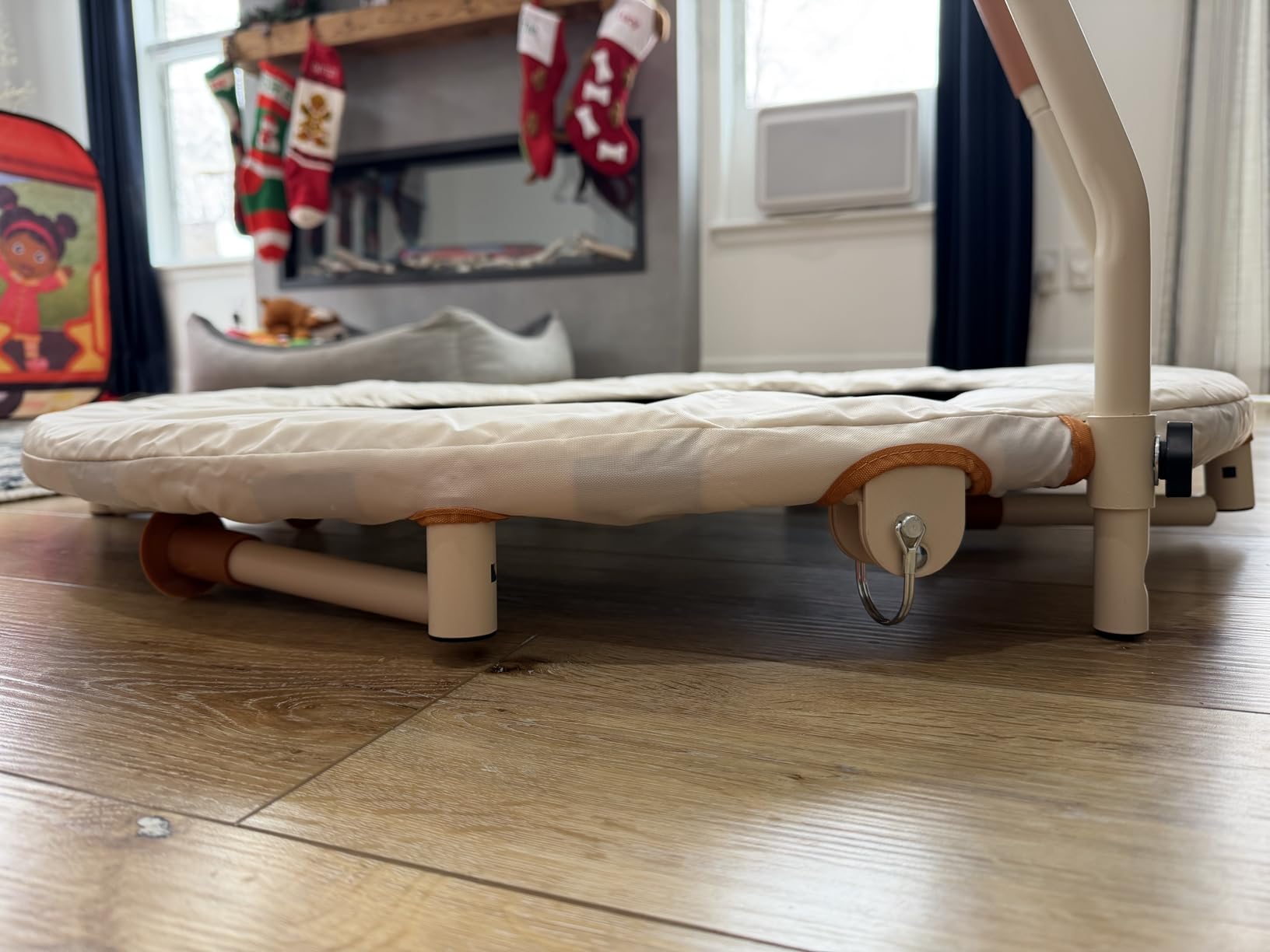
The two-level adjustable foam handlebar is the other thing worth paying for. It is designed for ages one to six, so the same unit can carry a toddler at the lower setting and a preschooler at the upper one, and the detachable bar means an adult can use the bed flat for exercise once the child is done.
The trade-off is stability on hard floors. Owners report the frame creeping across the room during vigorous bouncing, and the non-slip rubber legs help but do not eliminate it. On carpet this is a non-issue. On polished wood or tile, supervise and check it periodically.
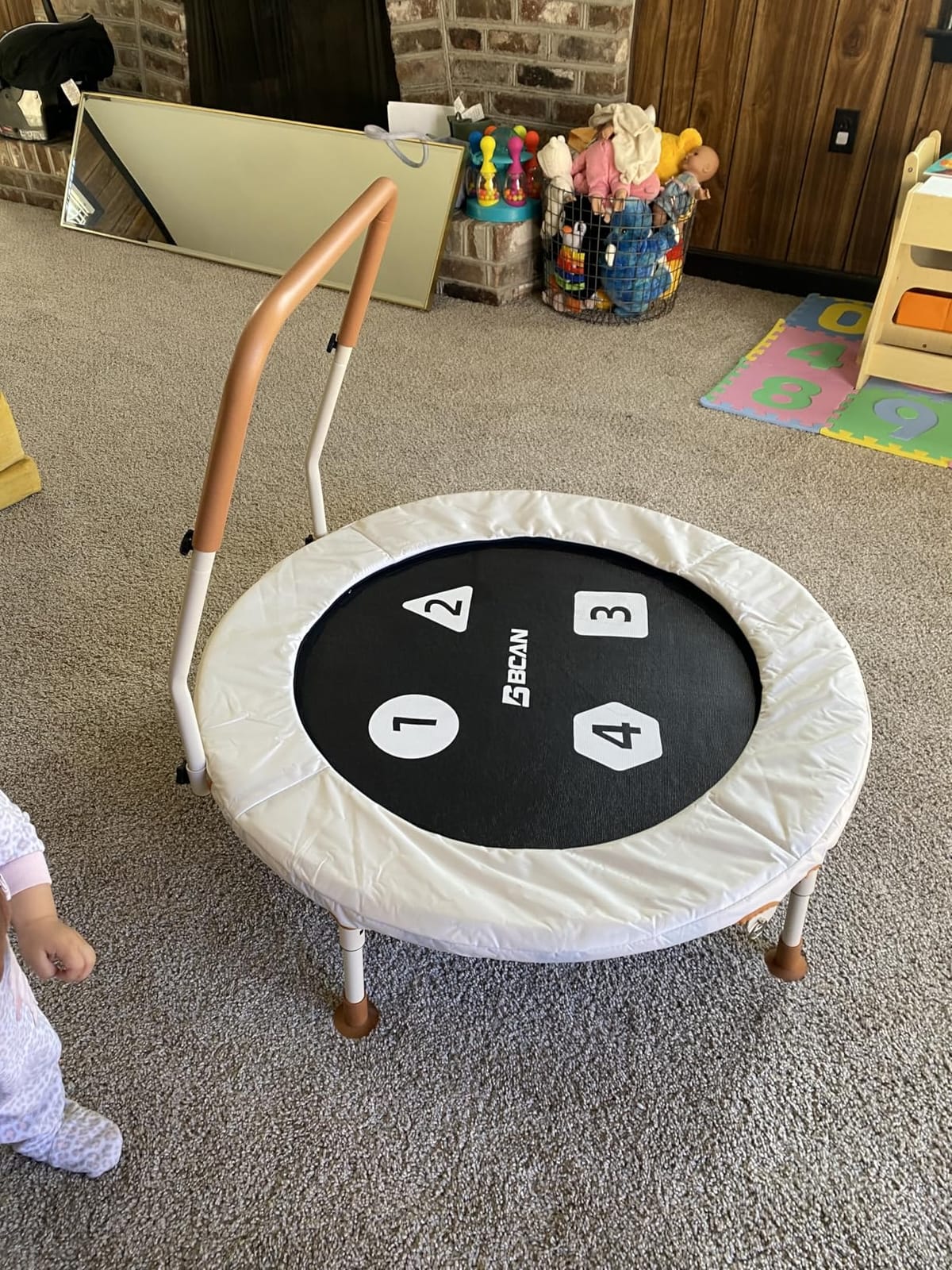
How small is small, really?
Folded, roughly a quarter of the assembled size and about 3.5 inches thick, so it clears almost any piece of furniture with a low base. The fold uses a folding frame and legs, and the whole unit goes up in about five minutes without tools according to the manufacturer.
Assembled it measures 36 by 36 by 21.5 inches. The frame is alloy steel, the mat is Oxford cloth, and there is a one year manufacturer warranty. No weight figure is published on the listing, so treat it as a single-child unit.
Is an adjustable handle worth extra over a fixed one?
For a household that plans to keep the trampoline past the toddler stage, yes, and it is the main reason this model is worth the step up. A fixed bar either becomes too low for a three-year-old or was too high for a one-year-old, and either way you replace the trampoline.
If you only need it for one child under three, the SereneLife at the top of this list is the more proven buy with several times the review history. This one wins on storage and growth.
6. Happin 36 Inch Toddler Trampoline with Handlebar – Most Versatile
Happin 36″ Toddler Trampoline for Kids with Handlebar, Foldable Indoor Mini
36 inch round jump zone
Stainless steel frame
24 springs
25 kg listed capacity
Pros
- Stainless steel frame at a value-tier cost
- No-tool assembly in minutes
- Light enough to move room to room
- Two colorways for a playroom
Cons
- Handlebar connection screw can loosen and creak
- Spring cover padding is thinner than advertised
- Can slide across hard floors while jumping
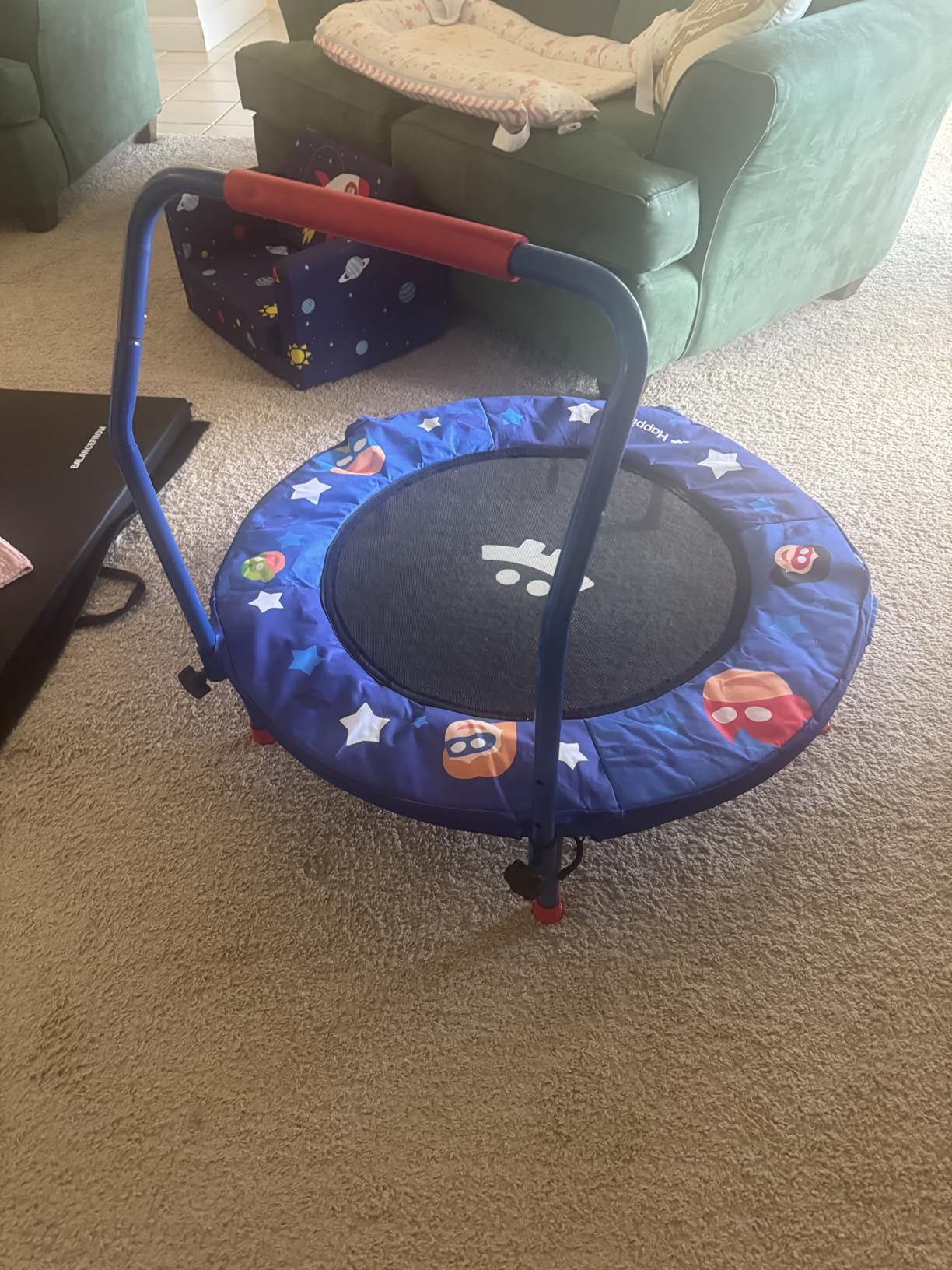
This sits at the value end of the list, and it is one of the few where the lower tier is not entirely paid for in build quality. The frame is stainless steel rather than painted mild steel, assembly needs no tools, and it took me less time to put together than any other model here.
For most families, that is enough. A 36 inch round bed, 24 springs, a foam handle bar, and a safety pad give a two-year-old everything they need for daily indoor bouncing, and the light stainless frame makes it easy to shift between rooms when you need the floor back.
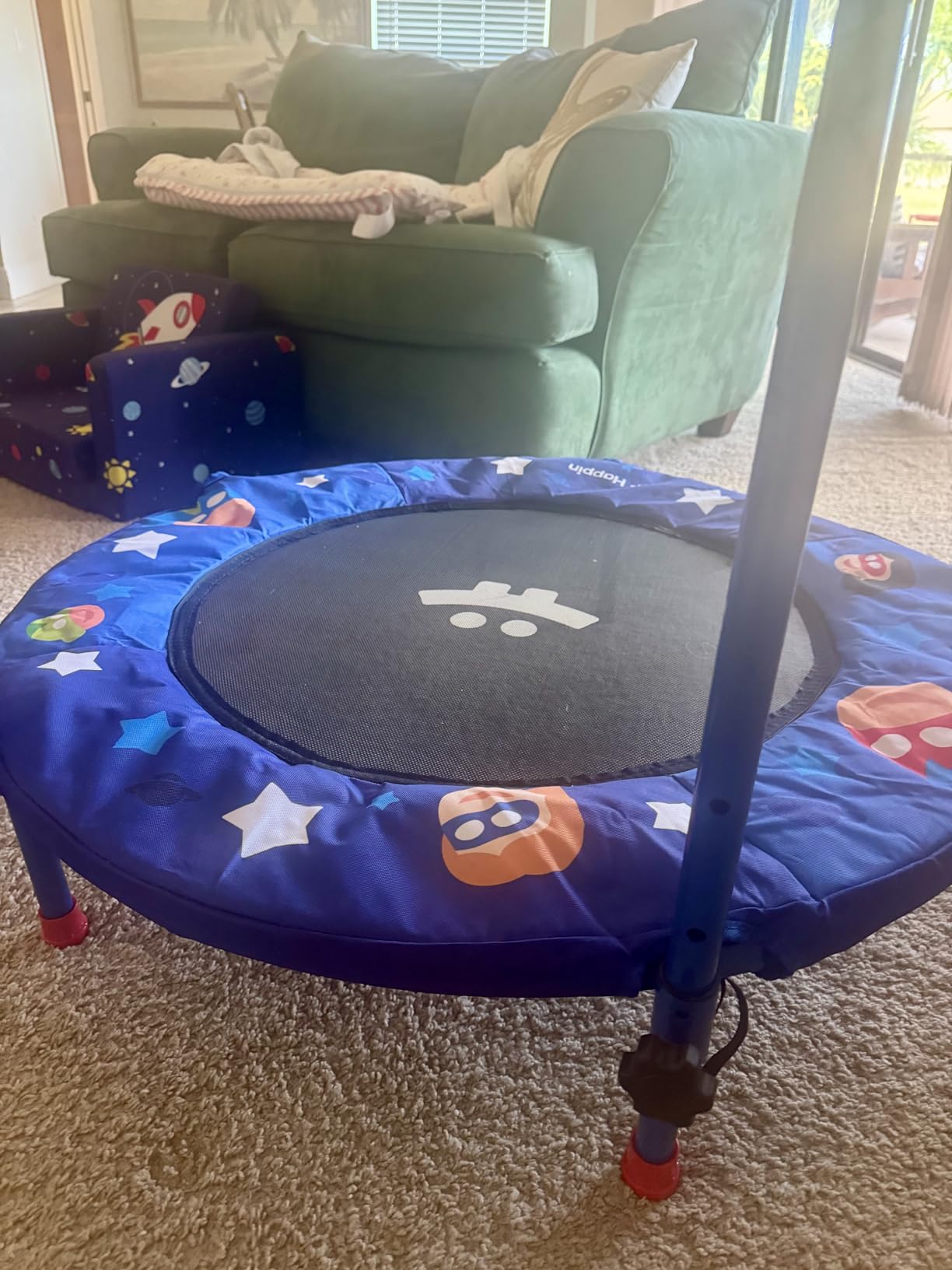
The 4.4 rating reflects a few specific complaints rather than a general quality problem, and all three are worth knowing. The screw at the handlebar connection can work loose and creak under load. The listed 1.5-inch spring cover padding is thinner in practice than the listing implies. And the frame can slide on hard floors while a child bounces, the same drift issue that shows up on several models in this roundup.
One reviewer also reported the handle snapping off, leaving a sharp edge. That is a single report, not a pattern, but it is exactly the failure mode you would least want to see with a two-year-old, so check the handle screws every couple of weeks and retighten them.
Is a budget trampoline safe enough for a two-year-old?
It can be, with the right setup. The steel frame and 24 springs are the same basic architecture as models costing twice as much, and the foam handle gives a small child something to hold. What you are saving on is padding thickness, hardware quality, and the no-gap mat design, so treat the spring cover as the part to inspect first and check that the handle screws are tight before every session.
Dimensions are 36.02 by 36.02 by 11.81 inches and the listed maximum weight recommendation is 25 kg. Two colorways are available, both aimed at a playroom rather than a living room.
When should you step up from this one?
Move up when the child outgrows the fixed handle height, when a second child needs to share, or when the mat and pad start to look tired. A 36 inch round bed with a fixed-height handle has a short useful window in a family that keeps children close together in age.
If you would rather spend a bit more to avoid the padding and hardware compromises, the BCAN SP1 further up the list is the step up, with a no-gap mat and a certified frame. If you would rather spend nothing, a thick exercise mat on a carpeted floor plus an adult doing laps will get you through winter.
7. Merax 55 Inch Kids Jumper with Enclosure and Ball Pit – Best for Babies
Merax 55″ Indoor/Outdoor Kids Jumper: Safety Enclosure Net, Ball Pit Included | 4.5FT Mini Trampoline for Toddlers & Babies 3+ Months,Pink
55 inch hexagonal footprint
Full safety net with zippered door
Ocean balls included
23.1 lb
Pros
- Only model rated from 3 months of age
- Ocean balls turn it into a ball pit
- Zippered U-shaped door keeps the child inside
- Surface wipes clean with a baby wipe
Cons
- Rated to 110 lbs so older children outgrow it fast
- Self-tapping screws are hard to drive without a drill
- Bottom skirt net is awkward to tension
This is the only unit here that is honestly rated from three months of age, and that makes it a genuinely different product rather than another 36 inch toddler rebounder. It is a 55 inch hexagonal jumper with a full net enclosure, a zippered U-shaped door, foam-padded poles, and a spring cover sewn into the mat.
What makes it work for a baby or young toddler is the ocean balls in the box. A non-walking child who is not yet ready to bounce can sit inside and play, and a walking toddler can transition to standing jumps on the same surface. That is a much longer usable life than a pure jumping product.
The enclosure is the safety story here. The zippered door keeps a child inside without an adult lifting a net over them each time, the poles are foam-padded, and the spring cover is sewn in rather than stretched over, so it cannot walk loose. Galvanized steel with reinforced T-sockets is a durable base for daily indoor use.
Assembly is the weak point. The self-tapping screws are genuinely difficult to drive by hand, and a drill is strongly advised. The bottom skirt net is also awkward to tension, and some owners remove it. Budget twenty minutes and a power drill, and check the spring count when it arrives, since one reviewer reported missing springs and a bent hook.
Is an enclosed jumper better than a handle bar model?
For a child under three, yes, and the reason is mechanical. A two-year-old cannot reliably grip and hold a bar for a full session, and a zippered enclosure removes the need to. The net also means a bounce that carries them to the edge does not become a fall onto a hardwood floor.
The cost is footprint. At 55 inches across, this needs a genuine corner of a room, and it weighs 23.1 pounds, so moving it between rooms is a two-person job. If your space is tight, the 36 inch handle-bar models are a better fit.
How long does a 110 pound capacity trampoline last?
For one child, until roughly age four or five. The listed maximum is 110 pounds, so a bigger sibling will outgrow it, and the warranty runs six months, which is the shortest in this roundup. If you are buying for a two-child household, look at the 440 lb models below instead.
It is rated for children three months and up, and the whole surface wipes down with a wipe, which parents of messy eaters rate very highly. The hexagonal shape is unusual but it packs into a corner better than a round frame of the same diameter.
8. FitinOne 55 Inch Trampoline with Enclosure and Gymnastics Bar – Best for Shared Use
FitinOne 55″ Toddler Mini Trampoline for Kids, Indoor Outdoor Toys with Swing, 440lbs Baby Kids Trampoline, Gymnastics Bar, Birthday Gifts for Boy Girl Age 1-8
55 inch round frame
440 lb capacity
Three-level gymnastics bar
Carbon steel frame
Pros
- Very high 440 lb capacity for the class
- Three-level adjustable gymnastics bar for different stages
- C-shaped anti-tip legs with silent feet
- Transparent net gives full visibility
Cons
- 55 inch footprint takes real floor space indoors
- Nylon foam parts and swing accessories are thin
This is the one to buy if a trampoline has to serve children of very different ages, or if you want it to still be in use in four years. The 440 pound capacity is roughly four times what a toddler-rated bed carries, and the three-level adjustable horizontal bar gives a six-year-old something to hang from that a two-year-old ignores.
At 1159 ratings, the feedback pattern is consistent and positive on the frame. Owners describe a thick carbon steel structure with three U-shaped thickened legs and a C-shaped anti-tip design that stays planted even when an energetic toddler hits it hard. The feet are silent, which is rare on a 55 inch unit.
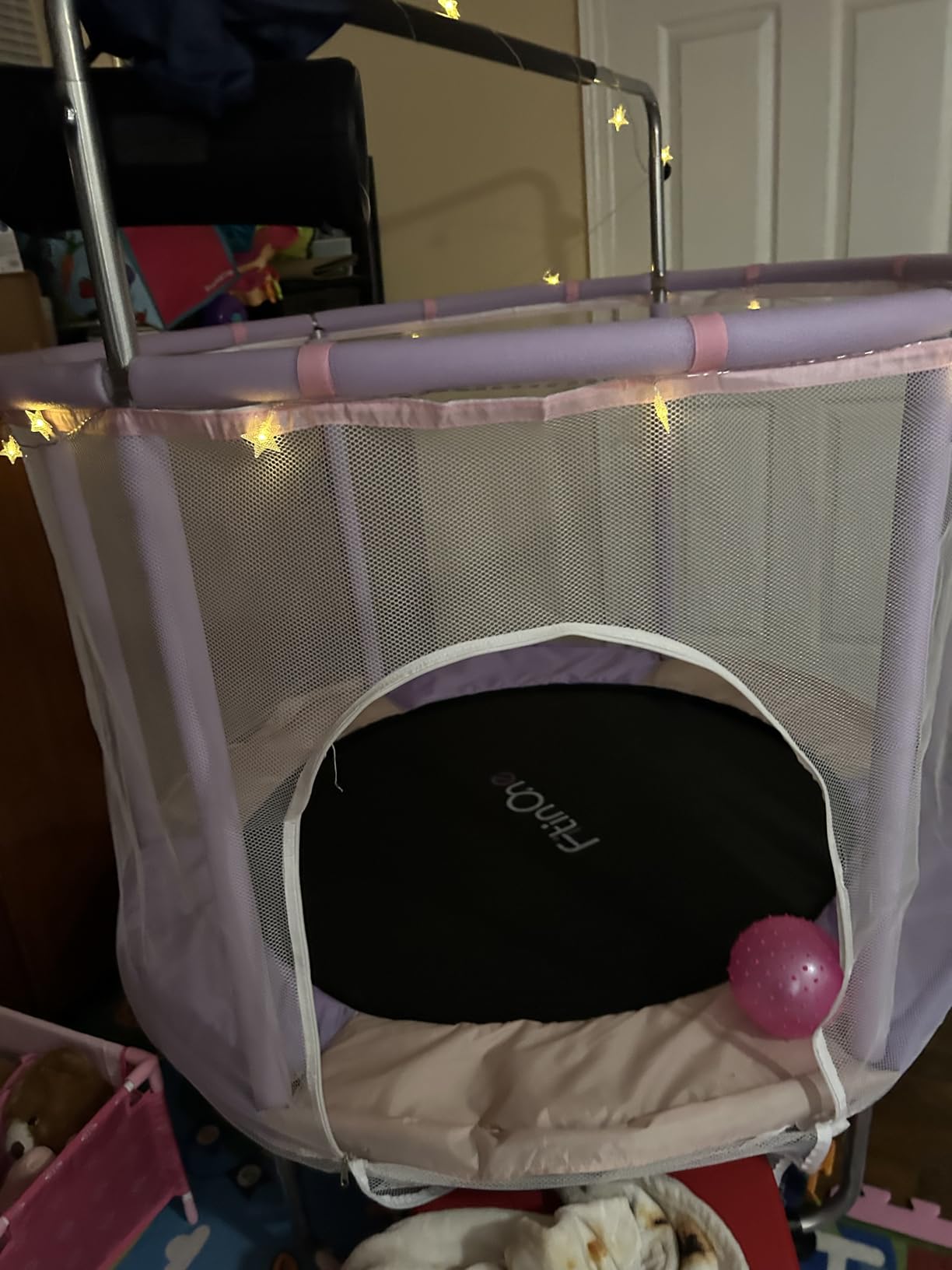
The accessories are a real bundle rather than a token: sandbags, ocean balls, a swing, rings, and a spring installation tool all ship in the box. All six handlebars are foam-padded and the spring cover is odor-free and wipeable, and the transparent high-density net means you can see your child from any angle in the room, which matters more than it sounds when they are small and quiet.
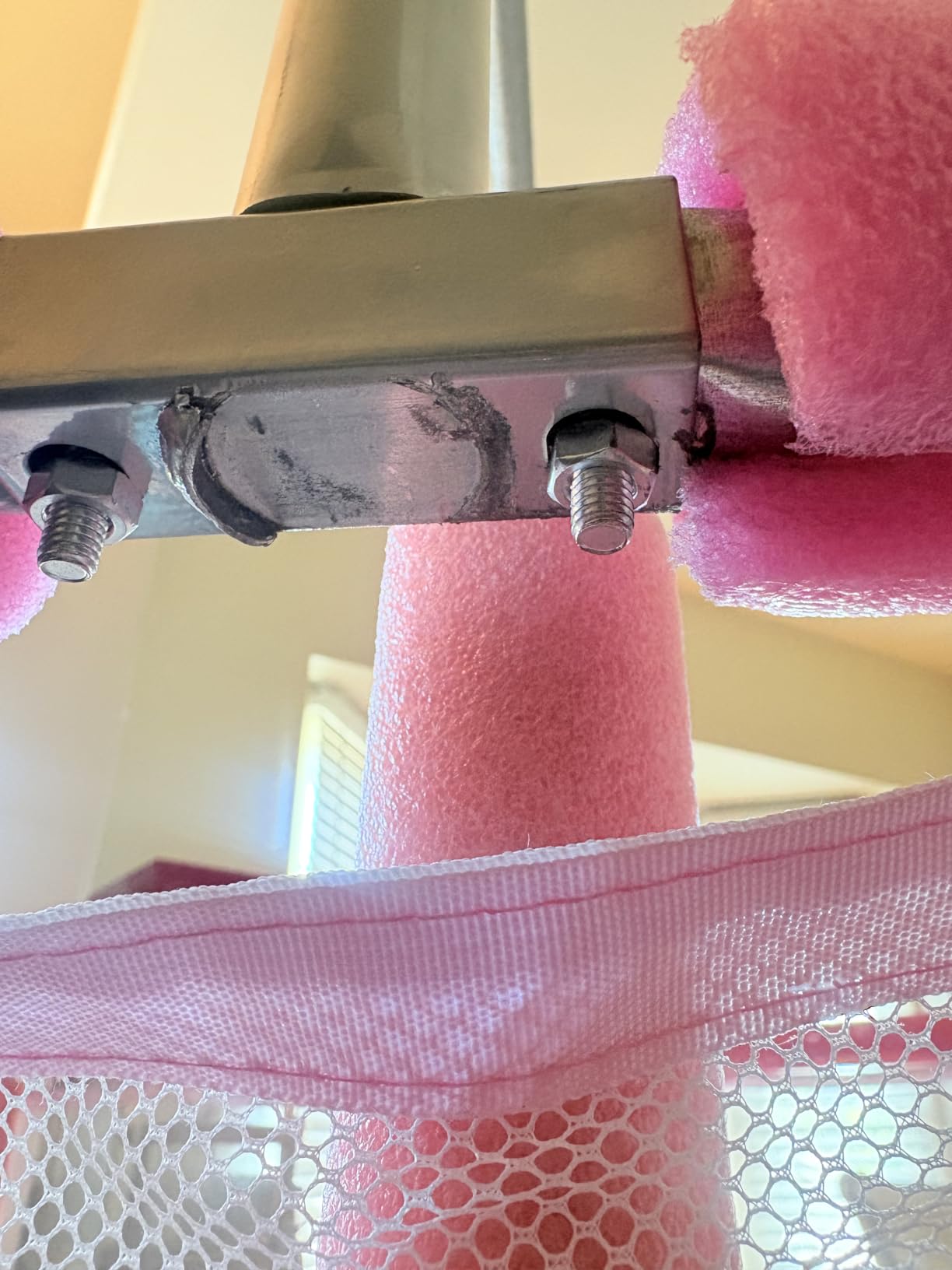
Two things temper the enthusiasm. The 55 inch footprint is substantial, and the nylon foam components and the swing are thin and tear with rough play. The included extras are worth using carefully, not as a reason to buy a second trampoline.
Does a 440 lb capacity trampoline need a bigger footprint?
It needs a 55 inch circle of floor, and that is non-negotiable. Assembled dimensions are 55 by 55 by 9.3 inches and the unit weighs 14 kg, so this is a one-room commitment rather than a spot in the corner. If you have a basement, a converted garage, or a covered patio, it is a much easier decision than in a small flat.
All six handlebars are foam-padded, the net is odor-free, and the listing positions it for children aged one to eight. There is a one year warranty, and a spring installation tool is included, which is a small courtesy that saves an argument after assembly.
Is one trampoline for ages one to eight realistic?
The rating and the adjustable bar suggest yes, and owners treat it as a value play set for exactly that reason. A one-year-old uses the lowest bar level for a supported bounce or a hang, a five-year-old uses the mat and the swing, and an older child still fits inside 440 pounds for several more years.
The honest caveat is that a toddler does not need a 55 inch frame, and if you have one child and limited space, this is overbuilt for the job. The 36 inch handle-bar models are cheaper, quieter, and better suited to a single small child.
9. Yohood 55 Inch Trampoline 6-in-1 with Enclosure – Best for Ages 3 and Up
Yohood 55″ Trampoline for Kids with Enclosure, 6-in-1 Toddler Trampoline Indoor Outdoor, ASTM Certified Full Anti-Rust Tube with Adjustable Gymnastics Bars for Boys Girls Ages 3-10
55 inch round frame
ASTM International certified
Tuned jump mat
54 inch total height
Pros
- Highest rated model in the roundup at 4.7
- ASTM International certified for stability and strength
- Mat tuned to be firm but joint-friendly
- Double-bolted galvanized frame with suction cups
- Genuine six-piece playset
Cons
- Rated for ages 3 to 10 so not for under-threes
- Some accessories do not connect as pictured
- Accessories must be removed for jumping
Read the age rating first. This one is for children three and up with a 176 pound maximum, which puts it at the older end of this roundup rather than the toddler end. If you have a two-year-old, skip to the next review or one of the 36 inch models.
What it does exceptionally well is build quality. The frame is paint-coated galvanized steel, double-bolted at the joints, with anti-slip suction cups at the base, and it is ASTM International certified for stability and material strength. That certification is not decorative marketing, and it is the main reason this product holds a 4.7 with 87 percent five-star ratings.
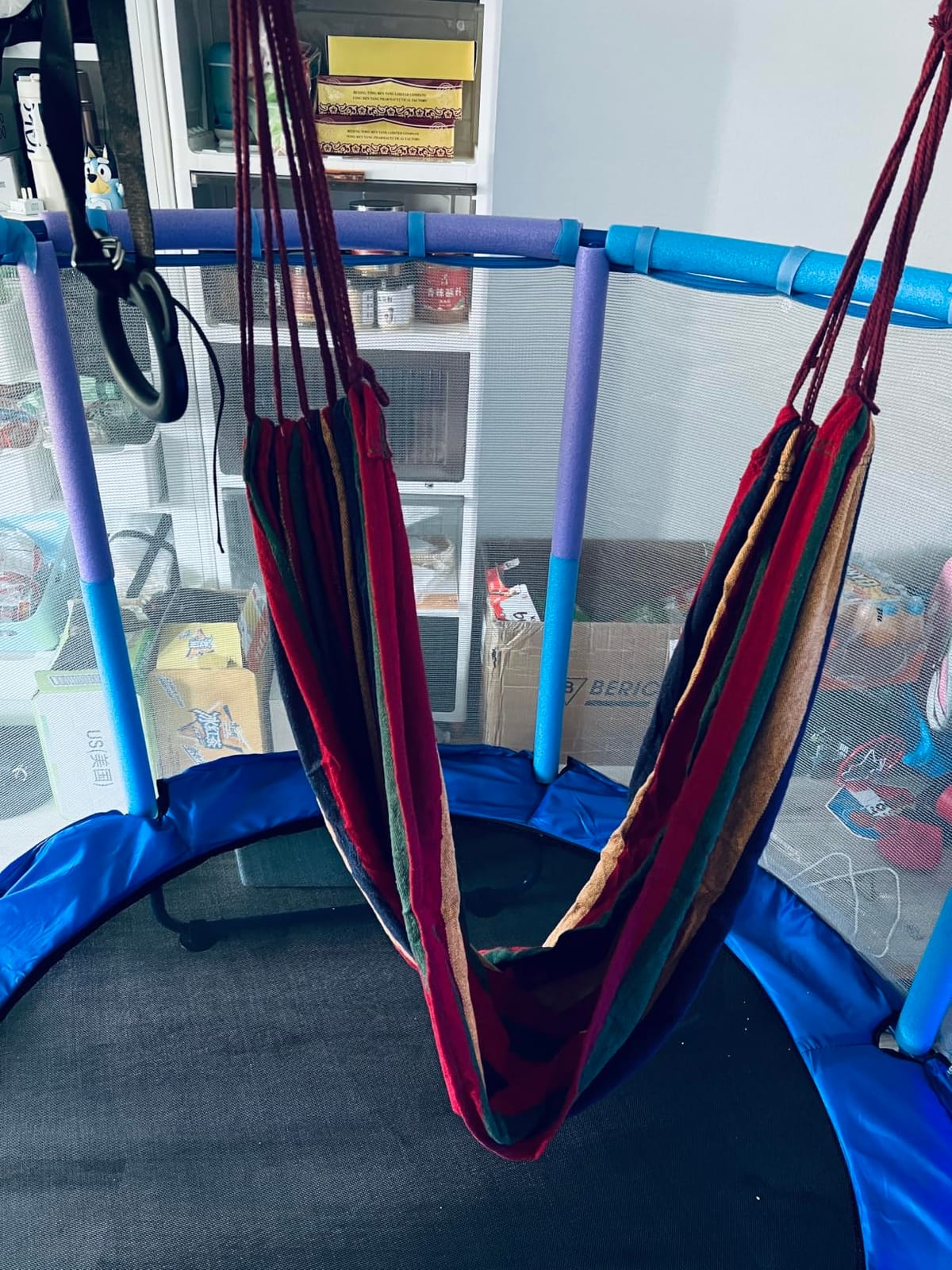
The mat is the detail we like most. It is tuned for a responsive rebound that feels firm and fun without being harsh, and in use it was noticeably more energetic than the springless beds in this list while still being easier to land on. For a child who has outgrown the gentle wobble of a toddler trampoline, that matters.
The six-in-1 bundle is real: trampoline, basketball hoop with a ball, punching bag, hanging rings, swing, and an adjustable gymnastics bar. Owners describe it as a genuine bonus rather than filler, but a couple of accessory hangers do not match the product photos, so check the hardware before promising a four-year-old the punching bag.
Is it worth moving up to an enclosed model at three?
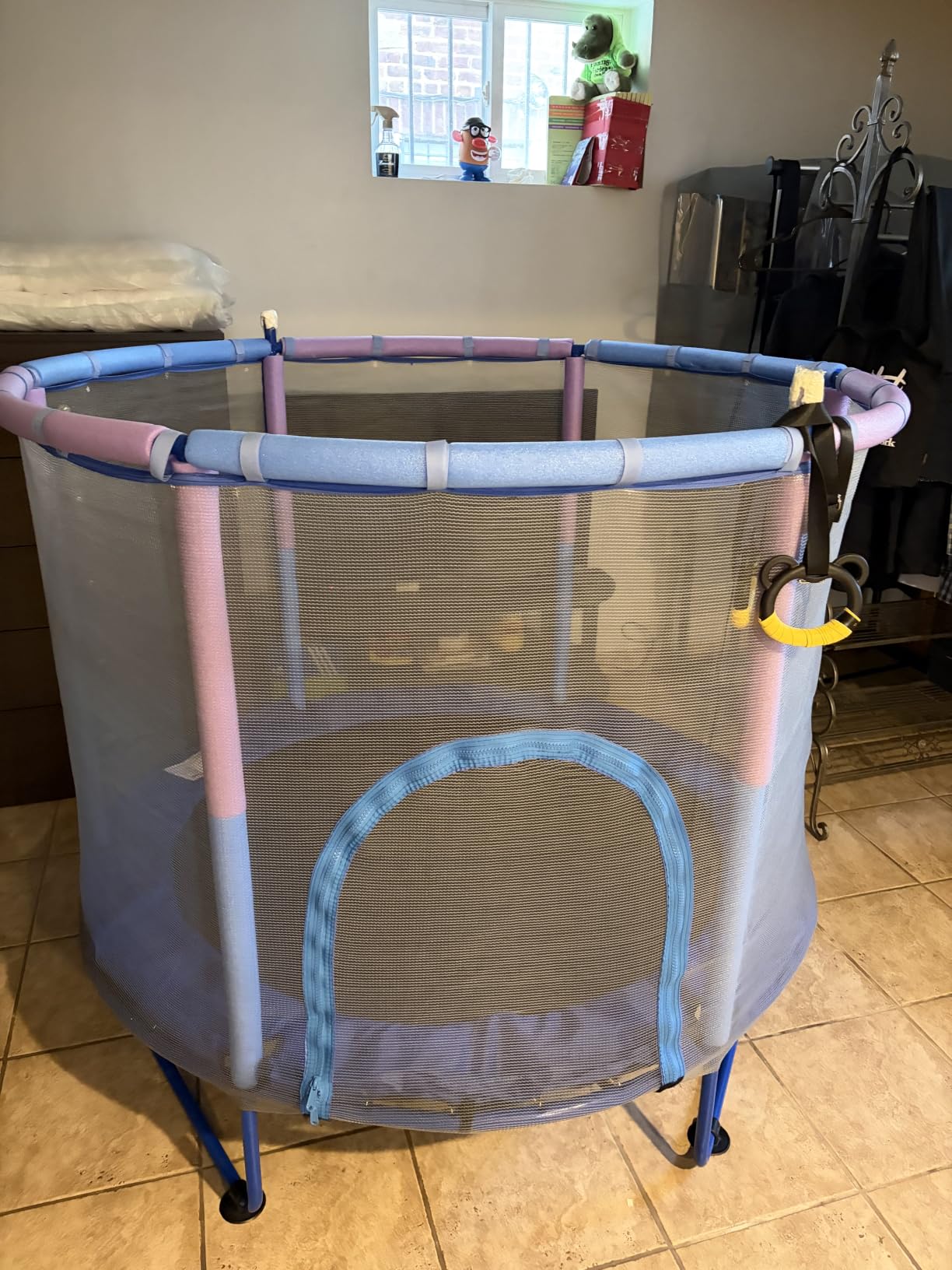
For a three-year-old who bounces hard and lands without looking, yes. The zippered enclosure, reinforced edge padding, and high-elasticity net mean a bounce that carries to the edge does not end in a fall, and the stiffer frame and mat handle a bigger child better than any 36 inch handle-bar bed in this list.
Total height including the enclosure is 54 inches, so check your ceiling clearance before you commit. A one year manufacturer warranty is included.
What ages and weight does it actually support?
Ages three to ten with a 176 pound maximum, which covers the preschool through elementary range. That is a much longer runway than a 55 or 66 pound toddler rating, and it is why this model tends to stay in a family rather than get replaced.
The one constraint to respect: every accessory has to come off before the trampoline function is used, and the adjustable handlebar can be set at different heights. Frame material is paint-coated galvanized steel, and it ships as a single unit with the playset pieces in the box.
10. ZCMHAXJ 55 Inch Toddler Trampoline with Enclosure – Most Enclosure for the Money
ZCMHAXJ 55″ Trampoline for Kids with Enclosure, 440lbs Capacity Indoor & Outdoor Toddler Trampoline with Adjustable Gymnastics Bar & Toys, Gifts for Boys & Girls
55 inch round frame
440 lb capacity
36 springs
Three-level removable bar
Pros
- Large review base for an enclosed model
- Thick carbon steel frame rated to 440 lb
- Three-level removable gymnastics bar
- Silent suction pads on the U-shaped tubes
Cons
- Instructions are small
- blurry and skip the accessories
- Base ring connection can pop apart on a hard jump
- Foam pole sleeves tear quickly
This one has the largest review base of any enclosed model here at 2817 ratings, which usually means a well-known product rather than a well-loved one. At 4.1 it is the lowest-rated pick in the roundup, and the reason is specific and consistent: assembly and finishing, not the frame itself.
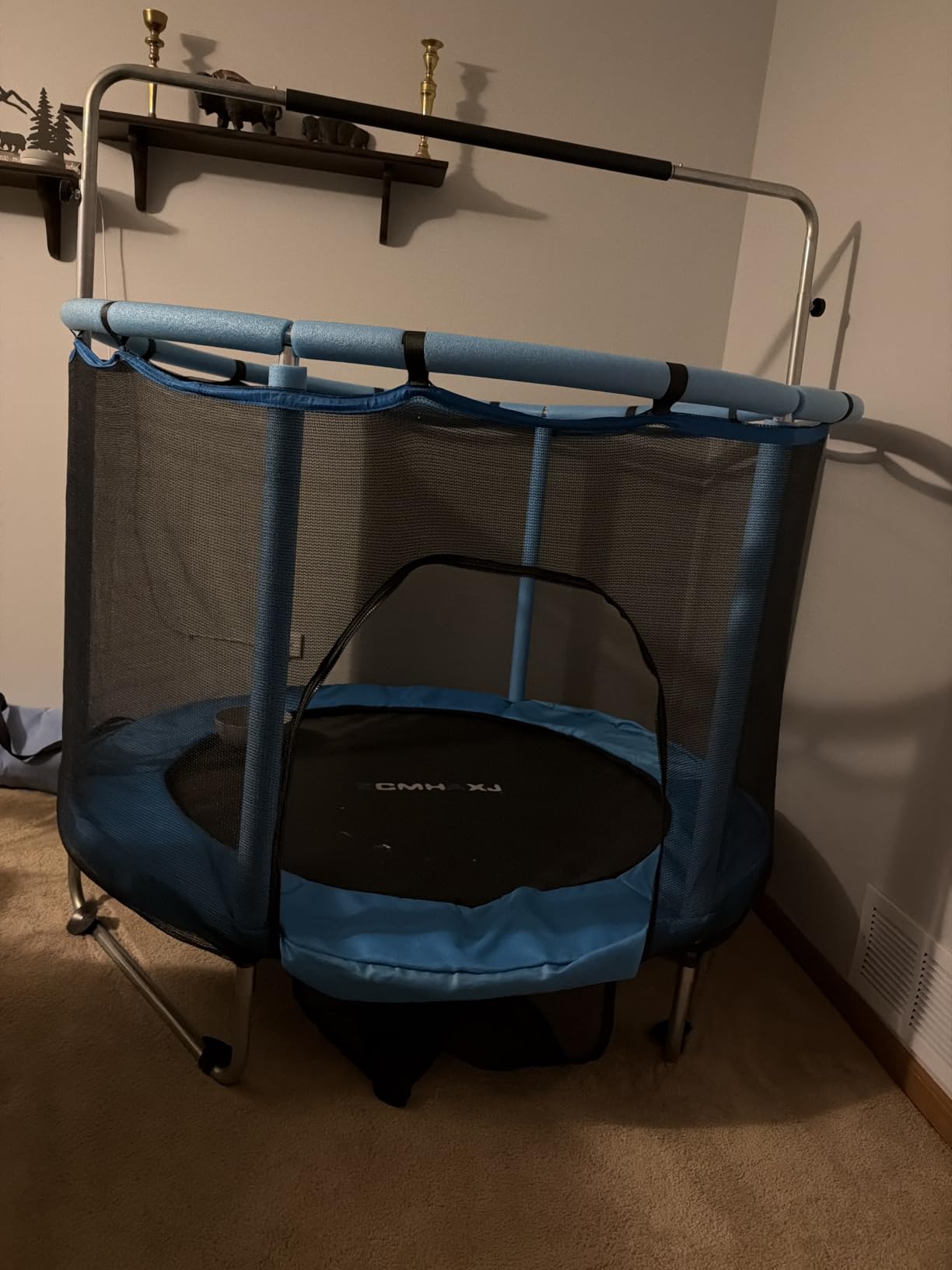
The frame is genuinely strong. Thick carbon steel, three U-shaped legs, and a 440 pound capacity, and owners describe it as taking hard play from energetic toddlers and older siblings without complaint. The three-level removable gymnastics bar is a nice touch because you can take it out when the mat gets crowded.
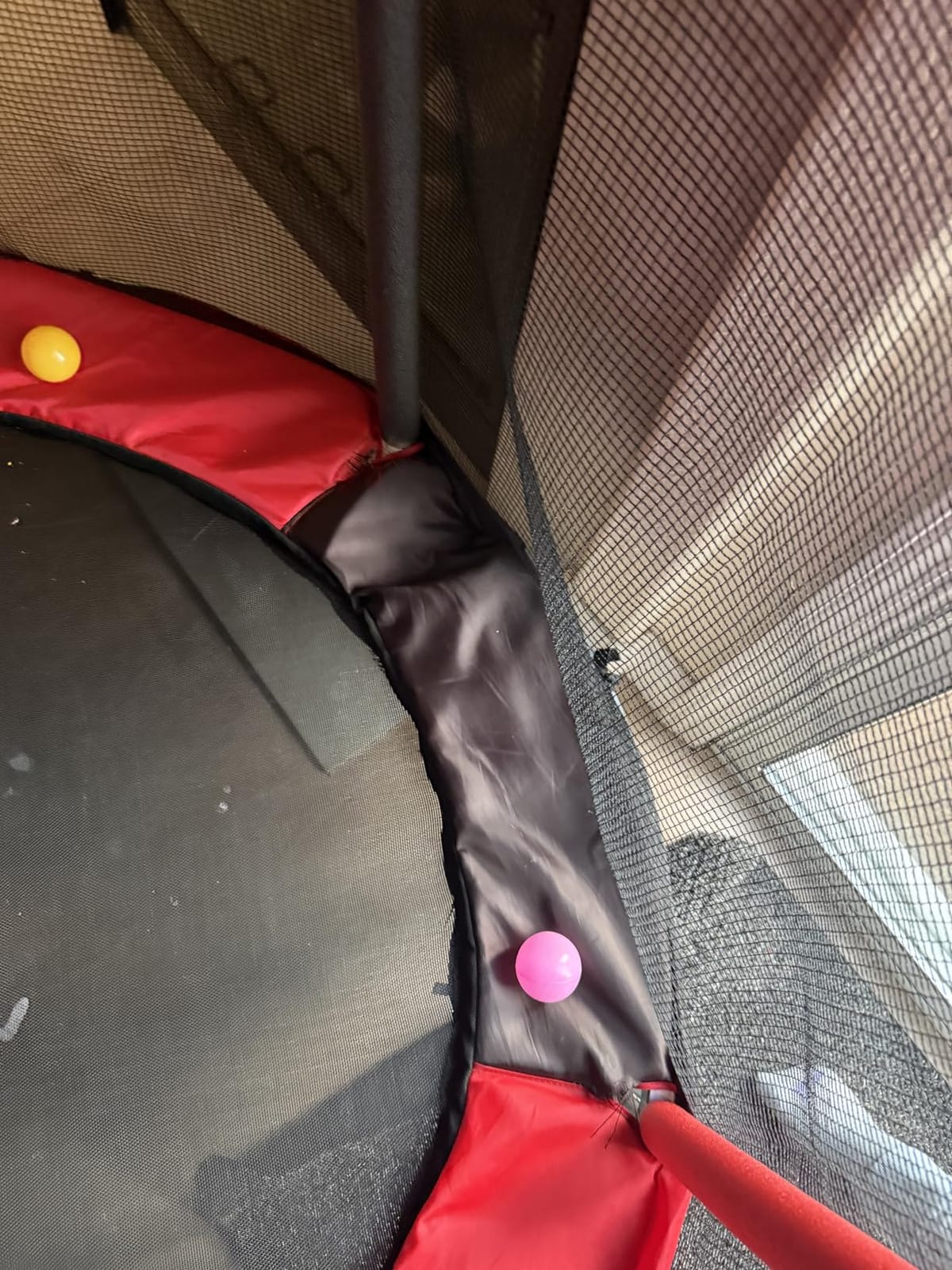
Where it falls down is the details. The instructions are small-print and blurry and do not cover the accessories at all, the base ring connection has no screws and can pop apart on the first hard jump, and the net ties have no proper anchor point, so they have to be tied to the base or the springs. Foam pole sleeves and the spring cover tear within days for some owners, and a common workaround is cutting pool noodles to sleeve the poles yourself.
If you buy this one, budget an afternoon and a roll of pool noodles, and plan to re-secure the base ring before the first serious bouncing session. Six colorways are offered, including animal prints, which children seem to like more than parents expect.
Do you need 440 pounds of capacity for a toddler?
No, but it is useful. The 440 pound rating is what lets a two-year-old and a ten-year-old share the same unit without replacement, and the three-level bar means the younger child has something to hold. If you only have one child under four, the capacity is overkill and the footprint is the real cost.
Assembled it measures 55 by 55 by 11.2 inches and weighs 14.15 kg, with 36 springs and a one year manufacturer warranty. Silent suction pads on the U-shaped tubes are a genuine plus in a shared-wall home.
Is this the best enclosed trampoline for toddlers?
It is an affordable way into a 55 inch enclosed setup, and the frame holds up. But the enclosure hardware, the instructions, and the foam components all need work after assembly, and the fit and finish sit clearly below the certified models above.
If you want an enclosed 55 inch trampoline and want to spend one afternoon instead of an entire weekend, the Yohood is the better buy. The same capacity with a certified frame, proper edge padding, and a secure zippered entrance, for more money but fewer repairs.
How to Choose a Mini Trampoline Your Toddler Can Actually Use
Almost every mistake I saw families make came down to buying on diameter or price instead of on how the child will hold on. Here is what actually decides whether a toddler trampoline gets used for two years or six weeks.
Age, honestly. Most products labelled as toddler trampolines are rated three and up, and a lot of listings contradict themselves. For a child under three, look for a model whose listing states an age or weight range that genuinely covers them, and check that the stated weight limit is not lower than your child’s realistic weight in a year. The Merax is the only unit here honestly rated from three months; most others start at three.
Handle bar or enclosure net. A padded handle bar is the right answer up to about age three, because a toddler can grip and hold it and it stops them drifting sideways. An enclosure net is the better answer once a child is bouncing hard and landing without looking, because it catches the bounce that would carry them off the edge. They are different products for different ages, not a quality tier.
Spring, elastic band, or no-gap mat. This is the most misunderstood spec. A no-gap mat closes the channel between the jump mat and the spring bed, which is where feet get caught, and only the BCAN models in this list do it properly. A springless elastic band bed removes metal from the equation entirely but gives a lower, softer bounce and wears faster. A steel-spring bed gives the liveliest bounce and keeps working longest, but needs a properly tensioned and thick cover.
Weight capacity and who shares. A 55 or 66 pound rating covers one small child and nobody else. A 110 pound rating carries one child to about four or five. A 440 pound rating is a shared-family product, not a toddler product, and the extra capacity also means a much bigger frame. Decide whether this is a one-child tool or a three-year investment before you pick a size.
Noise and your floor type. On carpet, a steel-spring bed is fine. On hardwood or tile, and especially above another household, an elastic band bed like the Ativafit 36 Inch is dramatically quieter. Floor type also determines drift, and several models in this list slide when a child bounces hard, so carpet or a rubber mat underneath is the cheap fix that works everywhere.
Folding and storage. The SereneLife folds to a quarter of its size and goes under a bed. The BCAN BT1 folds to about 3.5 inches thick. The rest are semi-permanent. If your floor space is limited, this single spec decides the purchase more often than any feature, because a trampoline that lives in the middle of the room is a trampoline nobody uses.
Ceiling clearance and supervision. An enclosed model with poles stands over 50 inches tall, so measure before you buy. And the setup rule is the same for every single product here: one jumper at a time, an adult within arm’s reach, handle screws and cover tension checked periodically, and no shoes.
For the wider context on size and setup, our guides to the best trampolines and the best trampolines with enclosures cover what changes when you move beyond the 36 inch mini format.
Frequently Asked Questions
What is the safest mini trampoline for toddlers?
The safest mini trampoline for a toddler is one that removes the three injury mechanisms rather than relying on supervision alone. Look for a foam-padded handle bar a child can grip, no exposed metal springs or a no-gap mat that closes the channel between the jump mat and the spring bed, a single-jumper size near 36 inches, and a stated age rating that genuinely covers your child. In our testing the BCAN SP1 has the most complete safety package, and the SereneLife is the safest springless option. The American Academy of Pediatrics and the Pediatric Orthopaedic Society of America both advise against recreational trampoline use for children under six, so talk to your pediatrician first.
Can a 2 year old use a mini trampoline?
A two-year-old can use a mini trampoline designed for their age, but only with an adult within arm’s reach at all times and only one jumper at a time. The AAP and POSNA recommend against trampolines for children under six because of head, neck, and spinal injury risk, and that guidance is aimed at open and full-size models. A low-to-the-ground rebounder with a padded handle bar, a bed with no visible gap, and a floor-based handle mount is a materially different object, and many pediatric OTs and PTs use them for balance and coordination work. Ask your own pediatrician before the first session, since they know your child.
What is a good mini trampoline for a 2-year-old?
A 36 inch round bed with a full-wrap foam handle bar the child can hold with both hands is the right shape for a two-year-old, because they cannot reliably grip a net and will drift into the frame without one. A springless elastic band bed is the quietest and lowest option for an apartment, while a no-gap mat design is the safest if the child bounces harder. Our pick for most families is the SereneLife 36 Inch Foldable Mini Trampoline, and the BCAN SP1 is the pick if exposed metal concerns you most.
Are mini trampolines safe for 2 year olds?
A mini trampoline built for toddlers is a different product from a full-size trampoline, and the risks are design-dependent rather than fixed. Bouncing off the edge, landing after a high bounce, and collisions between two jumpers account for most child trampoline injuries, and all three are controlled by a low bed, a handle bar, and a one-jumper rule. Parents on parenting forums split sharply on this, with some citing the under-six guidance and others saying their own pediatrician cleared it. Neither position is unreasonable. Supervise within arm’s reach, no shoes, one jumper, and check with your pediatrician.
How old should a child be before jumping on a trampoline?
There is no single answer because the rating should come from the product and your pediatrician, not from a birthday. Most 36 inch toddler trampolines are honestly rated from about three years, and a few, such as the enclosed ball-pit style jumpers, are rated from three months for sitting play. Between three and four, a child who cannot yet hold a handle bar consistently should stay off a jumping surface and use the product for supported play instead. The pediatric guidance still says wait until six for recreational use on any trampoline, and that remains the most commonly cited position.
The Best Mini Trampoline for Toddlers Is the One You Can Supervise
After ten trampolines, a broken handle screw, and a lot of small feet on a 36 inch mat, the decision is simpler than the spec sheets make it. For a single toddler in a normal home, the SereneLife 36 Inch Foldable Mini Trampoline is the best mini trampoline for toddlers pick, because it has the most owner history, a handle bar that does not wobble, no exposed metal, and a fold that lets it disappear when the floor is needed for something else.
Pick the Ativafit 36 Inch if noise through a shared wall is your real constraint, the BCAN SP1 if you want the tightest safety engineering, and the BCAN BT1 if storage is the binding constraint in your home. Go to a 55 inch enclosed model only when the trampoline has to serve more than one child or last past age four.
And before the first bounce, make the two-minute call to your pediatrician. It is the highest-value safety step in this entire roundup, and it is the one step that costs nothing.