
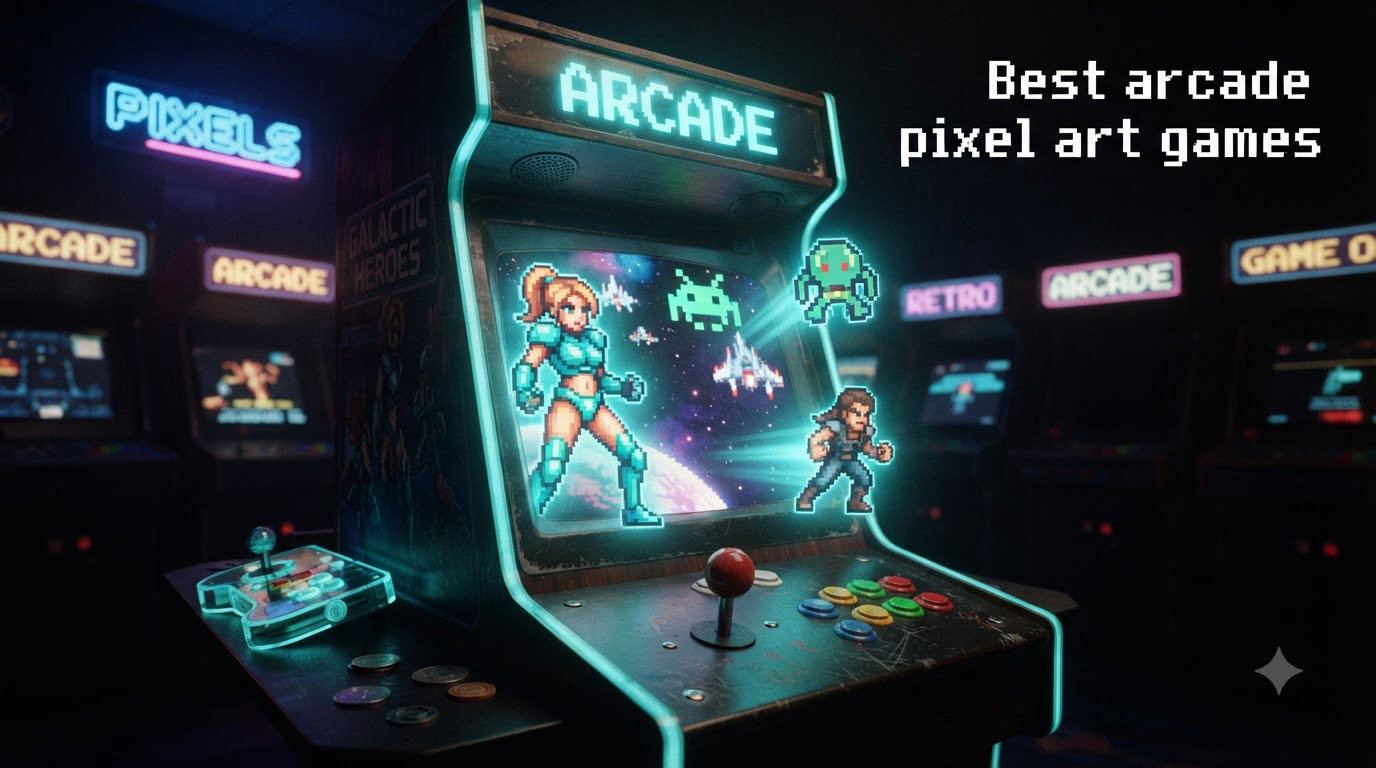
The glow of a CRT monitor, the clatter of arcade cabinet buttons, and pixels dancing across the screen in a symphony of color and motion. This is the world of arcade pixel art games, a genre that has captivated gamers for over four decades and shows no signs of slowing down. Whether you are a veteran who grew up feeding quarters into machines at the local arcade or a newcomer curious about what makes these games so beloved, this comprehensive guide will take you through the very best arcade pixel art games across every era.
The appeal of arcade pixel art games goes far beyond simple nostalgia. These handcrafted visual experiences represent some of the most innovative game design in history, where every pixel was carefully placed to create maximum impact. The combination of tight arcade-style gameplay mechanics with distinctive pixel art styles created gaming experiences that remain unmatched in their immediacy and pure fun. From the simple yet addictive gameplay of early 8-bit classics to the sophisticated modern indie pixel art games that grace our screens today, the genre has evolved while maintaining its essential character.
In this guide, we will explore the history, artistry, and enduring appeal of the best arcade pixel art games. We will revisit the legendary titles that started the arcade revolution in the 1980s, celebrate the golden age of 16-bit classics in the 1990s, and discover the incredible modern indie games that have taken the aesthetic to new heights. We will also examine what makes great arcade pixel art, appreciate the incredible soundtracks that accompany these visual feasts, and help you find the perfect game to suit your preferences.
By the end of this article, you will have a comprehensive understanding of why arcade pixel art games continue to thrive in 2026, with new titles joining the canon regularly. Whether you are looking for quick arcade action on your mobile device or immersive experiences on your gaming PC or console, there has never been a better time to dive into this remarkable genre. And if you are particularly interested in gaming on Android devices, be sure to check out our dedicated guide to the best pixel art games on Android for more targeted recommendations.
Table of Contents
What Makes Arcade Pixel Art Games So Special?
To understand the enduring appeal of arcade pixel art games, we need to appreciate both what “arcade” and what “pixel art” truly mean in the gaming context. Arcade games, at their core, are designed to be immediately engaging and accessible while offering depth for dedicated players. They emphasize skill-based gameplay, quick restarts after failure, and the satisfying loop of “one more try.” Pixel art, on the other hand, is a deliberate artistic choice rather than a technical limitation, where artists work at the granular level of individual pixels to create characters, environments, and visual effects.
The combination of these two elements creates something magical. Arcade pixel art games strip away the pretense and complexity of modern gaming to deliver pure, distilled fun. When you play a game like Galaga or Pac-Man, every pixel serves a purpose. There is no wasted screen space, no detail that does not contribute to gameplay or atmosphere. This efficiency of design is what makes classic arcade pixel art games so elegant and timeless.
The nostalgia factor plays a significant role in the genre’s enduring popularity, but it is not the whole story. Modern arcade pixel art games like Shovel Knight and Celeste prove that the aesthetic can evolve and remain fresh. These contemporary titles take the principles that made classic arcade pixel art games great, such as tight controls, precise gameplay, and distinctive visual styles, and apply them with modern game design sensibilities. The result is games that feel familiar yet excitingly new.
Another aspect that makes arcade pixel art games special is their accessibility. Unlike demanding 3D graphics that require powerful hardware, pixel art games can run on virtually any device while still looking beautiful. This has helped the genre flourish on mobile platforms, indie game scenes, and even within the constraints of browser-based gaming. The democratization of game development tools has led to an explosion of creativity in the pixel art space, with developers finding new ways to push the boundaries of what can be achieved with sprites and limited color palettes.
The social element of arcade gaming also contributes significantly to the appeal. Many arcade pixel art games feature local multiplayer, co-operative or competitive gameplay that brings friends and family together around a single screen. In an era of online gaming, there is something refreshingly immediate about sharing physical space with your gaming companions, working together to defeat a challenging boss or competing to set high scores.
Classic Arcade Pixel Art Games That Started It All (1980s)
The 1980s was the golden age of arcade gaming, and the pixel art of this era defined what the medium could achieve. Games from this decade established many of the conventions that still influence game design today, from the concept of the platformer to the evolution of the fighting game genre. Let us examine the foundational arcade pixel art games that every enthusiast should experience.
Pac-Man (1980)
Created by Toru Iwatani at Namco, Pac-Man stands as perhaps the most iconic arcade pixel art game ever made. The game introduced players to the simple yet addictive concept of navigating a maze while evading colorful ghosts, each with distinct behavioral patterns. The pixel art of Pac-Man was revolutionary for its time, featuring smooth character animation that gave personality to both Pac-Man himself and the four ghosts: Blinky, Pinky, Inky, and Clyde. The game is available on numerous platforms including modern consoles and mobile devices.
Donkey Kong (1981)
Nintendo’s Donkey Kong was the game that launched a company and an industry. Shigeru Miyamoto is credited with creating Mario (originally Jumpman) in this classic arcade pixel art game. The game features a love story told through pixel art cutscenes, with the heroine Pauline and the menacing Donkey Kong conveyed through expressive sprite work despite their limited resolution. Donkey Kong established the platformer genre and demonstrated how arcade games could tell stories through gameplay and visuals.
Galaga (1981)
N Midway’s Galaga perfected the space shooter genre with its combination of fast-paced action and strategic depth. The pixel art in Galaga is exceptional, featuring detailed alien designs, smooth diving animations, and impressive explosion effects. What sets Galaga apart is its capture mechanic, where enemies can capture your ship and force you to rescue it later in the game. The game remains one of the highest-grossing arcade games of all time and is still played competitively today.
Tetris (1984)
While originally created by Alexey Pajitnov in the Soviet Union, Tetris became an arcade phenomenon through Nintendo’s Game Boy version. The pixel art simplicity of Tetris is deceptive, as the game is deceptively deep. The seven tetromino shapes are rendered as simple colored blocks, yet the game creates endless variety through their falling and placement. Tetris proved that puzzle games could be just as compelling as action titles and remains one of the best-selling games of all time.
Street Fighter (1987)
Capcom’s original Street Fighter laid the groundwork for one of gaming’s most beloved franchises. While the pixel art of the original arcade version may seem primitive by today’s standards, it introduced special moves, health bars, and two-player competitive gameplay that would define the fighting game genre. The game featured eight playable characters, each with unique moves and origins, establishing the roster format that fighting games would adopt for decades.
The 16-Bit Arcade Boom: 1990s Pixel Art Classics
The 1990s represented the pinnacle of arcade gaming sophistication, with hardware advances allowing for richer pixel art, more colors, and smoother animations than ever before. This era produced some of the most beloved arcade pixel art games in history, many of which remain actively played and celebrated today. The 16-bit era also saw the rise of the Neo-Geo arcade system, which delivered truly stunning pixel art that has yet to be surpassed.
Street Fighter II (1991)
Capcom’s Street Fighter II is arguably the most influential fighting game ever made and one of the greatest arcade pixel art games of all time. The character sprites were massive by arcade standards, with incredible detail and fluid animation that gave each of the eight original fighters distinct personality. The game introduced special moves, combo systems, and tournament-style competition that changed gaming forever. Street Fighter II’s pixel art set a new standard for the industry and remains a touchstone of character animation.
Metal Slug Series (1996-2000)
Nazca Corporation and later SNK created the Metal Slug series, which represents run-and-gun pixel art at its absolute finest. The games feature military-themed action with tanks, infantry, and incredible explosion effects, all rendered in gorgeous pixel art with massive sprites and meticulous detail. Metal Slug is frequently cited by fans as having some of the best pixel art in any game, with hand-drawn animation and creative visual effects that make every moment feel alive. The series also features co-operative gameplay that remains a blast to experience.
Sonic the Hedgehog (1991)
Sega’s answer to Mario redefined what a platformer could be with its emphasis on speed and attitude. Sonic the Hedgehog featured vibrant pixel art filled with bright colors and flowing animation, capturing the energy of the 1990s perfectly. The game introduced loop-de-loops, springs, and physics-based platforming that felt revolutionary. Sonic became a cultural phenomenon and proved that arcade platformers could compete with Nintendo’s offerings while establishing Sega as a major gaming force.
Teenage Mutant Ninja Turtles (1989)
Konami’s Teenage Mutant Ninja Turtles arcade game brought the beloved franchise to arcades with outstanding side-scrolling beat ’em up gameplay and detailed pixel art. The game allowed up to four players simultaneously, creating chaotic and fun co-operative sessions. Each turtle had unique combat moves, and the pixel art did an excellent job of translating the cartoon’s style into the arcade format. The game remains a nostalgic favorite for anyone who grew up in the late 1980s and early 1990s.
The Neo-Geo platform, developed by SNK, deserves special mention for its contribution to arcade pixel art. Games like The King of Fighters series, Samurai Shodown, and Metal Slug pushed pixel art to its absolute limits with 4096-color palettes, massive sprites, and animation quality that still impresses today. The Neo-Geo hardware was essentially a home console masquerading as an arcade system, which is why many of its games were eventually ported to console and still look phenomenal.
Modern Indie Arcade-Style Pixel Art Games
The indie game movement has embraced arcade pixel art aesthetics with tremendous enthusiasm, creating some of the most acclaimed games of the past decade. These modern titles take inspiration from classic arcade games while adding contemporary design sensibilities, resulting in experiences that feel both nostalgic and fresh. Let us explore the modern indie arcade-style pixel art games that have earned their place among the greats.
Shovel Knight (2014)
Yacht Club Games’ Shovel Knight is a love letter to classic NES-era platformers, particularly the early Mega Man and Castlevania games. The pixel art in Shovel Knight is meticulously crafted, with every sprite and animation frame hand-drawn to capture the look and feel of 1980s Nintendo games. The gameplay is equally impressive, offering tight controls, creative level design, and a perfect difficulty curve. Shovel Knight proves that the classic arcade platformer formula still has tremendous potential when executed with care and passion.
Celeste (2018)
Maddy Makes Games’ Celeste is a masterclass in combining challenging precision platforming with emotional storytelling. The pixel art style is deceptively simple, using a limited color palette to create expressive character animation and atmospheric environments. What sets Celeste apart is how its pixel art communicates the protagonist Madeline’s anxiety and personal journey, using visual metaphors like climbing a mountain as a representation of overcoming mental health challenges. The game has received widespread acclaim for both its gameplay and its sensitive storytelling.
Dead Cells (2018)
Motion Twin’s Dead Cells brings roguelike elements to the arcade action genre with spectacular results. The pixel art is dark and beautiful, featuring intricate creature designs, atmospheric environments, and satisfying combat effects. The game features permanent progression alongside randomized level generation, creating addictive gameplay loops that keep players coming back. Dead Cells demonstrates how modern indie developers can take arcade-style action to new heights while maintaining the aesthetic charm of pixel art games.
Katana ZERO (2019)
Askiisoft’s Katana ZERO is a neo-arcade action game that combines pixel art with film noir aesthetics. The game features slow-motion combat, time manipulation abilities, and a gripping narrative about memory and identity. The pixel art style is crisp and distinctive, using high contrast and neon accents to create a retrofuturistic atmosphere. Katana ZERO has been praised for its tight gameplay, unique visual presentation, and willingness to experiment with narrative structure.
Blasphemous (2019)
The Game Kitchen’s Blasphemous combines Metroidvania exploration with dark pixel art inspired by Spanish religious art. The game features grotesque and beautiful pixel art that creates an atmosphere of gothic horror, with each environment filled with disturbing imagery and religious symbolism. The pixel art animation is exceptional, bringing the pixelated saints and sinners to life in disturbing and memorable ways. Forum discussions consistently highlight Blasphemous as a game with some of the most impressive pixel art in recent memory.
Broforce (2015)
Free Lives’ Broforce is an explosive celebration of 1980s action movies, featuring destructible environments and over-the-top violence rendered in charming pixel art. The game features parody versions of action heroes like Bromander and The Brodetor, each with unique abilities. The pixel art is colorful and exaggerated, perfectly capturing the spirit of the films it parodies. The co-operative gameplay is chaotic and hilarious, making Broforce a must-play for fans of retro arcade action.
Hidden Gems: Arcade Pixel Art Games You Might Have Missed
While AAA titles and indie darlings dominate the conversation, there are countless hidden gem arcade pixel art games that deserve more attention. These games often fly under the radar despite offering exceptional experiences, and exploring them can be incredibly rewarding for discerning gamers willing to look beyond the mainstream.
Huntdown (2020)
Coffee Stain Publishing’s Huntdown is a run-and-gun platformer that draws inspiration from classic 16-bit arcade games like Metal Slug. The pixel art is absolutely gorgeous, featuring detailed industrial environments, expressive character animation, and spectacular boss designs. The game supports two-player co-operative play and offers challenging gameplay that rewards skill and coordination. Despite its quality, Huntdown remains relatively unknown compared to similar titles, making it a perfect hidden gem for arcade enthusiasts.
Star Renegades (2020)
Raw Fury’s Star Renegades combines tactical RPG combat with arcade-style action in a procedurally generated sci-fi setting. The pixel art features a distinct hand-drawn quality, with characters rendered as detailed sprites against colorful alien landscapes. The game features a rebellion against an evil empire, with procedurally generated missions and encounters that create high replayability. The combat system is innovative, blending turn-based strategy with real-time action sequences.
Cuphead (2017)
Studio MDHR’s Cuphead deserves mention even though its art style is technically hand-drawn cel animation rather than pixel art. The game is frequently discussed alongside arcade pixel art games due to its retro 1930s cartoon aesthetic and challenging arcade-style gameplay. Cuphead features bosses that are works of art, animated with the same techniques used in Fleischer Studios cartoons. The gameplay is brutal but fair, requiring pattern recognition and precise inputs to defeat each boss.
Forum discussions on Reddit and ResetEra consistently highlight these hidden gems as games that deserve more recognition. Community members frequently express frustration that marketing budgets often determine which games become popular, leaving exceptional titles like Huntdown and Star Renegades relatively obscure. By seeking out these hidden gems, you can discover some of the most creative and enjoyable arcade-style experiences available while supporting developers who prioritize quality over marketing.
Classic vs Modern Arcade Pixel Art: How the Style Has Evolved
The evolution of arcade pixel art across decades represents one of the most fascinating artistic journeys in gaming. Comparing classic arcade pixel art games from the 1980s and 1990s to modern indie pixel art reveals both continuity in principles and dramatic advances in technique. Understanding this evolution helps us appreciate both the pioneering work of early game artists and the refined craft of contemporary pixel art developers.
| Aspect | Classic Arcade Pixel Art (1980s-1990s) | Modern Indie Pixel Art |
|---|---|---|
| Color Palette | Limited to 16-256 colors due to hardware constraints | Much larger palettes, sometimes thousands of colors |
| Resolution | Typically 240p-480p, with tiny sprite sizes | Often 720p or higher, with larger detailed sprites |
| Animation | 2-8 frames per animation cycle | 12-60+ frames for smooth animation |
| Art Direction | Influenced by hardware limitations | Deliberate artistic choices, various retro styles |
| Effects | Simple particle effects, limited to palette tricks | Complex shaders, lighting effects, post-processing |
One of the most significant advances in modern pixel art is the concept of HD-2D, pioneered by Octopath Traveler and similar games. HD-2D combines pixel art characters and environments with 3D backgrounds and modern lighting effects, creating a unique aesthetic that pays homage to classic sprite-based games while taking advantage of modern hardware capabilities. This approach has proven incredibly popular, with games like Sea of Stars and Octopath Traveler 2 continuing to refine the technique.
Despite these advances, the core principles of great arcade pixel art remain unchanged. Whether you are looking at a 1985 sprite from Ninja Gaiden or a 2024 sprite from Sea of Stars, the best pixel art shares certain qualities: clear readability, expressive animation, cohesive color design, and art direction that supports gameplay rather than distracting from it. Modern indie artists have studied the classics extensively and learned from both their triumphs and their limitations.
The animation quality in modern pixel art has increased dramatically, with contemporary games featuring frame-by-frame animation that rivals hand-drawn cartoons. Games like Blasphemous and Dead Cells feature creature animations that convey personality and weight, using principles established in classical animation like squash and stretch, anticipation, and follow-through. This attention to animation fundamentals helps modern pixel art feel alive and responsive in ways that early arcade games could not achieve.
The Sound of Pixels: Chiptune and Arcade Soundtracks
While visual art often takes center stage in discussions of arcade pixel art games, the music and sound design are equally important to the overall experience. The soundtracks of these games have left an indelible mark on gaming culture, influencing music genres and inspiring countless musicians. Understanding the role of music in arcade pixel art games adds another dimension to our appreciation of the medium.
Classic arcade games from the 1980s used specialized sound chips to create their distinctive chiptune music. The Yamaha YM2612, PSG, and similar chips produced the iconic beeps and boops that defined arcade audio. Composers like Koji Kondo (Super Mario Bros.), Hirokazu Tanaka (Metroid), and Yuzo Koshiro (Streets of Rage) created memorable melodies using severe technical constraints, proving that creativity thrives within limitations. These chiptune soundtracks remain influential today, inspiring entire music genres and communities dedicated to preserving and creating 8-bit and 16-bit style music.
Modern arcade-style pixel art games continue the tradition of memorable soundtracks while incorporating contemporary musical influences. Games like Undertale feature dynamic soundtracks that react to gameplay, while Shovel Knight pays homage to classic NES music with compositions that feel authentically retro yet fresh. Dead Cells features an industrial-inspired soundtrack that complements its dark atmosphere, and Katana ZERO’s synthwave score perfectly captures its neo-noir aesthetic.
“The best arcade pixel art games understand that music and visuals must work together as a unified experience. When Pac-Man’s theme plays or Metal Slug’s military brass kicks in, the audio transforms good pixel art into an unforgettable sensory experience.”
Forum discussions frequently highlight soundtrack quality as a factor in their favorite arcade pixel art games. Community members express emotional connections to specific game soundtracks, with many describing how the music brings back powerful memories of gaming sessions with friends and family. Some players specifically seek out games with exceptional chiptune or chiptune-inspired soundtracks, creating a subculture around arcade audio appreciation.
How to Choose the Right Arcade Pixel Art Game for You
With so many excellent arcade pixel art games available across multiple platforms and decades of content to explore, choosing where to start can feel overwhelming. By considering a few key factors, you can narrow down your options and find games that will provide the most enjoyment based on your preferences, available platforms, and gaming style.
Consider Your Preferred Platform
Arcade pixel art games are available on virtually every gaming platform, from mobile devices to current-generation consoles and gaming PCs. If you prefer gaming on the go, mobile platforms offer many excellent options, including retro arcade ports and modern indie games designed for touch controls. Console players might prefer the premium versions of games like Shovel Knight and Celeste, which often include additional content and refined controls. PC gaming provides access to the largest library of arcade pixel art games, including obscure indie titles and retro game preservation platforms.
Identify Your Genre Preferences
Arcade pixel art games span numerous genres, from pure action platformers to puzzle games to fighting games. Classic arcade enthusiasts might gravitate toward faithful recreations of arcade classics like Pac-Man, Galaga, and Street Fighter II. Players who enjoy precision platforming should explore Celeste, Shovel Knight, and Super Meat Boy. Fans of action RPGs and Metroidvanias might prefer Dead Cells, Blasphemous, or Hollow Knight. Understanding which genres appeal to you most will help narrow your choices significantly.
Difficulty Considerations
Arcade pixel art games are known for their challenging difficulty curves, though modern titles often include accessibility options. Classic arcade games typically feature punishing difficulty designed to extract quarters from players, while modern indie games frequently offer multiple difficulty modes. Celeste, for example, includes an assist mode that allows players to adjust game speed and remove obstacles. If you prefer less stressful gaming experiences, look for games with generous checkpoint systems or adjustable difficulty settings.
Single Player vs Multiplayer
Consider whether you prefer gaming alone or with friends. Many arcade pixel art games offer co-operative multiplayer, including TMNT, Metal Slug, and Broforce. These games create social gaming experiences perfect for local multiplayer sessions. Single-player arcade pixel art games like Celeste, Shovel Knight, and Katana ZERO focus on personal skill development and narrative experiences. Some games offer both, with strong single-player campaigns alongside multiplayer options.
Regardless of your preferences, there has never been a better time to explore arcade pixel art games. The genre continues to evolve with new releases, remastered classics, and preservation efforts that keep vintage games accessible. Whether you are revisiting childhood favorites or discovering classic games for the first time, the world of arcade pixel art gaming offers endless entertainment. And for more mobile-focused recommendations, do not forget to explore our guide to the best pixel art games on Android.
Frequently Asked Questions About Arcade Pixel Art Games
What pixel art game has 100 endings?
While no single arcade pixel art game has exactly 100 endings, several games come close in terms of branching paths and multiple conclusions. The NES classic Zelda II: The Adventure of Link features multiple endings depending on your performance. More recently, Undertale gained fame for its multiple endings based on player choices, though not quite reaching 100. Some dungeon crawlers and roguelikes offer near-infinite replayability through procedural generation rather than scripted endings.
What is the best pixel game ever?
Determining the “best” pixel art game is inherently subjective and depends on personal criteria. However, games like The Legend of Zelda: A Link to the Past, Chrono Trigger, Stardew Valley, and Undertale frequently appear on “best of” lists due to their exceptional pixel art, gameplay, and cultural impact. Modern games like Celeste, Shovel Knight, and Hollow Knight have also earned their place among the greats through critical acclaim and passionate fan communities.
Are arcade pixel art games still popular?
Arcade pixel art games remain incredibly popular in 2026. The indie scene continues to produce acclaimed pixel art titles, while classic arcade games are preserved and remastered for modern platforms. Games like Shovel Knight have sold millions of copies, and new pixel art games regularly appear on best-seller charts. The aesthetic continues to attract both nostalgic players and newcomers who appreciate the distinctive visual style.
Why do pixel art games have such strong nostalgia appeal?
Pixel art games trigger nostalgia because they remind players of childhood gaming experiences from the 1980s and 1990s, when this visual style represented the cutting edge of gaming technology. The limited color palettes and sprite-based graphics create a distinct aesthetic that feels authentic and charming. Many modern pixel art games deliberately evoke the emotional warmth of retro gaming while incorporating contemporary gameplay improvements, appealing to both veterans and new players.
What makes great arcade pixel art?
Great arcade pixel art combines several key elements: a cohesive color palette that creates visual harmony, smooth sprite animation with frame-by-frame detail, clear readability of gameplay elements, and art direction that supports the overall experience rather than distracting from it. Games like Metal Slug and Shovel Knight exemplify these qualities, with meticulously crafted pixel art that enhances gameplay while creating memorable visual impressions.
Final Thoughts on the Best Arcade Pixel Art Games
The world of arcade pixel art games represents one of gaming’s most vibrant and enduring genres. From the pioneering classics of the 1980s that established the medium to the sophisticated modern indie games that push pixel art to new heights, these games continue to captivate players across generations.
What makes arcade pixel art games so special is their unique combination of accessibility, artistry, and pure gameplay fun. These games strip away the complexity of modern gaming to deliver immediate, satisfying experiences that reward skill while welcoming newcomers. Whether you prefer the nostalgic charm of Pac-Man and Donkey Kong, the visual sophistication of Metal Slug and Neo-Geo classics, or the modern refinement of Shovel Knight and Celeste, there is something in the world of arcade pixel art for everyone.
As we look to the future, the arcade pixel art genre shows no signs of slowing down. New developers continue to join the scene, bringing fresh ideas and artistic visions to the medium. Meanwhile, preservation efforts ensure that classic arcade pixel art games remain accessible for future generations to discover and enjoy. Whether you are a seasoned arcade veteran or a curious newcomer, the journey through the best arcade pixel art games offers endless rewards.
We encourage you to dive in, explore different eras and styles, and discover your personal favorites among these remarkable games. The perfect arcade pixel art game for you is waiting to be found, whether it is a legendary classic you somehow missed or a modern indie gem that deserves a wider audience.