
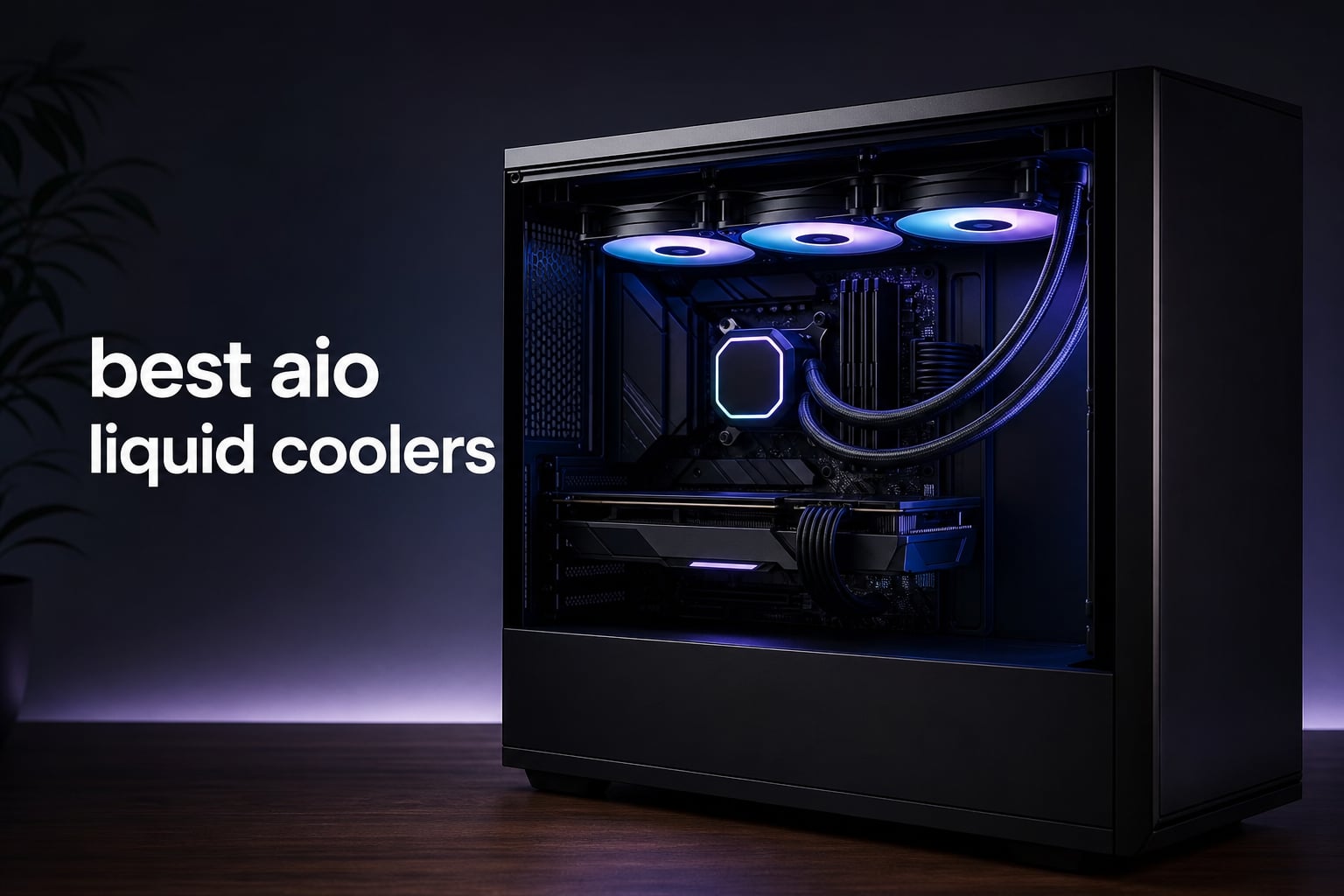
The best AIO liquid coolers move CPU heat to a radiator outside the crowded socket area, which can make a high-end gaming PC easier to cool and easier to build around. An all-in-one liquid cooler is a sealed loop: a pump sends coolant from the CPU block through tubes to a radiator, and its fans release that heat into the case airflow.
I would begin with case clearance, not appearance. A 360mm radiator can be a smart match for sustained rendering or a heavily loaded high-end CPU, but a well-fitted 240mm or 280mm AIO CPU cooler is often the more sensible choice for a typical gaming system.
This guide compares 12 current models using the listed radiator sizes, fan and pump details, socket support, warranty information, and customer-rating data. If your chassis takes a larger radiator, our guide to 420mm AIO liquid coolers is a useful next stop; for a broader shortlist, see these liquid CPU coolers.
The short answer on brands is that there is no single winner for every build. ARCTIC stands out here for its thick 360mm radiator and integrated VRM fan, Corsair offers strong cable-focused options and long listed warranties on selected models, while NZXT is the display-focused route; the right brand is the one whose radiator fits and whose controls you will actually use.
The top 3 picks are the (August 2026)
These category picks are a fast answer for builders who want a direction before reading the full list. They are not a temperature chart: this selection is based on the verified feature sets and fit priorities in the product data.
Best overall: ARCTIC Liquid Freezer III Pro 360 A-RGB pairs a 38mm radiator with P12 Pro fans, offset mounting, cable routing in the tube sleeve, and a small VRM fan. Best value-oriented compact pick: Thermalright Aqua Elite 240 V3 supplies two ARGB fans, listed 66.17 CFM airflow, and broad current socket support. Best with a screen: PCCOOLER DC360 has a 2.4-inch IPS display plus 90.56 CFM listed fan airflow.

These 12 AIO liquid coolers cover the main radiator sizes in 2026
The overview below puts the whole field in one place. Before narrowing it down, compare the physical radiator class with the manufacturer’s case specification, then check whether the mounting hardware covers your exact AMD or Intel socket.
| Product | Specifications | Action |
|---|---|---|
 Corsair Nautilus 360 RS ARGB Corsair Nautilus 360 RS ARGB |
|
Check Latest Price |
 Thermalright Aqua Elite 240 V3 Thermalright Aqua Elite 240 V3 |
|
Check Latest Price |
 MSI MAG Coreliquid A13 360 MSI MAG Coreliquid A13 360 |
|
Check Latest Price |
 ID-COOLING FX360 PRO ID-COOLING FX360 PRO |
|
Check Latest Price |
 NZXT Kraken Core 240 RGB NZXT Kraken Core 240 RGB |
|
Check Latest Price |
 Corsair iCUE Link Titan 240 RX Corsair iCUE Link Titan 240 RX |
|
Check Latest Price |
 Cooler Master 360L Core Cooler Master 360L Core |
|
Check Latest Price |
| ARCTIC Liquid Freezer III Pro 360 |
|
Check Latest Price |
 Thermaltake TH120 ARGB Sync V2 Thermaltake TH120 ARGB Sync V2 |
|
Check Latest Price |
 PCCOOLER DC360 PCCOOLER DC360 |
|
Check Latest Price |
 NZXT Kraken Elite 280 RGB NZXT Kraken Elite 280 RGB |
|
Check Latest Price |
 NZXT Kraken Plus 280 NZXT Kraken Plus 280 |
|
Check Latest Price |
The Corsair Nautilus 360 RS ARGB is the straightforward 360mm choice for a motherboard-controlled build.
CORSAIR Nautilus 360 RS ARGB Liquid CPU Cooler – 360mm AIO – Low-Noise – Direct Motherboard Connection – Daisy-Chain – Intel LGA 1851/1700, AMD AM5/AM4 – 3X RS120 ARGB Fans Included – White
360mm
20 dBA pump
RS120 ARGB fans
Pros
- 20 dBA listed pump
- Daisy-chain wiring
- Pre-applied paste
- AM5 and LGA1851
Cons
- No listed display
- 360mm case clearance needed
The Nautilus 360 RS ARGB makes a practical first choice when you want a large radiator without committing to a separate proprietary controller. Corsair lists direct motherboard connection, three RS120 ARGB fans, and daisy-chained connections, so the build should have fewer individual fan leads to route.
The supplied 20 dBA pump specification is appealing for a quiet PC build, while the product page lists a 36 dB overall noise level. Those are different measurements, so I would treat them as component specifications rather than a promise of a specific in-case noise result.
Its convex cold plate arrives with thermal paste applied, and support includes AMD AM5/AM4 plus Intel LGA 1851/1700. That makes it a simple option for current platforms, provided the case supports a 360mm radiator and the required fan depth.
Case fit is the deciding check before choosing this 360mm radiator.
Check top and front mounting clearance with fans installed, not radiator length alone. A 360mm liquid cooling system can conflict with motherboard heatsinks, tall RAM near a top mount, or a front-mounted GPU clearance path.
Motherboard control is the cleanest way to run its lighting and fans.
The direct-connection and daisy-chain design suits builders who prefer BIOS fan curves and their board’s ARGB software. Corsair lists a five-year manufacturer warranty, which adds useful long-term coverage to a closed-loop component.
The Thermalright Aqua Elite 240 V3 is the compact value pick for cases that cannot take a 360mm unit.
Pros
- Compact 240mm format
- 66.17 CFM listed
- ARGB motherboard sync
- AM5 and LGA1851
Cons
- Less radiator area than 280mm or 360mm
- No listed warranty detail
Thermalright’s Aqua Elite 240 V3 is the best fit when a 240mm mount is what your case offers and you still want an AIO water cooler. It combines a fourth-generation pump head, two S-FDB-bearing PWM ARGB fans, and a listed 66.17 CFM maximum airflow figure.
The manufacturer lists the pump at up to 2800 RPM and a 40,000-hour lifespan. That is a component claim rather than a guarantee for the full loop, but it gives shoppers a clearer durability data point than many entries in this category.
For compatibility, this model supports AMD AM4/AM5 and Intel LGA 1150/1151/1200/1700/1851. Its 5V three-pin ARGB connection should be matched with the correct motherboard header; do not force it onto a different RGB connector.
Radiator fit is easier with this 240mm format than with a larger AIO.
A 240mm unit is often easier to position in a smaller case, but measure the mounting area and tube route anyway. It remains a better match for moderate loads than a 120mm radiator, with two fans sharing the job.
Fan control is most useful when you set a sensible PWM curve.
Start with a gradual curve rather than a sharp ramp at ordinary gaming temperatures. The listed 25 dB noise figure and S-FDB fan bearings make this a reasonable candidate for a balanced profile, though case panels and fan orientation change what you hear.
The MSI MAG Coreliquid A13 360 is a long-tube 360mm option with an integrated-pump radiator design.
MSI MAG Coreliquid A13 360 – AIO ARGB CPU Liquid Cooler – 360mm Radiator – LGA 1700/1851 / AM5/AM4 Compatible – Triple 120mm ARGB PWM Fans, Black
360mm
3800 RPM pump
390mm tubing
Pros
- Split-flow radiator
- 390mm tubing
- LGA1851 ready
- Three-phase pump
Cons
- 360mm mount required
- Three-year warranty
The MSI MAG Coreliquid A13 360 is worth attention when tube reach and a current-socket kit matter. MSI lists 390mm evaporation-proof tubing, which can help with front-radiator routing in a taller mid-tower or full tower.
Its split-flow radiator includes the pump, and the listed three-phase motor design is intended to reduce motor resonance. MSI states pump operation up to 3800 RPM and includes thermal paste, making the hardware list fairly complete for a fresh installation.
The product supports AMD AM5/AM4 and Intel LGA 1700/1851, with LGA 1851 ready out of the box. Its listed 14.4 dB value sounds low, but as with every specification, fan curve, placement, and chassis acoustics decide the finished system’s sound.
Tube length is the feature that separates this model from many basic 360mm AIOs.
Longer tubes give more choices for routing the radiator with the tubes at the bottom or side, depending on the chassis layout. Avoid tight bends and confirm that the tube path will not press against a GPU backplate or side panel.
Installation works best when the radiator is secured before the pump block.
Mount the radiator and fans loosely first, then establish a comfortable tube path before tightening the CPU block. That sequence makes it easier to check that the tubing is not bearing the block’s weight.
The ID-COOLING FX360 PRO is the airflow-focused 360mm choice for a black gaming build.
ID-COOLING FX360 PRO Liquid CPU Cooler for Desktop – 360mm AIO Cooler, 3 x 120mm High-efficient Fans, Special CD Pattern Pump Header, Intel & AMD Compatible
360mm
82.5 CFM
2900 RPM pump
Pros
- 82.5 CFM listed airflow
- Daisy-chain connectors
- All-black look
- AM5 and LGA1851
Cons
- 35.2 dB listed noise
- 360mm clearance needed
The FX360 PRO targets builders who want three high-airflow fans and minimal visual distraction. ID-COOLING lists 82.5 CFM maximum airflow, 2.55 mmH2O maximum air pressure, and a 2900 RPM pump, alongside a plain all-black layout.
The stated 350W TDP capability is a brand claim, not a cross-brand benchmark result. I would use it as a sign of the cooler’s intended workload class, then select it only after confirming radiator clearance and your CPU’s real power behavior.
Daisy-chain fan connectors are a welcome build detail because three radiator fans can otherwise create a busy cable run. Socket support covers Intel LGA 1851/1700 and earlier listed Intel sockets, plus AMD AM4/AM5.
Airflow is the main reason to select the FX360 PRO.
Its 82.5 CFM maximum figure is among the higher fan-airflow figures listed in this group. More airflow can aid radiator heat transfer at high speed, though it can also mean more audible fan noise.
Noise tuning is needed if you prefer a low-key gaming PC.
ID-COOLING lists 35.2 dB, so this is not the first unit I would choose strictly for silence. A custom PWM curve that limits fan speed during lighter work is the first adjustment to make after checking temperatures.
The NZXT Kraken Core 240 RGB is the tidy 240mm option with a single-frame fan assembly.
NZXT Kraken Core 240 RGB – AIO CPU Liquid Cooler – 240 mm Radiator – 240 mm Single-Frame Fan – Compatible with Intel® LGA 1851/1700/1200/115X & AMD® AM5/AM4 – Black
240mm
3100 RPM pump
Single-frame RGB fan
Pros
- Single-frame fan
- Fewer screws and cables
- 3100 RPM pump
- Five-year warranty
Cons
- 240mm radiator size
- 31.9 dB listed noise
The Kraken Core 240 RGB puts installation neatness ahead of an oversized radiator. Its single-frame RGB Core fan design reduces the number of separate components to mount and wire, which is a genuine advantage when the top of the case is crowded.
NZXT lists a 3100 RPM pump for heavy gaming and multitasking, 75.05 CFM airflow, and PWM fan control. The cooler connects directly to the motherboard, so it suits a builder who does not want to add a separate controller just for a 240mm radiator.
Compatibility includes AMD AM5/AM4 and Intel LGA 1851/1700/1200/115X. The five-year manufacturer warranty is a positive counterweight to the general forum concern about closed-loop pump longevity.
Cable reduction is the clear advantage of the single-frame fan design.
Fewer screws and connectors mean fewer chances to trap a cable beneath the radiator or forget a fan lead. Plan the fan and RGB header connections before the radiator is fully tightened against the case roof.
Performance fit is strongest for a capable but space-limited system.
A 240mm AIO is not automatically weak; it simply has less radiator surface than 280mm and 360mm alternatives. For continuous heavy workstation loads, I would compare it with the larger units in this guide before deciding.
The Corsair iCUE Link Titan 240 RX RGB is the cable-management pick with a six-year listed warranty.
Pros
- iCUE Link hub included
- Zero RPM mode
- Pre-mounted RX fans
- Six-year warranty
Cons
- Needs system hub
- 240mm radiator
Corsair’s iCUE Link Titan 240 RX RGB is for builders willing to use the iCUE Link system in exchange for a cleaner interconnect approach. It includes the system hub and pre-mounted RX RGB fans, so the cooler arrives designed as part of a coordinated cable ecosystem.
The FlowDrive cooling engine uses a three-phase motor pump, while PWM control reaches up to 2100 RPM and includes Zero RPM mode. The listed fan airflow is 73.5 CFM; Zero RPM mode is especially useful when silent idle operation matters more than a constant breeze through the radiator.
It supports Intel LGA 1851/1700 and AMD AM5/AM4. A six-year manufacturer warranty is one of the longest listed here, which is meaningful because sealed-loop serviceability is limited compared with a custom loop.
Controller planning is required before installing the iCUE Link Titan.
Reserve a suitable place for the included hub and map its power and data connections before routing the radiator. This is more deliberate than a simple motherboard-only setup, but it can leave the finished case less cluttered.
Low-load behavior is the feature to prioritize for a quiet desk setup.
Zero RPM mode can stop the radiator fans during low demand, but use a curve that restarts them smoothly as temperatures climb. Do not judge any cooler only by idle silence; gaming and rendering load are the real stress cases.
The Cooler Master 360L Core is the familiar 360mm ARGB choice with included CryoFuze thermal paste.
Cooler Master 360L Core AIO CPU Liquid Cooler – 360mm Radiator, 3X ARGB PWM Fans, Patented Gen S Dual-Chamber Pump, Quiet Cooling & Easy Installation, AMD AM5/AM4 & Intel LGA 1851/1700, Black
360mm
Gen S pump
CryoFuze thermal paste
Pros
- Gen S dual-chamber pump
- CryoFuze paste included
- ARGB fans
- AM5 and LGA1851
Cons
- Two-year warranty
- 360mm fit required
The Cooler Master 360L Core has a conventional three-fan formula, making it easy to understand for a first large-radiator build. It includes three ARGB PWM fans, a Gen S dual-chamber pump, and CryoFuze thermal paste specified at 14W/mK thermal conductivity.
Cooler Master lists 71.93 CFM airflow, 1800 RPM maximum fan speed, and 27.2 dB noise. The lower maximum fan speed can be attractive to people who dislike the sharp sound of very high-RPM fans, although no single dB number replaces a standardized review comparison.
The mounting package supports AMD AM5/AM4 and Intel LGA 1851/1700. The listed warranty is two years, so I would register it immediately and retain the proof of purchase after installation.
Thermal-paste inclusion makes a replacement build less complicated.
The included CryoFuze paste means you have a named paste specification rather than an unknown packet. Apply it as directed if you ever remove the preinstalled block or reinstall the cooler after a CPU change.
Lighting setup is simplest when all ARGB headers are checked first.
Its frosted fan blades are designed to spread ARGB illumination. Confirm that the motherboard has enough headers or use a compatible splitter, and keep the 5V addressable-RGB standard separate from 12V RGB connectors.
The ARCTIC Liquid Freezer III Pro 360 A-RGB is the best overall option for thermal headroom and VRM attention.
Pros
- 38mm radiator
- Integrated VRM fan
- Offset mounting
- Contact frame included
Cons
- Thick radiator needs clearance
- No listed noise figure
The Liquid Freezer III Pro 360 A-RGB has the most distinct cooling hardware package in this roundup. ARCTIC uses a 38mm radiator, P12 Pro fans that reach a listed 3000 RPM, native offset mounting, and an integrated VRM fan beside the pump block.
That VRM fan is not a substitute for motherboard airflow, but it can provide targeted airflow around voltage regulators. The cooler also includes an Intel LGA 1851/1700 contact frame and supports AMD AM5/AM4, giving current-platform builders a well-considered mounting package.
ARCTIC routes PWM cables within the tube sleeve, a small detail that keeps a water cooled PC looking cleaner. Its six-year warranty and 4.5 rating from 2.5k+ reviews make it the model I would start with for a powerful CPU when the case has enough room.
Radiator thickness is the compatibility detail that cannot be skipped.
The 38mm radiator is thicker than many standard AIO radiators, and fans add further depth. Check the manufacturer’s radiator-plus-fan clearance, especially for a top installation where RAM and motherboard heatsinks compete for space.
VRM airflow is helpful when the motherboard area runs warm.
The integrated VRM fan offers directed cooling around the socket’s power-delivery area. It is a worthwhile feature for a high-end CPU build, but a case still needs balanced intake and exhaust for the benefit to matter.
The Thermaltake TH120 ARGB Sync V2 is the single-fan choice for the tightest compatible cases.
Thermaltake TH120 ARGB Sync V2 CPU Liquid Cooler/AlO Liquid Cooling/Fan 120mm*1/PWM 500~2000 RPM/Mirror Waterblock/MB ARGB Sync Control, CL-W360-PL12SW-A , Black
120mm
Mirror waterblock
2000 RPM PWM fan
Pros
- Small 120mm radiator
- Broad socket support
- Rotating mirror cap
- ARGB motherboard sync
Cons
- Least radiator area
- Two-year warranty
The TH120 ARGB Sync V2 exists for builds with a 120mm radiator mount and little else. It has one PWM fan rated from 500 to 2000 RPM, a copper base plate, motherboard ARGB synchronization, and an infinity-mirror waterblock cap that can rotate through 360 degrees.
Its socket list is unusually broad, covering Intel LGA 1851/1700 and older Intel platforms as well as AMD AM5/AM4 and earlier AMD sockets. That range is useful for a refresh build, though the 120mm format should set realistic expectations for high-end CPU cooling.
Thermaltake lists 25.8 dB noise and a two-year warranty. I would reserve this model for a constrained chassis, a lower-power CPU, or an owner whose priority is moving away from a stock cooler without changing the case.
Space saving is the valid reason to choose a 120mm AIO.
One 120mm fan and radiator take far less mounting space than the rest of the roundup. That advantage disappears if the CPU is routinely subjected to long, high-power workloads that need more heat-exchange area.
Socket flexibility makes this a practical upgrade for older hardware.
Verify the exact CPU socket against the manual even with this broad list. Keep the hardware grouped by socket during installation; mixed standoffs are a common source of poor mounting pressure.
The PCCOOLER DC360 is the best screen-equipped 360mm unit for builders who want live system information.
PCCOOLER CPU Cooler, 360mm AIO Liquid Cooling, High-Performance Pump, 2.4” IPS Display, CPS ARGB Water Cooling with Quiet F5 R120 Fans(DC360 Black)
360mm
2.4 inch IPS
90.56 CFM fans
Pros
- 2.4 inch IPS screen
- 90.56 CFM listed airflow
- 400mm sleeved tubes
- ARGB sync
Cons
- 39.8 dB listed noise
- No listed warranty detail
The PCCOOLER DC360 puts the visual feature on the pump block: a 2.4-inch IPS display that can show CPU temperatures, logos, and animations. It is the best AIO liquid cooler with screen in this selection if you want the display without dropping to a smaller radiator class.
Behind the screen, PCCOOLER lists a 2600 RPM pump at 15 dBA and F5 ARGB fans that reach 2500 RPM, 90.56 CFM, and 4.07 mmH2O static pressure. The product’s 39.8 dB listed noise level shows why I would set a measured fan curve instead of leaving every fan at maximum.
The CNC aluminum housing and 400mm sleeved tubes support a polished build, while socket support includes AMD AM4/AM5 and Intel LGA 115X/1200/1700/1851. Check how the display is controlled before buying if you want particular monitoring or animation behavior.
Display value is highest when you will use temperature monitoring regularly.
A pump display is useful when it shows a temperature or workload figure you actually check from your desk. If it will only show a static image, a less complex model may be a better match for your build priorities.
Full-speed fan noise needs active control on this high-airflow design.
Its fan specification favors airflow and static pressure, both useful for a dense radiator. Build a PWM curve around your own CPU temperature behavior, since 2500 RPM is more fan speed than many idle and light-gaming scenarios require.
The NZXT Kraken Elite 280 RGB is the premium large-display option with 140mm fan spacing.
NZXT Kraken Elite 280 RGB 2024 – AIO CPU Liquid Cooler – 280mm Radiator – F280 RGB Core Fan – Customizable 2.72″ IPS LCD – NZXT Turbine Pump – AMD® AM5, AM4 – Intel® LGA 1851/1700, 1200/115X – White
280mm
2.72 inch IPS LCD
Tool-free mounting
Pros
- Large 2.72 inch LCD
- 280mm radiator
- Tool-free brackets
- Six-year warranty
Cons
- 10 percent one-star reviews
- 34.5 dB listed noise
The NZXT Kraken Elite 280 RGB is the display-first pick for a case that supports a 280mm radiator. Its 2.72-inch IPS LCD has 640 by 640 resolution, a 60Hz refresh rate, and 690 cd/m² stated brightness, giving it more visual impact than the smaller screen on the Kraken Plus.
NZXT says the Turbine pump is designed for high flow and head pressure, while the radiator uses an RGB Core single-frame fan setup. Pre-applied thermal paste, a single breakout cable, and tool-free brackets help make the physical installation less intimidating than the feature set suggests.
The 4.3 rating is based on 531 reviews, with 10% one-star ratings in the supplied data. That does not diagnose a specific fault, but it is a reason to read current warranty terms, test every display and fan function during the return period, and retain serial information.
Radiator compatibility favors cases that explicitly list 280mm support.
A 280mm radiator uses two 140mm fans, so it is not interchangeable with a 240mm mount even though both have two fans. Confirm width as well as length, particularly at the roof of compact cases.
Display customization is the reason to pick the Elite rather than a simpler NZXT model.
The screen can handle system information, GIFs, images, and listed integrations such as Spotify and YouTube. Choose it when that customization is part of the build goal, not because you expect a display alone to change cooling capacity.
The NZXT Kraken Plus 280 is the smaller-screen 280mm alternative with Zero RPM mode.
NZXT Kraken Plus 280 – AIO CPU Liquid Cooler – 280mm Radiator – 2 x F140P Fans – Customizable 1.54″ Square LCD – AMD® AM5, AM4 – Intel® LGA 1851/1700, 1200/115X – Black
280mm
1.54 inch LCD
Zero RPM mode
Pros
- 280mm radiator
- 1.54 inch LCD
- Zero RPM mode
- Tool-free mounting
Cons
- 12 percent one-star reviews
- Display is smaller than Elite
The Kraken Plus 280 is the NZXT route for someone who wants a 280mm radiator, a display, and a less dominant pump screen. Its 1.54-inch square LCD can show temperatures, images, GIFs, and selected web integrations through NZXT CAM.
The listed high-static-pressure fans include Zero RPM mode for silent low-load periods. A single breakout cable, pre-applied thermal paste, and tool-free mounting brackets follow the same build-friendly approach found on the larger Elite line.
It supports AMD AM5/AM4 and Intel LGA 1851/1700/1200/115X, and NZXT lists a six-year manufacturer warranty. Its supplied review mix includes 12% one-star ratings from 322 reviews, so I would pay attention to setup, firmware prompts, and the functionality of every component right away.
Screen size is the practical difference between Kraken Plus and Kraken Elite.
The Plus has a 1.54-inch square screen, while the Elite’s display is substantially larger. Pick the Plus if basic monitoring or a small animation is enough and you prefer the pump head to stay visually restrained.
Idle silence is realistic when the rest of the case airflow is also planned.
Zero RPM mode can make radiator fans silent at low load, but other case fans and the GPU may still be audible. Set the entire system’s fan curves together so the cooler does not become quiet while heat lingers inside the chassis.
The right AIO size follows your case clearance, CPU workload, and noise goal.
Start with the case manual. A 240mm radiator normally uses two 120mm fans, a 280mm radiator uses two 140mm fans, and a 360mm radiator uses three 120mm fans; each needs not just length but enough depth for the radiator and its fans.
A 360mm AIO is not automatically overkill for a Ryzen 7 9800X3D. For ordinary gaming, a good 240mm or 280mm model can be sufficient, but a 360mm unit can run fans at a lower speed or provide more thermal capacity for long mixed workloads if your case accommodates it.
Socket support must match the CPU and included mounting hardware.
AM5 and Intel LGA 1851/1700 are the main current checks across this roundup. Verify the exact model’s box contents and manual before opening the thermal-paste packet, since older stock may have a different bracket set.
Radiator placement works best when it supports natural case airflow.
A top-mounted radiator often acts as exhaust, while a front mount can work as intake depending on the case. The better choice is the one that avoids tube strain, clears the GPU and motherboard, and maintains a sensible intake-to-exhaust path.
Noise depends on the whole curve rather than a single decibel number.
Pump and fan figures are often measured differently, so compare like with like only when a source provides the same method for every cooler. In a real PC, set gradual PWM curves, listen for pump tone at idle, and avoid abrupt fan ramps near common gaming temperatures.
Software and cables should be chosen as carefully as radiator size.
Some models connect directly to motherboard fan and ARGB headers, while iCUE Link uses its included hub and NZXT’s display features use CAM. Community discussions commonly flag RGB compatibility and cables as pain points, so map the required headers and USB connections before checkout.
AIO lifespan is usually about pump health and coolant aging, not regular refilling.
Most AIOs are closed systems and do not have a user-service refill routine. Over years, pump wear and gradual coolant permeation can affect performance; periodic dust cleaning, checking fan and pump behavior, and keeping warranty records are more useful than trying to open the loop.
Forum discussions often mention failures after two to three years, but that is anecdotal rather than a universal lifespan. Listed five- and six-year warranties on several models provide a stronger purchase safeguard, and you should investigate new rattling, persistent temperature changes, or pump errors promptly.
For CPU-specific fit ideas, see our guide to CPU coolers for Ryzen 7800X3D. Builders comparing the ARCTIC model with other options can also browse the best Arctic CPU coolers list, while all our CPU cooler guides collect the wider category.
These answers cover the AIO questions buyers ask most often.
Which brand of AIO is best?
ARCTIC is the strongest all-round choice in this list for builders who have clearance for its 38mm 360mm radiator, thanks to its integrated VRM fan, offset mount, and six-year warranty. Corsair is a strong choice for cable-focused builds, while NZXT is best suited to buyers who value an LCD display. Check case fit first.
Is a 360mm AIO overkill for a 9800X3D?
A 360mm AIO is not required for a 9800X3D gaming build, but it is not overkill if your case supports it and you want more radiator area or lower fan speeds during long workloads. A capable 240mm or 280mm AIO can also be a sensible choice when space, simpler mounting, or lower overall bulk matters more.
Is AIO or liquid cooling better?
An AIO is liquid cooling: it is a sealed, preassembled liquid-cooling loop with a pump, tubes, CPU block, radiator, and fans. Compared with a custom liquid loop, an AIO is much simpler to install and needs less ongoing attention. Compared with an air cooler, it can move heat to a larger radiator location but adds a pump and more fit considerations.
What is the average lifespan of an AIO cooler?
There is no fixed lifespan for every AIO cooler because pump wear, coolant permeation, operating temperature, and manufacturing all matter. Plan around the stated warranty and monitor temperatures and pump behavior over time. Most sealed AIOs are not designed for owner refilling; clean radiator dust and act on persistent new noise or temperature changes.
The ARCTIC Liquid Freezer III Pro 360 is my first pick when the case supports its thicker radiator.
For the best aio liquid coolers in 2026, start with the ARCTIC if you want thermal-oriented hardware, the Thermalright if a compact 240mm layout is the priority, or the PCCOOLER and NZXT options if the screen is part of the build you want to see every day.
Measure the radiator mount, confirm the socket kit, and plan fan, pump, RGB, USB, and controller connections before ordering. That short compatibility check matters more than any single specification on a product page.