
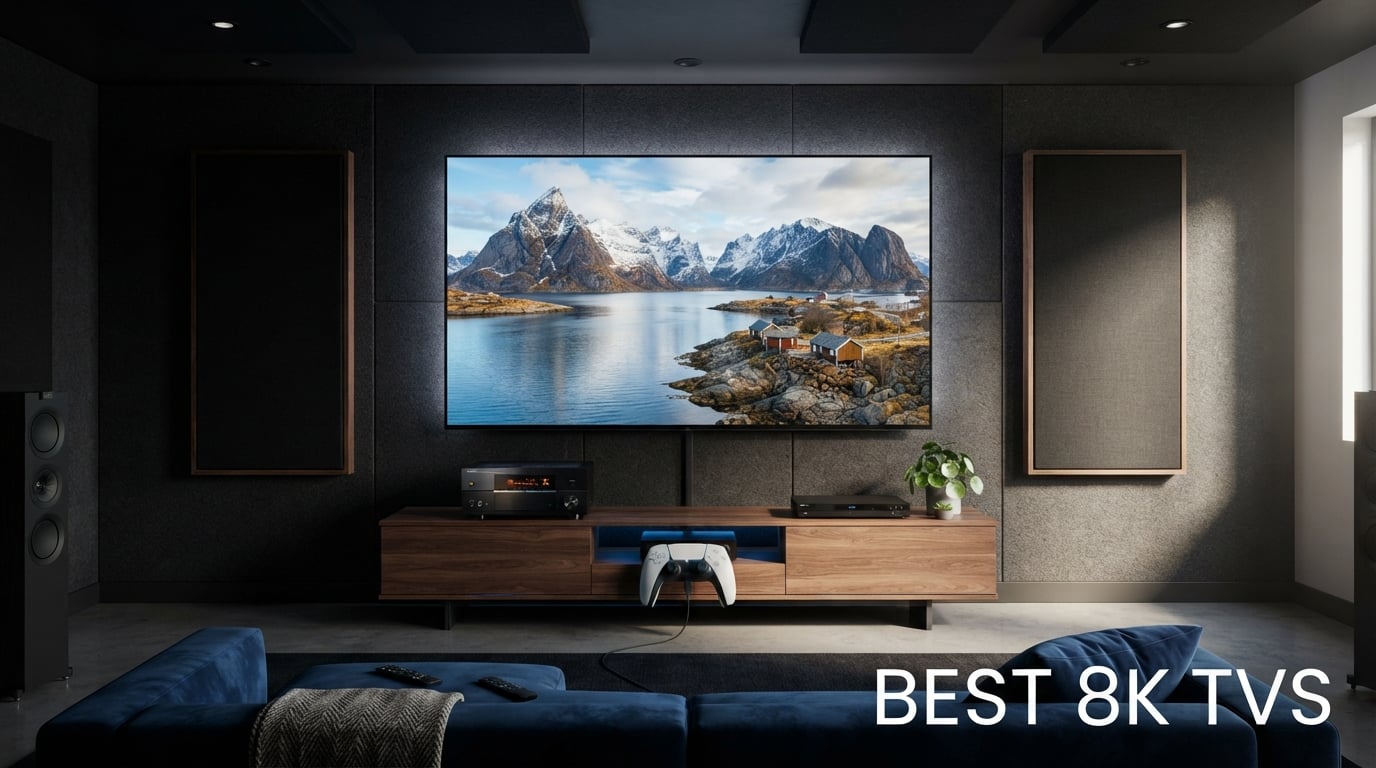
The best 8K TVs are remarkable large-screen displays, but they are not an automatic upgrade from a great 4K TV. I would consider one only for a 75-inch or 85-inch screen, a seating position close enough to benefit from the density, and a real interest in premium upscaling rather than a hope for a large native-8K streaming library.
An 8K television has 7,680 by 4,320 pixels: four times the pixel count of 4K and sixteen times Full HD. That sounds decisive, yet the source material most people watch is still 4K, HD, or lower, so the processor, backlight, HDR support, and room setup usually matter more than the 8K badge.
We compared all eight available models by their documented panel technology, processors, refresh-rate claims, sound systems, inputs, ratings, and review patterns. The skeptical view from home-theater forums is built into the recommendations: very little native 8K content exists, current consoles target 4K, and many viewers will see a bigger improvement from a strong 4K display than from extra pixels.
For an 8K home-cinema build, the rest of the signal chain matters. Our best home theater receivers for 8K TVs guide covers a useful companion for HDMI 2.1 sources, while our roundup of graphics cards for 8K movie playback is relevant to PC-based playback.
Table of Contents
These top 3 picks match the main 8K TV use cases
The Samsung QN900F is our editor’s choice because it pairs the highest listed rating in this group, 4.5 from 37 reviews, with an 85-inch glare-free Neo QLED panel, 256 AI neural networks, 165Hz motion support, and five HDMI ports. The Sony Z9K is the focused choice for a PlayStation 5 setup and Dolby Vision movies, while the Samsung QN900D is the high-refresh-rate option for a gaming PC or sports-heavy room.
None of those choices changes the basic 8K reality. Pick a model for its screen size, Mini LED contrast, processing, connections, and day-to-day 4K performance; treat native 8K as a future possibility, not the source you will watch every evening.
These are the best 8K TVs in 2026 at a glance
This full comparison makes the differences easier to sort. Ratings and review counts are listing snapshots, not laboratory scores, but the combination of feedback and documented features shows why some models are easier to recommend than others.
| Product | Specifications | Action |
|---|---|---|
 Samsung QN900F 85 inch Samsung QN900F 85 inch |
|
See details |
 Sony Z9K 75 inch Sony Z9K 75 inch |
|
See details |
 Samsung QN900C 75 inch Samsung QN900C 75 inch |
|
See details |
 Samsung QN900D 75 inch Samsung QN900D 75 inch |
|
See details |
 Samsung QN800B 65 inch Samsung QN800B 65 inch |
|
See details |
 Samsung QN900B 75 inch Samsung QN900B 75 inch |
|
See details |
 Samsung QN990F 85 inch Samsung QN990F 85 inch |
|
See details |
 Samsung QN800D 85 inch Samsung QN800D 85 inch |
|
See details |
1. Samsung QN900F is the best 8K TV for bright large rooms
Samsung 85-Inch Class Neo QLED 8K QN900F Series, Vision AI, Mini LED Smart TV (2025 Model, 85QN900F) Neo Quantum HDR 8K Pro, Object Tracking Sound + w/Dolby Atmos, Glare Free, Alexa Built-in
85 inch Neo QLED
NQ8 AI Gen2
165Hz motion
Pros
- 4.5 rating
- Glare Free coating
- 256 AI neural networks
- 70W Atmos audio
- 5 HDMI ports
Cons
- 368W power draw
- 37-review sample
The 85-inch QN900F is the most balanced entry in this list. Its Neo QLED screen combines Ultimate 8K Dimming Pro and Neo Quantum HDR 8K Pro, while the Glare Free treatment speaks directly to the bright windows and lamps that can undermine a large TV in a family room.
Samsung specifies an NQ8 AI Gen2 Processor and 256 AI neural networks. I would view that as its main everyday benefit: processing for 4K, HD, and lower-resolution sources, not a claim that it can turn ordinary streaming into genuine native 8K detail.
Motion Xcelerator 165Hz supports smooth motion up to 4K at 165Hz. The 4.2.2-channel, 70-watt Object Tracking Sound+ system with Dolby Atmos is a capable built-in arrangement, and five HDMI ports are unusually handy once a receiver, consoles, PC, and streamer all need a home.
The QN900F fits viewers who need reflection control and ports
I would put the QN900F first for an 85-inch living room where daytime viewing matters as much as dark-room movies. The 600 by 400 mm VESA pattern, 101.9-pound listed weight, and 75.1-inch width mean the mount and wall deserve planning before it arrives.
Its nearly edgeless metal design is a welcome touch in a large installation, but it is the glare handling, input count, processing, and high listed rating that make its case. The 37-review sample is encouraging, not definitive.
The QN900F needs a buyer who accepts 8K’s limits
This is not the answer for somebody shopping primarily for native 8K streaming, because the supplied research says that content ecosystem is effectively absent. A viewer seated far from the screen should not assume the added pixel density will be easy to detect.
The 368-watt power figure is another practical consideration. Choose it for a very large screen, processing, and glare control rather than as a low-draw display or a promise of instant 8K source material.
2. Sony BRAVIA XR Z9K is the best 8K TV for PlayStation 5 owners
Sony 75 Inch 8K Ultra HD TV Z9K Series: BRAVIA XR 8K Mini LED Smart Google TV with Dolby Vision HDR and Exclusive Features for The Playstation® 5 XR75Z9K- Latest Model,Black
75 inch Mini LED
Cognitive Processor XR
PS5 features
Pros
- Dolby Vision
- PS5 Auto HDR mapping
- VRR and ALLM
- Google TV
- BRAVIA CAM included
Cons
- Older model
- 16-review sample
Sony’s 75-inch Z9K uses the Cognitive Processor XR, XR Backlight Master Drive, and XR Triluminos Pro instead of Samsung’s neural-network naming. It carries a 4.2 rating from 16 reviews and is the clearest choice here for a PlayStation 5-centered setup because it explicitly lists Auto HDR Tone Mapping.
Its HDMI 2.1 feature set includes 4K at 120Hz, VRR, and ALLM. That distinction is welcome: it matches real current console use, which remains 4K-first, instead of suggesting that a buyer will regularly play console games in native 8K.
Dolby Vision HDR, IMAX Enhanced, Google TV, Google Assistant, BRAVIA CAM, and BRAVIA CORE credits create a feature mix that differs sharply from the Samsung alternatives. Four HDMI and two USB ports are sufficient for a focused setup, although not as flexible as the five HDMI ports on the QN900F.
The Z9K serves PS5 players and Dolby Vision movie fans
I would examine the Z9K if PS5 gaming and Dolby Vision are established priorities rather than occasional extras. The documented gaming features support 4K at 120Hz with VRR and ALLM, while its Mini LED backlight and Sony processing target contrast and color.
Acoustic Multi-Audio and 3D Spatial Audio are helpful for an all-in-one TV installation. A full surround system is still the stronger option for a theater room, which is why an HDMI 2.1 receiver can be a meaningful companion.
The Z9K is less suitable for buyers seeking the newest specification sheet
The listing calls it a 2022 model and its 16 reviews are a small feedback sample. I would not pick it solely for the Sony name when a newer Samsung processor count or higher listed motion capability is the actual priority.
It has a well-defined reason to exist: Sony processing, Dolby Vision, Google TV, and explicit PS5 features. Without those preferences, compare it closely with the newer Mini LED models in this roundup.
3. Samsung QN900C is the best 8K TV for ambitious built-in sound
SAMSUNG 75-Inch Class Neo QLED 8K QN900C Series Mini LED Quantum HDR Smart TV with Infinity Screen, Dolby Atmos, Object Tracking Sound Pro, Alexa Built-in (QN75QN900C, 2023 Model)
75 inch Neo QLED
Neural Processor 8K
74.5W audio
Pros
- Infinity Screen
- Quantum Matrix Pro
- 144Hz motion
- 74.5W 6.2.4 audio
- Anti-glare viewing
Cons
- FireOS listing
- 178W standby figure
The QN900C brings an Infinity Screen, Quantum Matrix Pro Mini LED backlight, and Neural Quantum Processor 8K to a 75-inch format. Its 4.1 rating from 60 reviews gives it more feedback behind it than most of the highest-specification models here.
Its clearest differentiator is sound: Samsung lists a 6.2.4-channel, 74.5-watt system with Dolby Atmos and Object Tracking Sound Pro. That does not replace separated speakers, but it is one of the more substantial audio configurations in the analyzed products.
It also lists up to 144Hz Motion Xcelerator Turbo Pro, four HDMI ports, anti-glare treatment, Ultra Viewing Angle, Pantone Validated color, and a Slim One Connect box. Those are credible features for a wall-mounted, wide-seating home-cinema room.
The QN900C works for a clean wall-mounted cinema arrangement
I would consider this set when the edge-to-edge screen and external connection box solve a real cable-routing issue. Moving source connections to the Slim One Connect box can make a large wall installation look less cluttered.
The anti-glare and wide-angle features add practical value for a room with side seating. Its 75-inch size is also more manageable than an 85-inch display without giving up the core Mini LED and 8K-upscaling proposition.
The QN900C needs a check of its exact platform details
The product record lists FireOS, which is unusual relative to other Samsung entries that list Tizen. Anyone committed to a particular smart-TV interface should confirm the software configuration of the exact unit before deciding.
The record also gives a 178-watt standby figure. Verify current product documentation and power information, then judge it as a sophisticated 75-inch TV rather than assuming every listing detail applies to all configurations.
4. Samsung QN900D is the best 8K TV for high-refresh-rate gaming
Samsung 75-Inch Class Neo QLED 8K QN900D Series Mini LED, Neo Quantum HDR Smart TV w/Dolby Atmos, Object Tracking Sound Pro, AI Motion Enhancer Pro, Alexa Built-in (QN75QN900D, 2024 Model)
75 inch Mini LED
NQ8 AI Gen3
240Hz motion
Pros
- 512 AI neural networks
- 240Hz Motion Xcelerator
- AI Motion Enhancer Pro
- 4 USB ports
- Infinity Air design
Cons
- HDR10 listing
- 382W power draw
The QN900D is Samsung’s most gaming-focused 75-inch choice on paper. It has the NQ8 AI Gen3 Processor, 512 AI neural networks for AI Upscaling Pro, and Motion Xcelerator 240Hz in an almost-invisible Infinity Air Design.
AI Motion Enhancer Pro is intended to help moving objects, and Quantum Matrix Pro is specified with 1.5 times more lighting zones. It also has a 6.2.2-channel Dolby Atmos system, four HDMI ports, four USB ports, Real Depth Enhancer Pro, and Auto HDR Remastering.
I would put its 4.1 rating from 41 reviews in context: it is a useful feedback signal, but not a huge pool. The listing’s HDR10 entry, rather than HDR10+ or Dolby Vision, is a meaningful limitation for buyers whose movie library depends on a preferred HDR format.
The QN900D fits a gaming PC and fast-sports room
I would shortlist this model for a compatible PC setup that can use the documented high-motion capability. It also makes sense for sports and action viewing, where processing and motion handling may provide a more obvious everyday benefit than the 8K resolution itself.
Current consoles remain centered on 4K output, a frustration repeatedly raised in forum discussions. The QN900D should therefore be bought for its 4K gaming performance and large-screen processing, not on an assumption of routine 8K console play.
The QN900D asks buyers to accept its HDR and power tradeoffs
Movie-first viewers should compare its stated HDR10 format with the Z9K’s listed Dolby Vision support. Different formats and source habits can matter more than a headline resolution number.
The 382-watt listing and 87.7-pound weight deserve a place in the decision. Its 400 by 400 mm VESA fit and physical dimensions need to work with a properly rated mount and the actual wall.
5. Samsung QN800B is the best 8K TV for a smaller room
SAMSUNG 65-Inch Class Neo QLED 8K QN800B Series Mini LED Quantum HDR 32x, Dolby Atmos, Object Tracking Sound+, Ultra Viewing Angle, Smart TV with Alexa Built-In (QN65QN800BFXZA, 2022 Model)
65 inch Mini LED
20 neural networks
120Hz panel
Pros
- 65 inch format
- Quantum Matrix Pro
- One Connect
- Atmos audio
- 4 HDMI ports
Cons
- 3.9 rating
- Older model
- 18 percent 1-star reviews
The 65-inch QN800B is the compact choice in a field dominated by 75-inch and 85-inch screens. Its 68.8-pound listed weight and 56.8-inch width make it easier to place, and it keeps core Neo QLED features rather than becoming a bare-bones alternative.
Samsung lists Quantum Matrix Technology Pro, a Neural Quantum Processor with 20 neural networks, real 8K resolution with AI upscaling, a 120Hz panel, Dolby Atmos, Object Tracking Sound+, anti-reflection treatment, and Ultra Viewing Angle. Four HDMI ports and the Slim One Connect design make it well equipped for a smaller media room.
Its feedback needs more caution than its specification sheet. It has the largest review total here at 148, but its 3.9 average rating and 18 percent one-star share mean I would read recent reports carefully before treating it as a simple entry point.
The QN800B works when 65 inches is genuinely the correct size
I would choose it because the room calls for 65 inches, not because it is the easiest path to visible 8K. At ordinary viewing distances, its useful gains may come from Mini LED contrast, HDR work, and upscaling rather than from individual pixels.
It suits a bedroom, office, or compact seating area that still needs a 120Hz display and multiple device inputs. The extra resolution cannot overcome a screen that is poorly matched to the room.
The QN800B needs careful feedback review before commitment
The 148-review sample gives the 3.9 score more context than a model with only a few ratings, and its one-star share is worth taking seriously. It does not belong above the QN900F simply because both share Samsung’s 8K branding.
As a 2022 model, it also lacks the newer NQ8 AI processor generations. Its practical case is a 65-inch size and solid connection set, not being the newest option in the category.
6. Samsung QN900B is the best 8K TV for Infinity Screen design
SAMSUNG 75-Inch Class Neo QLED 8K QN900B Series Mini LED Quantum HDR 64x, Infinity Screen, Dolby Atmos, Object Tracking Sound Pro, Smart TV, Bluetooth with Alexa Built-in (QN75QN900BFXZA, 2022 Model)
75 inch Neo QLED
Mini LED
6.2.4 channel sound
Pros
- Infinity Screen
- Quantum Matrix Pro
- 120Hz panel
- 6.2.4 audio
- Slim One Connect
Cons
- 3.9 rating
- 21 percent 1-star reviews
- Older model
The 75-inch QN900B uses the Infinity Screen design, Quantum Matrix Technology Pro Mini LEDs, and a Neural Quantum Processor 8K with 20 neural networks. It has a 120Hz panel, Game Mode with VRR support, four HDMI ports, and an attachable Slim One Connect cable-management system.
Its built-in audio is a 6.2.4-channel Dolby Atmos system with Object Tracking Sound Pro, while Quantum HDR 64x and multiple voice assistants round out the entertainment feature list. The 225-watt power-consumption figure is lower than several newer Samsung flagship listings but still relevant to a large panel.
The key concern is customer sentiment. The listing shows a 3.9 average from 107 reviews, including a 21 percent one-star share, so the design and feature list should not be treated as a substitute for current owner feedback.
The QN900B suits buyers who prioritize a minimalist wall installation
I would consider it if the edge-to-edge panel and One Connect cable routing are important for the room. The 92.2-pound listed weight and 400 by 400 mm VESA support still call for a carefully selected mount.
For mixed entertainment, its Mini LED contrast system, 120Hz motion, VRR support, and documented audio are complete enough for a serious TV-first setup. It is not merely an 8K panel with little else around it.
The QN900B is a mixed-feedback choice rather than a safe default
A 107-review sample with a notable one-star share deserves more weight than marketing language. I would independently check current support, warranty, and return terms rather than infer them from its older flagship position.
It is a 2022 model, so buyers should compare it directly with the QN900C and QN900D. Its clean installation concept and audio are the reason to examine it, not a claim of uniform owner satisfaction.
7. Samsung QN990F is the best 8K TV for maximum AI processing
Samsung 85-Inch Class Neo QLED QN990F 8K Mini LED Smart TV (2025 Model) NQ8 AI Gen3 Processor, 8K AI Upscaling Pro, Wireless One Connect, Glare Free, Samsung Vision AI, Alexa Built-in
85 inch Neo QLED
768 AI networks
Wireless Connect
Pros
- 768 AI neural networks
- Wireless One Connect
- Glare Free
- 240Hz motion
- 90W Atmos audio
Cons
- 3.7 rating
- 18-review sample
- 362W power draw
The QN990F has the most ambitious Samsung numbers in this group: an 85-inch Neo QLED Mini LED display, NQ8 AI Gen3 Processor, and 768 AI neural networks for 8K AI Upscaling Pro. It also adds Wireless One Connect, which is designed to keep source hardware connections away from the display.
Samsung lists Motion Xcelerator 240Hz, AI Motion Enhancer, a 6.2.4-channel 90-watt Dolby Atmos system, Glare Free treatment, five HDMI ports, and three USB ports. Those are substantial specifications for a large home-theater or PC-gaming wall.
Search competitors identify the QN990F as a leading 8K model, but the supplied listing has a 3.7 rating from just 18 reviews and a 20 percent one-star share. I would not allow a huge AI-network count to override such an early and mixed feedback signal.
The QN990F fits an enthusiast who wants Samsung’s largest AI spec
I would inspect this one for an 85-inch theater space where cable routing is difficult and the wireless connection box has a genuine purpose. Its everyday role is refining ordinary source material on a very dense, very large panel.
The 90-watt audio configuration is the most powerful stated system in this group, though it still does not replace dedicated speakers for a complete cinema room. Its 600 by 400 mm VESA mount and 117.7-pound listed weight call for deliberate installation.
The QN990F requires patience with its limited owner record
Eighteen reviews do not give a broad picture of long-term ownership, and the 3.7 average is below the QN900F. I would look closely at current reviews before treating this as a blind recommendation.
It also cannot solve the central content problem for 8K. If most viewing is normal streaming and console material from a typical distance, a first-rate 4K display remains a serious alternative.
8. Samsung QN800D is the best 8K TV for a feature-rich 85-inch panel
SAMSUNG 85-Inch Class QLED 8K QN800D Series Mini LED, Neo Quantum HDR Smart TV w/Dolby Atmos, Object Tracking Sound+, AI Motion Enhancer, Real Depth Enhancer Pro, Alexa Built-in (QN85QN800D, 2024)
85 inch Mini LED
512 AI networks
165Hz motion
Pros
- 2
- 000 nit listing
- 512 AI neural networks
- 165Hz motion
- 4 HDMI ports
- Depth Enhancer Pro
Cons
- 3.5 rating
- 31 percent 1-star reviews
- 127.2-pound weight
The QN800D is an 85-inch Neo QLED Mini LED model with the NQ8 AI Gen2 Processor and 512 AI neural networks. Its listing also cites 2,000 nits, Quantum Matrix Pro with additional lighting zones, Neo Quantum HDR 8K+, and Real Depth Enhancer Pro.
Motion Xcelerator 165Hz, AI Motion Enhancer, four HDMI ports, four USB ports, Dolby Atmos, and Object Tracking Sound+ make it feature rich on paper. For a large bright room, those details may matter more day to day than the difference between 4K and 8K source resolution.
Its review pattern is the decisive drawback: a 3.5 rating from 54 reviews and a 31 percent one-star share. The product insights flag reliability concerns, so the attractive screen and processing specifications come with more risk signals than our leading picks.
The QN800D fits a sizable room that can support an 85-inch Mini LED
I would assess it only when an 85-inch screen and the listed brightness capability are central to the room plan. Its 512-network processing and 165Hz motion figure make it a formidable specification package for a bright, large viewing space.
Its 127.2-pound listed weight is the highest here, with 600 by 400 mm VESA support. Wall construction, mount capacity, and installation help are basic requirements, not small details.
The QN800D demands extra caution because buyer sentiment is weak
The 54-review sample is substantial enough that a 3.5 average and 31 percent one-star share cannot be dismissed. I would prioritize current owner reports and support coverage over the neural-network and HDR claims.
For people who make their own footage, our guide to 8K action cameras for 8K TV content identifies one of the few routes to a true high-resolution source. That niche use still does not make the QN800D a general recommendation over the QN900F.
An 8K TV makes sense only when screen size and seating make it visible
The honest value case for 8K is narrow. The extra pixels can show finer detail on a very large display when seating is close, but users in home-theater forums repeatedly say the difference is difficult to justify at normal distances, especially beside a great 4K TV.
That does not make this category pointless. The QN900F, Z9K, QN900C, QN900D, QN800B, QN900B, QN990F, and QN800D each combine their panels with features that can matter now: Mini LED backlights, AI processing, high motion figures, glare reduction, sound, and modern inputs.
A 75-inch or 85-inch display gives 8K its clearest practical case
Begin with the room, wall, and seating distance. An 85-inch screen has far more chance to show the benefit of pixel density than a 65-inch screen, while a too-large display can dominate a small room regardless of resolution.
The QN800B is the appropriate choice only when 65 inches is the right fit. The 75-inch and 85-inch models have a stronger 8K argument, but screen size should still serve the room before any resolution calculation does.
AI upscaling is the feature every owner will use most
Native 8K streaming is not a dependable source, so real ownership rests on how a TV treats 4K movies, HD broadcasts, old video, and games. Samsung’s listings range from 20 neural networks in older models to 768 in the QN990F; Sony uses the Cognitive Processor XR.
Those processors can sharpen, reduce noise, and manage detail, but they cannot restore genuine source information that was never captured. That is why impressive upscaling is useful without being proof that every image becomes native 8K quality.
Mini LED and HDR can matter more than the resolution label
Every set here is a QLED or Mini LED variation. Samsung calls its local-light-control systems Quantum Matrix Technology Pro or Quantum Matrix Pro, while Sony calls its system XR Backlight Master Drive; all are intended to improve contrast and brightness control.
HDR preferences also change the decision. The Sony Z9K lists Dolby Vision, the QN900F and QN990F list HDR10+, and the QN900D record lists HDR10, so a favorite movie format can have more practical importance than a pixel count alone.
Gaming remains a 4K-first use case on an 8K television
Forum users are right to challenge 8K gaming claims: current consoles are still centered on 4K output. Look instead for documented 4K at 120Hz, VRR, ALLM, port count, and motion support when a console is the key source.
The Z9K explicitly lists 4K at 120Hz, VRR, ALLM, and PS5 Auto HDR Tone Mapping. Samsung lists up to 240Hz motion on the QN900D and QN990F, plus up to 4K at 165Hz on the QN900F, which is most relevant to compatible PCs.
Connections, sound, and power need a place in the decision
Count sources before choosing. Four HDMI ports are common, but the QN900F and QN990F provide five, a difference that helps when eARC audio, multiple consoles, a PC, and a streaming box all share the setup.
The QN990F lists 90 watts of Dolby Atmos audio and the QN900C lists 74.5 watts, but a dedicated receiver and speakers remain the better route for full surround sound. Large-screen power figures and mounting weights also belong in the plan, especially for the 85-inch models.
Future-proofing is uncertain because the 8K ecosystem is uncertain
Buyers reasonably worry that availability may shrink before native content becomes common. Some models are also older inventory, which makes current support, review quality, screen size, HDR needs, and connection needs more important than chasing the biggest processing number.
The best future-oriented decision is the TV that fits how you watch now. If that means a top 4K panel better suits your room and sources, waiting is a sensible answer rather than a compromise.
These FAQs give direct answers on buying an 8K TV
Is it worth getting an 8K TV now?
An 8K TV is worth considering only for buyers who want a 75-inch or 85-inch screen, sit close enough to see fine detail, and value AI upscaling, Mini LED contrast, and high-refresh-rate features. Native 8K content remains extremely scarce, streaming is not a dependable 8K source, and current consoles are centered on 4K output. For many rooms, a high-quality 4K TV is the more rational choice.
What 8K TV do experts recommend?
The Samsung QN990F is frequently named by search competitors as a leading 8K model because it uses Samsung’s NQ8 AI Gen3 Processor and lists 768 AI neural networks. In this comparison, the Samsung QN900F is the more balanced top pick because it combines an 85-inch glare-free screen, 256 AI neural networks, five HDMI ports, and the highest supplied rating of 4.5. Check current feedback before choosing any model.
Why are 8K TVs being discontinued?
8K TV availability is limited because demand has been constrained by scarce native 8K content, limited streaming support, and the fact that many viewers cannot see a major difference from 4K at normal distances. Console gaming is also focused on 4K. Manufacturers can still make advanced 8K displays, but fewer models make sense when buyers often choose strong 4K alternatives with comparable real-world benefits.
Is 8K TV really better than 4K?
An 8K TV has four times as many pixels as a 4K TV, so it can show finer detail on a sufficiently large screen at a close viewing distance. It is not automatically better in normal use because most content is 4K or lower and must be upscaled. A great 4K TV can be the better choice when it offers stronger contrast, preferred HDR support, or a viewing distance that makes 8K detail difficult to notice.
The Samsung QN900F is the safest first 8K TV to consider
The QN900F leads this group with the highest supplied rating, an 85-inch glare-free screen, capable AI processing, five HDMI ports, and high-refresh-rate support. The Z9K is the targeted PS5 and Dolby Vision alternative, while the QN900D is the Samsung choice for buyers who focus on motion.
Even among the best 8K TVs in 2026, waiting or choosing a high-end 4K display can be correct. Buy 8K for a large panel, close viewing, and effective processing—not because native 8K content is about to change everyday streaming.