
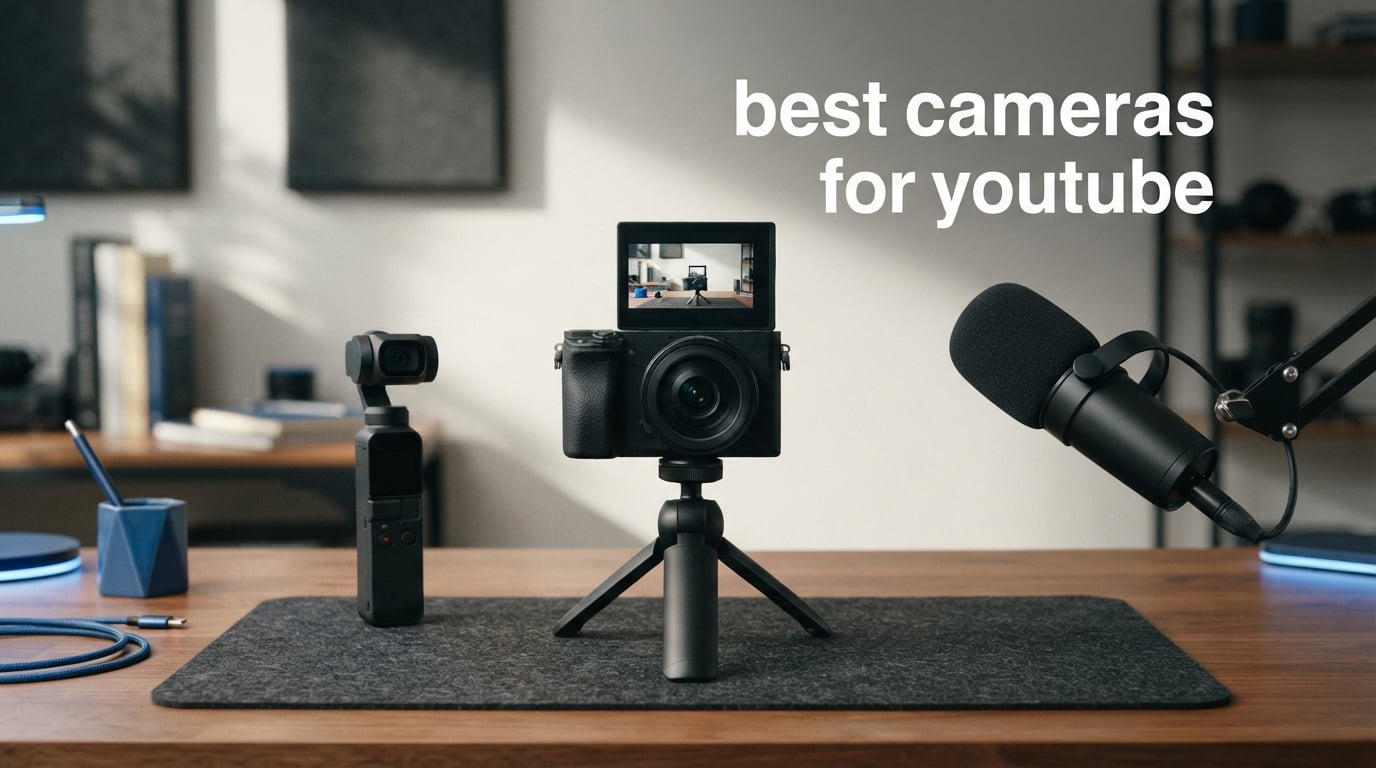
The best cameras for YouTube are the Canon EOS R6 Mark II for a full-frame hybrid setup, the DJI Osmo Pocket 3 for stabilized travel footage, and the Canon EOS R100 for a simple first mirrorless kit. The right choice depends less on a spec sheet and more on how you record: seated tutorials, handheld vlogs, product demos, live streams, or fast-moving travel videos.
I ranked these 10 cameras using the available manufacturer specifications, included items, and customer feedback rather than pretending every creator needs the same tool. A good YouTube camera should make it easier to stay in focus, see yourself while recording, capture usable sound through an external mic when possible, and finish a video without turning setup into the hard part.
Creators in community discussions repeatedly flag three things after they start recording: continuous autofocus matters when working alone, a flip screen removes guesswork, and built-in microphone quality has limits. That is why this guide calls out those practical details alongside resolution, sensor size, stabilization, and included lenses.
A dedicated camera is not compulsory on day one. If your channel is still taking shape, our guide to smartphones for content creators is a useful comparison point; a phone can be a sensible start, while a camera brings better control and, in many cases, a clearer upgrade route.
Table of Contents
The Canon EOS R6 Mark II, DJI Osmo Pocket 3, and Canon EOS R100 are the three clearest starting points
Choose the Canon for full-frame 4K production and strong stabilization, the DJI for walk-and-talk work, or the R100 when you want to learn interchangeable-lens shooting without a complicated feature set. The visual cards below give the short version before the full reviews.
These 10 cameras cover YouTube recording from a basic first setup to full-frame work in 2026
The comparison below keeps the decision focused on recorded video, focusing behavior, stabilization, sensor format, and creator-friendly hardware. Ratings and review totals reflect the analyzed product listings, so smaller totals should be read as a smaller feedback sample, not a verdict on a camera’s ability.
| Product | Specifications | Action |
|---|---|---|
 Canon EOS R6 Mark II Canon EOS R6 Mark II |
|
View on Amazon |
 Sony Alpha 7 IV Sony Alpha 7 IV |
|
View on Amazon |
 Canon EOS R100 Canon EOS R100 |
|
View on Amazon |
 Sony ZV-E10 Sony ZV-E10 |
|
View on Amazon |
 DJI Osmo Pocket 3 DJI Osmo Pocket 3 |
|
View on Amazon |
 Canon EOS R50 V Canon EOS R50 V |
|
View on Amazon |
 Sony ZV-1F Creator Kit Sony ZV-1F Creator Kit |
|
View on Amazon |
 Panasonic VX3 Panasonic VX3 |
|
View on Amazon |
 Duluvulu 4K Camera Duluvulu 4K Camera |
|
View on Amazon |
 Sony ZV-E10 II Sony ZV-E10 II |
|
View on Amazon |
1. Canon EOS R6 Mark II is the best full-frame hybrid choice for polished YouTube video
Canon EOS R6 Mark II Mirrorless Camera RF24-105mm F4-7.1 is STM Lens Kit, Full-Frame Hybrid Camera, 24.2 Megapixel CMOS Sensor, Photo and Video Capabilities, Black
24.2MP full frame
4K 60p C-Log
8-stop IBIS
Pros
- Full-frame 24.2MP sensor
- 4K 60p C-Log
- 8-stop IBIS
- 1
- 053 AF zones
Cons
- Lens has f/4-7.1 aperture
- No built-in flash
The EOS R6 Mark II is my top pick for a creator who wants one body for a serious YouTube channel and still photography. Its 24.2MP full-frame sensor, DIGIC X processor, internal 4K at 60p with C-Log, and included RF 24-105mm lens form a capable starting package for studio pieces, interviews, and B-roll.
The autofocus case is especially strong for one-person production. Canon lists 1,053 autofocus zones across the frame plus automatic detection for people, animals, vehicles, aircraft, trains, and horses, so the camera has a broad subject-recognition brief rather than a narrowly framed focus system.
For handheld clips, the stated in-body stabilization of up to eight stops is a meaningful advantage over bodies that rely only on lens or digital stabilization. I would still use a tripod for a seated lesson, but this specification makes the R6 Mark II the more flexible option when a shot moves from desk to doorway.
It also records 6K ProRes RAW and carries dual UHS-II SD card slots. Those are production-oriented features that give a growing channel more recording and post-production headroom than a compact fixed-lens camera.
This camera fits creators who need a full-frame system that can grow with their channel
I would point filmmakers, photographers who also publish video, and channels with multiple formats toward this Canon. The RF mount and included 24-105mm range give you a practical place to begin, while an interchangeable-lens system leaves room to change the look of later videos.
Customer feedback is notably positive: the listing reports a 4.8 rating from 242 reviews, with praise for image quality, subject detection, and the 40 fps electronic shutter. That feedback matches the product’s broad hybrid emphasis rather than positioning it as a single-purpose vlogging body.
This camera requires a creator who is ready to manage a larger full-frame workflow
The included RF 24-105mm lens has an f/4-7.1 maximum aperture, which is narrower than an L-series alternative. It can serve general shooting well, but creators seeking a very shallow background or more light-gathering ability may later want a different lens.
There is no built-in flash, and full-frame gear is not the simplest route for someone who only wants quick social clips. For that narrow job, a flip-screen compact or gimbal camera may remove more friction.
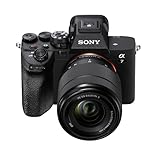
2. Sony Alpha 7 IV is the best choice for creators who want detailed 4K and eye tracking
Sony Alpha a7 IV Mirrorless Camera with 28-70mm Lens Black
33MP full frame
4K 60p 10-bit
759-point AF
Pros
- 33MP full-frame sensor
- 4K 60p 10-bit
- Real-time Eye AF
- vari-angle LCD
Cons
- Video battery life may be limited
- Small review sample
The Sony Alpha 7 IV brings a 33MP back-illuminated full-frame sensor and 4K at 60p video to a creator who wants rich capture options. Its BIONZ XR processor, S-Cinetone, S-Log3, HLG, Focus Map, and breathing compensation give the camera a video toolset that reaches well beyond basic point-and-record work.
For solo talking-head videos, real-time Eye AF and 759 phase-detection points are the headline. I see that combination as useful when you move closer to the lens, hold a product up, or shift positions during an explanation, because the listed tracking is built around maintaining a subject rather than locking focus once.
The camera records 10-bit 4:2:2 video with full-pixel readout and has a vari-angle LCD. That screen matters because it lets you confirm framing from the recording side of the camera without adding a separate monitor.
It includes an FE 28-70mm F3.5-5.6 OSS II lens and has two UHS-II SD slots. The zoom range can cover a roomier setup and a tighter presenter frame, while the card arrangement may appeal to creators who want a more deliberate capture routine.
This camera suits channels that mix YouTube production with high-resolution photography
The Alpha 7 IV makes sense when a channel publishes polished tutorials, reviews, portraits, and event coverage from the same camera. Its 33MP sensor makes still output a central part of the package, while its video profiles provide options for creators who color-grade their footage.
The listing’s 4.8 rating comes from 18 reviews, so I would not treat that small sample as conclusive. Early feedback specifically highlights image quality, autofocus, and the processor, which are the same areas that define the model on paper.
This camera is less suited to creators who want a no-fuss handheld vlogging tool
Full-frame interchangeable-lens shooting asks you to think about lenses, cards, settings, and recording time. The listing also flags battery life as a possible video limitation, so plan longer sessions around spare power instead of expecting a single battery to cover every shoot.
There is no built-in flash. That will not stop a YouTube recording, but it reinforces that this is a production camera, not a compact all-in-one travel device.
3. Canon EOS R100 is the best beginner mirrorless route for learning interchangeable lenses
Canon EOS R100 Mirrorless Camera with RF-S18-45mm F4.5-6.3 IS STM Lens Kit, 24.1 Megapixel CMOS (APS-C) Sensor, 4K Video, RF Mount | Black Bundled with 64GB Memory Card & Camera Shoulder Bag (3 Items)
24.1MP APS-C
4K 24fps
RF-S lens and accessories
Pros
- 24.1MP APS-C sensor
- compact mirrorless body
- face and eye detection
- card and bag included
Cons
- No in-body stabilization
- Limited video autofocus
The Canon EOS R100 is a straightforward answer for a creator who wants to step past a phone and learn a mirrorless camera without starting from a complex body. It pairs a 24.1MP APS-C sensor and DIGIC 8 processor with an RF-S 18-45mm lens, a 64GB card, and a shoulder bag in the analyzed bundle.
It records 4K at 24fps, Full HD at 60fps, and HD at 120fps. That means it can handle a cinematic-style 24fps talking-head video, standard 60fps Full HD, and a slower-motion HD clip, but it does not offer the 4K 60p headroom of the more advanced models here.
Canon lists Dual Pixel CMOS AF with 143 zones, face and eye detection, plus animal and vehicle detection. I would use it on a tripod for an initial studio setup, keep the subject position predictable, and learn the focus modes before depending on it for a fast handheld vlog.
The body has Wi-Fi, Bluetooth, HDMI output, and a built-in pop-up flash. Those features make the camera more versatile for a first kit, though the flash is primarily a still-photo aid rather than a solution for video lighting.
This camera suits first-time YouTubers who want a compact camera and a clear learning path
The R100 is the beginner YouTube camera I would choose for recorded lessons, desk reviews, crafts, or family-style videos where the camera can stay in a planned position. The included card and bag also remove two early shopping decisions, which is helpful when the real priority is publishing a first video.
Its listing reports a 4.7 rating from 66 reviews, and the feedback praises compact size, image quality, and the useful starter bundle. Those points fit a camera designed to lower the barrier to entering Canon’s RF system.
This camera is not built for creators who need stabilized walk-and-talk 4K
There is no in-body image stabilization, and the listing notes limits to autofocus in video mode. I would not make it the first choice for a channel based on moving selfie footage, erratic subjects, or long, unplanned handheld takes.
The plastic build feels less premium according to customer feedback, and it has one UHS-I card slot. Those are reasonable compromises for a basic setup, but they set a ceiling on the production workflow.
4. Sony ZV-E10 is the best creator-first APS-C camera for product demos and simple vlogs
Sony ZV-E10 APS-C Mirrorless Camera with 16-50mm Lens Black
24.2MP APS-C
4K 30p
Product Showcase setting
Pros
- Side flip-out touchscreen
- 425-point AF
- Product Showcase setting
- 3-capsule mic
Cons
- No viewfinder
- No in-body stabilization
The original Sony ZV-E10 is explicitly designed around the tasks a vlogger repeats: watch your framing on a side flip-out touchscreen, keep a face in focus, and switch attention from your face to an item in your hand. Its 24.2MP APS-C sensor records oversampled 4K at 30p from 6K capture with full-pixel readout.
Its Product Showcase Setting is the feature I would call out for review channels. Instead of relying on a presenter to block their face or manually change focus, the setting is intended to make focus transitions to an object easier to manage.
Sony lists 425-point Fast Hybrid AF, real-time Eye AF and tracking, plus a directional three-capsule microphone with a windscreen. That does not remove the benefit of an external mic, yet it gives a solo creator a more purposeful onboard audio starting point than many cameras offer.
The included E PZ 16-50mm F3.5-5.6 OSS II lens adds a compact power-zoom option. USB streaming capability is also listed, so it can play a role in a simple live or desktop setup in addition to recording videos to edit later.
This camera suits creators who record themselves and regularly show items to the lens
I would place the ZV-E10 near the top for beauty, gadgets, food, stationery, and product-review channels. The flip screen, tracking, Product Showcase Setting, and background-defocus button are all specific to the recurring problem of being both presenter and camera operator.
The product holds a 4.6 rating from 124 reviews, with vloggers particularly praising the screen, focusing, product setting, and built-in mic. That is useful feedback because it comes from the same use case the body is designed to serve.
This camera needs support equipment when your recording involves a lot of movement
The ZV-E10 has no in-body image stabilization, so its lens stabilization and your shooting technique matter more for handheld clips. A compact tripod, a stabilized lens, or one of our recommended camera gimbals to pair with your YouTube camera can make a visible difference in walking footage.
There is no viewfinder and no headphone jack for audio monitoring. Creators who need to assess sound during the take should factor that limitation into their recording plan.
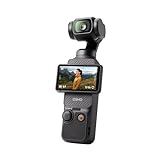
5. DJI Osmo Pocket 3 is the best compact camera for stable travel and walking videos
DJI Osmo Pocket 3 Vlogging Camera with 1” CMOS & 4K/120fps Video
1-inch sensor
4K 120fps
3-axis mechanical gimbal
Pros
- Three-axis gimbal
- 4K 120fps
- ActiveTrack 6.0
- rotatable screen
Cons
- Not water resistant
- Limited internal storage
The DJI Osmo Pocket 3 solves a different YouTube problem from a mirrorless body: it is a 179-gram camera with a built-in three-axis mechanical gimbal. I would take this route when the camera must travel lightly, start quickly, and keep a walking shot from looking like it was filmed while running.
Its 1-inch CMOS sensor, 4K at 120fps capability, D-Log M with 10-bit color, and fast focusing give it serious recording specifications in a small form. The 2-inch rotatable touchscreen supports both horizontal and vertical shooting, which is handy if the same session supplies a long video and short-form clips.
ActiveTrack 6.0 is listed for face and object tracking. That is useful for a creator moving through a space or putting an item in front of the camera, because the tracking task is built into the product rather than added through a separate gimbal.
Stereo audio recording and compatibility with DJI Mic 2 and Mic Mini transmitters round out the creator-focused design. I would still put spoken-word clarity ahead of convenience and pair it with an appropriate mic when dialogue is the main reason people watch.
This camera suits travel vloggers who need stabilization without building a rig
The Osmo Pocket 3 is a particularly strong fit for city walks, behind-the-scenes footage, events, and travel YouTube where changing lenses would slow everything down. Its one-inch sensor may also be attractive for creators who want a bigger sensor than a typical small action camera provides.
It has a 4.5 rating from more than 3.4k reviews, the largest feedback pool in this guide. Customers frequently praise the stabilization, image quality, tracking, and rotating display, which supports its position as a purpose-built travel vlogging camera.
This camera is not the right tool for wet environments or very long unattended sessions
The listing states that it is not water resistant and has limited internal storage. For water-heavy, rough, or immersive shots, review our action camera alternatives for YouTube rather than treating this gimbal camera like an action camera.
Battery life is listed at up to 166 minutes, and a charger is sold separately. I would plan storage, charging, and microphone setup before a full day away from a desk.
6. Canon EOS R50 V is the best Canon option for vertical clips and livestream-ready connections
Canon EOS R50 V Mirrorless Camera with 14-30mm Lens Bundle
24.2MP APS-C
4K 30p
Vertical mode and USB-C
Pros
- Fully articulating screen
- Dual Pixel AF
- vertical video mode
- 14-30mm lens
Cons
- Small review sample
- No Prime delivery listed
The Canon EOS R50 V packages features that make sense for a creator publishing across YouTube and vertical platforms. It has a 24.2MP APS-C CMOS sensor, DIGIC X processor, uncropped 4K at 30p, Full HD at 120p, and a fully articulating flip screen.
The included RF-S 14-30mm f/4-6.3 IS STM PZ lens brings a wide starting perspective that can work well in a small room, at arm’s length, or for a desk scene. Its optical stabilization complements a body built around compact creator recording.
Canon specifies Dual Pixel CMOS AF with eye, face, and subject detection, 179 autofocus points, and 10-bit video. I would use those capabilities for a presenter-led channel that wants a dependable focus system without jumping to a full-frame camera.
Vertical video mode and USB-C livestream readiness are practical distinctions here. They make it easier to frame intentional vertical material and connect the camera into a streaming-oriented workflow, rather than cropping every recording after the fact.
This camera suits multi-format creators who produce both horizontal YouTube videos and vertical shorts
The R50 V is a compelling fit for tutorials, lifestyle channels, home-studio vlogs, and creators publishing a main episode with supporting clips. The combination of a flip screen, wide power-zoom lens, vertical orientation feature, and USB-C connection supports that mixed publishing routine.
The analyzed listing gives it a 4.5 rating from 33 reviews. That is a much smaller pool than the DJI or Duluvulu listings here, so I would weigh the stated specifications and your desired workflow as heavily as the rating.
This camera is better for planned creator work than a fully sealed adventure setup
The available data describes a compact mirrorless body, not a weatherproof action device. Treat it as a camera for controlled shooting, travel with care, and use stabilization technique when the shot moves.
The bundle includes a bag and 64GB card, which reduces setup errands, but it does not eliminate the need for a separate audio plan. A good external microphone remains a sensible addition for dialogue-led channels.
7. Sony ZV-1F Creator Kit is the best fixed-lens compact option for simple product-focused videos
Sony ZV-1F Content Creator’s Ultimate Kit: 128GB Extreme Memory, Mic, Video Light, Editing Software U-Grip, and Tripod Bundle (21pc)
1-inch sensor
4K video
Product Showcase and creator kit
Pros
- F2.0 lens
- Real-time Eye AF
- Product Showcase setting
- tripod and mic bundle
Cons
- Digital stabilization
- Fixed-lens design
The Sony ZV-1F Creator Kit is a compact camera package for someone who wants to start recording without choosing a lens system first. Its one-inch CMOS sensor, 20MP still resolution, 4K DCI recording, and fixed 24-70mm equivalent F2.0 lens cover a useful range of creator needs.
The F2.0 maximum aperture is notable for a compact camera, especially when you want a little more subject separation or are not filming in direct daylight. Real-time Eye AF, Product Showcase Setting, and a Background Defocus mode continue the Sony creator-focused pattern seen in the ZV-E10.
The analyzed bundle includes a microphone, 128GB memory, video light, editing software, U-grip, tripod, and other accessories. I like that approach for a first-time creator because a camera alone rarely creates a workable shooting station.
Active Mode digital stabilization is included for steadier handheld video, while Wi-Fi, Bluetooth, micro HDMI, and USB widen the connection options. It is designed as a compact fixed-lens tool, so ease and portability are the trade for not swapping lenses later.
This camera suits creators who want a compact recording package and a bright fixed lens
I would recommend this kit for desktop reviews, casual vlogs, makeup, food, and straightforward presenter videos where the 24-70mm equivalent range is enough. The product-setting control is again helpful for anyone showing a device, package, or craft close to the camera.
The listing reports a 4.4 rating from 199 reviews. Customers and the listed feature set both point toward convenience, subject-focused recording, and a beginner-friendly collection of accessories.
This camera is not for creators who expect interchangeable lenses or mechanical stabilization
The lens is fixed, so the focal range you buy is the focal range you have. That can be freeing for a new creator, but it is less flexible for a channel that later needs a very wide room view or a distant telephoto shot.
Its stabilization is digital rather than a mechanical gimbal or in-body system. I would use a tripod or grip for most talking-head clips and reserve handheld shooting for calmer movement.
8. Panasonic VX3 is the best camcorder choice for distant subjects and stable optical zoom
Panasonic VX3 4K Camcorder, Lightweight Video Camera, Record Memories and Moments that Last
4K 30p
24x optical zoom
5-axis Hybrid OIS
Pros
- 24x optical zoom
- F1.8 lens
- 5-axis Hybrid OIS
- lightweight camcorder
Cons
- About 55-minute battery life
- Small review sample
The Panasonic VX3 is the different-looking choice in this list: a traditional handheld camcorder with 24x optical zoom from a 25mm wide view to a 600mm telephoto equivalent. That range has real YouTube value for sports, school events, wildlife, stage performances, and any channel that cannot physically move the camera close.
It records 4K UHD at up to 30fps through a 1/2.5-inch BSI MOS sensor and F1.8 lens. The lens brightness and sensor design are relevant when light drops, while the format favors a dedicated video workflow over a stills-first mirrorless approach.
Panasonic lists 5-Axis Hybrid O.I.S.+, high-precision AF, and a 3-inch touchscreen LCD. I would trust the optical zoom and stabilization pairing more than digital zoom when the goal is to capture a distant person with useful framing and less visible shake.
It also supports Wi-Fi, USB-C, a remote-control port, and in-camera 4K-to-2K editing. Those connections and edit options can reduce friction for a creator who wants to make basic trims without immediately moving every clip to a computer.
This camera suits channels that need reach more than interchangeable lenses
The VX3 belongs on the shortlist for performances, instructional sports footage, family-event coverage, travel details, and subjects that stay far from the camera. Its 0.96-pound weight also makes it easier to hold than a larger rig while still providing a long optical zoom.
Its 4.4 rating comes from 12 reviews, which is too limited to make broad claims from customer sentiment. The listed specifications are clearer evidence of its intended role: long-range video capture with stabilization in a lightweight camcorder shape.
This camera is less suited to creators building a stills-and-video interchangeable-lens system
The VX3 has a fixed lens and a 1/2.5-inch sensor, so it is not the same proposition as an APS-C or full-frame mirrorless camera. It is a focused video tool, and that focus is its strength when optical reach matters most.
Battery life is approximately 55 minutes according to the listing. I would bring spare power and plan recording blocks around that number for an event or long shoot.
9. Duluvulu 4K Digital Camera is the simplest basic starter bundle for a first YouTube experiment
Duluvulu 4K Digital Camera for Photography Autofocus, 2026 Latest 48MP Vlogging Camera for YouTube with SD Card, 2 Batteries, 3″ 180°Flip Screen Compact Travel Camera for Teens with 16X Zoom,Black
48MP and 4K
180-degree flip screen
Webcam function
Pros
- Flip screen
- 32GB card and two batteries
- webcam function
- time-lapse tools
Cons
- Digital zoom only
- Small sensor limits low light
The Duluvulu 4K Digital Camera focuses on getting a new creator recording with a 180-degree flip screen, supplied 32GB SD card, and two rechargeable batteries. It records 4K video, captures up to 48MP photos, and offers USB webcam functionality for basic live streaming or video calls.
I see it as a low-commitment way to learn framing, talking to a lens, transferring clips, and publishing consistently. Its feature list also includes time-lapse, slow motion, anti-shake, face and smile detection, a fill light, and filters, which gives beginners room to try formats without extra equipment.
Keep the technical limits in view. The camera uses a 1/3-inch CMOS sensor, an entry-level autofocus arrangement with one AF point, digital image stabilization, and 16x digital zoom rather than optical zoom.
Those facts do not make it unusable; they explain how to shoot around it. I would film in decent light, stand close instead of relying on zoom, keep the camera steady, and use it as a learning camera rather than expect full-frame low-light results.
This camera suits beginners who need a self-framing camera, card, and spare power in one bundle
The flip screen is valuable for a first vlog because it lets you correct headroom and positioning while recording yourself. Its webcam feature can also help a beginner try a live format before committing to a separate streaming camera.
The listing reports a 4.3 rating from 2.5k+ reviews. That broad sample suggests many buyers have tried this entry-level path, but its listed small sensor and digital-only tools should shape realistic expectations.
This camera works poorly for dark scenes, distant subjects, and demanding focus changes
Digital zoom enlarges the image instead of adding the optical reach provided by the Panasonic camcorder’s lens. I would avoid depending on it for stage events, wildlife, or a distant subject where detail matters.
The small sensor also limits low-light performance, and one autofocus point does not provide the tracking flexibility of Sony or Canon mirrorless systems. A window, simple light, and tripod will do more for the final video than a long digital zoom setting.
10. Sony ZV-E10 II is the best APS-C creator camera here for 4K at 60p and slow motion
Sony ZV-E10 II APS-C Mirrorless Creator Camera with 16-50mm Lens Black
26MP APS-C
4K 60p
759-point Fast Hybrid AF
Pros
- 4K 60p
- 759 AF points
- flip-out LCD
- Full HD 120p
Cons
- 4.1 rating
- No Prime delivery listed
The Sony ZV-E10 II advances the creator-oriented formula with a 26MP APS-C Exmor R BSI CMOS sensor, 4K at 60p, and Full HD at 120p. If you want smoother 60fps 4K footage or slow-motion sequences from a small interchangeable-lens camera, these recording modes are its main reason to consider it.
Its 759 phase-detection autofocus points and real-time Eye AF for humans, animals, and birds give it the most extensive listed AF-point count among the APS-C options in this guide. The vari-angle flip-out LCD keeps it practical for self-recording, not just behind-camera shooting.
The supplied E PZ 16-50mm F3.5-5.6 OSS II power-zoom lens is compact, and the E-mount opens a larger lens system when your visual needs change. Sony also lists digital and optical stabilization, with optical stabilization provided by the lens.
S&Q mode allows five-times slow motion at 120fps, while Creative Look provides 10 preset styles. I would use these settings deliberately for B-roll or a planned visual transition, rather than treating effects as a substitute for a clear story.
This camera suits creators who want extra frame-rate flexibility in a small mirrorless body
The ZV-E10 II is a good match for food, fitness, tutorials, product videos, and vlogs that regularly include slow-motion cutaways. It also suits a channel that expects to explore different E-mount lenses rather than live with a fixed compact lens forever.
The listing’s 4.1 rating from 259 reviews is lower than the other Sony and Canon options above, and 12% of reviews are one star. I would read those signals carefully and compare the specific feature set against your actual shooting routine before deciding.
This camera needs thoughtful stabilization and feedback review before you commit
Lens-based optical stabilization and digital stabilization are helpful, but they are not the same as the DJI’s three-axis mechanical gimbal or the Canon R6 Mark II’s listed in-body stabilization. For consistently moving travel footage, choose the support method that matches your shot style.
It is not listed as Prime eligible. More importantly, the lower customer rating means this is a model where the 4K 60p and autofocus specification should be weighed alongside the broader feedback rather than looking at one headline feature alone.
Choose a YouTube camera by matching its recording workflow to the videos you will actually make
The most useful buying rule is simple: choose the camera that removes the biggest problem in your next 20 videos. A full-frame sensor does not repair poor sound, an enormous zoom does not help a desk tutorial, and 4K at 120fps does not matter if you mainly record a stationary explanation.
Autofocus should be the first priority for solo talking-head and product channels
When you record alone, the camera has to hold focus while you present, lean forward, or show an item. Sony’s real-time Eye AF systems, Canon’s face-and-eye detection, and DJI ActiveTrack all address that work in different ways; choose the one that fits your subject and whether you change lenses.
For product reviews, a focus-transition feature can save repeated takes. The Sony ZV-E10 and ZV-1F each list Product Showcase Setting, while the Canon and Sony mirrorless bodies supply broader subject detection and AF-point systems.
Stabilization should match whether you stand still, walk, or film from a distance
A tripod is still the cleanest answer for a seated video, even when a camera offers stabilization. For travel and walk-and-talk clips, the DJI Osmo Pocket 3’s mechanical three-axis gimbal is the most direct built-in solution in this group.
For a handheld mirrorless look, the Canon R6 Mark II lists up to eight stops of in-body stabilization, while the Panasonic VX3 combines optical zoom with 5-Axis Hybrid O.I.S.+. The ZV-E10 has no in-body stabilization, so it benefits more from a stabilized lens, careful movement, or a separate gimbal.
A flip screen is a practical requirement when you film yourself
A front-facing or fully articulating screen lets you check framing, lighting, and whether a product is actually in view. The Sony ZV-E10, Sony ZV-E10 II, Canon EOS R50 V, DJI Osmo Pocket 3, and Duluvulu all provide self-framing screens in their own formats.
Do not underestimate this feature because it is not glamorous. Forum discussions from new creators consistently describe flip screens as one of the first features they miss when a camera lacks one.
Audio deserves attention before resolution because viewers will forgive 1080p sooner than unclear speech
Built-in microphones are convenient, but creator communities consistently report disappointing results from them across camera types. The ZV-E10’s directional three-capsule microphone and the Osmo Pocket 3’s stereo recording are useful starting points, yet a suitable external microphone remains a practical upgrade for narration, interviews, and busy rooms.
Start with a quiet room, get the mic close to the speaker, and listen back with headphones before a long shoot. That simple routine has more impact than chasing a higher-resolution mode that your editing workflow does not need.
Sensor size and lenses should follow the image control you need, not a status label
Full-frame cameras such as the Canon R6 Mark II and Sony Alpha 7 IV provide the largest sensors in this selection and use interchangeable lenses. APS-C models such as the R100, ZV-E10, R50 V, and ZV-E10 II remain strong options when you want lens flexibility in a smaller creator-focused system.
The one-inch sensors in the DJI and Sony compact make those cameras compact alternatives, while the Panasonic’s camcorder lens prioritizes a 24x optical range. The Duluvulu’s 1/3-inch sensor is best treated as a good-light starter solution.
Streaming and gaming content need a connection plan as much as a camera plan
Check whether the camera offers the connection your setup needs before buying capture hardware. The ZV-E10 lists USB streaming and micro HDMI, the R50 V is listed as USB-C livestream-ready, and several other products list HDMI or micro HDMI outputs.
For face-cam gaming content, a stable frame, controlled light, and clean audio can matter more than the most advanced recording mode. If immersive footage is part of your channel idea, our roundup of Insta360 cameras for YouTube covers a format that conventional cameras do not replicate.
Beginners should start with a small repeatable setup and upgrade after a publishing habit exists
You do not need to begin with a full-frame body to make useful YouTube videos. A phone, the Duluvulu starter kit, Canon R100, or Sony ZV-1F can all help you practice composition, sound, lighting, and editing before more advanced requirements become clear.
My advice is to make a test video in your actual room and workflow before adding accessories. Check focus while you move, inspect audio, try a short handheld clip, and confirm the file format works in your editor; those answers tell you more than a feature list alone.
These common questions answer the core YouTube camera decisions directly
What camera do most YouTubers use?
Many YouTubers use mirrorless cameras because they pair strong autofocus, interchangeable lenses, and 4K recording in comparatively compact bodies. In this guide, the Canon EOS R6 Mark II, Sony Alpha 7 IV, Sony ZV-E10, Canon EOS R50 V, and Sony ZV-E10 II fit that model, while the DJI Osmo Pocket 3 is a focused alternative for stabilized travel work.
Is a mirrorless camera better for YouTube than a DSLR?
For many new YouTube setups, a mirrorless camera is the more practical choice because the products here combine live-view screens, video-oriented autofocus, compact bodies, and interchangeable lenses. A DSLR can still record useful video, but this product selection shows why mirrorless models now cover most talking-head, vlog, and hybrid photo-video needs.
What specs matter most for YouTube cameras?
Prioritize reliable continuous autofocus, a flip or articulating screen if you record yourself, stabilization for handheld clips, an audio path for an external microphone, and the frame rates you will really use. Sensor size and interchangeable lenses matter when you want more control, while an optical zoom matters most for distant subjects.
Can I use a smartphone camera for YouTube?
Yes. A smartphone can be a sensible way to start a YouTube channel, especially for well-lit stationary videos, because publishing consistency, clear sound, and a useful topic matter first. Move to a dedicated camera when you need better focus control, a flip screen, optical zoom, stabilization, or an interchangeable-lens system.
What is the best budget camera for YouTube beginners?
The Canon EOS R100 is the stronger beginner mirrorless pick in this list because it combines a 24.1MP APS-C sensor, 4K at 24fps, face and eye detection, an RF-S 18-45mm lens, memory card, and bag. The Duluvulu 4K Digital Camera is the simpler basic bundle for creators who mainly need a flip screen, card, two batteries, and webcam functionality.
The Canon EOS R6 Mark II is the strongest all-around choice, while the right alternative depends on your format
For the best cameras for YouTube in 2026, choose the Canon EOS R6 Mark II when full-frame video, robust autofocus, and in-body stabilization are your priorities. Choose the DJI Osmo Pocket 3 for a small stabilized travel rig, the Canon EOS R100 for an approachable first mirrorless system, or the Panasonic VX3 when optical reach leads the brief.
I would not delay your first upload waiting for a perfect camera. Pick the product whose screen, focus, stabilization, and connections solve the job you have now, record a short real-world test, and add lenses, audio, or support gear only after your channel makes the next need clear.